DEFINITION OF ENSO
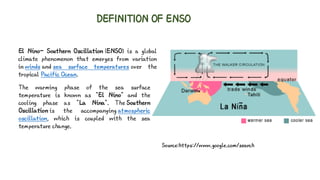
ElNino– Southern Oscillation (ENSO) is a global
climate phenomenon that emerges from variation
in winds and sea surface temperatures over the
tropical Pacific Ocean.
The warming phase of the sea surface
temperature is known as "El Nino" and the
cooling phase as "La Nina". The Southern
Oscillation is the accompanying atmospheric
oscillation, which is coupled with the sea
temperature change.
Source:https://www.google.com/search
3.
• El NinoSouthern Oscillation (ENSO) is a recurring oceano-atmospheric condition in the Southern
equatorial pacific due to change in the sea surface temperature. This alternating warming and
cooling pattern, also known as the ENSO cycle, has a direct impact on rainfall distribution in the
tropics and may have a significant impact on weather across the Indian subcontinent and other
parts of the world. So this combination of El Nino, La Nina, and the neutral state between the two
opposite effects is called the El Nino Southern Oscillation (ENSO).
DIFFERENT PHASES OF EL NINO-SOUTHERN OSCILLATION (ENSO):
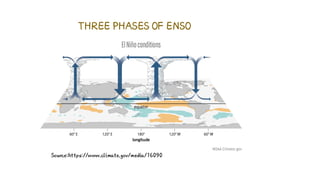
The El Nino– Southern Oscillation is a single climate phenomenon that periodically fluctuates
between three phases:
Neutral
La Nina
El Nino
La Nina and El Nino are opposite phases in the oscillation which are deemed to occur when specific
ocean and atmospheric conditions are reached or exceeded.
4.
EL NINO
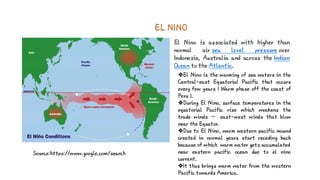
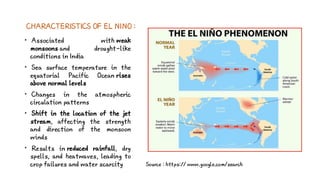
El Ninois associated with higher than
normal air sea level pressure over
Indonesia, Australia and across the Indian
Ocean to the Atlantic.
Source:https://www.google.com/search
El Nino is the warming of sea waters in the
Central-east Equatorial Pacific that occurs
every few years ( Warm phase off the coast of
Peru ).
During El Nino, surface temperatures in the
equatorial Pacific rise which weakens the
trade winds — east-west winds that blow
near the Equator.
Due to El Nino, warm western pacific mound
created in normal years start receding back
because of which warm water gets accumulated
near eastern pacific ocean due to el nino
current.
It thus brings warm water from the western
Pacific towards America.
5.
CHARACTERISTICS OF ELNINO :
• Associated with weak
monsoons and drought-like
conditions in India
• Sea surface temperature in the
equatorial Pacific Ocean rises
above normal levels
• Changes in the atmospheric
circulation patterns
• Shift in the location of the jet
stream, affecting the strength
and direction of the monsoon
winds
• Results in reduced rainfall, dry
spells, and heatwaves, leading to
crop failures and water scarcity Source : https:// www.google.com/search
6.
LA NINA
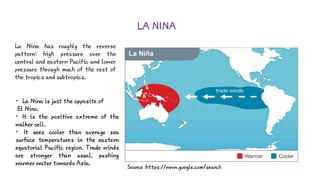
La Ninahas roughly the reverse
pattern: high pressure over the
central and eastern Pacific and lower
pressure through much of the rest of
the tropics and subtropics.
Source :https://www.google.com/search
• La Nina is just the opposite of
El Nino.
• It is the positive extreme of the
walker cell.
• It sees cooler than average sea
surface temperatures in the eastern
equatorial Pacific region. Trade winds
are stronger than usual, pushing
warmer water towards Asia.
7.
CHARACTERISTICS OF LANINA :
• Associated with above-normal rainfall and floods in India
• Sea surface temperature in the equatorial Pacific Ocean drops below normal levels
• Changes in the atmospheric circulation patterns
• Increase in the strength of the monsoon winds, bringing more moisture and rainfall to India
• Excessive rainfall can also lead to floods and landslides, causing damage to crops and
infrastructure
8.
NEUTRAL (WALKER CELL):
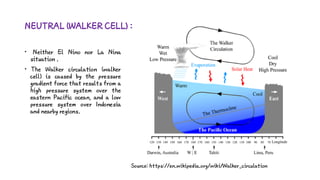
• Neither El Nino nor La Nina
situation .
• The Walker circulation (walker
cell) is caused by the pressure
gradient force that results from a
high pressure system over the
eastern Pacific ocean, and a low
pressure system over Indonesia
and nearby regions.
Source: https://en.wikipedia.org/wiki/Walker_circulation
9.
THREE PHASES OFENSO
Source:https://www.climate.gov/media/16090
10.
EL NINO ANDINDIAN MONSOON
The El Nino-Southern Oscillation (ENSO) significantly influences the Indian summer
monsoon.
• El Nino and its impact on Indian monsoon: El Nino refers to abnormal warming of surface
waters in the equatorial Pacific Ocean, which tends to suppress monsoon rainfall in India.
• Phases of El Nino Southern Oscillation (ENSO): ENSO consists of three phases in the
Pacific Ocean: El Nino, La Nina (abnormal cooling), and a neutral phase with sea surface
temperatures close to long-term averages.
• Ocean and atmospheric conditions: ENSO involves not only temperature abnormalities of
sea surface waters but also atmospheric conditions, including differences in sea-level air
pressure and wind strength and direction.
• Southern oscillation and the role of winds: Southern Oscillation Index measures the
difference in sea-level air pressure over the western and eastern sides of the Pacific
Ocean, while wind patterns play a crucial role in ENSO.
11.
HOW ENSO IMPACTSMONSOON AND AGRICULTURE IN INDIA :
Monsoon:
• ENSO has a profound impact on summer monsoonal rainfall across India, as most
major droughts occur during El Nino events.
• During La Nina events, above average rainfall is witnessed in the Indian sub-continent.
Agricultural productivity:
• El Nino has a direct impact on India's agricultural sector since it tends to reduce the
production of summer crops.
• For example, affected crops include rice, sugarcane, cotton, and oilseeds.
• Rainfall during La Nina events might result in farmers losing their standing Kharif crops.
• For example, while Kharif crop harvesting happens in September-end or early October, any
rain immediately before that would be damaging to the standing crops.
12.
OTHER IMPACTS ININDIA
• Temperature Extremes: ENSO can also influence temperature extremes in India. During El
Nino, parts of India may experience higher temperatures, exacerbating heatwaves and
affecting crops, livestock, and human health.
• Water Resources: El Niño-induced droughts can deplete water reservoirs and groundwater
levels, affecting irrigation and water availability for agricultural purposes.
• Pest Outbreaks: Changes in temperature and moisture conditions during ENSO events can
influence the prevalence of pests and diseases, affecting crop health and yields.
• Livelihood and Food Security: The variability in monsoon rainfall due to ENSO can impact
rural livelihoods, especially for farmers who heavily rely on rainfed agriculture.
Fluctuations in agricultural productivity can also affect food security in the country.
13.
ENSO is oneof the most important climate phenomena on Earth due to its ability to change the
global atmospheric circulation, which in turn influences temperature and precipitation across the
globe. Because of ENSO, we can often predict the arrival of many seasons in advance of its
strongest impacts on weather and climate.