-by
Vikash Shashi
Veer Kumar
Ajay Kumar
Mr Meena
Bhawani Shankar
Bacterial Growth
o most lab organisms are grown in a batch
culture
 closed system
 new materials are not added
 waste products are not removed
 under these conditions bacteria
populations follow distinct patterns of
growth.
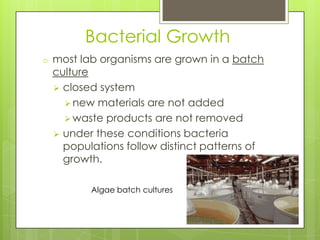
Algae batch cultures
Continuous Culture
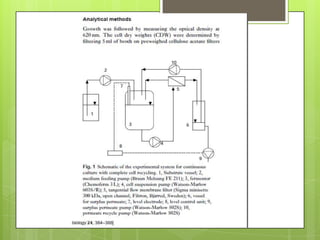
 continuous culture is maintained by-
 nutrients must be continually supplied
 end products must be removed
 exponential growth phase maintained
Continuous culture in lab
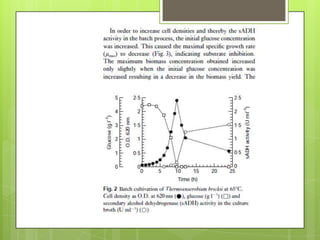
Growth in Batch Culture
 “Growth” is generally used to refer
to the acquisition of biomass leading
to cell division, or reproduction.
Bacterial Growth Curve:
laboratory conditions
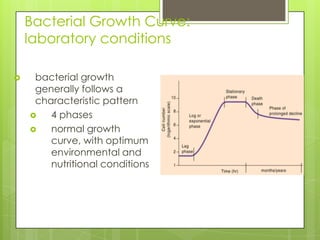
 bacterial growth
generally follows a
characteristic pattern
 4 phases
 normal growth
curve, with optimum
environmental and
nutritional conditions
Bacterial Growth Curve:
laboratory conditions
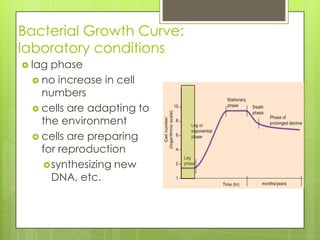
 lag phase
 no increase in cell
numbers
 cells are adapting to
the environment
 cells are preparing
for reproduction
synthesizing new
DNA, etc.
Bacterial Growth Curve:
laboratory conditions
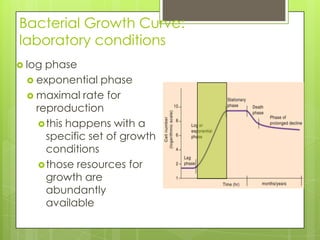
 log phase
 exponential phase
 maximal rate for
reproduction
this happens with a
specific set of growth
conditions
those resources for
growth are
abundantly
available
Bacterial Growth Curve:
laboratory conditions
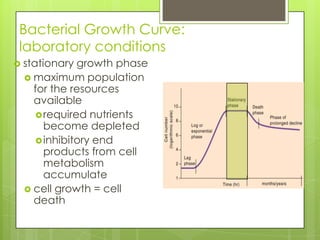
 stationary growth phase
 maximum population
for the resources
available
required nutrients
become depleted
inhibitory end
products from cell
metabolism
accumulate
 cell growth = cell
death
Bacterial Growth Curve:
laboratory conditions
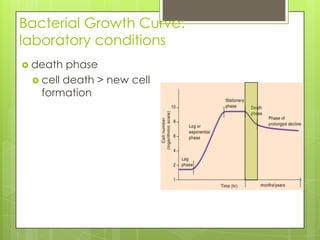
 death phase
 cell death > new cell
formation
Growth Kinetics
and Yield
Coefficients of the
Extreme
Thermophile
Thermothrix
thiopara in
Continuous Culture
Daniel K. Brannan and Douglas E.
Caldwell
Continuous culture studies were carried out at three
temperatures (65, 70, and 75°C) with a culture volume of
350 ml, provided with agitation (200 rpm). Temperature
was accurately regulated with rheostat-controlled heat
tapes and a thermostatically controlled heating element.
Aeration was provided by controlling the flow rate (350
cm3/min) of air enriched with 5% (vol/vol) C02, using a
Manostat flow meter .The culture pH remained constant
(6.7 ± 0.2) during steady states. Wall growth was
minimized by coating the culture vessel with 5% (vol/vol)
dichlorosilane.
Determination of μ-max by
washout kinetics
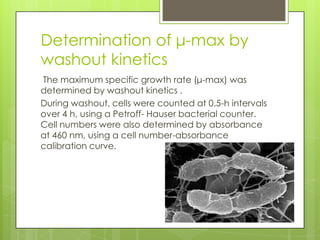
The maximum specific growth rate (μ-max) was
determined by washout kinetics .
During washout, cells were counted at 0.5-h intervals
over 4 h, using a Petroff- Hauser bacterial counter.
Cell numbers were also determined by absorbance
at 460 nm, using a cell number-absorbance
calibration curve.
The equations of Marr et al. and Pirt were used to
account for substrate used for growth and
maintenance, where maintenance is the
consumption of potential biomass-
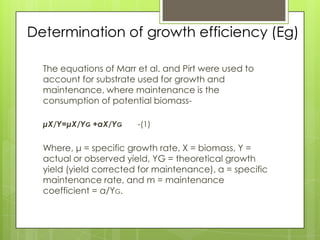
μX/Y=μX/YG +aX/YG -(1)
Where, μ = specific growth rate, X = biomass, Y =
actual or observed yield, YG = theoretical growth
yield (yield corrected for maintenance), a = specific
maintenance rate, and m = maintenance
coefficient = a/YG.
Determination of growth efficiency (Eg)
When μ = μmax, the equation becomes:
μ –maxX/Y = μ–maxX/YG + aX/Y; -(2)
Thus, the total rate of substrate utilization at μ max (μ maxX/YT)
equals the rate used for growth (μ-maxX/YG) plus that used for
maintenance (aX/YG). The fraction
(F) of substrate used for growth at μ -max is:
F = (μ –max X/YG)(μ-maxX/Y) -(3)
Substituting for μ-maxX/Y from equation (2) results in the
following ratio:
F = (μ –max X/YG)/[μ–maxX/YG + aX/Y] -(4)
By cancelling terms and defining F as the growth
efficiency, the following equation is obtained:
Eg = μ-max/(μ-max + a).
Growth efficiency (Eg) can then be determined from
μ -max and the specific maintenance rate (a).
RESULTS AND DISCUSSION
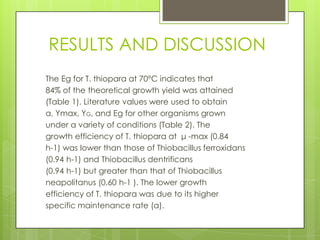
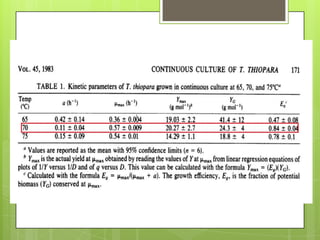
The Eg for T. thiopara at 70°C indicates that
84% of the theoretical growth yield was attained
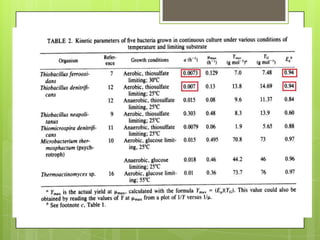
(Table 1). Literature values were used to obtain
a, Ymax, YG, and Eg for other organisms grown
under a variety of conditions (Table 2). The
growth efficiency of T. thiopara at μ -max (0.84
h-1) was lower than those of Thiobacillus ferroxidans
(0.94 h-1) and Thiobacillus dentrificans
(0.94 h-1) but greater than that of Thiobacillus
neapolitanus (0.60 h-1 ). The lower growth
efficiency of T. thiopara was due to its higher
specific maintenance rate (a).
Vikash
Vikash
Vikash
Vikash
Vikash
Vikash
Vikash
Vikash
Vikash
Vikash
Vikash
Vikash
Vikash

Vikash

  • 1.
    -by Vikash Shashi Veer Kumar AjayKumar Mr Meena Bhawani Shankar
  • 2.
    Bacterial Growth o mostlab organisms are grown in a batch culture  closed system  new materials are not added  waste products are not removed  under these conditions bacteria populations follow distinct patterns of growth. Algae batch cultures
  • 3.
    Continuous Culture  continuousculture is maintained by-  nutrients must be continually supplied  end products must be removed  exponential growth phase maintained Continuous culture in lab
  • 4.
    Growth in BatchCulture  “Growth” is generally used to refer to the acquisition of biomass leading to cell division, or reproduction.
  • 5.
    Bacterial Growth Curve: laboratoryconditions  bacterial growth generally follows a characteristic pattern  4 phases  normal growth curve, with optimum environmental and nutritional conditions
  • 6.
    Bacterial Growth Curve: laboratoryconditions  lag phase  no increase in cell numbers  cells are adapting to the environment  cells are preparing for reproduction synthesizing new DNA, etc.
  • 7.
    Bacterial Growth Curve: laboratoryconditions  log phase  exponential phase  maximal rate for reproduction this happens with a specific set of growth conditions those resources for growth are abundantly available
  • 8.
    Bacterial Growth Curve: laboratoryconditions  stationary growth phase  maximum population for the resources available required nutrients become depleted inhibitory end products from cell metabolism accumulate  cell growth = cell death
  • 9.
    Bacterial Growth Curve: laboratoryconditions  death phase  cell death > new cell formation
  • 10.
    Growth Kinetics and Yield Coefficientsof the Extreme Thermophile Thermothrix thiopara in Continuous Culture Daniel K. Brannan and Douglas E. Caldwell
  • 11.
    Continuous culture studieswere carried out at three temperatures (65, 70, and 75°C) with a culture volume of 350 ml, provided with agitation (200 rpm). Temperature was accurately regulated with rheostat-controlled heat tapes and a thermostatically controlled heating element. Aeration was provided by controlling the flow rate (350 cm3/min) of air enriched with 5% (vol/vol) C02, using a Manostat flow meter .The culture pH remained constant (6.7 ± 0.2) during steady states. Wall growth was minimized by coating the culture vessel with 5% (vol/vol) dichlorosilane.
  • 12.
    Determination of μ-maxby washout kinetics The maximum specific growth rate (μ-max) was determined by washout kinetics . During washout, cells were counted at 0.5-h intervals over 4 h, using a Petroff- Hauser bacterial counter. Cell numbers were also determined by absorbance at 460 nm, using a cell number-absorbance calibration curve.
  • 13.
    The equations ofMarr et al. and Pirt were used to account for substrate used for growth and maintenance, where maintenance is the consumption of potential biomass- μX/Y=μX/YG +aX/YG -(1) Where, μ = specific growth rate, X = biomass, Y = actual or observed yield, YG = theoretical growth yield (yield corrected for maintenance), a = specific maintenance rate, and m = maintenance coefficient = a/YG. Determination of growth efficiency (Eg)
  • 14.
    When μ =μmax, the equation becomes: μ –maxX/Y = μ–maxX/YG + aX/Y; -(2) Thus, the total rate of substrate utilization at μ max (μ maxX/YT) equals the rate used for growth (μ-maxX/YG) plus that used for maintenance (aX/YG). The fraction (F) of substrate used for growth at μ -max is: F = (μ –max X/YG)(μ-maxX/Y) -(3) Substituting for μ-maxX/Y from equation (2) results in the following ratio: F = (μ –max X/YG)/[μ–maxX/YG + aX/Y] -(4) By cancelling terms and defining F as the growth efficiency, the following equation is obtained: Eg = μ-max/(μ-max + a). Growth efficiency (Eg) can then be determined from μ -max and the specific maintenance rate (a).
  • 15.
    RESULTS AND DISCUSSION TheEg for T. thiopara at 70°C indicates that 84% of the theoretical growth yield was attained (Table 1). Literature values were used to obtain a, Ymax, YG, and Eg for other organisms grown under a variety of conditions (Table 2). The growth efficiency of T. thiopara at μ -max (0.84 h-1) was lower than those of Thiobacillus ferroxidans (0.94 h-1) and Thiobacillus dentrificans (0.94 h-1) but greater than that of Thiobacillus neapolitanus (0.60 h-1 ). The lower growth efficiency of T. thiopara was due to its higher specific maintenance rate (a).