By;
k.Vinitha
M.Tech
2018694619
The energy leaving surface 1 and arriving at surface 2 is
Eb1A1F12 and the energy leaving surface 2 and arriving at
surface 1 is Eb2A2F21. All the incident radiation will be absorbed
by the blackbody and the net energy exchange will be,
Q = Eb1A1F12 - Eb2A2F21
At thermal equilibrium between the surfaces Q12 = 0 and
Eb1 = Eb2, thus
A1F12 - A2F21
AiFij - AjFji
,
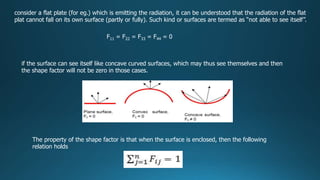
consider a flat plate (for eg.) which is emitting the radiation, it can be understood that the radiation of the flat
plat cannot fall on its own surface (partly or fully). Such kind or surfaces are termed as “not able to see itself”.
F11 = F22 = F33 = F44 = 0
if the surface can see itself like concave curved surfaces, which may thus see themselves and then
the shape factor will not be zero in those cases.
The property of the shape factor is that when the surface is enclosed, then the following
relation holds
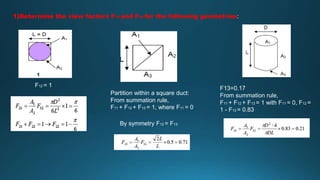
1)Determine the view factors F12 and F21 for the following geometries:
F12 = 1
Partition within a square duct:
From summation rule,
F11 + F12 + F13 = 1, where F11 = 0
By symmetry F12 = F13
F13=0.17
From summation rule,
F11 + F12 + F13 = 1 with F11 = 0, F12 =
1 - F13 = 0.83
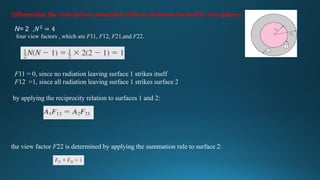
2)Determine the view factors associated with an enclosure formed by two spheres
N= 2 ,𝑁2
= 4
four view factors , which are F11, F12, F21,and F22.
F11 = 0, since no radiation leaving surface 1 strikes itself
F12 =1, since all radiation leaving surface 1 strikes surface 2
by applying the reciprocity relation to surfaces 1 and 2:
the view factor F22 is determined by applying the summation rule to surface 2:
The Superposition Rule:
The view factor from a surface i to a surface j is equal to the sum of the view factors from surface i
to the parts of surface j.
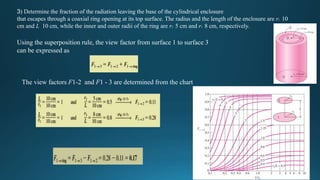
3) Determine the fraction of the radiation leaving the base of the cylindrical enclosure
that escapes through a coaxial ring opening at its top surface. The radius and the length of the enclosure are r1 10
cm and L 10 cm, while the inner and outer radii of the ring are r2 5 cm and r3 8 cm, respectively.
Using the superposition rule, the view factor from surface 1 to surface 3
can be expressed as
The view factors F1-2 and F1 - 3 are determined from the chart
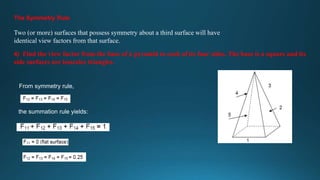
4) Find the view factor from the base of a pyramid to each of its four sides. The base is a square and its
side surfaces are isosceles triangles.
From symmetry rule,
the summation rule yields:
Two (or more) surfaces that possess symmetry about a third surface will have
identical view factors from that surface.
The Symmetry Rule
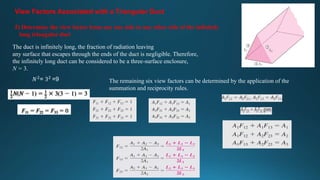
View Factors Associated with a Triangular Duct
5) Determine the view factor from any one side to any other side of the infinitely
long triangular duct
The duct is infinitely long, the fraction of radiation leaving
any surface that escapes through the ends of the duct is negligible. Therefore,
the infinitely long duct can be considered to be a three-surface enclosure,
N = 3.
𝑁2
= 32
=9 The remaining six view factors can be determined by the application of the
summation and reciprocity rules.
The Crossed-Strings Method Geometries such as channels and ducts that are very long in one direction
can be considered two-dimensional (since radiation through end surfaces can be neglected).
The Crossed-Strings Method
6) Two infinitely long parallel plates of widths a 12 cm and b 5 cm are located a distance c 6 cm apart,. (a)
Determine the view factor F1 - 2 from surface 1 to surface 2 by using the crossed-strings method. (b) Derive the
crossed-strings formula by forming triangles on the given geometry.
Then applying the summation rule to surface 1 yields
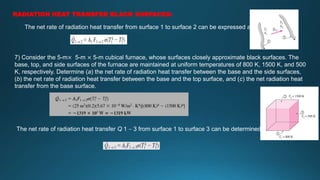
RADIATION HEAT TRANSFER BLACK SURFACES:
The net rate of radiation heat transfer from surface 1 to surface 2 can be expressed as
7) Consider the 5-m× 5-m × 5-m cubical furnace, whose surfaces closely approximate black surfaces. The
base, top, and side surfaces of the furnace are maintained at uniform temperatures of 800 K, 1500 K, and 500
K, respectively. Determine (a) the net rate of radiation heat transfer between the base and the side surfaces,
(b) the net rate of radiation heat transfer between the base and the top surface, and (c) the net radiation heat
transfer from the base surface.
The net rate of radiation heat transfer Q 1 - 3 from surface 1 to surface 3 can be determined
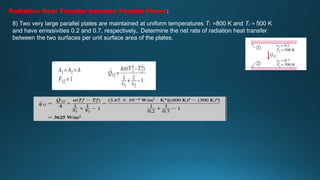
Radiation Heat Transfer between Parallel Plates:
8) Two very large parallel plates are maintained at uniform temperatures T1 =800 K and T2 = 500 K
and have emissivities 0.2 and 0.7, respectively,. Determine the net rate of radiation heat transfer
between the two surfaces per unit surface area of the plates.
Radiation Heat Transfer in a Cylindrical Furnace:
9) Consider a cylindrical furnace with r0 =H = 1 m, The top (surface 1) and the base (surface 2) of the furnace has
emissivities 0.8 and 2 0.4, respectively, and are maintained at uniform temperaturesT1 700 K and T2 500 K. The
side surface closely approximates a blackbody and is maintained at a temperature of T3 400 K. Determine the net
rate of radiation heat transfer at each surface during steady operation and explain how these surfaces can be
maintained at specified temperatures.
To maintain the surfaces at the specified temperatures, we must supply heat to the top surface
continuously at a rate of 27.6 kW while removing 2.13 kW from the base and 25.5 kW from the side
surfaces.
View factors numericals

View factors numericals

  • 1.
  • 2.
    The energy leavingsurface 1 and arriving at surface 2 is Eb1A1F12 and the energy leaving surface 2 and arriving at surface 1 is Eb2A2F21. All the incident radiation will be absorbed by the blackbody and the net energy exchange will be, Q = Eb1A1F12 - Eb2A2F21 At thermal equilibrium between the surfaces Q12 = 0 and Eb1 = Eb2, thus A1F12 - A2F21 AiFij - AjFji
  • 3.
    , consider a flatplate (for eg.) which is emitting the radiation, it can be understood that the radiation of the flat plat cannot fall on its own surface (partly or fully). Such kind or surfaces are termed as “not able to see itself”. F11 = F22 = F33 = F44 = 0 if the surface can see itself like concave curved surfaces, which may thus see themselves and then the shape factor will not be zero in those cases. The property of the shape factor is that when the surface is enclosed, then the following relation holds
  • 4.
    1)Determine the viewfactors F12 and F21 for the following geometries: F12 = 1 Partition within a square duct: From summation rule, F11 + F12 + F13 = 1, where F11 = 0 By symmetry F12 = F13 F13=0.17 From summation rule, F11 + F12 + F13 = 1 with F11 = 0, F12 = 1 - F13 = 0.83
  • 5.
    2)Determine the viewfactors associated with an enclosure formed by two spheres N= 2 ,𝑁2 = 4 four view factors , which are F11, F12, F21,and F22. F11 = 0, since no radiation leaving surface 1 strikes itself F12 =1, since all radiation leaving surface 1 strikes surface 2 by applying the reciprocity relation to surfaces 1 and 2: the view factor F22 is determined by applying the summation rule to surface 2:
  • 6.
    The Superposition Rule: Theview factor from a surface i to a surface j is equal to the sum of the view factors from surface i to the parts of surface j.
  • 7.
    3) Determine thefraction of the radiation leaving the base of the cylindrical enclosure that escapes through a coaxial ring opening at its top surface. The radius and the length of the enclosure are r1 10 cm and L 10 cm, while the inner and outer radii of the ring are r2 5 cm and r3 8 cm, respectively. Using the superposition rule, the view factor from surface 1 to surface 3 can be expressed as The view factors F1-2 and F1 - 3 are determined from the chart
  • 8.
    4) Find theview factor from the base of a pyramid to each of its four sides. The base is a square and its side surfaces are isosceles triangles. From symmetry rule, the summation rule yields: Two (or more) surfaces that possess symmetry about a third surface will have identical view factors from that surface. The Symmetry Rule
  • 9.
    View Factors Associatedwith a Triangular Duct 5) Determine the view factor from any one side to any other side of the infinitely long triangular duct The duct is infinitely long, the fraction of radiation leaving any surface that escapes through the ends of the duct is negligible. Therefore, the infinitely long duct can be considered to be a three-surface enclosure, N = 3. 𝑁2 = 32 =9 The remaining six view factors can be determined by the application of the summation and reciprocity rules.
  • 10.
    The Crossed-Strings MethodGeometries such as channels and ducts that are very long in one direction can be considered two-dimensional (since radiation through end surfaces can be neglected). The Crossed-Strings Method
  • 11.
    6) Two infinitelylong parallel plates of widths a 12 cm and b 5 cm are located a distance c 6 cm apart,. (a) Determine the view factor F1 - 2 from surface 1 to surface 2 by using the crossed-strings method. (b) Derive the crossed-strings formula by forming triangles on the given geometry. Then applying the summation rule to surface 1 yields
  • 12.
    RADIATION HEAT TRANSFERBLACK SURFACES: The net rate of radiation heat transfer from surface 1 to surface 2 can be expressed as 7) Consider the 5-m× 5-m × 5-m cubical furnace, whose surfaces closely approximate black surfaces. The base, top, and side surfaces of the furnace are maintained at uniform temperatures of 800 K, 1500 K, and 500 K, respectively. Determine (a) the net rate of radiation heat transfer between the base and the side surfaces, (b) the net rate of radiation heat transfer between the base and the top surface, and (c) the net radiation heat transfer from the base surface. The net rate of radiation heat transfer Q 1 - 3 from surface 1 to surface 3 can be determined
  • 14.
    Radiation Heat Transferbetween Parallel Plates: 8) Two very large parallel plates are maintained at uniform temperatures T1 =800 K and T2 = 500 K and have emissivities 0.2 and 0.7, respectively,. Determine the net rate of radiation heat transfer between the two surfaces per unit surface area of the plates.
  • 15.
    Radiation Heat Transferin a Cylindrical Furnace: 9) Consider a cylindrical furnace with r0 =H = 1 m, The top (surface 1) and the base (surface 2) of the furnace has emissivities 0.8 and 2 0.4, respectively, and are maintained at uniform temperaturesT1 700 K and T2 500 K. The side surface closely approximates a blackbody and is maintained at a temperature of T3 400 K. Determine the net rate of radiation heat transfer at each surface during steady operation and explain how these surfaces can be maintained at specified temperatures.
  • 16.
    To maintain thesurfaces at the specified temperatures, we must supply heat to the top surface continuously at a rate of 27.6 kW while removing 2.13 kW from the base and 25.5 kW from the side surfaces.