
Foreign Staffing, Inc.
 Proper Vietnamese business
etiquette is essential to gain new
partners and clients in the
Vietnamese business community.
 Your Vietnamese colleagues
communicate directly and when
you share their cultural behaviors
it demonstrates that you are
respectful and worthy of respect
and that you are indeed worthy
of partnership.
 Using proper business etiquette
will demonstrate both your
admiration and familiarity of
Vietnamese cultural practices
and your ability in the business
world.
 In Vietnam, a country rich in cultural
heritage, personal respect is tantamount
to life itself.
 In that sense of avoiding shame and
humiliation, the Vietnamese are
dedicated to protecting a person’s status
or sense of dignity.
 Never insult or tell off a Vietnamese
colleague. If a contact should feel a
sense of lost status, lost sense of dignity, or
that proverbial “lost face” because of an
error on your part, you will certainly lose
the contact.
 When meeting with a new person, shake
hands.
 If a woman does not offer her hand, be
sure to bow your head slightly.
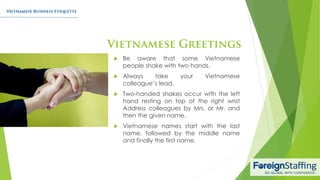
 Be aware that some Vietnamese
people shake with two hands.
 Always take your Vietnamese
colleague’s lead.
 Two-handed shakes occur with the left
hand resting on top of the right wrist
Address colleagues by Mrs. or Mr. and
then the given name.
 Vietnamese names start with the last
name, followed by the middle name
and finally the first name.
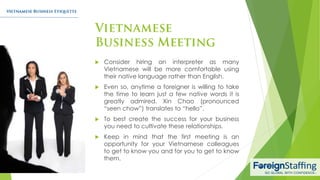
 Consider hiring an interpreter as many
Vietnamese will be more comfortable using
their native language rather than English.
 Even so, anytime a foreigner is willing to take
the time to learn just a few native words it is
greatly admired. Xin Chao (pronounced
“seen chow”) translates to “hello”.
 To best create the success for your business
you need to cultivate these relationships.
 Keep in mind that the first meeting is an
opportunity for your Vietnamese colleagues
to get to know you and for you to get to know
them.
 Because of the cultural nuances in this
ancient far east country, when a third
party can introduce you and act as a
reference it is always better.
 Your Vietnamese colleagues will be more
likely to conduct business with someone
they trust.
 Be sure to go that extra mile and impress
your Vietnamese colleagues by providing
a Vietnamese translation of all pertinent
documents.
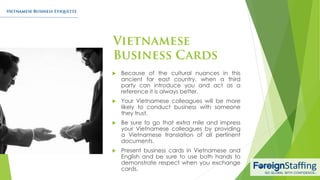
 Present business cards in Vietnamese and
English and be sure to use both hands to
demonstrate respect when you exchange
cards.
 Truly and thoroughly look at your
colleague’s card before
respectfully putting it away.
 Be aware that presenting business
cards is an important ritual in the
Vietnamese business world.
 Cards are exchanged at the
beginning of a meeting.
 Remember that when you translate
your written materials into
Vietnamese you are showing high
regard for your Vietnamese
colleagues.
 Be punctual as your Vietnamese
colleagues will arrive on time and they
will expect you to do the same.
 Business is a win or loss to the Vietnamese.
 Your Vietnamese colleagues may try to get the
best deal for their interests, even if it means
slowing down the decision making process so
be patient.
 Remember to allow the most senior member of
the company to be the first to enter a room. I
 n addition, it’s the oldest member of a party
who is first to be seated at restaurants,
respecting their status of authority.
 If you are invited to a colleague’s home for
dinner, please wait to be shown where you are
to sit.
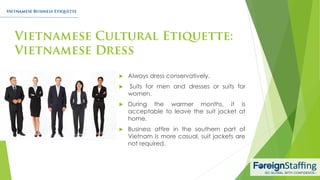
 Always dress conservatively.
 Suits for men and dresses or suits for
women.
 During the warmer months, it is
acceptable to leave the suit jacket at
home.
 Business attire in the southern part of
Vietnam is more casual, suit jackets are
not required.

Vietnamese Business Etiquette

  • 1.
  • 2.
     Proper Vietnamesebusiness etiquette is essential to gain new partners and clients in the Vietnamese business community.  Your Vietnamese colleagues communicate directly and when you share their cultural behaviors it demonstrates that you are respectful and worthy of respect and that you are indeed worthy of partnership.  Using proper business etiquette will demonstrate both your admiration and familiarity of Vietnamese cultural practices and your ability in the business world.
  • 3.
     In Vietnam,a country rich in cultural heritage, personal respect is tantamount to life itself.  In that sense of avoiding shame and humiliation, the Vietnamese are dedicated to protecting a person’s status or sense of dignity.  Never insult or tell off a Vietnamese colleague. If a contact should feel a sense of lost status, lost sense of dignity, or that proverbial “lost face” because of an error on your part, you will certainly lose the contact.  When meeting with a new person, shake hands.  If a woman does not offer her hand, be sure to bow your head slightly.
  • 4.
     Be awarethat some Vietnamese people shake with two hands.  Always take your Vietnamese colleague’s lead.  Two-handed shakes occur with the left hand resting on top of the right wrist Address colleagues by Mrs. or Mr. and then the given name.  Vietnamese names start with the last name, followed by the middle name and finally the first name.
  • 5.
     Consider hiringan interpreter as many Vietnamese will be more comfortable using their native language rather than English.  Even so, anytime a foreigner is willing to take the time to learn just a few native words it is greatly admired. Xin Chao (pronounced “seen chow”) translates to “hello”.  To best create the success for your business you need to cultivate these relationships.  Keep in mind that the first meeting is an opportunity for your Vietnamese colleagues to get to know you and for you to get to know them.
  • 6.
     Because ofthe cultural nuances in this ancient far east country, when a third party can introduce you and act as a reference it is always better.  Your Vietnamese colleagues will be more likely to conduct business with someone they trust.  Be sure to go that extra mile and impress your Vietnamese colleagues by providing a Vietnamese translation of all pertinent documents.  Present business cards in Vietnamese and English and be sure to use both hands to demonstrate respect when you exchange cards.
  • 7.
     Truly andthoroughly look at your colleague’s card before respectfully putting it away.  Be aware that presenting business cards is an important ritual in the Vietnamese business world.  Cards are exchanged at the beginning of a meeting.  Remember that when you translate your written materials into Vietnamese you are showing high regard for your Vietnamese colleagues.
  • 8.
     Be punctualas your Vietnamese colleagues will arrive on time and they will expect you to do the same.
  • 9.
     Business isa win or loss to the Vietnamese.  Your Vietnamese colleagues may try to get the best deal for their interests, even if it means slowing down the decision making process so be patient.  Remember to allow the most senior member of the company to be the first to enter a room. I  n addition, it’s the oldest member of a party who is first to be seated at restaurants, respecting their status of authority.  If you are invited to a colleague’s home for dinner, please wait to be shown where you are to sit.
  • 10.
     Always dressconservatively.  Suits for men and dresses or suits for women.  During the warmer months, it is acceptable to leave the suit jacket at home.  Business attire in the southern part of Vietnam is more casual, suit jackets are not required.