

 Various factors contribute to the Cambodian
  culture including Theravada
  Buddhism, Hinduism, French
  colonialism, Angkorian culture, and modern
  globalization.
 Things we are talking about today:
       Clothing
       Customs
       Cuisine
       Family and Marriage
       Music and Arts
   Clothing in Cambodia is one of the most
     important aspects of the culture. Cambodian
     fashion differs according to ethnic group and
     social class
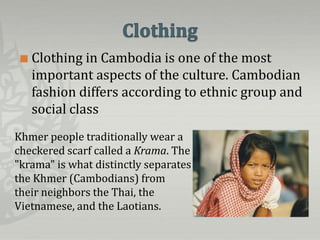
Khmer people traditionally wear a
checkered scarf called a Krama. The
"krama" is what distinctly separates
the Khmer (Cambodians) from
their neighbors the Thai, the
Vietnamese, and the Laotians.
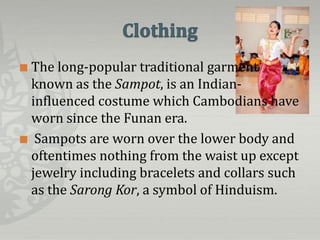
 The long-popular traditional garment
  known as the Sampot, is an Indian-
  influenced costume which Cambodians have
  worn since the Funan era.
 Sampots are worn over the lower body and
  oftentimes nothing from the waist up except
  jewelry including bracelets and collars such
  as the Sarong Kor, a symbol of Hinduism.
 As Buddhism began to
  replace Hinduism, Khmer people started
  wearing the blouse, shirt and trousers of
  Khmer style. Khmer people, both common and
  royal, stopped wearing the Hindu-style collars
  and began to adopt beautiful decorated shawls
  such as Sbai instead.
 In fact, a Khmer lady habitually chooses the
  right colour for her Sampot or blouse, both to
  please herself and to follow the costume of
  good luck.
 In Khmer culture a person's head is believed to
  contain the person's soul--therefore making
  it taboo to touch or point one's feet at it. It is
  also considered to be extremely disrespectful
  to use the feet to point out a person, or to sit or
  sleep with the soles of the feet pointing at a
  person, as the feet are the lowest part of the
  body and are considered to be impure.
 When greeting people or to show respect in
  Cambodia people do the "sampeah"
  gesture, identical to the Indian namaste and
  Thai wai.
   In Cambodia it is not polite to make eye
    contact with someone who is older or
    someone who is considered a superior.
   Khmer cuisine is similar to that of
    its Southeast Asian neighbors. It shares
    many similarities with Thai
    cuisine, Vietnamese cuisine and Teochew
    cuisine. Cambodian cuisine also uses fish
    sauce in soups, stir-fried cuisine, and as
    dippings.
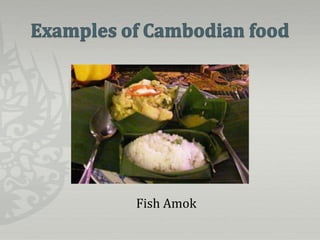
Fish Amok
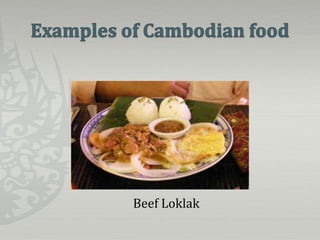
Beef Loklak
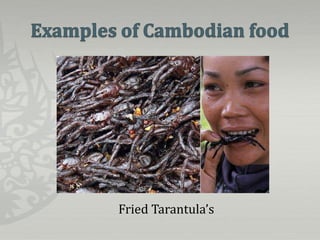
Fried Tarantula’s
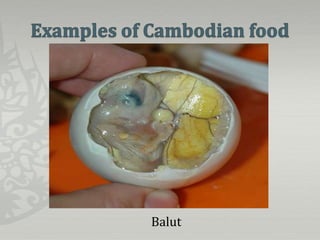
Balut
   Marriage traditionally is arranged by the parents of the bride
    and groom or by someone acting as their representative.
    Ideally, the groom originates the courtship process
   Considerations of the benefits to the two families often figure
    more prominently in the choice of a marriage partner than does
    romantic love.
    It is not unusual for decisions about marriage to be made before
    a couple has had much contact. Specialists in reading
    horoscopes typically are consulted about the appropriateness of
    a wedding, although their advice is not always followed.
    The groom pays bride-wealth to the
    family of the bride; this money sometimes is used to buy jewelry
    or clothing for the bride or defray the cost of the wedding.
 Legally, the husband is the head of the Khmer
  family, but the wife has considerable
  authority, especially in family economics.
 The husband is responsible for providing
  shelter and food for his family; the wife is
  generally in charge of the family budget, and
  she serves as the major ethical and religious
  model for the children, especially the
  daughters. Both husbands and wives are
  responsible for domestic economic tasks
   Cambodian Dance can be divided into three main
    categories: classical dance, folk dances, and vernacular
    dances.
   Khmer classical dance is a form of Cambodian dance
    originally performed only for royalty
   Khmer folk dances, which are performed for
    audiences, are fast-paced. The movements and gestures
    are not as stylized as Khmer classical dance. Folk
    dancers wear clothes of the people they are portraying
    such as Chams, hill tribes, farmers, and peasants.
   Cambodian vernacular dances (or social dances) are
    those danced at social gatherings.
   Apsara Dance, a khmer dance that has
    survived since the Angkor Era, has been
    singled out to attract foreign tourists and to
    make the richness of khmer culture known
    to the world.

Cambodian culture

  • 2.
     Various factorscontribute to the Cambodian culture including Theravada Buddhism, Hinduism, French colonialism, Angkorian culture, and modern globalization.  Things we are talking about today:  Clothing  Customs  Cuisine  Family and Marriage  Music and Arts
  • 3.
    Clothing in Cambodia is one of the most important aspects of the culture. Cambodian fashion differs according to ethnic group and social class Khmer people traditionally wear a checkered scarf called a Krama. The "krama" is what distinctly separates the Khmer (Cambodians) from their neighbors the Thai, the Vietnamese, and the Laotians.
  • 4.
     The long-populartraditional garment known as the Sampot, is an Indian- influenced costume which Cambodians have worn since the Funan era.  Sampots are worn over the lower body and oftentimes nothing from the waist up except jewelry including bracelets and collars such as the Sarong Kor, a symbol of Hinduism.
  • 5.
     As Buddhismbegan to replace Hinduism, Khmer people started wearing the blouse, shirt and trousers of Khmer style. Khmer people, both common and royal, stopped wearing the Hindu-style collars and began to adopt beautiful decorated shawls such as Sbai instead.  In fact, a Khmer lady habitually chooses the right colour for her Sampot or blouse, both to please herself and to follow the costume of good luck.
  • 6.
     In Khmerculture a person's head is believed to contain the person's soul--therefore making it taboo to touch or point one's feet at it. It is also considered to be extremely disrespectful to use the feet to point out a person, or to sit or sleep with the soles of the feet pointing at a person, as the feet are the lowest part of the body and are considered to be impure.  When greeting people or to show respect in Cambodia people do the "sampeah" gesture, identical to the Indian namaste and Thai wai.
  • 7.
    In Cambodia it is not polite to make eye contact with someone who is older or someone who is considered a superior.
  • 8.
    Khmer cuisine is similar to that of its Southeast Asian neighbors. It shares many similarities with Thai cuisine, Vietnamese cuisine and Teochew cuisine. Cambodian cuisine also uses fish sauce in soups, stir-fried cuisine, and as dippings.
  • 9.
  • 10.
  • 11.
  • 12.
  • 13.
    Marriage traditionally is arranged by the parents of the bride and groom or by someone acting as their representative. Ideally, the groom originates the courtship process  Considerations of the benefits to the two families often figure more prominently in the choice of a marriage partner than does romantic love.  It is not unusual for decisions about marriage to be made before a couple has had much contact. Specialists in reading horoscopes typically are consulted about the appropriateness of a wedding, although their advice is not always followed.  The groom pays bride-wealth to the family of the bride; this money sometimes is used to buy jewelry or clothing for the bride or defray the cost of the wedding.
  • 14.
     Legally, thehusband is the head of the Khmer family, but the wife has considerable authority, especially in family economics.  The husband is responsible for providing shelter and food for his family; the wife is generally in charge of the family budget, and she serves as the major ethical and religious model for the children, especially the daughters. Both husbands and wives are responsible for domestic economic tasks
  • 15.
    Cambodian Dance can be divided into three main categories: classical dance, folk dances, and vernacular dances.  Khmer classical dance is a form of Cambodian dance originally performed only for royalty  Khmer folk dances, which are performed for audiences, are fast-paced. The movements and gestures are not as stylized as Khmer classical dance. Folk dancers wear clothes of the people they are portraying such as Chams, hill tribes, farmers, and peasants.  Cambodian vernacular dances (or social dances) are those danced at social gatherings.
  • 16.
    Apsara Dance, a khmer dance that has survived since the Angkor Era, has been singled out to attract foreign tourists and to make the richness of khmer culture known to the world.