1
Video-making Project in an ESL
Classroom
Thanh Do
Thanh Do
Why video-making project?
Thanh Do
“Authentic learning in the context of DV (digital
video) projects comprised learning in ways that
fitted with real world contexts,
where the learning was motivated and developed
by the context.”
(Spotlight on authentic learning: Student developed digital video projects,2006)
Thanh Do
Is a classroomproject
Students’ performance
Combine different media
Be creative and Fun
Expressstudents’
understandingof the course
content
Engage in learning
Practice “real-life”skills
Others…
Thanh Do
PROJECT’S STAGES
Stage 1: Organizing the project
Stage 2: Choosing the context
Stage 3: Writing the scripts and storyboard
Stage 4: Filming
Stage 5: Editing
Stage 6: Publishing
Stage 7: Evaluating
Thanh Do
A suitable context covering culture
misunderstandings situations
(8-10 minutes in length)
An analysis of verbal andnon-verbal cues
causing misunderstandings in the video
VIDEO
PRESENTATI
ON
GROUP
S
A group of 4 to 5 members
Organizing the project
Thanh Do
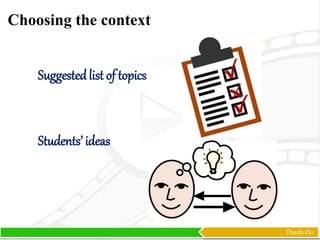
Suggestedlist of topics
Students’ ideas
Choosing the context
Thanh Do
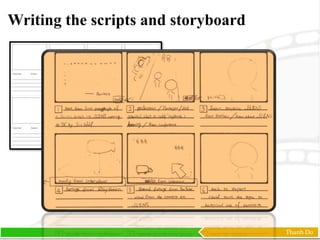
Writing the scripts and storyboard
Thanh Do
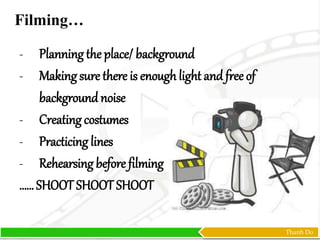
- Planning the place/ background
- Making sure there is enough light and free of
backgroundnoise
- Creating costumes
- Practicing lines
- Rehearsing before filming
…… SHOOT SHOOT SHOOT
Filming…
Thanh Do
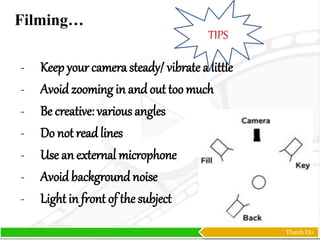
- Keep your camera steady/ vibrate a little
- Avoidzooming in andout too much
- Be creative: various angles
- Do not readlines
- Use an external microphone
- Avoidbackgroundnoise
- Light in front of the subject
TIPS
Filming…
Thanh Do
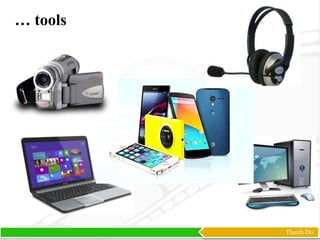
… tools
Thanh Do
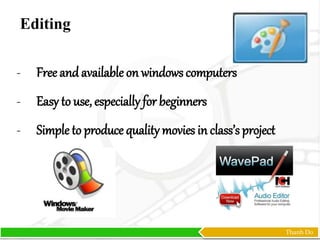
- Free and available on windows computers
- Easy to use, especially for beginners
- Simple to produce quality movies in class’s project
Editing
Thanh Do
Publishing
Thanh Do
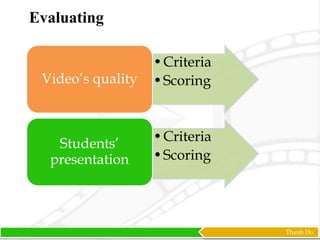
Evaluating
•Criteria
•ScoringVideo’s quality
•Criteria
•Scoring
Students’
presentation
Thanh Do
Conclusion
Thanh Do
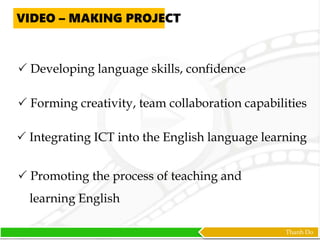
 Developing language skills, confidence
 Forming creativity, team collaboration capabilities
 Integrating ICT into the English language learning
VIDEO – MAKING PROJECT
 Promoting the process of teaching and
learning English
Thanh Do
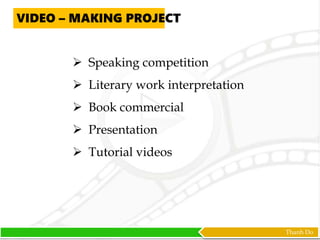
 Speaking competition
 Literary work interpretation
 Book commercial
 Presentation
 Tutorial videos
VIDEO – MAKING PROJECT
Thanh Do
Arthur, P. (1999). "Why use video? A teacher's perspective", VSELT 2(4),4.
Canning-Wilson, C. (2000). Practical Aspects of Using Video in the Foreign Language Classroom. The
Internet TESL Journal, VI (11). Retrieved on May 20, 2014 from http://iteslj.org/Articles/Canning-
Video.html
Dresser, N. (2003). Our own journey – Readings for Cross Cultural Communication. Pearson
Hung, N. (2013). National Foreign Languages 2020 Project Presentation, Vietnam engineering education
conference at Can Tho University, March 20. Retrieved May 13, 2014 from http://heeap.org/docu-
ment/nguyen-ngoc-hung-national-foreign-languages-2020-project-presentation-vietnam-engineering
Kearney, M. & Schuck, S. (2006). “Spotlight on authentic learning: Student developed digital video projects,”
Australasian Journal of Educational Technology, 22(2), 189-208.
Levin, H. (2003). Making history come alive: Students interview Holocaust survivors on camera and publish
their stories on the web. Learning and Leading with Technology, 31(3), 22-27. Retrieved March 18, 2014
http://www.howardlevin.com/download/iste-11-03.pdf
Loveless, A.M. (2002). Literature review in creativity, new technologies and learning (Futurelab Series Re-port
4). Retrieved May 20, 2014 from http://archive.futurelab.org.uk/resources/docum-
ents/lit_reviews/Creativity_Review.pdf
Masats, D., Dooly, M., & Costa, X. (2009). Exploring the potential of language learning through video making.
In L. Gómez Chova, D. Martí Belenguer & I. Candel Torres (Eds.). Proceedings of EDULEARN09
Conference, 341-352. Retrieved March 10, 2014 from http://www.divisproject.eu/attach-
ments/083_EDULEARN_09_DIVIS.pdf
Moet (2011). Official dispatch-the guidance of implementing information and communication technology (ICT)
tasks for school year 2011-2012. 4960/BGDĐT-CNTT (in Vietnamese)
Nikitina, L. (2010). Video-Making in the Foreign Language Classroom: Applying Principles of Constructivist
Pedagogy. Electronic Journal of Foreign Language Teaching. 7(1), 21-31.
Poonpon, K. (2011) Enhancing English Skills through Project-based Learning. The English Teacher. XL.1-10.
Retrieved May 18, 2014 from http://www.melta.org.my/ET/2011/1
REFERENCES
Video making project

Video making project

  • 1.
    1 Video-making Project inan ESL Classroom Thanh Do
  • 2.
  • 3.
    Thanh Do “Authentic learningin the context of DV (digital video) projects comprised learning in ways that fitted with real world contexts, where the learning was motivated and developed by the context.” (Spotlight on authentic learning: Student developed digital video projects,2006)
  • 4.
    Thanh Do Is aclassroomproject Students’ performance Combine different media Be creative and Fun Expressstudents’ understandingof the course content Engage in learning Practice “real-life”skills Others…
  • 5.
    Thanh Do PROJECT’S STAGES Stage1: Organizing the project Stage 2: Choosing the context Stage 3: Writing the scripts and storyboard Stage 4: Filming Stage 5: Editing Stage 6: Publishing Stage 7: Evaluating
  • 6.
    Thanh Do A suitablecontext covering culture misunderstandings situations (8-10 minutes in length) An analysis of verbal andnon-verbal cues causing misunderstandings in the video VIDEO PRESENTATI ON GROUP S A group of 4 to 5 members Organizing the project
  • 7.
    Thanh Do Suggestedlist oftopics Students’ ideas Choosing the context
  • 8.
    Thanh Do Writing thescripts and storyboard
  • 9.
    Thanh Do - Planningthe place/ background - Making sure there is enough light and free of backgroundnoise - Creating costumes - Practicing lines - Rehearsing before filming …… SHOOT SHOOT SHOOT Filming…
  • 10.
    Thanh Do - Keepyour camera steady/ vibrate a little - Avoidzooming in andout too much - Be creative: various angles - Do not readlines - Use an external microphone - Avoidbackgroundnoise - Light in front of the subject TIPS Filming…
  • 11.
  • 12.
    Thanh Do - Freeand available on windows computers - Easy to use, especially for beginners - Simple to produce quality movies in class’s project Editing
  • 13.
  • 14.
  • 15.
  • 16.
    Thanh Do  Developinglanguage skills, confidence  Forming creativity, team collaboration capabilities  Integrating ICT into the English language learning VIDEO – MAKING PROJECT  Promoting the process of teaching and learning English
  • 17.
    Thanh Do  Speakingcompetition  Literary work interpretation  Book commercial  Presentation  Tutorial videos VIDEO – MAKING PROJECT
  • 18.
    Thanh Do Arthur, P.(1999). "Why use video? A teacher's perspective", VSELT 2(4),4. Canning-Wilson, C. (2000). Practical Aspects of Using Video in the Foreign Language Classroom. The Internet TESL Journal, VI (11). Retrieved on May 20, 2014 from http://iteslj.org/Articles/Canning- Video.html Dresser, N. (2003). Our own journey – Readings for Cross Cultural Communication. Pearson Hung, N. (2013). National Foreign Languages 2020 Project Presentation, Vietnam engineering education conference at Can Tho University, March 20. Retrieved May 13, 2014 from http://heeap.org/docu- ment/nguyen-ngoc-hung-national-foreign-languages-2020-project-presentation-vietnam-engineering Kearney, M. & Schuck, S. (2006). “Spotlight on authentic learning: Student developed digital video projects,” Australasian Journal of Educational Technology, 22(2), 189-208. Levin, H. (2003). Making history come alive: Students interview Holocaust survivors on camera and publish their stories on the web. Learning and Leading with Technology, 31(3), 22-27. Retrieved March 18, 2014 http://www.howardlevin.com/download/iste-11-03.pdf Loveless, A.M. (2002). Literature review in creativity, new technologies and learning (Futurelab Series Re-port 4). Retrieved May 20, 2014 from http://archive.futurelab.org.uk/resources/docum- ents/lit_reviews/Creativity_Review.pdf Masats, D., Dooly, M., & Costa, X. (2009). Exploring the potential of language learning through video making. In L. Gómez Chova, D. Martí Belenguer & I. Candel Torres (Eds.). Proceedings of EDULEARN09 Conference, 341-352. Retrieved March 10, 2014 from http://www.divisproject.eu/attach- ments/083_EDULEARN_09_DIVIS.pdf Moet (2011). Official dispatch-the guidance of implementing information and communication technology (ICT) tasks for school year 2011-2012. 4960/BGDĐT-CNTT (in Vietnamese) Nikitina, L. (2010). Video-Making in the Foreign Language Classroom: Applying Principles of Constructivist Pedagogy. Electronic Journal of Foreign Language Teaching. 7(1), 21-31. Poonpon, K. (2011) Enhancing English Skills through Project-based Learning. The English Teacher. XL.1-10. Retrieved May 18, 2014 from http://www.melta.org.my/ET/2011/1 REFERENCES

Editor's Notes

  • #4 “Spotlight on authentic learning: Student developed digital video projects,” Australasian Journal of Educational Technology, 2006, 22(2), 189-208.