The Victorian Period 1837  to  1901
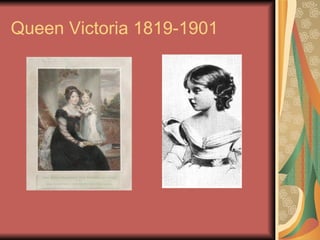
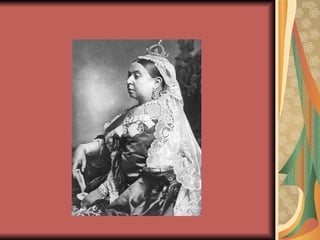
Queen Victoria  1819- 1901


Britain became the most powerful country in the world, with the largest empire that had ever existed, ruling a quarter of the world's population.  Population doubled,  ->  huge demand for food, clothes and housing.  Factories and machines - new towns -ways people lived and worked changed.  Railways.
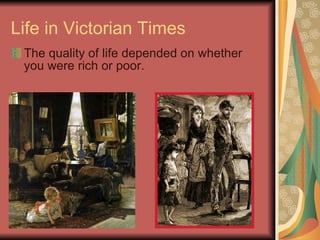
Life in Victorian Times The quality of life depended on whether you were rich or poor.
 
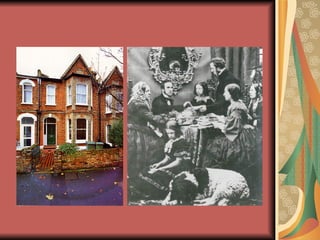
Rich Victorians Large families Big, comfortable houses.  Children were taught to "know their place".  "Spare the rod and spoil the child"     Brought up by their nanny Children rarely saw their parents. A 1-hour visit in the nursery each night  ” Wet-nurse”
 
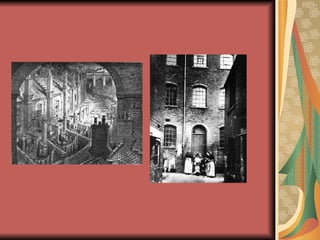
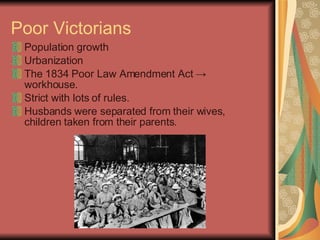
Poor Victorians Population growth Urbanization The 1834 Poor Law Amendment Act  ->  workhouse.  Strict with lots of rules.  Husbands were separated from their wives, children taken from their parents.
 
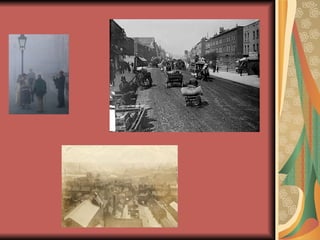
Death in the city 1851 ->  half the population lived in towns  The towns  ->  work + higher wages than the countryside. The countryside  ->  healthier.  A baby born in a large town with a population of more than 100,000 in the 1820s might expect to live to 35 - in the 1830s,  ->  29.  1851, a boy born in inner Liverpool  ->  26 years, countryside ->  57. Cholera and typhoid  ->  polluted water,  Typhus  ->  lice,  ‘ Summer diarrhoea'  ->  swarms of flies feeding on horse manure and human waste.
 
 
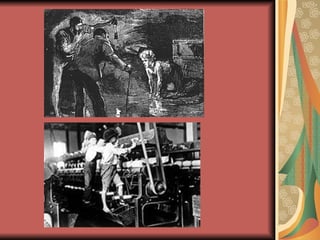
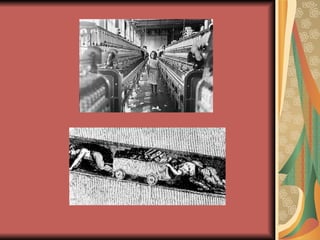
Child Labour Children were employed for 3 simple reasons : There were plenty of them in orphanages and they could be replaced easily if accidents occurred  Cheaper than adults  Small enough to crawl under machinery to tie up broken threads
Child Labour Children as young as 5 worked; Mines Factories Chimney sweeps Mills
1841 Mines Act - No child under the age of 10 to work underground.  1868 Agricultural Gangs Act - No child under the age of 8 to be employed in a gang of farm workers.  1874 Factory Act - No child under the age of 10 is to be employed in a factory.  1875 Climbing Boys Act - Illegal to send boys up chimneys.
When a woman entered a room, it was considered rude for a man to offer his seat to her because the cushion might still be warm. People thought food digested better in the dark, so a dining room located in the basement was considered the best spot in which to eat. A glance into a bedroom was considered improper if viewed by a visitor, so bedrooms were located on the second floor. For a lady to show her ankles was considered very risqué!
People were shy about having water closets, so they disguised fixtures as dressers and cabinets. Tubs were enclosed in wooden boxes that resembled large chests. People went to great lengths to hide toilets from view. In some homes, they were behind a curtain or screen, or even in a room of their own.
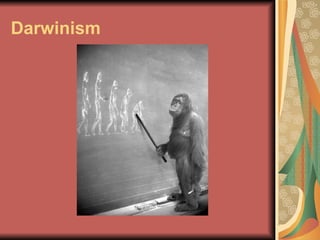
Darwinism

Victorians

  • 1.
  • 2.
    Queen Victoria 1819- 1901
  • 3.
  • 4.
  • 5.
  • 6.
    Britain became themost powerful country in the world, with the largest empire that had ever existed, ruling a quarter of the world's population. Population doubled, -> huge demand for food, clothes and housing. Factories and machines - new towns -ways people lived and worked changed. Railways.
  • 7.
    Life in VictorianTimes The quality of life depended on whether you were rich or poor.
  • 8.
  • 9.
    Rich Victorians Largefamilies Big, comfortable houses. Children were taught to "know their place". "Spare the rod and spoil the child"   Brought up by their nanny Children rarely saw their parents. A 1-hour visit in the nursery each night  ” Wet-nurse”
  • 10.
  • 11.
    Poor Victorians Populationgrowth Urbanization The 1834 Poor Law Amendment Act -> workhouse. Strict with lots of rules. Husbands were separated from their wives, children taken from their parents.
  • 12.
  • 13.
    Death in thecity 1851 -> half the population lived in towns The towns -> work + higher wages than the countryside. The countryside -> healthier. A baby born in a large town with a population of more than 100,000 in the 1820s might expect to live to 35 - in the 1830s, -> 29. 1851, a boy born in inner Liverpool -> 26 years, countryside -> 57. Cholera and typhoid -> polluted water, Typhus -> lice, ‘ Summer diarrhoea' -> swarms of flies feeding on horse manure and human waste.
  • 14.
  • 15.
  • 16.
    Child Labour Childrenwere employed for 3 simple reasons : There were plenty of them in orphanages and they could be replaced easily if accidents occurred Cheaper than adults Small enough to crawl under machinery to tie up broken threads
  • 17.
    Child Labour Childrenas young as 5 worked; Mines Factories Chimney sweeps Mills
  • 18.
    1841 Mines Act- No child under the age of 10 to work underground. 1868 Agricultural Gangs Act - No child under the age of 8 to be employed in a gang of farm workers. 1874 Factory Act - No child under the age of 10 is to be employed in a factory. 1875 Climbing Boys Act - Illegal to send boys up chimneys.
  • 19.
    When a womanentered a room, it was considered rude for a man to offer his seat to her because the cushion might still be warm. People thought food digested better in the dark, so a dining room located in the basement was considered the best spot in which to eat. A glance into a bedroom was considered improper if viewed by a visitor, so bedrooms were located on the second floor. For a lady to show her ankles was considered very risqué!
  • 20.
    People were shyabout having water closets, so they disguised fixtures as dressers and cabinets. Tubs were enclosed in wooden boxes that resembled large chests. People went to great lengths to hide toilets from view. In some homes, they were behind a curtain or screen, or even in a room of their own.
  • 21.