TEACHING VOCABULARY NATURALLY
Tiered Vocabulary Words
TIER ONE
 Tier one consists of the most basic words. These
  words rarely require direct instruction
 Typically do not have multiple meanings

 Sight words, nouns, verbs, adjectives, and early
  reading words occur at this level
 Examples of tier one words are:
  book, girl, sad, run, dog, and orange.
 8,000 word families in English included in tier one
TIER TWO
 Tier two consists of high frequency words that occur
  across a variety of domains
 Words occur often in mature language situations
  such as adult conversations and literature, and
  therefore strongly influence speaking and reading
 Standards for Tier 2 words:
       Important for reading comprehension
       Characteristic of mature language users
       Contain multiple meanings
       Increased descriptive vocabulary
       Used across a variety of environments
TIER TWO – MOST IMPORTANT
 Tier two words are the most important words for
  direct instruction
 Excellent indicators of a student’s progress through
  school
 Examples of tier two words are: masterpiece,
  fortunate, industrious, measure, and benevolent
 There are about 7,000 word families in English (or
  700 per year) in tier two
 Purposefully use them in your classroom
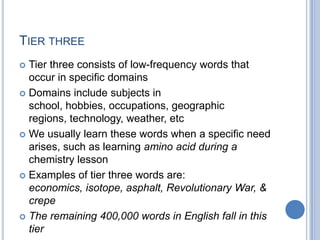
TIER THREE
 Tier three consists of low-frequency words that
  occur in specific domains
 Domains include subjects in
  school, hobbies, occupations, geographic
  regions, technology, weather, etc
 We usually learn these words when a specific need
  arises, such as learning amino acid during a
  chemistry lesson
 Examples of tier three words are:
  economics, isotope, asphalt, Revolutionary War, &
  crepe
 The remaining 400,000 words in English fall in this
  tier
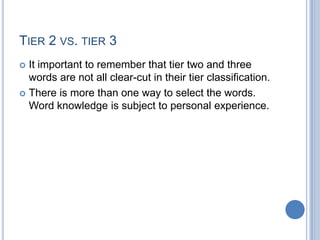
TIER 2 VS. TIER 3
 It important to remember that tier two and three
  words are not all clear-cut in their tier classification.
 There is more than one way to select the words.
  Word knowledge is subject to personal experience.
RESOURCES
   Beck, Isabel L., McKeown, Margaret G., and Kucan, Linda.
    (2002). Bringing words to life. New York, NY: The Guilford
    Press
   Montgomery, Judy K. (2008). MAVA-Montgomery assessment
    of vocabulary acquisition. Greenville, South Carolina: Super
    Duper Publications, Inc.
   Montgomery, Judy K. (2007). Vocabulary Intervention for RTI:
    Tiers 1, 2, 3 Retrieved October
    28, 2008, http://74.125.45.104/search?q=cache:VjfiwE6PJYEJ
    :convention.asha.org/2007/handouts/1137_1757Montgomery_
    Judy_106716_Nov05_2007_Time_122121AM.ppt+three+tiers
    +of+vocabulary&hl=en&ct=clnk&cd=6&gl=us
   3 Tier vocabulary words. Retrieved October 28, 2008
    http://t4.jordan.k12.ut.us/cbl/images/CBL_Documents/3tiervoc
    ab.pdf
   http://www.superduperinc.com/handouts/pdf/182_VocabularyT
    iers.pdf

Tiered vocabulary

  • 1.
  • 2.
    TIER ONE  Tierone consists of the most basic words. These words rarely require direct instruction  Typically do not have multiple meanings  Sight words, nouns, verbs, adjectives, and early reading words occur at this level  Examples of tier one words are: book, girl, sad, run, dog, and orange.  8,000 word families in English included in tier one
  • 3.
    TIER TWO  Tiertwo consists of high frequency words that occur across a variety of domains  Words occur often in mature language situations such as adult conversations and literature, and therefore strongly influence speaking and reading  Standards for Tier 2 words:  Important for reading comprehension  Characteristic of mature language users  Contain multiple meanings  Increased descriptive vocabulary  Used across a variety of environments
  • 4.
    TIER TWO –MOST IMPORTANT  Tier two words are the most important words for direct instruction  Excellent indicators of a student’s progress through school  Examples of tier two words are: masterpiece, fortunate, industrious, measure, and benevolent  There are about 7,000 word families in English (or 700 per year) in tier two  Purposefully use them in your classroom
  • 5.
    TIER THREE  Tierthree consists of low-frequency words that occur in specific domains  Domains include subjects in school, hobbies, occupations, geographic regions, technology, weather, etc  We usually learn these words when a specific need arises, such as learning amino acid during a chemistry lesson  Examples of tier three words are: economics, isotope, asphalt, Revolutionary War, & crepe  The remaining 400,000 words in English fall in this tier
  • 6.
    TIER 2 VS.TIER 3  It important to remember that tier two and three words are not all clear-cut in their tier classification.  There is more than one way to select the words. Word knowledge is subject to personal experience.
  • 7.
    RESOURCES  Beck, Isabel L., McKeown, Margaret G., and Kucan, Linda. (2002). Bringing words to life. New York, NY: The Guilford Press  Montgomery, Judy K. (2008). MAVA-Montgomery assessment of vocabulary acquisition. Greenville, South Carolina: Super Duper Publications, Inc.  Montgomery, Judy K. (2007). Vocabulary Intervention for RTI: Tiers 1, 2, 3 Retrieved October 28, 2008, http://74.125.45.104/search?q=cache:VjfiwE6PJYEJ :convention.asha.org/2007/handouts/1137_1757Montgomery_ Judy_106716_Nov05_2007_Time_122121AM.ppt+three+tiers +of+vocabulary&hl=en&ct=clnk&cd=6&gl=us  3 Tier vocabulary words. Retrieved October 28, 2008 http://t4.jordan.k12.ut.us/cbl/images/CBL_Documents/3tiervoc ab.pdf  http://www.superduperinc.com/handouts/pdf/182_VocabularyT iers.pdf