Self-
determination
Self-advocacy
Dr. Seuss tells us
• “You have brains in your head.
   You have feet in your shoes.
   You can steer yourself in any
     Direction you choose.
      You’re on your own
 And you know what you know.
   And YOU are the guy/girl
  Who’ll decide where to go.”
Self-Determination means


• Being able to accept, respect, and value
  yourself.

• Being able to set goals that are important
  to you and having the skills to achieve
  these goals (Field and Hoffman, 1996).
According to transition
information from NICHY, it is
suggested that four of the most
fundamental skills students can
 have that serve them well in a
wide variety of adult situations
              are:
The ability to assess yourself,
   including your skills and
    abilities, and the needs
associated with your disability
Awareness of the academic
adjustments/accommodations
         you need
Knowledge of your civil rights
 to accommodations through
    legislation such as the
Americans with Disabilities Act
              and
          Section 504
The self-advocacy skills
necessary to express your needs
in the workplace, in educational
 institutions, and in community
              settings
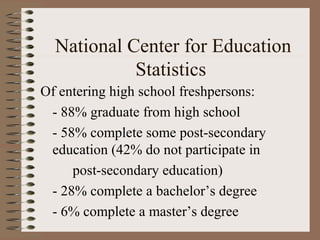
National Center for Education
            Statistics
Of entering high school freshpersons:
 - 88% graduate from high school
 - 58% complete some post-secondary
 education (42% do not participate in
     post-secondary education)
 - 28% complete a bachelor’s degree
 - 6% complete a master’s degree
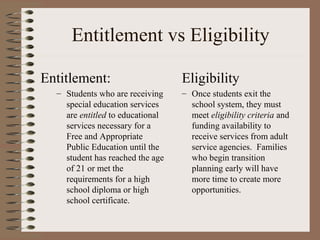
Entitlement vs Eligibility

Entitlement:                      Eligibility
  – Students who are receiving    – Once students exit the
    special education services      school system, they must
    are entitled to educational     meet eligibility criteria and
    services necessary for a        funding availability to
    Free and Appropriate            receive services from adult
    Public Education until the      service agencies. Families
    student has reached the age     who begin transition
    of 21 or met the                planning early will have
    requirements for a high         more time to create more
    school diploma or high          opportunities.
    school certificate.
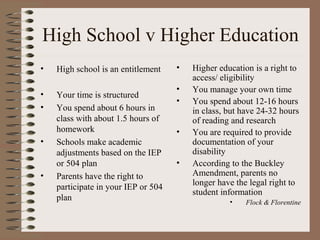
High School v Higher Education
•   High school is an entitlement    •   Higher education is a right to
                                         access/ eligibility
                                     •   You manage your own time
•   Your time is structured
                                     •   You spend about 12-16 hours
•   You spend about 6 hours in           in class, but have 24-32 hours
    class with about 1.5 hours of        of reading and research
    homework                         •   You are required to provide
•   Schools make academic                documentation of your
    adjustments based on the IEP         disability
    or 504 plan                      •   According to the Buckley
•   Parents have the right to            Amendment, parents no
    participate in your IEP or 504       longer have the legal right to
                                         student information
    plan                                           •    Flock & Florentine
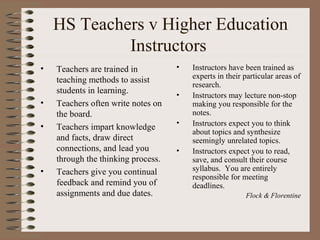
HS Teachers v Higher Education
             Instructors
•   Teachers are trained in         •   Instructors have been trained as
    teaching methods to assist          experts in their particular areas of
                                        research.
    students in learning.           •   Instructors may lecture non-stop
•   Teachers often write notes on       making you responsible for the
    the board.                          notes.
•                                   •   Instructors expect you to think
    Teachers impart knowledge
                                        about topics and synthesize
    and facts, draw direct              seemingly unrelated topics.
    connections, and lead you       •   Instructors expect you to read,
    through the thinking process.       save, and consult their course
•   Teachers give you continual         syllabus. You are entirely
                                        responsible for meeting
    feedback and remind you of          deadlines.
    assignments and due dates.                           Flock & Florentine
PP
rr
ee
ss
     Do I have to inform a post-secondary school
ii
dd
               that I have a disability?
ee
nn
tt
::


     NO.

     Telling the school personnel that you have a
       disability is voluntary – only you have the
       right to state that you have a disability.
May a post-secondary school deny my
    admission because I have a disability?


NO.
If you meet the requirements for admission, a post-
   secondary school may not deny your admission
   simply because you have a disability.
If I need an academic adjustment, what must
                   I do?


- You must inform the school that you have
  a disability and need an academic
  adjustment.
- You are responsible for knowing and
  following the procedure to request an
  academic adjustment.
Work Rights
          and Responsibilities
• You have the right to   • You have the
                            responsibility to educate
  work!                     to train yourself to
• Your parents will not     perform a job.
  allow you to stay       • You have the
  home and eat pizza        responsibility to do as
  and watch SpongeBob       much on your own as
  for the rest of your      possible.
  life.                                     TransCen, Inc
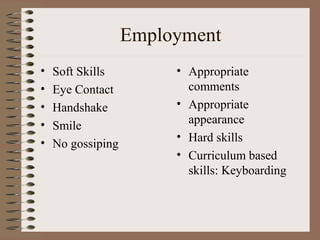
Employment
•   Soft Skills         • Appropriate
•   Eye Contact           comments
•   Handshake           • Appropriate
•                         appearance
    Smile
                        • Hard skills
•   No gossiping
                        • Curriculum based
                          skills: Keyboarding
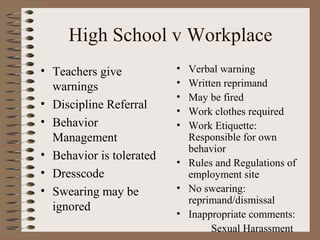
High School v Workplace
• Teachers give           • Verbal warning
  warnings                • Written reprimand
                          • May be fired
• Discipline Referral
                          • Work clothes required
• Behavior                • Work Etiquette:
  Management                Responsible for own
                            behavior
• Behavior is tolerated
                          • Rules and Regulations of
• Dresscode                 employment site
• Swearing may be         • No swearing:
                            reprimand/dismissal
  ignored
                          • Inappropriate comments:
                                 Sexual Harassment
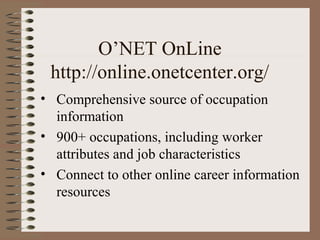
O’NET OnLine
 http://online.onetcenter.org/
• Comprehensive source of occupation
  information
• 900+ occupations, including worker
  attributes and job characteristics
• Connect to other online career information
  resources
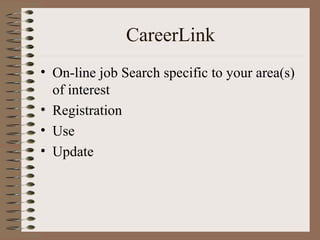
CareerLink
• On-line job Search specific to your area(s)
  of interest
• Registration
• Use
• Update
Job Search Sites
• Snag-a-job.com
• US Government
• Employer Websites
Community Rights and
            Responsibilities
•   You have the right to      • You have the
    services in the              responsibility to do as
    community.                   much as you can for
•   You have the right to        yourself.
    have access to the         • You have the
    community.                   responsibility to ask
•   You have the right to        for the services you
    have help to live in the     need.
    community.                                  TransCen, Inc
Community Access
•   ID Card/Driver’s License
•   Voter Registration
•   Selective Service
•   Living Arrangements
•   Banking
•   Travel Access
What do you want to do with the
       rest of your life?
• What do you like to do?
• What job do you dream about doing?
• What kinds of things would you do at this
    job?
What do you do for fun?
• What do you enjoy doing?
• What do you do with friends and family?
• What are some of your favorite places to
     go?
• Your ‘avocation’ can become your
  ‘vocation’.
Bibliography
• Anderson, E.L., Seaton, K., Dinas, P. (1995). Fostering
  Self-Determination.
• Caristo, C. and Mastorovich, M. (1999). Life’s Path.
• Field, S. & Hoffman, A. (1996). Steps to Self-
  Determination.
• Field, S. & Hoffman, A. (1998). Self-Determination.
• NICHY, (2002). Helping Students Develop Their IEPs.
• Paraschiv, I. (2000). Self-Determination, Self-Advocacy,
  and the Role of the Professional.
• Wehmeyer, M.L., Agran, M. & Hughes, C. (1998).
  Teaching Self-determination to Students with
  Disabilities.

Self determination senior presentation

  • 1.
  • 2.
    Dr. Seuss tellsus • “You have brains in your head. You have feet in your shoes. You can steer yourself in any Direction you choose. You’re on your own And you know what you know. And YOU are the guy/girl Who’ll decide where to go.”
  • 3.
    Self-Determination means • Beingable to accept, respect, and value yourself. • Being able to set goals that are important to you and having the skills to achieve these goals (Field and Hoffman, 1996).
  • 4.
    According to transition informationfrom NICHY, it is suggested that four of the most fundamental skills students can have that serve them well in a wide variety of adult situations are:
  • 5.
    The ability toassess yourself, including your skills and abilities, and the needs associated with your disability
  • 6.
    Awareness of theacademic adjustments/accommodations you need
  • 7.
    Knowledge of yourcivil rights to accommodations through legislation such as the Americans with Disabilities Act and Section 504
  • 8.
    The self-advocacy skills necessaryto express your needs in the workplace, in educational institutions, and in community settings
  • 9.
    National Center forEducation Statistics Of entering high school freshpersons: - 88% graduate from high school - 58% complete some post-secondary education (42% do not participate in post-secondary education) - 28% complete a bachelor’s degree - 6% complete a master’s degree
  • 10.
    Entitlement vs Eligibility Entitlement: Eligibility – Students who are receiving – Once students exit the special education services school system, they must are entitled to educational meet eligibility criteria and services necessary for a funding availability to Free and Appropriate receive services from adult Public Education until the service agencies. Families student has reached the age who begin transition of 21 or met the planning early will have requirements for a high more time to create more school diploma or high opportunities. school certificate.
  • 11.
    High School vHigher Education • High school is an entitlement • Higher education is a right to access/ eligibility • You manage your own time • Your time is structured • You spend about 12-16 hours • You spend about 6 hours in in class, but have 24-32 hours class with about 1.5 hours of of reading and research homework • You are required to provide • Schools make academic documentation of your adjustments based on the IEP disability or 504 plan • According to the Buckley • Parents have the right to Amendment, parents no participate in your IEP or 504 longer have the legal right to student information plan • Flock & Florentine
  • 12.
    HS Teachers vHigher Education Instructors • Teachers are trained in • Instructors have been trained as teaching methods to assist experts in their particular areas of research. students in learning. • Instructors may lecture non-stop • Teachers often write notes on making you responsible for the the board. notes. • • Instructors expect you to think Teachers impart knowledge about topics and synthesize and facts, draw direct seemingly unrelated topics. connections, and lead you • Instructors expect you to read, through the thinking process. save, and consult their course • Teachers give you continual syllabus. You are entirely responsible for meeting feedback and remind you of deadlines. assignments and due dates. Flock & Florentine
  • 13.
    PP rr ee ss Do I have to inform a post-secondary school ii dd that I have a disability? ee nn tt :: NO. Telling the school personnel that you have a disability is voluntary – only you have the right to state that you have a disability.
  • 14.
    May a post-secondaryschool deny my admission because I have a disability? NO. If you meet the requirements for admission, a post- secondary school may not deny your admission simply because you have a disability.
  • 15.
    If I needan academic adjustment, what must I do? - You must inform the school that you have a disability and need an academic adjustment. - You are responsible for knowing and following the procedure to request an academic adjustment.
  • 16.
    Work Rights and Responsibilities • You have the right to • You have the responsibility to educate work! to train yourself to • Your parents will not perform a job. allow you to stay • You have the home and eat pizza responsibility to do as and watch SpongeBob much on your own as for the rest of your possible. life. TransCen, Inc
  • 17.
    Employment • Soft Skills • Appropriate • Eye Contact comments • Handshake • Appropriate • appearance Smile • Hard skills • No gossiping • Curriculum based skills: Keyboarding
  • 18.
    High School vWorkplace • Teachers give • Verbal warning warnings • Written reprimand • May be fired • Discipline Referral • Work clothes required • Behavior • Work Etiquette: Management Responsible for own behavior • Behavior is tolerated • Rules and Regulations of • Dresscode employment site • Swearing may be • No swearing: reprimand/dismissal ignored • Inappropriate comments: Sexual Harassment
  • 19.
    O’NET OnLine http://online.onetcenter.org/ •Comprehensive source of occupation information • 900+ occupations, including worker attributes and job characteristics • Connect to other online career information resources
  • 20.
    CareerLink • On-line jobSearch specific to your area(s) of interest • Registration • Use • Update
  • 21.
    Job Search Sites •Snag-a-job.com • US Government • Employer Websites
  • 22.
    Community Rights and Responsibilities • You have the right to • You have the services in the responsibility to do as community. much as you can for • You have the right to yourself. have access to the • You have the community. responsibility to ask • You have the right to for the services you have help to live in the need. community. TransCen, Inc
  • 23.
    Community Access • ID Card/Driver’s License • Voter Registration • Selective Service • Living Arrangements • Banking • Travel Access
  • 24.
    What do youwant to do with the rest of your life? • What do you like to do? • What job do you dream about doing? • What kinds of things would you do at this job?
  • 25.
    What do youdo for fun? • What do you enjoy doing? • What do you do with friends and family? • What are some of your favorite places to go? • Your ‘avocation’ can become your ‘vocation’.
  • 26.
    Bibliography • Anderson, E.L.,Seaton, K., Dinas, P. (1995). Fostering Self-Determination. • Caristo, C. and Mastorovich, M. (1999). Life’s Path. • Field, S. & Hoffman, A. (1996). Steps to Self- Determination. • Field, S. & Hoffman, A. (1998). Self-Determination. • NICHY, (2002). Helping Students Develop Their IEPs. • Paraschiv, I. (2000). Self-Determination, Self-Advocacy, and the Role of the Professional. • Wehmeyer, M.L., Agran, M. & Hughes, C. (1998). Teaching Self-determination to Students with Disabilities.