Definition
Veterinary medicine is the branch of science
that deals with the prevention, diagnosis and
treatment of disease, disorder and injury in
animals. The scope of veterinary medicine is
wide, covering all animal species, both
domesticated and wild, with a wide range of
conditions which can affect different species.
History
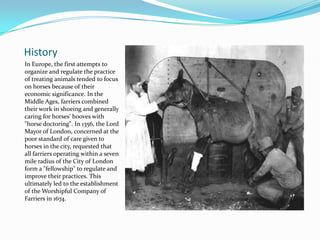
In Europe, the first attempts to
organize and regulate the practice
of treating animals tended to focus
on horses because of their
economic significance. In the
Middle Ages, farriers combined
their work in shoeing and generally
caring for horses' hooves with
"horse doctoring". In 1356, the Lord
Mayor of London, concerned at the
poor standard of care given to
horses in the city, requested that
all farriers operating within a seven
mile radius of the City of London
form a "fellowship" to regulate and
improve their practices. This
ultimately led to the establishment
of the Worshipful Company of
Farriers in 1674.
First Veterinary Schools
 The first veterinary college in Europe had been founded in Lyon,
France in 1762 by Claude Bourgelat. In the ensuing 20 years
similar colleges were established in other European cities. The
Veterinary College of London was founded in 1791 by a group led
by Granville Penn, a grandson of William Penn. In the United
States, the first veterinarians had been trained in Europe.
However, Boston, New York and Philadelphia all had their own
private veterinary schools by the 1850s. These urban schools
concentrated primarily on the care of horses. By the turn of the
20th century, several American agricultural colleges had started
their own veterinary schools which were focused on livestock
animals. In 1879, Iowa Agricultural College became the first land
grant college to establish a school of veterinary medicine.
Furthermore, the first veterinary school founded at Tehran
University in Iran.
1. Cornell University (US)
2. Royal Veterinary College of London (UK)
3. Glasgow University (UK)
4. Cambridge University (UK)
5. Colorado State University (US)
6. University of California (US)
7. University of Guelph (Canada)
8. Ohio State University (US)
Royal Veterinary College (UK) Cornell University (US)
1996
2012
What is DVM and VMD ?
There are several types of degrees that aspiring vets can
earn; these differ according to country and may involve
undergraduate or graduate education. For example, in
the United States, schools award the Doctor of
Veterinary Medicine degree (DVM), Veterinary Medical
Doctor (VMD), and the same degree is awarded in
Bangladesh, Canada, Ethiopia, Hungary, Iran, Malaysia,
Nigeria, Pakistan, Philippines, South Korea, Thailand,
Tobago and Trinidad. However, In the UK, France and
Germany veterinary is taught in different programs , like
BVetMed and the like.
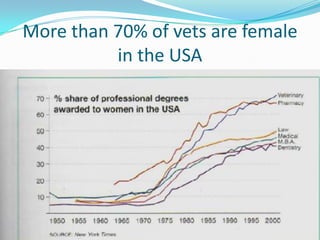
More than 70% of vets are female
in the USA
1. http://www.avma.org/
2. http://www.ivsa.org/
3. http://careerplanning.about.com/od/occupations/p/veterinarian.htm
4. http://www.bls.gov/ooh/healthcare/veterinarians.htm
5. http://www.vet.cornell.edu/library/publicsvcs/freeresources.cfm
6. http://www.library.illinois.edu/vex/vetlinks.htm
7. “It really does happen to a vet” Joe Iglis
8. “Animal patients: 50 years in the life of an animal doctor” Edward J. Scanlon
HTTPS://WWW.FACEBOOK.COM/TAUSVM
Sina Taefehshokr

Veterinary Medicine

  • 3.
    Definition Veterinary medicine isthe branch of science that deals with the prevention, diagnosis and treatment of disease, disorder and injury in animals. The scope of veterinary medicine is wide, covering all animal species, both domesticated and wild, with a wide range of conditions which can affect different species.
  • 4.
    History In Europe, thefirst attempts to organize and regulate the practice of treating animals tended to focus on horses because of their economic significance. In the Middle Ages, farriers combined their work in shoeing and generally caring for horses' hooves with "horse doctoring". In 1356, the Lord Mayor of London, concerned at the poor standard of care given to horses in the city, requested that all farriers operating within a seven mile radius of the City of London form a "fellowship" to regulate and improve their practices. This ultimately led to the establishment of the Worshipful Company of Farriers in 1674.
  • 5.
    First Veterinary Schools The first veterinary college in Europe had been founded in Lyon, France in 1762 by Claude Bourgelat. In the ensuing 20 years similar colleges were established in other European cities. The Veterinary College of London was founded in 1791 by a group led by Granville Penn, a grandson of William Penn. In the United States, the first veterinarians had been trained in Europe. However, Boston, New York and Philadelphia all had their own private veterinary schools by the 1850s. These urban schools concentrated primarily on the care of horses. By the turn of the 20th century, several American agricultural colleges had started their own veterinary schools which were focused on livestock animals. In 1879, Iowa Agricultural College became the first land grant college to establish a school of veterinary medicine. Furthermore, the first veterinary school founded at Tehran University in Iran.
  • 6.
    1. Cornell University(US) 2. Royal Veterinary College of London (UK) 3. Glasgow University (UK) 4. Cambridge University (UK) 5. Colorado State University (US) 6. University of California (US) 7. University of Guelph (Canada) 8. Ohio State University (US)
  • 7.
    Royal Veterinary College(UK) Cornell University (US)
  • 8.
  • 9.
  • 10.
    What is DVMand VMD ? There are several types of degrees that aspiring vets can earn; these differ according to country and may involve undergraduate or graduate education. For example, in the United States, schools award the Doctor of Veterinary Medicine degree (DVM), Veterinary Medical Doctor (VMD), and the same degree is awarded in Bangladesh, Canada, Ethiopia, Hungary, Iran, Malaysia, Nigeria, Pakistan, Philippines, South Korea, Thailand, Tobago and Trinidad. However, In the UK, France and Germany veterinary is taught in different programs , like BVetMed and the like.
  • 11.
    More than 70%of vets are female in the USA
  • 13.
    1. http://www.avma.org/ 2. http://www.ivsa.org/ 3.http://careerplanning.about.com/od/occupations/p/veterinarian.htm 4. http://www.bls.gov/ooh/healthcare/veterinarians.htm 5. http://www.vet.cornell.edu/library/publicsvcs/freeresources.cfm 6. http://www.library.illinois.edu/vex/vetlinks.htm 7. “It really does happen to a vet” Joe Iglis 8. “Animal patients: 50 years in the life of an animal doctor” Edward J. Scanlon HTTPS://WWW.FACEBOOK.COM/TAUSVM Sina Taefehshokr