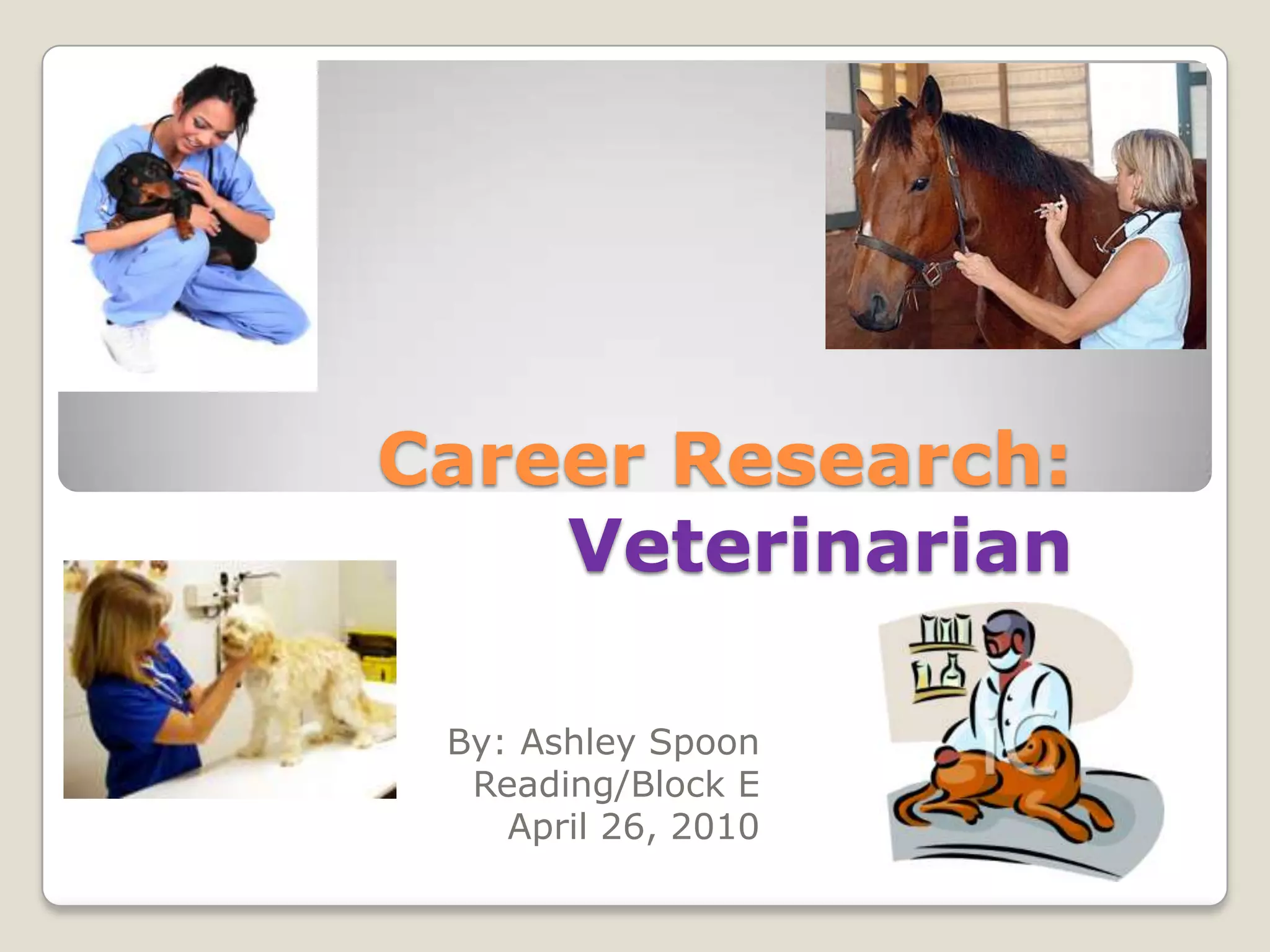
Career Research:VeterinarianBy: Ashley Spoon       Reading/Block EApril 26, 2010
Veterinarian:  Job Responsibilities•  Trained to diagnose and treat diseases and dysfunctions of animals.•  Veterinarians care for the health of pets, livestock, and animals.  •  Their work involves treating illnesses, minor injuries, and infectious diseases in large and small animals.
Veterinarian:  Job Responsibilities•  Vaccinate against diseases, medicate animals suffering from infections, treat wounds, set fractures, and perform surgery.   •  Conductresearch and protect humans against diseases carried by animals, such as rabies and anthrax.  •  Protect our food supply chainby being involved in food safety by checking animals for transmissible diseases such as E. coli.
Veterinarian:  Education RequiredThe educational requirements include:•  Four year college degree that includes at least two years of pre-veterinary course work.•  Four years of  veterinary school that lead to a Doctor of Veterinary Medicine Degree (D.V.M.).•  Must pass an examination required by most states in order to receive a license to practice.•  Required clinical and classroom work include courses in anatomy, physiology, microbiology, zoology and pathology.
Veterinarian:  SCANS Skills NeededIn addition to mastering the basic skills of reading, writing, mathematics and communicating, a veterinarian should also possess the following skills:•  Social – Must interact with pet owners and show understanding for their needs.•  Leadership – Professional communication and ability to influence others, especially their employees and colleagues.•  Self-Management – Should be accountable to running their business without supervision and achieving daily goals.•  Responsibility – Must be dependable and perform high quality work, especially when dealing with life and death situations.•  Problem Solving & Decision Making – Must have the ability to diagnose an animal’s health problem, and be decisive in taking action.
Veterinarian:  Salary Range•  In 2008, the nation’s starting salary for veterinarians was approximately $52,000. •  The median annual income was $79,050.•  The annual potential salary exceeded $143,000.
Veterinarian:  Salary Range
Veterinarian:  Growth Potential and Job OutlookThe outlook for this profession is excellent.•  The employment growth is expected to increase 33% between 2008 and 2018.•  Growth is due to the needed support for public health and food safety, and national disease programs.•  Also, growing demand for Vets because pets are increasingly viewed as a member of the family.
Veterinarian:  Interesting Facts•  Veterinary medicine has dentists who are licensed to perform dentistry on horses.•  The National Zoo has had a history of training some of the top leaders in the field of Veterinary Science.•  Admission to vet school is competitive, as there are only 28 accredited veterinary colleges in the U.S.  •  The number of pet owners purchasing pet insurance is rising.
Veterinarian:  Interview SourceInterview with Dr. Carlos Sanchez…• Dr. Sanchez leads the Veterinary Training Program for the Smithsonian National Zoo.• Involved in the daily clinical care of animals   in the National Zoo collection.• Known for his work with Pandas in China and his training programs throughout Latin America.
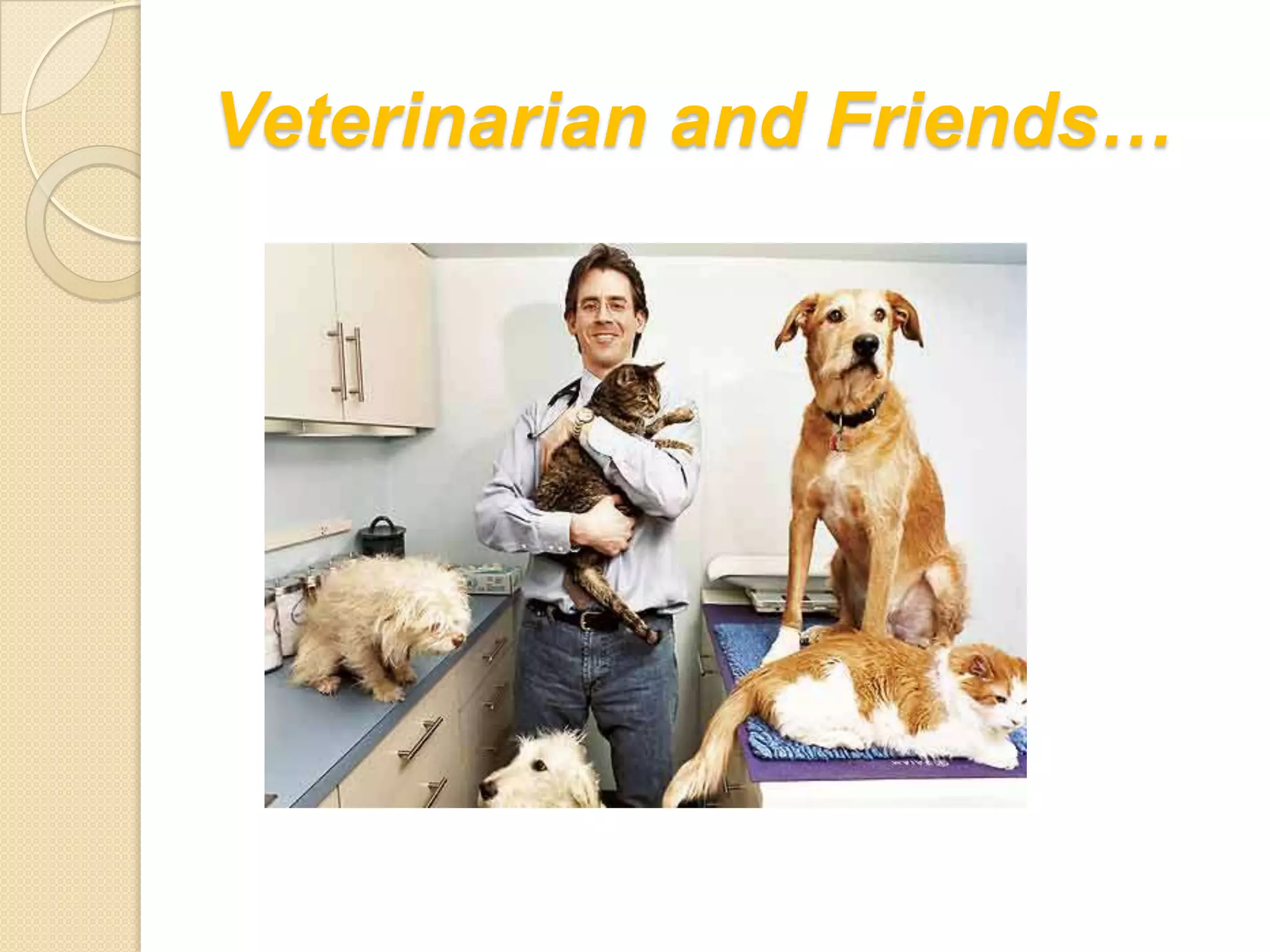
Veterinarian and Friends…
Veterinarian:  Works CitedSanchez, Carlos. “Careers-Interview with Zoo Veterinarian Dr. Carlos Sanchez.” Kids.gov. N.p., n.d. Web. 21 Apr. 2010. <http://www.kids.gov/‌internal/‌zoovet.shtml>.“Veterinarians.” Career Discovery Encyclopedia. Vol. 8. 2000. 86,87. Print. 8 vols.“Veterinarians.” http://www.bls.gov/‌oco/‌ocos076.htm. Bureau of Labor Statistics, U.S. Department of Labor, 17 Dec. 2009. Web. 13 Apr. 2010. <http://www.bls.gov/‌oco/‌ocos076.htm>.“Veterinary Medicine.” World Book Online Reference Center. N.p., 11 Apr. 2010. Web. 11 Apr. 2010. <http://www.worldbookonline.com>.

Ashley Spoon 2010 veterinarian research project 2

  • 1.
    Career Research:VeterinarianBy: AshleySpoon Reading/Block EApril 26, 2010
  • 2.
    Veterinarian: JobResponsibilities• Trained to diagnose and treat diseases and dysfunctions of animals.• Veterinarians care for the health of pets, livestock, and animals. • Their work involves treating illnesses, minor injuries, and infectious diseases in large and small animals.
  • 3.
    Veterinarian: JobResponsibilities• Vaccinate against diseases, medicate animals suffering from infections, treat wounds, set fractures, and perform surgery. • Conductresearch and protect humans against diseases carried by animals, such as rabies and anthrax. • Protect our food supply chainby being involved in food safety by checking animals for transmissible diseases such as E. coli.
  • 4.
    Veterinarian: EducationRequiredThe educational requirements include:• Four year college degree that includes at least two years of pre-veterinary course work.• Four years of veterinary school that lead to a Doctor of Veterinary Medicine Degree (D.V.M.).• Must pass an examination required by most states in order to receive a license to practice.• Required clinical and classroom work include courses in anatomy, physiology, microbiology, zoology and pathology.
  • 5.
    Veterinarian: SCANSSkills NeededIn addition to mastering the basic skills of reading, writing, mathematics and communicating, a veterinarian should also possess the following skills:• Social – Must interact with pet owners and show understanding for their needs.• Leadership – Professional communication and ability to influence others, especially their employees and colleagues.• Self-Management – Should be accountable to running their business without supervision and achieving daily goals.• Responsibility – Must be dependable and perform high quality work, especially when dealing with life and death situations.• Problem Solving & Decision Making – Must have the ability to diagnose an animal’s health problem, and be decisive in taking action.
  • 6.
    Veterinarian: SalaryRange• In 2008, the nation’s starting salary for veterinarians was approximately $52,000. • The median annual income was $79,050.• The annual potential salary exceeded $143,000.
  • 7.
  • 8.
    Veterinarian: GrowthPotential and Job OutlookThe outlook for this profession is excellent.• The employment growth is expected to increase 33% between 2008 and 2018.• Growth is due to the needed support for public health and food safety, and national disease programs.• Also, growing demand for Vets because pets are increasingly viewed as a member of the family.
  • 9.
    Veterinarian: InterestingFacts• Veterinary medicine has dentists who are licensed to perform dentistry on horses.• The National Zoo has had a history of training some of the top leaders in the field of Veterinary Science.• Admission to vet school is competitive, as there are only 28 accredited veterinary colleges in the U.S. • The number of pet owners purchasing pet insurance is rising.
  • 10.
    Veterinarian: InterviewSourceInterview with Dr. Carlos Sanchez…• Dr. Sanchez leads the Veterinary Training Program for the Smithsonian National Zoo.• Involved in the daily clinical care of animals in the National Zoo collection.• Known for his work with Pandas in China and his training programs throughout Latin America.
  • 11.
  • 12.
    Veterinarian: WorksCitedSanchez, Carlos. “Careers-Interview with Zoo Veterinarian Dr. Carlos Sanchez.” Kids.gov. N.p., n.d. Web. 21 Apr. 2010. <http://www.kids.gov/‌internal/‌zoovet.shtml>.“Veterinarians.” Career Discovery Encyclopedia. Vol. 8. 2000. 86,87. Print. 8 vols.“Veterinarians.” http://www.bls.gov/‌oco/‌ocos076.htm. Bureau of Labor Statistics, U.S. Department of Labor, 17 Dec. 2009. Web. 13 Apr. 2010. <http://www.bls.gov/‌oco/‌ocos076.htm>.“Veterinary Medicine.” World Book Online Reference Center. N.p., 11 Apr. 2010. Web. 11 Apr. 2010. <http://www.worldbookonline.com>.