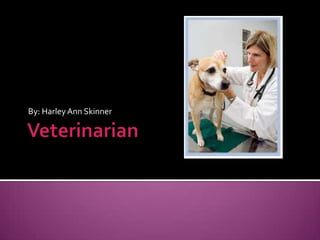
By: Harley Ann Skinner


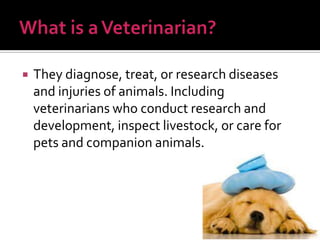
They diagnose, treat, or research diseases
and injuries of animals. Including
veterinarians who conduct research and
development, inspect livestock, or care for
pets and companion animals.


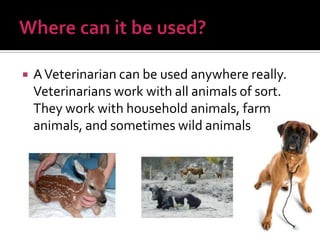
A Veterinarian can be used anywhere really.
Veterinarians work with all animals of sort.
They work with household animals, farm
animals, and sometimes wild animals


Starting:

Other Professional, Scientific, and Technical Services-47,670
National Security and International Affairs-46,610



Median:

Other Professional, Scientific, and Technical Services- $110,199
National Security and International Affairs- $106,466


This career requires a four-year degree or
more.



Many people start at a community college
and then transfer to a 4 year college.



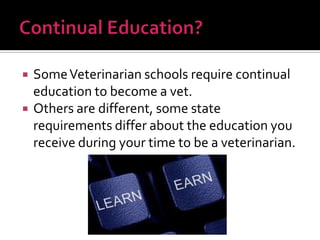
Some Veterinarian schools require continual
education to become a vet.
Others are different, some state
requirements differ about the education you
receive during your time to be a veterinarian.












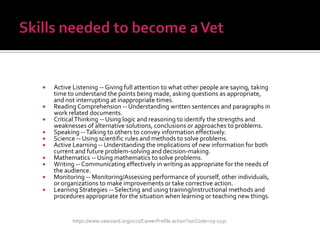
Active Listening -- Giving full attention to what other people are saying, taking
time to understand the points being made, asking questions as appropriate,
and not interrupting at inappropriate times.
Reading Comprehension -- Understanding written sentences and paragraphs in
work related documents.
Critical Thinking -- Using logic and reasoning to identify the strengths and
weaknesses of alternative solutions, conclusions or approaches to problems.
Speaking -- Talking to others to convey information effectively.
Science -- Using scientific rules and methods to solve problems.
Active Learning -- Understanding the implications of new information for both
current and future problem-solving and decision-making.
Mathematics -- Using mathematics to solve problems.
Writing -- Communicating effectively in writing as appropriate for the needs of
the audience.
Monitoring -- Monitoring/Assessing performance of yourself, other individuals,
or organizations to make improvements or take corrective action.
Learning Strategies -- Selecting and using training/instructional methods and
procedures appropriate for the situation when learning or teaching new things.

https://www.vawizard.org/vccs/CareerProfile.action?socCode=29-1131





I will finish school with a advanced degree.
I will go to Germanna Community College and
study Science, Liberal Arts, and General
studies.
I will get a 4 year degree or higher




Any State is good really. Every state has at
least one Veterinarian available. And every
state has animals that are in need of a
veterinarians assistance.
But its best to live in a state that isn't over the
supply of veterinarians.


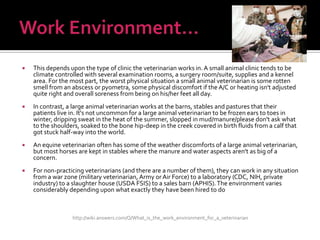
This depends upon the type of clinic the veterinarian works in. A small animal clinic tends to be
climate controlled with several examination rooms, a surgery room/suite, supplies and a kennel
area. For the most part, the worst physical situation a small animal veterinarian is some rotten
smell from an abscess or pyometra, some physical discomfort if the A/C or heating isn't adjusted
quite right and overall soreness from being on his/her feet all day.



In contrast, a large animal veterinarian works at the barns, stables and pastures that their
patients live in. It's not uncommon for a large animal veterinarian to be frozen ears to toes in
winter, dripping sweat in the heat of the summer, slopped in mud/manure/please don't ask what
to the shoulders, soaked to the bone hip-deep in the creek covered in birth fluids from a calf that
got stuck half-way into the world.



An equine veterinarian often has some of the weather discomforts of a large animal veterinarian,
but most horses are kept in stables where the manure and water aspects aren't as big of a
concern.



For non-practicing veterinarians (and there are a number of them), they can work in any situation
from a war zone (military veterinarian, Army or Air Force) to a laboratory (CDC, NIH, private
industry) to a slaughter house (USDA FSIS) to a sales barn (APHIS). The environment varies
considerably depending upon what exactly they have been hired to do

http://wiki.answers.com/Q/What_is_the_work_environment_for_a_veterinarian


Accreditations - This is a list of possible accreditations a veterinarian or potential veterinarian can
earn. Furthering your education, experience and training can provide more benefits in your career.



Board Certification – Becoming board certified can improve a veterinarian’s income, job security
and overall happiness with the choice of career. Board certified veterinarians are able to join
associations to help them advance in their careers and provide a better life for themselves. Learn
what it takes to become board certified in veterinary medicine.



Continuing Education – Like with any career in medicine, continuing your education is very
important and mandatory within the veterinary medicine field. Science and technology are
constantly evolving, and continued educated credits ensure that a veterinarian is up-to-date with
all new discoveries, advancements and data in the field.



Residency – Residency programs are extremely competitive to get into. Find out what it takes for a
potential veterinarian to get into a residency program at the school or university of their wish.



Veterinary Specialties – The veterinary medicine industry is growing rapidly and specialists are
needed in all fields of interest. Learn about the different specialties you can get involved with after
receiving your Doctorate of Veterinary Medicine.

http://www.veterinariancareerinformation.com/advancement.html







Biology I,
Biology II-Genetics
Biology II-Advanced Survey of Biology
Anatomy
Physiology
Most math classes

http://www.kgcs.k12.va.us/kghs/guidance/documents/KGHS_Program_of_Studies_2013-14.pdf




How many people apply a year: 60 to 100
How many people make it: About 30
Student chances: About 25

http://www.pcc.edu/programs/vet-tech/faq.html









https://www.vawizard.org/vccs/CareerProfile.action?socCode=29-1131
http://www.vmb.ca.gov/licensees/mcefaq_1.shtml
http://money.usnews.com/careers/best-jobs/veterinarian/salary
http://www.vetmed.wsu.edu/ProspectiveStudents/Prepare/Experience/
http://www.germanna.edu/Academics_And_Student_Services/Academics/Programs/
http://wiki.answers.com/Q/What_is_the_work_environment_for_a_veterinarian
http://www.pcc.edu/programs/vet-tech/faq.html

Veterinarian Career

  • 1.
  • 2.
     They diagnose, treat,or research diseases and injuries of animals. Including veterinarians who conduct research and development, inspect livestock, or care for pets and companion animals.
  • 3.
     A Veterinarian canbe used anywhere really. Veterinarians work with all animals of sort. They work with household animals, farm animals, and sometimes wild animals
  • 4.
     Starting: Other Professional, Scientific,and Technical Services-47,670 National Security and International Affairs-46,610  Median: Other Professional, Scientific, and Technical Services- $110,199 National Security and International Affairs- $106,466
  • 5.
     This career requiresa four-year degree or more.  Many people start at a community college and then transfer to a 4 year college.
  • 6.
      Some Veterinarian schoolsrequire continual education to become a vet. Others are different, some state requirements differ about the education you receive during your time to be a veterinarian.
  • 7.
              Active Listening --Giving full attention to what other people are saying, taking time to understand the points being made, asking questions as appropriate, and not interrupting at inappropriate times. Reading Comprehension -- Understanding written sentences and paragraphs in work related documents. Critical Thinking -- Using logic and reasoning to identify the strengths and weaknesses of alternative solutions, conclusions or approaches to problems. Speaking -- Talking to others to convey information effectively. Science -- Using scientific rules and methods to solve problems. Active Learning -- Understanding the implications of new information for both current and future problem-solving and decision-making. Mathematics -- Using mathematics to solve problems. Writing -- Communicating effectively in writing as appropriate for the needs of the audience. Monitoring -- Monitoring/Assessing performance of yourself, other individuals, or organizations to make improvements or take corrective action. Learning Strategies -- Selecting and using training/instructional methods and procedures appropriate for the situation when learning or teaching new things. https://www.vawizard.org/vccs/CareerProfile.action?socCode=29-1131
  • 8.
       I will finishschool with a advanced degree. I will go to Germanna Community College and study Science, Liberal Arts, and General studies. I will get a 4 year degree or higher
  • 9.
      Any State isgood really. Every state has at least one Veterinarian available. And every state has animals that are in need of a veterinarians assistance. But its best to live in a state that isn't over the supply of veterinarians.
  • 10.
     This depends uponthe type of clinic the veterinarian works in. A small animal clinic tends to be climate controlled with several examination rooms, a surgery room/suite, supplies and a kennel area. For the most part, the worst physical situation a small animal veterinarian is some rotten smell from an abscess or pyometra, some physical discomfort if the A/C or heating isn't adjusted quite right and overall soreness from being on his/her feet all day.  In contrast, a large animal veterinarian works at the barns, stables and pastures that their patients live in. It's not uncommon for a large animal veterinarian to be frozen ears to toes in winter, dripping sweat in the heat of the summer, slopped in mud/manure/please don't ask what to the shoulders, soaked to the bone hip-deep in the creek covered in birth fluids from a calf that got stuck half-way into the world.  An equine veterinarian often has some of the weather discomforts of a large animal veterinarian, but most horses are kept in stables where the manure and water aspects aren't as big of a concern.  For non-practicing veterinarians (and there are a number of them), they can work in any situation from a war zone (military veterinarian, Army or Air Force) to a laboratory (CDC, NIH, private industry) to a slaughter house (USDA FSIS) to a sales barn (APHIS). The environment varies considerably depending upon what exactly they have been hired to do http://wiki.answers.com/Q/What_is_the_work_environment_for_a_veterinarian
  • 11.
     Accreditations - Thisis a list of possible accreditations a veterinarian or potential veterinarian can earn. Furthering your education, experience and training can provide more benefits in your career.  Board Certification – Becoming board certified can improve a veterinarian’s income, job security and overall happiness with the choice of career. Board certified veterinarians are able to join associations to help them advance in their careers and provide a better life for themselves. Learn what it takes to become board certified in veterinary medicine.  Continuing Education – Like with any career in medicine, continuing your education is very important and mandatory within the veterinary medicine field. Science and technology are constantly evolving, and continued educated credits ensure that a veterinarian is up-to-date with all new discoveries, advancements and data in the field.  Residency – Residency programs are extremely competitive to get into. Find out what it takes for a potential veterinarian to get into a residency program at the school or university of their wish.  Veterinary Specialties – The veterinary medicine industry is growing rapidly and specialists are needed in all fields of interest. Learn about the different specialties you can get involved with after receiving your Doctorate of Veterinary Medicine. http://www.veterinariancareerinformation.com/advancement.html
  • 12.
          Biology I, Biology II-Genetics BiologyII-Advanced Survey of Biology Anatomy Physiology Most math classes http://www.kgcs.k12.va.us/kghs/guidance/documents/KGHS_Program_of_Studies_2013-14.pdf
  • 13.
       How many peopleapply a year: 60 to 100 How many people make it: About 30 Student chances: About 25 http://www.pcc.edu/programs/vet-tech/faq.html
  • 14.