A Minimum of Five-Year Follow-Up Study
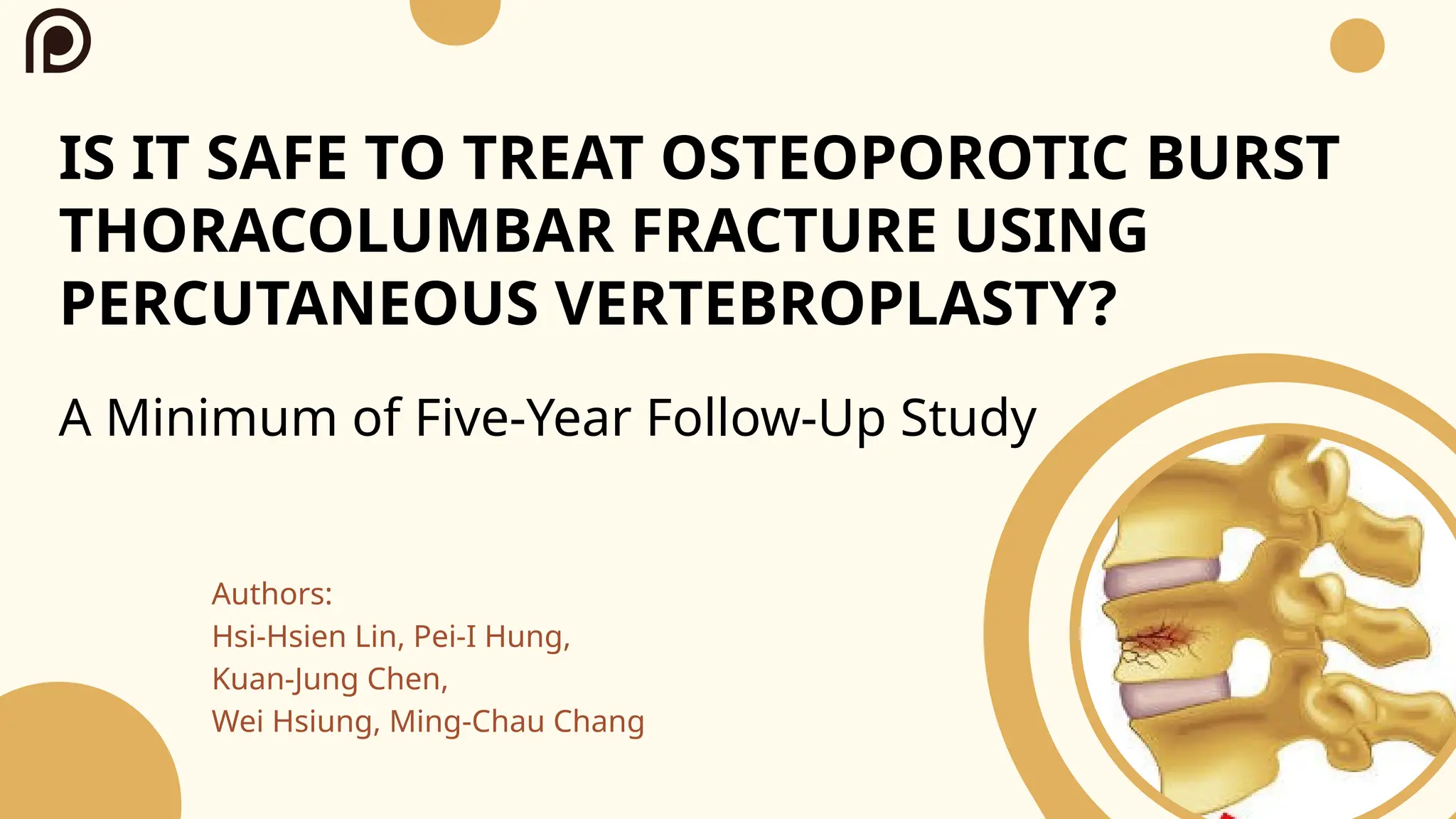
IS IT SAFE TO TREAT OSTEOPOROTIC BURST
THORACOLUMBAR FRACTURE USING
PERCUTANEOUS VERTEBROPLASTY?
Authors:
Hsi-Hsien Lin, Pei-I Hung,
Kuan-Jung Chen,
Wei Hsiung, Ming-Chau Chang
• Published in: The Spine Journal, 2024
• DOI: https://doi.org/10.1016/
j.spinee.2024.10.019
• Institutions: Department of Orthopedics and
Traumatology, Taipei Veterans General
Hospital National Yang Ming Chiao
Tung University
• Contact: Dr. Hsi-Hsien Lin - Email:
hsihsienlin@gmail.com
01 02
05 06
03 04
07
Table of contents
Abstract Introduction
Discussio
n
Limitations
Methodology Results
Conclusion
01
Abstract
Abstract
• Background Context:
Percutaneous vertebroplasty for osteoporotic burst fractures is
controversial. Previous research suggests asymptomatic spinal canal
compromise is not a contraindication.
• Purpose:
To evaluate long-term outcomes of percutaneous
vertebroplasty in osteoporotic burst fractures.
• Study Design:
Prospective observational study with a minimum
of five-year follow-up.
Abstract
• Patient Sample:
- 96 patients with Dennis Type I/II and AO Type A1–A4 osteoporotic fractures.
• Outcome Measures:
- Clinical: Visual Analog Scale (VAS) for pain and Oswestry Disability
Index
(ODI).
- Radiological: Vertebral body height and kyphotic angle.
• Results:
Significant pain relief and functional improvement were observed in
both groups. No differences in long-term outcomes between
compression and burst fractures.
Conclusions:
Vertebroplasty is safe and effective for osteoporotic burst
fractures with asymptomatic spinal canal compromise.
02
Introduction
Introduction
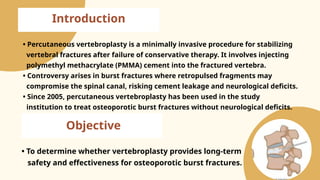
• Percutaneous vertebroplasty is a minimally invasive procedure for stabilizing
vertebral fractures after failure of conservative therapy. It involves injecting
polymethyl methacrylate (PMMA) cement into the fractured vertebra.
• Controversy arises in burst fractures where retropulsed fragments may
compromise the spinal canal, risking cement leakage and neurological deficits.
• Since 2005, percutaneous vertebroplasty has been used in the study
institution to treat osteoporotic burst fractures without neurological deficits.
• To determine whether vertebroplasty provides long-term
safety and effectiveness for osteoporotic burst fractures.
Objective
03
Methodology
Methodology
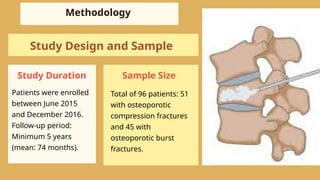
Study Duration
Study Design and Sample
Patients were enrolled
between June 2015
and December 2016.
Follow-up period:
Minimum 5 years
(mean: 74 months).
Sample Size
Total of 96 patients: 51
with osteoporotic
compression fractures
and 45 with
osteoporotic burst
fractures.
Methodology
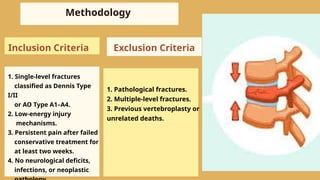
Inclusion Criteria
1. Pathological fractures.
2. Multiple-level fractures.
3. Previous vertebroplasty or
unrelated deaths.
1. Single-level fractures
classified as Dennis Type
I/II
or AO Type A1–A4.
2. Low-energy injury
mechanisms.
3. Persistent pain after failed
conservative treatment for
at least two weeks.
4. No neurological deficits,
infections, or neoplastic
Exclusion Criteria
Methodology
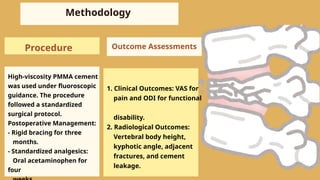
Procedure
1. Clinical Outcomes: VAS for
pain and ODI for functional
disability.
2. Radiological Outcomes:
Vertebral body height,
kyphotic angle, adjacent
fractures, and cement
leakage.
High-viscosity PMMA cement
was used under fluoroscopic
guidance. The procedure
followed a standardized
surgical protocol.
Postoperative Management:
- Rigid bracing for three
months.
- Standardized analgesics:
Oral acetaminophen for
four
Outcome Assessments
04
Results
Patient Demographics
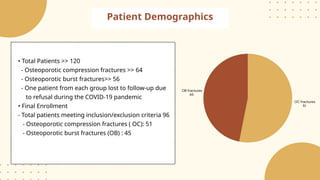
• Total Patients >> 120
- Osteoporotic compression fractures >> 64
- Osteoporotic burst fractures>> 56
- One patient from each group lost to follow-up due
to refusal during the COVID-19 pandemic
• Final Enrollment
- Total patients meeting inclusion/exclusion criteria 96
- Osteoporotic compression fractures ( OC): 51
- Osteoporotic burst fractures (OB) : 45
Patient Demographics
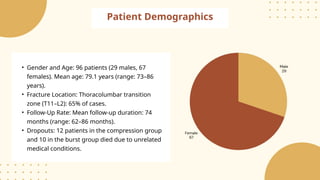
• Gender and Age: 96 patients (29 males, 67
females). Mean age: 79.1 years (range: 73–86
years).
• Fracture Location: Thoracolumbar transition
zone (T11–L2): 65% of cases.
• Follow-Up Rate: Mean follow-up duration: 74
months (range: 62–86 months).
• Dropouts: 12 patients in the compression group
and 10 in the burst group died due to unrelated
medical conditions.
Clinical Outcomes
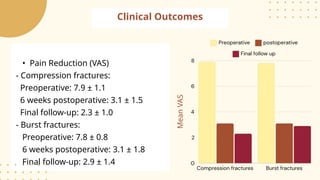
• Pain Reduction (VAS)
- Compression fractures:
Preoperative: 7.9 ± 1.1
6 weeks postoperative: 3.1 ± 1.5
Final follow-up: 2.3 ± 1.0
- Burst fractures:
Preoperative: 7.8 ± 0.8
6 weeks postoperative: 3.1 ± 1.8
Final follow-up: 2.9 ± 1.4
Mean
VAS
Clinical Outcomes
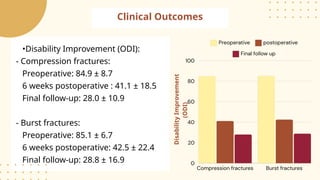
•Disability Improvement (ODI):
- Compression fractures:
Preoperative: 84.9 ± 8.7
6 weeks postoperative : 41.1 ± 18.5
Final follow-up: 28.0 ± 10.9
- Burst fractures:
Preoperative: 85.1 ± 6.7
6 weeks postoperative: 42.5 ± 22.4
Final follow-up: 28.8 ± 16.9
Disability
Improvement
(ODI)
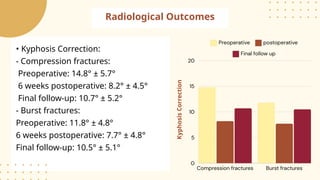
Radiological Outcomes
• Kyphosis Correction:
- Compression fractures:
Preoperative: 14.8° ± 5.7°
6 weeks postoperative: 8.2° ± 4.5°
Final follow-up: 10.7° ± 5.2°
- Burst fractures:
Preoperative: 11.8° ± 4.8°
6 weeks postoperative: 7.7° ± 4.8°
Final follow-up: 10.5° ± 5.1°
Kyphosis
Correction
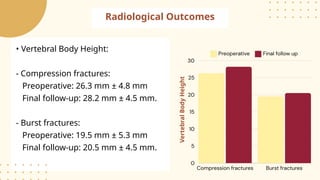
Radiological Outcomes
• Vertebral Body Height:
- Compression fractures:
Preoperative: 26.3 mm ± 4.8 mm
Final follow-up: 28.2 mm ± 4.5 mm.
- Burst fractures:
Preoperative: 19.5 mm ± 5.3 mm
Final follow-up: 20.5 mm ± 4.5 mm.
Vertebral
Body
Height
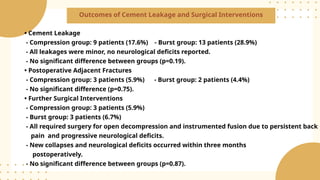
• Cement Leakage
- Compression group: 9 patients (17.6%) - Burst group: 13 patients (28.9%)
- All leakages were minor, no neurological deficits reported.
- No significant difference between groups (p=0.19).
• Postoperative Adjacent Fractures
- Compression group: 3 patients (5.9%) - Burst group: 2 patients (4.4%)
- No significant difference (p=0.75).
• Further Surgical Interventions
- Compression group: 3 patients (5.9%)
- Burst group: 3 patients (6.7%)
- All required surgery for open decompression and instrumented fusion due to persistent back
pain and progressive neurological deficits.
- New collapses and neurological deficits occurred within three months
postoperatively.
- No significant difference between groups (p=0.87).
Outcomes of Cement Leakage and Surgical Interventions
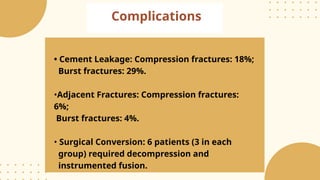
Complications
• Cement Leakage: Compression fractures: 18%;
Burst fractures: 29%.
•Adjacent Fractures: Compression fractures:
6%;
Burst fractures: 4%.
• Surgical Conversion: 6 patients (3 in each
group) required decompression and
instrumented fusion.
05
Discussion
Discussion
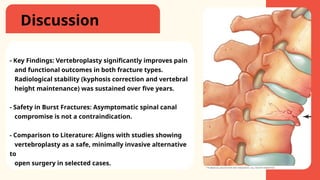
- Key Findings: Vertebroplasty significantly improves pain
and functional outcomes in both fracture types.
Radiological stability (kyphosis correction and vertebral
height maintenance) was sustained over five years.
- Safety in Burst Fractures: Asymptomatic spinal canal
compromise is not a contraindication.
- Comparison to Literature: Aligns with studies showing
vertebroplasty as a safe, minimally invasive alternative
to
open surgery in selected cases.
06
Limitations
Limitations
Sample Size: Relatively small, limiting generalizability..
1
Follow-Up Challenges: High dropout rates due to advanced age
and
unrelated deaths.
Heterogeneity: Variability in fracture patterns and bone density
among patients.
2
3
07
Conclusion
Conclusion
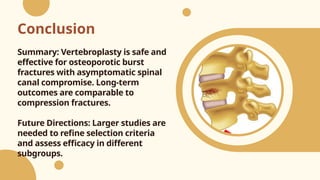
Summary: Vertebroplasty is safe and
effective for osteoporotic burst
fractures with asymptomatic spinal
canal compromise. Long-term
outcomes are comparable to
compression fractures.
Future Directions: Larger studies are
needed to refine selection criteria
and assess efficacy in different
subgroups.

Thank
you

VAS 2_20241124_214611_0000 presentation.pptx

  • 1.
    A Minimum ofFive-Year Follow-Up Study IS IT SAFE TO TREAT OSTEOPOROTIC BURST THORACOLUMBAR FRACTURE USING PERCUTANEOUS VERTEBROPLASTY? Authors: Hsi-Hsien Lin, Pei-I Hung, Kuan-Jung Chen, Wei Hsiung, Ming-Chau Chang
  • 2.
    • Published in:The Spine Journal, 2024 • DOI: https://doi.org/10.1016/ j.spinee.2024.10.019 • Institutions: Department of Orthopedics and Traumatology, Taipei Veterans General Hospital National Yang Ming Chiao Tung University • Contact: Dr. Hsi-Hsien Lin - Email: hsihsienlin@gmail.com
  • 3.
    01 02 05 06 0304 07 Table of contents Abstract Introduction Discussio n Limitations Methodology Results Conclusion
  • 4.
  • 5.
    Abstract • Background Context: Percutaneousvertebroplasty for osteoporotic burst fractures is controversial. Previous research suggests asymptomatic spinal canal compromise is not a contraindication. • Purpose: To evaluate long-term outcomes of percutaneous vertebroplasty in osteoporotic burst fractures. • Study Design: Prospective observational study with a minimum of five-year follow-up.
  • 6.
    Abstract • Patient Sample: -96 patients with Dennis Type I/II and AO Type A1–A4 osteoporotic fractures. • Outcome Measures: - Clinical: Visual Analog Scale (VAS) for pain and Oswestry Disability Index (ODI). - Radiological: Vertebral body height and kyphotic angle. • Results: Significant pain relief and functional improvement were observed in both groups. No differences in long-term outcomes between compression and burst fractures. Conclusions: Vertebroplasty is safe and effective for osteoporotic burst fractures with asymptomatic spinal canal compromise.
  • 7.
  • 8.
    Introduction • Percutaneous vertebroplastyis a minimally invasive procedure for stabilizing vertebral fractures after failure of conservative therapy. It involves injecting polymethyl methacrylate (PMMA) cement into the fractured vertebra. • Controversy arises in burst fractures where retropulsed fragments may compromise the spinal canal, risking cement leakage and neurological deficits. • Since 2005, percutaneous vertebroplasty has been used in the study institution to treat osteoporotic burst fractures without neurological deficits. • To determine whether vertebroplasty provides long-term safety and effectiveness for osteoporotic burst fractures. Objective
  • 9.
  • 10.
    Methodology Study Duration Study Designand Sample Patients were enrolled between June 2015 and December 2016. Follow-up period: Minimum 5 years (mean: 74 months). Sample Size Total of 96 patients: 51 with osteoporotic compression fractures and 45 with osteoporotic burst fractures.
  • 11.
    Methodology Inclusion Criteria 1. Pathologicalfractures. 2. Multiple-level fractures. 3. Previous vertebroplasty or unrelated deaths. 1. Single-level fractures classified as Dennis Type I/II or AO Type A1–A4. 2. Low-energy injury mechanisms. 3. Persistent pain after failed conservative treatment for at least two weeks. 4. No neurological deficits, infections, or neoplastic Exclusion Criteria
  • 12.
    Methodology Procedure 1. Clinical Outcomes:VAS for pain and ODI for functional disability. 2. Radiological Outcomes: Vertebral body height, kyphotic angle, adjacent fractures, and cement leakage. High-viscosity PMMA cement was used under fluoroscopic guidance. The procedure followed a standardized surgical protocol. Postoperative Management: - Rigid bracing for three months. - Standardized analgesics: Oral acetaminophen for four Outcome Assessments
  • 13.
  • 14.
    Patient Demographics • TotalPatients >> 120 - Osteoporotic compression fractures >> 64 - Osteoporotic burst fractures>> 56 - One patient from each group lost to follow-up due to refusal during the COVID-19 pandemic • Final Enrollment - Total patients meeting inclusion/exclusion criteria 96 - Osteoporotic compression fractures ( OC): 51 - Osteoporotic burst fractures (OB) : 45
  • 15.
    Patient Demographics • Genderand Age: 96 patients (29 males, 67 females). Mean age: 79.1 years (range: 73–86 years). • Fracture Location: Thoracolumbar transition zone (T11–L2): 65% of cases. • Follow-Up Rate: Mean follow-up duration: 74 months (range: 62–86 months). • Dropouts: 12 patients in the compression group and 10 in the burst group died due to unrelated medical conditions.
  • 16.
    Clinical Outcomes • PainReduction (VAS) - Compression fractures: Preoperative: 7.9 ± 1.1 6 weeks postoperative: 3.1 ± 1.5 Final follow-up: 2.3 ± 1.0 - Burst fractures: Preoperative: 7.8 ± 0.8 6 weeks postoperative: 3.1 ± 1.8 Final follow-up: 2.9 ± 1.4 Mean VAS
  • 17.
    Clinical Outcomes •Disability Improvement(ODI): - Compression fractures: Preoperative: 84.9 ± 8.7 6 weeks postoperative : 41.1 ± 18.5 Final follow-up: 28.0 ± 10.9 - Burst fractures: Preoperative: 85.1 ± 6.7 6 weeks postoperative: 42.5 ± 22.4 Final follow-up: 28.8 ± 16.9 Disability Improvement (ODI)
  • 18.
    Radiological Outcomes • KyphosisCorrection: - Compression fractures: Preoperative: 14.8° ± 5.7° 6 weeks postoperative: 8.2° ± 4.5° Final follow-up: 10.7° ± 5.2° - Burst fractures: Preoperative: 11.8° ± 4.8° 6 weeks postoperative: 7.7° ± 4.8° Final follow-up: 10.5° ± 5.1° Kyphosis Correction
  • 19.
    Radiological Outcomes • VertebralBody Height: - Compression fractures: Preoperative: 26.3 mm ± 4.8 mm Final follow-up: 28.2 mm ± 4.5 mm. - Burst fractures: Preoperative: 19.5 mm ± 5.3 mm Final follow-up: 20.5 mm ± 4.5 mm. Vertebral Body Height
  • 20.
    • Cement Leakage -Compression group: 9 patients (17.6%) - Burst group: 13 patients (28.9%) - All leakages were minor, no neurological deficits reported. - No significant difference between groups (p=0.19). • Postoperative Adjacent Fractures - Compression group: 3 patients (5.9%) - Burst group: 2 patients (4.4%) - No significant difference (p=0.75). • Further Surgical Interventions - Compression group: 3 patients (5.9%) - Burst group: 3 patients (6.7%) - All required surgery for open decompression and instrumented fusion due to persistent back pain and progressive neurological deficits. - New collapses and neurological deficits occurred within three months postoperatively. - No significant difference between groups (p=0.87). Outcomes of Cement Leakage and Surgical Interventions
  • 21.
    Complications • Cement Leakage:Compression fractures: 18%; Burst fractures: 29%. •Adjacent Fractures: Compression fractures: 6%; Burst fractures: 4%. • Surgical Conversion: 6 patients (3 in each group) required decompression and instrumented fusion.
  • 22.
  • 23.
    Discussion - Key Findings:Vertebroplasty significantly improves pain and functional outcomes in both fracture types. Radiological stability (kyphosis correction and vertebral height maintenance) was sustained over five years. - Safety in Burst Fractures: Asymptomatic spinal canal compromise is not a contraindication. - Comparison to Literature: Aligns with studies showing vertebroplasty as a safe, minimally invasive alternative to open surgery in selected cases.
  • 24.
  • 25.
    Limitations Sample Size: Relativelysmall, limiting generalizability.. 1 Follow-Up Challenges: High dropout rates due to advanced age and unrelated deaths. Heterogeneity: Variability in fracture patterns and bone density among patients. 2 3
  • 26.
  • 27.
    Conclusion Summary: Vertebroplasty issafe and effective for osteoporotic burst fractures with asymptomatic spinal canal compromise. Long-term outcomes are comparable to compression fractures. Future Directions: Larger studies are needed to refine selection criteria and assess efficacy in different subgroups.
  • 28.