Verb Tenses Present and past
CONTRAST I study at the University. I am studying at the University. (temporarily) I never drink coffee but today I am having one.
Present Simple Form: Inf + s/es for third person singular Aux: Is/do/does or modals Verbs ending in  o,h,s,z  add –es Verbs ending in  C-y  change  y  to  i  and add  -es situations or actions permanent or repeated He always studies at night In adverbial clauses with future meaning When he gets up tomorrow, he’ll phone me
Present Progressive Form:  to be + vb-ing Aux: to be CVC (stressed) double Consonant:  Stopping Activity in progress or temporary Shut up! I’m trying to hear We are eating in the terrace this month
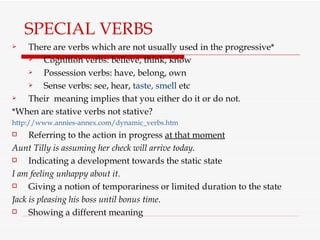
SPECIAL VERBS There are verbs which are not usually used in the progressive* Cognition verbs: believe, think, know Possession verbs: have, belong, own Sense verbs: see, hear,  taste, smell  etc Their  meaning implies that you either do it or do not. *When are stative verbs not stative? http://www.annies-annex.com/dynamic_verbs.htm   Referring to the action in progress  at that moment Aunt Tilly is assuming her check will arrive today.    Indicating a development towards the static state I am feeling unhappy about it.    Giving a notion of temporariness or limited duration to the state Jack is pleasing his boss until bonus time .   Showing a different meaning
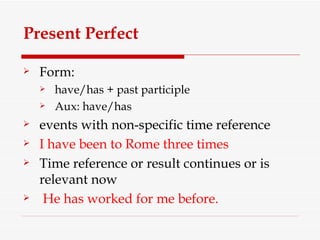
Present Perfect Form: have/has + past participle Aux: have/has events with non-specific time reference I have been to Rome three times Time reference or result continues or is relevant now He has worked for me before.
Past Simple Form:  Regular: Vb + ed CY: ied VY: yed   CVC: CC-ed VB- e: adds only d  Irregular from list Aux DID + INF Action with specific time reference in the past He played the piano when he was nine. He went for a walk
Past Progressive Form:  Was/were + Vb-ing AUX: Was/were Activity in progress at a certain time in the past  activity of a limited duration over a longer period At 9 o´clock I was doing English That week I was visiting my friends
Past Perfect HAD+ past participle Action occurring before certain action in the past or that had consequences in a period in the past Before I arrived, he had prepared dinner
CONTRAST Charles Dickens wrote some good books. (He is dead, so his bookwriting days are past.) J.K. Rowling has written some good books. (She's still alive, so she can always write some more books, although her Harry Potter series is done.) She waited in line for 8 hours before she could buy the latest Harry Potter book. After she had waited in line for 8 hours and had bought the book, she sat down and started reading it immediately.
Homework Do the exercises on present simple and progressive, past simple and progressive, past simple and present perfect and past simple and past perfect. Booklet pages 19-21.
Practice Write 6 sentences using each of the tenses we have just seen.  These sentences may be true or false, but try to make them sound credible.  Swap your sentences with your partner.  Correct, if necessary, your partner’s sentences. Try to guess if they are true or not.

Verb_tenses (present&past)

  • 1.
  • 2.
    CONTRAST I studyat the University. I am studying at the University. (temporarily) I never drink coffee but today I am having one.
  • 3.
    Present Simple Form:Inf + s/es for third person singular Aux: Is/do/does or modals Verbs ending in o,h,s,z add –es Verbs ending in C-y change y to i and add -es situations or actions permanent or repeated He always studies at night In adverbial clauses with future meaning When he gets up tomorrow, he’ll phone me
  • 4.
    Present Progressive Form: to be + vb-ing Aux: to be CVC (stressed) double Consonant: Stopping Activity in progress or temporary Shut up! I’m trying to hear We are eating in the terrace this month
  • 5.
    SPECIAL VERBS Thereare verbs which are not usually used in the progressive* Cognition verbs: believe, think, know Possession verbs: have, belong, own Sense verbs: see, hear, taste, smell etc Their meaning implies that you either do it or do not. *When are stative verbs not stative? http://www.annies-annex.com/dynamic_verbs.htm Referring to the action in progress at that moment Aunt Tilly is assuming her check will arrive today.   Indicating a development towards the static state I am feeling unhappy about it.   Giving a notion of temporariness or limited duration to the state Jack is pleasing his boss until bonus time .  Showing a different meaning
  • 6.
    Present Perfect Form:have/has + past participle Aux: have/has events with non-specific time reference I have been to Rome three times Time reference or result continues or is relevant now He has worked for me before.
  • 7.
    Past Simple Form: Regular: Vb + ed CY: ied VY: yed CVC: CC-ed VB- e: adds only d Irregular from list Aux DID + INF Action with specific time reference in the past He played the piano when he was nine. He went for a walk
  • 8.
    Past Progressive Form: Was/were + Vb-ing AUX: Was/were Activity in progress at a certain time in the past activity of a limited duration over a longer period At 9 o´clock I was doing English That week I was visiting my friends
  • 9.
    Past Perfect HAD+past participle Action occurring before certain action in the past or that had consequences in a period in the past Before I arrived, he had prepared dinner
  • 10.
    CONTRAST Charles Dickenswrote some good books. (He is dead, so his bookwriting days are past.) J.K. Rowling has written some good books. (She's still alive, so she can always write some more books, although her Harry Potter series is done.) She waited in line for 8 hours before she could buy the latest Harry Potter book. After she had waited in line for 8 hours and had bought the book, she sat down and started reading it immediately.
  • 11.
    Homework Do theexercises on present simple and progressive, past simple and progressive, past simple and present perfect and past simple and past perfect. Booklet pages 19-21.
  • 12.
    Practice Write 6sentences using each of the tenses we have just seen. These sentences may be true or false, but try to make them sound credible. Swap your sentences with your partner. Correct, if necessary, your partner’s sentences. Try to guess if they are true or not.