1
EARLY-STAGE
STARTUP VALUATION
Stephen R. Poland
June 14th, 2016
Welcome
3
Today’s Topics
• When You Need to Establish a Valuation
• The Valuation Equation
• Valuation and Raise Amount
• Calculating Investor Ownership %
• Talking About Your Valuation to Investors
• Valuation Methods: How to determine your
valuation
4
About Me…
• Co-Founder of 4 Startups
• Current Company – 1x1 Media
• Corporate Roles – Disney, MacMillan, Bertelsmann
• Advisor to Angel Investment Groups
• Author of 7 Books on Startup Funding
• Focus on helping startups become Investor-Ready
• Live in North Carolina, USA
5
Contact Info
Twitter:
• @1x1steve
LinkedIn:
• https://www.linkedin.com/in/steve-poland-
9b545a6
Website:
• www.1x1media.com
6
LET’S GET STARTED…
7
Why You Need a Valuation
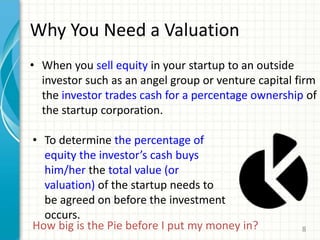
• When you sell equity in your startup to an outside
investor such as an angel group or venture capital firm
the investor trades cash for a percentage ownership of
the startup corporation.
8
• To determine the percentage of
equity the investor’s cash buys
him/her the total value (or
valuation) of the startup needs to
be agreed on before the investment
occurs.
How big is the Pie before I put my money in?
The Many Questions in the Investor
• Market Size. How big is the market the startup is going
after?
• Size of the Company. What are the revenue projections
over the next three to five years?
• Intellectual Property (IP). Does the startup have
significant IP or other high competitive barrier
advantages?
• Founders and Team. How experienced is the founding
team? Have they worked on a startup before, or is this
their first go?
• Product/Service or Technology. Is it revolutionary and
disruptive, or merely evolutionary?
9
The Many Questions of the Investor
• Traction. Do you have customers or users? At what rate can
you add new ones?
• Amount Already Invested. How much money has already
been invested, and how much time in terms of development,
research, or innovation?
• Stage of the Startup. What stage of development is the
startup at: idea/business plan, product developed and
tested, or other?
• Competition. What is the competition like in the sector of
the startup?
• Need for Addition Investment. Does the startup need a
significant amount of additional cash to reach its goals?
10
The First Rule of Startup Valuation
Your company is worth whatever you
and the investor agree it’s worth.
11
VALUATION, FOUNDER DILUTION
AND
STARTUP STAGES
12
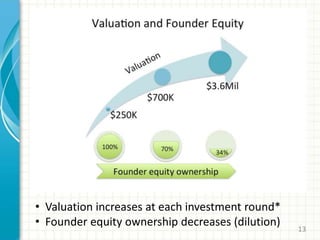
• Valuation increases at each investment round*
• Founder equity ownership decreases (dilution) 13
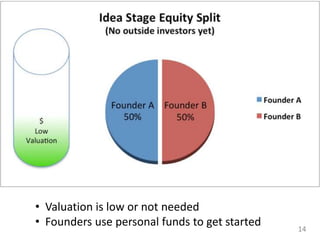
• Technology
• Valuation is low or not needed
• Founders use personal funds to get started 14
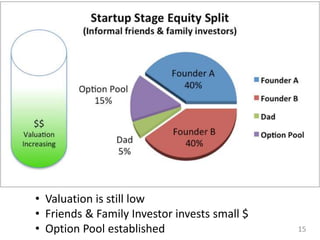
• Valuation is still low
• Friends & Family Investor invests small $
• Option Pool established 15
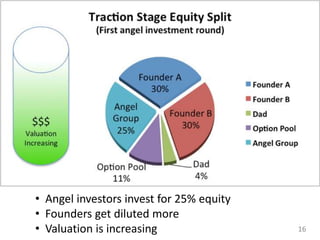
• Angel investors invest for 25% equity
• Founders get diluted more
• Valuation is increasing 16
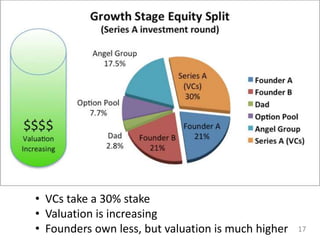
• VCs take a 30% stake
• Valuation is increasing
• Founders own less, but valuation is much higher 17
THE BASIC VALUATION EQUATION
18
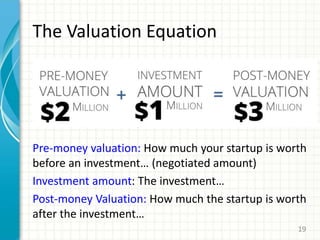
The Valuation Equation
Pre-money valuation: How much your startup is worth
before an investment… (negotiated amount)
Investment amount: The investment…
Post-money Valuation: How much the startup is worth
after the investment…
19
HOW TO TALK ABOUT YOUR
VALUATION WITH INVESTORS
IMPLIED VALUATION
20
How to Talk About Your Valuation
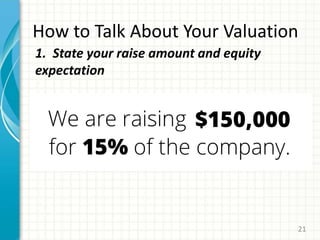
1. State your raise amount and equity
expectation
21
How to Talk About Your Valuation
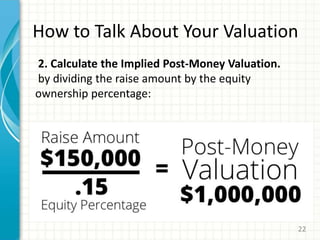
2. Calculate the Implied Post-Money Valuation.
by dividing the raise amount by the equity
ownership percentage:
22
How to Talk About Your Valuation
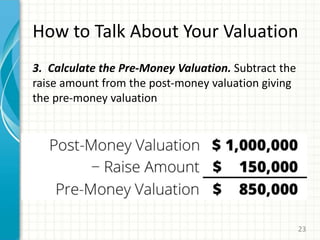
3. Calculate the Pre-Money Valuation. Subtract the
raise amount from the post-money valuation giving
the pre-money valuation
23
HOW TO TALK ABOUT YOUR
VALUATION WITH INVESTORS
IMPLIED FOUNDER DILUTION
24
How to Talk About Your Valuation
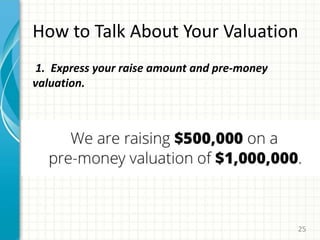
1. Express your raise amount and pre-money
valuation.
25
How to Talk About Your Valuation
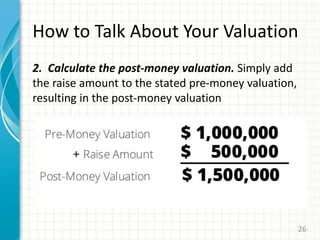
2. Calculate the post-money valuation. Simply add
the raise amount to the stated pre-money valuation,
resulting in the post-money valuation
26
How to Talk About Your Valuation
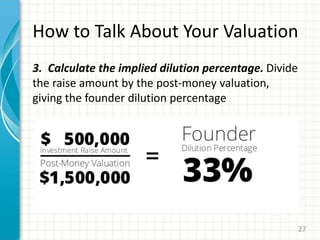
3. Calculate the implied dilution percentage. Divide
the raise amount by the post-money valuation,
giving the founder dilution percentage
27
VALUATION & RAISE AMOUNT
THE 2X TRICK
28
The 2X Trick
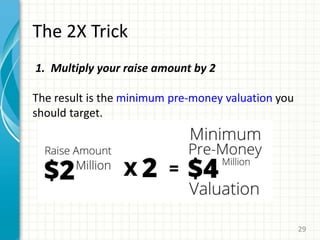
1. Multiply your raise amount by 2
The result is the minimum pre-money valuation you
should target.
29
The 2X Trick
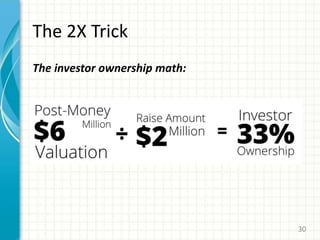
The investor ownership math:
30
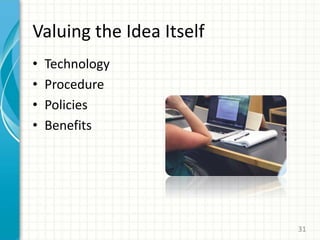
Valuing the Idea Itself
• Technology
• Procedure
• Policies
• Benefits
31
Early-stage
Valuation
Methods
32
Valuation Factors
• Market Size. How big is the market the startup is
going after?
• Revenue Potential. What are the revenue
projections over the next three to five years?
• Intellectual Property (IP). Does the startup have
significant IP or other high competitive barrier
advantages?
• Founders and Team. How experienced is the
founding team? Have they worked on a startup
before, or is this their first go?
• Product/Service or Technology. Is it revolutionary
and disruptive, or merely evolutionary? 33
More Valuation Factors
• Traction. Do you have customers or users? At what rate
can you add new ones?
• Amount Already Invested. How much money has
already been invested, and how much time in terms of
development, research, or innovation?
• Stage of the Startup. What stage of development is the
startup at: idea/business plan, product developed and
tested, or other?
• Competition. What is the competition like in the sector
of the startup?
• Need for Addition Investment. Does the startup need a
significant amount of additional cash to reach its goals?
34
VALUATION METHOD #1
THE MARKET COMPARISON
METHOD
35
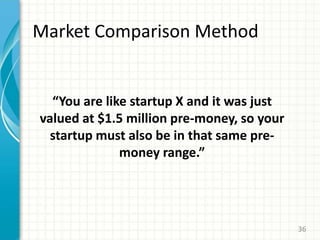
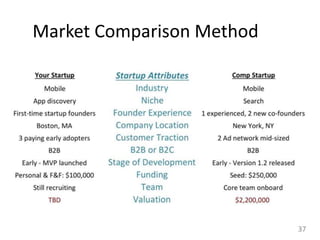
Market Comparison Method
“You are like startup X and it was just
valued at $1.5 million pre-money, so your
startup must also be in that same pre-
money range.”
36
Market Comparison Method
37
VALUATION METHOD #2
THE VC QUICK METHOD
38
The VC Quick Method
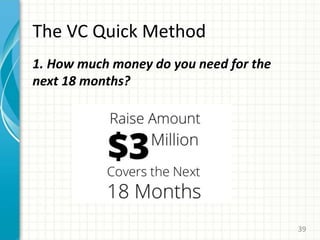
1. How much money do you need for the
next 18 months?
39
The VC Quick Method
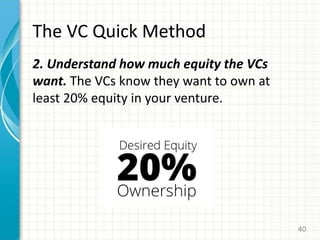
2. Understand how much equity the VCs
want. The VCs know they want to own at
least 20% equity in your venture.
40
The VC Quick Method
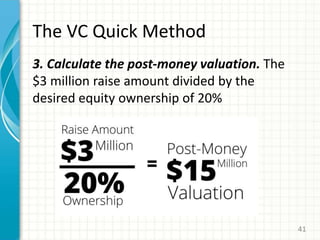
3. Calculate the post-money valuation. The
$3 million raise amount divided by the
desired equity ownership of 20%
41
The VC Quick Method
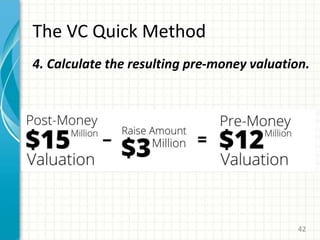
4. Calculate the resulting pre-money valuation.
42
VALUATION METHOD #3
THE RISK REDUCTION METHOD
43
Risk Reduction Method
Assigning values to the tasks and
accomplishments that reduce the RISK in
your startup.
44
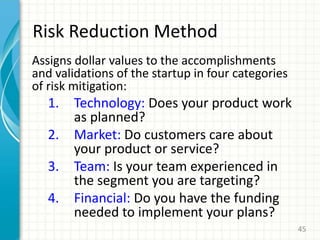
Risk Reduction Method
Assigns dollar values to the accomplishments
and validations of the startup in four categories
of risk mitigation:
1. Technology: Does your product work
as planned?
2. Market: Do customers care about
your product or service?
3. Team: Is your team experienced in
the segment you are targeting?
4. Financial: Do you have the funding
needed to implement your plans?
45
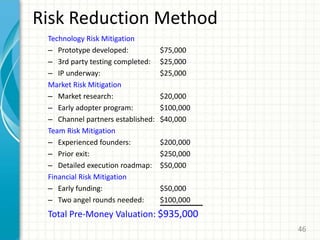
Risk Reduction Method
Technology Risk Mitigation
– Prototype developed: $75,000
– 3rd party testing completed: $25,000
– IP underway: $25,000
Market Risk Mitigation
– Market research: $20,000
– Early adopter program: $100,000
– Channel partners established: $40,000
Team Risk Mitigation
– Experienced founders: $200,000
– Prior exit: $250,000
– Detailed execution roadmap: $50,000
Financial Risk Mitigation
– Early funding: $50,000
– Two angel rounds needed: $100,000
Total Pre-Money Valuation: $935,000
46
WHAT QUESTIONS
DO YOU HAVE?
47
Resources
• How-To Guides for Startup Founders
1x1media.com
• Startup Valuation: The App
https://goo.gl/QxdRXf
• The Ultimate Angel Funding Checklist:
http://goo.gl/DHydWe
48

Early Stage Startup Valuation

  • 1.
  • 2.
  • 3.
  • 4.
    Today’s Topics • WhenYou Need to Establish a Valuation • The Valuation Equation • Valuation and Raise Amount • Calculating Investor Ownership % • Talking About Your Valuation to Investors • Valuation Methods: How to determine your valuation 4
  • 5.
    About Me… • Co-Founderof 4 Startups • Current Company – 1x1 Media • Corporate Roles – Disney, MacMillan, Bertelsmann • Advisor to Angel Investment Groups • Author of 7 Books on Startup Funding • Focus on helping startups become Investor-Ready • Live in North Carolina, USA 5
  • 6.
    Contact Info Twitter: • @1x1steve LinkedIn: •https://www.linkedin.com/in/steve-poland- 9b545a6 Website: • www.1x1media.com 6
  • 7.
  • 8.
    Why You Needa Valuation • When you sell equity in your startup to an outside investor such as an angel group or venture capital firm the investor trades cash for a percentage ownership of the startup corporation. 8 • To determine the percentage of equity the investor’s cash buys him/her the total value (or valuation) of the startup needs to be agreed on before the investment occurs. How big is the Pie before I put my money in?
  • 9.
    The Many Questionsin the Investor • Market Size. How big is the market the startup is going after? • Size of the Company. What are the revenue projections over the next three to five years? • Intellectual Property (IP). Does the startup have significant IP or other high competitive barrier advantages? • Founders and Team. How experienced is the founding team? Have they worked on a startup before, or is this their first go? • Product/Service or Technology. Is it revolutionary and disruptive, or merely evolutionary? 9
  • 10.
    The Many Questionsof the Investor • Traction. Do you have customers or users? At what rate can you add new ones? • Amount Already Invested. How much money has already been invested, and how much time in terms of development, research, or innovation? • Stage of the Startup. What stage of development is the startup at: idea/business plan, product developed and tested, or other? • Competition. What is the competition like in the sector of the startup? • Need for Addition Investment. Does the startup need a significant amount of additional cash to reach its goals? 10
  • 11.
    The First Ruleof Startup Valuation Your company is worth whatever you and the investor agree it’s worth. 11
  • 12.
  • 13.
    • Valuation increasesat each investment round* • Founder equity ownership decreases (dilution) 13
  • 14.
    • Technology • Valuationis low or not needed • Founders use personal funds to get started 14
  • 15.
    • Valuation isstill low • Friends & Family Investor invests small $ • Option Pool established 15
  • 16.
    • Angel investorsinvest for 25% equity • Founders get diluted more • Valuation is increasing 16
  • 17.
    • VCs takea 30% stake • Valuation is increasing • Founders own less, but valuation is much higher 17
  • 18.
  • 19.
    The Valuation Equation Pre-moneyvaluation: How much your startup is worth before an investment… (negotiated amount) Investment amount: The investment… Post-money Valuation: How much the startup is worth after the investment… 19
  • 20.
    HOW TO TALKABOUT YOUR VALUATION WITH INVESTORS IMPLIED VALUATION 20
  • 21.
    How to TalkAbout Your Valuation 1. State your raise amount and equity expectation 21
  • 22.
    How to TalkAbout Your Valuation 2. Calculate the Implied Post-Money Valuation. by dividing the raise amount by the equity ownership percentage: 22
  • 23.
    How to TalkAbout Your Valuation 3. Calculate the Pre-Money Valuation. Subtract the raise amount from the post-money valuation giving the pre-money valuation 23
  • 24.
    HOW TO TALKABOUT YOUR VALUATION WITH INVESTORS IMPLIED FOUNDER DILUTION 24
  • 25.
    How to TalkAbout Your Valuation 1. Express your raise amount and pre-money valuation. 25
  • 26.
    How to TalkAbout Your Valuation 2. Calculate the post-money valuation. Simply add the raise amount to the stated pre-money valuation, resulting in the post-money valuation 26
  • 27.
    How to TalkAbout Your Valuation 3. Calculate the implied dilution percentage. Divide the raise amount by the post-money valuation, giving the founder dilution percentage 27
  • 28.
    VALUATION & RAISEAMOUNT THE 2X TRICK 28
  • 29.
    The 2X Trick 1.Multiply your raise amount by 2 The result is the minimum pre-money valuation you should target. 29
  • 30.
    The 2X Trick Theinvestor ownership math: 30
  • 31.
    Valuing the IdeaItself • Technology • Procedure • Policies • Benefits 31
  • 32.
  • 33.
    Valuation Factors • MarketSize. How big is the market the startup is going after? • Revenue Potential. What are the revenue projections over the next three to five years? • Intellectual Property (IP). Does the startup have significant IP or other high competitive barrier advantages? • Founders and Team. How experienced is the founding team? Have they worked on a startup before, or is this their first go? • Product/Service or Technology. Is it revolutionary and disruptive, or merely evolutionary? 33
  • 34.
    More Valuation Factors •Traction. Do you have customers or users? At what rate can you add new ones? • Amount Already Invested. How much money has already been invested, and how much time in terms of development, research, or innovation? • Stage of the Startup. What stage of development is the startup at: idea/business plan, product developed and tested, or other? • Competition. What is the competition like in the sector of the startup? • Need for Addition Investment. Does the startup need a significant amount of additional cash to reach its goals? 34
  • 35.
    VALUATION METHOD #1 THEMARKET COMPARISON METHOD 35
  • 36.
    Market Comparison Method “Youare like startup X and it was just valued at $1.5 million pre-money, so your startup must also be in that same pre- money range.” 36
  • 37.
  • 38.
    VALUATION METHOD #2 THEVC QUICK METHOD 38
  • 39.
    The VC QuickMethod 1. How much money do you need for the next 18 months? 39
  • 40.
    The VC QuickMethod 2. Understand how much equity the VCs want. The VCs know they want to own at least 20% equity in your venture. 40
  • 41.
    The VC QuickMethod 3. Calculate the post-money valuation. The $3 million raise amount divided by the desired equity ownership of 20% 41
  • 42.
    The VC QuickMethod 4. Calculate the resulting pre-money valuation. 42
  • 43.
    VALUATION METHOD #3 THERISK REDUCTION METHOD 43
  • 44.
    Risk Reduction Method Assigningvalues to the tasks and accomplishments that reduce the RISK in your startup. 44
  • 45.
    Risk Reduction Method Assignsdollar values to the accomplishments and validations of the startup in four categories of risk mitigation: 1. Technology: Does your product work as planned? 2. Market: Do customers care about your product or service? 3. Team: Is your team experienced in the segment you are targeting? 4. Financial: Do you have the funding needed to implement your plans? 45
  • 46.
    Risk Reduction Method TechnologyRisk Mitigation – Prototype developed: $75,000 – 3rd party testing completed: $25,000 – IP underway: $25,000 Market Risk Mitigation – Market research: $20,000 – Early adopter program: $100,000 – Channel partners established: $40,000 Team Risk Mitigation – Experienced founders: $200,000 – Prior exit: $250,000 – Detailed execution roadmap: $50,000 Financial Risk Mitigation – Early funding: $50,000 – Two angel rounds needed: $100,000 Total Pre-Money Valuation: $935,000 46
  • 47.
  • 48.
    Resources • How-To Guidesfor Startup Founders 1x1media.com • Startup Valuation: The App https://goo.gl/QxdRXf • The Ultimate Angel Funding Checklist: http://goo.gl/DHydWe 48

Editor's Notes

  • #13 Use a section header for each of the topics, so there is a clear transition to the audience.
  • #14 13* It’s possible for
  • #15 Valuation Low or Not Necessary. At the idea stage, the valuation of the startup is expectedly low. Because typically few if any tasks have been executed to move the startup forward, no real need to actually put a valuation on the company exists. Personal Funding. Funding at the idea stage typically comes from the entrepreneur, with sources including personal savings, credit cards, or other opportunities such as pitch competitions. Friends and family money, government research funding, and occasionally independent angel investors can also fund the early steps at the idea stage.
  • #16 Valuation Still Low, but Growing. At the startup stage, the valuation of the startup is still low, but efforts toward building the product and proving it with customers are well underway. These accomplishments help increase the valuation of the startup Pivots are Common. At the startup stage it is common for founders to change directions in terms of the product, its features, or even the customer being targeted—these changes are called “pivots” in startup lingo, and are common at the startup stage. Investors want to see how potential customers like the prototype, beta, or test version of your innovation. Seasoned investors know that founders have a high likelihood of needing to pivot during the early stages of the startup.
  • #17 Customer Validation Drives the Traction Stage. The validation that people want and are willing to pay for your product is the Holy Grail for investors. The closer you get to true paying customers, the less risk the angel perceives in the venture. Angels Start To Play and Valuation Grows. At the traction stage, angel investors can talk to your paying customers, get a first hand view of the market segments you serve, and begin to assess the investment risks and potential rewards.
  • #18 Investors in growth stage startups look at historical metrics of your company. Months, if not years, of actual financial data are available, and investors want to know: How efficiently have you used the capital you’ve received? How well have you controlled expenses? Are you at or close to a break-even level of sales/revenue? Are there major infrastructure costs needed to serve an ever larger number of customers
  • #19 Use a section header for each of the topics, so there is a clear transition to the audience.
  • #20 The Pre-money valuation is what gets negotiated with investors. When they ask “what’s your valuation”, they are talking about the Pre-money valuation.
  • #21 Use a section header for each of the topics, so there is a clear transition to the audience.
  • #28 The Founder Dilution % is also how much equity the investor owns after the investment deal is complete.
  • #29 Use a section header for each of the topics, so there is a clear transition to the audience.
  • #30 What will the audience be able to do after this training is complete? Briefly describe each objective and how the audience will benefit from this presentation.
  • #39 Use a section header for each of the topics, so there is a clear transition to the audience.
  • #44 Use a section header for each of the topics, so there is a clear transition to the audience.
  • #46 What will the audience be able to do after this training is complete? Briefly describe each objective and how the audience will benefit from this presentation.
  • #47 Can have a detailed conversation with investors about each line item. Shows the work you have accomplished.
  • #48 Microsoft Confidential
  • #49 Microsoft Confidential