VENTURE CAPITAL
1
SUMMARY
1. Brief history and definition of Venture
Capital;
2. Corporate structure and operation;
3. Italian contest
4. Main European players and relationship with
EU istitutions
5. New sector of investment and conclusions
2
History of Venture Capital
• 1946 = first two venture capital firms:
1. ARDC
2. J.H Whitney & Company ;
• 1960/1970 = Venture Capital as e synonymous
with
technology finance;
• 1980 = declining returns caused by the growth of
the
industry;
• 1990/2000= The Venture Capital Boom and the
Internet Bubble.
3
Venture Capital
• It’s a private funding used to support risky
new business and speculative ventures,
usually with high growth potential.
• A typical venture capital investment
usually involves the business owner giving
up equity to venture capitalist in return for
funding.
4
Venture Capitalists and
Business Angels
• Venture Capitalists are investment firms
that makes venture investment, providing
capital for start-up or expansion.
• They are looking for higher rate of return,
bringing their managerial abilities to small
businesses with great potential growth.
• Business Angels are private investor with
huge personal capital, looking forward to
invest their money in business which are not
helped by financial institutions because are
too risky.
5
Structure of
Venture Capital Firms
• Venture capital firms are typically structured as
partnership;
• This comprises both high net worth individuals and
institutions with large amounts of available capital, such
as state and private pension funds, university financial
endowments, foundations, insurance companies, and
pooled investment vehicles, called fund of funds or
mutual funds
• VC firms in the United States may also be structured as
limited liability companies, in which case the firm's
managers are known as managing members.
6
Venture capital funding
• Venture capitalists are typically very selective in deciding
what to invest in;
• Funds are most interested in ventures with exceptionally
high growth potential,providing the financial returns and
successful exit event within the required timeframe
(typically 3–7 years) that venture capitalists expect.
• Young companies to raise venture capital require a
combination of innovative technology, potential for rapid
growth, a well-developed business model, and an
impressive management team.
7
Venture capital funding
• This sheme meets businesses having large up-front capital
requirements which cannot be financed by cheaper
alternatives such as debt.
• Intangible assets such as software, and other intellectual
property, whose value is unproven,explains why venture
capital is most prevalent in the fast-growing technology and
life sciences or biotechnology fields.
• Venture capitalists are expected to nurture the companies in
which they invest, in order to increase the likelihood of
reaching an IPO stage when valuations are favorable.
8
Financing
According to the development of the company,
there are three types of financing with
venture capital:
1.Early
2.Expansion and development
3.Acquisitions and restructuring
To analyze these points, they can be divided in
several subgroups in order to stress the fact
that every step in a company lifetime involves
a different approach by venture capitalists.
9
Disinvestment
• Time of exit from the firm’s capital is almost never
predetermined, but depends on the development of the
company.
• In successful cases, divestments take place when the
company has reached the level of expected
development and the value of the company and thus the
membership, has consequently increased.
• Disinvestments happens when the conviction that is no
more possible to solve the situation created takes hold.
10
How to disinvest?
• There are several ways of disinvestment,
depending on the type of business and
operations previously put in place and on
results achieved. Typical channels used by
investors to sell shares in their possession
are:
1.the IPO of the subsidiary titles
2.sale of the securities to another firm or to
another institutional investor;
3.the repurchase of the participation by the
original business group
4.the sale to new and old members, resulting
from the merger of several companies in the
meantime achieved.
11
Venture capital
• Focus on high potential growth small
companies;
• It makes research on the company and it
builds a business plan fot the small company;
• Often venture capitalists buy company and
after restiring them,they sell them at an
higher price.
12
Business angel
• A business angel is an affluent individual
who provides capital for a business start up;
• Usually in exchange for convertible debt or
ownership equity;
• A small but increasing number of angel
investors organize themselves into angel
groups or angel networks to share research
and pool their investment capital.
13
Renewvables energies:
an opportunity to catch for
venture capital
 Venture capitals put their eyes on renewvables
energies;
 They sat special teams or branches to focus better
on this special kind of investment;
 U.S and Europe kept investing a lot over the years
on this new market in order to find new sources of
energies.
14
Renewvables energies:an
opportunity to catch for the
venture capital
Three reasons of attractiveness :
1. Governments keep increasing deregulation of the
market energy;
2. Enviromentalists put the attenction on the need of
the world of new sources of energies;
3. Increasing costs of the oils.
15
The goals
• Venture capital energy companies invest on projects
long the value chain,focusing on two directions:
1.Increasing efficiency of the energetic system;
1.Decreasing the use of fossil fuel put down the values
of the pollutions.
16
In recent years
 2006:venture capital invested $7.4 billion on
renewvables energies winth an increasing of 146%
respect the last year;
 2008:in the last mounths of the year a drop in the
market occured
 2009/2010:investments increase again supported by
the developing countries (China)and U.S.
17
©2000, Entrepreneurial Finance, Smith and Kiholm Smith Chapter
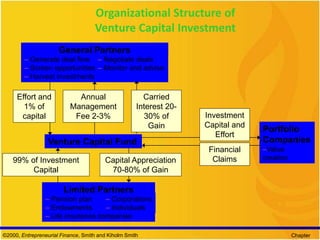
Organizational Structure of
Venture Capital Investment
Portfolio
Companies
–Value
creation
– Generate deal flow
– Screen opportunities
– Harvest investments
– Negotiate deals
– Monitor and advise
General Partners
Venture Capital Fund
– Pension plan
– Endowments
– Life insurance companies
– Corporations
– Individuals
Limited Partners
Effort and
1% of
capital
Annual
Management
Fee 2-3%
Carried
Interest 20-
30% of
Gain
99% of Investment
Capital
Capital Appreciation
70-80% of Gain
Investment
Capital and
Effort
Financial
Claims
VENTURE CAPITAL
Hybrid Financing Techniques by VC Funds
Because New Venture has No Verifiable Cash
Flow or Tangible Assets for Collateral
$ Debt not Viable Option
$ Consideration for Investment is Transfer of
Negotiated Ownership Interest (Stock
Sale), which includes Measure of Control,
from Entrepreneur/Founder to Venture
Capitalist
VENTURE CAPITAL
Hybrid Structure: Preferred Stock
convertible into Common Stock
 Dividends accrue at Debt-like Rate; Payable
at Positive Cash Flow
 When Milestones achieved, non-Voting
Preferred Stock converts into Voting
Common Stock
 Venture Capitalist will have Board
Membership and Control over Major
Strategic Decisions
VENTURE CAPITAL
Hybrid Financing used by VC Funds
Ultimate Source of Repayment for Investment will be
Initial Public Offering (IPO)
 Managing General Partners paid
 By Limited Partners/Investors for
Management Services and …
 Percentage of Capital Gain at IPO
 Limited Partners/Investors earn Capital Gain
 Investment Time Frame: 7 to 10 years
VENTURE CAPITAL
Myths about Venture Capital Financing
$ VCs want no less than 50% Ownership
Fact: VC Funds customarily hold 47% to 53% Voting
Interest
$ VCs have the Right to Fire the Founder/CEO
Fact: Customary Condition is Employment Contract
authorizing Majority of Directors to fire
Founder/CEO “with or without cause.”
Performance Issues vs. Company Needs:
Administrator or Inspirational Leader
VENTURE CAPITAL
Myths about Venture Capital Financing
$ VCs dominate the Private Equity Market
Fact: VCs account for less than 1% of the Private
Equity Market
$ VCs finance a Broad Range of Industry Types on a
Nationwide Basis
Fact: Most VC investments are in High-Technology or
Bio-science Industries in California’s Silicon
Valley or Boston area
VENTURE CAPITAL
Myths about Venture Capital Financing
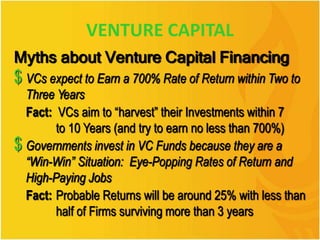
$ VCs expect to Earn a 700% Rate of Return within Two to
Three Years
Fact: VCs aim to “harvest” their Investments within 7
to 10 Years (and try to earn no less than 700%)
$ Governments invest in VC Funds because they are a
“Win-Win” Situation: Eye-Popping Rates of Return and
High-Paying Jobs
Fact: Probable Returns will be around 25% with less than
half of Firms surviving more than 3 years
VENTURE CAPITAL
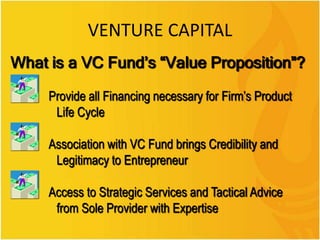
What is a VC Fund’s “Value Proposition”?
Provide all Financing necessary for Firm’s Product
Life Cycle
Association with VC Fund brings Credibility and
Legitimacy to Entrepreneur
Access to Strategic Services and Tactical Advice
from Sole Provider with Expertise
VENTURE CAPITAL
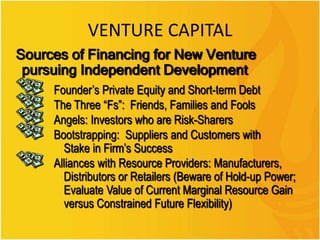
Sources of Financing for New Venture
pursuing Independent Development
Founder’s Private Equity and Short-term Debt
The Three “Fs”: Friends, Families and Fools
Angels: Investors who are Risk-Sharers
Bootstrapping: Suppliers and Customers with
Stake in Firm’s Success
Alliances with Resource Providers: Manufacturers,
Distributors or Retailers (Beware of Hold-up Power;
Evaluate Value of Current Marginal Resource Gain
versus Constrained Future Flexibility)
VENTURE CAPITAL
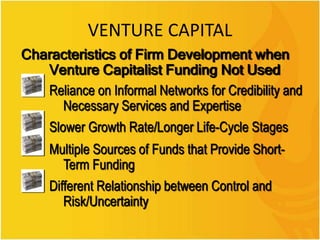
Characteristics of Firm Development when
Venture Capitalist Funding Not Used
Reliance on Informal Networks for Credibility and
Necessary Services and Expertise
Slower Growth Rate/Longer Life-Cycle Stages
Multiple Sources of Funds that Provide Short-
Term Funding
Different Relationship between Control and
Risk/Uncertainty

VENTURE CAPITAL .ppt

  • 1.
  • 2.
    SUMMARY 1. Brief historyand definition of Venture Capital; 2. Corporate structure and operation; 3. Italian contest 4. Main European players and relationship with EU istitutions 5. New sector of investment and conclusions 2
  • 3.
    History of VentureCapital • 1946 = first two venture capital firms: 1. ARDC 2. J.H Whitney & Company ; • 1960/1970 = Venture Capital as e synonymous with technology finance; • 1980 = declining returns caused by the growth of the industry; • 1990/2000= The Venture Capital Boom and the Internet Bubble. 3
  • 4.
    Venture Capital • It’sa private funding used to support risky new business and speculative ventures, usually with high growth potential. • A typical venture capital investment usually involves the business owner giving up equity to venture capitalist in return for funding. 4
  • 5.
    Venture Capitalists and BusinessAngels • Venture Capitalists are investment firms that makes venture investment, providing capital for start-up or expansion. • They are looking for higher rate of return, bringing their managerial abilities to small businesses with great potential growth. • Business Angels are private investor with huge personal capital, looking forward to invest their money in business which are not helped by financial institutions because are too risky. 5
  • 6.
    Structure of Venture CapitalFirms • Venture capital firms are typically structured as partnership; • This comprises both high net worth individuals and institutions with large amounts of available capital, such as state and private pension funds, university financial endowments, foundations, insurance companies, and pooled investment vehicles, called fund of funds or mutual funds • VC firms in the United States may also be structured as limited liability companies, in which case the firm's managers are known as managing members. 6
  • 7.
    Venture capital funding •Venture capitalists are typically very selective in deciding what to invest in; • Funds are most interested in ventures with exceptionally high growth potential,providing the financial returns and successful exit event within the required timeframe (typically 3–7 years) that venture capitalists expect. • Young companies to raise venture capital require a combination of innovative technology, potential for rapid growth, a well-developed business model, and an impressive management team. 7
  • 8.
    Venture capital funding •This sheme meets businesses having large up-front capital requirements which cannot be financed by cheaper alternatives such as debt. • Intangible assets such as software, and other intellectual property, whose value is unproven,explains why venture capital is most prevalent in the fast-growing technology and life sciences or biotechnology fields. • Venture capitalists are expected to nurture the companies in which they invest, in order to increase the likelihood of reaching an IPO stage when valuations are favorable. 8
  • 9.
    Financing According to thedevelopment of the company, there are three types of financing with venture capital: 1.Early 2.Expansion and development 3.Acquisitions and restructuring To analyze these points, they can be divided in several subgroups in order to stress the fact that every step in a company lifetime involves a different approach by venture capitalists. 9
  • 10.
    Disinvestment • Time ofexit from the firm’s capital is almost never predetermined, but depends on the development of the company. • In successful cases, divestments take place when the company has reached the level of expected development and the value of the company and thus the membership, has consequently increased. • Disinvestments happens when the conviction that is no more possible to solve the situation created takes hold. 10
  • 11.
    How to disinvest? •There are several ways of disinvestment, depending on the type of business and operations previously put in place and on results achieved. Typical channels used by investors to sell shares in their possession are: 1.the IPO of the subsidiary titles 2.sale of the securities to another firm or to another institutional investor; 3.the repurchase of the participation by the original business group 4.the sale to new and old members, resulting from the merger of several companies in the meantime achieved. 11
  • 12.
    Venture capital • Focuson high potential growth small companies; • It makes research on the company and it builds a business plan fot the small company; • Often venture capitalists buy company and after restiring them,they sell them at an higher price. 12
  • 13.
    Business angel • Abusiness angel is an affluent individual who provides capital for a business start up; • Usually in exchange for convertible debt or ownership equity; • A small but increasing number of angel investors organize themselves into angel groups or angel networks to share research and pool their investment capital. 13
  • 14.
    Renewvables energies: an opportunityto catch for venture capital  Venture capitals put their eyes on renewvables energies;  They sat special teams or branches to focus better on this special kind of investment;  U.S and Europe kept investing a lot over the years on this new market in order to find new sources of energies. 14
  • 15.
    Renewvables energies:an opportunity tocatch for the venture capital Three reasons of attractiveness : 1. Governments keep increasing deregulation of the market energy; 2. Enviromentalists put the attenction on the need of the world of new sources of energies; 3. Increasing costs of the oils. 15
  • 16.
    The goals • Venturecapital energy companies invest on projects long the value chain,focusing on two directions: 1.Increasing efficiency of the energetic system; 1.Decreasing the use of fossil fuel put down the values of the pollutions. 16
  • 17.
    In recent years 2006:venture capital invested $7.4 billion on renewvables energies winth an increasing of 146% respect the last year;  2008:in the last mounths of the year a drop in the market occured  2009/2010:investments increase again supported by the developing countries (China)and U.S. 17
  • 18.
    ©2000, Entrepreneurial Finance,Smith and Kiholm Smith Chapter Organizational Structure of Venture Capital Investment Portfolio Companies –Value creation – Generate deal flow – Screen opportunities – Harvest investments – Negotiate deals – Monitor and advise General Partners Venture Capital Fund – Pension plan – Endowments – Life insurance companies – Corporations – Individuals Limited Partners Effort and 1% of capital Annual Management Fee 2-3% Carried Interest 20- 30% of Gain 99% of Investment Capital Capital Appreciation 70-80% of Gain Investment Capital and Effort Financial Claims
  • 19.
    VENTURE CAPITAL Hybrid FinancingTechniques by VC Funds Because New Venture has No Verifiable Cash Flow or Tangible Assets for Collateral $ Debt not Viable Option $ Consideration for Investment is Transfer of Negotiated Ownership Interest (Stock Sale), which includes Measure of Control, from Entrepreneur/Founder to Venture Capitalist
  • 20.
    VENTURE CAPITAL Hybrid Structure:Preferred Stock convertible into Common Stock  Dividends accrue at Debt-like Rate; Payable at Positive Cash Flow  When Milestones achieved, non-Voting Preferred Stock converts into Voting Common Stock  Venture Capitalist will have Board Membership and Control over Major Strategic Decisions
  • 21.
    VENTURE CAPITAL Hybrid Financingused by VC Funds Ultimate Source of Repayment for Investment will be Initial Public Offering (IPO)  Managing General Partners paid  By Limited Partners/Investors for Management Services and …  Percentage of Capital Gain at IPO  Limited Partners/Investors earn Capital Gain  Investment Time Frame: 7 to 10 years
  • 22.
    VENTURE CAPITAL Myths aboutVenture Capital Financing $ VCs want no less than 50% Ownership Fact: VC Funds customarily hold 47% to 53% Voting Interest $ VCs have the Right to Fire the Founder/CEO Fact: Customary Condition is Employment Contract authorizing Majority of Directors to fire Founder/CEO “with or without cause.” Performance Issues vs. Company Needs: Administrator or Inspirational Leader
  • 23.
    VENTURE CAPITAL Myths aboutVenture Capital Financing $ VCs dominate the Private Equity Market Fact: VCs account for less than 1% of the Private Equity Market $ VCs finance a Broad Range of Industry Types on a Nationwide Basis Fact: Most VC investments are in High-Technology or Bio-science Industries in California’s Silicon Valley or Boston area
  • 24.
    VENTURE CAPITAL Myths aboutVenture Capital Financing $ VCs expect to Earn a 700% Rate of Return within Two to Three Years Fact: VCs aim to “harvest” their Investments within 7 to 10 Years (and try to earn no less than 700%) $ Governments invest in VC Funds because they are a “Win-Win” Situation: Eye-Popping Rates of Return and High-Paying Jobs Fact: Probable Returns will be around 25% with less than half of Firms surviving more than 3 years
  • 25.
    VENTURE CAPITAL What isa VC Fund’s “Value Proposition”? Provide all Financing necessary for Firm’s Product Life Cycle Association with VC Fund brings Credibility and Legitimacy to Entrepreneur Access to Strategic Services and Tactical Advice from Sole Provider with Expertise
  • 26.
    VENTURE CAPITAL Sources ofFinancing for New Venture pursuing Independent Development Founder’s Private Equity and Short-term Debt The Three “Fs”: Friends, Families and Fools Angels: Investors who are Risk-Sharers Bootstrapping: Suppliers and Customers with Stake in Firm’s Success Alliances with Resource Providers: Manufacturers, Distributors or Retailers (Beware of Hold-up Power; Evaluate Value of Current Marginal Resource Gain versus Constrained Future Flexibility)
  • 27.
    VENTURE CAPITAL Characteristics ofFirm Development when Venture Capitalist Funding Not Used Reliance on Informal Networks for Credibility and Necessary Services and Expertise Slower Growth Rate/Longer Life-Cycle Stages Multiple Sources of Funds that Provide Short- Term Funding Different Relationship between Control and Risk/Uncertainty