Velocys Product/ProcessVelocys Product/Process
DevelopmentDevelopment
John GlenningJohn Glenning
July 23, 2009July 23, 2009
Velocys Micro-Channel ProcessVelocys Micro-Channel Process
DevelopmentDevelopment
Fischer-Tropsch Project: Micro-channel Reactors
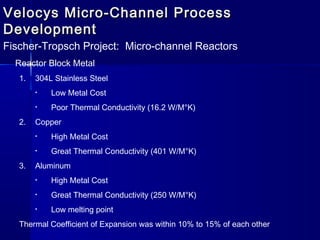
Reactor Block Metal
1. 304L Stainless Steel
• Low Metal Cost
• Poor Thermal Conductivity (16.2 W/M°K)
2. Copper
• High Metal Cost
• Great Thermal Conductivity (401 W/M°K)
3. Aluminum
• High Metal Cost
• Great Thermal Conductivity (250 W/M°K)
• Low melting point
Thermal Coefficient of Expansion was within 10% to 15% of each other
Velocys Micro-Channel ProcessVelocys Micro-Channel Process
DevelopmentDevelopment
Fischer-Tropsch Project: Micro-channel Reactors
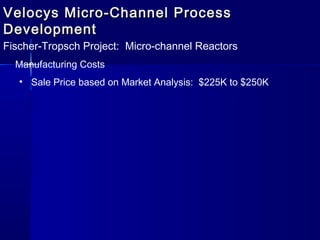
Manufacturing Costs
• Sale Price based on Market Analysis: $225K to $250K
Velocys Micro-Channel ProcessVelocys Micro-Channel Process
DevelopmentDevelopment
Fischer-Tropsch Project: Micro-channel Reactors
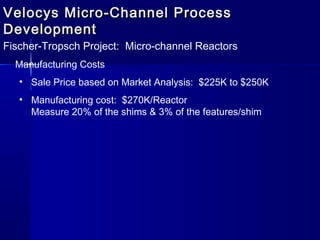
Manufacturing Costs
• Sale Price based on Market Analysis: $225K to $250K
• Manufacturing cost: $270K/Reactor
Measure 20% of the shims & 3% of the features/shim
Velocys Micro-Channel ProcessVelocys Micro-Channel Process
DevelopmentDevelopment
Fischer-Tropsch Project: Micro-channel Reactors
Manufacturing Costs
• Sale Price based on Market Analysis: $225K to $250K
• Manufacturing cost: $270K/Reactor
Measure 20% of the shims & 3% of the features/shim
• Measure 100% of the shims & 3% of the features/shim
Cost: $340K/Reactor
Velocys Micro-Channel ProcessVelocys Micro-Channel Process
DevelopmentDevelopment
Fischer-Tropsch Project: Micro-channel Reactors
Manufacturing Costs
• Sale Price based on Market Analysis: $225K to $250K
• Manufacturing cost: $270K/Reactor
Measure 20% of the shims & 3% of the features/shim
• Measure 100% of the shims & 3% of the features/shim
Cost: $340K/Reactor
• Measure 100% of the shims & 100% of the features/shim
Cost: $1,700K/Reactor
Velocys Micro-Channel ProcessVelocys Micro-Channel Process
DevelopmentDevelopment
Fischer-Tropsch Project: Micro-channel Reactors
Manufacturing Costs
• Sale Price based on Market Analysis: $225K to $250K
• Manufacturing cost: $270K/Reactor
Measure 20% of the shims & 3% of the features/shim
• Measure 100% of the shims & 3% of the features/shim
Cost: $340K/Reactor
• Measure 100% of the shims & 100% of the features/shim
Cost: $1,700K/Reactor
• Shipping Costs: $95K/Reactor
Velocys Micro-Channel ProcessVelocys Micro-Channel Process
DevelopmentDevelopment
Fischer-Tropsch Project: Micro-channel Reactors
Plan of Record Manufacturing Process
• Photochemical Machining (PCM) of patterns into the Shims
• Plating Shims with brazing material
• Clean Shims
• Stack Shims
• Braze Reactor
Velocys Micro-Channel ProcessVelocys Micro-Channel Process
DevelopmentDevelopment
Fischer-Tropsch Project: Micro-channel Reactors
Plan of Record Manufacturing Process
• Photochemical Machining (PCM) of patterns into the Shims
• Plating Shims with brazing material
• Clean Shims
• Stack Shims
• Braze Reactor
Photochemical Machining industry is consolidating in the US
• Projecting increase manufacturing costs
Velocys Micro-Channel ProcessVelocys Micro-Channel Process
DevelopmentDevelopment
Fischer-Tropsch Project: Micro-channel Reactors
Plan of Record Manufacturing Process
• Photochemical Machining (PCM) of patterns into the Shims
• Plating Shims with brazing material
• Clean Shims
• Stack Shims
• Braze Reactor
Photochemical Machining industry is consolidating in the US
• Projecting increase manufacturing costs
Photochemical Machining in Asia
• Reduced PCM Cost
• Offset by Trans-Pacific Shipping Costs
Velocys Micro-Channel ProcessVelocys Micro-Channel Process
DevelopmentDevelopment
Fischer-Tropsch Project: Micro-channel Reactors
Manufacturing Capability
• 5 reactors builds using 3 PCM companies
Velocys Micro-Channel ProcessVelocys Micro-Channel Process
DevelopmentDevelopment
Fischer-Tropsch Project: Micro-channel Reactors
Manufacturing Capability
• 5 reactors builds using 3 PCM companies
• If design specification became manufacturing specification: 0% yield
Velocys Micro-Channel ProcessVelocys Micro-Channel Process
DevelopmentDevelopment
Fischer-Tropsch Project: Micro-channel Reactors
Manufacturing Capability
• 5 reactors builds using 3 PCM companies
• If design specification became manufacturing specification: 0% yield
• Manufacturing process was “Not Capable”
• Over 80% of specified features had Cp/Cpk significantly less than 1.00
on a consistent basis
• Processing variability was well within the norm for the PCM industry
• To eliminate the need for mass inspect, all the Cp/Cpk had to be
greater than 2.00
Velocys Micro-Channel ProcessVelocys Micro-Channel Process
DevelopmentDevelopment
Fischer-Tropsch Project: Micro-channel Reactors
Manufacturing Capability
• 5 reactors builds using 3 PCM companies
• If design specification became manufacturing specification: 0% yield
• Manufacturing process was “Not Capable”
• Over 80% of specified features had Cp/Cpk significantly less than 1.00
on a consistent basis
• Processing variability was well within the norm for the PCM industry
• To eliminate the need for mass inspect, all the Cp/Cpk had to be
greater than 2.00
• Initial product testing showed Reactor productivity 60% to 80% higher than
anticipated based on modeling
Velocys Micro-Channel ProcessVelocys Micro-Channel Process
DevelopmentDevelopment
Fischer-Tropsch Project: Micro-channel Reactors
Manufacturing Capability
• 5 reactors builds using 3 PCM companies
• If design specification became manufacturing specification: 0% yield
• Manufacturing process was “Not Capable”
• Over 80% of specified features had Cp/Cpk significantly less than 1.00
on a consistent basis
• Processing variability was well within the norm for the PCM industry
• To eliminate the need for mass inspect, all the Cp/Cpk had to be
greater than 2.00
• Initial product testing showed Reactor productivity 60% to 80% higher than
anticipated based on modeling
• Reviewed results and proposed specification relief
Velocys Micro-Channel ProcessVelocys Micro-Channel Process
DevelopmentDevelopment
Fischer-Tropsch Project: Micro-channel Reactors
Manufacturing Capability
• 5 reactors builds using 3 PCM companies
• If design specification became manufacturing specification: 0% yield
• Manufacturing process was “Not Capable”
• Over 80% of specified features had Cp/Cpk significantly less than 1.00
on a consistent basis
• Processing variability was well within the norm for the PCM industry
• To eliminate the need for mass inspect, all the Cp/Cpk had to be
greater than 2.00
• Initial product testing showed Reactor productivity 60% to 80% higher than
anticipated based on modeling
• Reviewed results and proposed specification relief
• With specification relief, the manufacturing process was still “Not Capable”
and still had 0% yield
Velocys Micro-Channel ProcessVelocys Micro-Channel Process
DevelopmentDevelopment
Fischer-Tropsch Project: Micro-channel Reactors
Product Design Review:
• Identify potential alternative manufacturing processes
Velocys Micro-Channel ProcessVelocys Micro-Channel Process
DevelopmentDevelopment
Fischer-Tropsch Project: Micro-channel Reactors
Product Design Review:
• Identify potential alternative manufacturing processes
• Reduce manufacturing cost
Velocys Micro-Channel ProcessVelocys Micro-Channel Process
DevelopmentDevelopment
Fischer-Tropsch Project: Micro-channel Reactors
Product Design Review:
• Identify potential alternative manufacturing processes
• Reduce manufacturing cost
• Improve manufacturing capability
Velocys Micro-Channel ProcessVelocys Micro-Channel Process
DevelopmentDevelopment
Fischer-Tropsch Project: Micro-channel Reactors
Product Design Review:
• Identify potential alternative manufacturing processes
• Reduce manufacturing cost
• Improve manufacturing capability
• Improve reactor productivity
Velocys Micro-Channel ProcessVelocys Micro-Channel Process
DevelopmentDevelopment
Fischer-Tropsch Project: Micro-channel Reactors
Reactor Productivity
• Limiting Factor for Reactor Productivity: Heat generated in the
catalyst bed
Velocys Micro-Channel ProcessVelocys Micro-Channel Process
DevelopmentDevelopment
Fischer-Tropsch Project: Micro-channel Reactors
Reactor Productivity
• Limiting Factor for Reactor Productivity: Heat generated in the
catalyst bed
• Limits Syn Gas injection rate
Velocys Micro-Channel ProcessVelocys Micro-Channel Process
DevelopmentDevelopment
Fischer-Tropsch Project: Micro-channel Reactors
Reactor Productivity
• Limiting Factor for Reactor Productivity: Heat generated in the
catalyst bed
• Limits Syn Gas injection rate
• Limiting Factor for removing heat: Thermal Conductivity of the
stainless steel
Velocys Micro-Channel ProcessVelocys Micro-Channel Process
DevelopmentDevelopment
Fischer-Tropsch Project: Micro-channel Reactors
Reactor Productivity
• Limiting Factor for Reactor Productivity: Heat generated in the
catalyst bed
• Limits Syn Gas injection rate
• Limiting Factor for removing heat: Thermal Conductivity of the
stainless steel
• Current design of the reactor is cross-current cooling
Velocys Micro-Channel ProcessVelocys Micro-Channel Process
DevelopmentDevelopment
Fischer-Tropsch Project: Micro-channel Reactors
Reactor Productivity
• Limiting Factor for Reactor Productivity: Heat generated in the
catalyst bed
• Limits Syn Gas injection rate
• Limiting Factor for removing heat: Thermal Conductivity of the
stainless steel
• Current design of the reactor is cross-current cooling
• Created a temperature gradient across the diagonal of the reactor
Velocys Micro-Channel ProcessVelocys Micro-Channel Process
DevelopmentDevelopment
Fischer-Tropsch Project: Micro-channel Reactors
Reactor Productivity
• Limiting Factor for Reactor Productivity: Heat generated in the
catalyst bed
• Limits Syn Gas injection rate
• Limiting Factor for removing heat: Thermal Conductivity of the
stainless steel
• Current design of the reactor is cross-current cooling
• Created a temperature gradient across the diagonal of the reactor
• Limited productivity and selectivity from the reactor
Velocys Micro-Channel ProcessVelocys Micro-Channel Process
DevelopmentDevelopment
Fischer-Tropsch Project: Micro-channel Reactors
Reactor Redesign for Manufacturability
• Counter-Current Cooling: Design minimizes temperature gradient in the catalyst
bed improving productivity and selectivity due to uniform temperature
Velocys Micro-Channel ProcessVelocys Micro-Channel Process
DevelopmentDevelopment
Fischer-Tropsch Project: Micro-channel Reactors
Reactor Redesign for Manufacturability
• Counter-Current Cooling: Design minimizes temperature gradient in the catalyst
bed improving productivity and selectivity due to uniform temperature
• Improve reactor productivity and selectivity due to better heat transfer
Velocys Micro-Channel ProcessVelocys Micro-Channel Process
DevelopmentDevelopment
Fischer-Tropsch Project: Micro-channel Reactors
Reactor Redesign for Manufacturability
• Counter-Current Cooling: Design minimizes temperature gradient in the catalyst
bed improving productivity and selectivity due to uniform temperature
• Improve reactor productivity and selectivity due to better heat transfer
• Coolant channel flow with no eddy currents
Velocys Micro-Channel ProcessVelocys Micro-Channel Process
DevelopmentDevelopment
Fischer-Tropsch Project: Micro-channel Reactors
Reactor Redesign for Manufacturability
• Counter-Current Cooling: Design minimizes temperature gradient in the catalyst
bed improving productivity and selectivity due to uniform temperature
• Improve reactor productivity and selectivity due to better heat transfer
• Coolant channel flow with no eddy currents
• Manufacturing Process: Electro-Chemical Machine (ECM) reactor with
alternative design
Velocys Micro-Channel ProcessVelocys Micro-Channel Process
DevelopmentDevelopment
Fischer-Tropsch Project: Micro-channel Reactors
Reactor Redesign for Manufacturability
• Counter-Current Cooling: Design minimizes temperature gradient in the catalyst
bed improving productivity and selectivity due to uniform temperature
• Improve reactor productivity and selectivity due to better heat transfer
• Coolant channel flow with no eddy currents
• Manufacturing Process: Electro-Chemical Machine (ECM) reactor with
alternative design
• Eliminates:
• Plating Brazing material
• Cleaning
• Stacking
• Brazing
Velocys Micro-Channel ProcessVelocys Micro-Channel Process
DevelopmentDevelopment
Fischer-Tropsch Project: Micro-channel Reactors
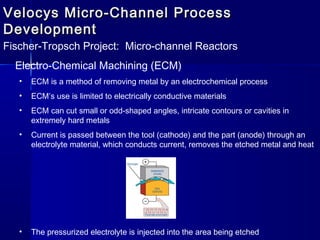
Electro-Chemical Machining (ECM)
• ECM is a method of removing metal by an electrochemical process
Velocys Micro-Channel ProcessVelocys Micro-Channel Process
DevelopmentDevelopment
Fischer-Tropsch Project: Micro-channel Reactors
Electro-Chemical Machining (ECM)
• ECM is a method of removing metal by an electrochemical process
• ECM’s use is limited to electrically conductive materials
Velocys Micro-Channel ProcessVelocys Micro-Channel Process
DevelopmentDevelopment
Fischer-Tropsch Project: Micro-channel Reactors
Electro-Chemical Machining (ECM)
• ECM is a method of removing metal by an electrochemical process
• ECM’s use is limited to electrically conductive materials
• ECM can cut small or odd-shaped angles, intricate contours or cavities in
extremely hard metals
Velocys Micro-Channel ProcessVelocys Micro-Channel Process
DevelopmentDevelopment
Fischer-Tropsch Project: Micro-channel Reactors
Electro-Chemical Machining (ECM)
• ECM is a method of removing metal by an electrochemical process
• ECM’s use is limited to electrically conductive materials
• ECM can cut small or odd-shaped angles, intricate contours or cavities in
extremely hard metals
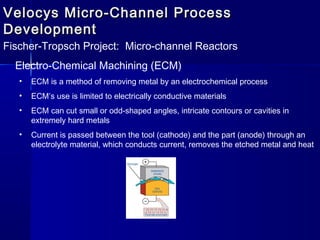
• Current is passed between the tool (cathode) and the part (anode) through an
electrolyte material, which conducts current, removes the etched metal and heat
Velocys Micro-Channel ProcessVelocys Micro-Channel Process
DevelopmentDevelopment
Fischer-Tropsch Project: Micro-channel Reactors
Electro-Chemical Machining (ECM)
• ECM is a method of removing metal by an electrochemical process
• ECM’s use is limited to electrically conductive materials
• ECM can cut small or odd-shaped angles, intricate contours or cavities in
extremely hard metals
• Current is passed between the tool (cathode) and the part (anode) through an
electrolyte material, which conducts current, removes the etched metal and heat
• The pressurized electrolyte is injected into the area being etched
Velocys Micro-Channel ProcessVelocys Micro-Channel Process
DevelopmentDevelopment
Fischer-Tropsch Project: Micro-channel Reactors
ECM Process Cost Reductions
• Metal Costs Reduction: $40K to $36K
• Shipping Costs Reduction: $95K to $15K
• Eliminate Plating, Clean, Stacking and Brazing: $100K cost
reduction
• Eliminate $184K in manufacturing costs
Velocys Micro-Channel ProcessVelocys Micro-Channel Process
DevelopmentDevelopment
Fischer-Tropsch Project: Micro-channel Reactors
ECM Process Cost Reductions
• Metal Costs Reduction: $40 to $36K
• Shipping Costs Reduction: $95K to $15K
• Eliminate Plating, Clean, Stacking and Brazing: $100K cost
reduction
• Eliminate $184K in manufacturing costs
Eliminate metal-brazing interfaces (240/reactor)
• Eliminate fatigue failures to the CTE mismatch
• Operate at higher pressures
• Increase conversion rates
• Increase formation of long chain liquid hydrocarbons
Velocys Micro-Channel ProcessVelocys Micro-Channel Process
DevelopmentDevelopment
Fischer-Tropsch Project: Micro-channel Reactors
ECM Manufacturing
• 5 ECM companies in the US
Velocys Micro-Channel ProcessVelocys Micro-Channel Process
DevelopmentDevelopment
Fischer-Tropsch Project: Micro-channel Reactors
ECM Manufacturing
• 5 ECM companies in the US
• ECM lines were built for the Raptor and Joint Strike Fighter
projects
Velocys Micro-Channel ProcessVelocys Micro-Channel Process
DevelopmentDevelopment
Fischer-Tropsch Project: Micro-channel Reactors
ECM Manufacturing
• 5 ECM companies in the US
• ECM lines were built for the Raptor and Joint Strike Fighter
projects
• Capacity utilization was between 5% and 20%, depending
on the ECM company
Velocys Micro-Channel ProcessVelocys Micro-Channel Process
DevelopmentDevelopment
Fischer-Tropsch Project: Micro-channel Reactors
ECM Manufacturing
• 5 ECM companies in the US
• ECM lines were built for the Raptor and Joint Strike Fighter
projects
• Capacity utilization was between 5% and 20%, depending
on the ECM company
• Worked with ECM companies to determine process
limitations and manufacturing variability
Velocys Micro-Channel ProcessVelocys Micro-Channel Process
DevelopmentDevelopment
Fischer-Tropsch Project: Micro-channel Reactors
ECM Manufacturing Costs
• Tooling Costs
• Design & Build of initial tooling: $50K to $150K
• Back-up Tooling Build: $25K to $50K
• Prorated tooling costs/Reactor over 7 years: $45 to
$115
Velocys Micro-Channel ProcessVelocys Micro-Channel Process
DevelopmentDevelopment
Fischer-Tropsch Project: Micro-channel Reactors
ECM Manufacturing Costs
• Tooling Costs
• Design & Build of initial tooling: $50K to $150K
• Back-up Tooling Build: $25K to $50K
• Prorated tooling costs/Reactor over 7 years: $45 to
$115
• ECM manufacturing time: 4 to 8 hours per reactor block
Velocys Micro-Channel ProcessVelocys Micro-Channel Process
DevelopmentDevelopment
Fischer-Tropsch Project: Micro-channel Reactors
ECM Manufacturing Costs
• Tooling Costs
• Design & Build of initial tooling: $50K to $150K
• Back-up Tooling Build: $25K to $50K
• Prorated tooling costs/Reactor over 7 years: $45 to
$115
• ECM manufacturing time: 4 to 8 hours per reactor block
• ECM costs were not determined due to Velocys’ acquisition
by Oxford Catalyst
Velocys Micro-Channel ProcessVelocys Micro-Channel Process
DevelopmentDevelopment
Fischer-Tropsch Project: Micro-channel Reactors
Productivity Improvement Opportunity
• Limiting Factor: Removing the heat from the catalyst bed
Velocys Micro-Channel ProcessVelocys Micro-Channel Process
DevelopmentDevelopment
Fischer-Tropsch Project: Micro-channel Reactors
Productivity Improvement Opportunity
• Limiting Factor: Removing the heat from the catalyst bed
• Thermal conductivity of 304L Stainless Steel: 16.2 W/M°K
Velocys Micro-Channel ProcessVelocys Micro-Channel Process
DevelopmentDevelopment
Fischer-Tropsch Project: Micro-channel Reactors
Productivity Improvement Opportunity
• Limiting Factor: Removing the heat from the catalyst bed
• Thermal conductivity of 304L Stainless Steel: 16.2 W/M°K
• Researched coating options to improve heat transfer
Velocys Micro-Channel ProcessVelocys Micro-Channel Process
DevelopmentDevelopment
Fischer-Tropsch Project: Micro-channel Reactors
Productivity Improvement Opportunity
• Limiting Factor: Removing the heat from the catalyst bed
• Thermal conductivity of 304L Stainless Steel: 16.2 W/M°K
• Researched coating options to improve heat transfer
• Thermal conductivity of Diamond: 1800 W/M°K
Velocys Micro-Channel ProcessVelocys Micro-Channel Process
DevelopmentDevelopment
Fischer-Tropsch Project: Micro-channel Reactors
Productivity Improvement Opportunity
• Limiting Factor: Removing the heat from the catalyst bed
• Thermal conductivity of 304L Stainless Steel: 16.2 W/M°K
• Researched coating options to improve heat transfer
• Thermal conductivity of Diamond: 1800 W/M°K
• Consulting with CVD company in California
Velocys Micro-Channel ProcessVelocys Micro-Channel Process
DevelopmentDevelopment
Fischer-Tropsch Project: Micro-channel Reactors
Productivity Improvement Opportunity
• Limiting Factor: Removing the heat from the catalyst bed
• Thermal conductivity of 304L Stainless Steel: 16.2 W/M°K
• Researched coating options to improve heat transfer
• Thermal conductivity of Diamond: 1800 W/M°K
• Consulting with CVD company in California
• 50 microns of diamond on the catalyst channel walls
Velocys Micro-Channel ProcessVelocys Micro-Channel Process
DevelopmentDevelopment
Fischer-Tropsch Project: Micro-channel Reactors
Productivity Improvement Opportunity
• Limiting Factor: Removing the heat from the catalyst bed
• Thermal conductivity of 304L Stainless Steel: 16.2 W/M°K
• Researched coating options to improve heat transfer
• Thermal conductivity of Diamond: 1800 W/M°K
• Consulting with CVD company in California
• 50 microns of diamond on the catalyst channel walls
• Significantly increase Syn gas injection rate while being able to
remove heat from the catalyst bed
Velocys Micro-Channel ProcessVelocys Micro-Channel Process
DevelopmentDevelopment
Fischer-Tropsch Project: Micro-channel Reactors
Productivity Improvement Opportunity
• Limiting Factor: Removing the heat from the catalyst bed
• Thermal conductivity of 304L Stainless Steel: 16.2 W/M°K
• Researched coating options to improve heat transfer
• Thermal conductivity of Diamond: 1800 W/M°K
• Consulting with CVD company in California
• 50 microns of diamond on the catalyst channel walls
• Significantly increase Syn gas injection rate while being able to
remove heat from the catalyst bed
• Increase liquid hydrocarbon productivity
Velocys Micro-Channel ProcessVelocys Micro-Channel Process
DevelopmentDevelopment
Fischer-Tropsch Project: Micro-channel Reactors
Productivity Improvement Opportunity
• Limiting Factor: Removing the heat from the catalyst bed
• Thermal conductivity of 304L Stainless Steel: 16.2 W/M°K
• Researched coating options to improve heat transfer
• Thermal conductivity of Diamond: 1800 W/M°K
• Consulting with CVD company in California
• 50 microns of diamond on the catalyst channel walls
• Significantly increase Syn gas injection rate while being able to
remove heat from the catalyst bed
• Increase liquid hydrocarbon productivity
• Cost and feasibility were not determined due to Velocys’ acquisition
by Oxford Catalyst
Velocys Micro-Channel ProcessVelocys Micro-Channel Process
DevelopmentDevelopment
Fischer-Tropsch Project: Micro-channel Reactors
End of Fischer-Tropsch
Presentation

Velocys1

  • 1.
  • 2.
    Velocys Micro-Channel ProcessVelocysMicro-Channel Process DevelopmentDevelopment Fischer-Tropsch Project: Micro-channel Reactors Reactor Block Metal 1. 304L Stainless Steel • Low Metal Cost • Poor Thermal Conductivity (16.2 W/M°K) 2. Copper • High Metal Cost • Great Thermal Conductivity (401 W/M°K) 3. Aluminum • High Metal Cost • Great Thermal Conductivity (250 W/M°K) • Low melting point Thermal Coefficient of Expansion was within 10% to 15% of each other
  • 3.
    Velocys Micro-Channel ProcessVelocysMicro-Channel Process DevelopmentDevelopment Fischer-Tropsch Project: Micro-channel Reactors Manufacturing Costs • Sale Price based on Market Analysis: $225K to $250K
  • 4.
    Velocys Micro-Channel ProcessVelocysMicro-Channel Process DevelopmentDevelopment Fischer-Tropsch Project: Micro-channel Reactors Manufacturing Costs • Sale Price based on Market Analysis: $225K to $250K • Manufacturing cost: $270K/Reactor Measure 20% of the shims & 3% of the features/shim
  • 5.
    Velocys Micro-Channel ProcessVelocysMicro-Channel Process DevelopmentDevelopment Fischer-Tropsch Project: Micro-channel Reactors Manufacturing Costs • Sale Price based on Market Analysis: $225K to $250K • Manufacturing cost: $270K/Reactor Measure 20% of the shims & 3% of the features/shim • Measure 100% of the shims & 3% of the features/shim Cost: $340K/Reactor
  • 6.
    Velocys Micro-Channel ProcessVelocysMicro-Channel Process DevelopmentDevelopment Fischer-Tropsch Project: Micro-channel Reactors Manufacturing Costs • Sale Price based on Market Analysis: $225K to $250K • Manufacturing cost: $270K/Reactor Measure 20% of the shims & 3% of the features/shim • Measure 100% of the shims & 3% of the features/shim Cost: $340K/Reactor • Measure 100% of the shims & 100% of the features/shim Cost: $1,700K/Reactor
  • 7.
    Velocys Micro-Channel ProcessVelocysMicro-Channel Process DevelopmentDevelopment Fischer-Tropsch Project: Micro-channel Reactors Manufacturing Costs • Sale Price based on Market Analysis: $225K to $250K • Manufacturing cost: $270K/Reactor Measure 20% of the shims & 3% of the features/shim • Measure 100% of the shims & 3% of the features/shim Cost: $340K/Reactor • Measure 100% of the shims & 100% of the features/shim Cost: $1,700K/Reactor • Shipping Costs: $95K/Reactor
  • 8.
    Velocys Micro-Channel ProcessVelocysMicro-Channel Process DevelopmentDevelopment Fischer-Tropsch Project: Micro-channel Reactors Plan of Record Manufacturing Process • Photochemical Machining (PCM) of patterns into the Shims • Plating Shims with brazing material • Clean Shims • Stack Shims • Braze Reactor
  • 9.
    Velocys Micro-Channel ProcessVelocysMicro-Channel Process DevelopmentDevelopment Fischer-Tropsch Project: Micro-channel Reactors Plan of Record Manufacturing Process • Photochemical Machining (PCM) of patterns into the Shims • Plating Shims with brazing material • Clean Shims • Stack Shims • Braze Reactor Photochemical Machining industry is consolidating in the US • Projecting increase manufacturing costs
  • 10.
    Velocys Micro-Channel ProcessVelocysMicro-Channel Process DevelopmentDevelopment Fischer-Tropsch Project: Micro-channel Reactors Plan of Record Manufacturing Process • Photochemical Machining (PCM) of patterns into the Shims • Plating Shims with brazing material • Clean Shims • Stack Shims • Braze Reactor Photochemical Machining industry is consolidating in the US • Projecting increase manufacturing costs Photochemical Machining in Asia • Reduced PCM Cost • Offset by Trans-Pacific Shipping Costs
  • 11.
    Velocys Micro-Channel ProcessVelocysMicro-Channel Process DevelopmentDevelopment Fischer-Tropsch Project: Micro-channel Reactors Manufacturing Capability • 5 reactors builds using 3 PCM companies
  • 12.
    Velocys Micro-Channel ProcessVelocysMicro-Channel Process DevelopmentDevelopment Fischer-Tropsch Project: Micro-channel Reactors Manufacturing Capability • 5 reactors builds using 3 PCM companies • If design specification became manufacturing specification: 0% yield
  • 13.
    Velocys Micro-Channel ProcessVelocysMicro-Channel Process DevelopmentDevelopment Fischer-Tropsch Project: Micro-channel Reactors Manufacturing Capability • 5 reactors builds using 3 PCM companies • If design specification became manufacturing specification: 0% yield • Manufacturing process was “Not Capable” • Over 80% of specified features had Cp/Cpk significantly less than 1.00 on a consistent basis • Processing variability was well within the norm for the PCM industry • To eliminate the need for mass inspect, all the Cp/Cpk had to be greater than 2.00
  • 14.
    Velocys Micro-Channel ProcessVelocysMicro-Channel Process DevelopmentDevelopment Fischer-Tropsch Project: Micro-channel Reactors Manufacturing Capability • 5 reactors builds using 3 PCM companies • If design specification became manufacturing specification: 0% yield • Manufacturing process was “Not Capable” • Over 80% of specified features had Cp/Cpk significantly less than 1.00 on a consistent basis • Processing variability was well within the norm for the PCM industry • To eliminate the need for mass inspect, all the Cp/Cpk had to be greater than 2.00 • Initial product testing showed Reactor productivity 60% to 80% higher than anticipated based on modeling
  • 15.
    Velocys Micro-Channel ProcessVelocysMicro-Channel Process DevelopmentDevelopment Fischer-Tropsch Project: Micro-channel Reactors Manufacturing Capability • 5 reactors builds using 3 PCM companies • If design specification became manufacturing specification: 0% yield • Manufacturing process was “Not Capable” • Over 80% of specified features had Cp/Cpk significantly less than 1.00 on a consistent basis • Processing variability was well within the norm for the PCM industry • To eliminate the need for mass inspect, all the Cp/Cpk had to be greater than 2.00 • Initial product testing showed Reactor productivity 60% to 80% higher than anticipated based on modeling • Reviewed results and proposed specification relief
  • 16.
    Velocys Micro-Channel ProcessVelocysMicro-Channel Process DevelopmentDevelopment Fischer-Tropsch Project: Micro-channel Reactors Manufacturing Capability • 5 reactors builds using 3 PCM companies • If design specification became manufacturing specification: 0% yield • Manufacturing process was “Not Capable” • Over 80% of specified features had Cp/Cpk significantly less than 1.00 on a consistent basis • Processing variability was well within the norm for the PCM industry • To eliminate the need for mass inspect, all the Cp/Cpk had to be greater than 2.00 • Initial product testing showed Reactor productivity 60% to 80% higher than anticipated based on modeling • Reviewed results and proposed specification relief • With specification relief, the manufacturing process was still “Not Capable” and still had 0% yield
  • 17.
    Velocys Micro-Channel ProcessVelocysMicro-Channel Process DevelopmentDevelopment Fischer-Tropsch Project: Micro-channel Reactors Product Design Review: • Identify potential alternative manufacturing processes
  • 18.
    Velocys Micro-Channel ProcessVelocysMicro-Channel Process DevelopmentDevelopment Fischer-Tropsch Project: Micro-channel Reactors Product Design Review: • Identify potential alternative manufacturing processes • Reduce manufacturing cost
  • 19.
    Velocys Micro-Channel ProcessVelocysMicro-Channel Process DevelopmentDevelopment Fischer-Tropsch Project: Micro-channel Reactors Product Design Review: • Identify potential alternative manufacturing processes • Reduce manufacturing cost • Improve manufacturing capability
  • 20.
    Velocys Micro-Channel ProcessVelocysMicro-Channel Process DevelopmentDevelopment Fischer-Tropsch Project: Micro-channel Reactors Product Design Review: • Identify potential alternative manufacturing processes • Reduce manufacturing cost • Improve manufacturing capability • Improve reactor productivity
  • 21.
    Velocys Micro-Channel ProcessVelocysMicro-Channel Process DevelopmentDevelopment Fischer-Tropsch Project: Micro-channel Reactors Reactor Productivity • Limiting Factor for Reactor Productivity: Heat generated in the catalyst bed
  • 22.
    Velocys Micro-Channel ProcessVelocysMicro-Channel Process DevelopmentDevelopment Fischer-Tropsch Project: Micro-channel Reactors Reactor Productivity • Limiting Factor for Reactor Productivity: Heat generated in the catalyst bed • Limits Syn Gas injection rate
  • 23.
    Velocys Micro-Channel ProcessVelocysMicro-Channel Process DevelopmentDevelopment Fischer-Tropsch Project: Micro-channel Reactors Reactor Productivity • Limiting Factor for Reactor Productivity: Heat generated in the catalyst bed • Limits Syn Gas injection rate • Limiting Factor for removing heat: Thermal Conductivity of the stainless steel
  • 24.
    Velocys Micro-Channel ProcessVelocysMicro-Channel Process DevelopmentDevelopment Fischer-Tropsch Project: Micro-channel Reactors Reactor Productivity • Limiting Factor for Reactor Productivity: Heat generated in the catalyst bed • Limits Syn Gas injection rate • Limiting Factor for removing heat: Thermal Conductivity of the stainless steel • Current design of the reactor is cross-current cooling
  • 25.
    Velocys Micro-Channel ProcessVelocysMicro-Channel Process DevelopmentDevelopment Fischer-Tropsch Project: Micro-channel Reactors Reactor Productivity • Limiting Factor for Reactor Productivity: Heat generated in the catalyst bed • Limits Syn Gas injection rate • Limiting Factor for removing heat: Thermal Conductivity of the stainless steel • Current design of the reactor is cross-current cooling • Created a temperature gradient across the diagonal of the reactor
  • 26.
    Velocys Micro-Channel ProcessVelocysMicro-Channel Process DevelopmentDevelopment Fischer-Tropsch Project: Micro-channel Reactors Reactor Productivity • Limiting Factor for Reactor Productivity: Heat generated in the catalyst bed • Limits Syn Gas injection rate • Limiting Factor for removing heat: Thermal Conductivity of the stainless steel • Current design of the reactor is cross-current cooling • Created a temperature gradient across the diagonal of the reactor • Limited productivity and selectivity from the reactor
  • 27.
    Velocys Micro-Channel ProcessVelocysMicro-Channel Process DevelopmentDevelopment Fischer-Tropsch Project: Micro-channel Reactors Reactor Redesign for Manufacturability • Counter-Current Cooling: Design minimizes temperature gradient in the catalyst bed improving productivity and selectivity due to uniform temperature
  • 28.
    Velocys Micro-Channel ProcessVelocysMicro-Channel Process DevelopmentDevelopment Fischer-Tropsch Project: Micro-channel Reactors Reactor Redesign for Manufacturability • Counter-Current Cooling: Design minimizes temperature gradient in the catalyst bed improving productivity and selectivity due to uniform temperature • Improve reactor productivity and selectivity due to better heat transfer
  • 29.
    Velocys Micro-Channel ProcessVelocysMicro-Channel Process DevelopmentDevelopment Fischer-Tropsch Project: Micro-channel Reactors Reactor Redesign for Manufacturability • Counter-Current Cooling: Design minimizes temperature gradient in the catalyst bed improving productivity and selectivity due to uniform temperature • Improve reactor productivity and selectivity due to better heat transfer • Coolant channel flow with no eddy currents
  • 30.
    Velocys Micro-Channel ProcessVelocysMicro-Channel Process DevelopmentDevelopment Fischer-Tropsch Project: Micro-channel Reactors Reactor Redesign for Manufacturability • Counter-Current Cooling: Design minimizes temperature gradient in the catalyst bed improving productivity and selectivity due to uniform temperature • Improve reactor productivity and selectivity due to better heat transfer • Coolant channel flow with no eddy currents • Manufacturing Process: Electro-Chemical Machine (ECM) reactor with alternative design
  • 31.
    Velocys Micro-Channel ProcessVelocysMicro-Channel Process DevelopmentDevelopment Fischer-Tropsch Project: Micro-channel Reactors Reactor Redesign for Manufacturability • Counter-Current Cooling: Design minimizes temperature gradient in the catalyst bed improving productivity and selectivity due to uniform temperature • Improve reactor productivity and selectivity due to better heat transfer • Coolant channel flow with no eddy currents • Manufacturing Process: Electro-Chemical Machine (ECM) reactor with alternative design • Eliminates: • Plating Brazing material • Cleaning • Stacking • Brazing
  • 32.
    Velocys Micro-Channel ProcessVelocysMicro-Channel Process DevelopmentDevelopment Fischer-Tropsch Project: Micro-channel Reactors Electro-Chemical Machining (ECM) • ECM is a method of removing metal by an electrochemical process
  • 33.
    Velocys Micro-Channel ProcessVelocysMicro-Channel Process DevelopmentDevelopment Fischer-Tropsch Project: Micro-channel Reactors Electro-Chemical Machining (ECM) • ECM is a method of removing metal by an electrochemical process • ECM’s use is limited to electrically conductive materials
  • 34.
    Velocys Micro-Channel ProcessVelocysMicro-Channel Process DevelopmentDevelopment Fischer-Tropsch Project: Micro-channel Reactors Electro-Chemical Machining (ECM) • ECM is a method of removing metal by an electrochemical process • ECM’s use is limited to electrically conductive materials • ECM can cut small or odd-shaped angles, intricate contours or cavities in extremely hard metals
  • 35.
    Velocys Micro-Channel ProcessVelocysMicro-Channel Process DevelopmentDevelopment Fischer-Tropsch Project: Micro-channel Reactors Electro-Chemical Machining (ECM) • ECM is a method of removing metal by an electrochemical process • ECM’s use is limited to electrically conductive materials • ECM can cut small or odd-shaped angles, intricate contours or cavities in extremely hard metals • Current is passed between the tool (cathode) and the part (anode) through an electrolyte material, which conducts current, removes the etched metal and heat
  • 36.
    Velocys Micro-Channel ProcessVelocysMicro-Channel Process DevelopmentDevelopment Fischer-Tropsch Project: Micro-channel Reactors Electro-Chemical Machining (ECM) • ECM is a method of removing metal by an electrochemical process • ECM’s use is limited to electrically conductive materials • ECM can cut small or odd-shaped angles, intricate contours or cavities in extremely hard metals • Current is passed between the tool (cathode) and the part (anode) through an electrolyte material, which conducts current, removes the etched metal and heat • The pressurized electrolyte is injected into the area being etched
  • 37.
    Velocys Micro-Channel ProcessVelocysMicro-Channel Process DevelopmentDevelopment Fischer-Tropsch Project: Micro-channel Reactors ECM Process Cost Reductions • Metal Costs Reduction: $40K to $36K • Shipping Costs Reduction: $95K to $15K • Eliminate Plating, Clean, Stacking and Brazing: $100K cost reduction • Eliminate $184K in manufacturing costs
  • 38.
    Velocys Micro-Channel ProcessVelocysMicro-Channel Process DevelopmentDevelopment Fischer-Tropsch Project: Micro-channel Reactors ECM Process Cost Reductions • Metal Costs Reduction: $40 to $36K • Shipping Costs Reduction: $95K to $15K • Eliminate Plating, Clean, Stacking and Brazing: $100K cost reduction • Eliminate $184K in manufacturing costs Eliminate metal-brazing interfaces (240/reactor) • Eliminate fatigue failures to the CTE mismatch • Operate at higher pressures • Increase conversion rates • Increase formation of long chain liquid hydrocarbons
  • 39.
    Velocys Micro-Channel ProcessVelocysMicro-Channel Process DevelopmentDevelopment Fischer-Tropsch Project: Micro-channel Reactors ECM Manufacturing • 5 ECM companies in the US
  • 40.
    Velocys Micro-Channel ProcessVelocysMicro-Channel Process DevelopmentDevelopment Fischer-Tropsch Project: Micro-channel Reactors ECM Manufacturing • 5 ECM companies in the US • ECM lines were built for the Raptor and Joint Strike Fighter projects
  • 41.
    Velocys Micro-Channel ProcessVelocysMicro-Channel Process DevelopmentDevelopment Fischer-Tropsch Project: Micro-channel Reactors ECM Manufacturing • 5 ECM companies in the US • ECM lines were built for the Raptor and Joint Strike Fighter projects • Capacity utilization was between 5% and 20%, depending on the ECM company
  • 42.
    Velocys Micro-Channel ProcessVelocysMicro-Channel Process DevelopmentDevelopment Fischer-Tropsch Project: Micro-channel Reactors ECM Manufacturing • 5 ECM companies in the US • ECM lines were built for the Raptor and Joint Strike Fighter projects • Capacity utilization was between 5% and 20%, depending on the ECM company • Worked with ECM companies to determine process limitations and manufacturing variability
  • 43.
    Velocys Micro-Channel ProcessVelocysMicro-Channel Process DevelopmentDevelopment Fischer-Tropsch Project: Micro-channel Reactors ECM Manufacturing Costs • Tooling Costs • Design & Build of initial tooling: $50K to $150K • Back-up Tooling Build: $25K to $50K • Prorated tooling costs/Reactor over 7 years: $45 to $115
  • 44.
    Velocys Micro-Channel ProcessVelocysMicro-Channel Process DevelopmentDevelopment Fischer-Tropsch Project: Micro-channel Reactors ECM Manufacturing Costs • Tooling Costs • Design & Build of initial tooling: $50K to $150K • Back-up Tooling Build: $25K to $50K • Prorated tooling costs/Reactor over 7 years: $45 to $115 • ECM manufacturing time: 4 to 8 hours per reactor block
  • 45.
    Velocys Micro-Channel ProcessVelocysMicro-Channel Process DevelopmentDevelopment Fischer-Tropsch Project: Micro-channel Reactors ECM Manufacturing Costs • Tooling Costs • Design & Build of initial tooling: $50K to $150K • Back-up Tooling Build: $25K to $50K • Prorated tooling costs/Reactor over 7 years: $45 to $115 • ECM manufacturing time: 4 to 8 hours per reactor block • ECM costs were not determined due to Velocys’ acquisition by Oxford Catalyst
  • 46.
    Velocys Micro-Channel ProcessVelocysMicro-Channel Process DevelopmentDevelopment Fischer-Tropsch Project: Micro-channel Reactors Productivity Improvement Opportunity • Limiting Factor: Removing the heat from the catalyst bed
  • 47.
    Velocys Micro-Channel ProcessVelocysMicro-Channel Process DevelopmentDevelopment Fischer-Tropsch Project: Micro-channel Reactors Productivity Improvement Opportunity • Limiting Factor: Removing the heat from the catalyst bed • Thermal conductivity of 304L Stainless Steel: 16.2 W/M°K
  • 48.
    Velocys Micro-Channel ProcessVelocysMicro-Channel Process DevelopmentDevelopment Fischer-Tropsch Project: Micro-channel Reactors Productivity Improvement Opportunity • Limiting Factor: Removing the heat from the catalyst bed • Thermal conductivity of 304L Stainless Steel: 16.2 W/M°K • Researched coating options to improve heat transfer
  • 49.
    Velocys Micro-Channel ProcessVelocysMicro-Channel Process DevelopmentDevelopment Fischer-Tropsch Project: Micro-channel Reactors Productivity Improvement Opportunity • Limiting Factor: Removing the heat from the catalyst bed • Thermal conductivity of 304L Stainless Steel: 16.2 W/M°K • Researched coating options to improve heat transfer • Thermal conductivity of Diamond: 1800 W/M°K
  • 50.
    Velocys Micro-Channel ProcessVelocysMicro-Channel Process DevelopmentDevelopment Fischer-Tropsch Project: Micro-channel Reactors Productivity Improvement Opportunity • Limiting Factor: Removing the heat from the catalyst bed • Thermal conductivity of 304L Stainless Steel: 16.2 W/M°K • Researched coating options to improve heat transfer • Thermal conductivity of Diamond: 1800 W/M°K • Consulting with CVD company in California
  • 51.
    Velocys Micro-Channel ProcessVelocysMicro-Channel Process DevelopmentDevelopment Fischer-Tropsch Project: Micro-channel Reactors Productivity Improvement Opportunity • Limiting Factor: Removing the heat from the catalyst bed • Thermal conductivity of 304L Stainless Steel: 16.2 W/M°K • Researched coating options to improve heat transfer • Thermal conductivity of Diamond: 1800 W/M°K • Consulting with CVD company in California • 50 microns of diamond on the catalyst channel walls
  • 52.
    Velocys Micro-Channel ProcessVelocysMicro-Channel Process DevelopmentDevelopment Fischer-Tropsch Project: Micro-channel Reactors Productivity Improvement Opportunity • Limiting Factor: Removing the heat from the catalyst bed • Thermal conductivity of 304L Stainless Steel: 16.2 W/M°K • Researched coating options to improve heat transfer • Thermal conductivity of Diamond: 1800 W/M°K • Consulting with CVD company in California • 50 microns of diamond on the catalyst channel walls • Significantly increase Syn gas injection rate while being able to remove heat from the catalyst bed
  • 53.
    Velocys Micro-Channel ProcessVelocysMicro-Channel Process DevelopmentDevelopment Fischer-Tropsch Project: Micro-channel Reactors Productivity Improvement Opportunity • Limiting Factor: Removing the heat from the catalyst bed • Thermal conductivity of 304L Stainless Steel: 16.2 W/M°K • Researched coating options to improve heat transfer • Thermal conductivity of Diamond: 1800 W/M°K • Consulting with CVD company in California • 50 microns of diamond on the catalyst channel walls • Significantly increase Syn gas injection rate while being able to remove heat from the catalyst bed • Increase liquid hydrocarbon productivity
  • 54.
    Velocys Micro-Channel ProcessVelocysMicro-Channel Process DevelopmentDevelopment Fischer-Tropsch Project: Micro-channel Reactors Productivity Improvement Opportunity • Limiting Factor: Removing the heat from the catalyst bed • Thermal conductivity of 304L Stainless Steel: 16.2 W/M°K • Researched coating options to improve heat transfer • Thermal conductivity of Diamond: 1800 W/M°K • Consulting with CVD company in California • 50 microns of diamond on the catalyst channel walls • Significantly increase Syn gas injection rate while being able to remove heat from the catalyst bed • Increase liquid hydrocarbon productivity • Cost and feasibility were not determined due to Velocys’ acquisition by Oxford Catalyst
  • 55.
    Velocys Micro-Channel ProcessVelocysMicro-Channel Process DevelopmentDevelopment Fischer-Tropsch Project: Micro-channel Reactors End of Fischer-Tropsch Presentation