Implementation of a 4-phase flash
for the detection of a third liquid
phase in hydrocarbon process
simulation using HYSYS
Speaker: Howard Wilson, James Holoboff
D. Embry1, H. Wilson1, J. Holoboff2 and M. Khoshkbarchi2
1ConocoPhillips Company
2Process Ecology Inc.
Outline
• Background & Industry Applications
• Limitations of HYSYS Flash
• Proposed Solution
• Stability Test Utility
• 4-Phase Flash Unit Operation Extension
• Impact on Simulation Results
• Demonstration
Background
• Liquid-liquid equilibrium is a common
phenomenon in hydrocarbon processes
• Possibility for liquid phases to further phase
separate (i.e. – 3 liquid phases)
• 3 liquid phases cannot be handled in HYSYS
Industry Applications (1)
• Hydrocarbon systems with heavy fractions
resulting in:
heavy phase (wax / asphaltene)
light hydrocarbon phase
water phase
• Immiscible tracer added to two-liquid phase
system
• Some mixtures with perfluoro compounds
Industry Applications (2)
• Solvent/polymer/water mixtures
• Oil and natural gas applications, where
mercury-free product is required
• Cryogenic applications where impurities such
as mercury must be addressed
Industry Applications - Mercury (1)
• Natural gas may contain low levels of mercury
• In cryogenic applications (e.g. - LNG, nitrogen
rejection), mercury can concentrate in cryogenic
aluminum heat exchangers
• Any contact of liquid mercury with aluminum can
cause liquid metal embrittlement and lead to
catastrophic failure
Industry Applications - Mercury (2)
• For some applications, “mercury-free” gas
product streams are required
• Mercury may need to be removed to prevent
catalyst deactivation and heat exchanger
problems in downstream processing
Industry Applications – Simulation
• From a simulation perspective, It would be
useful to determine when / where mercury is
predicted to form a separate phase
• HYSYS can be used to model industry
applications, but may not adequately predict
properties of mercury or formation/separation of
mercury phase
Improvements to HYSYS
1. Improve pure component property model
(vapor pressure)
2. Improve predicted solubility of key
components in hydrocarbons and water
(modify interaction parameters)
3. Detect presence of key components as a
separate phase
• This presentation focuses on #3
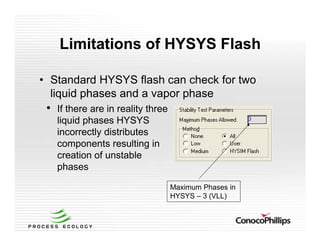
Limitations of HYSYS Flash
• If there are in reality three
liquid phases HYSYS
incorrectly distributes
components resulting in
creation of unstable
phases
• Standard HYSYS flash can check for two
liquid phases and a vapor phase
Maximum Phases in
HYSYS – 3 (VLL)
Proposed Solution
• Perform stability calculation on stream:
• Select “test” component
• Calculate Gibbs energy of pure
component (Gibbs1)
• Calculate Gibbs energy of specified
component in stream (Gibbs2)
• If Gibbs1 < Gibbs2 then new phase
with pure component is stable
Proposed Solution
• Create additional functionality in HYSYS
to check for additional phases:
• Develop HYSYS unit operation
extension, which includes:
• Compiled code (DLL)
• View file (EDF)
• Report file (RDF)
Required skills
• Programming (e.g. Visual Basic, C++)
• Familiarity with HYSYS automation interfaces
• Knowledge of user interfaces and formats (EDF, RDF)
• Understanding of interaction between unit operation
and flowsheet
• General and HYSYS-specific thermodynamics
knowledge (e.g., understanding of HYSYS reference
state)
• Extensions required about 7 weeks development time
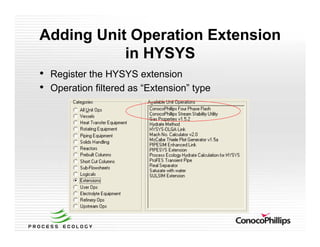
Adding Unit Operation Extension
in HYSYS
• Register the HYSYS extension
• Operation filtered as “Extension” type
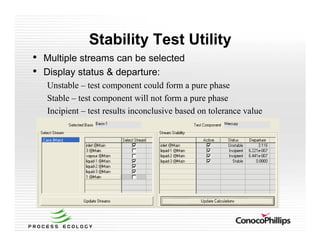
Stability Test Utility
• Multiple streams can be selected
• Display status & departure:
Unstable – test component could form a pure phase
Stable – test component will not form a pure phase
Incipient – test results inconclusive based on tolerance value
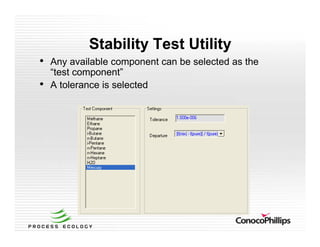
Stability Test Utility
• Any available component can be selected as the
“test component”
• A tolerance is selected
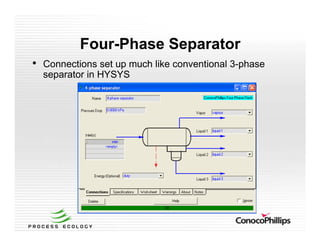
Four-Phase Separator
• Connections set up much like conventional 3-phase
separator in HYSYS
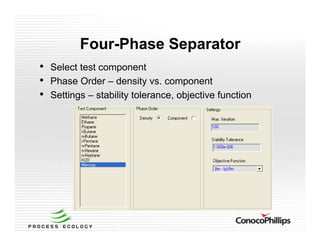
Four-Phase Separator
• Select test component
• Phase Order – density vs. component
• Settings – stability tolerance, objective function
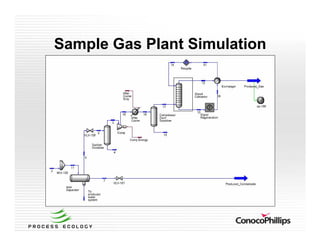
Sample Gas Plant Simulation
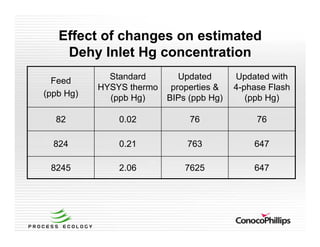
Effect of changes on estimated
Dehy Inlet Hg concentration
64776252.068245
6477630.21824
76760.0282
Updated with
4-phase Flash
(ppb Hg)
Updated
properties &
BIPs (ppb Hg)
Standard
HYSYS thermo
(ppb Hg)
Feed
(ppb Hg)
Demonstration
Thank-you!
• Thanks to ConocoPhillips and Process
Ecology management for permitting
discussion of this material

Implementation of a 4 phase flash in HYSYS

  • 1.
    Implementation of a4-phase flash for the detection of a third liquid phase in hydrocarbon process simulation using HYSYS Speaker: Howard Wilson, James Holoboff D. Embry1, H. Wilson1, J. Holoboff2 and M. Khoshkbarchi2 1ConocoPhillips Company 2Process Ecology Inc.
  • 2.
    Outline • Background &Industry Applications • Limitations of HYSYS Flash • Proposed Solution • Stability Test Utility • 4-Phase Flash Unit Operation Extension • Impact on Simulation Results • Demonstration
  • 3.
    Background • Liquid-liquid equilibriumis a common phenomenon in hydrocarbon processes • Possibility for liquid phases to further phase separate (i.e. – 3 liquid phases) • 3 liquid phases cannot be handled in HYSYS
  • 4.
    Industry Applications (1) •Hydrocarbon systems with heavy fractions resulting in: heavy phase (wax / asphaltene) light hydrocarbon phase water phase • Immiscible tracer added to two-liquid phase system • Some mixtures with perfluoro compounds
  • 5.
    Industry Applications (2) •Solvent/polymer/water mixtures • Oil and natural gas applications, where mercury-free product is required • Cryogenic applications where impurities such as mercury must be addressed
  • 6.
    Industry Applications -Mercury (1) • Natural gas may contain low levels of mercury • In cryogenic applications (e.g. - LNG, nitrogen rejection), mercury can concentrate in cryogenic aluminum heat exchangers • Any contact of liquid mercury with aluminum can cause liquid metal embrittlement and lead to catastrophic failure
  • 7.
    Industry Applications -Mercury (2) • For some applications, “mercury-free” gas product streams are required • Mercury may need to be removed to prevent catalyst deactivation and heat exchanger problems in downstream processing
  • 8.
    Industry Applications –Simulation • From a simulation perspective, It would be useful to determine when / where mercury is predicted to form a separate phase • HYSYS can be used to model industry applications, but may not adequately predict properties of mercury or formation/separation of mercury phase
  • 9.
    Improvements to HYSYS 1.Improve pure component property model (vapor pressure) 2. Improve predicted solubility of key components in hydrocarbons and water (modify interaction parameters) 3. Detect presence of key components as a separate phase • This presentation focuses on #3
  • 10.
    Limitations of HYSYSFlash • If there are in reality three liquid phases HYSYS incorrectly distributes components resulting in creation of unstable phases • Standard HYSYS flash can check for two liquid phases and a vapor phase Maximum Phases in HYSYS – 3 (VLL)
  • 11.
    Proposed Solution • Performstability calculation on stream: • Select “test” component • Calculate Gibbs energy of pure component (Gibbs1) • Calculate Gibbs energy of specified component in stream (Gibbs2) • If Gibbs1 < Gibbs2 then new phase with pure component is stable
  • 12.
    Proposed Solution • Createadditional functionality in HYSYS to check for additional phases: • Develop HYSYS unit operation extension, which includes: • Compiled code (DLL) • View file (EDF) • Report file (RDF)
  • 13.
    Required skills • Programming(e.g. Visual Basic, C++) • Familiarity with HYSYS automation interfaces • Knowledge of user interfaces and formats (EDF, RDF) • Understanding of interaction between unit operation and flowsheet • General and HYSYS-specific thermodynamics knowledge (e.g., understanding of HYSYS reference state) • Extensions required about 7 weeks development time
  • 14.
    Adding Unit OperationExtension in HYSYS • Register the HYSYS extension • Operation filtered as “Extension” type
  • 15.
    Stability Test Utility •Multiple streams can be selected • Display status & departure: Unstable – test component could form a pure phase Stable – test component will not form a pure phase Incipient – test results inconclusive based on tolerance value
  • 16.
    Stability Test Utility •Any available component can be selected as the “test component” • A tolerance is selected
  • 17.
    Four-Phase Separator • Connectionsset up much like conventional 3-phase separator in HYSYS
  • 18.
    Four-Phase Separator • Selecttest component • Phase Order – density vs. component • Settings – stability tolerance, objective function
  • 19.
    Sample Gas PlantSimulation
  • 20.
    Effect of changeson estimated Dehy Inlet Hg concentration 64776252.068245 6477630.21824 76760.0282 Updated with 4-phase Flash (ppb Hg) Updated properties & BIPs (ppb Hg) Standard HYSYS thermo (ppb Hg) Feed (ppb Hg)
  • 21.
  • 22.
    Thank-you! • Thanks toConocoPhillips and Process Ecology management for permitting discussion of this material