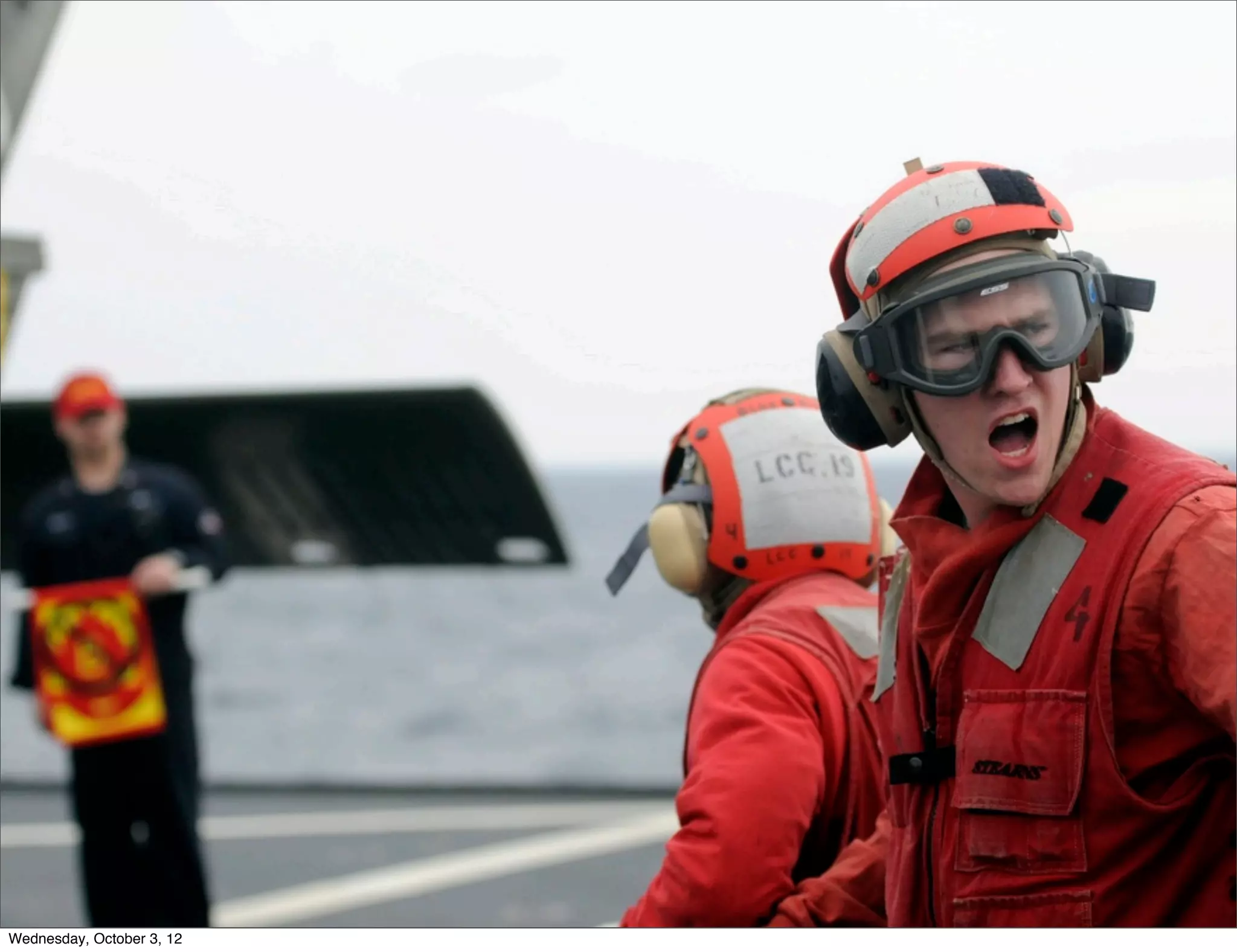
Escalating
                           Scenarios
                           A Deep Dive Into Outage
                                   Pitfalls


                                            John Allspaw
                                               Velocity
                                             London 2012


Wednesday, October 3, 12
TROUBLESHOOTING


         This is NOT about troubleshooting

         Or, not just about troubleshooting

Wednesday, October 3, 12
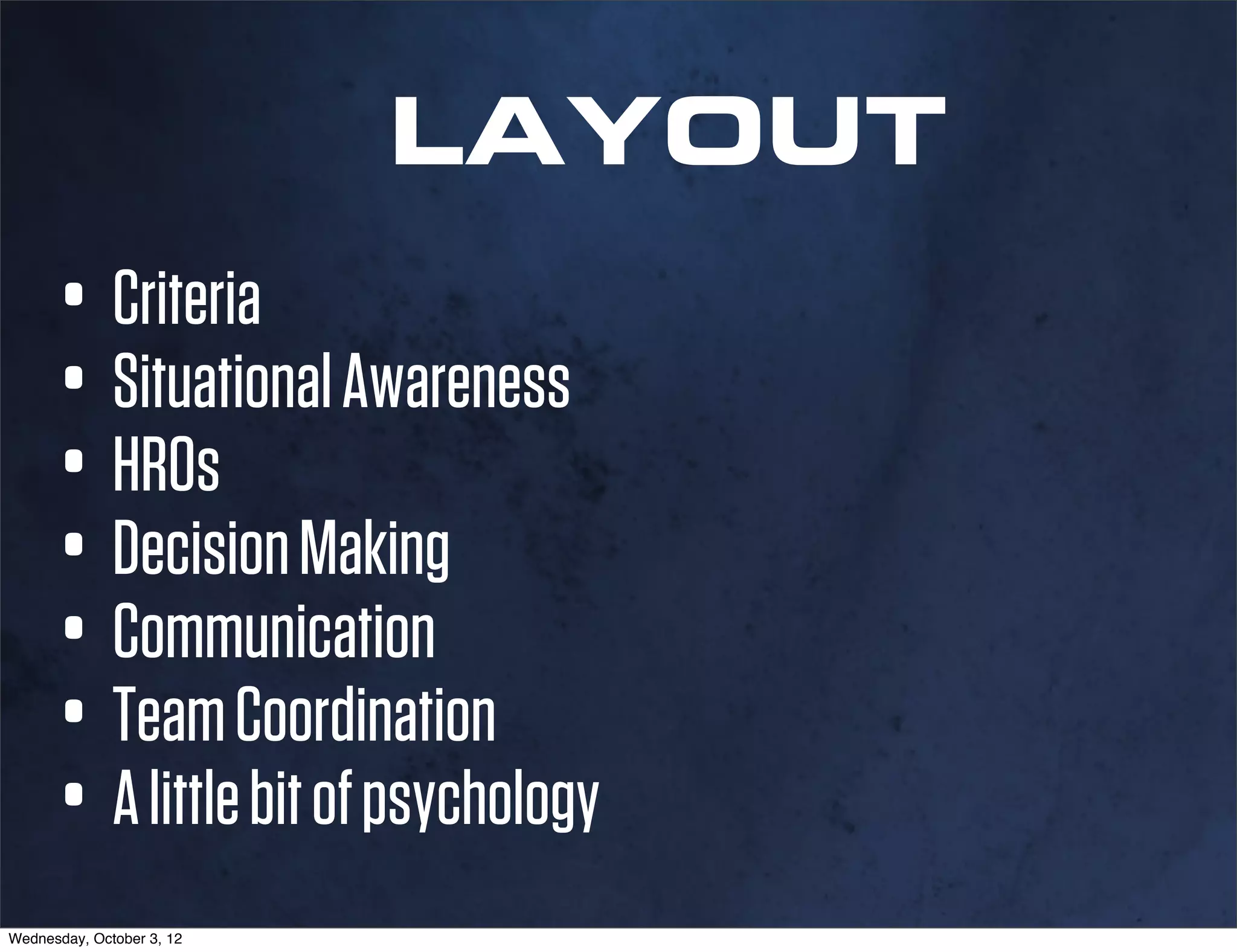
LAYOUT
      • Criteria
      • Situational Awareness
      • HROs
      • Decision Making
      • Communication
      • Team Coordination
      • A little bit of psychology
Wednesday, October 3, 12
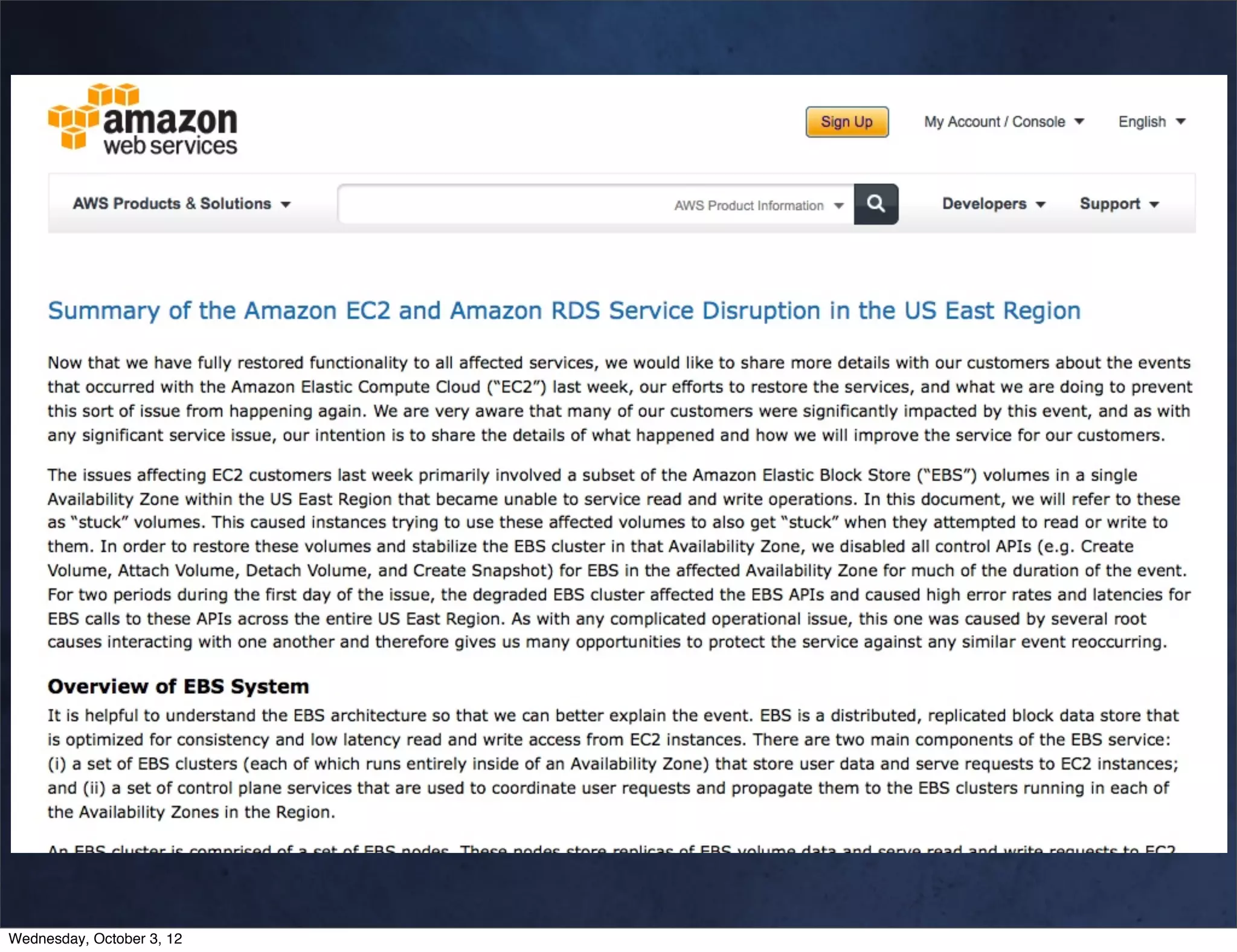
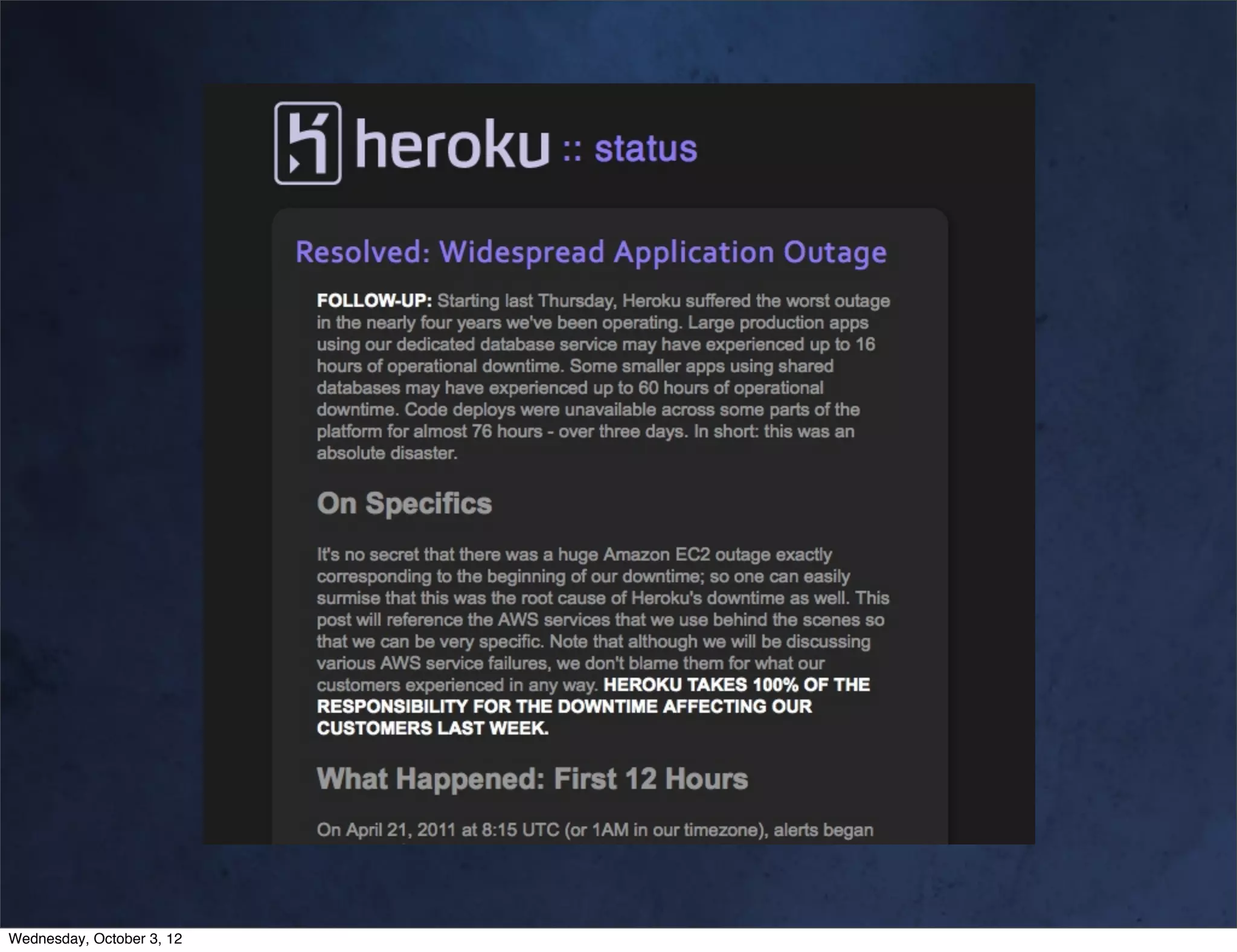
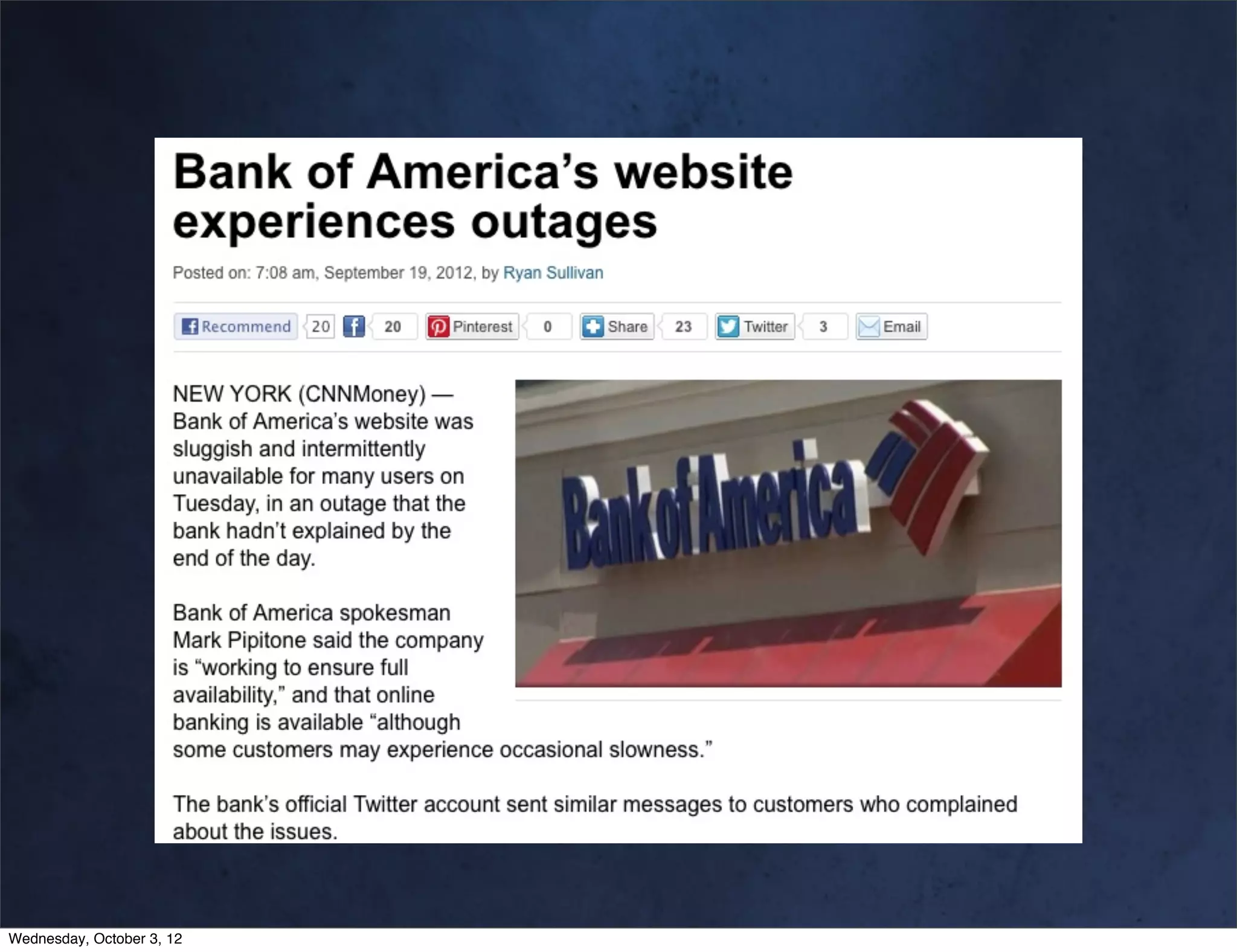
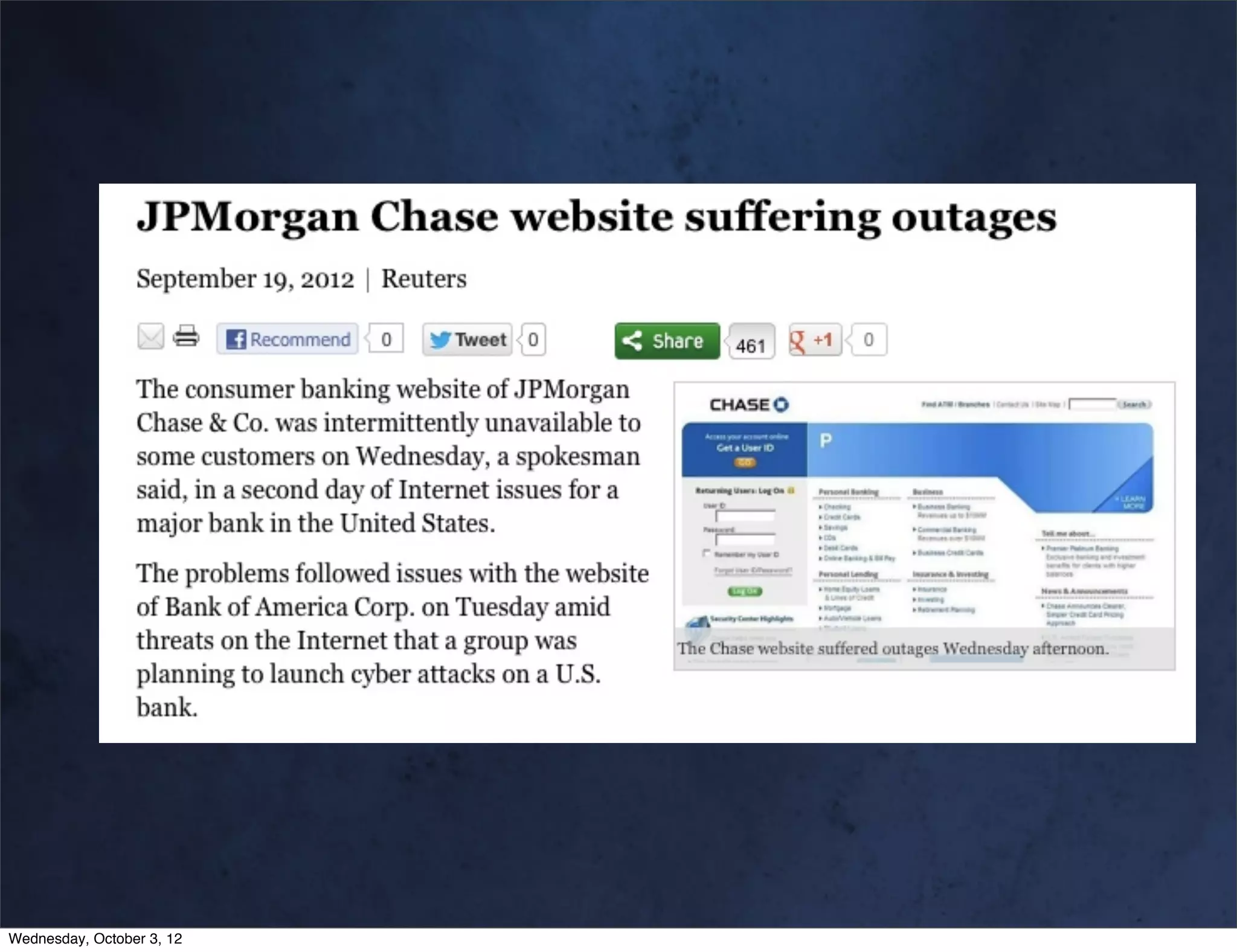
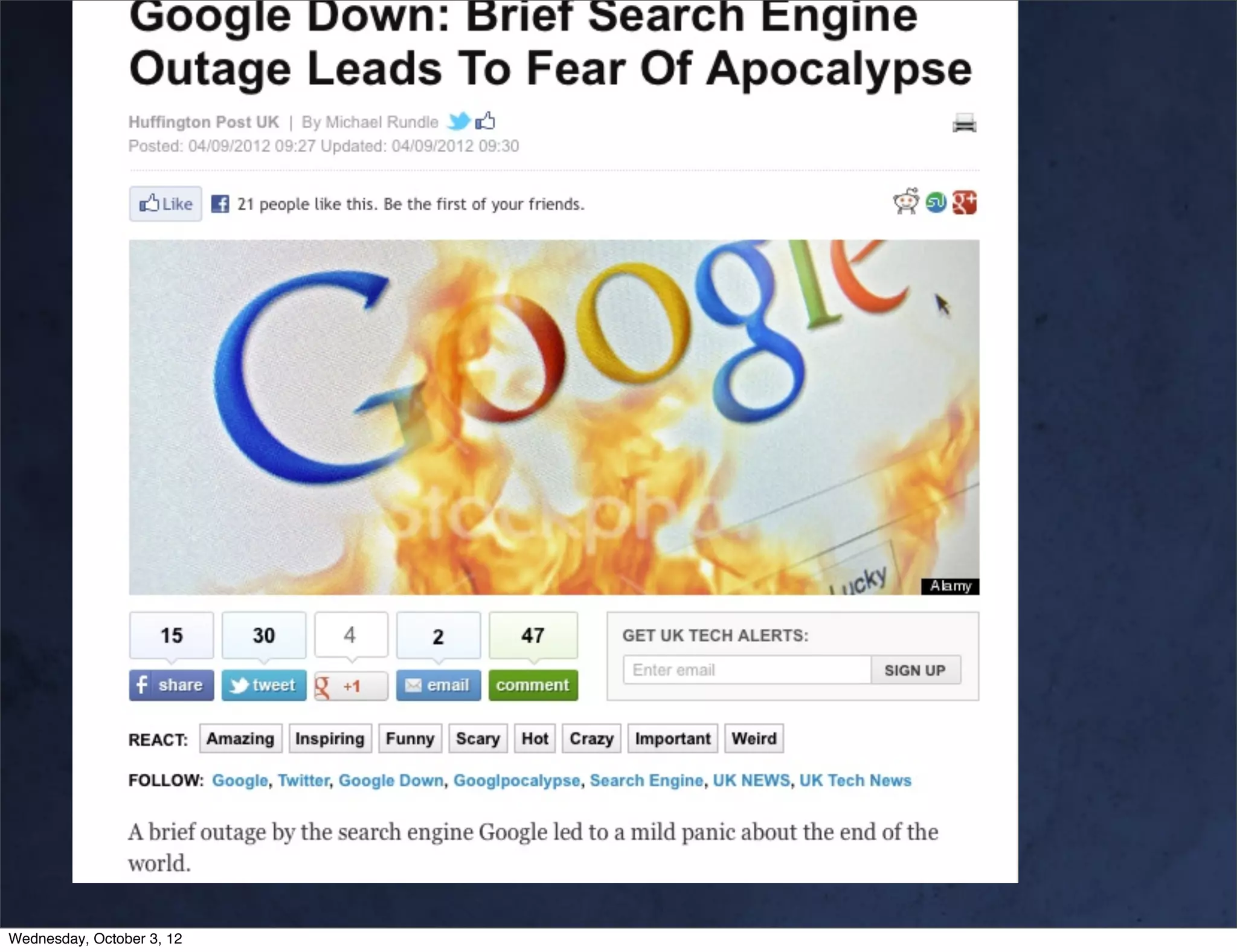
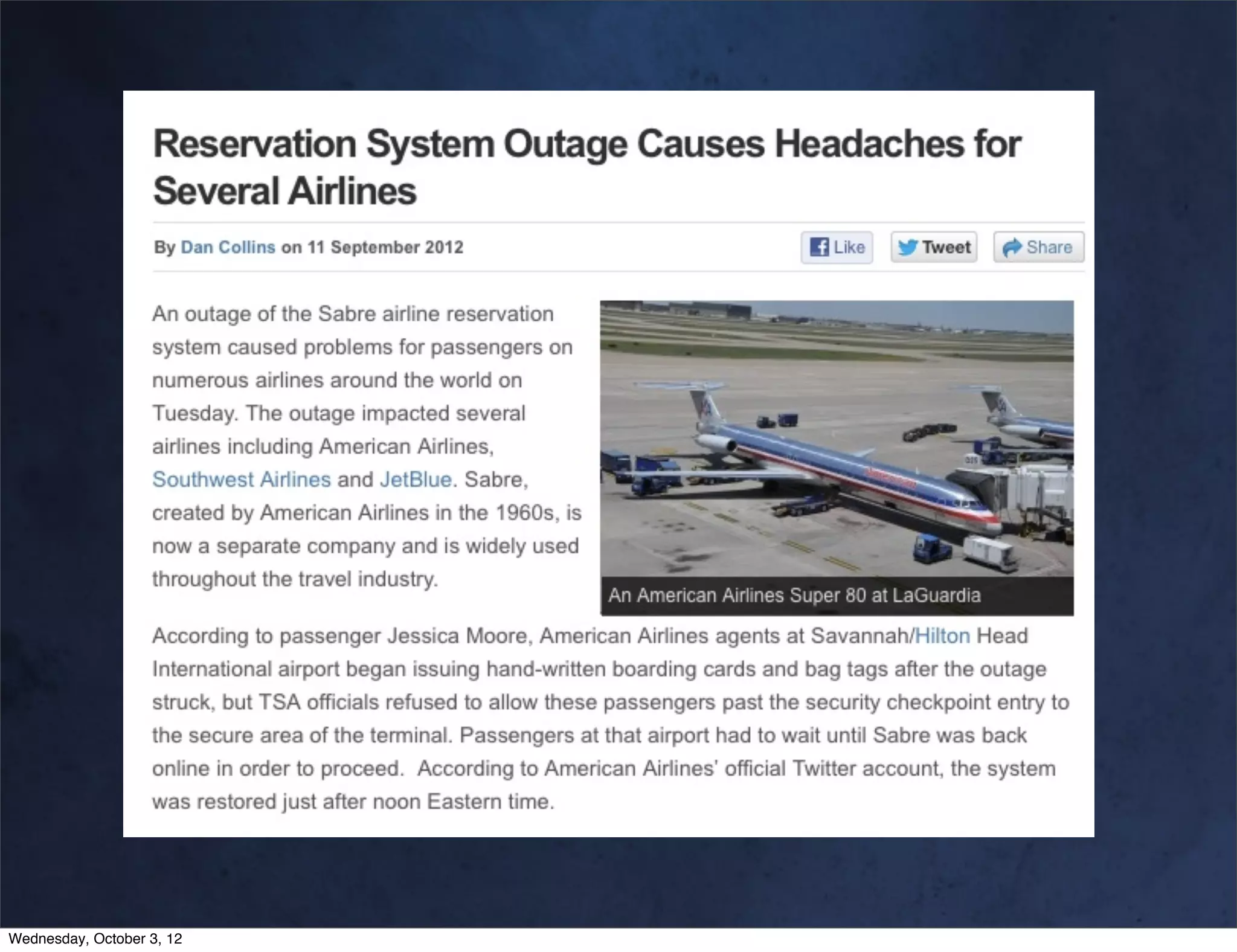
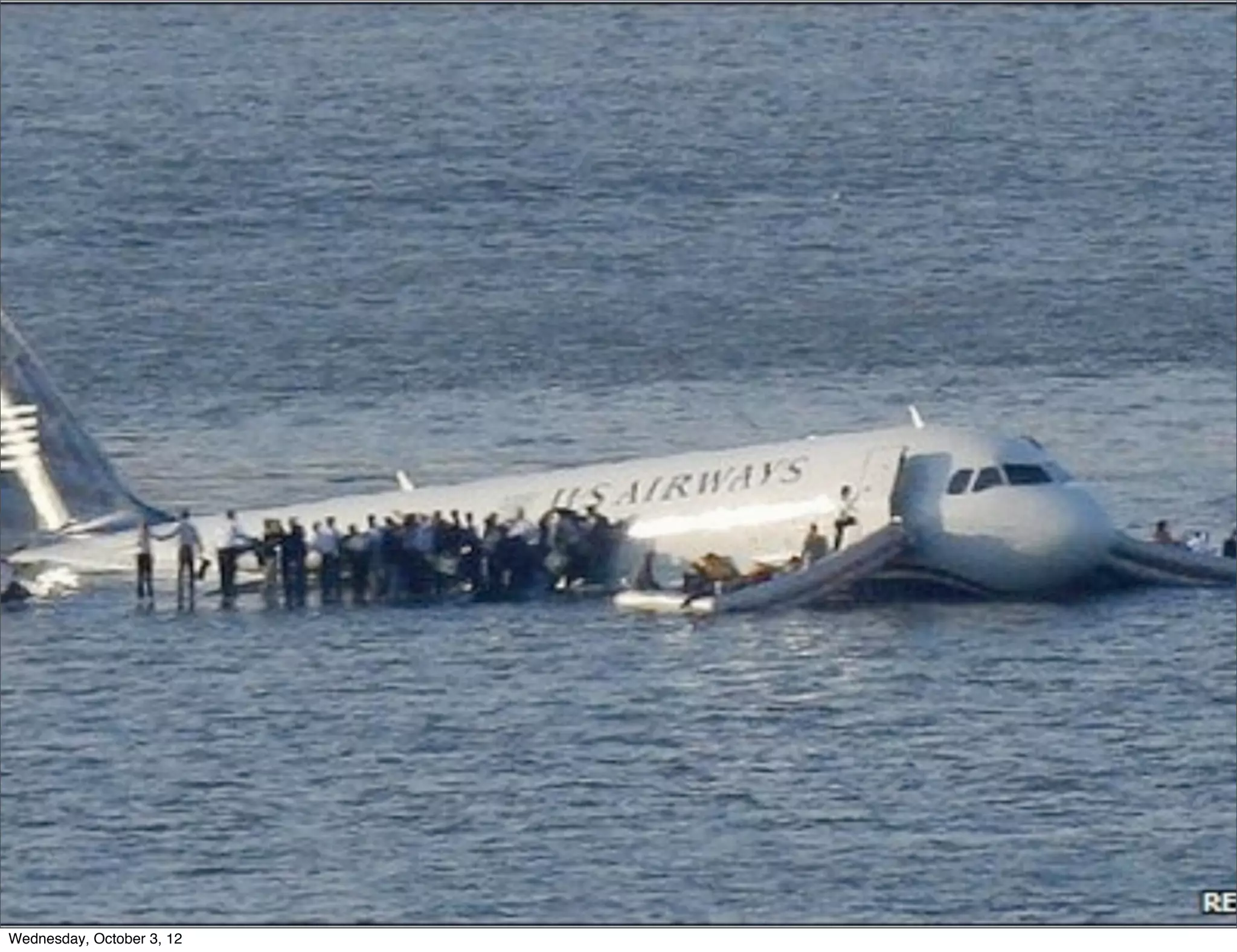
How important is this?


Wednesday, October 3, 12
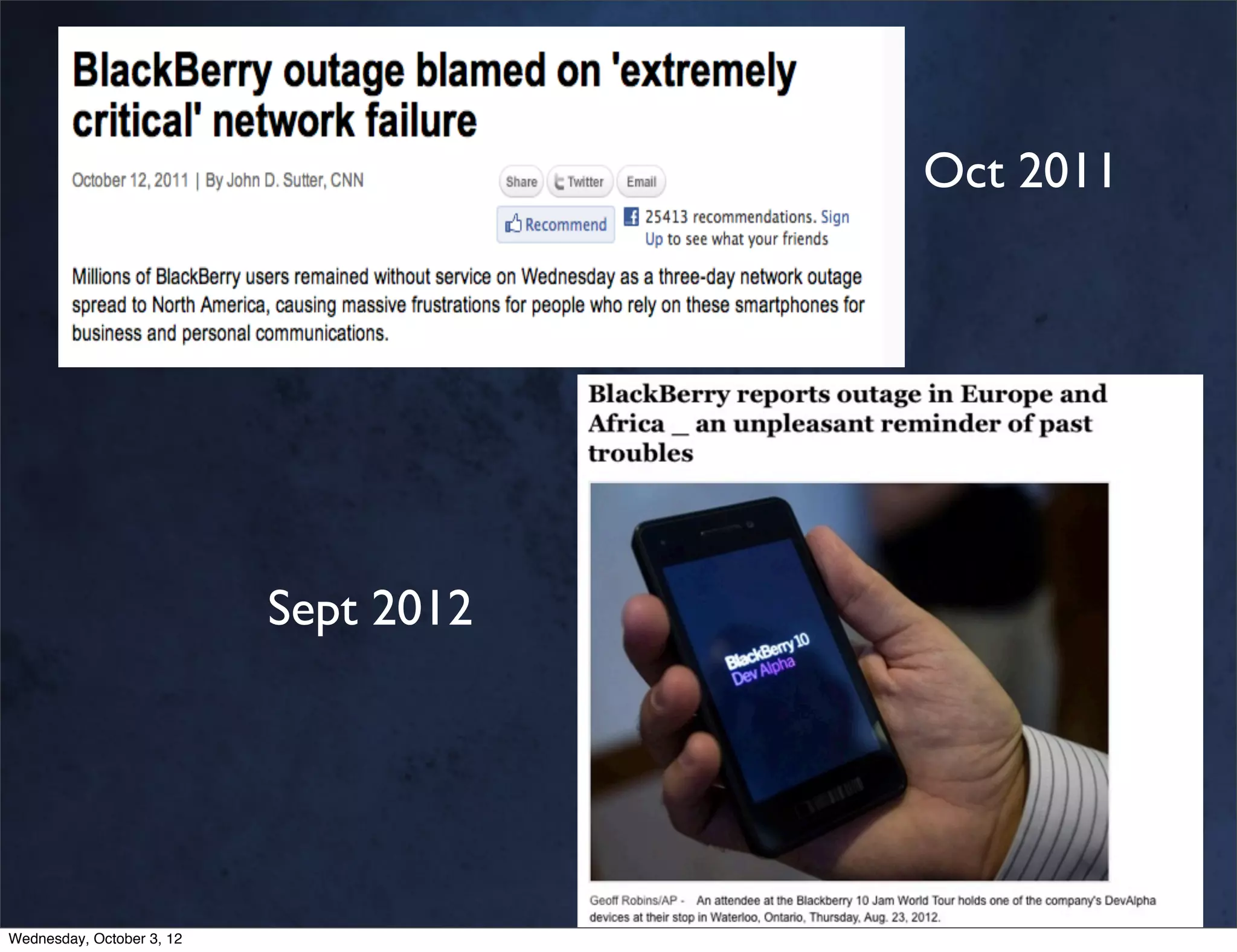
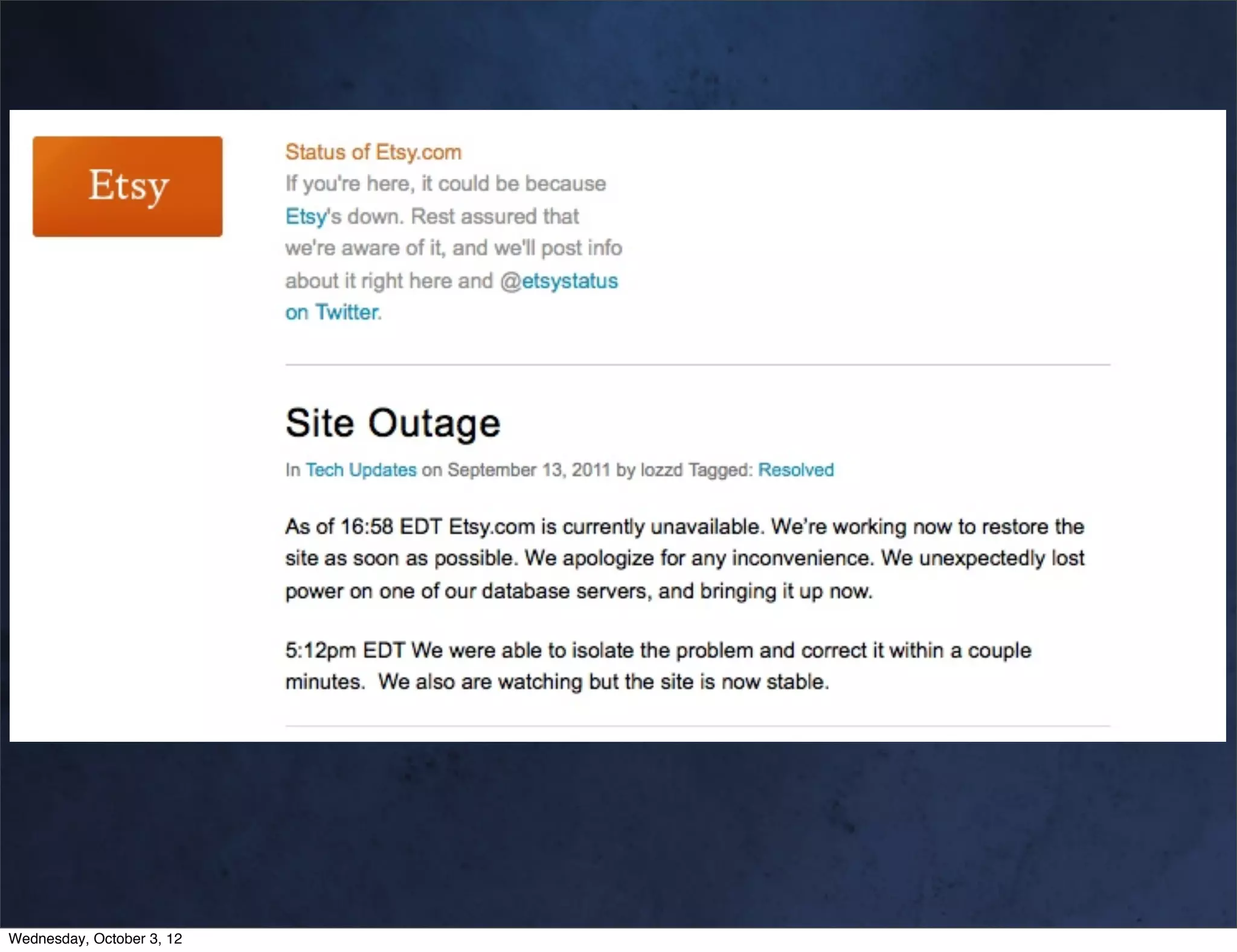
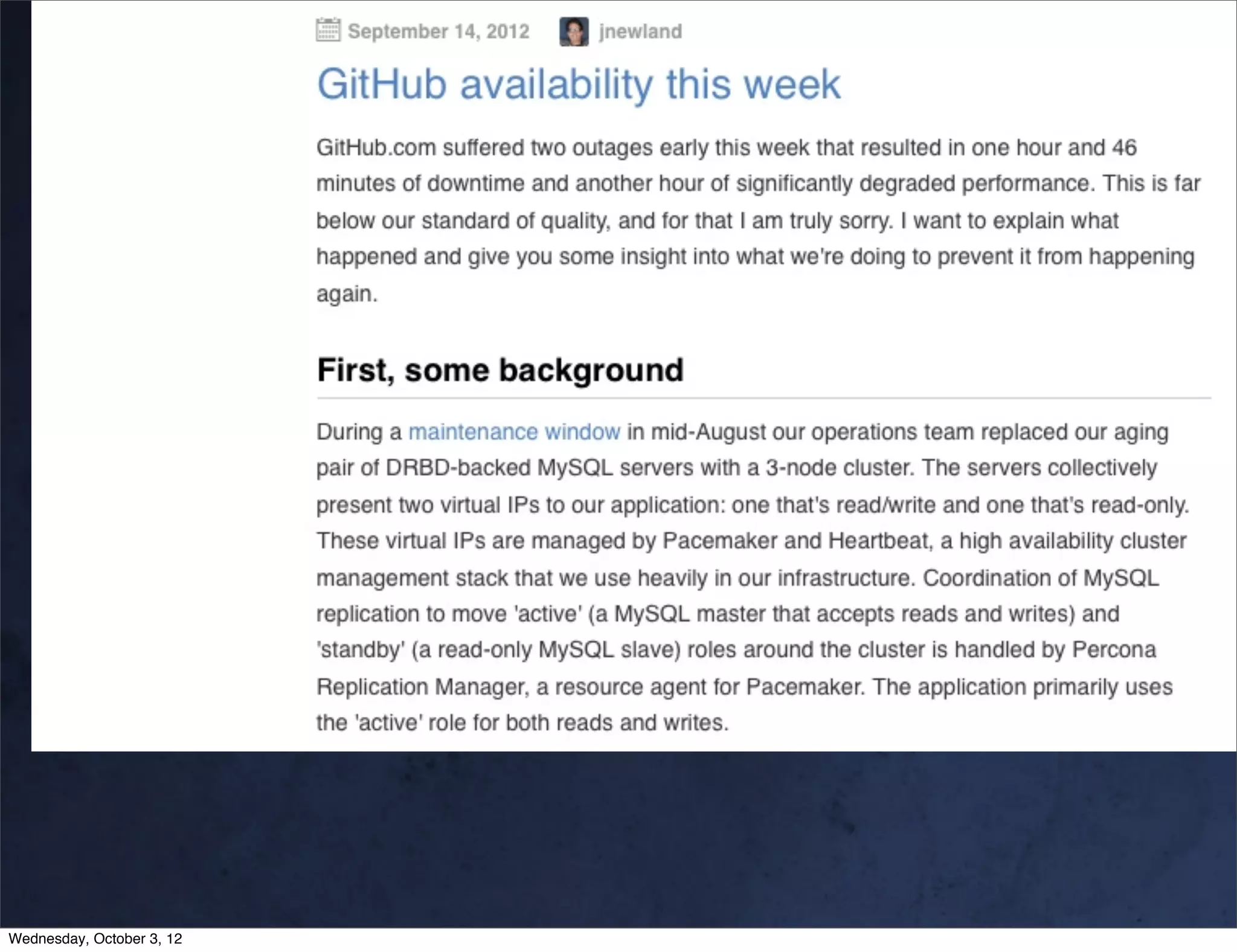
Oct 2011


                           Sept 2012


Wednesday, October 3, 12
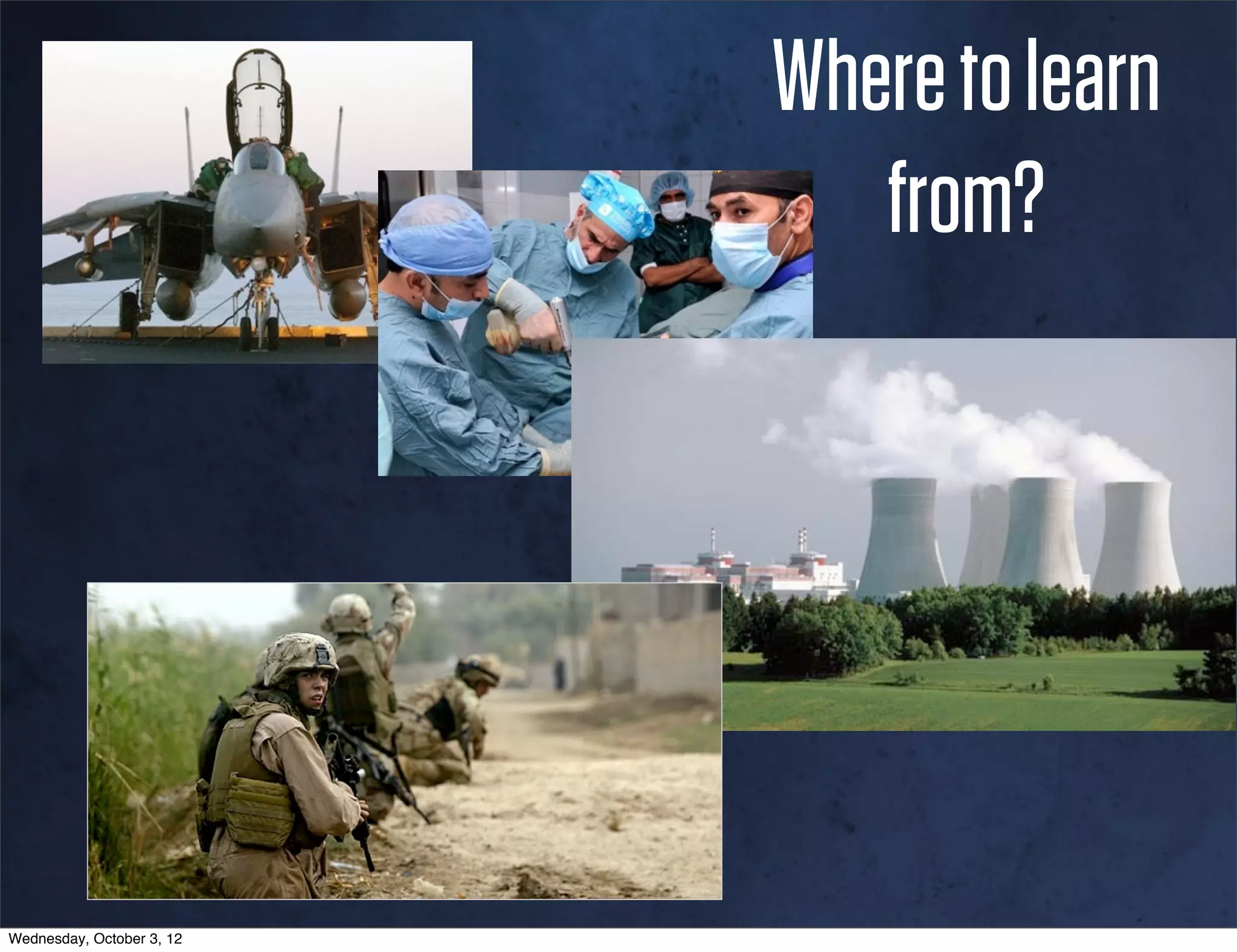
Where to learn
                              from?


Wednesday, October 3, 12
TMI


Wednesday, October 3, 12
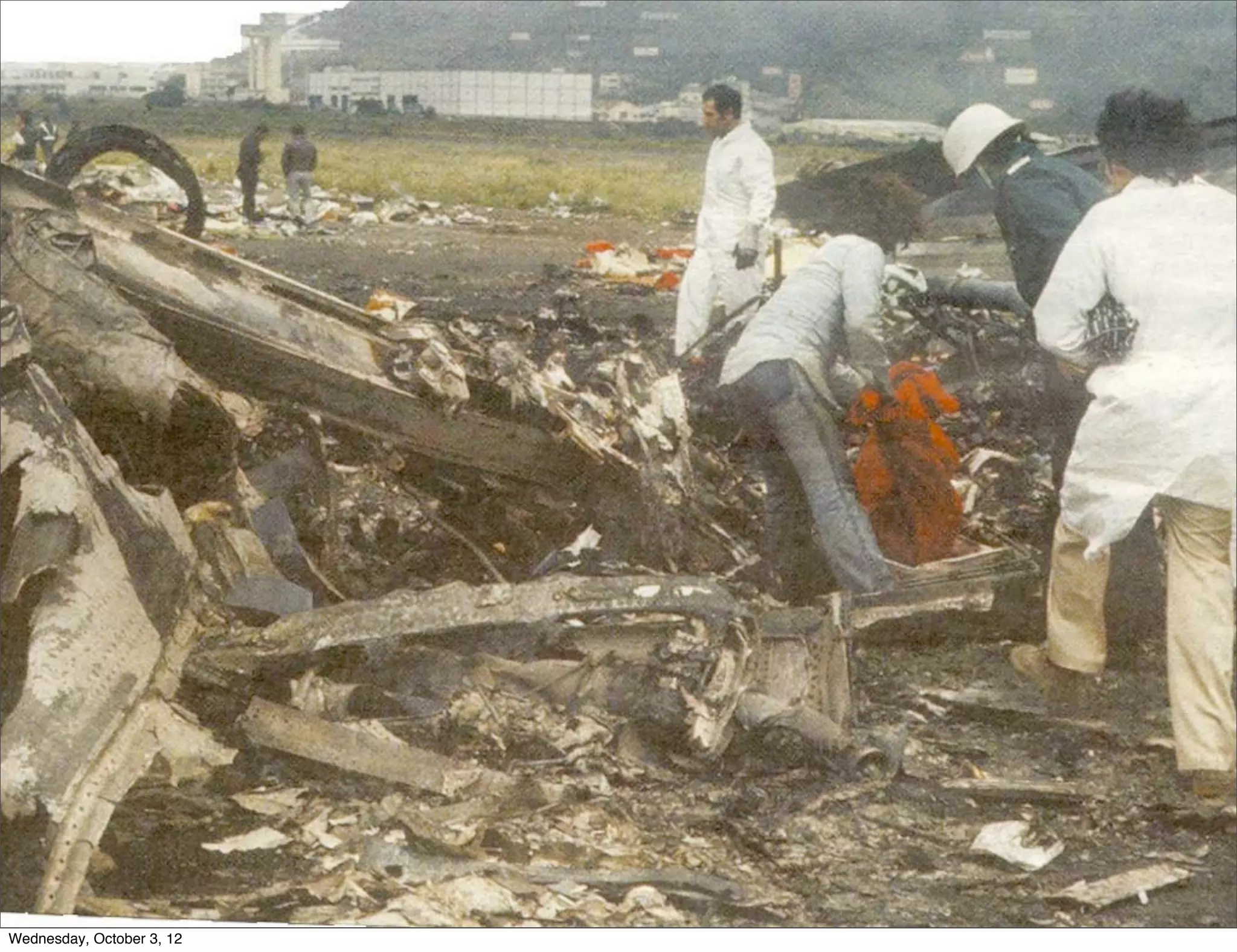
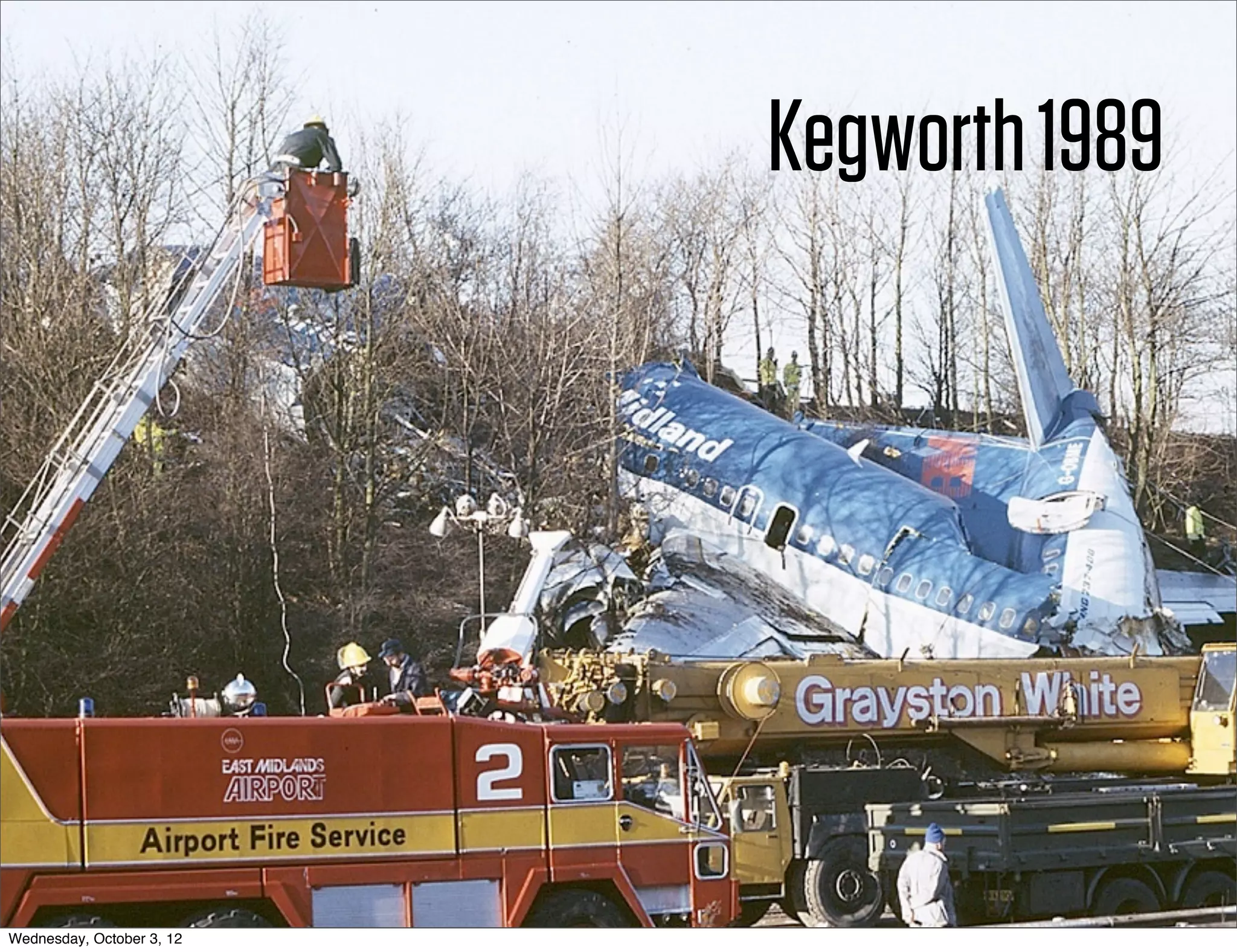
Kegworth 1989


Wednesday, October 3, 12
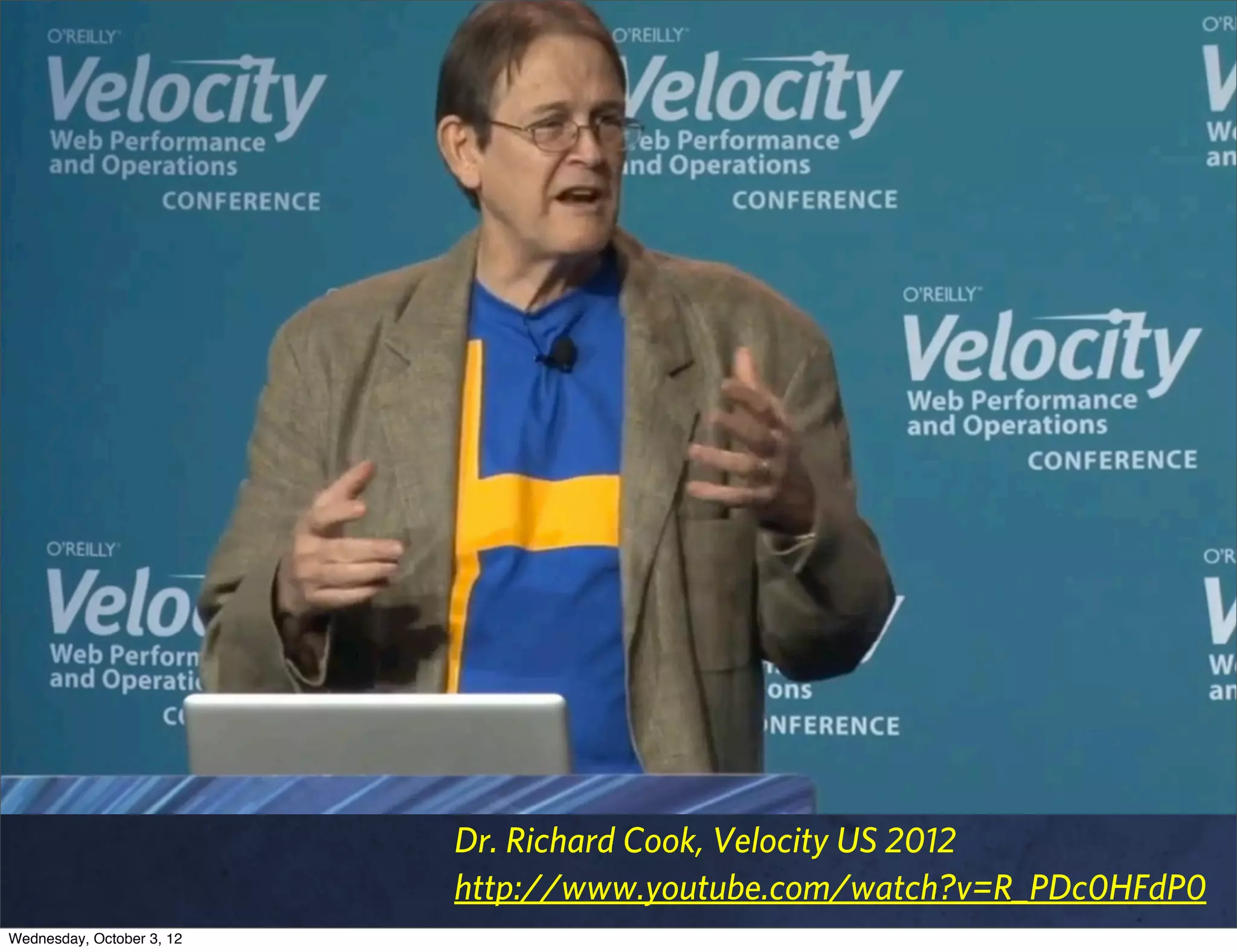
Dr. Richard Cook, Velocity US 2012
                           http://www.youtube.com/watch?v=R_PDc0HFdP0
Wednesday, October 3, 12
“The Self-Designing High-Reliability Organization:
         Aircraft Carrier Flight Operations at Sea”
         Rochlin, La Porte, and Roberts. Naval War College Review 1987

         http://govleaders.org/reliability.htm


Wednesday, October 3, 12
What Goes On In Our Heads?


Wednesday, October 3, 12
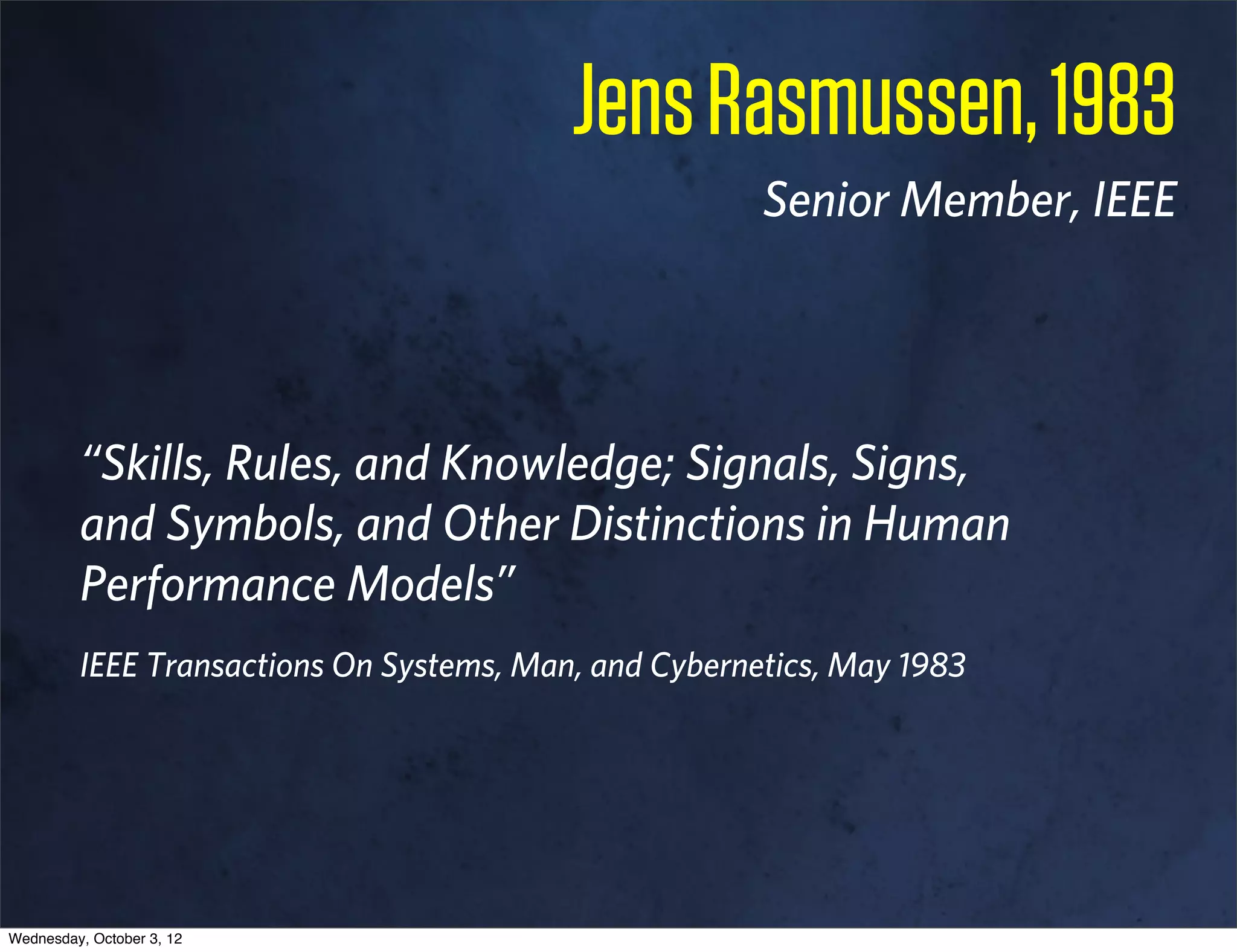
Jens Rasmussen, 1983
                                                       Senior Member, IEEE


         “Skills, Rules, and Knowledge; Signals, Signs,
         and Symbols, and Other Distinctions in Human
         Performance Models”
         IEEE Transactions On Systems, Man, and Cybernetics, May 1983


Wednesday, October 3, 12
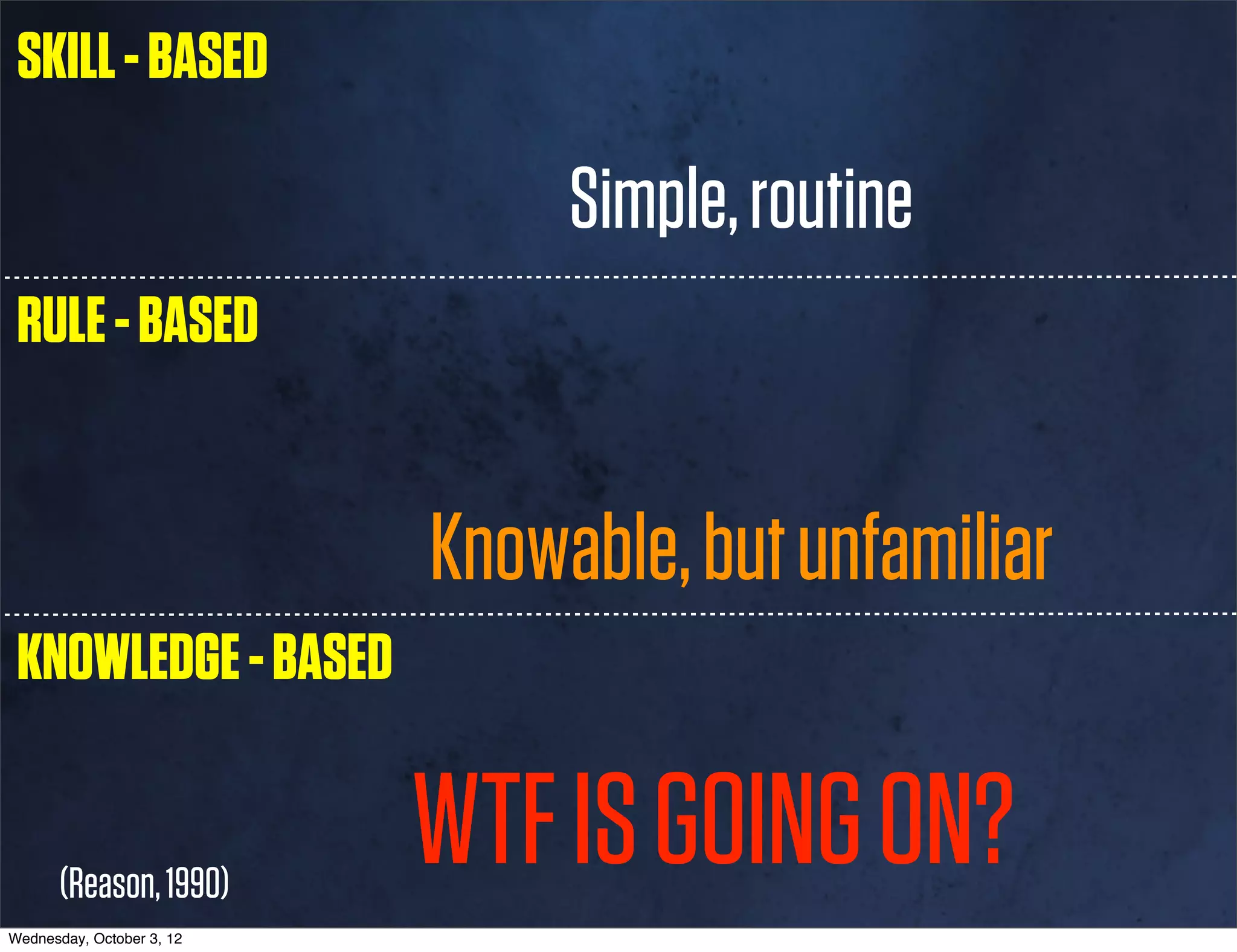
SKILL - BASED

                                Simple, routine
 RULE - BASED


                           Knowable, but unfamiliar
 KNOWLEDGE - BASED


       (Reason, 1990)
                           WTF IS GOING ON?
Wednesday, October 3, 12
Situational Awareness
"the perception of elements in the environment within a volume of
time and space, the comprehension of their meaning, and the
projection of their status in the near future,” - (Endsley, 1995)

"keeping track of what is going on around you in a complex,
dynamic environment" (Moray, 2005, p. 4)

"knowing what is going on so you can figure out what to
do" (Adam, 1993)

Wednesday, October 3, 12
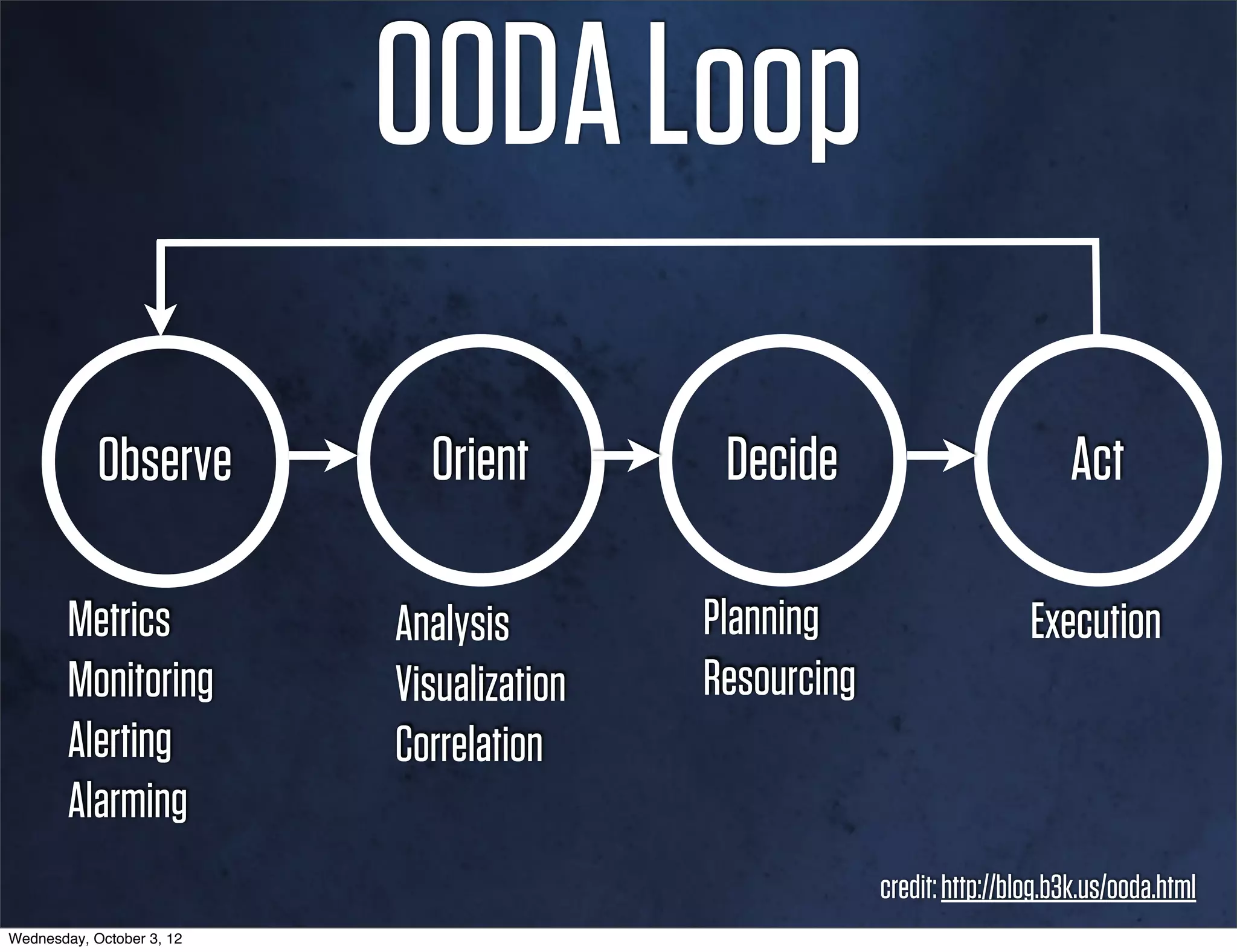
OODA Loop
            Observe          Orient         Decide                           Act

        Metrics            Analysis        Planning                      Execution
        Monitoring         Visualization   Resourcing
        Alerting           Correlation
        Alarming
                                                        credit: http://blog.b3k.us/ooda.html
Wednesday, October 3, 12
Canonical Work

         “Towards a Theory of Situational Awareness”
         Mica Endsley, Human Factors (1995)

         http://www.satechnologies.com/Papers/pdf/Toward%20a%20Theory
         %20of%20SA.pdf


Wednesday, October 3, 12
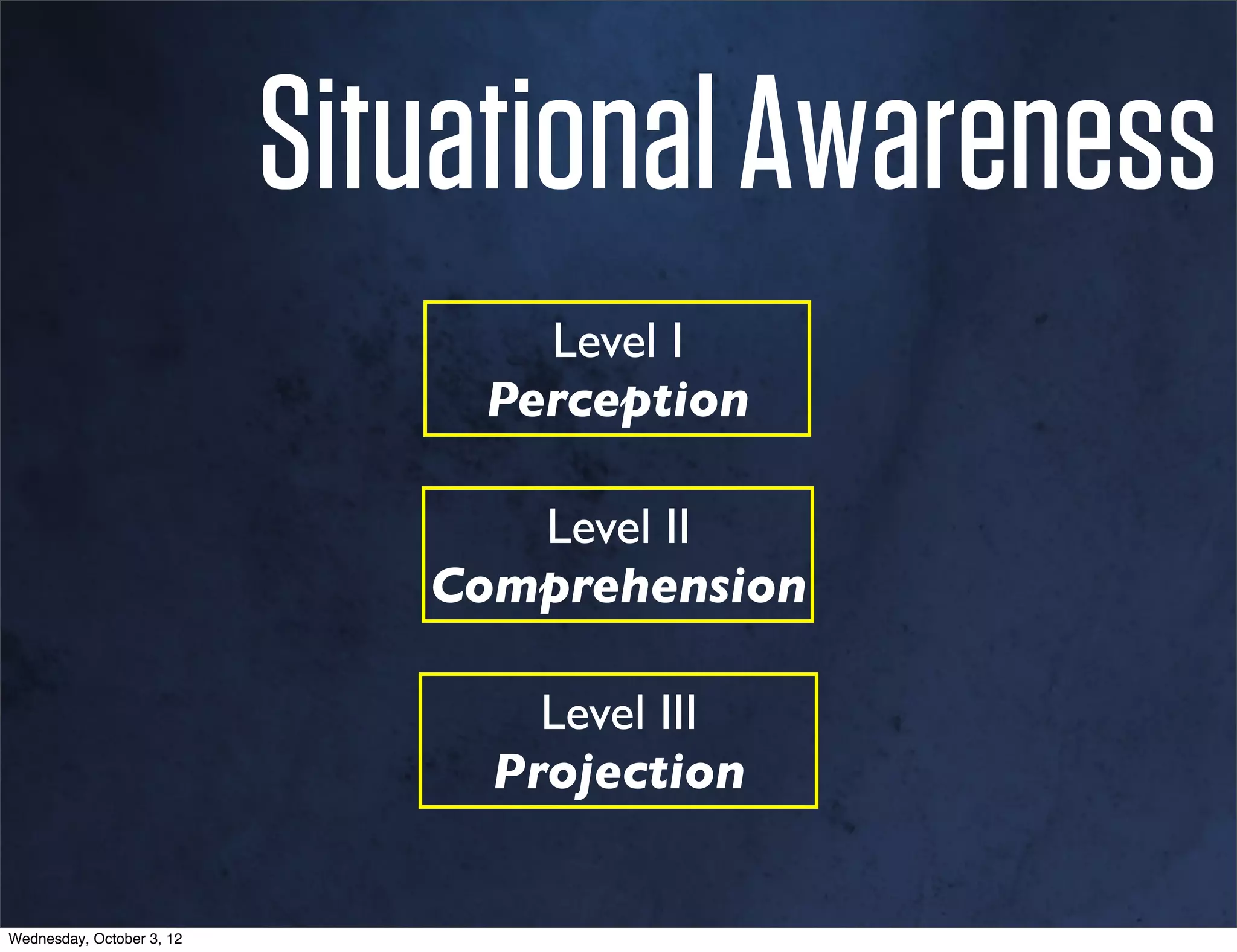
Situational Awareness
                                  Level I
                                Perception

                                 Level II
                              Comprehension

                                  Level III
                                Projection


Wednesday, October 3, 12
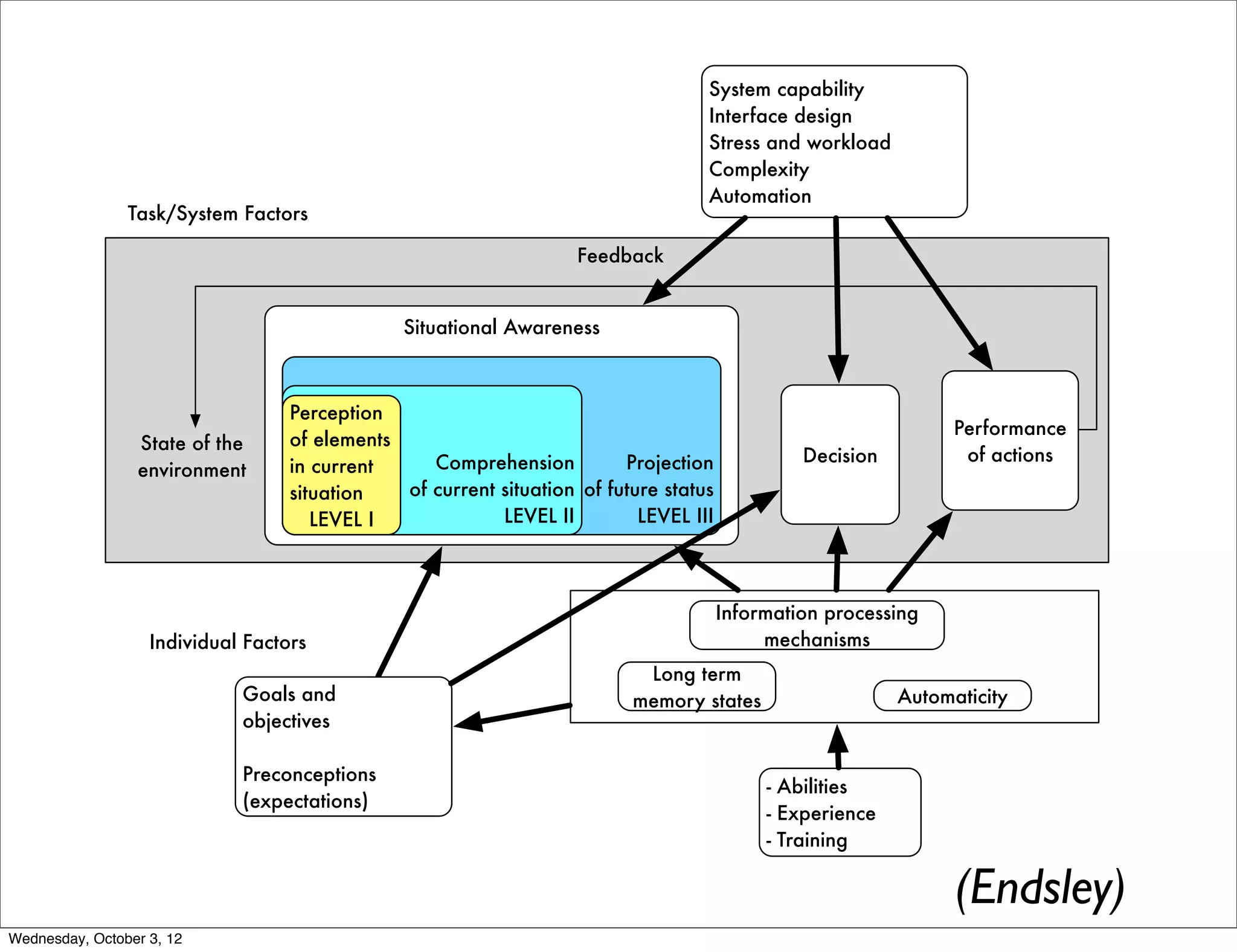
System capability
                                                                                   Interface design
                                                                                   Stress and workload
                                                                                   Complexity
                                                                                   Automation
                Task/System Factors

                                                                    Feedback


                                                Situational Awareness


                                   Perception
                                                                                                                 Performance
                 State of the      of elements
                                                  Comprehension          Projection             Decision          of actions
                 environment       in current
                                   situation   of current situation of future status
                                      LEVEL I             LEVEL II         LEVEL III


                                                                                       Information processing
                   Individual Factors                                                       mechanisms
                                                                           Long term
                             Goals and                                    memory states                    Automaticity
                             objectives

                             Preconceptions
                                                                                            - Abilities
                             (expectations)
                                                                                            - Experience
                                                                                            - Training

                                                                                                                 (Endsley)
Wednesday, October 3, 12
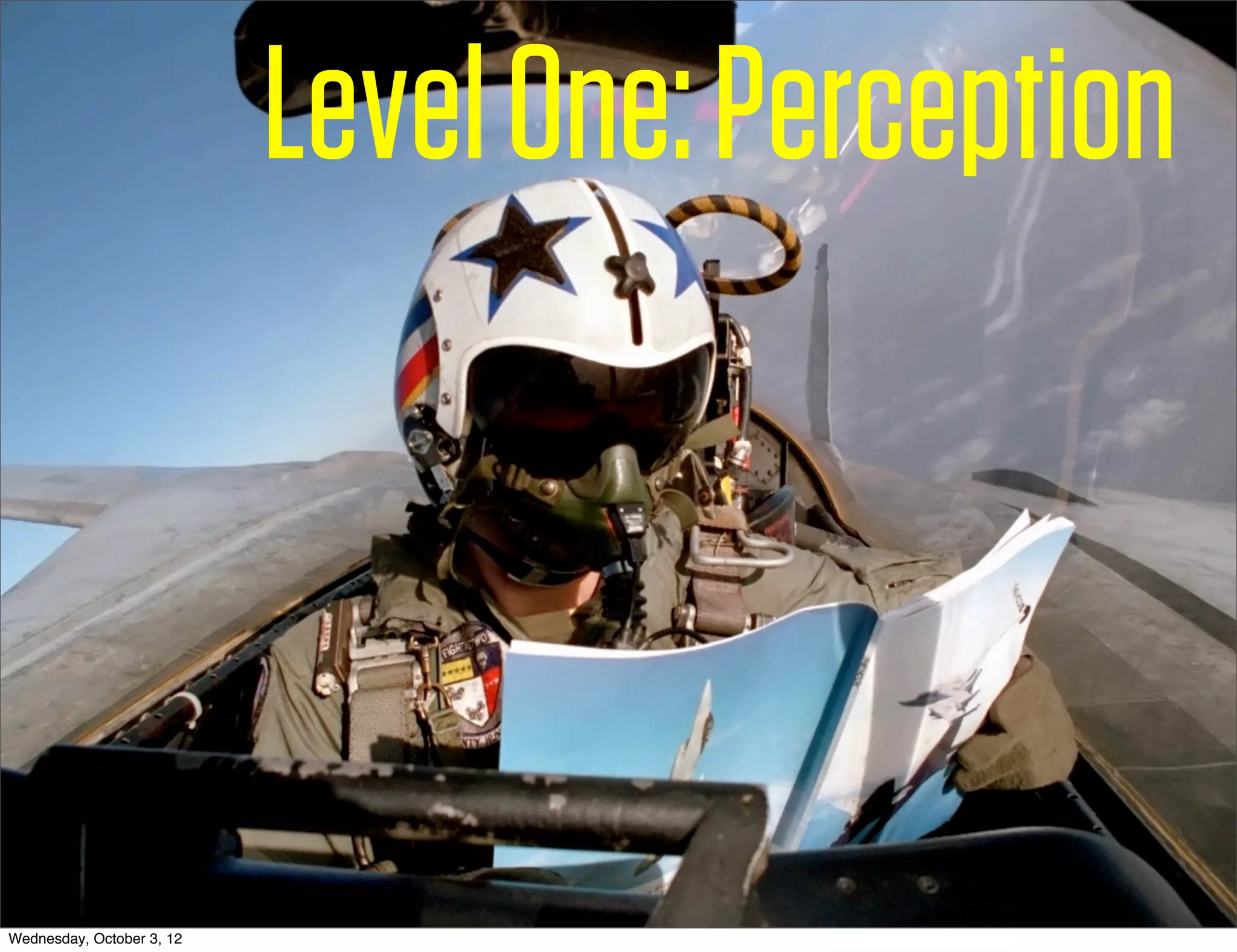
Level One: Perception


Wednesday, October 3, 12
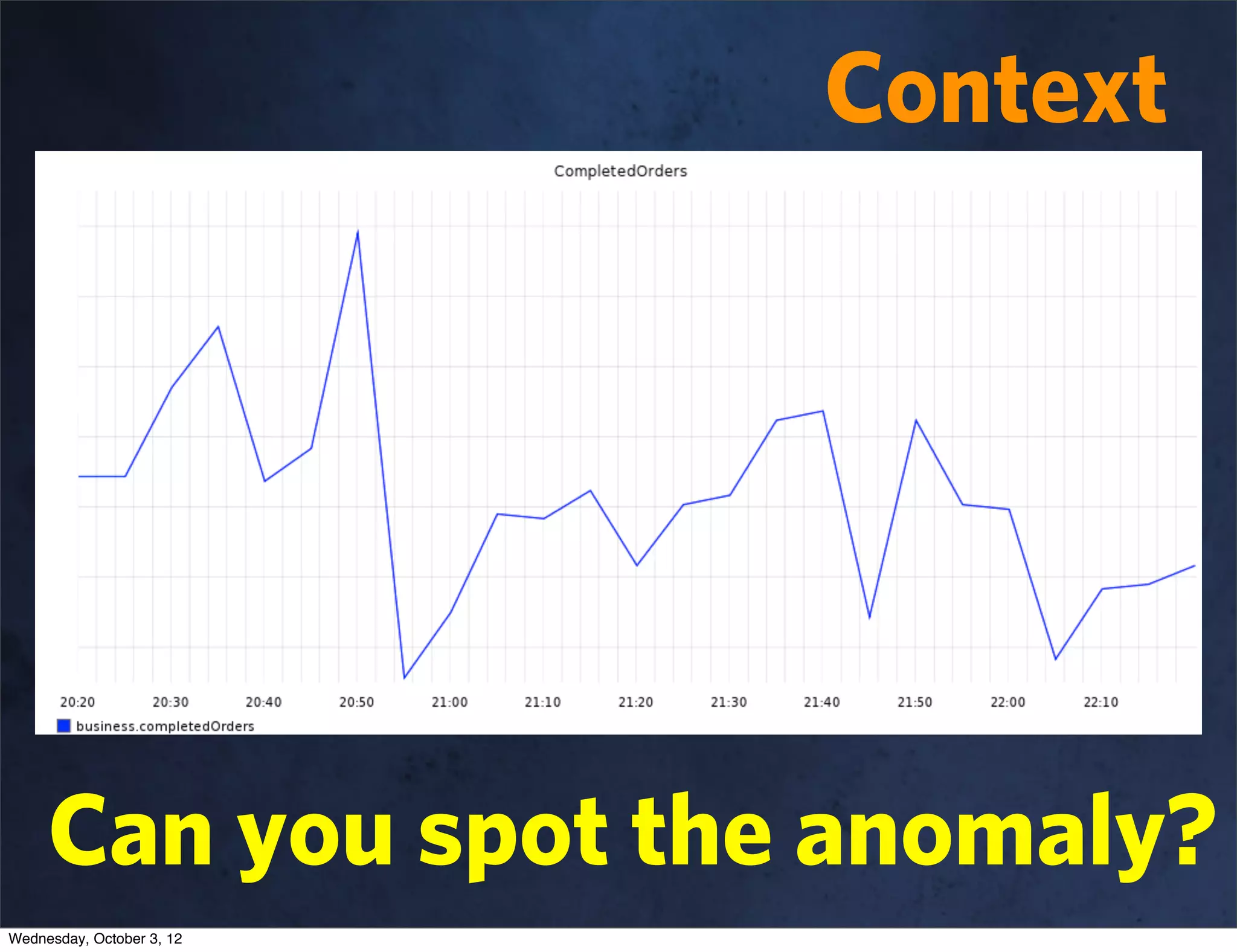
Context


     Can you spot the anomaly?
Wednesday, October 3, 12
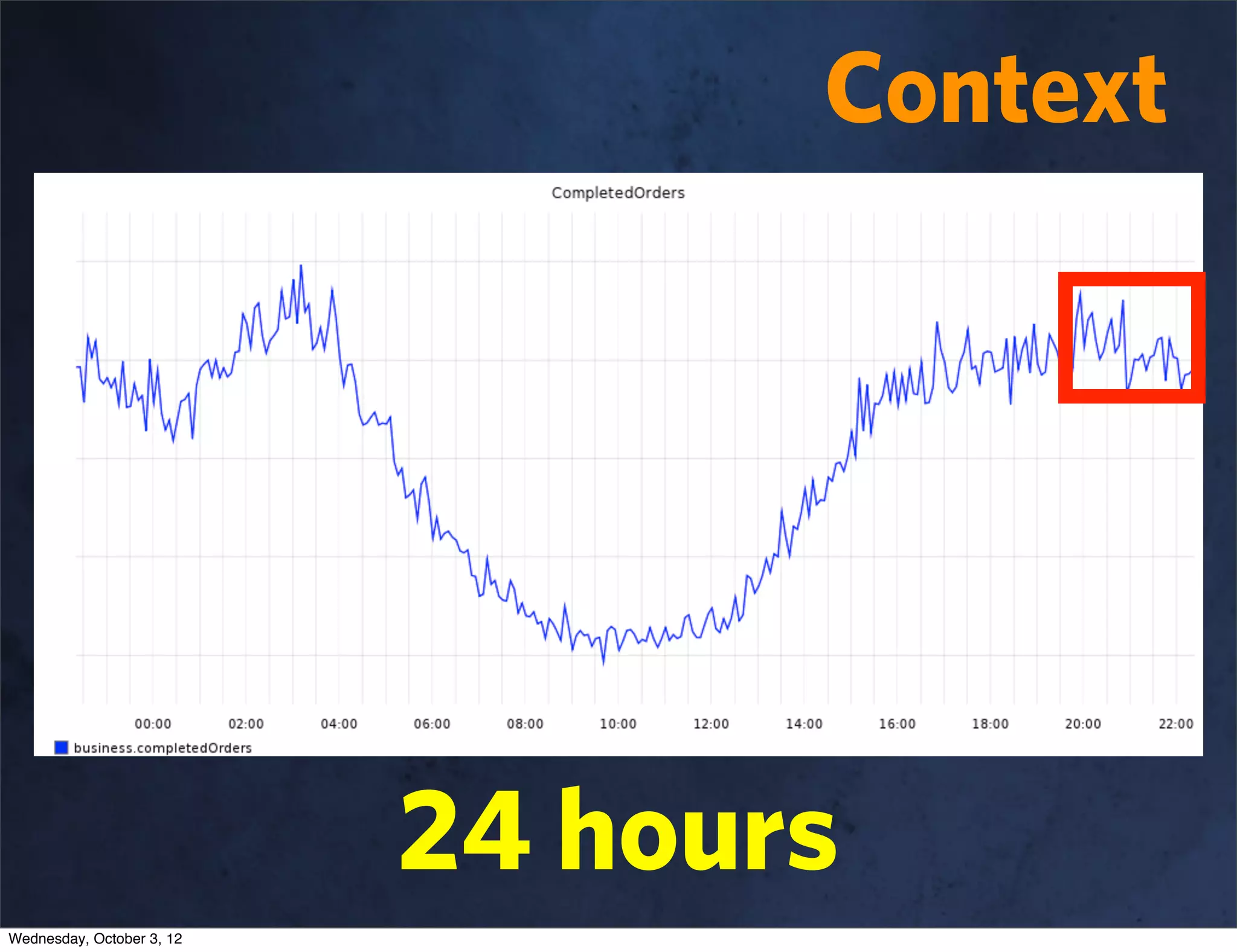
Context


                           24 hours
Wednesday, October 3, 12
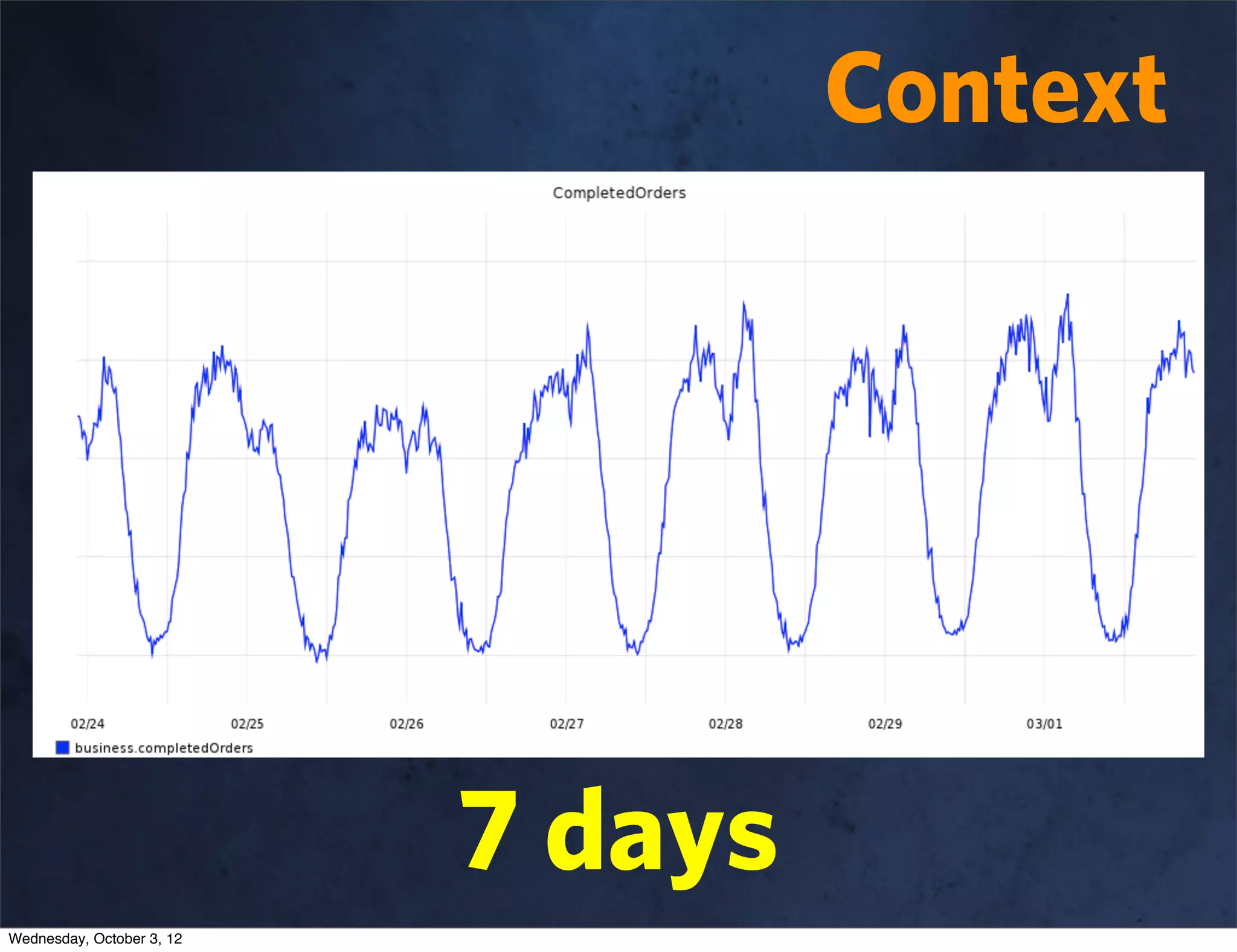
Context


                           7 days
Wednesday, October 3, 12
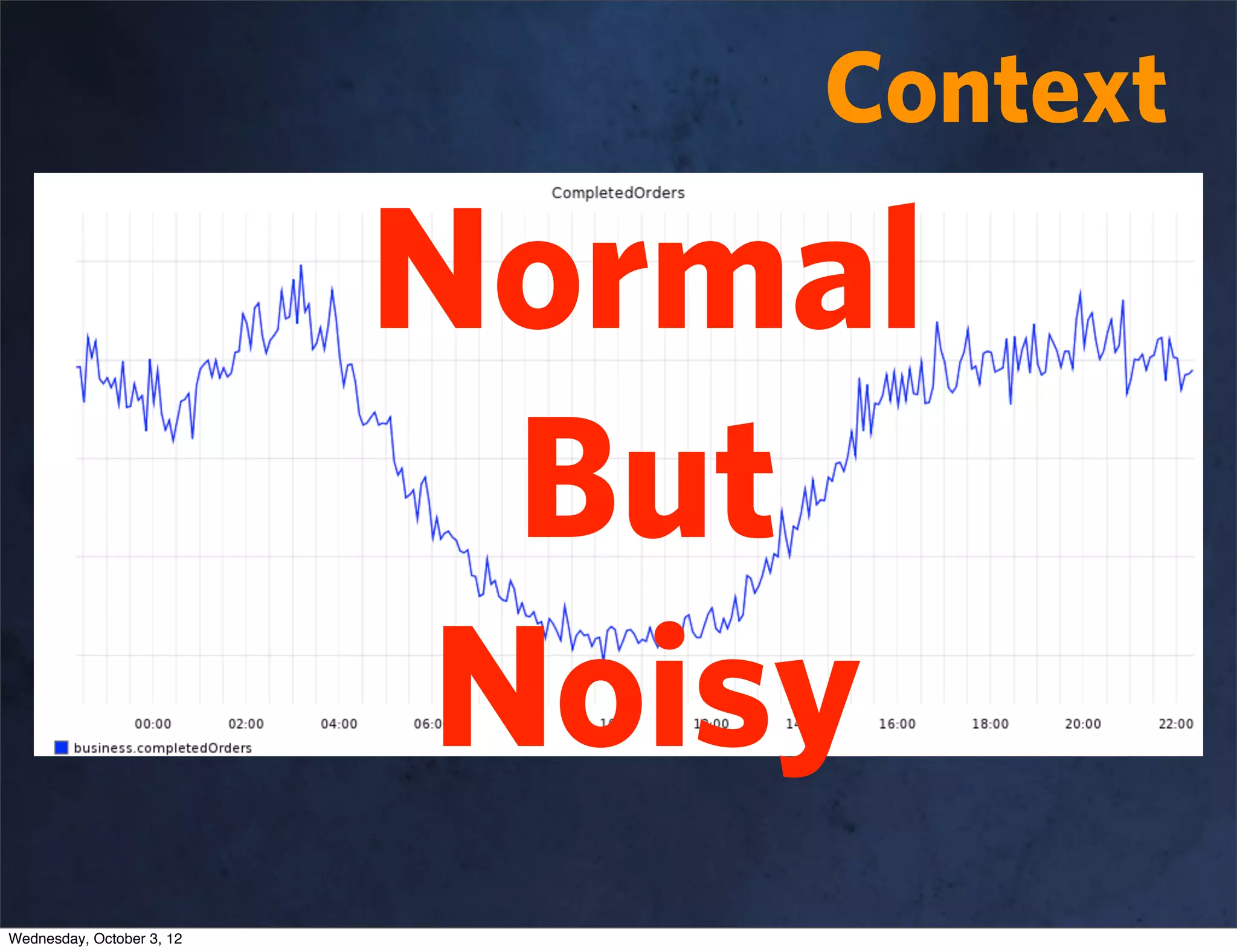
Context

                           Normal
                             But
                            Noisy
Wednesday, October 3, 12
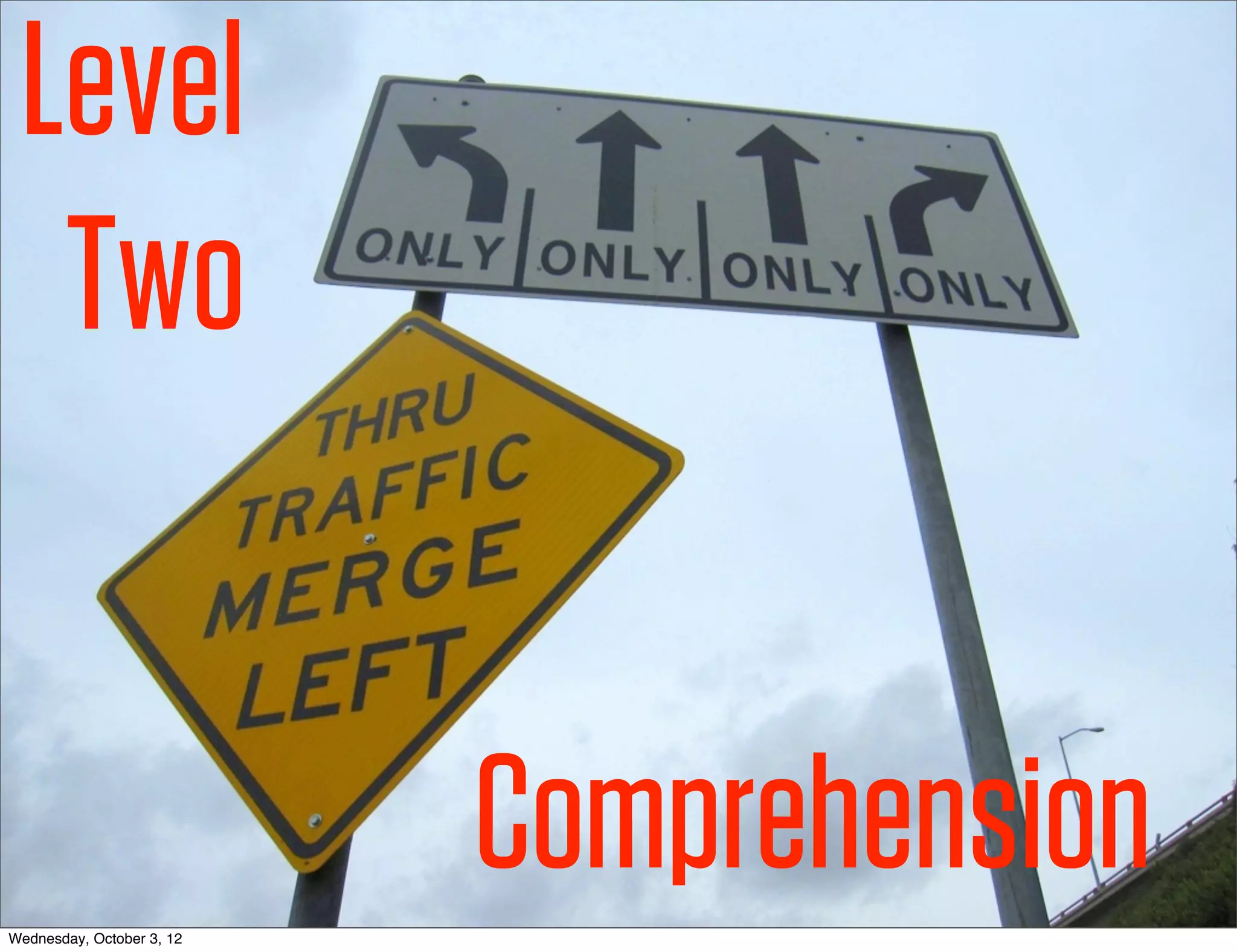
Level
  Two


Wednesday, October 3, 12
                           Comprehension
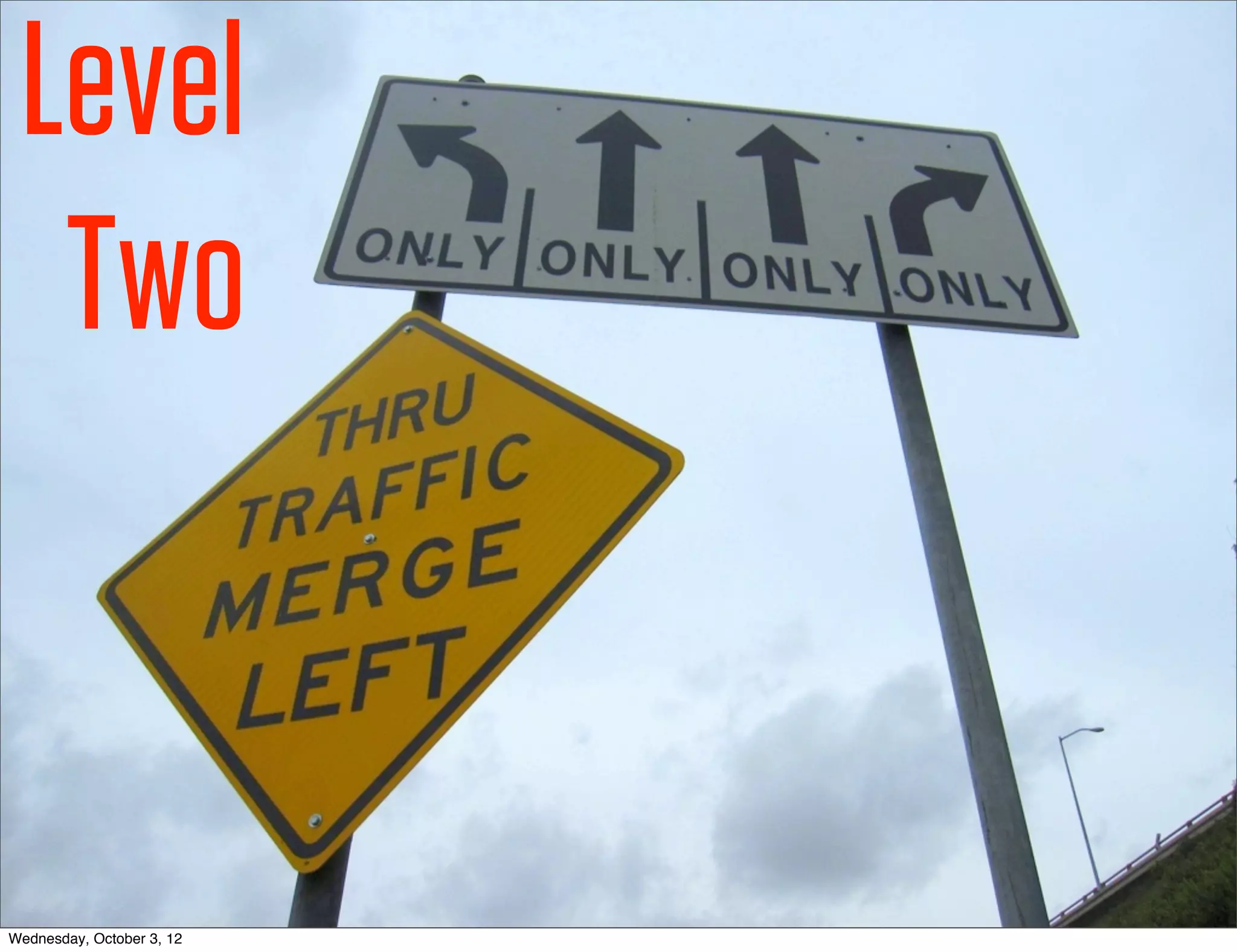
Level
  Two


Wednesday, October 3, 12
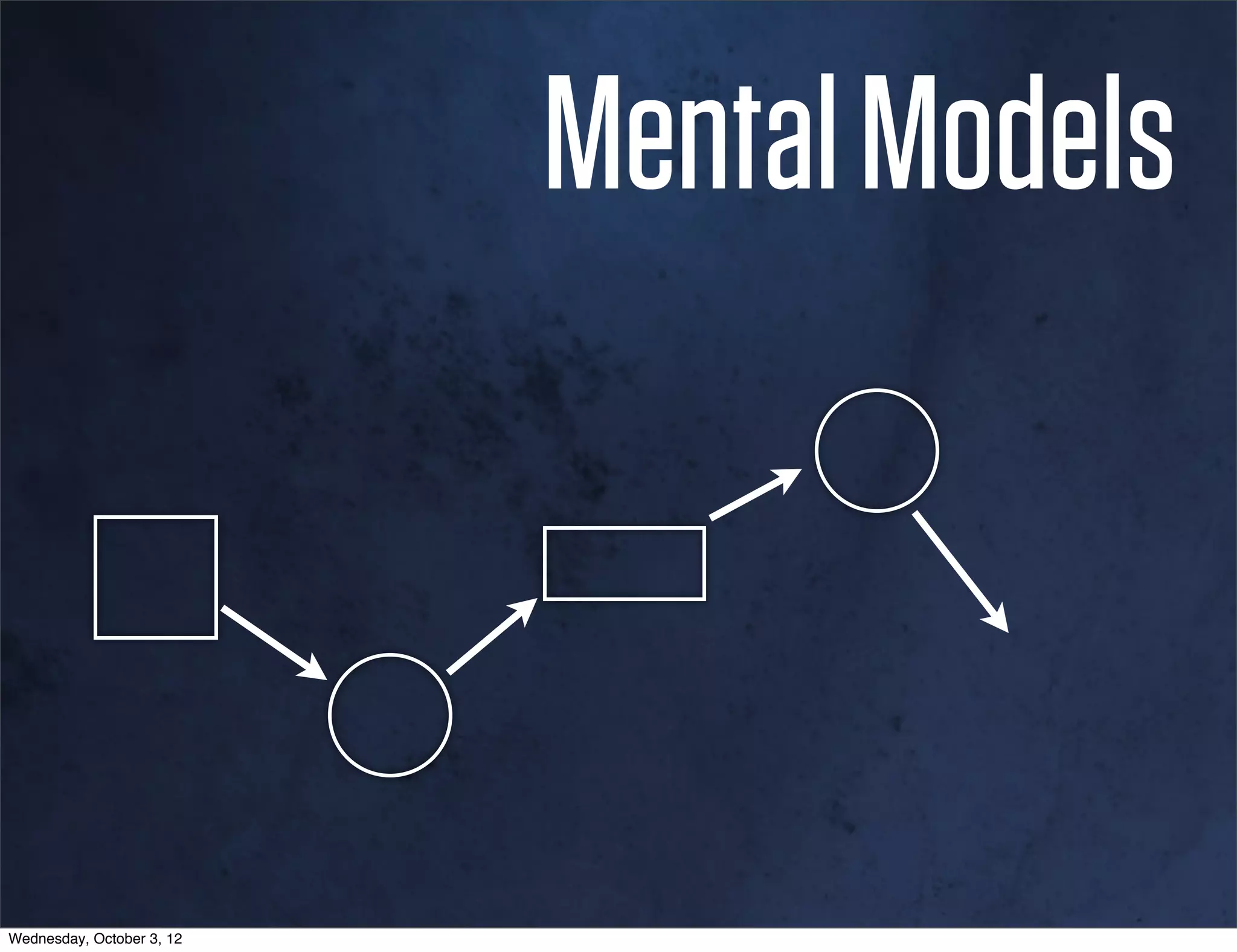
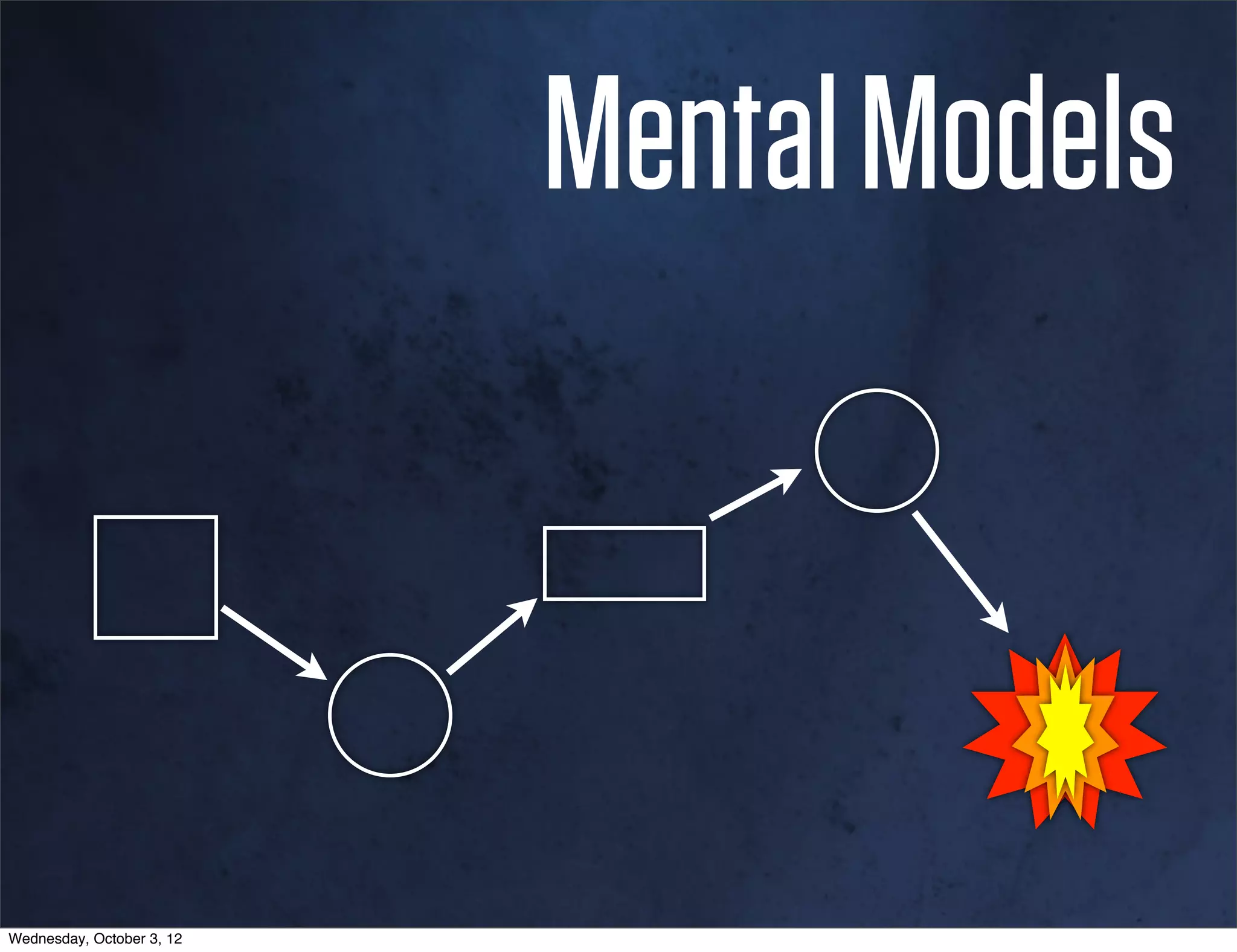
Mental Models

      • Categorization & Comprehension
      • Mental “map” or “schema”
      • Informed by experience, stored in memory
Wednesday, October 3, 12
Mental Models


Wednesday, October 3, 12
Level Three


Wednesday, October 3, 12
Mental Models


Wednesday, October 3, 12
Level Three
       Common Clues you’re losing SA at this level
         • Ambiguity
         • Fixation
         • Confusion
         • Lack of Information
         • Failure to maintain
         • Failure to meet expected checkpoint or target
         • Failure to resolve discrepancies
         • A bad gut feeling that things are not quite right 


Wednesday, October 3, 12
Characteristics of response to
    escalating scenarios


Wednesday, October 3, 12
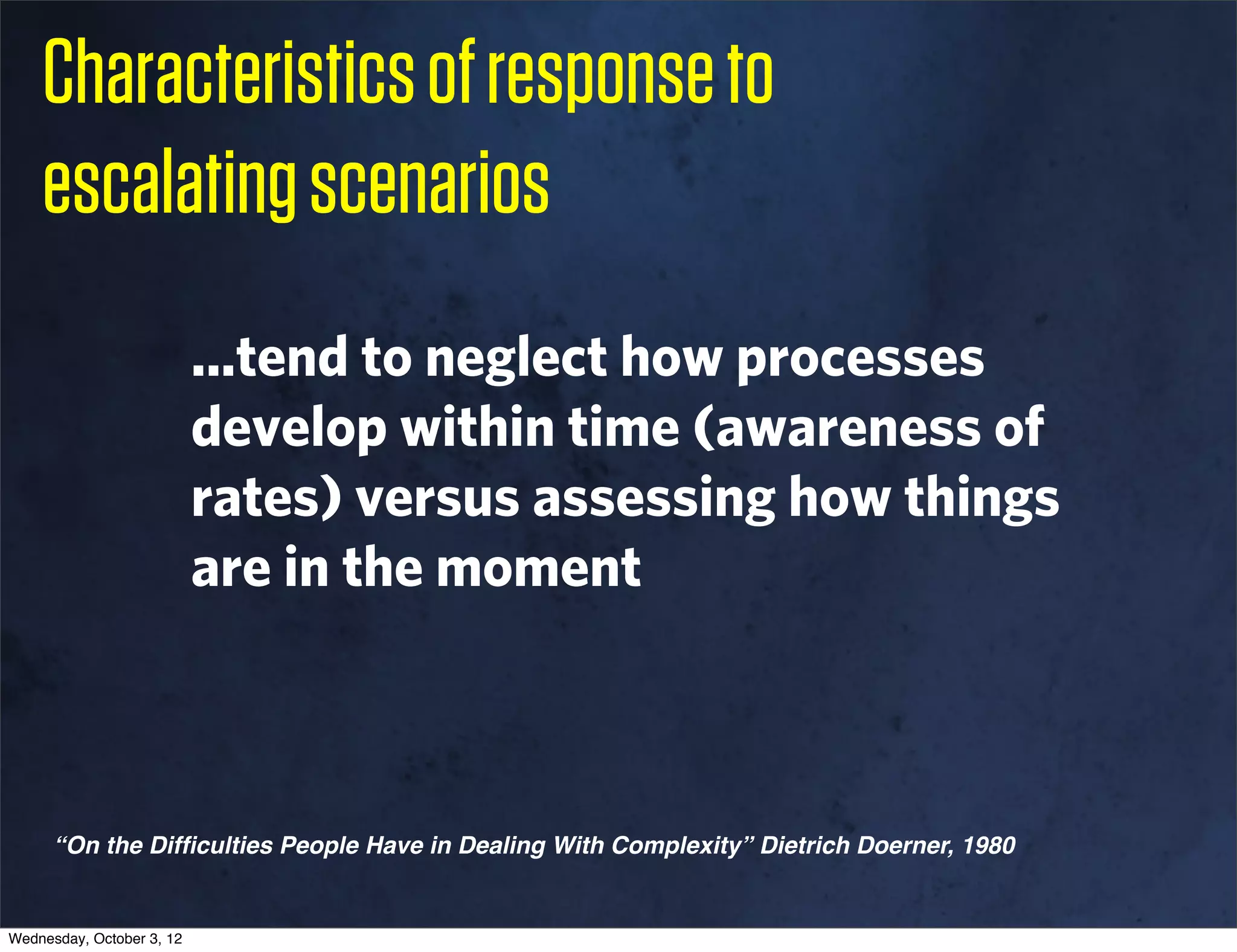
Characteristics of response to
    escalating scenarios
                           ...tend to neglect how processes
                           develop within time (awareness of
                           rates) versus assessing how things
                           are in the moment


      “On the Difficulties People Have in Dealing With Complexity” Dietrich Doerner, 1980


Wednesday, October 3, 12
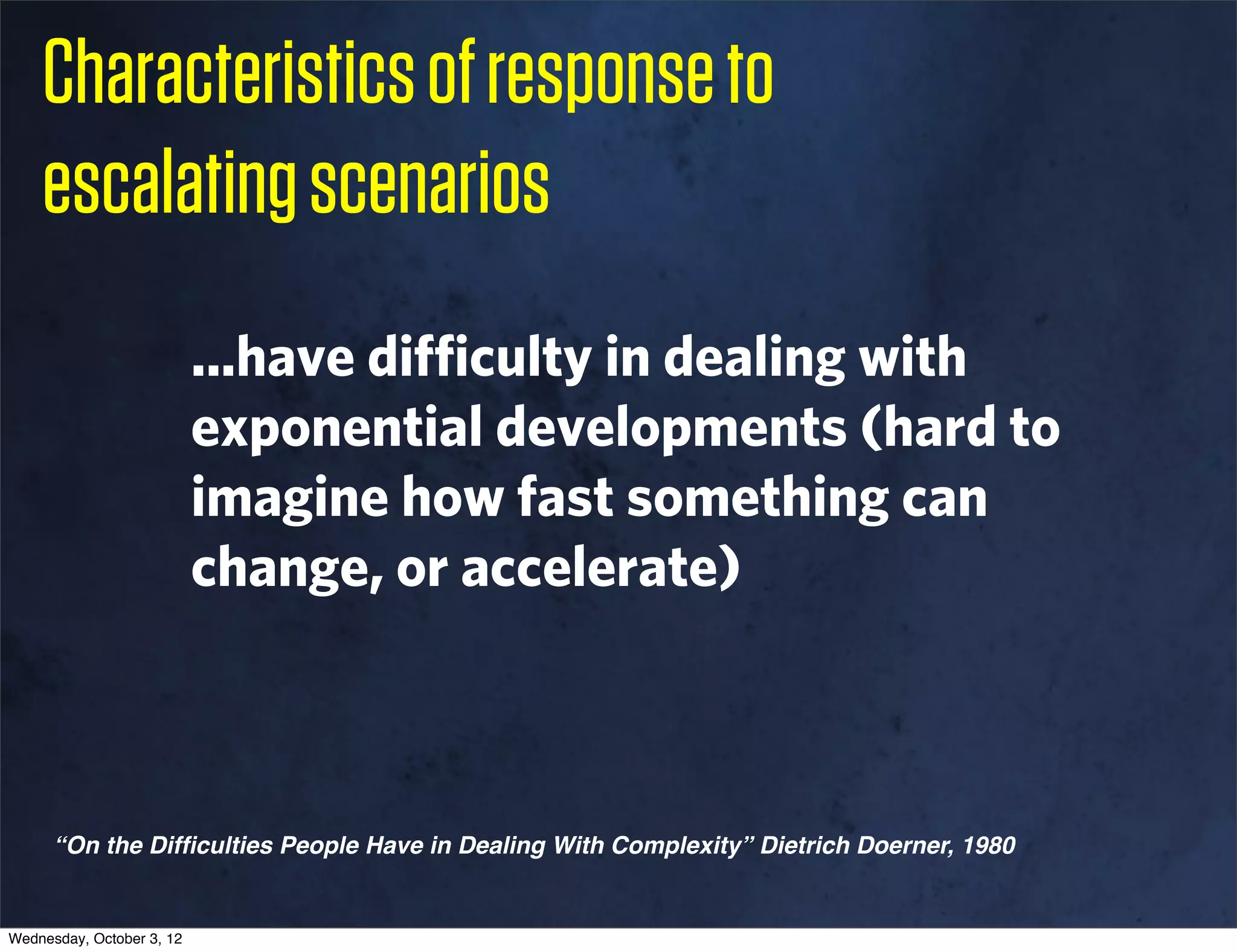
Characteristics of response to
    escalating scenarios
                           ...have difficulty in dealing with
                           exponential developments (hard to
                           imagine how fast something can
                           change, or accelerate)


      “On the Difficulties People Have in Dealing With Complexity” Dietrich Doerner, 1980


Wednesday, October 3, 12
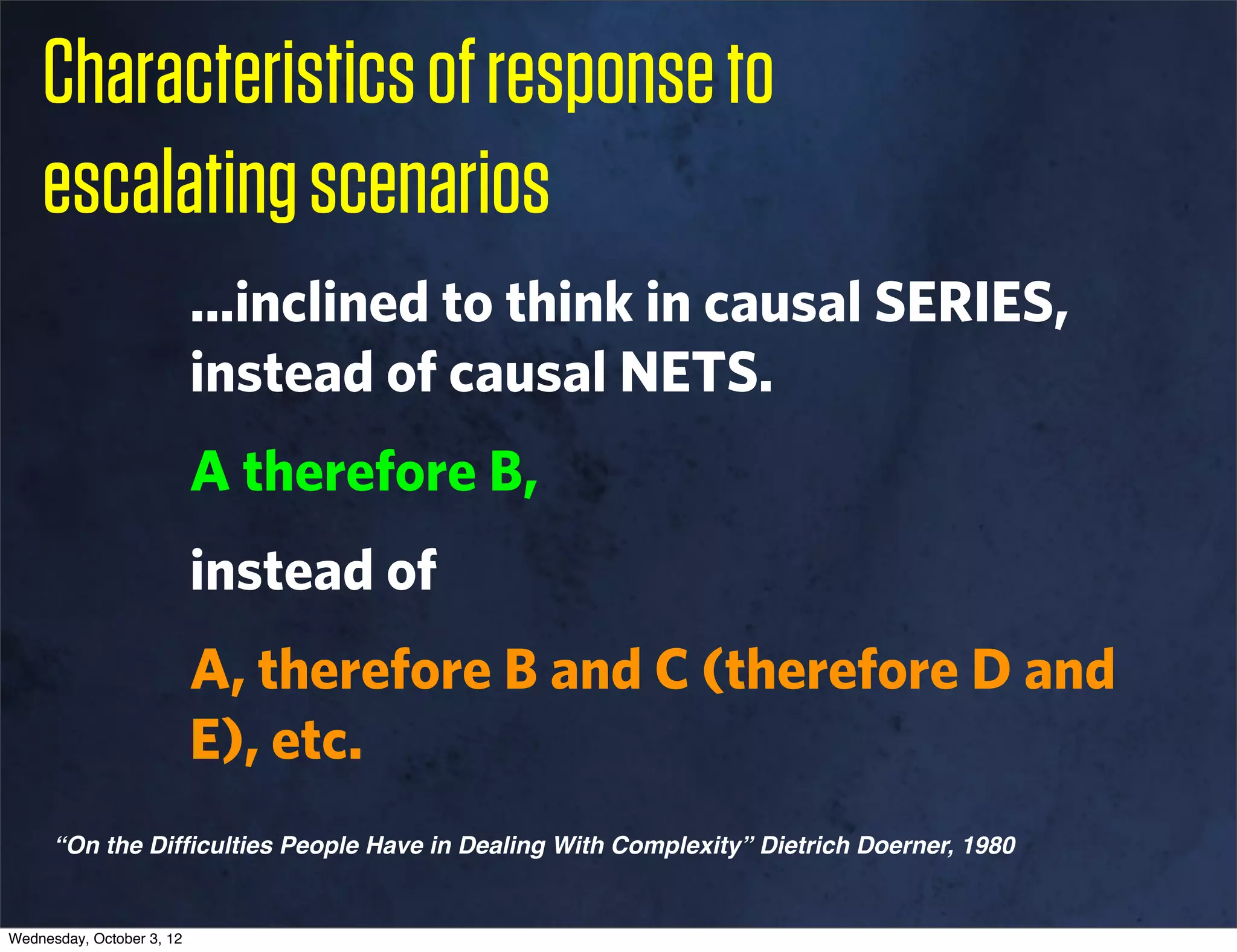
Characteristics of response to
    escalating scenarios
                           ...inclined to think in causal SERIES,
                           instead of causal NETS.
                           A therefore B,
                           instead of
                           A, therefore B and C (therefore D and
                           E), etc.
      “On the Difficulties People Have in Dealing With Complexity” Dietrich Doerner, 1980


Wednesday, October 3, 12
SA
                           Pitfalls


Requisite Memory Trap

Wednesday, October 3, 12
SA
                           Pitfalls

Workload, anxiety,
fatigue, other stressors

Wednesday, October 3, 12
SA
                           Pitfalls


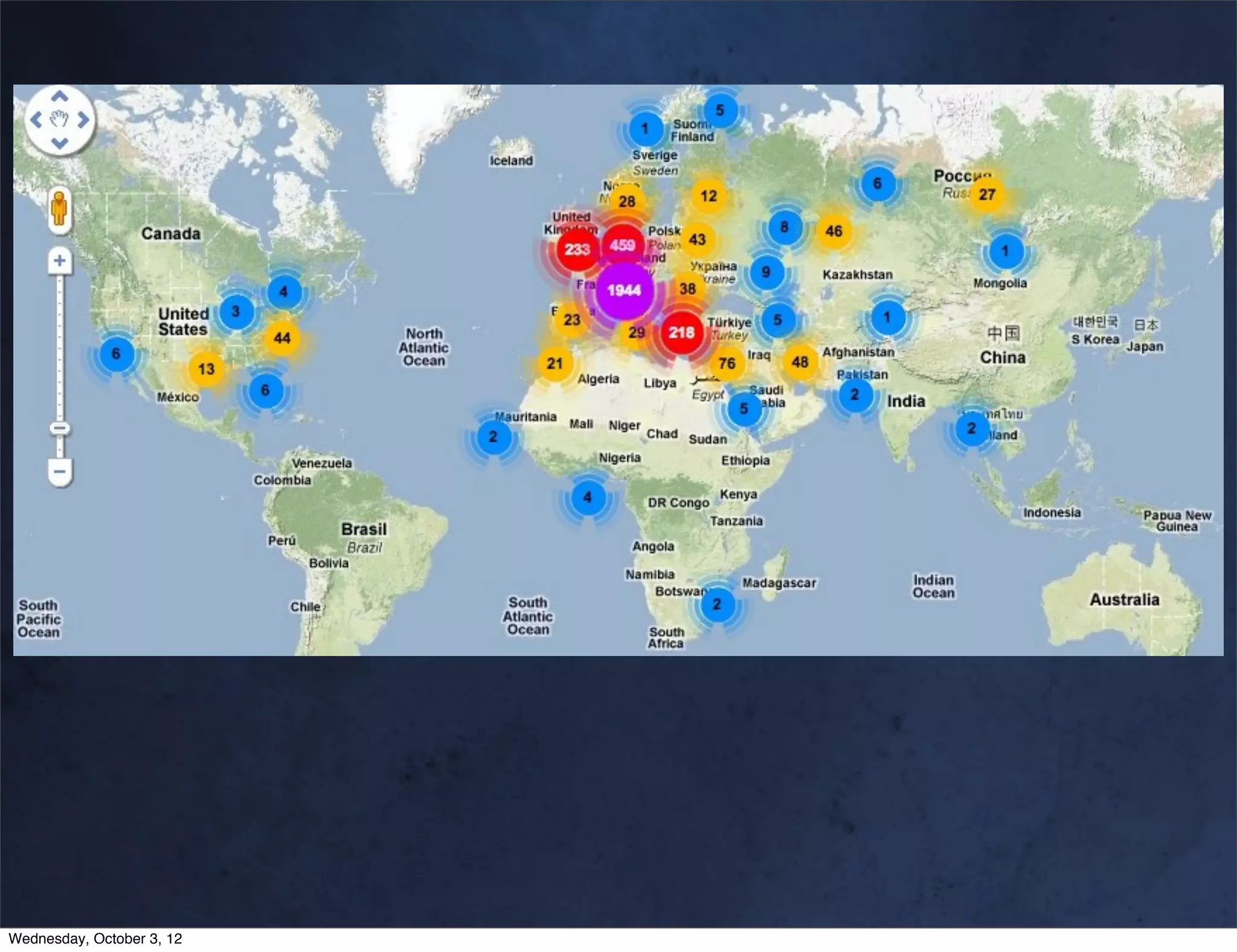
Data Overload

Wednesday, October 3, 12
SA
                           Pitfalls


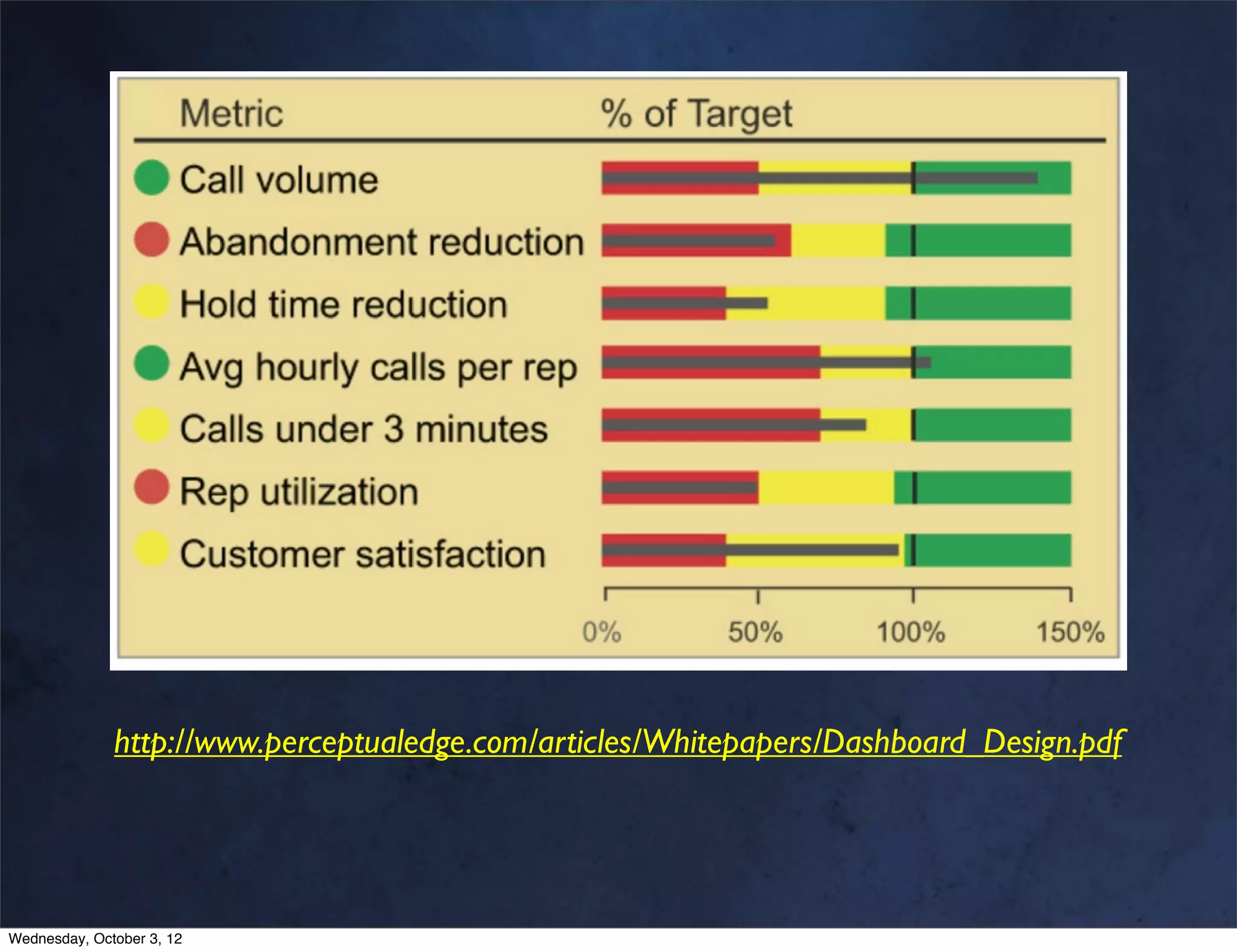
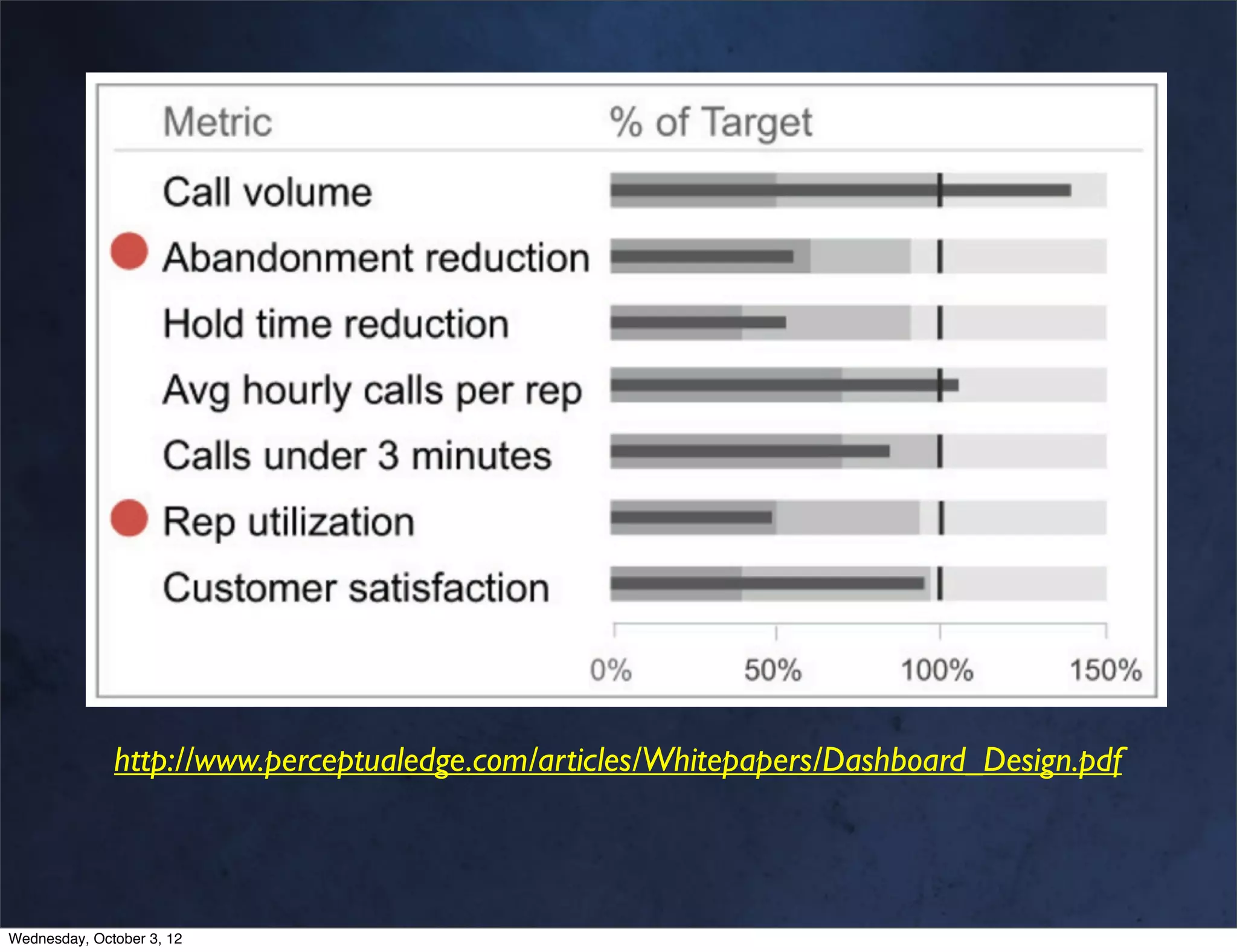
Misplace Salience

Wednesday, October 3, 12
http://www.perceptualedge.com/articles/Whitepapers/Dashboard_Design.pdf


Wednesday, October 3, 12
http://www.perceptualedge.com/articles/Whitepapers/Dashboard_Design.pdf


Wednesday, October 3, 12
SA
                                                 Pitfalls

 Complexity Creep
             “Everything should be as simple as it can be, but not simpler.”
             - paraphrased, Einstein


Wednesday, October 3, 12
SA
                           Pitfalls


Poor Mental Models

Wednesday, October 3, 12
SA
                           Pitfalls

Out-Of-The-Loop
Syndrome

Wednesday, October 3, 12
SA
                           Pitfalls

Refusal to make
decisions

Wednesday, October 3, 12
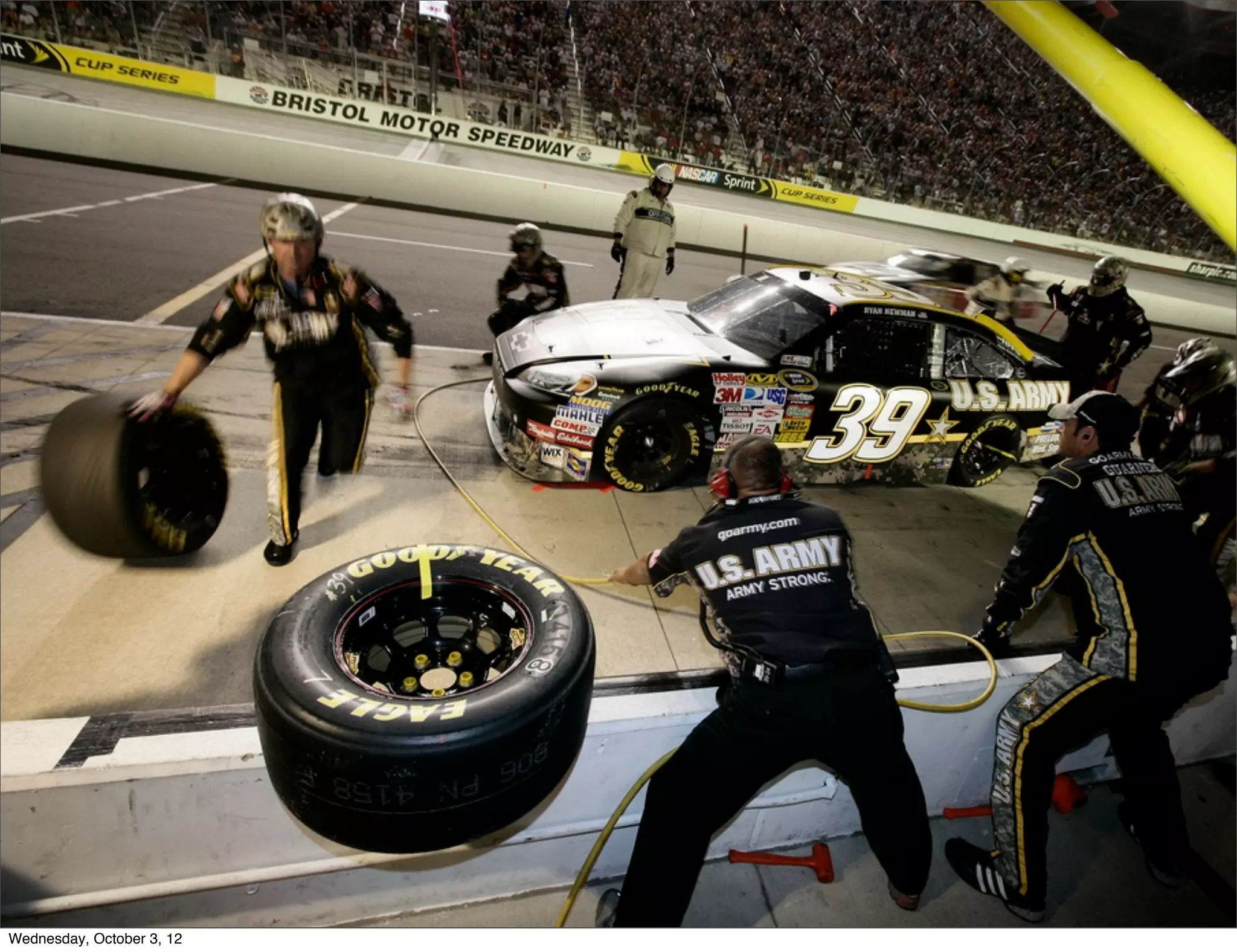
Heroism
         Non-communicating lone wolf-isms


Wednesday, October 3, 12
Distraction
         Irrelevant noise in comm channels


Wednesday, October 3, 12
TEAMS
      • Divide and conquer applied to problem space,
              division of labor
      • Incident resolution vs. Problem resolution
      • Reproducibility
      • Fault Tolerance Effects
Wednesday, October 3, 12
TEAMS


         Shotgun debugging


Wednesday, October 3, 12
JOINT
                                      ACTIVITY
      • Interpredictability
      • Common Ground
      • Directability
             http://csel.eng.ohio-state.edu/woods/distributed/CG%20final.pdf
Wednesday, October 3, 12
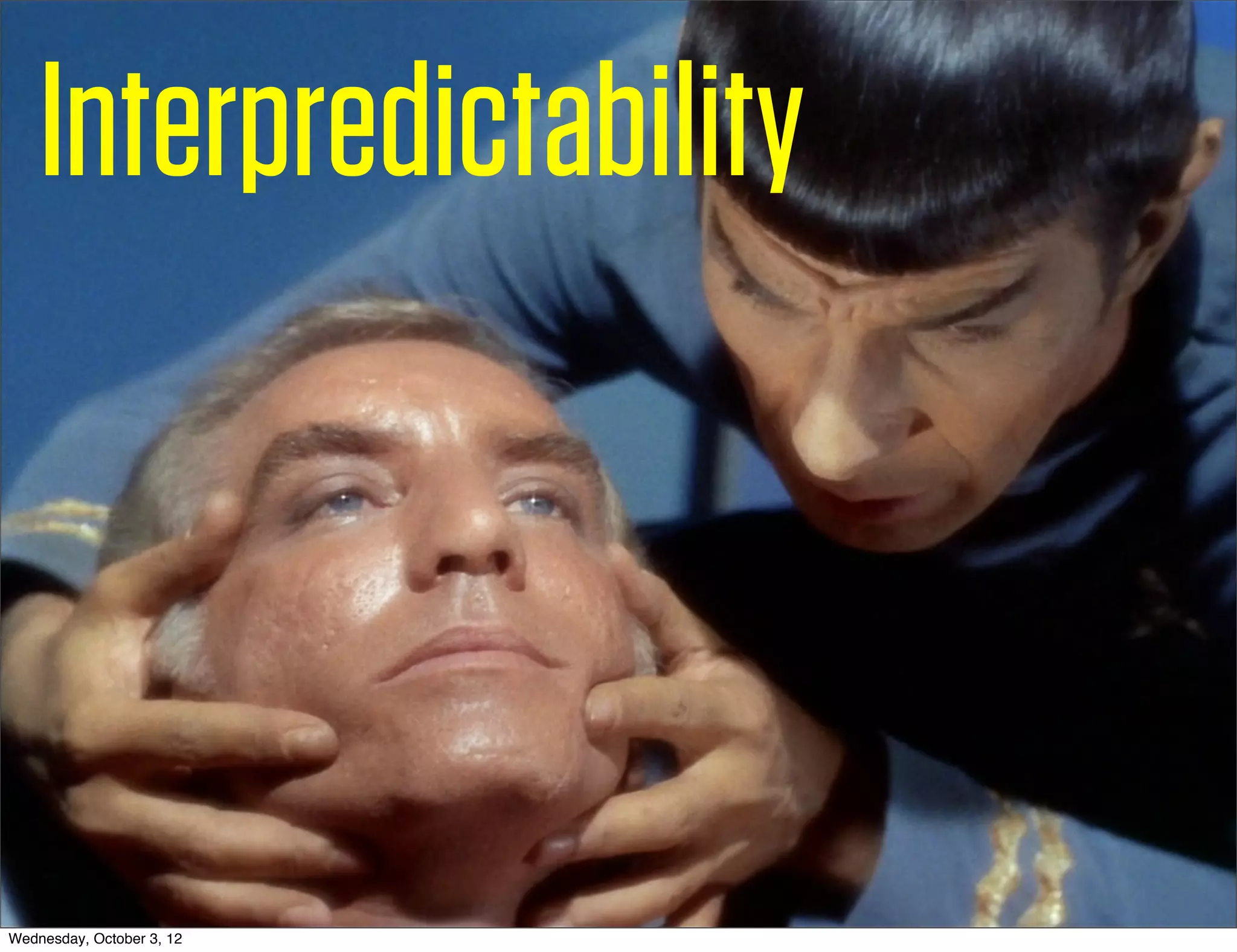
Interpredictability


Wednesday, October 3, 12
Common Ground
Wednesday, October 3, 12
Directability


Wednesday, October 3, 12
Improvisation


Wednesday, October 3, 12
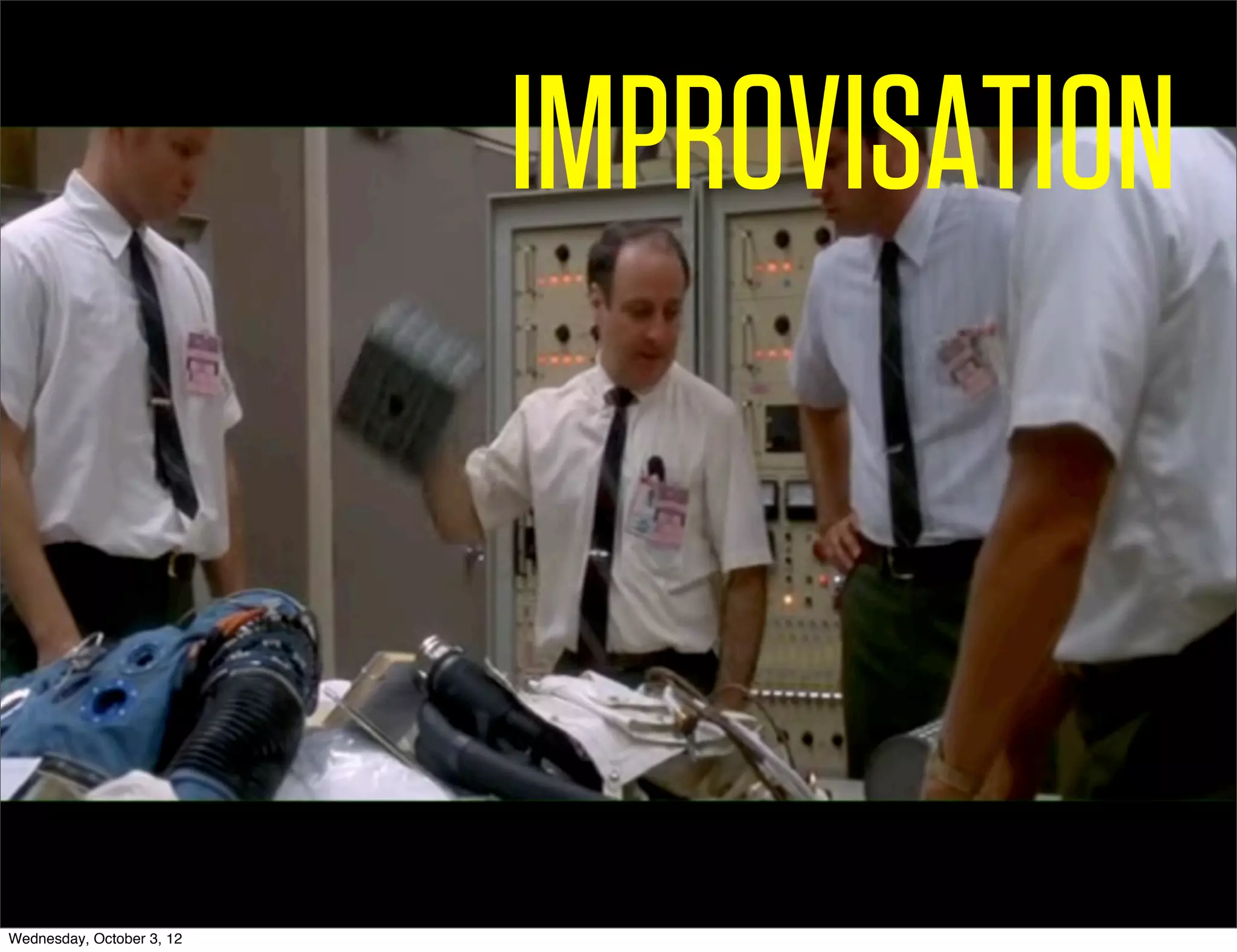
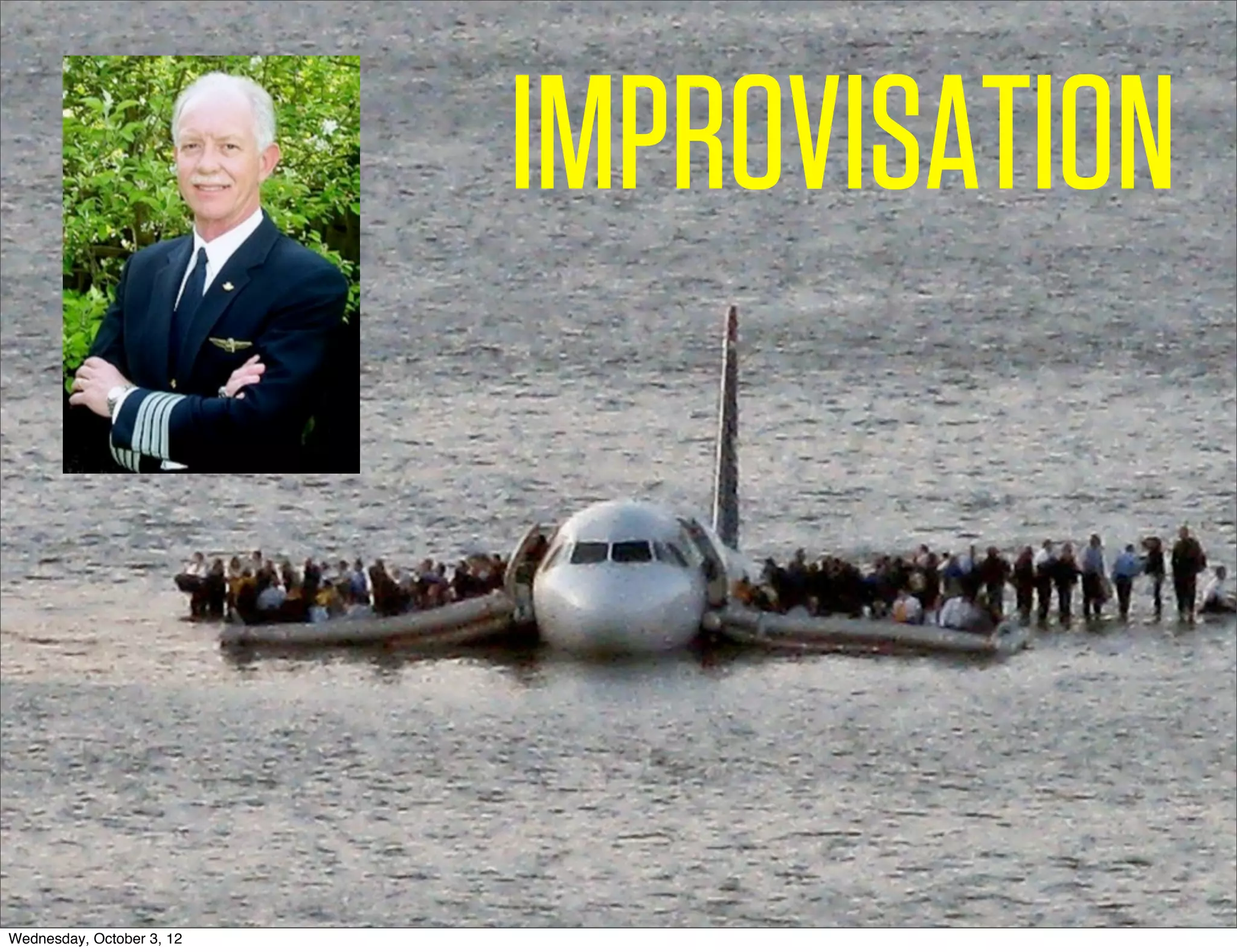
IMPROVISATION


Wednesday, October 3, 12
IMPROVISATION


Wednesday, October 3, 12
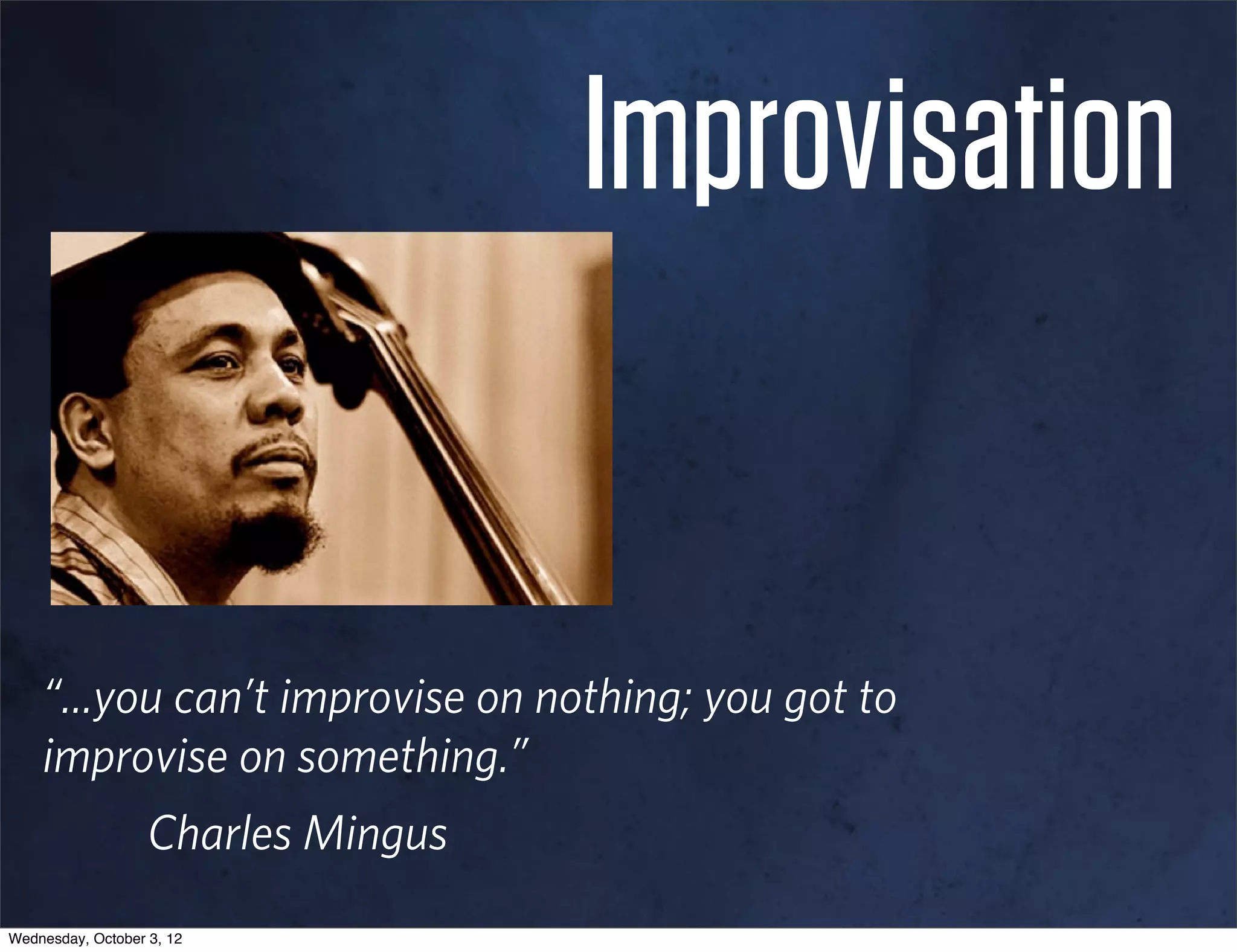
Improvisation


    “...you can’t improvise on nothing; you got to
    improvise on something.”
                   Charles Mingus
Wednesday, October 3, 12
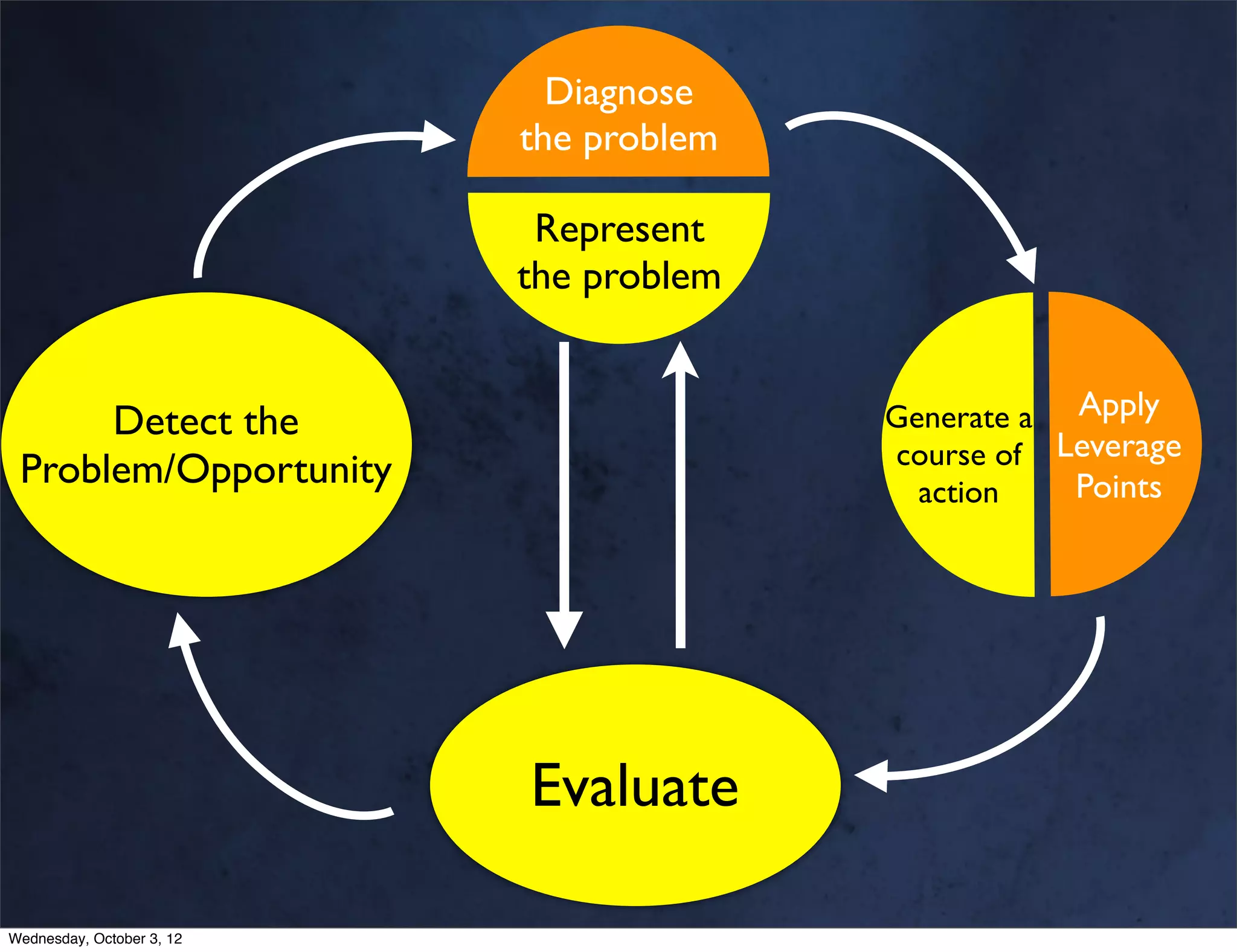
Diagnose
                           the problem

                            Represent
                           the problem


      Detect the                         Generate a Apply
                                         course of Leverage
 Problem/Opportunity                       action   Points


                           Evaluate

Wednesday, October 3, 12
Communication
     Recommendations

         •Explicitness
         •Assertiveness
         •Timing


Wednesday, October 3, 12
Assertiveness

      • Passive
      • Assertive
      • Aggressive
Wednesday, October 3, 12
Exercise


Wednesday, October 3, 12
Communication
      • IRC?
      • Face-To-Face?
      • Conference Call?
      • Morse Code?
Wednesday, October 3, 12
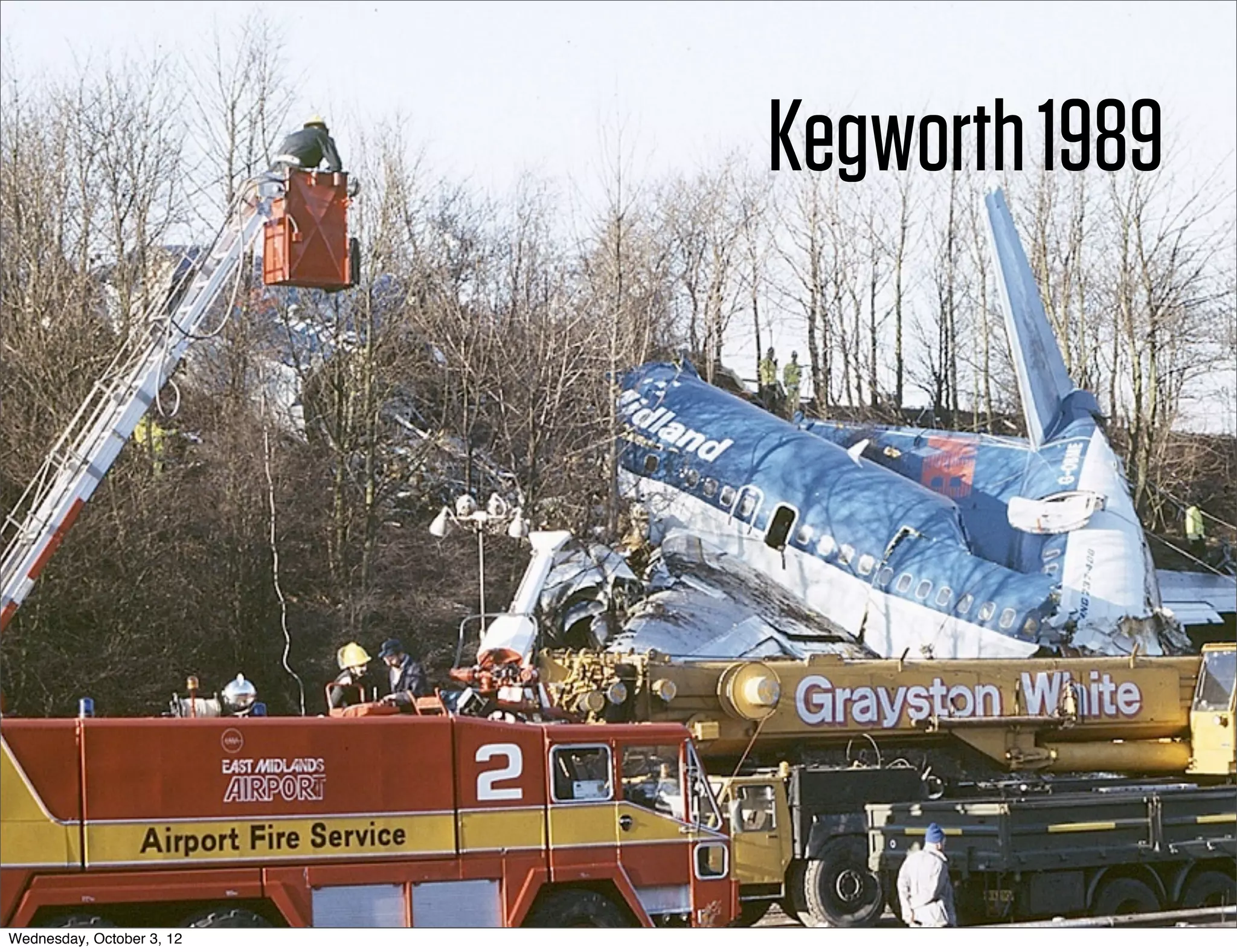
Kegworth 1989


Wednesday, October 3, 12
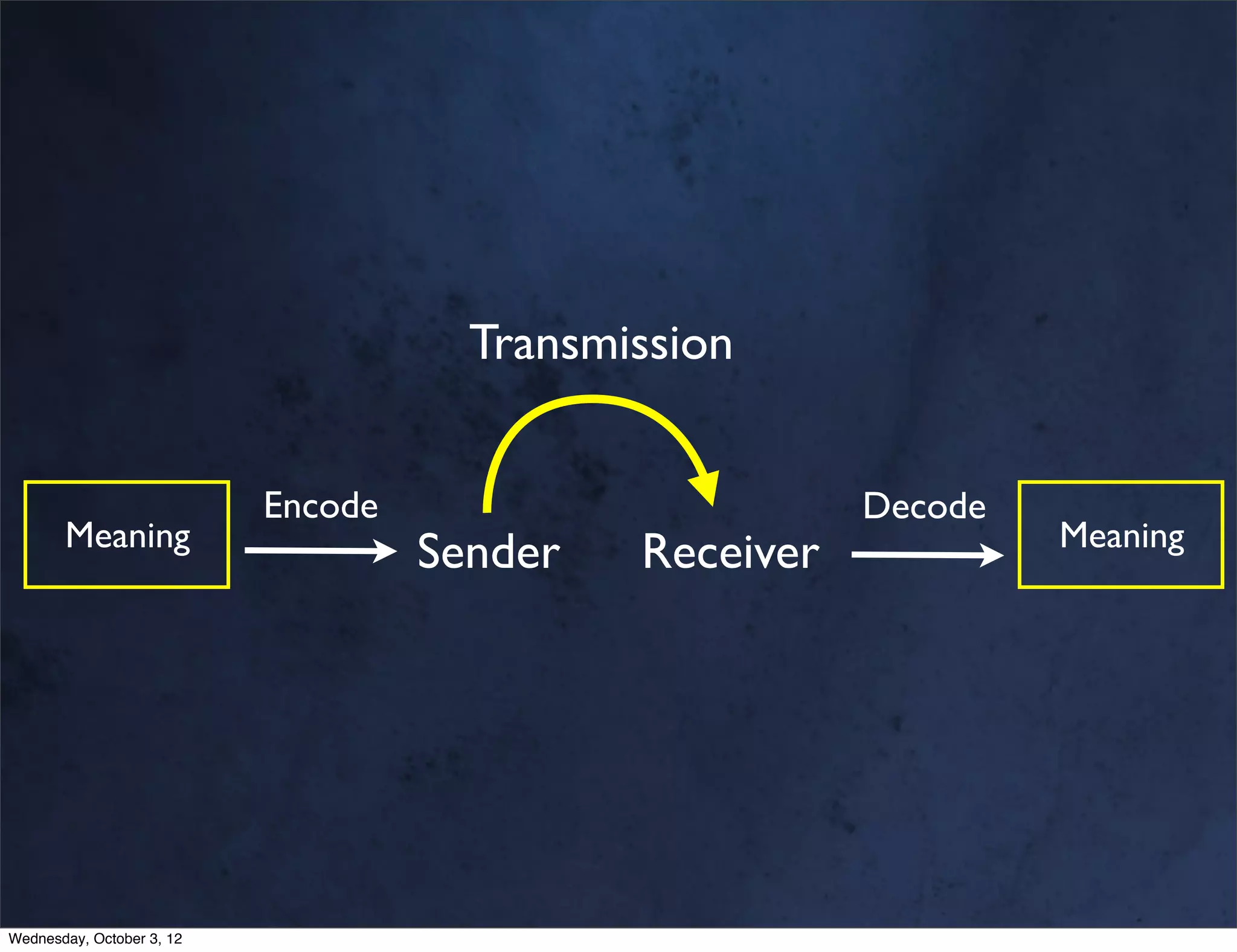
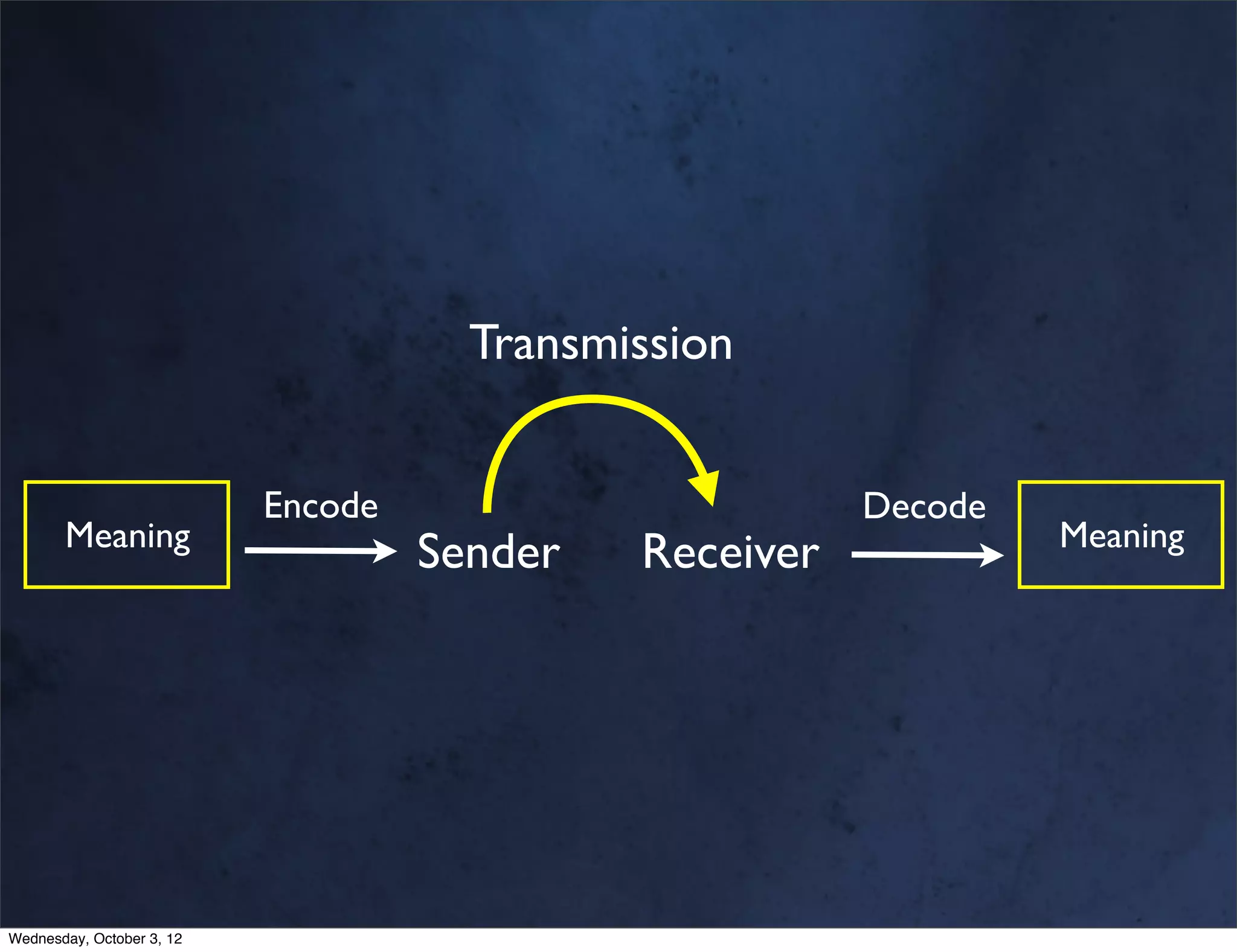
Transmission


                           Encode                       Decode
       Meaning                                                   Meaning
                                    Sender   Receiver


Wednesday, October 3, 12
Transmission


                           Encode                       Decode
       Meaning                                                   Meaning
                                    Sender   Receiver


Wednesday, October 3, 12
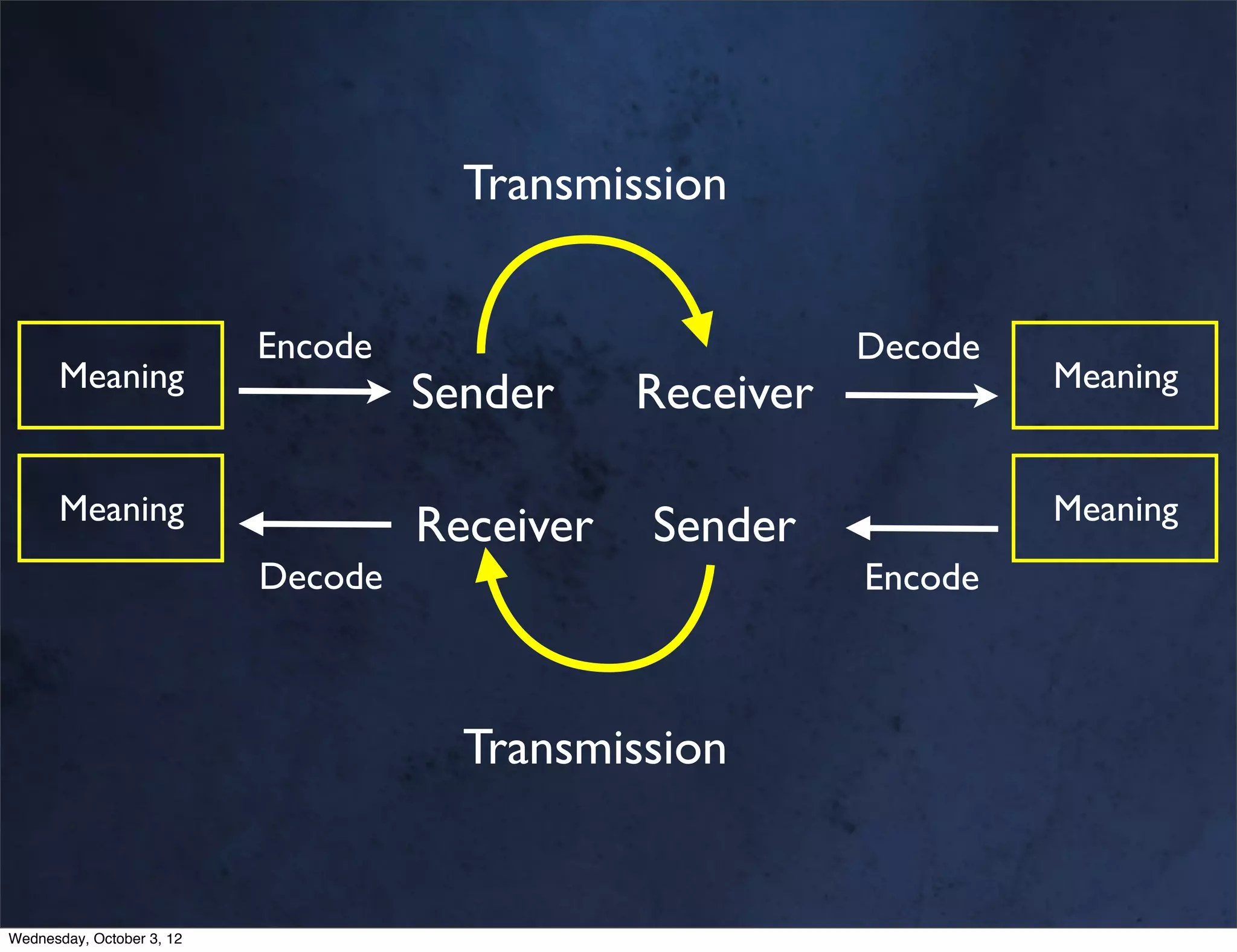
Transmission


                           Encode                         Decode
      Meaning                                                      Meaning
                                    Sender     Receiver

      Meaning                                                      Meaning
                                    Receiver   Sender
                           Decode                         Encode


                                      Transmission


Wednesday, October 3, 12
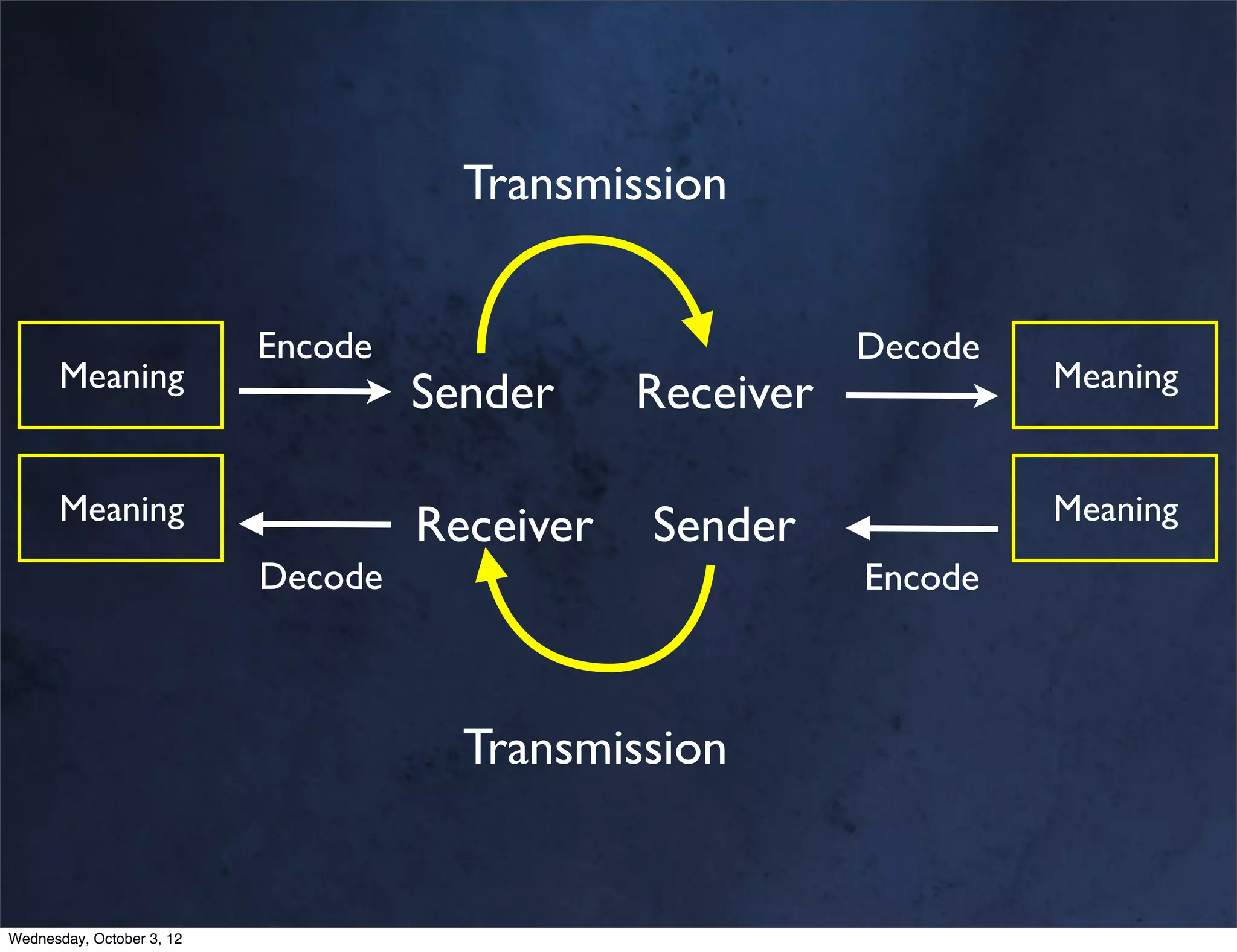
Transmission


                           Encode                         Decode
      Meaning                                                      Meaning
                                    Sender     Receiver

      Meaning                                                      Meaning
                                    Receiver   Sender
                           Decode                         Encode


                                      Transmission


Wednesday, October 3, 12
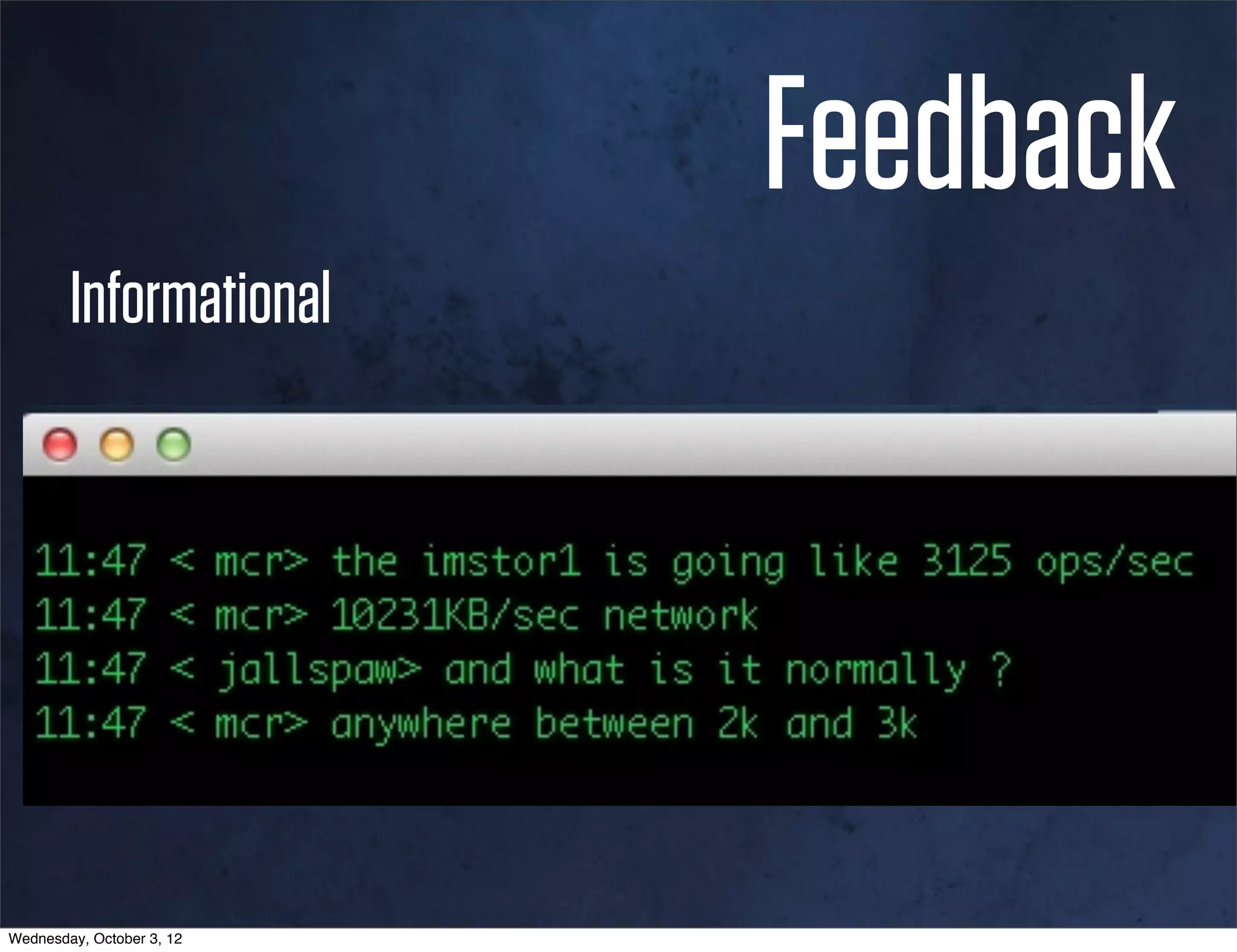
Feedback
        Informational


Wednesday, October 3, 12
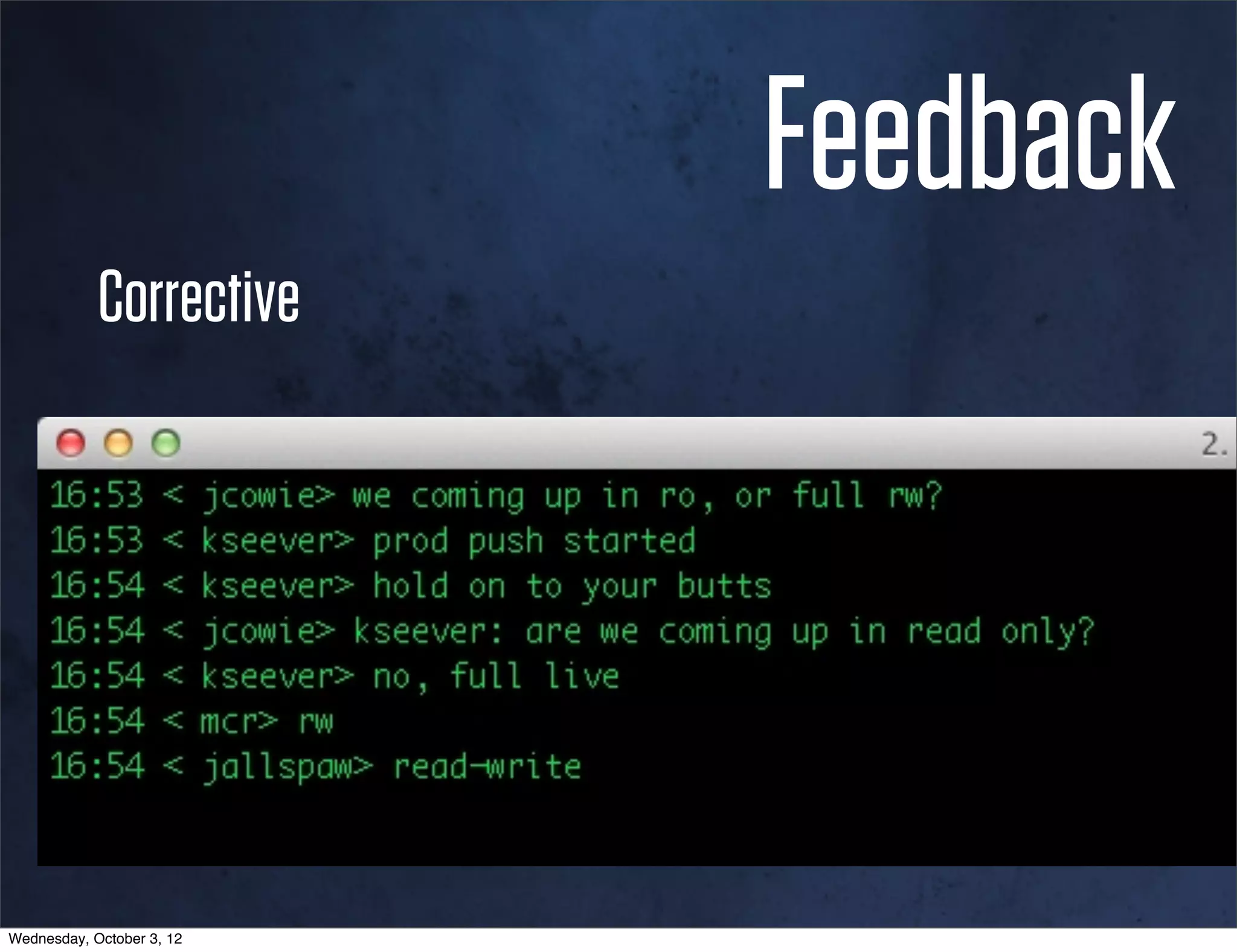
Feedback
            Corrective


Wednesday, October 3, 12
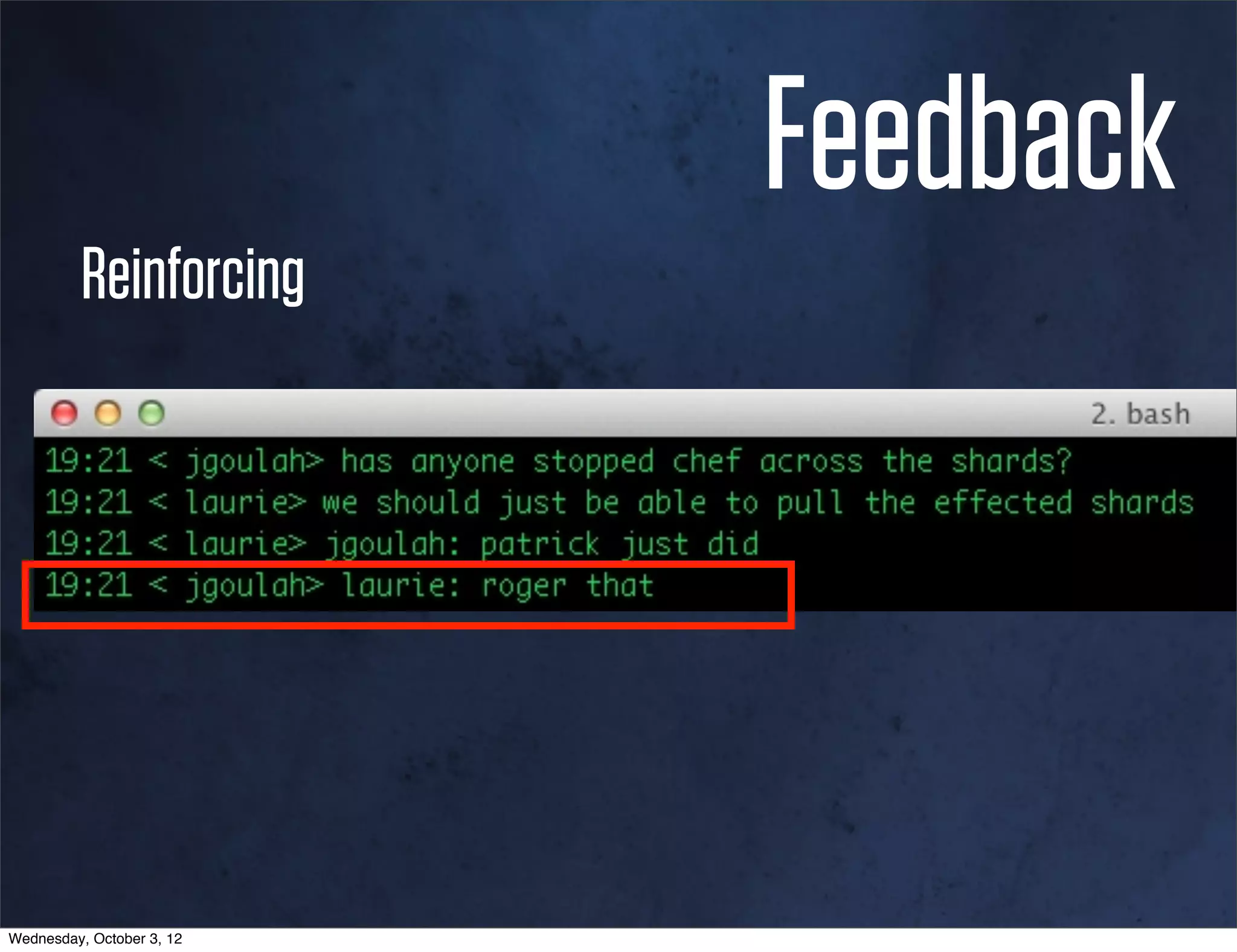
Feedback
          Reinforcing


Wednesday, October 3, 12
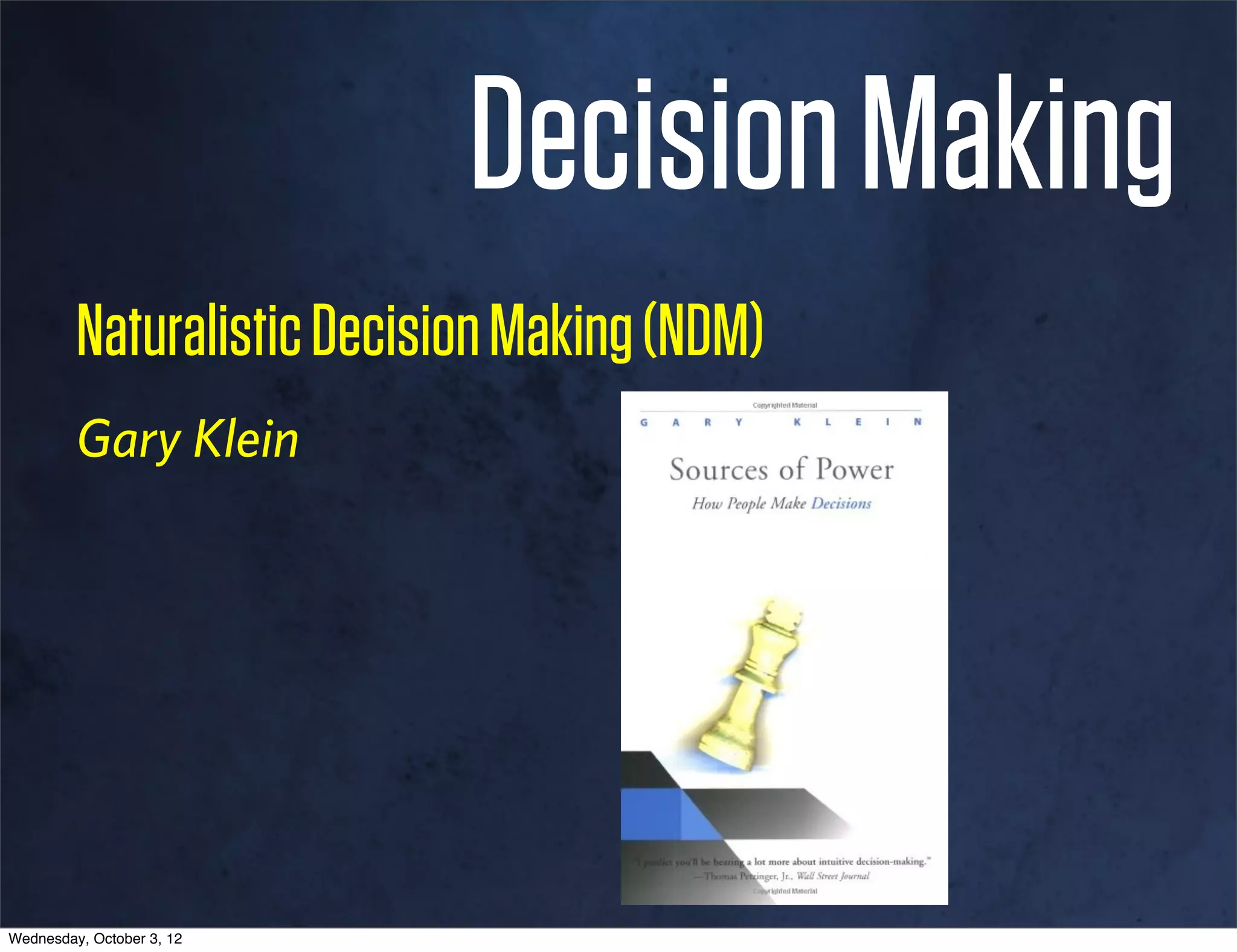
Decision Making
         Naturalistic Decision Making (NDM)
         Gary Klein


Wednesday, October 3, 12
Decision Making

         Step One: What is the problem?


Wednesday, October 3, 12
Decision Making

         Step Two: What shall I do?


Wednesday, October 3, 12
Decision Making

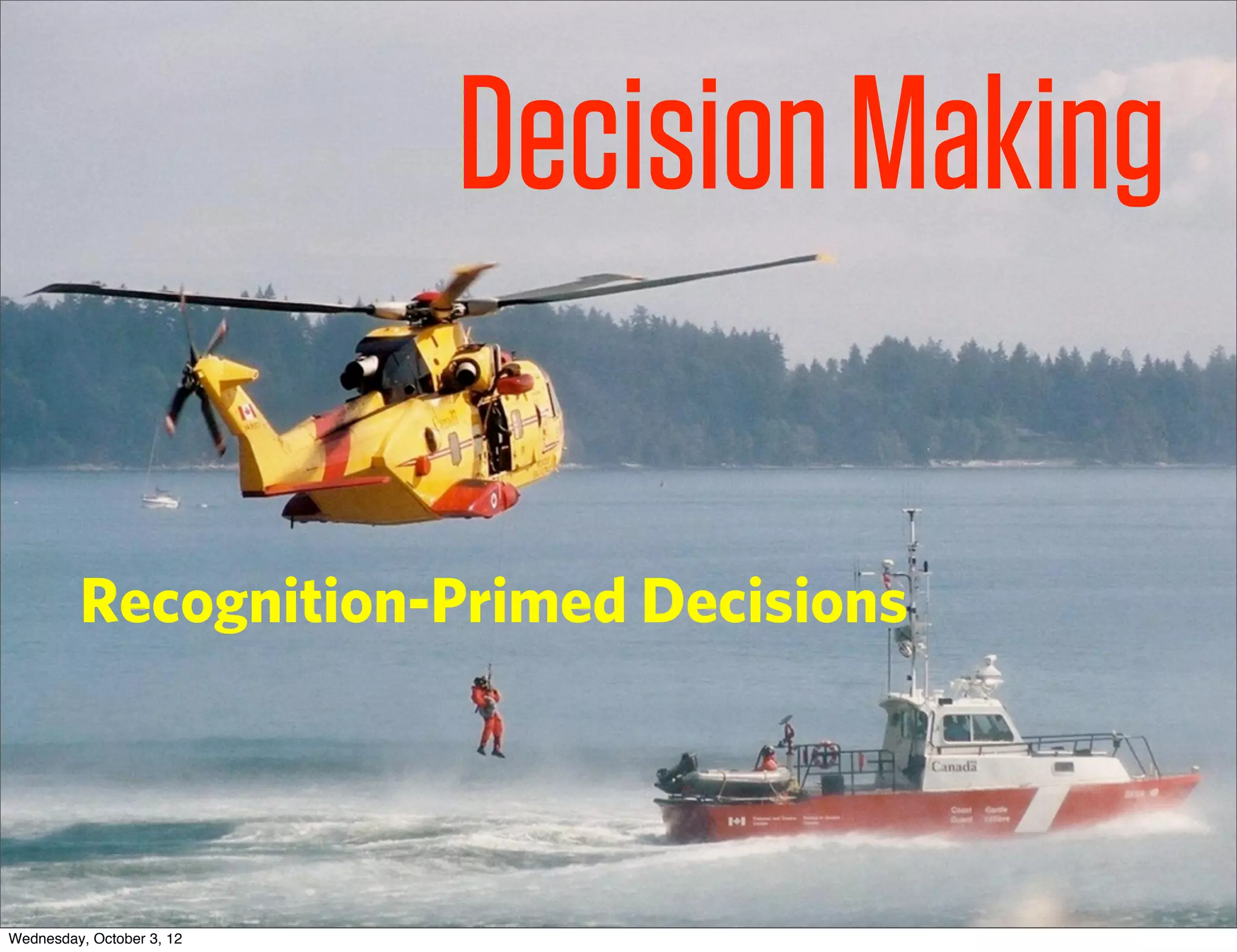
         Recognition-Primed Decisions


Wednesday, October 3, 12
Decision Making

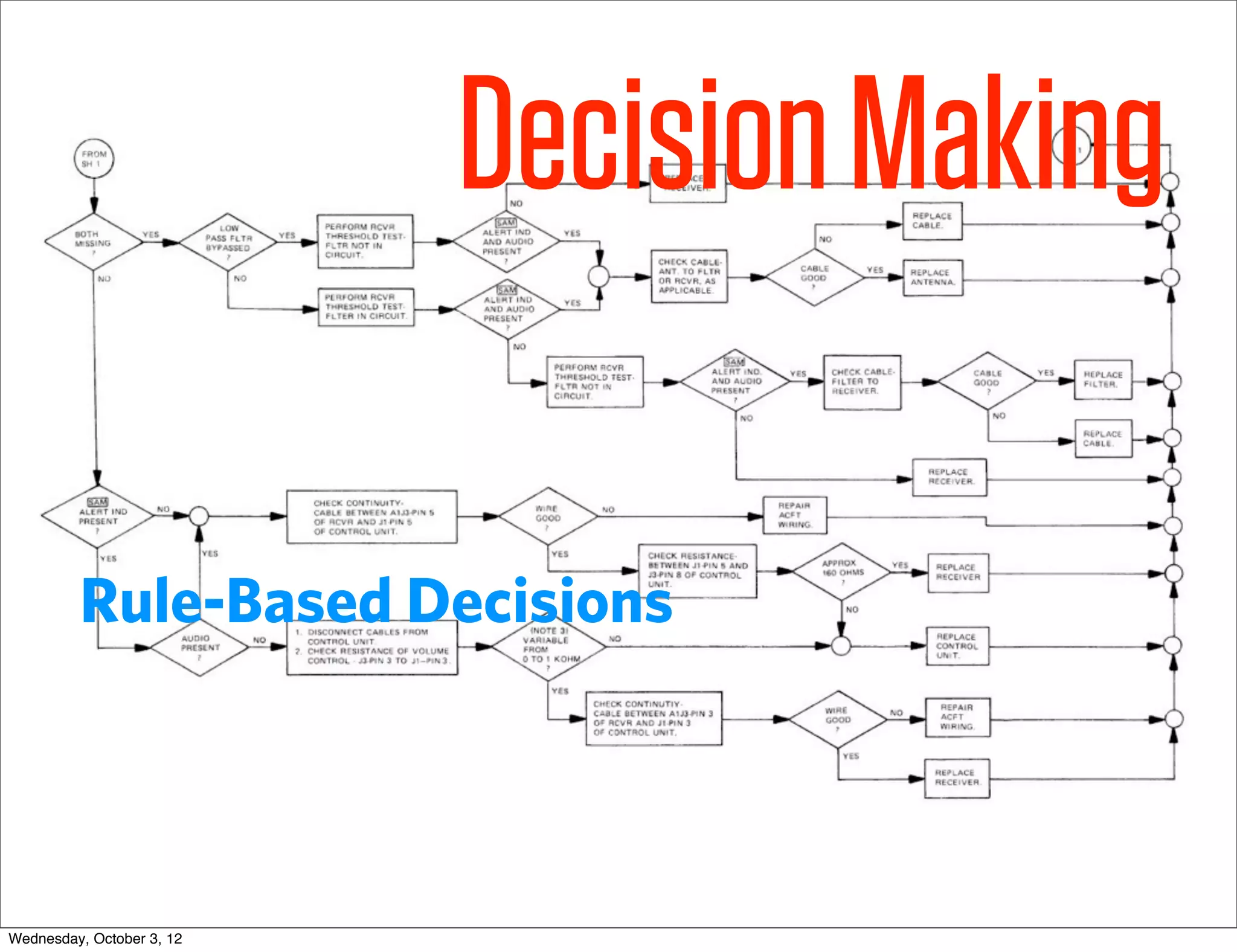
         Rule-Based Decisions


Wednesday, October 3, 12
Decision Making

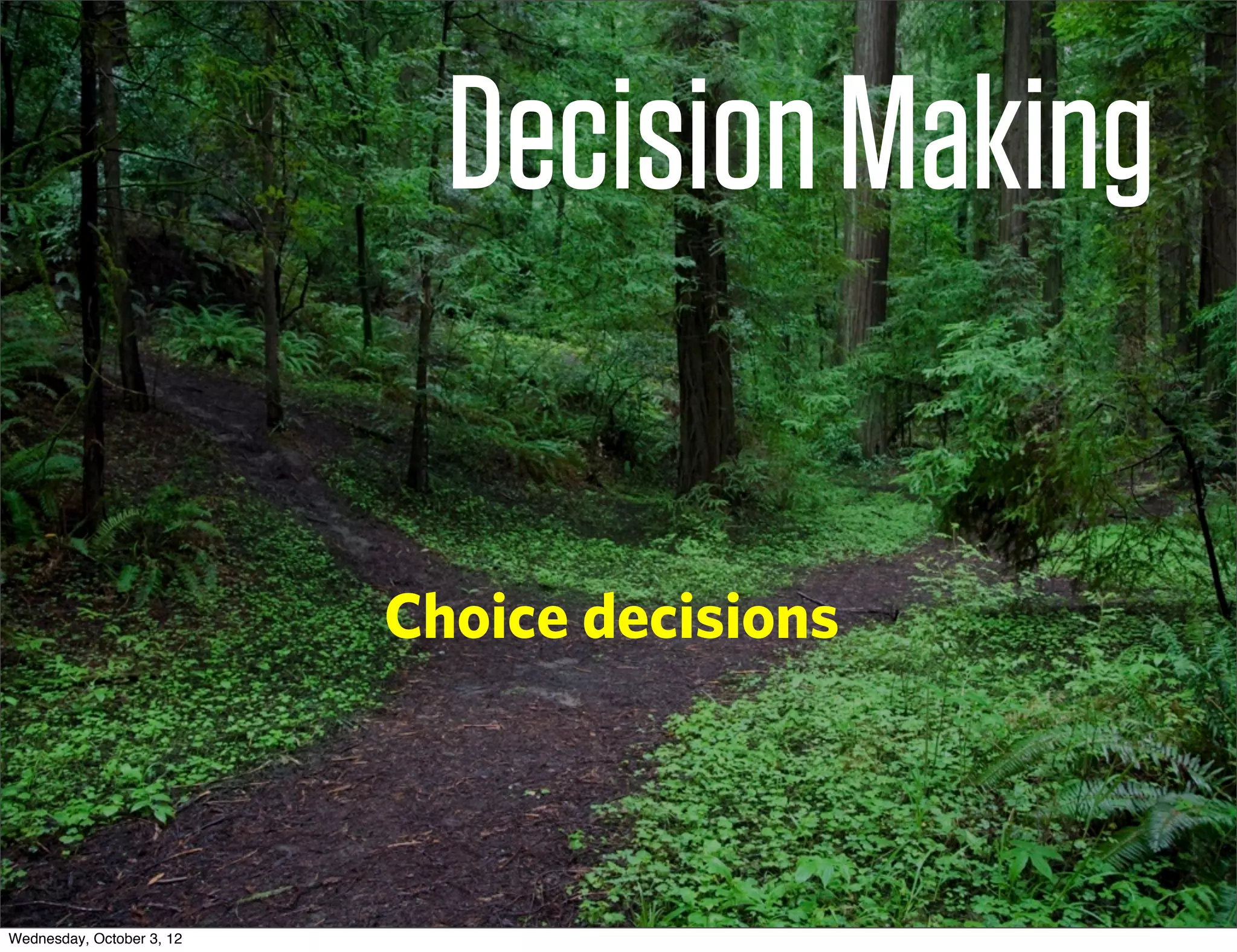
                           Choice decisions


Wednesday, October 3, 12
Decision Making
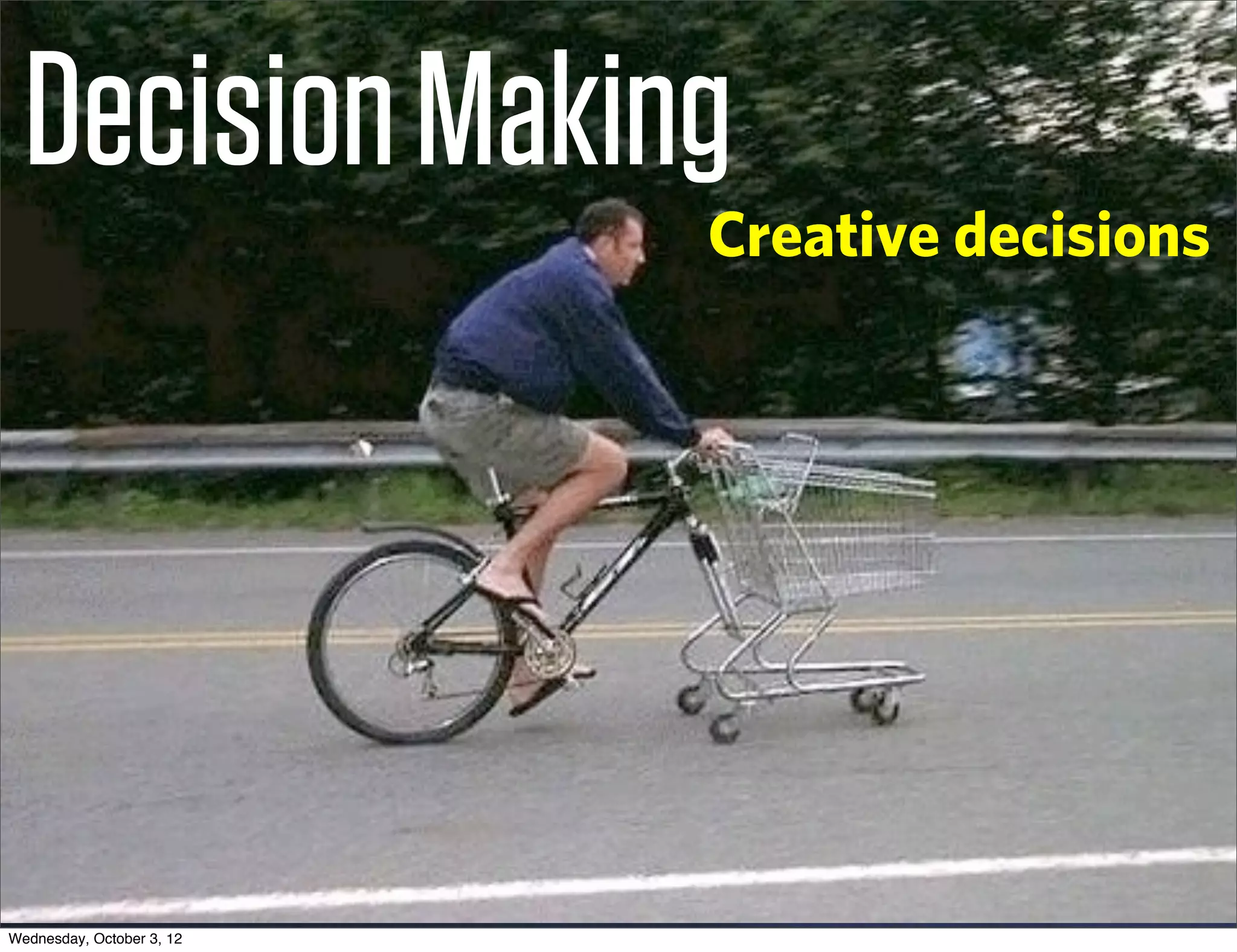
                           Creative decisions


Wednesday, October 3, 12
Decision Making
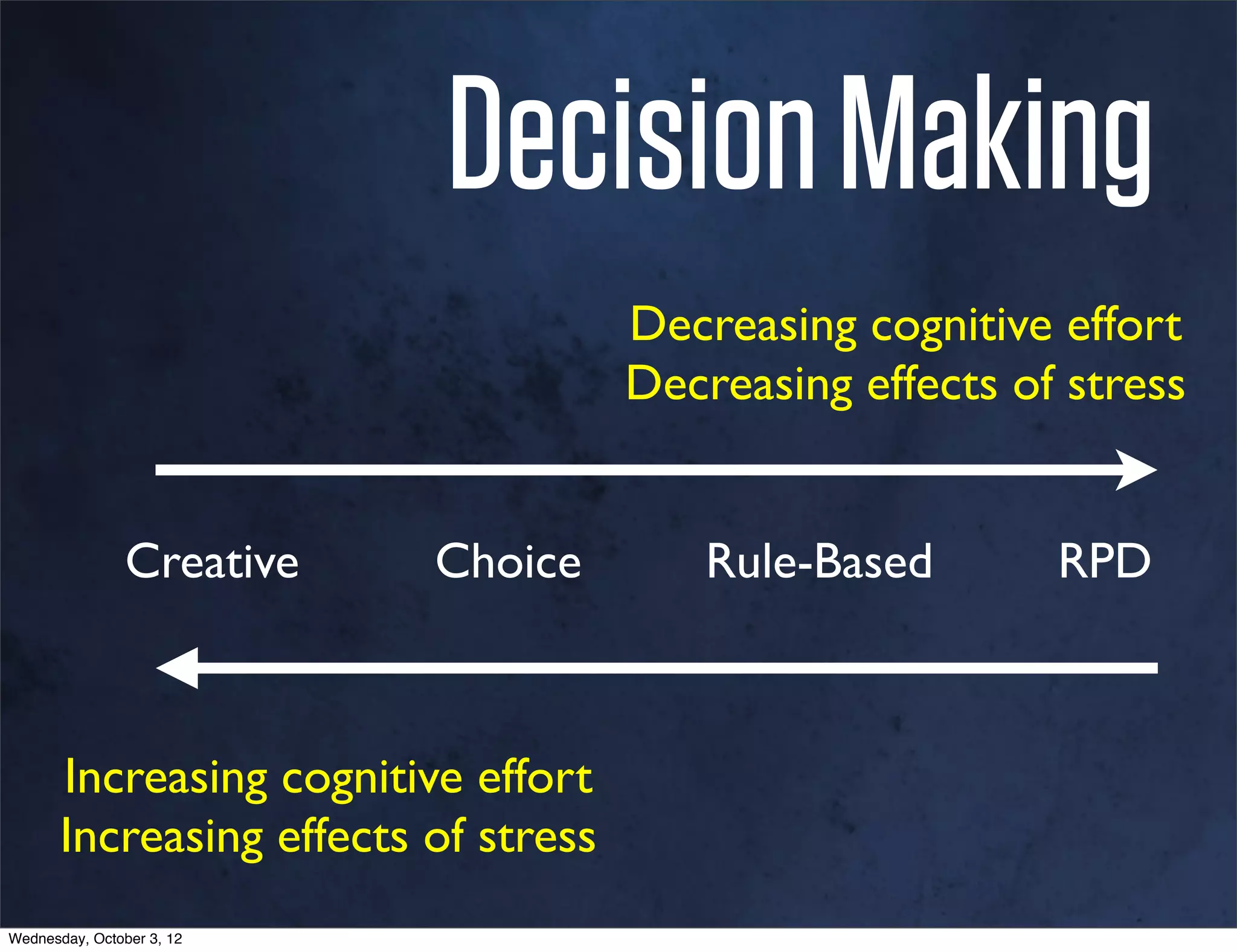
                                      Decreasing cognitive effort
                                      Decreasing effects of stress


                Creative   Choice         Rule-Based       RPD


       Increasing cognitive effort
       Increasing effects of stress
Wednesday, October 3, 12
Decision Making

         PRE-Mortem


Wednesday, October 3, 12
Tooling


Wednesday, October 3, 12
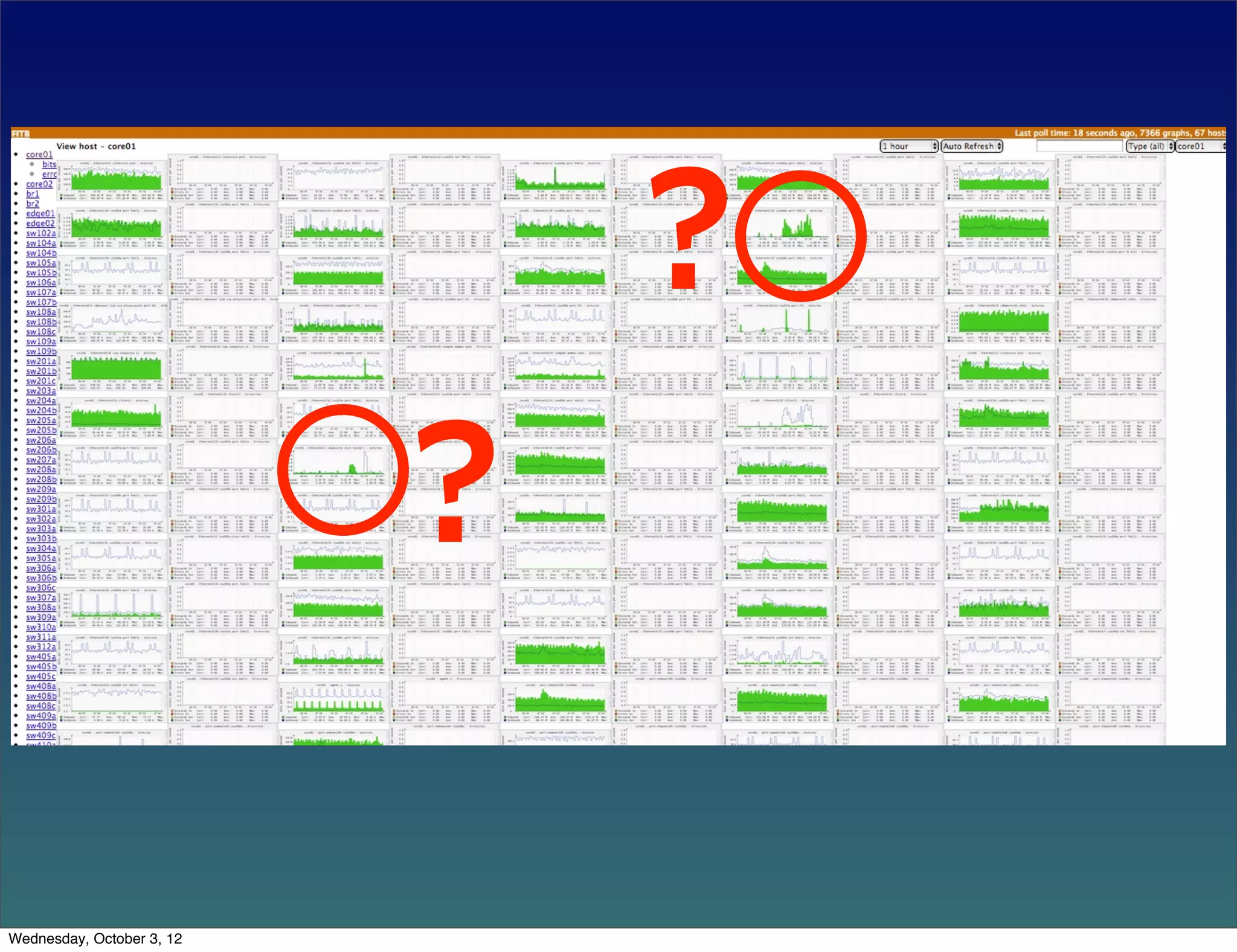
?
                           ?

Wednesday, October 3, 12
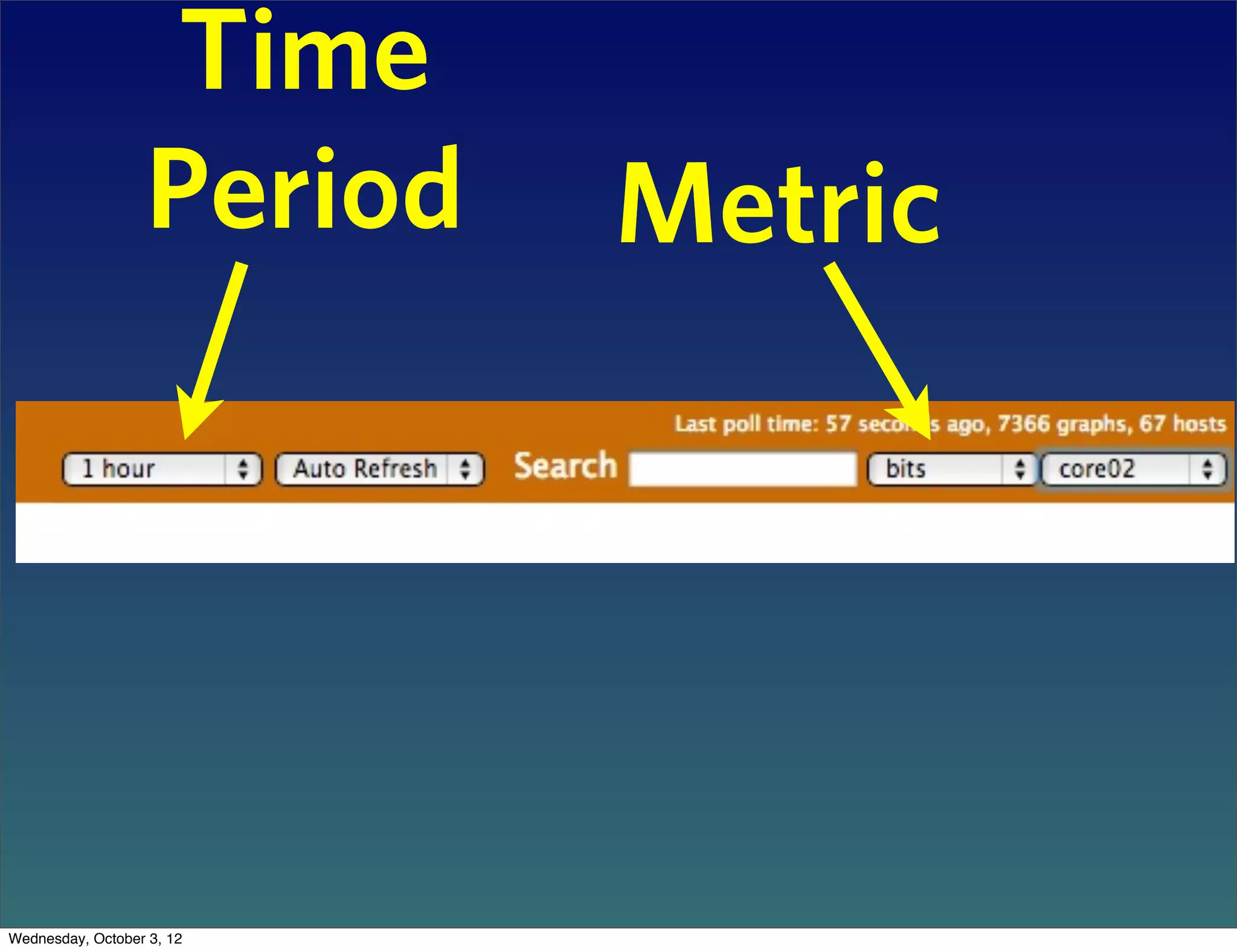
Time
                  Period   Metric


Wednesday, October 3, 12
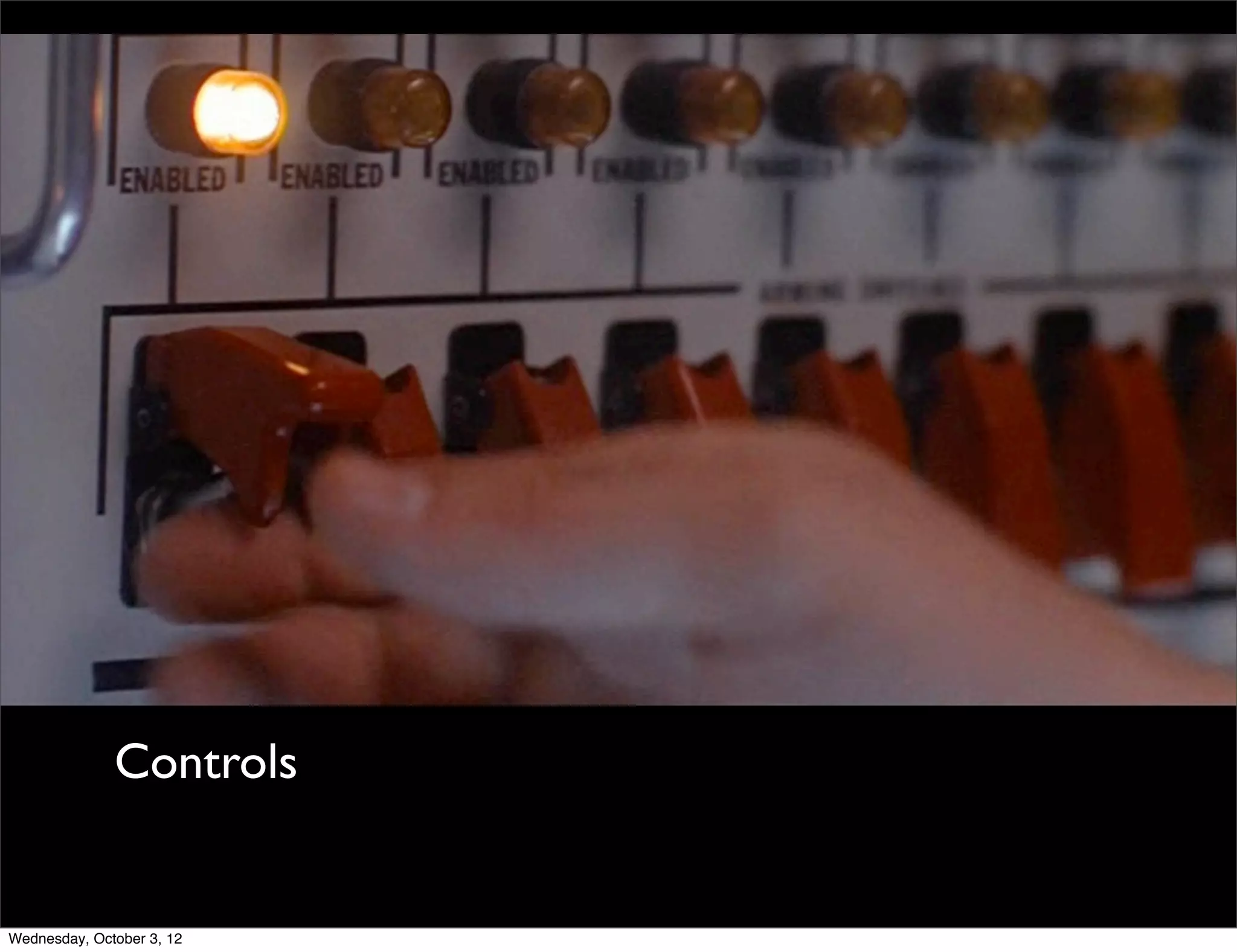
Controls


Wednesday, October 3, 12
ALERTS
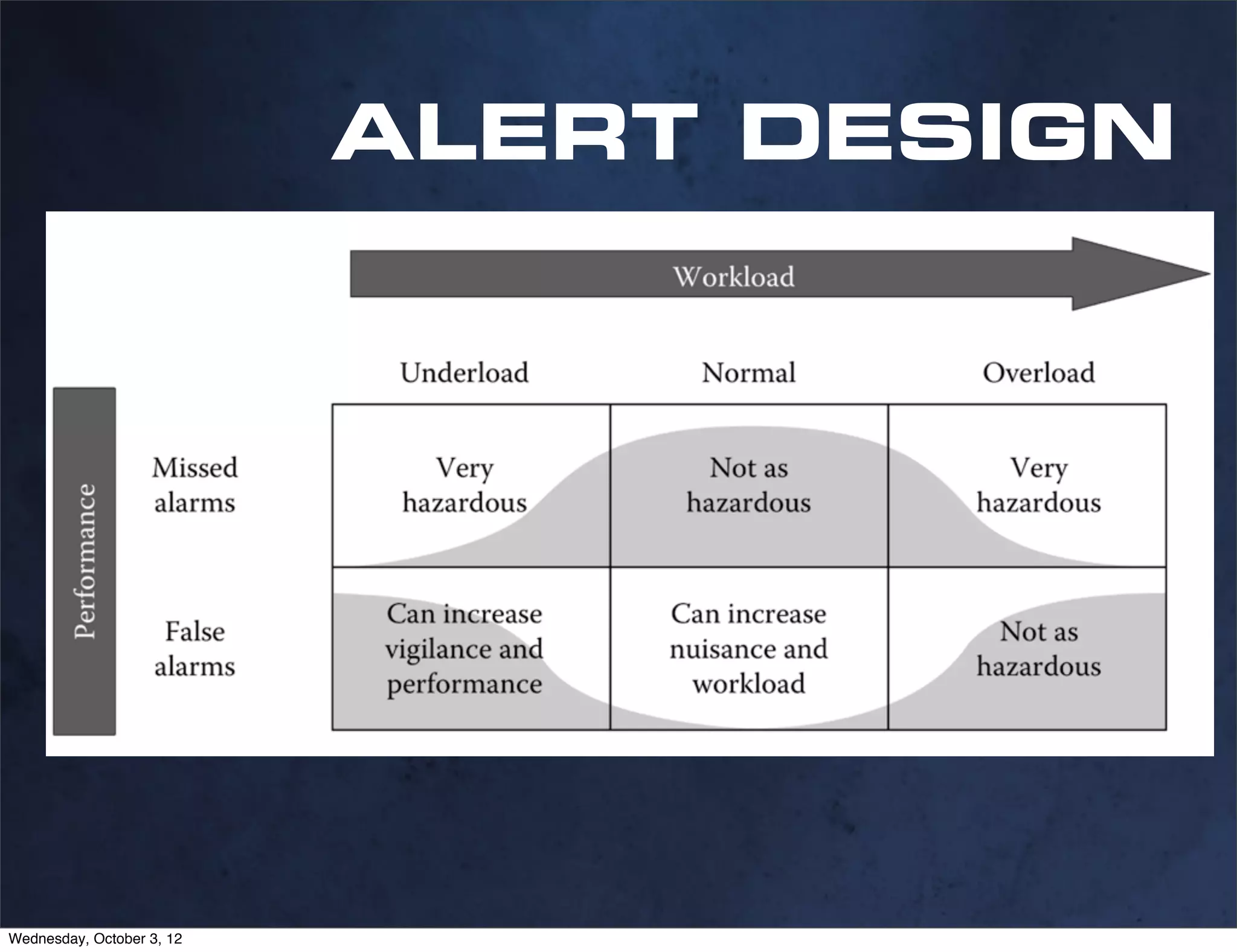
      • Meant to boost SA
      • Alarm overload
      • High false alarm rates
      • Routinely disable alerts
Wednesday, October 3, 12
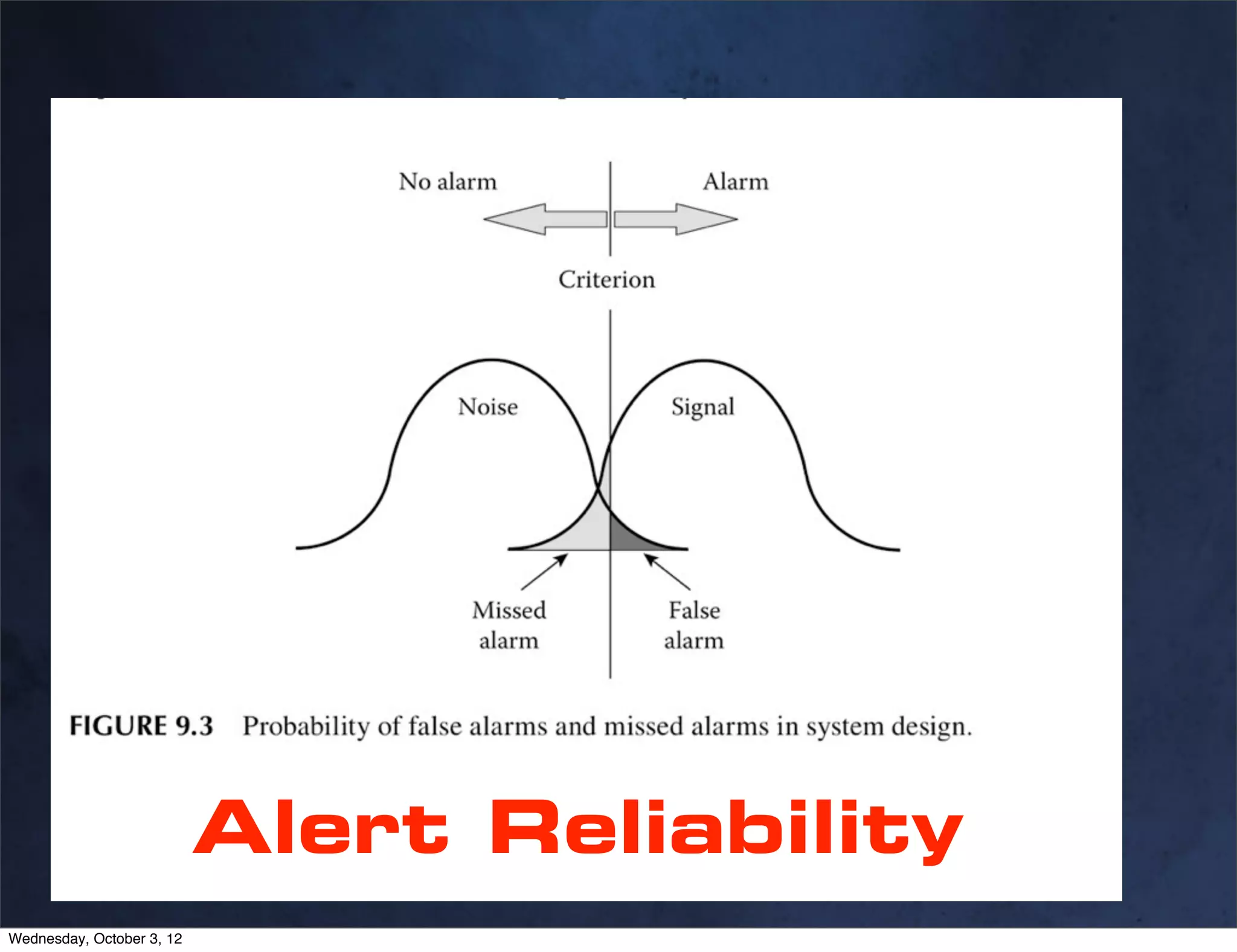
Alert Reliability
Wednesday, October 3, 12
ALERT DESIGN


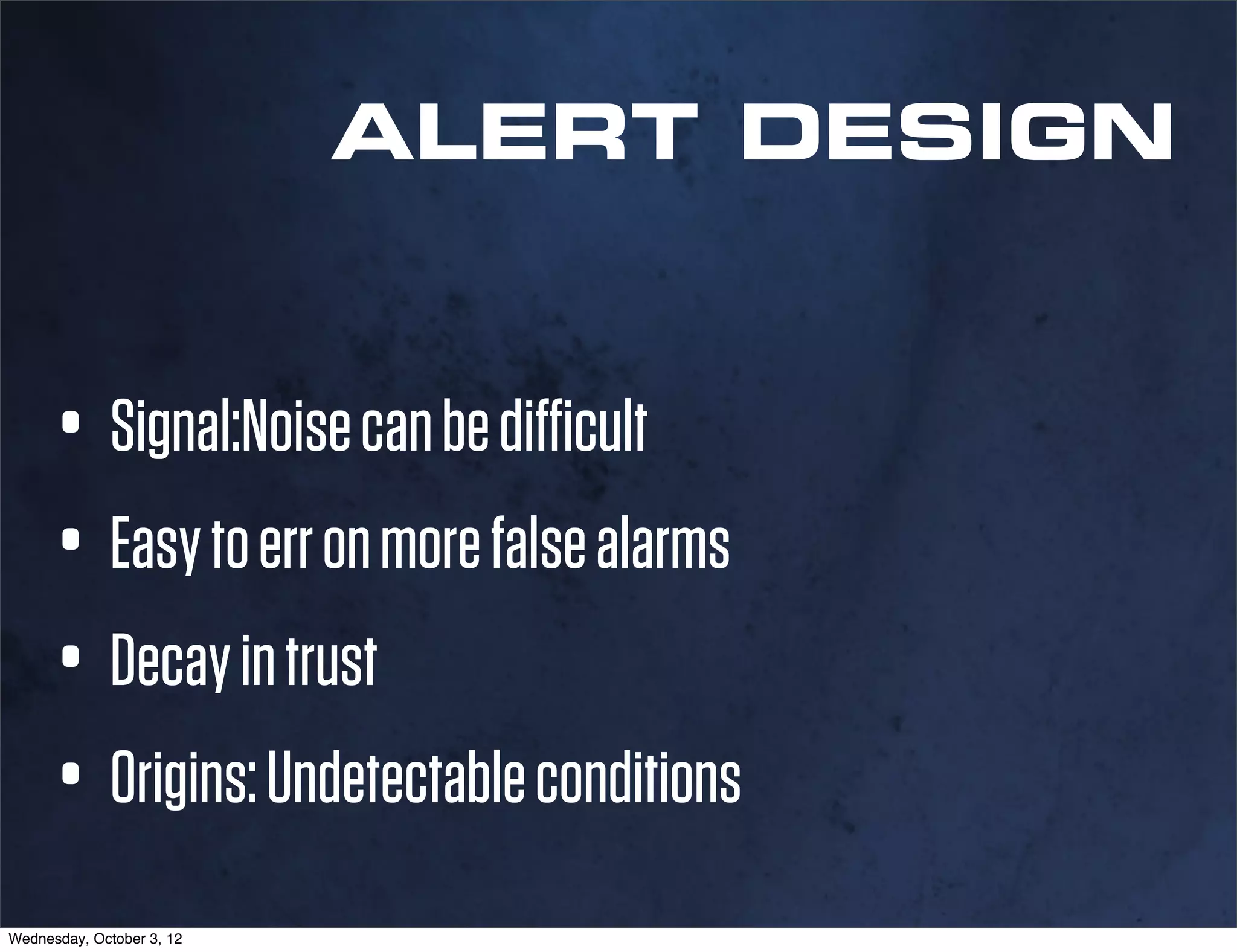
      • Signal:Noise can be difficult
      • Easy to err on more false alarms
      • Decay in trust
      • Origins: Undetectable conditions
Wednesday, October 3, 12
ALERT DESIGN


         Confirmation


Wednesday, October 3, 12
ALERT DESIGN


         Expectancy


Wednesday, October 3, 12
ALERT DESIGN


Wednesday, October 3, 12
ALERT DESIGN


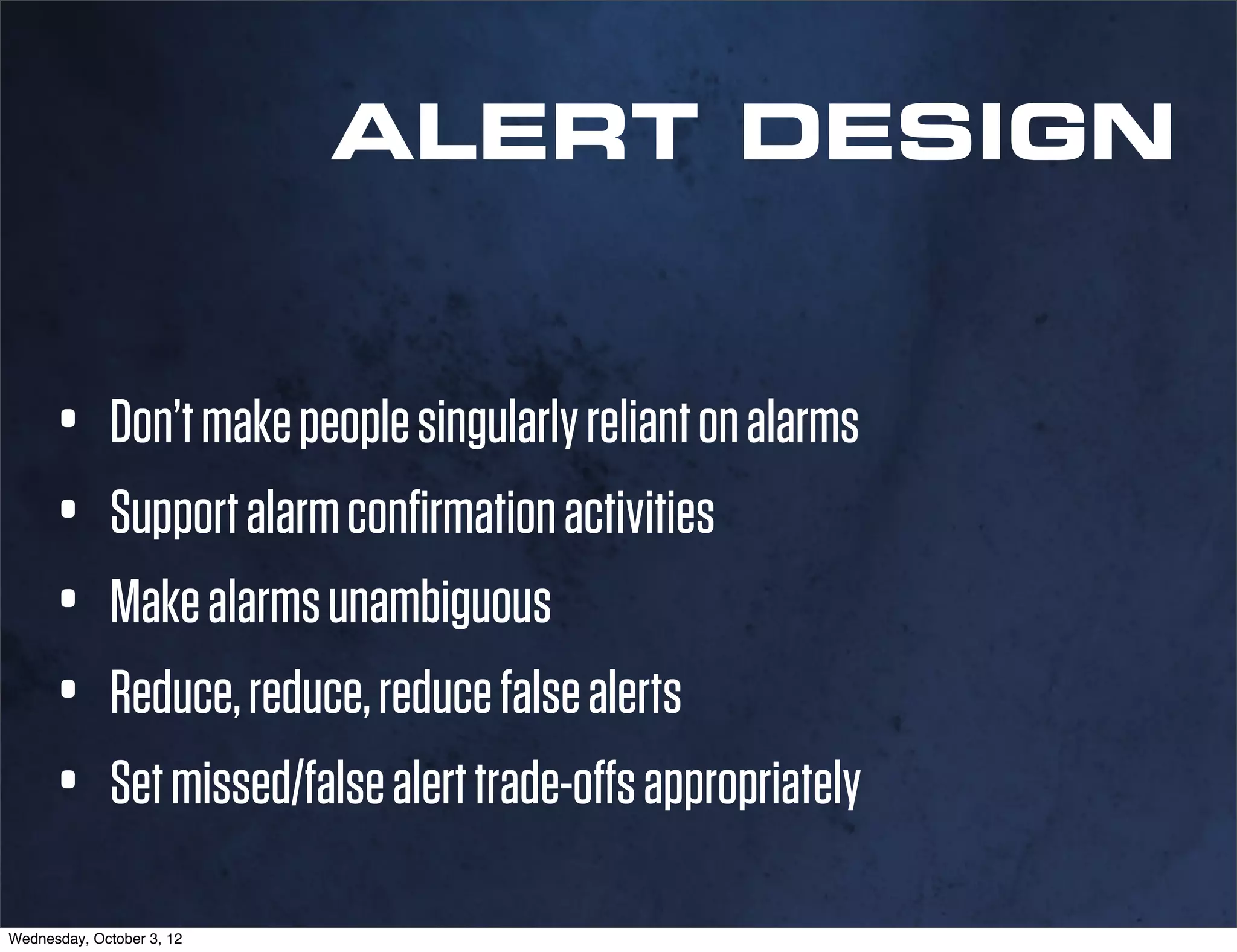
      • Don’t make people singularly reliant on alarms
      • Support alarm confirmation activities
      • Make alarms unambiguous
      • Reduce, reduce, reduce false alerts
      • Set missed/false alert trade-offs appropriately
Wednesday, October 3, 12
ALERT DESIGN


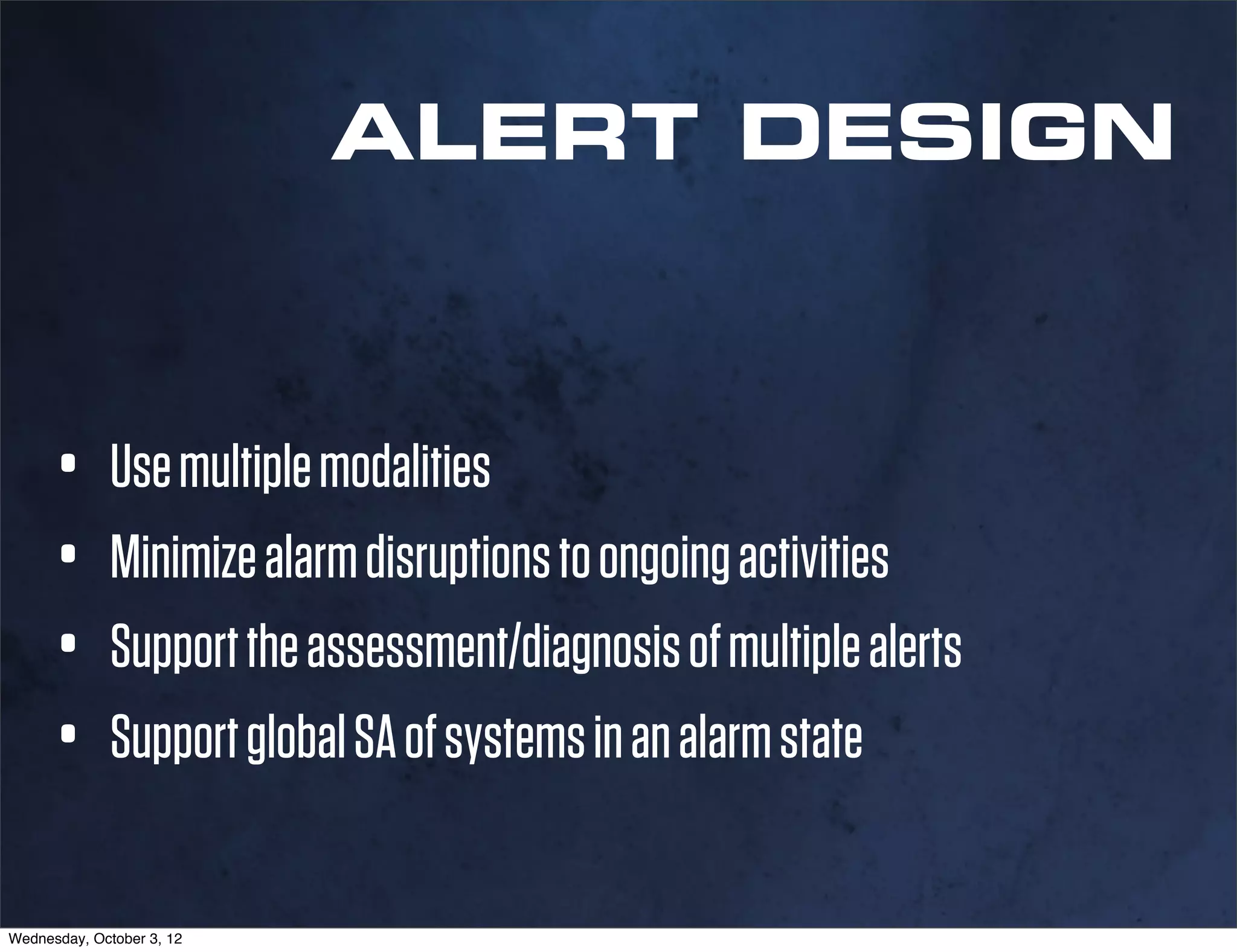
      • Use multiple modalities
      • Minimize alarm disruptions to ongoing activities
      • Support the assessment/diagnosis of multiple alerts
      • Support global SA of systems in an alarm state
Wednesday, October 3, 12
Mature Role of Automation

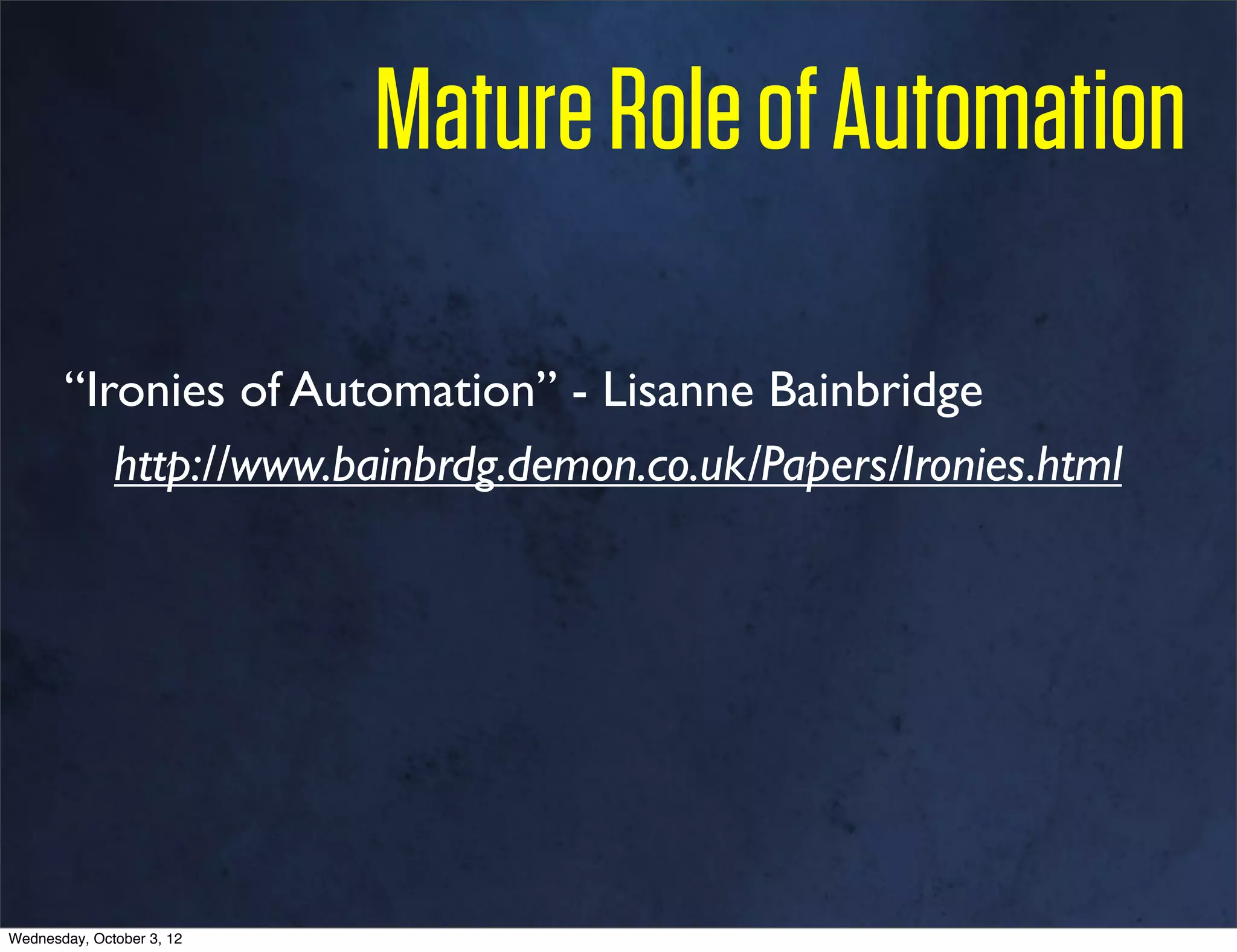
       “Ironies of Automation” - Lisanne Bainbridge
          http://www.bainbrdg.demon.co.uk/Papers/Ironies.html


Wednesday, October 3, 12
Mature Role of Automation
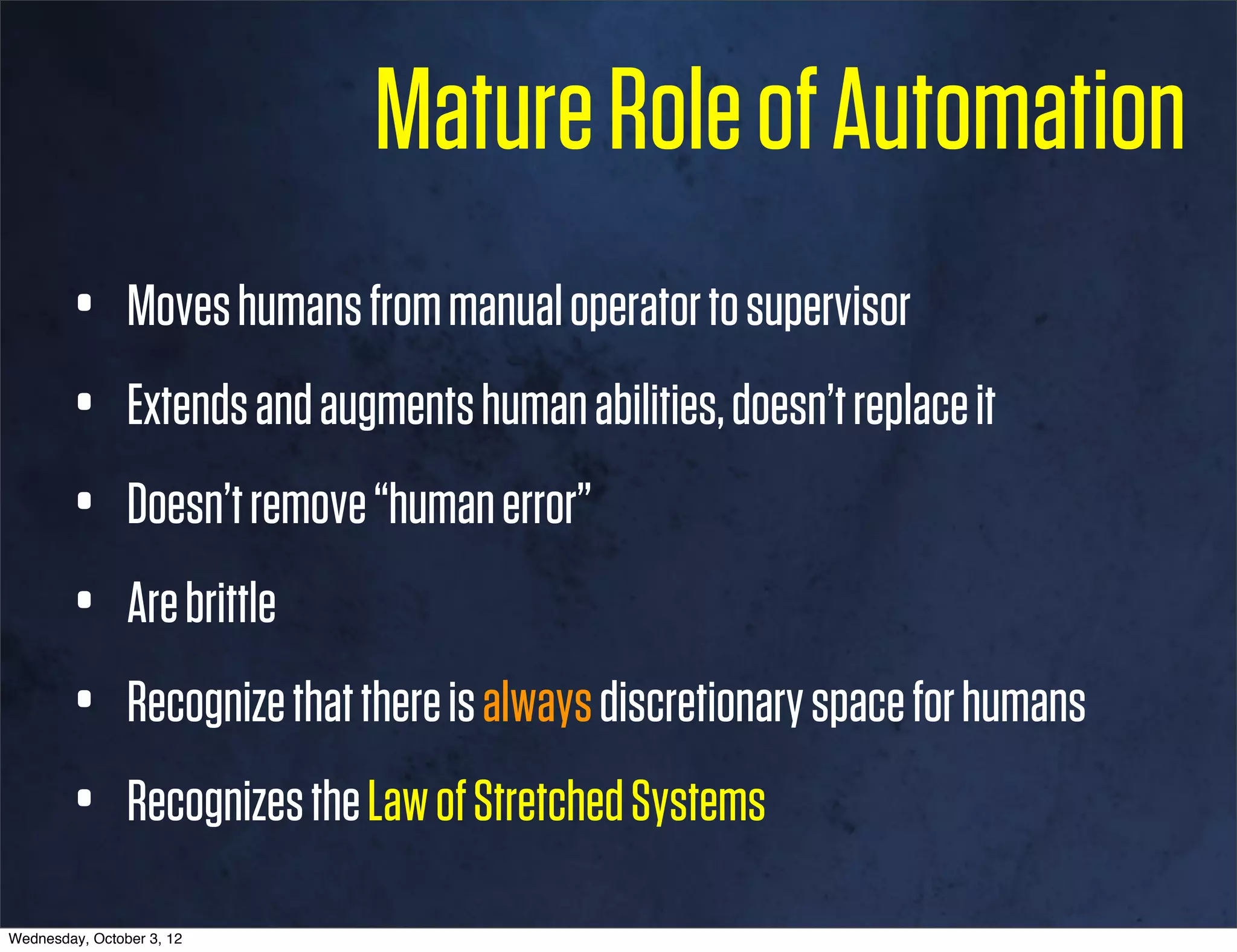
        •       Moves humans from manual operator to supervisor
        •       Extends and augments human abilities, doesn’t replace it
        •       Doesn’t remove “human error”
        •       Are brittle
        •       Recognize that there is always discretionary space for humans
        •       Recognizes the Law of Stretched Systems

Wednesday, October 3, 12
SUMMARY
Wednesday, October 3, 12
So what can we do?


         “In preparing for battle, I have always
         found that plans are useless but planning
         is indispensable.”
         - Eisenhower


Wednesday, October 3, 12
So what can we do?
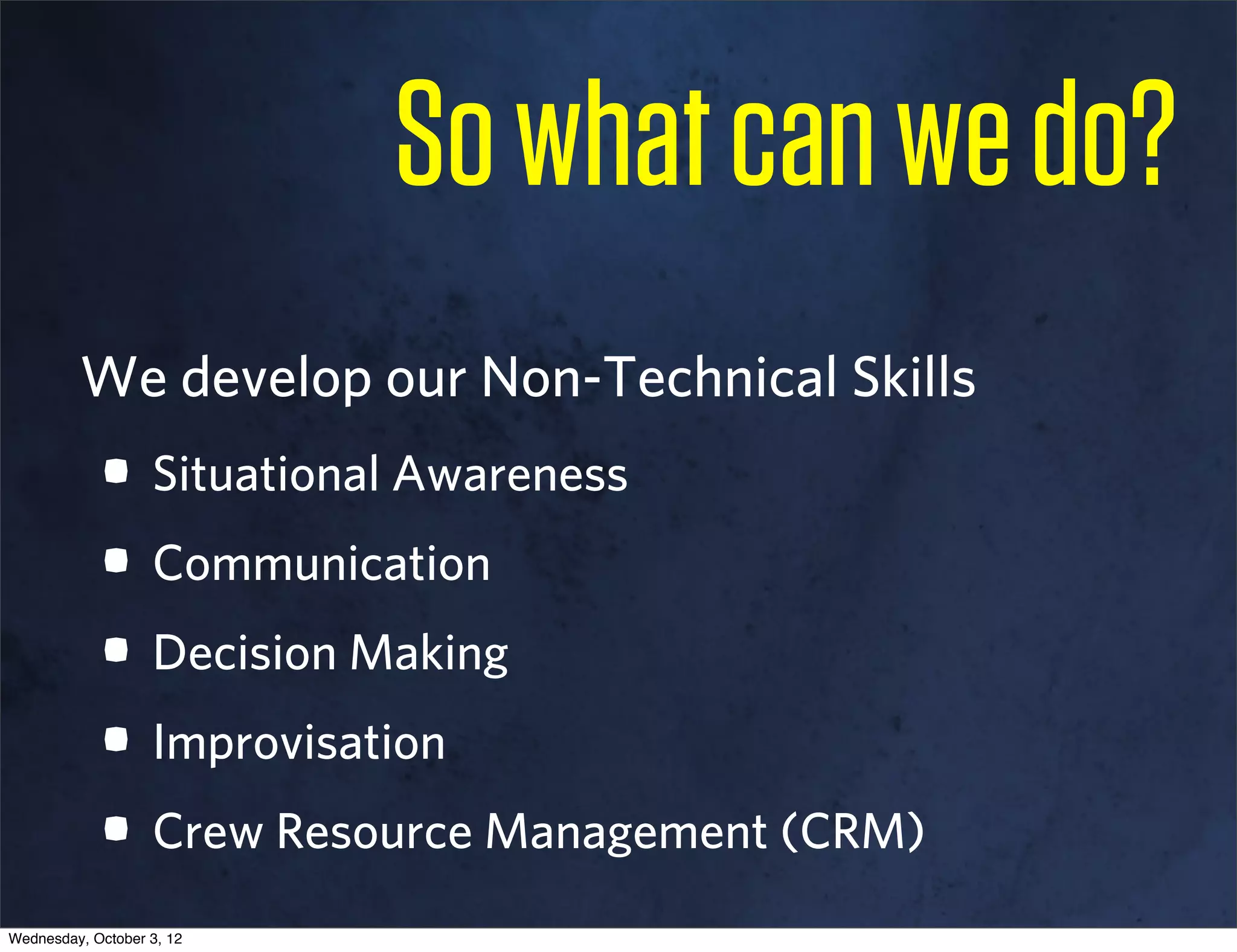
         We develop our Non-Technical Skills
            • Situational Awareness
            • Communication
            • Decision Making
            • Improvisation
            • Crew Resource Management (CRM)
Wednesday, October 3, 12
So what can we do?
         We tailor our environment to adapt
            • Tooling to support SA
            • Learning from outages (PostMortem)
            • Anticipating problems (PreMortem)
            • Gather Meta-Metrics
Wednesday, October 3, 12
THE END
Wednesday, October 3, 12
Credits
       •      http://www.flickr.com/photos/28650594@N03/2718027136/

       •      http://www.flickr.com/photos/telstar/2816887784/

       •      http://www.flickr.com/photos/soldiersmediacenter/3855375117/

       •      http://www.flickr.com/photos/19743256@N00/2640217771/

       •      http://www.flickr.com/photos/29456680@N06/6148754691/

       •      https://www.flickr.com/photos/spencediddy/3197199659/sizes/l/in/faves-allspaw/

       •      http://www.flickr.com/photos/splorp/64027565/sizes/l/in/photostream/


Wednesday, October 3, 12

Velocity EU 2012 Escalating Scenarios: Outage Handling Pitfalls

  • 1.
    Escalating Scenarios A Deep Dive Into Outage Pitfalls John Allspaw Velocity London 2012 Wednesday, October 3, 12
  • 2.
    TROUBLESHOOTING This is NOT about troubleshooting Or, not just about troubleshooting Wednesday, October 3, 12
  • 3.
    LAYOUT • Criteria • Situational Awareness • HROs • Decision Making • Communication • Team Coordination • A little bit of psychology Wednesday, October 3, 12
  • 4.
  • 5.
  • 6.
    How important isthis? Wednesday, October 3, 12
  • 7.
  • 8.
  • 9.
  • 10.
  • 11.
  • 12.
    Oct 2011 Sept 2012 Wednesday, October 3, 12
  • 13.
  • 14.
  • 15.
  • 16.
  • 17.
    Where to learn from? Wednesday, October 3, 12
  • 18.
  • 19.
  • 20.
  • 21.
  • 22.
    Dr. Richard Cook,Velocity US 2012 http://www.youtube.com/watch?v=R_PDc0HFdP0 Wednesday, October 3, 12
  • 23.
    “The Self-Designing High-ReliabilityOrganization: Aircraft Carrier Flight Operations at Sea” Rochlin, La Porte, and Roberts. Naval War College Review 1987 http://govleaders.org/reliability.htm Wednesday, October 3, 12
  • 24.
  • 25.
  • 26.
    What Goes OnIn Our Heads? Wednesday, October 3, 12
  • 27.
    Jens Rasmussen, 1983 Senior Member, IEEE “Skills, Rules, and Knowledge; Signals, Signs, and Symbols, and Other Distinctions in Human Performance Models” IEEE Transactions On Systems, Man, and Cybernetics, May 1983 Wednesday, October 3, 12
  • 28.
    SKILL - BASED Simple, routine RULE - BASED Knowable, but unfamiliar KNOWLEDGE - BASED (Reason, 1990) WTF IS GOING ON? Wednesday, October 3, 12
  • 29.
    Situational Awareness "the perceptionof elements in the environment within a volume of time and space, the comprehension of their meaning, and the projection of their status in the near future,” - (Endsley, 1995) "keeping track of what is going on around you in a complex, dynamic environment" (Moray, 2005, p. 4) "knowing what is going on so you can figure out what to do" (Adam, 1993) Wednesday, October 3, 12
  • 30.
    OODA Loop Observe Orient Decide Act Metrics Analysis Planning Execution Monitoring Visualization Resourcing Alerting Correlation Alarming credit: http://blog.b3k.us/ooda.html Wednesday, October 3, 12
  • 31.
    Canonical Work “Towards a Theory of Situational Awareness” Mica Endsley, Human Factors (1995) http://www.satechnologies.com/Papers/pdf/Toward%20a%20Theory %20of%20SA.pdf Wednesday, October 3, 12
  • 32.
    Situational Awareness Level I Perception Level II Comprehension Level III Projection Wednesday, October 3, 12
  • 33.
    System capability Interface design Stress and workload Complexity Automation Task/System Factors Feedback Situational Awareness Perception Performance State of the of elements Comprehension Projection Decision of actions environment in current situation of current situation of future status LEVEL I LEVEL II LEVEL III Information processing Individual Factors mechanisms Long term Goals and memory states Automaticity objectives Preconceptions - Abilities (expectations) - Experience - Training (Endsley) Wednesday, October 3, 12
  • 34.
  • 35.
  • 36.
    Context Can you spot the anomaly? Wednesday, October 3, 12
  • 37.
    Context 24 hours Wednesday, October 3, 12
  • 38.
    Context 7 days Wednesday, October 3, 12
  • 39.
    Context Normal But Noisy Wednesday, October 3, 12
  • 40.
    Level Two Wednesday,October 3, 12 Comprehension
  • 41.
    Level Two Wednesday,October 3, 12
  • 42.
    Mental Models • Categorization & Comprehension • Mental “map” or “schema” • Informed by experience, stored in memory Wednesday, October 3, 12
  • 43.
  • 44.
  • 45.
  • 46.
    Level Three Common Clues you’re losing SA at this level • Ambiguity • Fixation • Confusion • Lack of Information • Failure to maintain • Failure to meet expected checkpoint or target • Failure to resolve discrepancies • A bad gut feeling that things are not quite right  Wednesday, October 3, 12
  • 47.
    Characteristics of responseto escalating scenarios Wednesday, October 3, 12
  • 48.
    Characteristics of responseto escalating scenarios ...tend to neglect how processes develop within time (awareness of rates) versus assessing how things are in the moment “On the Difficulties People Have in Dealing With Complexity” Dietrich Doerner, 1980 Wednesday, October 3, 12
  • 49.
    Characteristics of responseto escalating scenarios ...have difficulty in dealing with exponential developments (hard to imagine how fast something can change, or accelerate) “On the Difficulties People Have in Dealing With Complexity” Dietrich Doerner, 1980 Wednesday, October 3, 12
  • 50.
    Characteristics of responseto escalating scenarios ...inclined to think in causal SERIES, instead of causal NETS. A therefore B, instead of A, therefore B and C (therefore D and E), etc. “On the Difficulties People Have in Dealing With Complexity” Dietrich Doerner, 1980 Wednesday, October 3, 12
  • 51.
    SA Pitfalls Requisite Memory Trap Wednesday, October 3, 12
  • 52.
    SA Pitfalls Workload, anxiety, fatigue, other stressors Wednesday, October 3, 12
  • 53.
    SA Pitfalls Data Overload Wednesday, October 3, 12
  • 54.
    SA Pitfalls Misplace Salience Wednesday, October 3, 12
  • 55.
  • 56.
  • 57.
  • 58.
    SA Pitfalls Complexity Creep “Everything should be as simple as it can be, but not simpler.” - paraphrased, Einstein Wednesday, October 3, 12
  • 59.
    SA Pitfalls Poor Mental Models Wednesday, October 3, 12
  • 60.
    SA Pitfalls Out-Of-The-Loop Syndrome Wednesday, October 3, 12
  • 61.
    SA Pitfalls Refusal to make decisions Wednesday, October 3, 12
  • 62.
    Heroism Non-communicating lone wolf-isms Wednesday, October 3, 12
  • 63.
    Distraction Irrelevant noise in comm channels Wednesday, October 3, 12
  • 64.
  • 65.
    TEAMS • Divide and conquer applied to problem space, division of labor • Incident resolution vs. Problem resolution • Reproducibility • Fault Tolerance Effects Wednesday, October 3, 12
  • 66.
    TEAMS Shotgun debugging Wednesday, October 3, 12
  • 67.
    JOINT ACTIVITY • Interpredictability • Common Ground • Directability http://csel.eng.ohio-state.edu/woods/distributed/CG%20final.pdf Wednesday, October 3, 12
  • 68.
  • 69.
  • 70.
  • 71.
  • 72.
  • 73.
  • 74.
    Improvisation “...you can’t improvise on nothing; you got to improvise on something.” Charles Mingus Wednesday, October 3, 12
  • 75.
    Diagnose the problem Represent the problem Detect the Generate a Apply course of Leverage Problem/Opportunity action Points Evaluate Wednesday, October 3, 12
  • 76.
    Communication Recommendations •Explicitness •Assertiveness •Timing Wednesday, October 3, 12
  • 77.
    Assertiveness • Passive • Assertive • Aggressive Wednesday, October 3, 12
  • 78.
  • 79.
  • 80.
    Communication • IRC? • Face-To-Face? • Conference Call? • Morse Code? Wednesday, October 3, 12
  • 81.
  • 82.
    Transmission Encode Decode Meaning Meaning Sender Receiver Wednesday, October 3, 12
  • 83.
    Transmission Encode Decode Meaning Meaning Sender Receiver Wednesday, October 3, 12
  • 84.
    Transmission Encode Decode Meaning Meaning Sender Receiver Meaning Meaning Receiver Sender Decode Encode Transmission Wednesday, October 3, 12
  • 85.
    Transmission Encode Decode Meaning Meaning Sender Receiver Meaning Meaning Receiver Sender Decode Encode Transmission Wednesday, October 3, 12
  • 86.
    Feedback Informational Wednesday, October 3, 12
  • 87.
    Feedback Corrective Wednesday, October 3, 12
  • 88.
    Feedback Reinforcing Wednesday, October 3, 12
  • 89.
    Decision Making Naturalistic Decision Making (NDM) Gary Klein Wednesday, October 3, 12
  • 90.
    Decision Making Step One: What is the problem? Wednesday, October 3, 12
  • 91.
    Decision Making Step Two: What shall I do? Wednesday, October 3, 12
  • 92.
    Decision Making Recognition-Primed Decisions Wednesday, October 3, 12
  • 93.
    Decision Making Rule-Based Decisions Wednesday, October 3, 12
  • 94.
    Decision Making Choice decisions Wednesday, October 3, 12
  • 95.
    Decision Making Creative decisions Wednesday, October 3, 12
  • 96.
    Decision Making Decreasing cognitive effort Decreasing effects of stress Creative Choice Rule-Based RPD Increasing cognitive effort Increasing effects of stress Wednesday, October 3, 12
  • 97.
    Decision Making PRE-Mortem Wednesday, October 3, 12
  • 98.
  • 99.
    ? ? Wednesday, October 3, 12
  • 100.
    Time Period Metric Wednesday, October 3, 12
  • 101.
  • 102.
    ALERTS • Meant to boost SA • Alarm overload • High false alarm rates • Routinely disable alerts Wednesday, October 3, 12
  • 103.
  • 104.
    ALERT DESIGN • Signal:Noise can be difficult • Easy to err on more false alarms • Decay in trust • Origins: Undetectable conditions Wednesday, October 3, 12
  • 105.
    ALERT DESIGN Confirmation Wednesday, October 3, 12
  • 106.
    ALERT DESIGN Expectancy Wednesday, October 3, 12
  • 107.
  • 108.
    ALERT DESIGN • Don’t make people singularly reliant on alarms • Support alarm confirmation activities • Make alarms unambiguous • Reduce, reduce, reduce false alerts • Set missed/false alert trade-offs appropriately Wednesday, October 3, 12
  • 109.
    ALERT DESIGN • Use multiple modalities • Minimize alarm disruptions to ongoing activities • Support the assessment/diagnosis of multiple alerts • Support global SA of systems in an alarm state Wednesday, October 3, 12
  • 110.
    Mature Role ofAutomation “Ironies of Automation” - Lisanne Bainbridge http://www.bainbrdg.demon.co.uk/Papers/Ironies.html Wednesday, October 3, 12
  • 111.
    Mature Role ofAutomation • Moves humans from manual operator to supervisor • Extends and augments human abilities, doesn’t replace it • Doesn’t remove “human error” • Are brittle • Recognize that there is always discretionary space for humans • Recognizes the Law of Stretched Systems Wednesday, October 3, 12
  • 112.
  • 113.
    So what canwe do? “In preparing for battle, I have always found that plans are useless but planning is indispensable.” - Eisenhower Wednesday, October 3, 12
  • 114.
    So what canwe do? We develop our Non-Technical Skills • Situational Awareness • Communication • Decision Making • Improvisation • Crew Resource Management (CRM) Wednesday, October 3, 12
  • 115.
    So what canwe do? We tailor our environment to adapt • Tooling to support SA • Learning from outages (PostMortem) • Anticipating problems (PreMortem) • Gather Meta-Metrics Wednesday, October 3, 12
  • 116.
  • 117.
  • 118.
    Credits • http://www.flickr.com/photos/28650594@N03/2718027136/ • http://www.flickr.com/photos/telstar/2816887784/ • http://www.flickr.com/photos/soldiersmediacenter/3855375117/ • http://www.flickr.com/photos/19743256@N00/2640217771/ • http://www.flickr.com/photos/29456680@N06/6148754691/ • https://www.flickr.com/photos/spencediddy/3197199659/sizes/l/in/faves-allspaw/ • http://www.flickr.com/photos/splorp/64027565/sizes/l/in/photostream/ Wednesday, October 3, 12