Download free for 30 days
Sign in
Upload
Language (EN)
Support
Business
Mobile
Social Media
Marketing
Technology
Art & Photos
Career
Design
Education
Presentations & Public Speaking
Government & Nonprofit
Healthcare
Internet
Law
Leadership & Management
Automotive
Engineering
Software
Recruiting & HR
Retail
Sales
Services
Science
Small Business & Entrepreneurship
Food
Environment
Economy & Finance
Data & Analytics
Investor Relations
Sports
Spiritual
News & Politics
Travel
Self Improvement
Real Estate
Entertainment & Humor
Health & Medicine
Devices & Hardware
Lifestyle
Change Language
Language
English
Español
Português
Français
Deutsche
Cancel
Save
Submit search
EN
Uploaded by
KobeDecena
19 views
Lecture_Ch03 in physics for engineering.pdf
Physics for engineering
Education
◦
Read more
0
Save
Share
Embed
Embed presentation
Download
Download to read offline
1
/ 45
2
/ 45
3
/ 45
4
/ 45
5
/ 45
6
/ 45
7
/ 45
8
/ 45
9
/ 45
10
/ 45
11
/ 45
12
/ 45
13
/ 45
14
/ 45
15
/ 45
16
/ 45
17
/ 45
18
/ 45
19
/ 45
20
/ 45
21
/ 45
22
/ 45
23
/ 45
24
/ 45
25
/ 45
26
/ 45
27
/ 45
28
/ 45
29
/ 45
30
/ 45
31
/ 45
32
/ 45
33
/ 45
34
/ 45
35
/ 45
36
/ 45
37
/ 45
38
/ 45
39
/ 45
40
/ 45
41
/ 45
42
/ 45
43
/ 45
44
/ 45
45
/ 45
More Related Content
PPT
Physics - Chapter 3 Powerpoint
by
Mrreynon
PDF
PHYS1020 Unit 3 F24.pdf12345678765432456
by
zzzayati
PPTX
03_LectureOutline.pptx
by
KevinDiehl6
PPT
Lecture Ch 03
by
rtrujill
PPT
Bellaire High School Advanced Physics - Chapter 3 - Projectile Motion
by
JPoilek
PPTX
vector.pptx
by
ssuser7d974e
PDF
Vectors projectile motion
by
Hassaan Bin Jalil
PPT
motion in a plane ppt on how to teach 2d
by
deepakshiJINDAL1
Physics - Chapter 3 Powerpoint
by
Mrreynon
PHYS1020 Unit 3 F24.pdf12345678765432456
by
zzzayati
03_LectureOutline.pptx
by
KevinDiehl6
Lecture Ch 03
by
rtrujill
Bellaire High School Advanced Physics - Chapter 3 - Projectile Motion
by
JPoilek
vector.pptx
by
ssuser7d974e
Vectors projectile motion
by
Hassaan Bin Jalil
motion in a plane ppt on how to teach 2d
by
deepakshiJINDAL1
Similar to Lecture_Ch03 in physics for engineering.pdf
PPT
1-_vectors.ppt
by
Dennis Mayor
PPTX
Chapter3physics
by
furmannv
PPTX
Lecture: Two-Way Kinematics
by
JasonMooney9
PPTX
Two Dimensional Motion and Vectors
by
ZBTHS
PDF
Ch3_Claudia.pdfuzjsjzjzjzjzkzkzkzkkzzkkzkzkz
by
HeadenBacalangcoLato
PPT
Chapter 3. vectors projectiles
by
Sonakshi Gupta
PDF
4. Motion in a Plane 1.pptx.pdf
by
MKumarVarnana
PPT
Lecture Ch 02
by
rtrujill
PPT
projectile-motion.ppt
by
MaRicaelaJamieFernan2
PPT
projectile-motion.ppt
by
MaRicaelaJamieFernan2
PPTX
Chapter 3
by
ZBTHS
PPT
4 kinematika
by
Galih Suryono
PPTX
04 - Kinematics In Two Dimensions.ppt.pptx
by
doctorfizik
PPTX
Ecp3
by
Albert Wallace
PPTX
Projectile motion ch 5 reg
by
ZBTHS
PPTX
Physics
by
knowledge1995
PPT
Chapter 3 Powerpoint
by
Mrreynon
PPT
Hp 03 win
by
Jeffinner
PPTX
Week 9-10 2D and 3D Motion.pptx
by
JayrillLuyong
PDF
kinematics1_d cheat sheet
by
Timothy Welsh
1-_vectors.ppt
by
Dennis Mayor
Chapter3physics
by
furmannv
Lecture: Two-Way Kinematics
by
JasonMooney9
Two Dimensional Motion and Vectors
by
ZBTHS
Ch3_Claudia.pdfuzjsjzjzjzjzkzkzkzkkzzkkzkzkz
by
HeadenBacalangcoLato
Chapter 3. vectors projectiles
by
Sonakshi Gupta
4. Motion in a Plane 1.pptx.pdf
by
MKumarVarnana
Lecture Ch 02
by
rtrujill
projectile-motion.ppt
by
MaRicaelaJamieFernan2
projectile-motion.ppt
by
MaRicaelaJamieFernan2
Chapter 3
by
ZBTHS
4 kinematika
by
Galih Suryono
04 - Kinematics In Two Dimensions.ppt.pptx
by
doctorfizik
Ecp3
by
Albert Wallace
Projectile motion ch 5 reg
by
ZBTHS
Physics
by
knowledge1995
Chapter 3 Powerpoint
by
Mrreynon
Hp 03 win
by
Jeffinner
Week 9-10 2D and 3D Motion.pptx
by
JayrillLuyong
kinematics1_d cheat sheet
by
Timothy Welsh
More from KobeDecena
PDF
Lecture_Ch04 in physics for engineering.pdf
by
KobeDecena
PPTX
Rizal's Life and Works History Chapter 2.pptx
by
KobeDecena
PPTX
Rizal's Life and Works History Chapter 1.pptx
by
KobeDecena
PDF
phisics for engineers lesson Lecture_Ch02.pdf
by
KobeDecena
PDF
physic for engineers lesson Lecture_Ch01.pdf
by
KobeDecena
PDF
WEEK-6-UCSP.pdf
by
KobeDecena
Lecture_Ch04 in physics for engineering.pdf
by
KobeDecena
Rizal's Life and Works History Chapter 2.pptx
by
KobeDecena
Rizal's Life and Works History Chapter 1.pptx
by
KobeDecena
phisics for engineers lesson Lecture_Ch02.pdf
by
KobeDecena
physic for engineers lesson Lecture_Ch01.pdf
by
KobeDecena
WEEK-6-UCSP.pdf
by
KobeDecena
Recently uploaded
PPTX
Shipping Policies & Picking Policies in Odoo 18 Inventory
by
Celine George
PPTX
How to use sorted() method in Odoo 18
by
Celine George
PDF
30 Ways Teachers Use AI in 2026 – Practical Classroom Workflows with Monsha f...
by
Monsha.AI
PDF
Application of ICT Lecture 5 ICT in Personal Finance and Shopping.pdf
by
Khalil Khan Marwat
PPTX
When UDL is no longer enough: Examining post-UDL reflections on inclusive des...
by
Frederic Fovet
PPTX
Chapter No. 5 Anti- Hypertensive Pharmacognosy-2.pptx
by
Ganu Gavade
PDF
1.The-Story-of-Indian-Farming ppt/7th part 2/by k sandeep swamy(MSc,BEd)/samy...
by
Sandeep Swamy
PPTX
CHAPTER NO. 09 HCP BY GG LABORATORY CLINICAL TEST
by
Ganu Gavade
PDF
Application of ICT Lecture 2 Basic ICT Productivity Tools.pdf
by
Khalil Khan Marwat
PDF
Application of Information and Communication Technology Content.pdf
by
Khalil Khan Marwat
PPTX
INSTAGRAM: Where Moment Turns Into Stories.pptx
by
andriemark51
PPTX
Prepositions of Place : English Grammar Presentation
by
Pintoo Dhillon
PDF
Bahan Ajar Digital Journalism - Ade Putra Tunggali
by
AdePutraTunggali
PDF
Digital Transformation, AI, and ML in Pharma R&D and Manufacturing Workflows ...
by
Ajaz Hussain
PPTX
How to Manage Sorting Cart by Category in Odoo 18 POS
by
Celine George
PDF
how to write your (written) research instruments
by
Thelma Villaflores
PDF
CHUYÊN ĐỀ ÔN LUYỆN TUYỂN SINH 9 LÊN 10 - MÔN TOÁN - CÓ LỜI GIẢI CHI TIẾT - TH...
by
Nguyen Thanh Tu Collection
PPTX
Mixing Pharmaceutical Engineering .pptxx
by
Shraddha Bandgar
PPTX
PLATELET RICH PLASMA in regenerative med
by
Dr SMRUTI REKHA HOTA
PDF
Profiling, Placement, Pathways, and Pedagogies.pdf
by
RHEAMARIMLA2
Shipping Policies & Picking Policies in Odoo 18 Inventory
by
Celine George
How to use sorted() method in Odoo 18
by
Celine George
30 Ways Teachers Use AI in 2026 – Practical Classroom Workflows with Monsha f...
by
Monsha.AI
Application of ICT Lecture 5 ICT in Personal Finance and Shopping.pdf
by
Khalil Khan Marwat
When UDL is no longer enough: Examining post-UDL reflections on inclusive des...
by
Frederic Fovet
Chapter No. 5 Anti- Hypertensive Pharmacognosy-2.pptx
by
Ganu Gavade
1.The-Story-of-Indian-Farming ppt/7th part 2/by k sandeep swamy(MSc,BEd)/samy...
by
Sandeep Swamy
CHAPTER NO. 09 HCP BY GG LABORATORY CLINICAL TEST
by
Ganu Gavade
Application of ICT Lecture 2 Basic ICT Productivity Tools.pdf
by
Khalil Khan Marwat
Application of Information and Communication Technology Content.pdf
by
Khalil Khan Marwat
INSTAGRAM: Where Moment Turns Into Stories.pptx
by
andriemark51
Prepositions of Place : English Grammar Presentation
by
Pintoo Dhillon
Bahan Ajar Digital Journalism - Ade Putra Tunggali
by
AdePutraTunggali
Digital Transformation, AI, and ML in Pharma R&D and Manufacturing Workflows ...
by
Ajaz Hussain
How to Manage Sorting Cart by Category in Odoo 18 POS
by
Celine George
how to write your (written) research instruments
by
Thelma Villaflores
CHUYÊN ĐỀ ÔN LUYỆN TUYỂN SINH 9 LÊN 10 - MÔN TOÁN - CÓ LỜI GIẢI CHI TIẾT - TH...
by
Nguyen Thanh Tu Collection
Mixing Pharmaceutical Engineering .pptxx
by
Shraddha Bandgar
PLATELET RICH PLASMA in regenerative med
by
Dr SMRUTI REKHA HOTA
Profiling, Placement, Pathways, and Pedagogies.pdf
by
RHEAMARIMLA2
Lecture_Ch03 in physics for engineering.pdf
1.
Copyright © 2009
Pearson Education, Inc. © 2009 Pearson Education, Inc. This work is protected by United States copyright laws and is provided solely for the use of instructors in teaching their courses and assessing student learning. Dissemination or sale of any part of this work (including on the World Wide Web) will destroy the integrity of the work and is not permitted. The work and materials from it should never be made available to students except by instructors using the accompanying text in their classes. All recipients of this work are expected to abide by these restrictions and to honor the intended pedagogical purposes and the needs of other instructors who rely on these materials. Lecture PowerPoints Chapter 3 Physics for Scientists & Engineers, with Modern Physics, 4th edition Giancoli
2.
Copyright © 2009
Pearson Education, Inc. Chapter 3 Kinematics in Two or Three Dimensions; Vectors
3.
Copyright © 2009
Pearson Education, Inc. Units of Chapter 3 • Vectors and Scalars • Addition of Vectors—Graphical Methods • Subtraction of Vectors, and Multiplication of a Vector by a Scalar • Adding Vectors by Components • Unit Vectors • Vector Kinematics • Projectile Motion • Solving Problems Involving Projectile Motion • Relative Velocity
4.
Copyright © 2009
Pearson Education, Inc. 3-1 Vectors and Scalars A vector has magnitude as well as direction. Some vector quantities: displacement, velocity, force, momentum A scalar has only a magnitude. Some scalar quantities: mass, time, temperature
5.
Copyright © 2009
Pearson Education, Inc. 3-2 Addition of Vectors—Graphical Methods For vectors in one dimension, simple addition and subtraction are all that is needed. You do need to be careful about the signs, as the figure indicates.
6.
Copyright © 2009
Pearson Education, Inc. 3-2 Addition of Vectors—Graphical Methods If the motion is in two dimensions, the situation is somewhat more complicated. Here, the actual travel paths are at right angles to one another; we can find the displacement by using the Pythagorean Theorem.
7.
Copyright © 2009
Pearson Education, Inc. 3-2 Addition of Vectors—Graphical Methods Adding the vectors in the opposite order gives the same result:
8.
Copyright © 2009
Pearson Education, Inc. 3-2 Addition of Vectors—Graphical Methods Even if the vectors are not at right angles, they can be added graphically by using the tail-to-tip method.
9.
Copyright © 2009
Pearson Education, Inc. 3-2 Addition of Vectors—Graphical Methods The parallelogram method may also be used; here again the vectors must be tail-to-tip.
10.
Copyright © 2009
Pearson Education, Inc. 3-3 Subtraction of Vectors, and Multiplication of a Vector by a Scalar In order to subtract vectors, we define the negative of a vector, which has the same magnitude but points in the opposite direction. Then we add the negative vector.
11.
Copyright © 2009
Pearson Education, Inc. 3-3 Subtraction of Vectors, and Multiplication of a Vector by a Scalar A vector can be multiplied by a scalar c; the result is a vector c that has the same direction but a magnitude cV. If c is negative, the resultant vector points in the opposite direction. V V
12.
Copyright © 2009
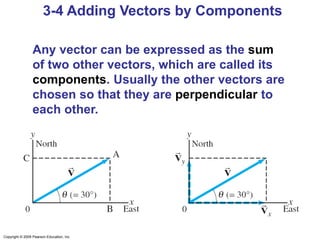
Pearson Education, Inc. 3-4 Adding Vectors by Components Any vector can be expressed as the sum of two other vectors, which are called its components. Usually the other vectors are chosen so that they are perpendicular to each other.
13.
Copyright © 2009
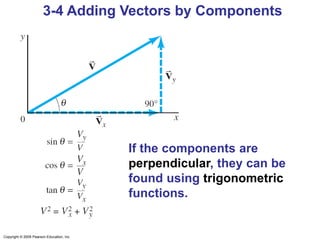
Pearson Education, Inc. 3-4 Adding Vectors by Components If the components are perpendicular, they can be found using trigonometric functions.
14.
Copyright © 2009
Pearson Education, Inc. 3-4 Adding Vectors by Components The components are effectively one-dimensional, so they can be added arithmetically.
15.
Copyright © 2009
Pearson Education, Inc. 3-4 Adding Vectors by Components Adding vectors: 1. Draw a diagram; add the vectors graphically. 2. Choose x and y axes. 3. Resolve each vector into x and y components. 4. Calculate each component using sines and cosines. 5. Add the components in each direction. 6. To find the length and direction of the vector, use: and .
16.
Copyright © 2009
Pearson Education, Inc. 3-4 Adding Vectors by Components Example 3-2: Mail carrier’s displacement. A rural mail carrier leaves the post office and drives 22.0 km in a northerly direction. She then drives in a direction 60.0° south of east for 47.0 km. What is her displacement from the post office?
17.
Copyright © 2009
Pearson Education, Inc. 3-4 Adding Vectors by Components Example 3-3: Three short trips. An airplane trip involves three legs, with two stopovers. The first leg is due east for 620 km; the second leg is southeast (45°) for 440 km; and the third leg is at 53° south of west, for 550 km, as shown. What is the plane’s total displacement?
18.
Copyright © 2009
Pearson Education, Inc. 3-5 Unit Vectors Unit vectors have magnitude 1. Using unit vectors, any vector can be written in terms of its components: V
19.
Copyright © 2009
Pearson Education, Inc. 3-6 Vector Kinematics In two or three dimensions, the displacement is a vector:
20.
Copyright © 2009
Pearson Education, Inc. 3-6 Vector Kinematics As Δt and Δr become smaller and smaller, the average velocity approaches the instantaneous velocity.
21.
Copyright © 2009
Pearson Education, Inc. 3-6 Vector Kinematics v v The instantaneous acceleration is in the direction of Δ = 2 – 1, and is given by: v
22.
Copyright © 2009
Pearson Education, Inc. 3-6 Vector Kinematics Using unit vectors,
23.
Copyright © 2009
Pearson Education, Inc. 3-6 Vector Kinematics Generalizing the one-dimensional equations for constant acceleration:
24.
Copyright © 2009
Pearson Education, Inc. 3-7 Projectile Motion A projectile is an object moving in two dimensions under the influence of Earth's gravity; its path is a parabola.
25.
Copyright © 2009
Pearson Education, Inc. It can be understood by analyzing the horizontal and vertical motions separately. 3-7 Projectile Motion
26.
Copyright © 2009
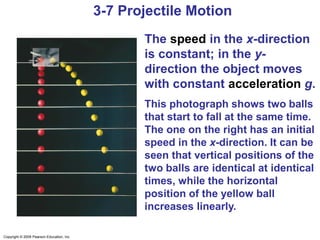
Pearson Education, Inc. 3-7 Projectile Motion The speed in the x-direction is constant; in the y- direction the object moves with constant acceleration g. This photograph shows two balls that start to fall at the same time. The one on the right has an initial speed in the x-direction. It can be seen that vertical positions of the two balls are identical at identical times, while the horizontal position of the yellow ball increases linearly.
27.
Copyright © 2009
Pearson Education, Inc. 3-7 Projectile Motion If an object is launched at an initial angle of θ0 with the horizontal, the analysis is similar except that the initial velocity has a vertical component.
28.
Copyright © 2009
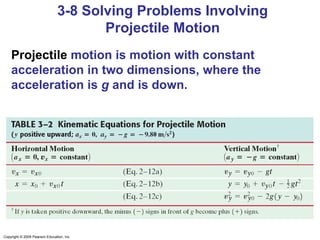
Pearson Education, Inc. 3-8 Solving Problems Involving Projectile Motion Projectile motion is motion with constant acceleration in two dimensions, where the acceleration is g and is down.
29.
Copyright © 2009
Pearson Education, Inc. 3-8 Solving Problems Involving Projectile Motion 1. Read the problem carefully, and choose the object(s) you are going to analyze. 2. Draw a diagram. 3. Choose an origin and a coordinate system. 4. Decide on the time interval; this is the same in both directions, and includes only the time the object is moving with constant acceleration g. 5. Examine the x and y motions separately.
30.
Copyright © 2009
Pearson Education, Inc. 3-8 Solving Problems Involving Projectile Motion 6. List known and unknown quantities. Remember that vx never changes, and that vy = 0 at the highest point. 7. Plan how you will proceed. Use the appropriate equations; you may have to combine some of them.
31.
Copyright © 2009
Pearson Education, Inc. 3-8 Solving Problems Involving Projectile Motion Example 3-6: Driving off a cliff. A movie stunt driver on a motorcycle speeds horizontally off a 50.0-m-high cliff. How fast must the motorcycle leave the cliff top to land on level ground below, 90.0 m from the base of the cliff where the cameras are? Ignore air resistance.
32.
Copyright © 2009
Pearson Education, Inc. 3-8 Solving Problems Involving Projectile Motion Example 3-7: A kicked football. A football is kicked at an angle θ0 = 37.0° with a velocity of 20.0 m/s, as shown. Calculate (a) the maximum height, (b) the time of travel before the football hits the ground, (c) how far away it hits the ground, (d) the velocity vector at the maximum height, and (e) the acceleration vector at maximum height. Assume the ball leaves the foot at ground level, and ignore air resistance and rotation of the ball.
33.
Copyright © 2009
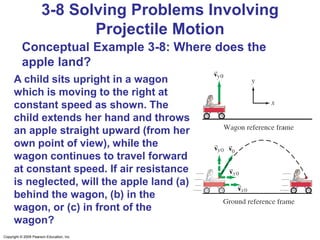
Pearson Education, Inc. 3-8 Solving Problems Involving Projectile Motion A child sits upright in a wagon which is moving to the right at constant speed as shown. The child extends her hand and throws an apple straight upward (from her own point of view), while the wagon continues to travel forward at constant speed. If air resistance is neglected, will the apple land (a) behind the wagon, (b) in the wagon, or (c) in front of the wagon? Conceptual Example 3-8: Where does the apple land?
34.
Copyright © 2009
Pearson Education, Inc. 3-8 Solving Problems Involving Projectile Motion Conceptual Example 3-9: The wrong strategy. A boy on a small hill aims his water-balloon slingshot horizontally, straight at a second boy hanging from a tree branch a distance d away. At the instant the water balloon is released, the second boy lets go and falls from the tree, hoping to avoid being hit. Show that he made the wrong move. (He hadn’t studied physics yet.) Ignore air resistance.
35.
Copyright © 2009
Pearson Education, Inc. 3-8 Solving Problems Involving Projectile Motion Example 3-10: Level horizontal range. (a) Derive a formula for the horizontal range R of a projectile in terms of its initial speed v0 and angle θ0. The horizontal range is defined as the horizontal distance the projectile travels before returning to its original height (which is typically the ground); that is, y(final) = y0. (b) Suppose one of Napoleon’s cannons had a muzzle speed, v0, of 60.0 m/s. At what angle should it have been aimed (ignore air resistance) to strike a target 320 m away?
36.
Copyright © 2009
Pearson Education, Inc. 3-8 Solving Problems Involving Projectile Motion Example 3-11: A punt. Suppose the football in Example 3–7 was punted and left the punter’s foot at a height of 1.00 m above the ground. How far did the football travel before hitting the ground? Set x0 = 0, y0 = 0.
37.
Copyright © 2009
Pearson Education, Inc. 3-8 Solving Problems Involving Projectile Motion Example 3-12: Rescue helicopter drops supplies. A rescue helicopter wants to drop a package of supplies to isolated mountain climbers on a rocky ridge 200 m below. If the helicopter is traveling horizontally with a speed of 70 m/s (250 km/h), (a) how far in advance of the recipients (horizontal distance) must the package be dropped? (b) Suppose, instead, that the helicopter releases the package a horizontal distance of 400 m in advance of the mountain climbers. What vertical velocity should the package be given (up or down) so that it arrives precisely at the climbers’ position? (c) With what speed does the package land in the latter case?
38.
Copyright © 2009
Pearson Education, Inc. 3-8 Solving Problems Involving Projectile Motion Projectile motion is parabolic: Taking the equations for x and y as a function of time, and combining them to eliminate t, we find y as a function of x: This is the equation for a parabola.
39.
Copyright © 2009
Pearson Education, Inc. 3-8 Solving Problems Involving Projectile Motion Examples of projectile motion. Notice the effects of air resistance.
40.
Copyright © 2009
Pearson Education, Inc. 3-9 Relative Velocity We have already considered relative speed in one dimension; it is similar in two dimensions except that we must add and subtract velocities as vectors. Each velocity is labeled first with the object, and second with the reference frame in which it has this velocity.
41.
Copyright © 2009
Pearson Education, Inc. Here, vWS is the velocity of the water in the shore frame, vBS is the velocity of the boat in the shore frame, and vBW is the velocity of the boat in the water frame. 3-9 Relative Velocity The relationship between the three velocities is:
42.
Copyright © 2009
Pearson Education, Inc. 3-9 Relative Velocity Example 3-14: Heading upstream. A boat’s speed in still water is vBW = 1.85 m/s. If the boat is to travel directly across a river whose current has speed vWS = 1.20 m/s, at what upstream angle must the boat head?
43.
Copyright © 2009
Pearson Education, Inc. 3-9 Relative Velocity Example 3-15: Heading across the river. The same boat (vBW = 1.85 m/s) now heads directly across the river whose current is still 1.20 m/s. (a) What is the velocity (magnitude and direction) of the boat relative to the shore? (b) If the river is 110 m wide, how long will it take to cross and how far downstream will the boat be then?
44.
Copyright © 2009
Pearson Education, Inc. 3-9 Relative Velocity Example 3-16: Car velocities at 90°. Two automobiles approach a street corner at right angles to each other with the same speed of 40.0 km/h (= 11.1 m/s), as shown. What is the relative velocity of one car with respect to the other? That is, determine the velocity of car 1 as seen by car 2.
45.
Copyright © 2009
Pearson Education, Inc. Summary of Chapter 3 • A quantity with magnitude and direction is a vector. • A quantity with magnitude but no direction is a scalar. • Vector addition can be done either graphically or by using components. • The sum is called the resultant vector. • Projectile motion is the motion of an object near the Earth’s surface under the influence of gravity.
Download