PLDI 2017 Tutorial Session
Vectorization with LMS:
SIMD Intrinsics
Alen StojanovDepartment of Computer Science,
ETH Zurich, Switzerland
2
SISD
SIMD
1
3
2
4
1
3
2
4
1
3
2
4
1
3
2
4
1
3
2
4
1
3
2
4
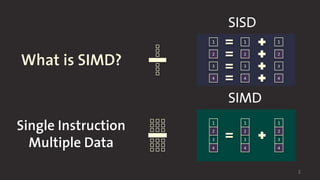
What is SIMD?
Single Instruction
Multiple Data
3
SISD
SIMD
1
3
2
4
1
3
2
4
1
3
2
4
1
3
2
4
1
3
2
4
1
3
2
4
AVX x4
#define T double
void add(T* x, T* y, T* z, int N) {
for(int i = 0; i < N; ++i) {
T x1, y1, z1;
x1 = x[i];
y1 = y[i];
z1 = x1 + y1;
z[i] = z1;
}
}
Scalar
#define T double
void add(T* x, T* y, T* z, int N) {
for(int i = 0; i < N; i += 4) {
__m256d x1, y1, z1;
x1 = _mm256_loadu_pd(x + i);
y1 = _mm256_loadu_pd(y + i);
z1 = _mm256_add_pd(x1, y1);
_mm256_storeu_pd(z + i, z1);
}
}
4
SISD
SIMDAVX x4
#define T double
void add(T* x, T* y, T* z, int N) {
for(int i = 0; i < N; ++i) {
T x1, y1, z1;
x1 = x[i];
y1 = y[i];
z1 = x1 + y1;
z[i] = z1;
}
}
Scalar
#define T double
void add(T* x, T* y, T* z, int N) {
for(int i = 0; i < N; i += 4) {
__m256d x1, y1, z1;
x1 = _mm256_loadu_pd(x + i);
y1 = _mm256_loadu_pd(y + i);
z1 = _mm256_add_pd(x1, y1);
_mm256_storeu_pd(z + i, z1);
}
}
LBB0_3:
movsd (%rdi,%rax,8), %xmm0
addsd (%rsi,%rax,8), %xmm0
movsd %xmm0, (%rdx,%rax,8)
incq %rax
cmpl %eax, %r9d
jne LBB0_3
LBB0_3:
vmovupd (%rdi,%r10,8), %ymm0
vaddpd (%rsi,%r10,8), %ymm0, %ymm0
vmovupd %ymm0, (%rax)
addq $4, %r10
addq $32, %rax
addq $1, %rcx
jne LBB0_3
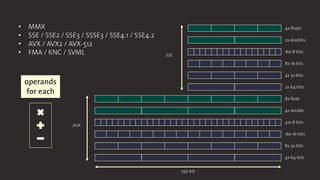
• MMX
• SSE / SSE2 / SSE3 / SSSE3 / SSE4.1 / SSE4.2
• AVX / AVX2 / AVX-512
• FMA / KNC / SVML
8x float
4x double
32x 8-bits
16x 16-bits
8x 32-bits
4x 64-bits
256-bit
AVX
4x floats
2x doubles
16x 8-bits
8x 16-bits
4x 32-bits
2x 64-bits
SSE
operands
for each
6
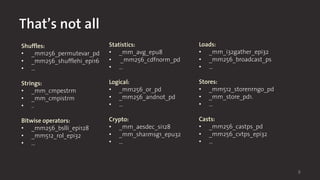
That’s not all
Shuffles:
• _mm256_permutevar_pd
• _mm256_shufflehi_epi16
• …
Strings:
• _mm_cmpestrm
• _mm_cmpistrm
• ..
Bitwise operators:
• _mm256_bslli_epi128
• _mm512_rol_epi32
• …
Statistics:
• _mm_avg_epu8
• _mm256_cdfnorm_pd
• …
Logical:
• _mm256_or_pd
• _mm256_andnot_pd
• …
Crypto:
• _mm_aesdec_si128
• _mm_sha1msg1_epu32
• …
Loads:
• _mm_i32gather_epi32
• _mm256_broadcast_ps
• …
Stores:
• _mm512_storenrngo_pd
• _mm_store_pd1.
• …
Casts:
• _mm256_castps_pd
• _mm256_cvtps_epi32
• …
7
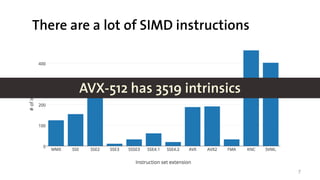
There are a lot of SIMD instructions
AVX-512 has 3519 intrinsics
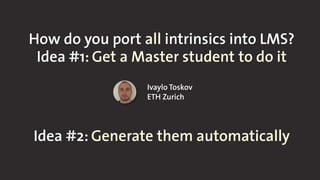
How do you port all intrinsics into LMS?
Ivaylo Toskov
ETH Zurich
Idea #2: Generate them automatically
Idea #1: Get a Master student to do it
9
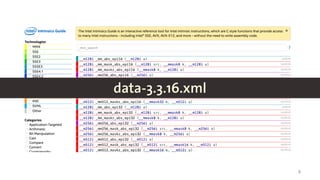
data-3.3.16.xml
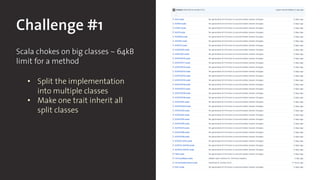
Challenge #1
Scala chokes on big classes ~ 64kB
limit for a method
• Split the implementation
into multiple classes
• Make one trait inherit all
split classes
Challenge #2
LMS has read / write effects
• Produce the effects
automatically using the
category data in the Intel
Intrinsics Guide
<intrinsic tech='AVX' rettype='__m256d' name='_mm256_loadu_pd'>
<type>Floating Point</type>
<CPUID>AVX</CPUID>
<category>Load</category>
<parameter varname='mem_addr' type='double const *’ />
<description>
Load 256-bits (composed of 4 packed
double-precision (64-bit) floating-point elements)
from memory into "dst". "mem_addr" does not need
to be aligned on any particular boundary.
</description>
<operation>
dst[255:0] := MEM[mem_addr+255:mem_addr]
dst[MAX:256] := 0
</operation>
<instruction name='vmovupd' form='ymm, m256’ />
<header>immintrin.h</header>
</intrinsic>
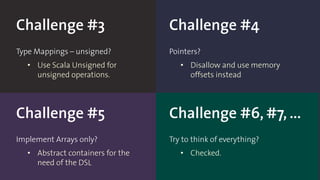
Challenge #3
Type Mappings – unsigned?
• Use Scala Unsigned for
unsigned operations.
Challenge #4
Pointers?
• Disallow and use memory
offsets instead
Challenge #5
Implement Arrays only?
• Abstract containers for the
need of the DSL
Challenge #6, #7, ...
Try to think of everything?
• Checked.
13
https://github.com/ivtoskov/lms-intrinsics
How do we make use of
the intrinsics ?
15
https://github.com/astojanov/lms-tutorial-pldi

Vectorization with LMS: SIMD Intrinsics

  • 1.
    PLDI 2017 TutorialSession Vectorization with LMS: SIMD Intrinsics Alen StojanovDepartment of Computer Science, ETH Zurich, Switzerland
  • 2.
  • 3.
    3 SISD SIMD 1 3 2 4 1 3 2 4 1 3 2 4 1 3 2 4 1 3 2 4 1 3 2 4 AVX x4 #define Tdouble void add(T* x, T* y, T* z, int N) { for(int i = 0; i < N; ++i) { T x1, y1, z1; x1 = x[i]; y1 = y[i]; z1 = x1 + y1; z[i] = z1; } } Scalar #define T double void add(T* x, T* y, T* z, int N) { for(int i = 0; i < N; i += 4) { __m256d x1, y1, z1; x1 = _mm256_loadu_pd(x + i); y1 = _mm256_loadu_pd(y + i); z1 = _mm256_add_pd(x1, y1); _mm256_storeu_pd(z + i, z1); } }
  • 4.
    4 SISD SIMDAVX x4 #define Tdouble void add(T* x, T* y, T* z, int N) { for(int i = 0; i < N; ++i) { T x1, y1, z1; x1 = x[i]; y1 = y[i]; z1 = x1 + y1; z[i] = z1; } } Scalar #define T double void add(T* x, T* y, T* z, int N) { for(int i = 0; i < N; i += 4) { __m256d x1, y1, z1; x1 = _mm256_loadu_pd(x + i); y1 = _mm256_loadu_pd(y + i); z1 = _mm256_add_pd(x1, y1); _mm256_storeu_pd(z + i, z1); } } LBB0_3: movsd (%rdi,%rax,8), %xmm0 addsd (%rsi,%rax,8), %xmm0 movsd %xmm0, (%rdx,%rax,8) incq %rax cmpl %eax, %r9d jne LBB0_3 LBB0_3: vmovupd (%rdi,%r10,8), %ymm0 vaddpd (%rsi,%r10,8), %ymm0, %ymm0 vmovupd %ymm0, (%rax) addq $4, %r10 addq $32, %rax addq $1, %rcx jne LBB0_3
  • 5.
    • MMX • SSE/ SSE2 / SSE3 / SSSE3 / SSE4.1 / SSE4.2 • AVX / AVX2 / AVX-512 • FMA / KNC / SVML 8x float 4x double 32x 8-bits 16x 16-bits 8x 32-bits 4x 64-bits 256-bit AVX 4x floats 2x doubles 16x 8-bits 8x 16-bits 4x 32-bits 2x 64-bits SSE operands for each
  • 6.
    6 That’s not all Shuffles: •_mm256_permutevar_pd • _mm256_shufflehi_epi16 • … Strings: • _mm_cmpestrm • _mm_cmpistrm • .. Bitwise operators: • _mm256_bslli_epi128 • _mm512_rol_epi32 • … Statistics: • _mm_avg_epu8 • _mm256_cdfnorm_pd • … Logical: • _mm256_or_pd • _mm256_andnot_pd • … Crypto: • _mm_aesdec_si128 • _mm_sha1msg1_epu32 • … Loads: • _mm_i32gather_epi32 • _mm256_broadcast_ps • … Stores: • _mm512_storenrngo_pd • _mm_store_pd1. • … Casts: • _mm256_castps_pd • _mm256_cvtps_epi32 • …
  • 7.
    7 There are alot of SIMD instructions AVX-512 has 3519 intrinsics
  • 8.
    How do youport all intrinsics into LMS? Ivaylo Toskov ETH Zurich Idea #2: Generate them automatically Idea #1: Get a Master student to do it
  • 9.
  • 10.
    Challenge #1 Scala chokeson big classes ~ 64kB limit for a method • Split the implementation into multiple classes • Make one trait inherit all split classes
  • 11.
    Challenge #2 LMS hasread / write effects • Produce the effects automatically using the category data in the Intel Intrinsics Guide <intrinsic tech='AVX' rettype='__m256d' name='_mm256_loadu_pd'> <type>Floating Point</type> <CPUID>AVX</CPUID> <category>Load</category> <parameter varname='mem_addr' type='double const *’ /> <description> Load 256-bits (composed of 4 packed double-precision (64-bit) floating-point elements) from memory into "dst". "mem_addr" does not need to be aligned on any particular boundary. </description> <operation> dst[255:0] := MEM[mem_addr+255:mem_addr] dst[MAX:256] := 0 </operation> <instruction name='vmovupd' form='ymm, m256’ /> <header>immintrin.h</header> </intrinsic>
  • 12.
    Challenge #3 Type Mappings– unsigned? • Use Scala Unsigned for unsigned operations. Challenge #4 Pointers? • Disallow and use memory offsets instead Challenge #5 Implement Arrays only? • Abstract containers for the need of the DSL Challenge #6, #7, ... Try to think of everything? • Checked.
  • 13.
  • 14.
    How do wemake use of the intrinsics ?
  • 15.