PROJECT 2:V-BENDING BY PRESS-BRAKE FORMING
ME 7680 - GROUP 2
APRIL 23RD,2016
GROUP MEMBERS
 Mohammed Nomaan Khan - Group Leader
 Ezhil NambiVijayan Ambika
 Abigail Davidson
 Rafi Alamgir
 Brandon Heid
 Ami Jariwala
 Kaustubh Keshav Zinjarde
 Harshada Sanjay Patil
GROUP COLLABORATION
 Online using Google Drive/Google Hangout/Microsoft Office
 Contact information
 Progress report
 Day-to-day updates
 Q & A
 Numerical Results
 Work in progress
 CAD and input files
 Literature - Articles available for all team members
 Meetings
 Saturday,April 9th - Review of project deliverables, set-up google drive
 Monday, April 11th - Review of model updates, division of labor
 Saturday,April 16th - Division of model iterations and analysis
 April 17th-20th – Team members working on individual iterations/tasks; online collaboration
 Thursday, April 21st – Google Hangout meeting to practice presentation
 Friday,April 22nd – Final meeting for presentation review
PROJECTAND PRESENTATION OVERVIEW
1. Generateunderstanding of problem statement
a. Literature review
2. Model assumptions and set-up
a. Goal: Achieve converging solution
3. Run iterations
a. Using solid mesh of blank
b. Each group member runs 1+ iteration
c. Goal:Optimize design to achieve 90°
4. Run optimized design using shell mesh of blank
5. Run optimized design using continuum shell mesh of blank
6. Compare solid vs. shell vs. continuum shell
7. 3D effects
8. Final recommendations
PROBLEM STATEMENT
For a given sheet blank,optimize the design of the die and punch to produce a 90°V-bent blank,after spring-back.
Punch
Die
Sheet Blank
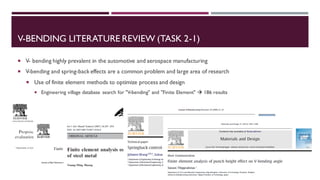
V-BENDING LITERATURE REVIEW (TASK 2-1)
 V- bending highly prevalent in the automotive and aerospace manufacturing
 V-bending and spring-back effects are a common problem and large area of research
 Use of finite element methods to optimize process and design
 Engineering village database search for "V-bending" and "Finite Element"  186 results
LITERATURE REVIEW
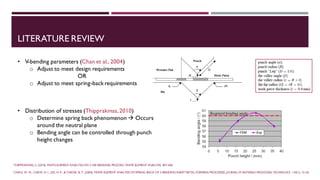
• Distribution of stresses (Thipprakmas,2010)
o Determine spring back phenomenon  Occurs
around the neutral plane
o Bending angle can be controlled through punch
height changes Outer Surface
THIPPRAKMAS, S. (2010). FINITE ELEMENT ANALYSIS ON V-DIE BENDING PROCESS. FINITE ELEMENT ANALYSIS, 407-428.
CHAN, W. M., CHEW, H. I., LEE, H. P., & CHEOK, B. T. (2004). FINITE ELEMENT ANALYSIS OFSPRING-BACK OF V-BENDING SHEET METAL FORMING PROCESSES. JOURNAL OF MATERIALS PROCESSING TECHNOLOGY, 148(1), 15-24.
• V-bending parameters (Chan et al., 2004)
o Adjust to meet design requirements
OR
o Adjust to meet spring-back requirements
PARAMETRIC MODEL THROUGH NX
 Three referencelines were created at locations A, B and C
 Edge point of referencelines were fixed.
 Parallel constrain was applied to referencelines C to B.
 Dimensional parameterof 28.6deg was applied from C to
die geometry.
 Dimensional parameterof 28.6deg was applied from B to
punch geometry.
 Angular parameterwas applied betweenA and B.
 Changing the angle betweenA and B will change the angle of
the punch and die.
FIXED
A
C
B
FIXED
PARAMETRIC MODEL THROUGH HYPERMESH
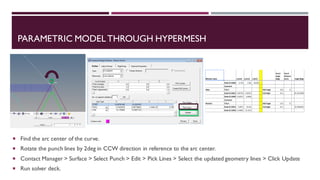
 Find the arc center of the curve.
 Rotate the punch lines by 2deg in CCW direction in reference to the arc center.
 Contact Manager > Surface > Select Punch > Edit > Pick Lines > Select the updated geometry lines > Click Update
 Run solver deck.
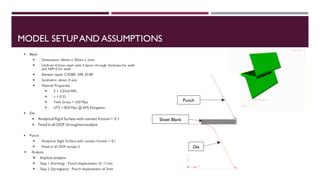
MODEL SETUPAND ASSUMPTIONS
 Blank
 Dimensions: 60mm x 30mm x 2mm
 Unifrom 0.5mm mesh with 5 layers through thickness for solid
and NIP=5 for shell
 Element types: C3D8R; S4R; SC8R
 Symmetric about X axis
 Material Properties
 E = 2.07e4 MPa
 ν = 0.33
 Yield Stress = 350 Mpa
 UTS = 850 Mpa @ 60% Elongation
 Die
 Analytical Rigid Surface with contact friction = 0.1
 Fixed in all DOF throughoutanalysis
 Punch
 Analytical Rigid Surface with contact friction = 0.1
 Fixed in all DOF except 2
 Analysis
 Implicit analysis
 Step 1 (Forming) : Punch displacement of -11mm
 Step 2 (Springback) : Punch displacement of 2mm
Punch
Die
Sheet Blank
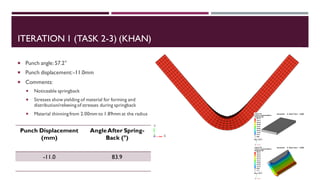
ITERATION 1 (TASK 2-3) (KHAN)
 Punch angle: 57.2°
 Punch displacement:-11.0mm
 Comments:
 Noticeable springback
 Stresses show yielding of material for forming and
distribution/relievingof stresses during springback
 Material thinningfrom 2.00mm to 1.89mm at the radius
Punch Displacement
(mm)
AngleAfter Spring-
Back (°)
-11.0 83.9
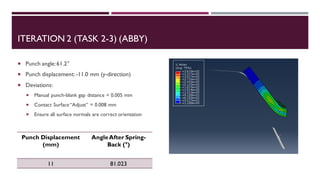
ITERATION 2 (TASK 2-3) (ABBY)
 Punch angle:61.2°
 Punch displacement: -11.0 mm (y-direction)
 Deviations:
 Manual punch-blank gap distance = 0.005 mm
 Contact Surface “Adjust” = 0.008 mm
 Ensure all surface normals are correct orientation
Punch Displacement
(mm)
AngleAfter Spring-
Back (°)
11 81.023
ITERATION 3 (TASK 2-3) (BRANDON)
 Punch angle: 65.2°
 Punch displacement:-11.0 mm (y-direction)
 Deviations:
 Manual punch-blank gap distance = 0.005 mm
 Contact Surface“Adjust” = 0.01 mm
 Ensure all surface normals are correct
orientation
Punch
Displacement
(mm)
AngleAfter
Spring-Back (°)
11 81.006
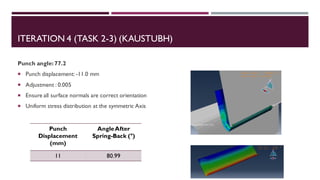
ITERATION 4 (TASK 2-3) (KAUSTUBH)
Punch angle:77.2
 Punch displacement: -11.0 mm
 Adjustment : 0.005
 Ensure all surface normals are correct orientation
 Uniform stress distribution at the symmetric Axis
Punch
Displacement
(mm)
AngleAfter
Spring-Back (°)
11 80.99
ITERATION 5 (TASK 2-3) (HARSHADA)
Punch angle:69.2
• Punch displacement:-11.0 mm
• Adjustment : 0.005
• Reduction of thickness near the bending radius
• Observable warping in step 2
Punch
Displacement
(mm)
AngleAfter
Spring-Back (°)
11 79.22
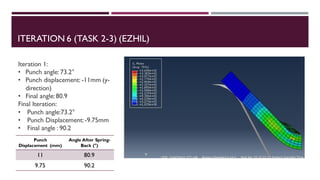
ITERATION 6 (TASK 2-3) (EZHIL)
Iteration 1:
• Punch angle: 73.2°
• Punch displacement: -11mm (y-
direction)
• Final angle:80.9
Final Iteration:
• Punch angle:73.2°
• Punch Displacement:-9.75mm
• Final angle : 90.2
Punch
Displacement (mm)
Angle After Spring-
Back (°)
11 80.9
9.75 90.2
ITERATION 7 (TASK 2-3) (RAFI)
Punch
Displacement
(mm)
Angle at Full
Punch
Displacement (°)
AngleAfter
Spring-Back (°)
-11 77.55 81.04
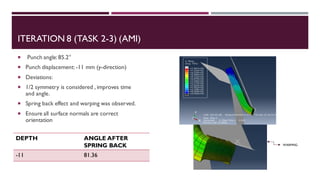
ITERATION 8 (TASK 2-3) (AMI)
DEPTH ANGLE AFTER
SPRING BACK
-11 81.36
 Punch angle:85.2°
 Punch displacement: -11 mm (y-direction)
 Deviations:
 1/2 symmetry is considered , improves time
and angle.
 Spring back effect and warping was observed.
 Ensure all surface normals are correct
orientation
WARPING
DESIGN OPTIMIZATION
 90° after spring-back was not achieved after only varying
punch angle
 We decide to change punch travel by changing distance value
 Different iteration were conducted through selecting
different travel depth without changing the punch angle in
order to achieve our 90°
Depth Angle after spring back
-11 81.36
-10 88.28
-9 136.71
-9.5 89.35
-9.75 90.22
-9.75(1/4 symmetry) 90.00
COMPARISON : C3D8R – S4R – SC8R
Solid (C3D8R) Shell (S4R) Continuum Shell (SC8R)
1)Von misses stress : - 6.061e+2 1)Von misses stress: - 6.468 e+2 1)Von misses stress: - 5.914e+2
2) Angle- 80.99 2) Angle- 88.82 2) Angle - 79.35
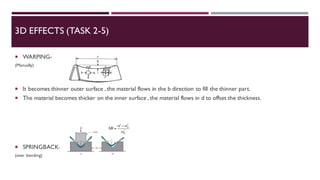
3D EFFECTS (TASK 2-5)
 WARPING-
(Manually)
 It becomes thinner outer surface , the material flows in the b direction to fill the thinner part.
 The material becomes thicker on the inner surface , the material flows in d to offset the thickness.
 SPRINGBACK-
(over bending)
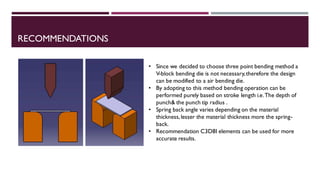
RECOMMENDATIONS
• Since we decided to choose three point bending method a
V-block bending die is not necessary,therefore the design
can be modified to a air bending die.
• By adopting to this method bending operation can be
performed purely based on stroke length i.e.The depth of
punch& the punch tip radius .
• Spring back angle varies depending on the material
thickness,lesser the material thickness more the spring-
back.
• Recommendation C3D8I elements can be used for more
accurate results.
FEM MODEL OF MODIFIED DIE
Stroke length Angle after spring back
11 97.39
10 90.96
 Punch angle:68°
 Punch displacement: -11 mm (y-direction)
 1/2 symmetry model is used
The maximum stress value obtained is 3.8273+02Mpa
CONCLUDING
 The FEM was used to investigate the effects of punch height on the bending angle in theV-bending process.With
respect to the punch heights,the FEM simulation results showed that the effects of punch height on the bending
angle.
 The maximum stress value throughout the process varies in-between 3.620e+02 – 6.100e+02 Mpa.
 Observed stress values are less than theYield stress.
 3D effects like Warping and Spring back was studied in the FEM model .
Observation:
 When the punch radius increases,the final angle of the part and the bending force increases.
THANKYOU
APPENDIX:INTERMEDIATE ITERATIONS
Team Member Punch Angle Punch
Displacement (mm)
Angle After Spring-
Back (°)
Abby 61.2 11 81.023
61.2 15 54.541
Rafi 81.2 11 81.042
81.2 7 113.896
81.2 9 96.436
81.2 9.75 90.369
Ezhil 68 12 90.8
Spring back mechanism
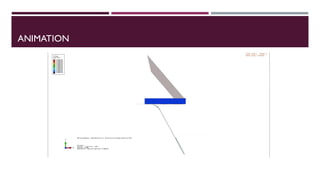
ANIMATION

V-Bending Presentation

  • 1.
    PROJECT 2:V-BENDING BYPRESS-BRAKE FORMING ME 7680 - GROUP 2 APRIL 23RD,2016
  • 2.
    GROUP MEMBERS  MohammedNomaan Khan - Group Leader  Ezhil NambiVijayan Ambika  Abigail Davidson  Rafi Alamgir  Brandon Heid  Ami Jariwala  Kaustubh Keshav Zinjarde  Harshada Sanjay Patil
  • 3.
    GROUP COLLABORATION  Onlineusing Google Drive/Google Hangout/Microsoft Office  Contact information  Progress report  Day-to-day updates  Q & A  Numerical Results  Work in progress  CAD and input files  Literature - Articles available for all team members  Meetings  Saturday,April 9th - Review of project deliverables, set-up google drive  Monday, April 11th - Review of model updates, division of labor  Saturday,April 16th - Division of model iterations and analysis  April 17th-20th – Team members working on individual iterations/tasks; online collaboration  Thursday, April 21st – Google Hangout meeting to practice presentation  Friday,April 22nd – Final meeting for presentation review
  • 4.
    PROJECTAND PRESENTATION OVERVIEW 1.Generateunderstanding of problem statement a. Literature review 2. Model assumptions and set-up a. Goal: Achieve converging solution 3. Run iterations a. Using solid mesh of blank b. Each group member runs 1+ iteration c. Goal:Optimize design to achieve 90° 4. Run optimized design using shell mesh of blank 5. Run optimized design using continuum shell mesh of blank 6. Compare solid vs. shell vs. continuum shell 7. 3D effects 8. Final recommendations
  • 5.
    PROBLEM STATEMENT For agiven sheet blank,optimize the design of the die and punch to produce a 90°V-bent blank,after spring-back. Punch Die Sheet Blank
  • 6.
    V-BENDING LITERATURE REVIEW(TASK 2-1)  V- bending highly prevalent in the automotive and aerospace manufacturing  V-bending and spring-back effects are a common problem and large area of research  Use of finite element methods to optimize process and design  Engineering village database search for "V-bending" and "Finite Element"  186 results
  • 7.
    LITERATURE REVIEW • Distributionof stresses (Thipprakmas,2010) o Determine spring back phenomenon  Occurs around the neutral plane o Bending angle can be controlled through punch height changes Outer Surface THIPPRAKMAS, S. (2010). FINITE ELEMENT ANALYSIS ON V-DIE BENDING PROCESS. FINITE ELEMENT ANALYSIS, 407-428. CHAN, W. M., CHEW, H. I., LEE, H. P., & CHEOK, B. T. (2004). FINITE ELEMENT ANALYSIS OFSPRING-BACK OF V-BENDING SHEET METAL FORMING PROCESSES. JOURNAL OF MATERIALS PROCESSING TECHNOLOGY, 148(1), 15-24. • V-bending parameters (Chan et al., 2004) o Adjust to meet design requirements OR o Adjust to meet spring-back requirements
  • 8.
    PARAMETRIC MODEL THROUGHNX  Three referencelines were created at locations A, B and C  Edge point of referencelines were fixed.  Parallel constrain was applied to referencelines C to B.  Dimensional parameterof 28.6deg was applied from C to die geometry.  Dimensional parameterof 28.6deg was applied from B to punch geometry.  Angular parameterwas applied betweenA and B.  Changing the angle betweenA and B will change the angle of the punch and die. FIXED A C B FIXED
  • 9.
    PARAMETRIC MODEL THROUGHHYPERMESH  Find the arc center of the curve.  Rotate the punch lines by 2deg in CCW direction in reference to the arc center.  Contact Manager > Surface > Select Punch > Edit > Pick Lines > Select the updated geometry lines > Click Update  Run solver deck.
  • 10.
    MODEL SETUPAND ASSUMPTIONS Blank  Dimensions: 60mm x 30mm x 2mm  Unifrom 0.5mm mesh with 5 layers through thickness for solid and NIP=5 for shell  Element types: C3D8R; S4R; SC8R  Symmetric about X axis  Material Properties  E = 2.07e4 MPa  ν = 0.33  Yield Stress = 350 Mpa  UTS = 850 Mpa @ 60% Elongation  Die  Analytical Rigid Surface with contact friction = 0.1  Fixed in all DOF throughoutanalysis  Punch  Analytical Rigid Surface with contact friction = 0.1  Fixed in all DOF except 2  Analysis  Implicit analysis  Step 1 (Forming) : Punch displacement of -11mm  Step 2 (Springback) : Punch displacement of 2mm Punch Die Sheet Blank
  • 11.
    ITERATION 1 (TASK2-3) (KHAN)  Punch angle: 57.2°  Punch displacement:-11.0mm  Comments:  Noticeable springback  Stresses show yielding of material for forming and distribution/relievingof stresses during springback  Material thinningfrom 2.00mm to 1.89mm at the radius Punch Displacement (mm) AngleAfter Spring- Back (°) -11.0 83.9
  • 12.
    ITERATION 2 (TASK2-3) (ABBY)  Punch angle:61.2°  Punch displacement: -11.0 mm (y-direction)  Deviations:  Manual punch-blank gap distance = 0.005 mm  Contact Surface “Adjust” = 0.008 mm  Ensure all surface normals are correct orientation Punch Displacement (mm) AngleAfter Spring- Back (°) 11 81.023
  • 13.
    ITERATION 3 (TASK2-3) (BRANDON)  Punch angle: 65.2°  Punch displacement:-11.0 mm (y-direction)  Deviations:  Manual punch-blank gap distance = 0.005 mm  Contact Surface“Adjust” = 0.01 mm  Ensure all surface normals are correct orientation Punch Displacement (mm) AngleAfter Spring-Back (°) 11 81.006
  • 14.
    ITERATION 4 (TASK2-3) (KAUSTUBH) Punch angle:77.2  Punch displacement: -11.0 mm  Adjustment : 0.005  Ensure all surface normals are correct orientation  Uniform stress distribution at the symmetric Axis Punch Displacement (mm) AngleAfter Spring-Back (°) 11 80.99
  • 15.
    ITERATION 5 (TASK2-3) (HARSHADA) Punch angle:69.2 • Punch displacement:-11.0 mm • Adjustment : 0.005 • Reduction of thickness near the bending radius • Observable warping in step 2 Punch Displacement (mm) AngleAfter Spring-Back (°) 11 79.22
  • 16.
    ITERATION 6 (TASK2-3) (EZHIL) Iteration 1: • Punch angle: 73.2° • Punch displacement: -11mm (y- direction) • Final angle:80.9 Final Iteration: • Punch angle:73.2° • Punch Displacement:-9.75mm • Final angle : 90.2 Punch Displacement (mm) Angle After Spring- Back (°) 11 80.9 9.75 90.2
  • 17.
    ITERATION 7 (TASK2-3) (RAFI) Punch Displacement (mm) Angle at Full Punch Displacement (°) AngleAfter Spring-Back (°) -11 77.55 81.04
  • 18.
    ITERATION 8 (TASK2-3) (AMI) DEPTH ANGLE AFTER SPRING BACK -11 81.36  Punch angle:85.2°  Punch displacement: -11 mm (y-direction)  Deviations:  1/2 symmetry is considered , improves time and angle.  Spring back effect and warping was observed.  Ensure all surface normals are correct orientation WARPING
  • 19.
    DESIGN OPTIMIZATION  90°after spring-back was not achieved after only varying punch angle  We decide to change punch travel by changing distance value  Different iteration were conducted through selecting different travel depth without changing the punch angle in order to achieve our 90° Depth Angle after spring back -11 81.36 -10 88.28 -9 136.71 -9.5 89.35 -9.75 90.22 -9.75(1/4 symmetry) 90.00
  • 20.
    COMPARISON : C3D8R– S4R – SC8R Solid (C3D8R) Shell (S4R) Continuum Shell (SC8R) 1)Von misses stress : - 6.061e+2 1)Von misses stress: - 6.468 e+2 1)Von misses stress: - 5.914e+2 2) Angle- 80.99 2) Angle- 88.82 2) Angle - 79.35
  • 21.
    3D EFFECTS (TASK2-5)  WARPING- (Manually)  It becomes thinner outer surface , the material flows in the b direction to fill the thinner part.  The material becomes thicker on the inner surface , the material flows in d to offset the thickness.  SPRINGBACK- (over bending)
  • 22.
    RECOMMENDATIONS • Since wedecided to choose three point bending method a V-block bending die is not necessary,therefore the design can be modified to a air bending die. • By adopting to this method bending operation can be performed purely based on stroke length i.e.The depth of punch& the punch tip radius . • Spring back angle varies depending on the material thickness,lesser the material thickness more the spring- back. • Recommendation C3D8I elements can be used for more accurate results.
  • 23.
    FEM MODEL OFMODIFIED DIE Stroke length Angle after spring back 11 97.39 10 90.96  Punch angle:68°  Punch displacement: -11 mm (y-direction)  1/2 symmetry model is used The maximum stress value obtained is 3.8273+02Mpa
  • 24.
    CONCLUDING  The FEMwas used to investigate the effects of punch height on the bending angle in theV-bending process.With respect to the punch heights,the FEM simulation results showed that the effects of punch height on the bending angle.  The maximum stress value throughout the process varies in-between 3.620e+02 – 6.100e+02 Mpa.  Observed stress values are less than theYield stress.  3D effects like Warping and Spring back was studied in the FEM model . Observation:  When the punch radius increases,the final angle of the part and the bending force increases.
  • 25.
  • 26.
    APPENDIX:INTERMEDIATE ITERATIONS Team MemberPunch Angle Punch Displacement (mm) Angle After Spring- Back (°) Abby 61.2 11 81.023 61.2 15 54.541 Rafi 81.2 11 81.042 81.2 7 113.896 81.2 9 96.436 81.2 9.75 90.369 Ezhil 68 12 90.8 Spring back mechanism
  • 27.