324
LESSON-21
EMERGING DIMENSIONS IN
TOURISM: INDIA SPECIFIC
Venugopalan T
STRUCTURE
21.0 Introduction
21.1 Objectives
21.2 Emerging dimensions in tourism: India specific
21.2.1 Health Tourism
21.2.2 Spiritual Tourism
21.2.3 Adventure Tourism
21.2.4 MICE Tourism
21.2.5 Nature Tourism
21.2.6 Rural tourism
21.2.7 Sustainable tourism
21.3 Summary
21.4 Key Words
21.5 Glossary
21.6 Review Questions
21.0 INTRODUCTION
We have discussed in the previous units in detail, that tourism industry is
one of the major segments of the Indian economy. It is a major contributor
to foreign exchange earnings provides employment to millions directly and
indirectly and acts as a vehicle for infrastructure development. Recognising
the importance of the tourism industry, the Government of India has taken
many policy measures such as Tourism Policy 1982, Tourism Plan of
Action 1992 and Tourism Policy 1997. Through these policies, the
government called for effective coordination of public and private
participation to achieve synergy in the development of tourism. These plans
identified new forms of tourism products for taking advantage of the
emerging markets. Business tourism, health tourism, rural tourism, pilgrim
tourism, adventure tourism, and sustainable tourism are some of the new
products devised for changing demand. Let us study these emerging
dimensions in the tourism sector.
21.1 OBJECTIVES
After studying this unit you will be able to achieve following objectives:
• Understand emerging trends in tourism.
• Learn about new products and old traditional tourism products.
325
• Know the importance of sustainable tourism development.
• Understand the concept of nature tourism.
• Develop environmental consciousness.
• Develop skills to locate important tourist destinations on the map.
• Know that tourism can be an instrumental for developing secularism
and national integration and universal brotherhood.
21.2 EMERGING DIMENSIONS
Tourism will expand greatly in future mainly due to the revolution that is
taking place on both the demand and supply side. The changing population
structure, improvement in living standard, more disposable income, fewer
working hours and long leisure time, better educated people, ageing
population and more curious youth in developing the countries, all will fuel
the tourism industry growth.
The arrival of a large number of customers, better educated and more
sophisticated, will compel the tourist industry to launch new products and
brands and re-invents traditional markets. The established traditional
destinations founded on sun-sea-sand products will have to re-engineer their
products. They must diversify and improve the criteria for destinations and
qualities of their traditional offers. Alongside beach tourism, the tourism
sector will register a steady development of new products based on natural
rural business, leisure and art and culture. Thus the study of new markets
and emerging markets and necessity of diversified products are the basis of
our strategy, which can enhance and sustain, existing and capture new
markets. Let us discuss some of the new tourism products.
21.2.1 HEALTH TOURISM
India is promoting the high-tech healing provided by its private health care
sector as a tourist attraction. This budding trade in medical tourism, selling
foreigners the idea of travelling to India for world-class medical treatment at
lowest cost, has really got attention in the overseas market.
The Indian system of medicine, which incorporates ayurveda, yoga, sidha,
unani, naturopathy and other traditional healing treatments, is very unique
and exotic. This medical expertise coupled with allopathic and other
modern methods become our new focus segment to project India as a Global
Healing Destination. If we believe the report published by McKenzie
Consultants and Confederation of Indian Industries (CII), the response is
quite positive and it could be generating revenue approximately Rs.100b by
the year 2012. Our medical tourism provides low cost treatment. Perhaps
you will wonder that the cost of same treatment in the US is ten times more
than that in India. Many state governments like Kerala, Andhra Pradesh,
Uttranchal, and Karnataka have been showcasing their medical tourism
segment in certain focused market like the Gulf and African regions. (Gaur
Kanchilal)
326
Indian private sector hospitals have undertaken massive investment in the
area of health. These super-specialty hospitals employ efficient and expert
doctors and other paramedical staffs with modern facilities. The experienced
doctors, dedicated service minded experts have made available their services
for giving alternative system of medicines and treatments. Health camps,
lecture training classes are also arranged for general awareness. Yogasana
has become popular and widespread and many public and private and other
organisations conduct Yoga classes. Ayurveda, naturopathy and nature
treatments are popular around the world.
Total Health: A New Mantra
Ayurveda
India has a rich heritage in the areas of traditional and natural medicines.
The earliest mention of Indian medical practices can be found in the Vedas
and Samhitas of Charaka, Bhela and Shusruta. A systematic and scientific
approach was adopted by the sages of the time leading to the development
of a system that is relevant even today. India is the land of Ayurveda. It
believes in removing the cause of illness and not just curing the disease
itself. It is based on herbals and herbal components without having side
effects.
Ayurveda considers that the base of life lies in the five primary elements;
ether (space), air, fire, water and earth. And the individual is made up of a
unique proportion of the five elements in unique combinations to form three
doshas (vata, pita and kapha). When any of these doshas become accute, a
person falls ill. Ayurveda recommends a special life style and nutritional
guidelines supplemented with herbal medicines. If toxins are abundant, then
a cleaning process known as Panchkarma is recommended to eliminate
those unwanted toxins and revitalize both mind and body. Ayurveda offers
treatments for ailments such as arthritis, paralysis, obesity, sinusitis,
migraine, premature aging and general health care.
Kerala is a world tourist destination and part of the reasons lies with the
well- known stress-releasing therapies of famed Ayurvedic research centers.
The climate along with the blessing of nature has turned Kerala into the
ideal place for ayurvedic, curative and rejuvenating treatments.
Yoga
If Ayurveda is the science of body, yoga is the science of the mind.
Practiced together they can go a long way in making an individual fit. The
word yoga means to join together. The ultimate aim of yoga is to unite the
human soul with the universal spirit. Yoga was developed 5000 years ago
and the base of yoga is described in theYoga Sutra of Patanjali. This
describes eight stages of yoga. These are Yam (universal moral commands),
Niyam (self purification), Asana (posture), Pranayama (breathing control),
Prathyahara (withdrawal of mind from external objects), Dharana
(concentration), Dhyana (meditation), and Samadhi (state of super-
consciousness). To get the benefits of yoga, one has to practice Asana,
Pranayama and Yoganidra. With the regular practice of asanas one can
327
control cholesterol level, reduce weight, normalize blood pressure and
improve cardiac performance. Pranayama helps to release tensions, develop
relaxed state of mind and Yoganidra is a form of meditation that relaxes
both physiological and psychological systems. Today, yoga has become
popular in India and abroad and in a number of places including urban and
rural areas yoga is taught and practiced.
Spas
Most of the other parts of the world have their own therapies and treatment
that are no doubt effective in restoring wellness and beauty. New kinds of
health tours that are gaining popularity in India are spa tours. Spas offer the
unique advantages of taking the best from the west and the east combining
them with the indigenous system and offering best of the two worlds. In
hydropathy, Swedish massages work with the Javanese Mandy, lulur,
aromatherapy, reflexology and traditional ayurveda procedures to help keep
the tourist healthy and enhance beauty. Combining these therapies with
meditation, yoga and pranayama make the spa experience in India a new
destination for medical tourism. The spas are very useful for controlling
blood pressure, insomnia, cure tension, depression, paralysis and number of
other deadly diseases. Ananda Resort in Rishikesh, Angsana Resort, Golden
Palm Spa and Ayurgram in Bangalore offer ayurveda, naturopathy, yoga
and meditation packages. (Gaur Kanchilal)
Allopathy
India has made rapid strides in advanced health care systems, which
provides world-class allopathic treatment. This has become possible
because of the emergence of the private sector in a big way in this field.
More and more foreign tourists are realizing that India is an ideal place for
stopover treatment. Indian Multi-specialty hospitals are providing world-
class treatment at an amazingly economical cost as compared to the west.
Quality services and low price factor primarily go in favour of India. The
cardio care, bone marrow transplantation, dialysis, kidney transplant,
neuron–surgery, joint replacement surgery, urology, osteoporosis and
numerous diseases are treated at Indian hospitals with full professional
expertise. Apollo hospital group, Escorts in Delhi, Jason Hospital, Global
Hospital, and Max Health Care are catering to medical care for international
patients in the areas of diagnostic, disease management, preventive health
care and incisive surgeries.
The tourism department has devised websites in order to provide
information. Many Ayurveda health resorts that are owned and rum by
traditional Ayurveda Institutes have come up. Ayurgram is a novel concept
that not only offers heritage accommodation but also offers a whole range of
Ayurvedic treatments and rejuvenating packages. Similarly hotels have also
included these types of packages in their holidays. Some of the tour
operators have worked out all-inclusive medical treatment package that
include treatment, accommodation, food, airport transfers, post operation
recuperative holidays, along with a host of other facilities.
328
This in fact shows our product offers true value for money for service.
Many world-class state-of-the-art furnishing and equipment are being
added to our Ayurveda Resorts to welcome international guests. Along with
these hospitals there are many centers which offer not just physical but
emotional and spiritual healing to patients. With all these India is going to
be one of the leading medical health care destinations in the near future.
CHECK YOUR PROGRESS
Activity 1
India had developed indigenous methods over centuries for curing diseases.
Ask your elders how they used to get rid of health problems in those days.
………………………………………………………………………………
………………………………………………………………………………
………………………………………………………………………………
………………………………………………………………………………
………………………………………………………………
Activity 2
What are the important indigenous methods of curing diseases?
………………………………………………………………………………
………………………………………………………………………………
………………………………………………………………………………
………………………………………………
Activity 3
Prepare a list of institutes proving medical education in your state.
...........................................................................................................................
...........................................................................................................................
...........................................................................................................................
...........................................................................................................................
....................................................................................
Activity 4
Find the key words which are not used in this topic
Joint replacement surgery
Urology
Ecstasy
Osteoporosis
Hydropathy
Fever
Panchkarma
Exotic
329
21.2.2 SPIRITUAL TOURISM
Globally people are increasingly mentally disturbed and looking for solace
in spiritual reading, meditation and moments of divine ecstasy. Our country
has been known as the seat of spiritualism and India’s cosmopolitan nature
is best reflected in its pilgrim centres. Religion is the life-blood for followers
of major religion and sects. Hinduism, Islam, Buddhism, Jainism,
Zoroastrianism and Christianity have lived here for centuries. The visible
outpouring of religious fervor is witnessed in the architecturally lavish
temples, mosques, monasteries and Churches spreads across the length and
breadth of the country. India is not only known as a place rich in its culture
with varied attractions but also for many places of worship, present itself as
embodiments of compassion where one get peace of mind.
Thus India has been respected as a destination for spiritual tourism for
domestic and international tourists. Spiritual tourism is also termed as
religious heritage tourism. It includes all the religions mentioned above;
religious places associated with, emotional attachment to these centers and
infrastructure facilities for the tourists. This can also be referred to as
pilgrimage tourism, as clients are not looking for luxury but arduous
journeys to meet the divine goal or simple life.
The essence of spiritual tourism is inner feeling through love. Love should
not be rationed on the basis of caste, creed and economic status or
intellectual attainment of the recipient. Religions come into existence for the
purpose of regulating human life; what are common to all of them are the
principles of love. Thus through religious tourism there is a sincere effort to
bring better understanding among various communities, nations and thus
foster global unity.
Hinduism is one of the oldest religions of India. Over 5000 years of
religious history created wonderful temples and survived through ages all
over India. The most popular spiritual tours are those that are centered on
holy Ganges River. Badrinath, Kedarnath, Haridwar, Gangotri, Yamunotri,
Allahabad, Varanasi. Jaganath temple at Puri, Bhubaneshwar, Konark in
Orissa, Mata Vaishnodevi of Jammu and Kashmir, are some of the
important pilgrim centers in north India. There are many spiritual sites in
South India as well which dates back beyond the 10th
centaury.
Rameshwaram, Mahabalipuram, Madurai Meenakshi temple in Tamilnadu
and Tirupati in Andhra Pradesh are some pilgrim centers. Every year
millions of tourists, both domestic and international, visit these places.
India is special to Buddhists all over the world and India is the destination
for pilgrimage because Buddhism emerged in India. The country is dotted
with places that are associated with the life and times of Gutham Buddha;
Lumbini-the birthplace of Buddha, Saranath where Buddha delivered his
first sermon, Buddha Gaya where lord Buddha attained enlightenment and
Vaishali where he delivered his last sermon and announced his nirvana.
330
Sikhism also emerged in India. The Golden Temple in Amritsar, the
Hemkund Sahib, and Gurunanak Devji Gurudwara at Manikaran, which is
also known for its hot water springs with healing properties, the holy city of
Patna Sahib and Anandpur Sahib are important for Sikhs.
The Jain temples of Dilwara and Mount Abu in Rajasthan, the Gomateswara
temple at Karnataka, draw thousands of Jain followers. Even small
communities like the Bahais have their own Lotus Temple at Delhi.
The Sultanate and Moghul empires built many historical monuments and
mosques during their reign, all over the country. Red Fort, Fatehapur Sikri,
Jama Masjid, TajMahal, Charminar etc., bear testimony to the blend of the
Indian and Islam traditions of architecture. The followers of Islam have
many mosques and shrines of Sufi Saints, like Moin-Uddin Chisti and
Nizamuddin Aulia.
For Christians, spiritual tours to Goa among other place like Mumbai and
Kolkata are must. Among the most popular sites in Goa is the church of Our
Lady of Rosary, the Rachel Seminary, and Church of Bom Jesus.
In addition to pilgrim centers there are personalities like the Satya Sai Baba,
Osho, Shirdhi and others. This shows that spirituality and religion in India is
a serious pursuit. The State Governments concerned, charitable trusts,
temple trusts have made elaborate arrangements for accommodation,
transport and ritual ceremonies. These organizations are also running
hospitals, educational institutes, ashrams, meditation centers which benefit
local community. More than 500 religious places have been identified and
efforts are being made to develop these centers by Central and State
Governments with private participation.
CHECK YOUR PROGRESS
Activity 1
Do you think spiritual tourism can promote religious harmony?
………………………………………………………………………………
………………………………………………………………………………
………………………………………………………………………………
Activity 2
Which are the important religious places which attract pilgrims in your
state?
………………………………………………………………………………
……………………………………………………………………………….
………………………………………………………………………………
………………………………………………………………………………
331
………………………………………………………………………………
………………………………………………………………………………
Activity 3
Match the following
A B
Jaganath temple ............. Goa
Mount Abu ............ Lumbini
Birthplace of Buddha ........... Rajasthan
Church of Bom Jesus .......... Puri
21.2.3 MICE TOURISM
The meetings, incentives, conferences and exhibitions (MICE) industry is
extensively and rapidly growing and is largely associated with travel for
business purpose. MICE related events include meetings, conferences,
conventions, exhibitions and incentive travels. Each of these different
subsections of MICE has quite different characteristics although the industry
is often referred to as MICE. Increasingly convention bureaus serve the
needs of meetings, incentives and exhibitions organizers and service
providers supply each of the sectors.
Business with Pleasure
With the Indian economy opening up and government restrictions loosening,
Mumbai, Bangalore, Hyderabad, Chennai, Delhi and Kolkata are assuming
importance as major centres of business activity in the country. The days of
red- tape always associated with Indian business activity is a thing of the
past and corporate India has moved towards more western standards of
professionalism. Since the liberalization of the Indian economy, MICE
tourism is becoming a growing segment in India. More and more business
people have been coming to India for business purpose and adding business
with pleasure in their India tour.
Most of the hotels and tour operators offer special facilities for travellers;
some even specialized in this field. They offers pick-up at the airport,
corporate floor rooms which will feature phones, fax machines, computers,
journals. All rooms offer elaborate conferencing facilities at hotels and
special conventions centers. Hotels are adept in organizing theme banquets
for a product launch, small cocktails etc. The important conference centers
are New Delhi, Mumbai, Jaipur, Kovalam, Chennai, Bangalore, Agra, and
Goa where popular convention tours offer exciting possibilities.
Incentive tourism
Incentive travel has emerged as a popular means of rewarding the
employees’ achievements and contributions, by several business houses
especially multinational companies, Insurance Companies, Banks,
Pharmaceuticals Firms, etc. Employees are given free tickets or holidays
packages to select destinations all paid by company. These are given as
332
added perks to keep up the interest of the executives who are the high
performers of the company. Incentive tours market has become fast growing
sector within the tourism industry.
CHECK YOUR PROGRESS
Activity 1
Describe the facilities provided by Indian Hotels for business tourism.
………………………………………………………………………………
………………………………………………………………………………
………………………………………………………………………………
………………………………………………………………………………
………………………………………………………………………………
Activity 2
Make a list of important destinations of MICE tourism.
………………………………………………………………………………
………………………………………………………………………………
………………………………………………………………………………
………………………………………………………………………………
………………………………………………………………
21.2.4 ADVENTURE TOURISM
Youth tourism has been identified as one of the largest segments of global
and domestic tourism. The young travellers are primarily experience
seekers, collecting, enquiring unique experiences. Adventure and risk have
a special role to play in the behaviour and attitudes of young travellers. The
growing number of young travellers is being fuelled by a number of factors
such as increased participation in higher education, falling level of youth
unemployment, increased travel budget through parental contribution,
search for an even more exciting and unique experience and cheaper long
distance travel.
Youth and adventure tourism appears to have considerable growth potential.
The rising income in some major potential source markets such as the
Central and Eastern Europe, Asia and Latin America, combined with the
lower travel cost, growing student populations around the world particularly
in developing countries, has fuelled the demand.
India: a heaven for adventure tourism
India has been an attraction for travellers from all over the world. Though
in the field of international tourism, the segment of adventure tourism in
333
India is getting only a fraction of such traffic. The trend has been showing
an increased movement year after year with the development of facilities
and greater awareness about adventure tourism options. Indian tourism
offers both international and domestic adventurers a wide choice of
adventures. Water sports, elephant safari, skiing, yachting, hail-skiing,
gliding, sailing, tribal tours, orchid tours, scaling the high peaks of
Himalayas, trekking to the valley of flowers, riding the waves in rapids, and
camel safari in the deserts are breath taking opportunities for nature
enthusias. Ladakh, the Garwal hills, the Himachal hills, Darjeeling, Goa,
Lakshadweep, Andaman and Nicobar, Jaisalmer and wildlife sanctuaries
and reserves are some of the places that offer adventure tourism.
Himalayas are the centre of India’s main adventure activities as well as out-
door recreational tourism. Our rivers, backwaters, Indian Ocean, Arabian
Sea and deserts are unique attractions for the various branches of adventure.
Trekking holds out the greatest potential in terms of numbers. It requires
little infrastructure and carries its benefits to remote hills and mountain
regions. Many of them are economically poor and backward. For our own
youth it also helps in inculcating a spirit of adventure, respect for nature.
Indian Mountaineering Federation, Ministry of Tourism and State
Governments are trying to improve trekking facilities and ensure safety and
protection of travellers. The Institute of Mountaineering also organises
courses for guides to train them in basic rock climbing safety procedures,
environmental knowledge, and flora and fauna conservation. The major trek
heads in the Himalayan region include Kashmir valley, Kirshwasser
Zanskar, Ladhak, Lahul and Spiti, Champa and Manali, etc, Trekking in the
Himalayas is a quite enjoyable. Let us now discuss some important
adventure activities:
Mountaineering Expedition
This is the first and foremost activity in the Himalayas. In India, the
expeditions are controlled and regulated by Indian Mountaineering
Federation, which is the nodal body. Foreign expedition groups have to
request the Indian Mountaineering Foundation (IMF) to book the required
peak and IMF confirms the peak, by charging the royalty depending upon
the number of persons and height of peak. Ministry of Defence, Home
Ministry, Ministry of External Affairs are also involved in this process.
River rafting
The Himalayan river’s offer River rafting that run through the beautiful
terrains, sandy white beaches, boulder studded rapids, river confluences,
deep gorges, and some revered temples and towns. White-water sports are
popular in Rishikesh, Manali, Zanskar Teesta, Beas, Central Ministry of
Tourism has great extremely extended support to import inflatable rafts,
canoes, kayaks, and accessories to boost water sports. Lakshadweep and
Andaman have been promoted for scuba diving and windsurfing.
334
Water Sports
To boost water sports, water skiing and sailing both in seas and lakes, and
river facilities has been provided. Chilka Lake in Orissa, Kollam in Kerala,
Bhopal Lake in Madhya Pradesh, Dal Lake in Kashmir are some of the
places where facilities have been provided for water sports. In Himachal
hills Heli-skiing is also being promoted in season. The Garwal Mandal
Vikas Nigam provides regular skiing courses during the season. It can be
said that India is a new destination for adventure tourism. The Ministry of
tourism, The Himalayan Task Force and Himalayan Tourism and Adventure
Tourism Board (HMTAB) meet every year to discuss conservation,
promotion for Himalayan tourism, and conservation of ecology.
CHECK YOUR PROGRESS
Activity 1
Write down the important adventure tourist destinations in your native
place?
……………………………………………………………
……………………………………………………………
……………………………………………………………
……………………………………………………………
……………………………………………………………
……………………………………………………………
Activity 2
You are an adventure tourist and you want to go for water sport, Which
places will you select?
……………………………………………………………
……………………………………………………………
……………………………………………………………
……………………………………………………………
……………………………………………………………
Activity 3
A foreign tourist is approaching you and asking about the places where he
can enjoy trekking. Which places will you suggest to him?
………………………………………………………………………………
………………………………………………………………………………
………………………………………………………………………………
………………………………………………………………………………
335
21.2.5 NATURE TOURISM
In search of new tourism products, travellers and suppliers are today seeking
to reshape the meaning of nature as a tourism attraction. Modern nature
based tourism focuses on experiencing flora and fauna in natural settings.
The nature based tourism related to nature, its attractiveness so that the
visitors experience it in its natural settings. Eco-tourism takes into account
unspoiled natural and socio-cultural attraction. Today the term nature
tourism is often used synonymously with eco-tourism. Today nature tourism
is the fastest growing segment of the tourism sector. It comprises around 40-
60% of all international tourism.
Diversity of India is to be seen not only in its people, culture, religions,
language and life style, the diversity starts in the land itself. The snowbourd
peaks of the Himalayas, tropical rain forests, and hot deserts and breath-
taking beautiful coasts. Each diverse geographical region generates a
different picture and exploring them provides a unique experience. Now all
these are packaged for tourists to provide eco-friendly holidays in India.
Wild life
The diversity of wild life in India is as rich as that of its flora and fauna.
The great wealth of Indian wild-life can be imagined with the sight of
majestic elephants, the dance of peacocks, the camel strides, the roar of
tigers, at unparalleled acts of beauty. Watching birds and animals in their
natural habitat is an experience in itself. The vastness of wild life and
wilderness is India unparallel in the world. All these account for the
immense opportunities for wild life tourism in India.
The immense heritage of wild life in India comprises 80 national parks and
another whopping 441 wild life sanctuaries including bird sanctuaries.
These reserves and forest areas are spread across the breadth and length
right form the foot hills of Himalayan, the Jim Corbet National park to six
national parks in Andaman, from Ranthambhor national park in Rajasthan to
Hazaribag wild life sanctuary in Bihar. India also boasts of the unique
ecosystem at Sunderbans which is a UNESCO world heritage site and home
to the largest number of tigers in the world.
The Himalayan region is renowned for being the national habitat for a
variety of wild life, elephants, snow leopards, deer, panther, wild buffalos,
wild ass, one horned rhinoceros, porcupine, snow leopards, etc. The
Kaziranga Game Sanctuary is ideal habitat for the rhino that the nature
lovers and environmentalists are fascinated by. The great Indian bustard
and the black buck of Kerera sanctuary attract a lot of tourists. The
Madhav National Park (Shivpuri Park) is another rich habitat for the wild
life. The royal animal, tiger happens to be symbol of strength and speed.
Amongst the best-known tiger reserves in India is Bandhawgarh in Madhya
Pradesh. It is also known as the crown in the wild life heritage of India.
336
The variety of birds in India is enormous. Several hundred species of bird
can be spotted across India. Indian wild life has its share of native birds
along with migratory birds. The region of Andaman is home to rare species
of birds like Narcondum hornbills, Nicobar pigeons and megaspores. The
Himalayan region is well known as the natural habitat for the pheasant
griffon, vulture and ravens. Dudhuwa wild life reserve, Keoladeao, Ghana
national park, the Bharatpur bird sanctuary in Rajasthan is home to
indigenous and migratory water birds. These bird sanctuaries are attracting
tourists from far and wide.
Fishing and angling
Among the amazing array of nature tours offered in India are those that
offer angling and fishing. The waters of Indian sub-continent are mind-
blowing grounds for the nature sports. The adventures settings range form
the majestic Himalayan valleys, snow fed streams and high altitude lakes
and wide coastal stretches of the Arabia Seas and Bay of Bengal. Amidst
the beautiful hills of the Himalayas is tented accommodation along the river
beds, excellent option for adventure holidays in India. The Cauvery fishing
lodge near Mysore, the hill stations of Munnar, and streams and lakes of
Kerala and Kashmir are a paradise for anglers.
Hill Stations
At heights that range from 600 m to 3500m above sea level, most of the hill
resorts of India are tourist destination in India. The hill stations add to the
nature tour of India with majestic mountains and ravishing rivers. Mountain
ranges of Shimla, Kullu Manali, Dalhousie, Palampur in Himachal Pradesh,
Nainital-Almora-Kausani in Kumaon hills of Uttar Pradesh, Pachmarhi in
MadhyaPradesh, Darjeeling are important for their snow-dusted peaks,
lakes, parks and hot springs. The waterfalls, sulphur bath and all provide
such an experience, which will linger in one’s mind.
Green heavens are on not only in the forest but the Islands are also a source
of the best eco-tourism destinations. The tourism activities in Lakshadweep
bring you close to nature. Andamans that are covered with rainforest,
ringed by coral reefs, marine life, swimming and sunbathing are good
experiences.
We are promoting tourism but while promoting tourism in eco-sensitive
areas the emphasis is to control the volume of tourists so that the fragile
balance of the area is not disturbed. The whole objective of nature tourism is
to have purposeful travel to natural areas. Taking special note of this very
objective of the eco-tourism while utilising the economic opportunities we
should ensure conservation of natural resources. People travel to those
areas, which enlightens, educates and entertains them. The new changed
concept of nature tourism revives the tired source of the eco-tourism. It also
provides basic economic upliftment to local people and other stakeholders
337
who are directly dependent on this natural heritage. This strong relationship
is targeted throughout eco-tourism.
Government Initiatives
Ministry of Tourism formulated eco-tourism guidelines for regulated and
sustainable tourism. Tour operators operating in the fragile zones have
adopted the (American Society of travel Agents) eco-practices for eco-
tourism practices. These are: -
• Leave only foot prints, take photographs, but do not take away from
natural areas and heritage monuments.
• Encourage local culture
• Respect local traditions
• Help in the conservation efforts
• Do not buy products made of endangered plants and animals.
• Try to respect natural habitats and support those products which
promote the cause of environment and protection Ecotourism
Guidelines. (Gaur Kanchilal)
CHECK YOUR PROGRESS
Activity 1
Distinguish between sanctuaries and national parks?
………………………………………………………………………………
……………………………………………………...........................................
...........................................................................................................................
...........................................................................................................................
Activity 2
Write the names of important bird sanctuaries in India?
………………………………………………………………………………
………………………………………………………………………………
………………………………………………………………………………
………………………………………………………………………………
Activity 3
Match the following
A B
Madhav National Park Andaman& Nicobar Island
Bharatpur World heritage site
Narcondum hornbills Munnar
Kanha Shivpuri
Sunderbans Bird sanctuary
Angling Wild life sanctuary
Activity 4
Make a list of wild life sanctuaries you had visited.
...........................................................................................................................
...........................................................................................................................
338
...........................................................................................................................
...........................................................................................................................
21.2.6 RURAL TOURISM
Rural tourism has been identified as one of the priority areas for
development of Indian tourism. Rural tourism experience should be
attractive to the tourists and sustainable for the host community. The Ninth
Plan identified basic objectives of rural tourism as: -
• Improve the quality of life of rural people
• Provide good experience to the tourist
• Maintain the quality of environment.
Indian villages have the potential for tourism development. With attractive
and unique traditional way of life, rich culture, nature, crafts, folk-lore and
livelihood of Indian villages are a promising destination for the tourist. It
also provides tourism facilities in terms of accessibility, accommodation,
sanitation and security. Rural tourism can be used as a means to:-
• Improve the well being of the rural poor
• Empower the rural people
• Empower the women
• Enhance the rural infrastructure
• Participate in decision-making and implementing tourism policies
• Interaction with the outside world
• Improve the social condition of lower sections of the society.
• Protection of culture, heritage, and nature.
To tap the immense opportunities, coordinated actives of all agencies
involved in the development are required. A carefully planned and properly
implemented development will definitely benefit the community
economically and improve the quality of life in the villages. The success of
such development depends upon the people’s participation at grass root
level for the development of tourist facilities and for creating a tourist
friendly atmosphere. Development of rural tourism is fast and trade in hotels
and restaurants is growing rapidly. Increase in the share of earnings through
rural tourism will no doubt; provide an attractive means of livelihood to the
poor rural community. It increases the purchasing power at all levels of
community and strengthens the rural economy. Development of
infrastructure facilities such as rail, electricity, water, health and sanitation
will definitely improve the quality of life.
Government Initiatives
Central Government and State Governments have been encouraging rural
handicrafts and fairs and festivals that have direct impact on preservation of
heritage and culture of rural India. It also draws tourists from all over the
world. Regional fairs, festivals help the growth of tourism, provide a ready
market for the handicrafts, alternative income to the community, and
facilitate regional interaction within the country.
339
The state governments have been monitoring closely the ecological
relationship, socio cultural impact and conducting feasibility studies before
selecting tourist sites. The state governments also ensure that: Tourism -
• Does not cause the tension for the host community
• No adverse impact on the resources
• Psychological satisfaction for the tourist.
• The large inflow of tourists would not put a stress on the local
system
• Local community should not be deprived of basic facilities for the
benefits of tourist
• The rural tourism does not disrupt the rhythm of community life
Thus the Central Government and State Governments have taken various
steps for the promotion of tourism and attainment of the goal of sustainable
tourism development.
CHECK YOUR PROGRESS
Activity 1
Who are the main beneficiaries of rural tourism?
………………………………………………………………………………
………………………………………………………………………………
………………………………………………………………………………
Activity 2
Can you suggest some of the attractions of rural areas, which can be
developed for rural tourism in your village?
………………………………………………………………………………
………………………………………………………………………………
………………………………………………………………………………
21.2.7 SUSTAINABLLE TOURISM
The concept of sustainability means that mankind must live within the
capacity of the environment that supports. Sustainable development has
been defined briefly as “that which meets the needs of the present without
compromising the ability of future generations to meet their own needs”.
The definition brings out certain important aspects of sustainable tourism: -
• Conservation and enhancement of resources for the future generation
• Protection of biological diversity
• Equity within and between generations
• Integration of environmental, social and economic considerations
The concept of sustainable development is all about conservation and
stewardship of resources for the future. The support for ecologically
sustainable development emerging strongly in the tourism sector, as it is the
logical way of balancing environmental concerns with growth and
340
development of the industry. Environmental problems facing the world
today are of such magnitude that urgent actions haveto be taken at the
highest levels to counter this fatal degradation. But it is not just enough for
government organisations to work towards sustainable development. Every
individual, every neighborhood, and every community has to contribute in
every away possible to get close to the goal. Since the earth summit, the
concept of sustainable development has been placed firmly on the global
agenda. This issue is assuming great significance in the development of
tourism in India also.
Tourism activities depend upon nature and natural heritage, it is essential to
ensure that tourism development is ecologically sustainable –ecological
process must not be neglected. Similarly tourism offers real experience of
unique culture of the country. Hence the development should ensure that
social and cultural sustainable tourism development compatible with the
culture and values of the local people.
The World Tourism Organization (WTO) defined sustainable tourism
development as “that which meets the needs of present tourist and host
regions while protecting and enhancing opportunities for the future. It is
envisaged as leading to the management of all resources in such a way that
economic, social and aesthetic needs can be fulfilled while maintaining
cultural integrity, essential for ecological process, biological diversity and
life supporting system”.
Thus tourism has to be human and adapted to the needs of the tourist,
respond to the needs of the local communities, be socio-economic and
culturally well planned and environmentally sound. The tourism must offer
products that are operated in harmony with the local environment,
community attitudes and culture so that they become permanent
beneficiaries and not the victims of tourism. The basic cultural identity of
these local people should not be adversely affected. Sustainability also
ensures economically sustainable-development process in the efficient
management of resources and such management to ensure that the resource
supports the future as well as the present generation.
Thus sustainable tourism aims to: -
• Improve the quality of life of people.
• Provide good experience to the tourists
• Maintain the quality of environment that is essential for both tourists
and the local community.
Tourism can be one of the effective tools for building a prosperous
community economically, socially and culturally. It must be
environmentally sustainable and based on the sustainance of the natural and
cultural base. Each destination should examine whether it has adequate
attractions and facilities for tourism and there is a potential for tourism
generating markets to be open to exploitation. The carrying capacity is the
central principle in environmental protection and sustainable tourism
development. It determines the maximum use of any place without causing
negative effects on resources on community, economy and culture. Thus
tourism has to be environmentally sustainable in both natural and cultural
environment
341
Basic Guidelines for achieving sustainable tourism
The following are certain guidelines that have to be followed to achieve
sustainable tourism:
• A general tourism policy incorporating sustainable tourism
objectives at national regional and local level should be followed.
• Targets established for the planning, development and operation of
tourism involving various government departments, public and
private sector companies, community groups and experts could
provide widest possible safeguards for success.
• Primary consideration should be given to the protection of natural
and cultural assets.
• All tourism participants will follow ethical and sound behavioral and
conservative rules regarding nature, culture, economy, and
community value system.
• The distribution of tourism development project should be rationed
on the basis of equity.
• Public awareness of benefits tourism and how to mitigate its
negative impacts should be pursued.
• Local people would be encouraged to assume leadership roles in
planning and development.
In the Tourism Policy, 1982 the guidelines in Eco-tourism have attempted to
achieve sustainability in tourism. It indicates that the key players in the
ecotourism are Central Government and state governments, local authorities,
developers, operators, visitors and local community. Each of them has to be
sensitive to the environment and local traditions and follow the guidelines
for successfully development of sustainable tourism.
CHECK YOUR PROGRESS
Activity 1
What do you mean by sustainable development?
………………………………………………………………………………
………………………………………………………………………………
………………………………………………………………………………
………………………………………………………………………………
Activity 2
How can sustainable tourism be achieved?
…………………………………………………………………………….…
……………………………………………………………………………….
………………………………………………………………………………
Activity 3
Who are the participants in sustainable tourism?
342
………………………………………………………………………………
………………………………………………………………………………
………………………………………………………………………………
………………………………………………………………………………
Activity 4
Delhi is famous for the historical monuments inherited by various dynasties.
Can you suggest some ideas how to sustainably tap the potential of these
historical monuments for tourism development?
………………………………………………………………………………
………………………………………………………………………………
………………………………………………………………………………
………………………………………………………………………………
21.3 SUMMARY
Tourism industry is one of the major segments of our economy, it
contributes major part of foreign exchange and generates employment and
helps infrastructure development. Government of India has formulated
policies to boost the tourism industry. Tourism will expand greatly in future
mainly due to the great revolutions that are taking place in demand and
supply. Thus the study is a critical issue in tourism industry. And new
product development and innovation is essential for survival. Health tourism
in India is promoted as high-tech healing destinations, which provide world-
class treatment at low cost, incorporating the Indian system of medicine-
ayurveda, naturopathy, unani, sidha and allopathy. India is the seat of
spiritualism. It is the confluence of different religions: Hinduism Sikhism,
Islam, Christianity, and Jainism, etc. The followers of religion built many
lavish temples, mosques, monasteries and churches across the country.
These are attracting both domestic and international tourists.
In India, adventure tourism and nature tourism have been identified as the
largest segment of global and domestic tourism. The geographical diversity
makes India as a heaven for adventurers. MICE tourism is a fast emerging
sector; especially after the liberalization of the Indian economy and Indian
tourism industry is equipped with all facilities to welcome business tourists.
Sustainable tourism is a new concept, which says that the tourism
development should meet the needs of the present without compromising
the ability of future generation to meet their needs.
21.4 KEY WORDS
The various key words which are mentioned in this lesson are:
Yam
Dhyana
343
Samadhi
Niyam
Asana
Pranayama
Prathyahara
Arduous
Exotic
Ecstasy
Fervor
Rejuvenation
Expertise
Therapy
Multi specialty
Preventive health care
21.5 GLOSSAY
Reflexology = a system of massage of points on the feet used to relieve
tensions and treat illness
Aromatherapy = the used of aromatic oils for healing
Insomnia = inability to sleep
Paralysis = the loss of the power of movement, inability to act or
move
21.6 REVIEW QUESTIONS
1. What are the emerging dimensions in the tourism sector?
2. What do you mean by spiritual tourism?
3. Explain the concept of sustainable tourism
4. Write a short note on nature tourism.
5. Why has India become a destination for adventure tourism in recent
years?
21.7 SOURCES AND FURTHER READINGS
1. Gaur Kanchi Lal, 2005. Indian Tourism through inner Eyes. Prabhat
Agency.
2. Dimitros Buhalis, Carlos Costa, 2005. Tourism Business Frontiers.
Publisher Elsevier. Butterworth Heinemann.
3. John J Ingram and Salaam Wahid, Tourism Development and Growth -
the Challenges of Sustainability. Publisher, Routilege-London New York.
344
LESSON 22
EMERGING CONCEPTS IN
EFFECTIVE TOURISM
DEVELOPMENTS
Venugopalan T
STRUCTURE
22.0 Introduction
22.1 Objectives
22.2 Effective tourism development
22.2.1 Destination Development
22.2.2 Destination Development: An Emerging Theme
22.2.3 Human Resource Management
22.2.4 Open sky policy
22.3 Summary
22.4 Glossary
22.5 Review Questions
22.6 Further readings
22.0 INTRODUCTION
We have discussed in lesson 13 and 15 the emerging dimensions in Indian
tourism and challenges posed due to globalization and liberalization. The
new trends in the tourism markets compel all the destinations to develop
new products and strengthen or re-engineer the existing products for
retaining, enhancing and capturing new markets. The effective tourism
development is the panacea for the success of the tourism industry. The
success of the future tourism development will depend upon how fast we are
incorporating and implementing the effective tourism development
techniques. This lesson discusses 3 major concepts of effective tourism
development in Indian context: Destination Development, Human Resource
Management and Open Sky Policy.
22.1 OBJECTIVES
This lesson is aimed at achieving the following objectives: -
• Understand the importance of destination development.
• Understand evolution of destinations and sustainable
Destination management.
• Understand the importance of Human Resource Management.
345
• Know the various human resource problems exist in Indian tourism.
• Know the various institutes provide tourism related courses.
22.2 EFFECTIVE TOURISM DEVELOPMENT
The success of future tourism is intrinsically connected with the way in
which the industry and the tourism system understand and incorporate the
emerging critical trends that support its expansion. Tourism is undergoing
major changes; aging world population (western countries) and active life
style of older traveller, the emerging markets, growing disposable income of
the youth and awareness about impact of tourism on environment, will
decisively influence the number of tourists, motivation, destination and
product choices as well as activities of future travellers. The rapid
liberalization and de-regulation of markets will bring fierce competition
based on price, quality and characteristics of the tourism products. These
trends will bring profound changes in the management and planning of
tourism business and destination
While global trends push forward new managerial approach, the managers
and planners must aware of the emerging tools that helps to manage and
market business and destinations. Future trend points towards three strategic
directions: satisfying consumers, destination development and management
and territory organisations.
22.2.1 DESTINATION DEVELOPMENT: AN
EMERGING THEME
Destinations face increasing challenges in international market place where
numerous stakeholders (tourists, local people, tour operators, hotels and
restaurants owners etc) with diverse values and often divergent needs
compete for scarce resources. The growing population of travellers and
inhabitants increasingly make impact on natural and social environment.
The success of tourism depends on the ability of the firms and destination to
engage in sustainable use and conservation of vital resources. The
destination development is the key to sustaining the natural and cultural
resources on which tourism depends. Therefore steps have been taken up as
key initiative in development of tourism destinations. The close interaction
between the public sector, the destinations tourism marketing organisations,
private sector and local residents in planning is the key principle of
sustainable tourism. Thus the stakeholders can work most effectively
together to manage local – global influences on their natural and cultural
resources. Effective destination development is the important problem
facing tourism managers.
Integrated Destination Management
346
A new concept adopts system approach where the ecological, physical,
social spaces are linked by various networks and institutional structures.
Traditionally, destination management tents to represent the tourism
industries interests. Their mission is building and enhancing favorable
destination image to attract targeted tourists and increase visitor numbers.
Therefore, destinations and state and tourism agencies often focus their
activities on tourism advertising campaigns. Historically, marketing focused
on developing product, price, place and promotion, which ensure reasonable
profit to individuals and organisations. Nowadays the marketing has been
changed to an organizational function and a set of process for creating,
communicating, delivering value to customers and its stakeholders. This
reflects a shift away from mere profit motive towards creating value for a
network of actors and environment.
The integrated destination management brings in destinations ecological –
human communities as equitable and integrated members of planning and
marketing and goal setting. The new approach integrates economic mobility,
social equity and environmental responsibilities towards achieving the
equality of life within living system.
Based on eco-system network model a sustainable planning and marketing
orientation does not just satisfy the needs and wants of individual but it
strives to attain sustain ecosystem. The benefits are not just profits, but civic
energy and social unity. Competition is replaced by dynamic interaction that
aims at environmental, social, economic equity within the local – global
network of living and physical structures.
Therefore, sustainable tourism marketing objectives are not to design
product, price, place of a tourism destination or attraction, but to ensure
quality of life and environments through tourism development. Achieving
this will be a challenge. It involves developing an interactive product or
place relationship that will give value to visitors and to diverse community
stakeholders.
22.2.2 DESTINATION DEVELOPMENT
Tourism system, the destination region is perhaps one of the most important
elements. Without the richness and variety of tourism environments around
the world we would not have the same quality of tourist experience. In order
to understand the supply of tourism, consideration has to be given to the
different environmental social and economical contexts around the world
within which tourism destinations are located. Destinations demonstrate
number of common features.
• Destinations are cultural appraisals
• They are perishable because tourism is consumed where it is
produced.
• Destination involves multiple use of tourism with other uses.
347
• To be successful the components of the amalgam needs to be of
equivalent quality.
It is important for the destination to deliver quality experience and product,
and in this regard, careful planning and management is essential to ensure a
tourism industry based on sustainable development.
The destination brings together all aspects of tourism – demand,
transportation, supply and marketing. It is one of the most important
elements of tourism because destinations and their image attract tourist,
motivates the visitor and therefore energize the whole tourism system. As
the demand for the tourism has increased, pressure from the growing
number of visitors has degraded some destinations. In response to this,
planning and management strategies have been implemented in the busier
destinations. Planning and management is the key to making existing tourist
destination and resources more effective in meeting current as well as future
demand.
Thus destination as the focus of facilities and services designed to meet the
needs of the tourists. Most destinations comprise a core of the following
components: -
• Attractions – manmade features, natural features or events that
provide motivation to visit.
• Access – local transport facilities.
• Amenities (accommodation, food, beverages, entertainment and
retailing.
• Auxiliary services in the form of local organisations.
Infrastructure and Super Structure
Infrastructure represents all forms of construction above or below the
ground, with extensive communication with the outside world as a basis for
tourism activity in the area. Adequate infrastructure is essential for tourism
development mainly in the form of transportation, utilities and other
services. Generally infrastructure does not generate income and is treated as
a public investment in most tourist developments. Where as a super
structure is normally private sector activity, as it is the profit-generating
element of the destination. It includes accommodation, built attractions,
retailing and other services. In many countries public sector is actively
providing financial incentives – grants, loans, and tax- holidays for private
sector tourism investment. The destination development is a combined effort
of public and private sectors.
Destination Evolution
The evolution of tourism has been closely linked to the evolution of
destinations and in particular, resorts. The evolution of resorts has been
driven by transport developments. Most of these are now touring centres
rather than destinations in their own right, and in response touring circuits
348
and clusters of attractions have developed. At the same time markets also
respond to these terms of their tourist facilities and services.
This evolution of tourism destination can be represented by tourist area life
cycle (TALC). This states that destinations go through a cycle of evolution
similar to the cycle of a product. The shape of TALC curve will vary, but for
each destination it will be dependent upon factors, which can delay or
accelerate progress through various stages such as the rate of development,
access, government policy, market trends and competing destinations.
The development can be stunned at any stage in cycles, and only tourist
developments promising considerable financial returns will mature to
experience all stages of cycle itself is variable. The tourism destinations
evolve from their beginning or inception stage through exploration,
involvement, development, consolidation, stagnation and eventual decline or
rejuvenation. Destination life cycle provides a framework for understanding
how destinations and their market evolve. Understanding the life cycle aids
the development of community – based and sustainable tourism strategies at
the involvement stage.
The components of tourist destination can be effective only if careful
planning and management deliver a sustainable tourism product. Only in
recent years, that the negative impact on tourism on destination, rise of
environmentalism and green consciousness have been set for a re-
assessment of the role and value of tourism to destinations.
The concept of sustainability demands a long-term view of tourism and
ensures that the consumption of tourism does not exceed the ability of the
host destination to provide for future tourists. In other words it represents a
trade-off between present and future needs. Perhaps the central issue for
here is the gradual shift from short-term to longer-term thinking and
planning at the destination.
Carrying Capacity
The concept of sustainability and carrying capacity we discussed in lesson
15 and 17. It is no longer acceptable for the industry to exploit and use-up
destinations. The carrying capacity of a site, resort, or even a region refers to
the ability to take tourism intervenes in the relationship carrying capacity is
the maximum number of people who can use a site without an unacceptable
alteration the physical environment and without an unacceptable decline in
the quality of experience gained by visitor. Thus the carrying capacity roots
in resource management, important aspect especially where finite
destination resources are under growing pressure from users.
Development of destination for tourists
A sustainable tourism development model attempts to keep tourism in a
particular place within the limits of capacity of the place. The late modern
forms of tourism are based more on specialization, niche areas and highly
349
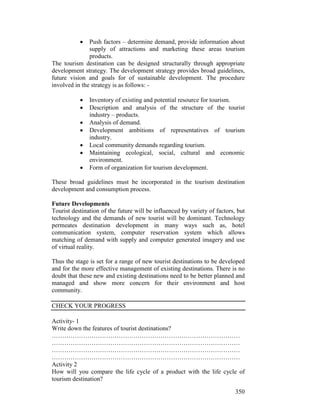
competitive than on earning money from volume tourism. Butler’s model of
tourism development at destination provides more detailed picture of how to
achieve the structural development of tourism. A different level of
development in an area is presented below: -
Development of a specialized offering for tourists.
• Simplest service offering for tourists is placed at the bottom
of service ladder. Common forms of services are cafeterias,
petrol stations and dabas. Both local residents and tourists
use these services.
• Next Step up the ladder is that there is some form of
overnight accommodation in the area, a hotel, and motels but
without any special attractions.
• Third step is specialized tourism service providing a greater
range of attractions, activities, and accommodations.
• The fourth stage is tourism centres where the whole range of
services has been adopted to the needs of tourism for one
season or two-season destination.
• Final step on the ladder is advanced service – rich source of
services and extensive specialization, in the form of theatres,
concert halls, large museums etc.
This model presents the stages in the development from small-scale tourism
to mass tourism.
Tourism development strategy
When developing a destination, a planner works on two factors: -
• Pull factors – tourism products and attractions.
Advanced
tourism services
Tourism Centres
Specialized tourism
services
Overnight accommodation
Temporary stopping places
Clients or areas with a highly specialized service
Centres where attractions for visitors are the predominant
features of the service offering.
A good choice of services, accommodation, attractions and
activities
Some choice as regards type of accommodation.
Simple service offering for visitors.
350
• Push factors – determine demand, provide information about
supply of attractions and marketing these areas tourism
products.
The tourism destination can be designed structurally through appropriate
development strategy. The development strategy provides broad guidelines,
future vision and goals for of sustainable development. The procedure
involved in the strategy is as follows: -
• Inventory of existing and potential resource for tourism.
• Description and analysis of the structure of the tourist
industry – products.
• Analysis of demand.
• Development ambitions of representatives of tourism
industry.
• Local community demands regarding tourism.
• Maintaining ecological, social, cultural and economic
environment.
• Form of organization for tourism development.
These broad guidelines must be incorporated in the tourism destination
development and consumption process.
Future Developments
Tourist destination of the future will be influenced by variety of factors, but
technology and the demands of new tourist will be dominant. Technology
permeates destination development in many ways such as, hotel
communication system, computer reservation system which allows
matching of demand with supply and computer generated imagery and use
of virtual reality.
Thus the stage is set for a range of new tourist destinations to be developed
and for the more effective management of existing destinations. There is no
doubt that these new and existing destinations need to be better planned and
managed and show more concern for their environment and host
community.
CHECK YOUR PROGRESS
Activity- 1
Write down the features of tourist destinations?
………………………………………………………………………………
………………………………………………………………………………
………………………………………………………………………………
………………………………………………………………………………
Activity 2
How will you compare the life cycle of a product with the life cycle of
tourism destination?
351
………………………………………………………………………………
………………………………………………………………………………
………………………………………………………………………………
Activity 3
Which are the parameters of carrying capacity and how do you determine
the capacity of a destination?
………………………………………………………………………………
………………………………………………………………………………
………………………………………………………………………………
Activity 4
Your friend asks you to prepare a tour package to Goa for next summer.
How will you collect necessary details for the plan?
………………………………………………………………………………
………………………………………………………………………………
………………………………………………………………………………
22.2.3 HUMAN RESOURCE DEVELOPMENT
The success of any industry depends to a great extend up on the quality of
human resource and tourism is not an exception. We have already learnt
that tourism is labour intensive industry which provides employment to
skilled, semi-skilled and unskilled workers directly and indirectly. The
progressive labour force with dynamic management and responsive
government and responsible society are the pillars of the tourism industry.
Traditionally, the employment has been seen as an area that is reactive to
changes in the wide business environment. There is a widely accepted
assumption that the role of people within organisations is required to change
and develop in response to developments in markets, products and
technology. Most of the large tourism companies recognized this
assumption and has been started organising work and support human
resource functions such as training and development. This is possible only
when the external labour market permits employers to adapt these changing
dimensions.
Globalization of business firms has a number of implications for human
resources management. A major consequence in tourism industry is the
issue of matching employee’s skills with changing industry requirements.
The traditional practice of employee’s learning the majority of skills on the
job and gradually progressing to senior position is threatened by the rapid
technological changes and the need to respond to the changing service
requirements. Employees at the operational and managerial levels are now
required to be more flexible and adaptive to constant change. Globalization
has major Implications for work and employment in tourism and these
include: -
• The need for different skills and competencies is the
employees to be able deal with use of technology.
352
• Dealing with employment related consequences of mergers
and strategic alliances.
• Issues of relocation of employees and social and cultural
sensitiveness of those working away from home.
• New forms of tourism utilizing natural and cultural
environment create a demand for indigenous employees, who
could deliver better quality and original products and
services.
• Meeting the needs of high skilled tourists who are more
experienced and demand higher quality of products and
services.
These pressures of globalization in tourism have significant implication for
work and employment, especially for human resources development and
dealing with cultural aspects.
HUMAN RESOURCE DEVELOPMENT IN INDIAN CONTEXT
In India there is a tremendous shortage of trained manpower in the
hospitality sector. Tourism sector on an average requires manpower about
20,000 per year. Against such a requirement the actual trained output from
govt. institution is only 5000 per year. When we consider all other private
institutions, the total available trained manpower does not exceed 10,000 in
a year. Thus there need to develop required human resource in various
segment of the tourism industry, as a consequence of the rapid growth in
tourism, changing technology and markets both national and international
level.
The main problems involving human resource development is in the tourism
sector are-
• Scarcity of qualified manpower.
• Shortage of tourism training infrastructure and qualified
trainers.
• Bad working conditions in tourism sector.
• Bad strategies and policies for human resource
development.
Tourism Industry has undergone a sea change with respect to human
resources development and in response to emerging trends for successful
tourism in the country. Both the governments and private sector have
realized that hospitality with professional service is the core of tourism. For
the industry, the tourists are the ultimate service activity and extending
quality service ensures continued clientele. For providing world- class
service will always require training, education, increased investment and
development of work culture, change in the attitudes and new methods of
motivating manpower in the industry for continued growth.
Thus this type of pressure of globalization in tourism has significant
implications for work and employment especially in human resources
353
development. . Hence necessity of trained manpower has become top
priority in the agenda of tourism plans over the years. The Government has
recognized tourism as a vehicle for economic development and generator of
employment for skilled-semiskilled and unskilled teaming millions not only
in popular tourist destinations but also in remotest areas of hinder land
The governments have been taking the initiative of setting up a number of
institutes all over the country. The institutes of Hotel Management Catering
and Technology Applied Nutrition were set up in New Delhi, Mumbai,
Chennai, and Kolkata. In order to meet the training requirements at craft
levels in specific disciplines, 14 Food Crafts Institutes were set up at
different places in the country. In order to harness the resources the Ministry
of Tourism established National Council of Hotel Management and Catering
Technology in 1984. The established objectives of the Council are-
• Advise the Govt. on coordinated development of hotel
management and catering education.
• Serve as a technical storehouse for use in training, affiliate
institutions and prescribe course of study.
• Standardize courses and infrastructures requirements.
• Prescribe educational and other qualifications, experiences
etc. for the members of staff in the affiliated institutions and
introduce faculty development programme.
• To give certification and accrediting at the national level.
With the establishment of National Council on Hotel Management and
Catering Technology has helped the expanding and modernizing the
capabilities of hotel and catering education programmes. In the order to
strengthen the existing training infrastructure, National Culinary Institute
and Advanced Hotel Management Institute are proposed in 9th
plan. The
intake of candidates for the 3 years diploma course in Hotel Management is
about 2000 and efforts are made to increase the capacity. These diploma
course Hotel Management and catering Technology has been recognized by
All India Council of Technical Education.
Travel and Tourism Education Institutes
All the Hotel Management & food craft Institutes are registered under
countries Regis Act 1860 and have separate board of Governors consisting
of representatives of the industry.
The institutes of Hotel Management & catering Technology & Applied
nutrition, national council for Hotel Management are funded by central
Governments through grants-in-aids.
Indian institute of Tourism & Travel Management (IITTM)- established as a
registered society in New Delhi, fully funded by Ministry of Tourism, Govt.
354
of Indian and has been set up to meet the needs of higher education &
Training of travel and tourism act as a centre for excellence.
National Institutes of water sports were set up in Goa in 1990 promotes
water sports active throughout the country. The institute establishes quality
norms for adventure sports industry and certify water sports professional in
the field of power boat handling & life saving.
Indian Institute of skiing & mountaineering (IIS&M) Gulmarg, setup in
1968 for developing adventure sports activities like mountaineering, skiing,
trekking etc.
Guide Training- Training of Guides is a very basic component of the
tourism services. Inadequate number of trained guides makes a lot of
problems to tourists especially for international tourists. Realizing this
urgent need the quality training is provided by Ministry of Tourism through
its tourism office or Indian Institutes of Travel and Tourism Management.
The state Governments are also provides training programmes at state level
.
The Govt. of India Tourism office assesses the requirement of fresh guides
in the region from time to time. It conducts training courses in coordination
Indian Institutes of Tourism Travel management, refresher courses and
orientation programmes for custom, immigration offices and various other
services providers like taxi-drivers. Thus strengthening of guide training at
grass root level workers has been given an emphasis to improve the quality
of service in respect of guides in India.
The National Tourism policy emphasis the necessity of professional
excellence in Human Resource Development and envisages the following
programmes:
• Strengthening the Institutional set up for Human Resource
Development and setting up of Advanced Institutes of Hotel
Management and Culinary Institute.
• Qualitative Improvement and modernization of existing training
Institutions.
• Setting up of food craft institutes in each state.
• Improve the standards through accreditation and quality control.
• Setting up National Tourism Documentation centre equipped with
modern technology systems to function as a repository of research
findings and publications on tourism.
• Encouraging Participation of private sector in human resource
development and encourage them to setup independent training
facilities.(Gaur Kanchilal)
CHECK YOUR PROGRESS
355
Activity-1
What are the main problems faced by India in human resource
development?
………………………………………………………………………………
………………………………………………………………………………
………………………………………………………………………………
Activity 2
Match the following
A B
Advanced Institutes of Hotel
Management and Culinary Institute. Goa
Indian institute of Tourism &
Travel Management (IITTM) Certification and accreditation
Indian Institute of skiing &
Mountaineering (IIS&M) Ministry of Tourism
National Council of Hotel Management
And Catering Technology New Delhi
National Institutes of water sports Gulmarg
22.2.4 OPEN SKY POLICY
The passenger aviation industry had been highly regulated in the
aftermath of Second World War till recently. The regulatory regime was
based on restrictive international agreements on a bilateral basis and
protected the national airlines against other scheduled competitors and
charter carriers. The national airlines were thought to act as factors of
economic modernization, which provided a stable and regular transport
service, facilitated regional development promoted international tourism
recognition. However, in practice the aviation sector offers low quality
service at unjustifiable high fares. The emerging customer dissatisfaction led
to the 1978 de-regulation of the US domestic market and triggered similar
practices worldwide. Many countries signed open-sky agreement.
In India we have opened the aviation sector to the private sector and a
number of private operators are operations flights in some selected routes. In
International flights the central government has given green signal to the
private sector to operate services. Jet Airways, King-Fisher, Spice Jet and
Deccan Airways have already started their presence in the Indian aviation
sector. With the privatization of aviation sector, the monopoly of the Indian
Airlines and Air India ceased and even their existence is in danger. The
immediate result is that the airline charges got reduced and the charges are
now determined by the market forces-demand and supply. India has signed
356
open sky agreement with many countries including South-East Asian
countries under the open sky policy. The privatization of airlines sector and
open sky policies in fact has given a boost to the tourism industry.
CHECK YOUR PROGRESS
Activity 1
Write down the names of important private sector airline companies.
………………………………………………………………………………
………………………………………………………………………………
……
Activity 2
Prepare a list of the foreign airline companies operating flights in India.
………………………………………………………………………………
………………………………………………………………………………
………………………………………………………………………………
Activity 3
Find the flight charges for different flights from Delhi to the following
destinations; Bangalore, Mumbai, Chennai, Srinagar, Gandhinagar, Kolkata.
………………………………………………………………………………
………………………………………………………………………………
………………………………………………………………………………
22.3 SUMMAY
The growing population of travellers and inhabitants has been putting
pressure on natural and social environment. The success of tourism depends
on the ability of destinations to engage in sustainable use and conservation
of vital resources. In integrated destination development adopts system
approach where ecological, physical and social spaces are networked brings
in destinations ecology and institutional structures. The integrated
destination management brings in destinations ecological and human
communities as equitable and integrated members of planning and
marketing and goal setting.
The globalization of business firms has a number of implications for human
resources management. In India there is a tremendous shortage of trained
manpower, shortage of training infrastructures and substandard working
conditions and lack of strategies to deal with the emerging trends.
Recognising the shortfall the central government and state governments
have taken various steps to improve the human resource development. The
Institute of Hotel Management, catering and Technology, Applied Nutrition
were set up in four metros and 14 Food and Craft Institutes were set up in all
over India and established National Council of Hotel Management and
Catering Technology.
357
Another new initiative taken by the government is to liberalize the airline
sector by signing open sky agreements with other countries in order to boost
inbound, outbound and domestic tourism.
22.4 KEY WORDS
Touring circuits
Clusters
Stakeholders
Re-engineering
Integrated destination management
Disposable income
Niche
Inhabitants
Ecology
22.5 GLOSSARY
Panacea ….. Solution or remedy for all difficulties or diseases
Adaptive ……Make or become suitable for new use or purpose
Consolidation ….. Making stronger or more secure
Stagnation ….. Stagger, showing little activity
Rejuvenation ….. Renewal, make more lively or youthful
Environmentalism ….. Conservationism, Idea of conservation and
protection of environment
22.5 REVIEW QUESTIONS
1. What do you mean by tourist destination life cycle?
2. How is tourism destinations evolved?
3. What are the main human resource problems being faced by India?
4. What is the recommendation given by the National Tourism Policy
for human resource development?
22.6 SOURCES AND FURTHER READINGS
1. Kanchi Lal, Indian Tourism: Through Inner Eyes Gour. Prabhat Agency,
2005
2. Bhuhalis Dimitros, Costa Carlos, Tourism Management Dynamics,
trends and management tools, Elsevier Buttorworth Heinemann, 2005
3. Page J Stephen, Brunt Papul, Bushy Graham, Connel Jo, Tourism: A
Modern Synthesis, Thompson Learning 2001
4. Incredible India, Ministry of Tourism, Government of India.
358
LESSON 23
EMERGING TOURISM SCENARIO
Venugopalan T
STRUCTURE
23.0 Introduction
23.1 Objectives
23.2 Impacts of tourism
23.2.1 Social impacts
23.2.2 Cultural impacts
23.2.3 Ecological impacts
23.3 Eco-friendly tourism
23.4 Sustainable tourism development in India
23.5 Summary
23.6 Glossary
23.7 Self assessment questions
23.8 Further Readings
23.0 INTRODUCTION
Any forms of Industrial development can make tremendous positive or
negative impact on social and physical and economic environment in which
it takes place. The tourism unlike other industries has a unique feature; the
tourists have to visit the place of production in order to consume the output
so that tourism is clearly responsible for such impacts. A number of
researchers have attempted to bring the different approaches made to study
of tourism impact on the destination into a unified frame work for analysis
but none of these researches could provide a practicable frame work tourism
impact for analysis. This lesson discusses the major impacts of tourism.
23.1 OBJECTIVES
This lesson is designed to achieve the following objectives for the students:
-
• Knowledge about old and new objectives of tourism
development
• Understand the economic, social, cultural and ecological impacts
of tourism
• Understand how to overcome negative impacts of tourism
development.
359
• Develop awareness among students that our culture, society and
environment are unique and every individual has the duty to
protect these.
• Understand the new concepts– eco-friendly tourism and
sustainable tourism development in India.
23.2 IMPACTS OF TOURISM
The impact of tourism on any destination will be determined by a
wide variety of factors: -
• Volume of tourism arrivals
• Structure of the economy
• Types of tourism activity
• Differences in socio-cultural characteristics between host and
the tourists.
• The fragility of the local environment.
As tourism development in a destination takes place, the magnitude of
impacts whether positive or negative will change the nature. Every
destination is subject to a carrying capacity- a level of tourism activity that
can be sustained into the long term without creating serious or irreversible
changes to the destination. The carrying capacity is defined “as that level of
tourist presence which creates impact on the host community, environment,
and economy that are acceptable to both tourists and hosts and sustainable
over future period of time”. If the carrying capacity is exceeded, the
destination will find that the negative impacts rapidly increase while the
positive impacts diminish. The tourism development process will be
hindered and irreversible damage may be experienced and finally the tourist
dissatisfaction results in the decline of destinations. The damage may be
concerned with social, environment or economic aspects but the end result
will be the same. The economic impact of tourism has been discussed in
lesson 4 and now we will discuss the social and environmental impacts.
23.2.1 SOCIAL AND CULTURAL IMPACTS
For many countries tourism is considered as an easy way of economic
development especially for developing and under developed countries. As
the economic impacts are more really measurable, other types of impacts
tend to remain more hidden, particularly social and cultural effects.
However social and cultural change may in our more significant costs than
economic benefits in the long term. This part discusses the nature of these
social and cultural impacts of tourism.
Tourism is a social event. It is all about people and how people as tourists
interact with other locations and peoples, engaging in experiences that may
influence their own or host community attitudes, expectations opinions and
life styles. Thus wide rang of tourism socio- cultural event for the traveller
360
and host community. Socio cultural impact relate to change in societal
values, systems, individual behaviour social relationship, life styles, modes
of expression and community structure. The focus of socio culture impact is
cantered on host a community person who resides in tourist destinations.
Sharply states that from social and cultural perspective, the rapid expansion
of tourism is important in two respects: -
Firstly, development of tourism as a vehicle for modernisation and
diversification leads to changes and development in the structure of society.
This may positive or negative. In positive sense, there may be society wide
improvements on income, employment opportunities, education, local
infrastructure and services. On the negative side there may be a threat posed
to traditional social values, creation of frictions and there are peoples
fascinated with western culture in the society who may take advantages of
others and adaptations or weakening of cultural values.
Secondly, all tourists to great extent inevitably take on holidays their own
beliefs, values and behavioural models what may be termed as cultural
baggages. Therefore, the scope for mixing of culture is great. This gives rise
to two arguments about socio cultural effect of tourism.
• The interaction between host and guest could destroy traditional
culture i.e. tourism primary as a threat to culture and people.
• The interaction between host and guest could create new
opportunities for peace and greater under standing.
There is evidence to prove both of their aspects are correct and a consensus
is by no means easy to generate. The study of the impact on society and
culture is complicated by the nature of more general social and cultural
change. The forces of change are many and varied, tourism being just one
factor. Other aspects include the role of advertising and media, effect of
multinational companies, the aspirations of government, education and
immigration. Given the complexity of influencing factors, it is hard to
extrapolate as one example of potential social cultural impact due to
tourism. However there is wide spread assumption about socio- cultural
impact that if the tourist generating country has a stronger economy and
culture than receiving country, then the socio- cultural impact is likely to be
higher. The greater the difference, greater is the impact.
Factors Influencing Socio Cultural Impacts
The main factors influencing the nature and extent of social cultural impacts
are: -
• Types and number of tourists.
• Importance of tourism industry in the economy
• Size and development of tourism industry
• Pace of tourism development
• Nature of guest – host interaction
• Nature of host destination and cultural simulates
• Community tolerance capacity
Experts comment that cultural similarity or dissimilarity is one of the major
factors in shaping socio cultural impact. Impacts tend to be greater where
361
the host and guest relationship is both culturally and geographically
different.
UNESCO (1976) suggests that host guest interactions in mass tourism are
characterized by four properties: -
• Transitory nature
• Temporal and spatial constraints
• Lack of spontaneity
• Unequal and unbalanced experience
These properties appear especially valid in the context of mass tourism to
developing countries The primary problems associated with tourism are the
demonstrations effect acculturation increase in crime and prostitution and
health, displacement of community, general host irritation and
commercialisation of culture.
Demonstration Effect
Demonstration effect is defined as changes in attitudes, values or behaviour
which can result from merely observing and imitating tourists. This may be
advantageous or disadvantageous to the host community. Tourists to
developing countries especially if they come from very different societies
introduce and display a very foreign way of life to the host population. This
may be positive when it stimulates certain behaviours or inspires people to
work for things they lack. More commonly, it is detrimental and causing
discontent and resentment among local people especially in developing
countries because if the lack of wealth to satisfy these desires.
The demonstration effect has also economic implication. Local people often
tend to initiate the rich person that changes the pattern of consumption from
local product to western products. Local people may turn illegal means to
obtain the wealth they desire, this crime rate may increase as a result of
tourism in a destination.
The demonstration effect has the greatest influence on young people and
may create generation gaps and class difference between the young
generations with those who wish to retain the traditional way of life. The
young especially the educated tend to migrate. The young people want
material side of modern life but fail to see the negative effects – such as
stress, unemployment, and environmental degradation. This type of changes
may be a disruptive force to traditional kinship overtime.
Acculturation
Many impacts of tourism appear relatively quickly while others tend to
manifest themselves more gradually. Cultural changes falls into this last
category and overtime, more long-term cultural change may result from
tourism. The external influences and the evolution of society results change,
regardless of the existence tourism. The enhanced networks of
communication, technology and emergency of global market are all part of
this process.
The infiltration of western culture into less developed countries is viewed as
problematic. The attitudes, behaviour pattern; expenditure pattern may not
be easily adapted from one culture to another. Nepal is a best example,
which is becoming a mainstream tourist destination, and westernisation of
362
Kathmandu is occurring as a result of tourism. This type of change coca-
colonization or Mc Donalisation is acculturation through tourism.
International tourism is thought to influence socio cultural change through
the process of acculturation. The theory of acculturation rests on the notion
that contact between cultures results in sharing and adoptions of one
another’s values and attitudes. A major concern is that when a culturally
weak society comes into contact with a strong one, the process will be one
way, that is the values and attitudes of the strong nation are transferred to
the weak nation. Thus acculturation is more pronounced in less developed
countries. Particularly those have had less contact with western society in
the past. Tourism induced acculturation may be difficult to disentangle from
wider cultural change.
There are two arguments on the cultural impact of tourism.
• Tourism results in the transformation of cultural events into
commercialised products. (Commodification of culture)
• Tourism results in preservations and revitalisation of traditional
culture practices by providing financial support engendering
community pride contributing positively to the goals of sustainable
tourism.
Anthropologists accept the increasing presence of international tourists in
the third world as an important element in the process of acculturation
where by people in contact borrow from each other’s cultural heritage. In
this instance the presence of stronger western ideas and practices introduced
by tourism means that the process is largely one of assimilation of the weak
host culture. This does not always happen of course as can be seen in those
countries under powerful Islamic religion influence (Malaysia, Indonesia,
and Mauritius) where active steps are taken to resists the forces of
assimilations.
Socio Cultural Effects of Tourism
Language
Language is a key indicator of acculturation because it is a social vehicle of
communication. Tourism can change the language of host community and
make an aversion towards regional languages and dialects take place in three
ways: -
• Economic changes through bring of immigrant or expatriate labour.
• Demonstration effect where the local community aspires to achieve
the status of visitors.
• Direct social contact and the need to converse to make commercial
transactions.
Sometimes, the host is obliged to learn the main incoming tourist languages
in order to deal with their requirements.
Religion
In some tourist destination religion (churches, temples and mosques and
monasteries) has been promoted as major tourism products and their sites
attracts large number of visitors, who may or may not have belief of that
particular religion Because of this increasing conflicts exists between local
worshippers, devout visitors and sight seers. The tourists do not always
363
recognize traditional ceremonies, rites and practice. In Bhutan, tourists are
not permitted to visit Monasteries. In India, temples are not opened to non-
Hindus in order to prevent tourism from disrupting religious life. In many
countries particularly Islamic countries tourists clothing can cause offence.
The Gambia, Maldives and some Islamic countries are best examples for
this.
Displacement
It is also important to understand the wider repercussions of tourist
development where economies have been placed priority before community
concerns. The most widely discussed phenomenon is the displacement of
local communities who have to move away from their residence to make
way for tourism. Land is taken over by government or private investors for
various reasons such as construction of hotels and other infrastructure. The
forceful displacement not only makes the local community homeless but
also loss lively hood. In the name of development, all over the world
millions of poor tribal societies have been displaced and driven in to eternal
poverty. Universal declaration of human rights (1948), which states, “the
basic standards that must underpin contemporary global society is clearly
contravened by some of the examples of tourism development”.
Displacement establishes the nature of power relationship between the
forces of tourism development, government and local communities and in
most cases the local people are the losers. There are large numbers of non-
governmental organisations that are campaigning to protect communities
which are displaced by the developmental activities. The main slogan of the
conservatisms is “our holidays, their homes”.
Tourism and Crime
Tourism and crime is a new emerging area of study within tourism but there
is no universal agreement on whether tourism development leads increased
crime in a locality. Tourists are vulnerable because they are in unfamiliar
surroundings may be carrying expensive consumer items, cash, credit cards
and passports which are valuable commodities in the black market. Tourists
may engage in crime and illicit activities such as violet, drunken behaviour,
drug smuggling and sex tourism. It appears that especially in seasonal basis
tourism raises the crime level as the tourist influx provides for more targets
and possibly easier and wealthier targets. Some scholars have established
certain relationship between crime and tourism.
Sex Tourism and Prostitution
Prostitution undeniably existed before the onset of mass tourism to
developing countries. However, in many countries tourism has undoubtedly
contributed to an increase in prostitution, organized gambling and various
types of crimes. Although, there exists casual connection between crimes
and tourism, it is very difficult to find hard evidence about the role played
by tourism. Given the fact that similar effects have been experienced in
countries that possessing low levels of tourism. It is thus wrong to make
tourism the scope goat for changes.
In relation to prostitution, it seems that different attitude to sex in some third
world countries were responsible for the growth of sex tourism and the
364
prevalence of sex tourism which dates back to the accounts of early
European adventures. This image has persisted in the marketing of some
exotic destinations like Thailand and other South Eastern Countries. The
demand for such services now includes almost everywhere affected by mass
tourism. The tiny West African country of the Gambia has been successfully
marketed in Scandinavian countries as the closest place to Europe
guaranteeing a pleasant climate during the northern winter. It is also a place
deeply affected by tourism impact on moral behaviour...
In additions to its major health effects on the entire population of some
regions like Central Africa, sex tourism to developing countries is only one
side of the coin, the other is the marriage trade towards industrialised
countries from developing countries. Probably the most famous and best-
documented sex tourism destinations are Thailand and Philippines and to
lesser extent South Korea, Kenya, Dominican Republic and Brazil.
The scare of AIDS had dramatic affection prostitution. The very recent
threat of AIDS as incurable sexually transmitted diseases will have
important implications for the popularity of some tourist destination. The
tourists wanted younger and younger prostitutes on the hope that there was a
lower likely hood this disease. In recent years, however several
industrialised countries have finally passed legislation, which prosecutes
their residents for sex with minors overseas. (Germany, Sweden) it is hoped
that this will serve as a disincentive.
With respect to crime and gambling, although there is plenty of evidence in
the developed metropolitan countries of a positive relationship between
tourism and increase in crime, there are few studies, which examine the
situation from third world perspective. Matheson and Wall suggest that
tourism and crime are influenced by population density during the peak
seasons, the location of resort in relation to an international border and
differences in per capita incomes between host society and the tourists.
Health
Tourism has the dual effect of promoting the provisions of improved health
care in third world destination, but in addition, it act as a vehicle to spread
some forms of diseases. There is increasing concern about spread of
sexually transmitted diseases (STD) through tourism at a variety of level
from minor diseases to spread of HIV and AIDS through sex tourism.
Standard health care may improve in tourism destination as better facilities
are introduced to cope with increased seasonal population. In some
destinations, cultural differences in safety standards can create unknown
levels of risk. Western visitors occasionally regards the fact that a low
standard of public hygiene in parts of third world rarely provide safe
drinking water supply and hospitals find it difficult to attract or retain the
services of skilled personal.
23.2.2 CULTURAL IMPACT
There has been much studies conducted to investigate tourisms role in
communication between cultures, its effect on the physical products of
365
culture such as crafts and arts and influence on custom and ceremony in the
host society.
Communication between cultures:
Cross-cultural contact arising from tourism is thought to be functions at
least 3 factors.
• Type of tourist the different categories of tourists in the third world
are reflected on expected differences in their kind of interaction with
local people.
• Context in which the contact takes place. Clearly things such as
length of stay, the environment under which the contact occurs, and
language ability will help to determine the depth of communication,
which takes place.
• The role of cultural brokers, who are intermeddling occupational
group such as interpreters and guide who are the conduct through
which much of contacts occurs their activities are thought to have a
considerable effect and on the manner and speed with which new
ideas and influences are transmitted.
Tourism and physical culture:
One of the obvious sign of cultural reawakening is to be found in the state of
traditional art forms in third world society. The growth of tourists’
handicrafts market has stimulated local production in both positive and
negative directions. Positive influence may be found in the financial success
traditional artefacts production in many places. On the other hand, the sheer
pressure caused by a ready market for handicrafts has also lead to fall in the
quality of workmanship and manufacture of cheap limitation known as
airport art.
Effects of tourism on local customs.
Tourism has the ability to market its products as a commodity, part of which
consists of promoting the cultural attractions of holidaying in an exotic
environment. Although this process is criticised cheeping cultural events
such as religious ceremonies, it is also responsible for the flow of funds into
many local activities.
CHECK YOUR PROGRESS
Activity 1
Why is tourism a socio- cultural event?
………………………………………………………………………………
………………………………………………………………………………
………………………………………………………………………………
Activity 2
Prepare a list of cultural events which can be exploited for tourism
development in your state
.………………………………………………………………………………
………………………………………………………………………………
………………………………………………………………………………
366
Activity 3
Tourism is always blamed for co social degradation in many countries. Do
you think this argument is right? What kind of impact has been created in
your state due to the tourism development?
………………………………………………………………………………
………………………………………………………………………………
………………………………………………………………………………
Activity 4
Substitute appropriate words for the following;
Extrapolate, acculturation, infiltration, vulnerable, perspective
………………………………………………………………………………
………………………………………………………………………………
………………………………………………………………………………
23.2.3 ENVIRONMENTAL IMPACT
Tourism development in many places has led to the deterioration in
environmental quality since the onset of mass tourism. In many destinations,
tourism development has taken place with little regard for natural
environment. The effect of mass tourism and increasing awareness of human
impact as environment led to a generalization that nature is not an in
exhaustive resource. For some destinations the environmental effects of
tourism have led to direct threat to the industry, as the success in attracting
tourist lead to negative impact on the attraction of environment. This section
discusses the major environmental impact of tourism. The environmental
effect of tourism in developing countries is among least studied one.
However they have attracted considerable attention in developed countries
where high intensity usage and demand by tourism has transformed many
land farms.
Tourism bought economic prosperity which adversely affected environment.
In search of holidays Million of tourists are crowding the popular beach
resorts, mountain treks, jungles and at ancient monuments. The population
of Goa is just one million but over one million visitors visit every year in
Goa. Its beaches are crowded at peak season. The beautiful Dal Lake of
Kashmir has been reduced to half of its size in less than 50 years by human
encroachments. 30 years ago, Manali in Himachal Pradesh was a small hill
resorts catering to the needs of people who loved nature. Now it is an
overcrowded city with ugly multi storied buildings. Precious wild life –
tigers, lions and panthers have become virtually extinct in Indian jungles
due to hunting and poaching. The Ladakh in Kashmir is jammed with litter
left by tourists. Too many hotels on the lovely beaches of Goa have created
anti-tourism feelings among the local people.
Modern tourism involves thousands of visitors and demand massive
infrastructure. Development takes many shapes and forms – roads, hotels,
367
restaurants and transport facilities – altering ecological balances of
destinations. The opening of new roads leads to the exploitation of remote
forest areas, which provided green cover and timely rains for our fields.
The rush to build tourist facilities at the most attractive and
convenient sites changes the ecosystem and affects the natural beauty of the
place.
The upsurge of world tourism has changed the situation and caused alarm all
over the world. The environmentalists who want to save nature from
destructions and motivate people to take care the future of this earth. Hunter
and Green provide an overview of the major potential impact of tourism on
the natural environment. The following Table illustrates the wide range of
potential consequence of tourism development in specific habitats.
Major impacts of tourism on natural environment
Habitat influenced by Effects of tourism
Tourism development
Sea Pollution from sewage outfall
Sea dumping of waste
Oil pollution from tourist boats
Litter and threat to marine creatures.
Coastal Habitats
Habitat loss and fragmentation
Deterioration of ecological diversity.
De-stabilization of sand dunes.
Erosion of coastal landscape.
Inland waters
Sewage pollution
Oil pollution from boats and barges
Upland/plateau Agriculture
Land
Erosion
Habitat loss and fragmentation
Disturbance to nesting birds
Loss of area of production
Conflict between adjacent agriculture
Uses and tourism
Forests
Habitat loss and fragmentation
Disturbances from recreational activities.
368
Tourism destination comprises a wide diversity of environment from
purpose built resorts to remote natural areas. The broad categories of impact
that may affect destinations are: -
• Inappropriate development
• Loss of habitat
• Extinction of species
• Pollution
• Loss of spirit
According to European Environment Agency tourism crates following
environmental problems: -
• Waste disposal
• Reducing level of biodiversity
• Pollution of inland waters
• Pollution of marine and coastal zones.
There are two types of environmental impacts, which occur in destination
development: -
• Those affecting the integrity and composition of the natural
environment.
• Those affecting the tourist experiences of the environment.
The environmental impact associated with tourism can also be considered in
terms of their direct, indirect and induced effects. It is not possible to
develop tourism without incurring environmental impacts, but it is possible,
with correct planning, to manage tourism development in order to minimize
the negative impacts while encouraging positive impacts. The direct
environmental impacts of tourism include following positive effects.
• Preservation ad restoration of historical buildings and sites.
• The creation of national parks and wild life parks
• Protection of coral reefs and beaches.
• Maintenance of forests.
The following are the major environmental impacts of tourism in
destinations.
Pollution
On the negative side, tourism may have direct environmental impact on the
quality of water air and on noise levels. Sewage disposals into water will
add to pollution problems and the use of powered boats on inland waterways
and sheltered seas can make water impure and thereby destroy precious
marine or water resources. Increased usage of the internal combustion
engine for tourist transport and oil burning to provide the power for hotels
air conditioning and refrigeration units pollute the air quality and noise level
may be dramatically increased in urban areas through increased road, rail
and traffic.
Inappropriate development
Tourism development may be seen as inappropriate where it fails to
consider the sensitive natural environment. Large tracts of coastal regions
369
around the world are now covered by urban sprawl to cater mass tourism
market. It had robbed the shores of natural features, displaced headlands and
harbours with badly made structures. These types of development occur as a
result of short term planning in environmental terms. Tourism creates
pressure for development to meet visitor needs and expectations. Problems
occur if facilities are not constructed in harmony with the local environment.
Loss of natural habitats and wild life
Development facilities and subsequent tourist use may result in rapid on
physical deterioration of both natural and man made environments that have
serious consequences. Hunting and fishing can have obvious impact on wild
life environment. Sand dunes of desert can be damaged and eroded by over
use; vegetation can be destroyed ancient monuments may be worn away or
disfigured and damaged and the improper disposal of litter can detract the
aesthetic quality of environment and harm precious wild life. These are just
few examples of direct negative environmental impacts.
The economic impact associated with tourism development can be direct
and indirect, and the same is true of environmental impacts. The tourism
activity requires production of output from a diverse range of industries,
including those that do not supply tourist goods and services directly, then
the environmental impact associated with the output and production process
of those industries should also be considered. Thus increase in tourism
activities increases the demand for more and more hotels and restaurants and
other infrastructure, put pressure on construction industry and natural
resources and ecology.
CHECK YOUR PROGRESS:
Activity 1
Write down examples for some of the famous destinations, which are
affected by tourism.
………………………………………………………………………………
………………………………………………………………………………
………………………………………………………………………………
Activity 2
Find the meaning of the following words;
Exhaustive, poaching, litters, sprawl, ecology
………………………………………………………………………………
………………………………………………………………………………
………………………………………………………………………………
Activity 3
How has pollution affected life of people in your area?
………………………………………………………………………………
………………………………………………………………………………
………………………………………………………………………………
370
Activity 4
Pollution is the major problem faced by all cities. Can you suggest
remedies for pollution of land, water, and air?
………………………………………………………………………………
………………………………………………………………………………
………………………………………………………………………………
23.4 ECOTOURSM
In search for new tourism products, travellers and supplies are today seeking
to reshape the meaning of nature as a tourism attraction. New products have
been developed in order to guarantee quality of a nature-experience and to
protect the natural and cultural base for business and generation of visitors.
The nature based tourism, which focuses on experiencing flora and fauna in
natural settings, eco-tourism, which is a broader environmentally friendly
concept.
The environmental movements have boosted awareness of the importance of
natural resources for tourism development. Environment quality is important
for all forms of nature tourism. Environmental quality management of a
tourist destination involves protection environmental information ensures
and environmental quality. Environment friendly tourism tries to minimize
the negative impacts of tourism- social, cultural and environmental that (we
have discussed in the beginning of this chapter) maximizes the positive
impacts and to incorporate environmental education, ethics and log- turn
social and economical benefits for the local population.
Ecotourism has grown as a consequence of the dissatisfaction with
conventional forms of tourism, which have in a general sense, ignored social
and ecological elements. The eco-tourism a more responsible forms of
tourism needs the following characteristics.
• Minimum environmental impact
• Minimum impact and maximum respect for host cultures.
• Maximum economic benefit to host country’s grassroots and
• Maximum recreational satisfaction to participating tourists.
The concept of development ecotourism grew as a culmination of
dissatisfaction with governments and society’s negative approach to
development especially from an ecological point of view.
NATURE TOURISM AND ECO-TOURISM
Modern nature based tourism focuses on experiencing flora and fauna is
natural settings and occurs in such forms as whale watching, trips to
rainforests and habitat of large mammals and viewing sceneries in natural
parks or virgin areas. Nature tourism includes all forms of mass tourism,
eco- tourism that use natural resource - including species, habitat, landscape,
371
scenery and salt and fresh water features. Nature tourism is travel for the
purpose of enjoying undeveloped natural areas or wild life.
Today the term nature tourism is often synonymously with ecotourism
although it shares only some of the ecotourism requirements. While nature
based tourism relates to nature, its attractiveness, and the visitor experience
in natural settings, ecotourism takes unspoiled natural and socio-cultural
attractiveness into account, further Ecotourism is closer to sustainable
tourism since it also takes care of environmental natural and social and
cultural impacts.
The concept of ecotourism refers to environmentally responsible travel and
visits to relatively undisturbed natural, cultural areas that promote
environmental education, management and conservation, while providing
for the beneficially active socio-economic involvement of local population.
Eco-tourism is low impact nature tourism which contributes to the
maintenance of specie and habitats either directly through a contribution and
provides revenue to the local community.
Characteristics of Eco Tourism
• Eco tourism inspired primarily by natural history of an area,
including its indigenous cultures.
• Eco-tourists visit relatively undeveloped area in the spirit of
appreciation, participation and sensitivity.
• Eco tourist practices non- consumptive use of wild life natural
resources and contributes to the visited area through financial means.
• Directly benefiting the conservation of the site
• Economic well - being of the local residents.
• The visit should strengthen the tourist appreciation of and dedication
to conservation issues in general, and to specific needs of the local
• Eco tourism also implies a managed approach host community
regions, which commits itself to establishing and maintaining the sites
with the participation of local residents.
• And using the proceeds of the enterprise to fund the area land
management as well as community development.
Thus Eco tourism is responsible travel to natural areas, which conserves
the environment and improves the welfare of local people. Eco-tourism is a
sustainable form of natural resource-based tourism that focuses primarily as
experiencing and learning about nature, and which is ethically managed to
be low impact and non- consumptive, and locally oriented. It typically
occurs in natural areas, and should contribute to the conservation and or
preservation of such areas. In many countries, eco tourism is policy
consideration and initial stage, and a policy and related actions are
increasingly required to ensure that tourism development is consistent with
the needs of both local people and environment. Tourism policy and eco
tourism policy covers wide spectrum of concern related to the
implementation of tourism programmes. The tourism policy establishes
372
strategies, objectives and guidelines to be followed for sustainable tourism
development. A strategy for tourism development is as follows: -
• Identifying objectives.
• Establishing priorities.
• Placing in a community context the rates of Government,
tourist organisations, and local govt. private sector business
ensure development of human resources.
• Establishing coordination and implementation of agreed
programmes to
• Monitoring and evaluation.
ECO TOURISM IN INDIA
Today, Eco-tourism is the fastest growing segment of the tourism industry
attracts between 40-60% of all international tourists. The diversity of India
is to be seen not only is its people, culture, religion, language and life style,
the diversity starts from land itself, which is made up of snow peaks of
Himalayas, beautiful valleys, tropical rainforests of south and north east
blistering not deserts of north western India and beautiful western and
eastern coastal regions. Each diverse geographical region generates different
picture and exploring them provide a unique experience. Now all there are
packaged for tourist to provide Eco- friendly holidays in India. We are
promoting tourism but while promoting tourism to eco sensitive areas, the
emphasis is to control the volume so that the fragile nature of the area is not
disturbed. The whole objective of eco-tourism is to have purposeful travel to
natural areas to understand culture, history of environment, taking special
care not to alter the integrity of eco- system while utilizing the economic
opportunities that make conservation of natural resources beneficial to local
people.
Thus travel to these areas enlightens, educates and revives the tired soul of
the Eco-tourists and as the other hand provides a basis of economic
upliftment of the local people, tribes or other stake holders directly
dependant on the natural heritage. This strong relationship is primarily
targeted through our eco tourism
Ministry of tourism has formulated Eco-tourism guidelines for regulated and
sustainable tourism, which have focused on to respect the frailty of the earth
and to leave behind the rich natural heritage for the future generations to
enjoy. The guidelines are as follows: -
• Leave only foot points, take only photographs but do not take
away from natural areas and heritage monuments.
• Encourage local culture, respect local traditions act help in
their conservation efforts
• Do not buy products from endangered plants or animal
• Always follow designated trails so that animals plants are not
• Try to respect natural habitat and support those products,
which promote the cause of environment protection etc.
373
All these have been discussed in eco tourism guidelines of ministry of
tourism. The tour operators who operate tours in fragile nature zones have
adopted ASTA (American Society of Travel Agents) for the eco tourism
businesses. (Gaur Kanchilal)
The basis objective of eco-tourism plan is to attain sustainable development
of India’s natural, cultural and ancient heritage without causing any adverse
effect. The ecotourism development harmonies with local population skills,
products as well as lively hoods and enhance the value of environment
which will make them authority of conservation.
Ecotourism as discussed above is a joint venture which involves may stake
holders: - local people, tour operators, hotel restaurant owners, and
government agencies, it is essential to have public private partnership with a
clear cut demarcation of the responsibilities, commitments and rights of all
the parties involved in the development. The local characters of these sites
are to be kept in mind while planning for future development work. Thus
documentation and mapping of the sites and their unique features are a pre-
requisite. The projects are to be prioritized and plan to be implementation
with proper allocation of funds.
The eco tourism addresses all types of environmental problems: - pollution –
air, water, sound, soil and waste management for quality life through
regulated activities to save the environment. For this purpose the industry
has to organise training programmes and borrow knowledge from experts to
deal with all issues, regularly monitor and measure the impact will ensure
the achievement of environmental conservation.
Being latecomer in tourism we have learnt enough from the mistakes of
developed countries and have imitated proper steps for sustainable eco
tourism development.
CHECK YOUR PROGRESS
Activity 1
Ecotourism has emerged due to the adverse effects of mass tourism. Can
you point out the adverse impact of tourism?
………………………………………………………………………………
………………………………………………………………………………
………………………………………………………………………………
Activity 2
Differentiate between nature tourism and Eco-tourism
………………………………………………………………………………
………………………………………………………………………………
………………………………………………………………………………
374
Activity 3
You are going for a trip to a ecologically sensitive destination with your
family. As the leader of the group what direction would you give to them
when you enter the place?
………………………………………………………………………………
………………………………………………………………………………
………………………………………………………………………………
23.4 SUSTAINABLE TOURISM
We have discussed the meaning, the concept, and basic principles
Sustainable tourism,
The tourism development must be sustainable environmentally, socially,
economically and culturally. Eco tourism is a form of sustainable tourism.
Sustainable tourism must ensure quality of life of people, good experience
to the tourists and maintain quality of environment alive to the requirements
to protect the haphazard growth in sensitive areas, government has put
number of legislation such as the forest conservation Act 1980, Wild Life
(Protection Act) 1972, Environment Protection Act 1986, Coastal
Regulatory Zone Act 1991.
The rationale for sustainable tourism
• The tourism which is sustainable should stimulate awareness
of tourism impacts be well planned with strategy identifying
limits of acceptable change/ carrying capacities.
• Generate direct and in-direct local employment
• Support viability of local enterprises
• Provide income, which is retained in the local area as much as
possible.
• Support diversification in local and regional economies.
• Support existing infrastructure and improve local services
• Respect the integrity of local environment, culture, people,
infrastructure and character of a area
• Promote local pride
• Assists in conservation of works in the natural and built
environment
• Be carefully monitored with strategic for minimising negative
impacts in place.
Ministry of tourism in its tourism policy 1982 and it its guidelines to eco
tourism have attempted to achieve sustainability in tourism activities by
clearly indicating that the key player in the eco tourism business are the
State Governments, Local Authorities, the developers and operators, the
visitors and local community. Each of these has to be sensitive to the
environment and local traditions and follow set of guidelines for successful
development of sustainable tourism.
The areas of responsibilities are indicated as under; (adapted from Gaur
Kanchilal)
375
THE GOVERNMENT’S
• The management plan for each area should be prepared
through professional landscape architects and urban planners
and in consultation with the local community as well as
others directly concerned.
• Integrated planning should be adopted to avoid into sectoral
and cross-sectoral conflicts.
• The architectural programmes for eco- tourism centres should
include controlled access points and cabins, roads, self-
guided nature trails, transportation options, interpretive
centres, signs, observations towers and blinds, adequate but
unpretentious lodging and dining facilities, docks, garbage
disposal facility etc, as per requirement, living quarters and
facilities for project personnel also have to be provided.
• Structures creating visual pollution, unaesthetic values and
non- compatible architecture should be controlled.
• Exclude developments in geologically unstable zones and
define development and buffer zones after proper
environmental impact assessments.
• Establish standards, building codes and other regulations.
• Specify environmental, physical and social carrying
capacities to limit development activities.
• Ensure continuous monitoring of adverse effects of tourism
activities and initiate suitable corrective measures.
• Recognise and award quality labels to eco- tourism operators.
• Provide visitor information and interpretation services
covering particularly (i) what to see and (ii) how to see and
(iii) how to behave. It can be by way of brochures, leaflets,
specialized guides, self- guided trails, wilderness trails,
visitor information centres etc.
• Prepare and widely distribute codes of conduct to all visitors.
• Launch training programmes on eco tourism to
administrators, planners, operators and general public.
DEVELOPERS AND OPERATORS
• Respect and follow the planning restrictions, standards
and codes provided by the Government and local
authorities.
• Implement sound environment principle through self-
regulation.
• Practice environmental impact assessment for all new
projects and conduct development of environmental
improvement programmes.
• Be sensitive to conservation of environmentally protected
or threatened areas, species and scenic, aesthetic,
achieving landscape enhancement wherever possible.
376
• Ensure that all structures are unobtrusive and do not
interfere with the natural ecosystem to the maximum
extent.
THE LOCAL POPULATION
• Realise and respect the value of environment, flora and
fauna, monuments and cultural heritage.
• Practice conservation of nature and culture as a way of life.
• Establish guidelines to protect valuable local resources and
foster tourism development.
• Realise and react to the potential threat of investors who see
opportunities for development but lack sensitivity to local
value.
• Become effective nature guides and conservationists of
nature areas by enhancing the practical and ancestral
knowledge of the natural features of the area.
• Be friendly with the visitors and help them to practice eco-
tourism codes.
• Recognize the optimal environment capacity and sociological
use limits on the site in creating tourist facilities. They should
also take into account safety and convenience of tourists.
• Buildings should be designed strictly on functional and
environmental considerations and avoid over construction.
• Local materials and designs should be used in all
constructions to the extent possible.
• Physical planning, architectural design and construction of
tourist facilities should employ eco-techniques like solar
energy, capture and re-utilization of rain water, recycling of
garbage, natural cross ventilation instead of air-conditioning,
a high level of self-sufficiency in food generation through
orchards, ecological farms, aquaculture, etc.
• Energy and water saving practices should be employed to the
extent possible. Also practice fresh water management and
control sewage disposal.
• Control and diminish air emissions, pollutants and noise
levels.
• Control and reduce environmentally un-friendly products
such as asbestos, CFCs, pesticides and toxic, corrosive,
infectious, explosive or flammable materials.
• Respect and support historic or religious objects and sites.
• Provide information and interpretive services to visitors
especially on attractions and facilities, safety and security,
local customers and traditions, prohibitive rules and
regulations, self-conduct and behaviour, etc.
• Ensure adequate opportunities to visitors for communion
with nature and native cultures.
377
• In marketing ecotourism products, customers should be given
correct information, as the visitors who appreciate
ecotourism products are also environmentally aware target
groups.
• Ensure safety and security of visitors and inform them about
precautions to be taken.
• Exercise due regard for the interests of local population,
including their history, tradition and culture and future
development.
• Involve the local community in various activities and
vocations.
THE VISITORS
• Contribute to the conservation of any habitat of flora and of
any site whether natural or cultural, which may be affected
by tourism.
• Make no open fires and discourage others from doing, so. If
water has to be heated with scarce firewood, use as little as
possible. Where possible, use kerosene or fuel efficient wood
stoves.
• Remove litter, burn or bury paper and carry back all non-
detergents in streams or springs. If no toilet facilities are
available, try to comfort yourself at least 30 meters away
from water sources and bury or cover the waste.
• Plants should be left to flourish in their natural environment
and resist from taking away cuttings, seeds and roots.
• Help the guides and porters to follow conservation measures.
Do not allow the cooks or porters to throw garbage in streams
or rivers.
• Respect the natural and cultural heritage of the area and
follow local customs.
• Respect local etiquette and wear loose, lightweight clothes in
preferences to revealing shorts, skimpy tops and tight fitting
action wears. Respect privacy of individuals and ask
permission and use restraint in taking photographs of others.
• Respect holy places and never touch or remove religious
objects.
• Strictly follow the guidelines for personal safety and security.
(Gaur Kanchilal)
Success stories of sustainable tourism achievers are to be encouraged and
made known. It is the essence for improving the quality of life. In India in
the Tourism Policy there is focused role of tourism in socio- economic
development of the backward areas weaker sections, women’s and artisans
and the goals to be pursued in tune with the goals of the enrichment of the
environment and eco- system and recognized the role of tourism as a potent
378
global force for nature international understanding and for creating
awareness for sustainable development.
CHECK YOUR PROGRESS
Activity 1
Which are the laws passed by government to protect environment?
………………………………………………………………………………
………………………………………………………………………………
………………………………………………………………………………
Activity 2
What are the steps to be taken by the government while developing tourism?
………………………………………………………………………………
………………………………………………………………………………
………………………………………………………………………………
Activity 3
As a member of the local community what measures will you take to
educate your friends while promoting sustainable tourism?
………………………………………………………………………………
………………………………………………………………………………
………………………………………………………………………………
23.5 SUMMARY
Tourism development like other industries brings negative impacts on
economy, society and the environment. The tourism industry generates
foreign exchange, employment and contributes to the balance of payment.
But these positive effects are often accompanied by disastrous implication
such as inflation, leakages and dependency. The social impacts of tourism
are demonstration effect, acculturation, prostitution and crime, displacement
of community and commercialization of culture. Tourism development in
many places has led to the deterioration of environmental quality. The loss
of habitat, extinction of species, pollution, etc. will ultimately result in
decline of the destination and even threatens the very existence of the
community.
In search for new tourism products, the suppliers are seeking to reshape the
nature as a tourism attraction. Eco tourism, a broader concept, is
environmental friendly concept involves protection and conservation of
environment. This is based on the sustainable tourism development. The
sustainable tourism development ensures the use of resources for present
and future generations.
23.6 KEY WORDS
Carrying capacity
Sustainability
379
Demonstration effect
Acculturation
Displacement
Sexually transmitted diseases
Mass tourism
Ecotourism
Rain forests
Natural resource based tourism
Environmental impact assessment
23.7 GLOSSARY
Peripheral = marginal
Ethnic = racially
Aesthetic = concerned with its beauty or appreciation
Buffer zone = an area which lessens the impact of harmful effects.
CFC = chloro fluro carbon
Diversify = expand
23.8 REVIEW QUESTIONS
1. Explain the impact of tourism on social and cultural spheres.
2. What do you mean by ecotourism?
3. Write a short note on ecotourism in India
4. How is environment affected by tourism?
5. Explain briefly the steps to be taken by the various agencies for the
development of sustainable tourism.
23.9 SOURCES AND FURTHER READINGS
1. Fennel A David, Ecotourism: An introduction. Routledge, London and
New York, 1999.
2. Page J Stephen, Brunt Paul, Bushy Graham and Connel Jo, Tourism: A
modern Synthesis. . Thompson Learning.2001
3. Gour Kanchilal, Indian Tourism through Inner eyes, Prabhat Agency,
2005
4. Aronsson Lars, the Development of Sustainable Tourism. Continuum
London & New York 20005. Mohan Puri, Gianchand, Tourism
management, Pragun Publications, New Delhi 2006.

Various tourism

  • 1.
    324 LESSON-21 EMERGING DIMENSIONS IN TOURISM:INDIA SPECIFIC Venugopalan T STRUCTURE 21.0 Introduction 21.1 Objectives 21.2 Emerging dimensions in tourism: India specific 21.2.1 Health Tourism 21.2.2 Spiritual Tourism 21.2.3 Adventure Tourism 21.2.4 MICE Tourism 21.2.5 Nature Tourism 21.2.6 Rural tourism 21.2.7 Sustainable tourism 21.3 Summary 21.4 Key Words 21.5 Glossary 21.6 Review Questions 21.0 INTRODUCTION We have discussed in the previous units in detail, that tourism industry is one of the major segments of the Indian economy. It is a major contributor to foreign exchange earnings provides employment to millions directly and indirectly and acts as a vehicle for infrastructure development. Recognising the importance of the tourism industry, the Government of India has taken many policy measures such as Tourism Policy 1982, Tourism Plan of Action 1992 and Tourism Policy 1997. Through these policies, the government called for effective coordination of public and private participation to achieve synergy in the development of tourism. These plans identified new forms of tourism products for taking advantage of the emerging markets. Business tourism, health tourism, rural tourism, pilgrim tourism, adventure tourism, and sustainable tourism are some of the new products devised for changing demand. Let us study these emerging dimensions in the tourism sector. 21.1 OBJECTIVES After studying this unit you will be able to achieve following objectives: • Understand emerging trends in tourism. • Learn about new products and old traditional tourism products.
  • 2.
    325 • Know theimportance of sustainable tourism development. • Understand the concept of nature tourism. • Develop environmental consciousness. • Develop skills to locate important tourist destinations on the map. • Know that tourism can be an instrumental for developing secularism and national integration and universal brotherhood. 21.2 EMERGING DIMENSIONS Tourism will expand greatly in future mainly due to the revolution that is taking place on both the demand and supply side. The changing population structure, improvement in living standard, more disposable income, fewer working hours and long leisure time, better educated people, ageing population and more curious youth in developing the countries, all will fuel the tourism industry growth. The arrival of a large number of customers, better educated and more sophisticated, will compel the tourist industry to launch new products and brands and re-invents traditional markets. The established traditional destinations founded on sun-sea-sand products will have to re-engineer their products. They must diversify and improve the criteria for destinations and qualities of their traditional offers. Alongside beach tourism, the tourism sector will register a steady development of new products based on natural rural business, leisure and art and culture. Thus the study of new markets and emerging markets and necessity of diversified products are the basis of our strategy, which can enhance and sustain, existing and capture new markets. Let us discuss some of the new tourism products. 21.2.1 HEALTH TOURISM India is promoting the high-tech healing provided by its private health care sector as a tourist attraction. This budding trade in medical tourism, selling foreigners the idea of travelling to India for world-class medical treatment at lowest cost, has really got attention in the overseas market. The Indian system of medicine, which incorporates ayurveda, yoga, sidha, unani, naturopathy and other traditional healing treatments, is very unique and exotic. This medical expertise coupled with allopathic and other modern methods become our new focus segment to project India as a Global Healing Destination. If we believe the report published by McKenzie Consultants and Confederation of Indian Industries (CII), the response is quite positive and it could be generating revenue approximately Rs.100b by the year 2012. Our medical tourism provides low cost treatment. Perhaps you will wonder that the cost of same treatment in the US is ten times more than that in India. Many state governments like Kerala, Andhra Pradesh, Uttranchal, and Karnataka have been showcasing their medical tourism segment in certain focused market like the Gulf and African regions. (Gaur Kanchilal)
  • 3.
    326 Indian private sectorhospitals have undertaken massive investment in the area of health. These super-specialty hospitals employ efficient and expert doctors and other paramedical staffs with modern facilities. The experienced doctors, dedicated service minded experts have made available their services for giving alternative system of medicines and treatments. Health camps, lecture training classes are also arranged for general awareness. Yogasana has become popular and widespread and many public and private and other organisations conduct Yoga classes. Ayurveda, naturopathy and nature treatments are popular around the world. Total Health: A New Mantra Ayurveda India has a rich heritage in the areas of traditional and natural medicines. The earliest mention of Indian medical practices can be found in the Vedas and Samhitas of Charaka, Bhela and Shusruta. A systematic and scientific approach was adopted by the sages of the time leading to the development of a system that is relevant even today. India is the land of Ayurveda. It believes in removing the cause of illness and not just curing the disease itself. It is based on herbals and herbal components without having side effects. Ayurveda considers that the base of life lies in the five primary elements; ether (space), air, fire, water and earth. And the individual is made up of a unique proportion of the five elements in unique combinations to form three doshas (vata, pita and kapha). When any of these doshas become accute, a person falls ill. Ayurveda recommends a special life style and nutritional guidelines supplemented with herbal medicines. If toxins are abundant, then a cleaning process known as Panchkarma is recommended to eliminate those unwanted toxins and revitalize both mind and body. Ayurveda offers treatments for ailments such as arthritis, paralysis, obesity, sinusitis, migraine, premature aging and general health care. Kerala is a world tourist destination and part of the reasons lies with the well- known stress-releasing therapies of famed Ayurvedic research centers. The climate along with the blessing of nature has turned Kerala into the ideal place for ayurvedic, curative and rejuvenating treatments. Yoga If Ayurveda is the science of body, yoga is the science of the mind. Practiced together they can go a long way in making an individual fit. The word yoga means to join together. The ultimate aim of yoga is to unite the human soul with the universal spirit. Yoga was developed 5000 years ago and the base of yoga is described in theYoga Sutra of Patanjali. This describes eight stages of yoga. These are Yam (universal moral commands), Niyam (self purification), Asana (posture), Pranayama (breathing control), Prathyahara (withdrawal of mind from external objects), Dharana (concentration), Dhyana (meditation), and Samadhi (state of super- consciousness). To get the benefits of yoga, one has to practice Asana, Pranayama and Yoganidra. With the regular practice of asanas one can
  • 4.
    327 control cholesterol level,reduce weight, normalize blood pressure and improve cardiac performance. Pranayama helps to release tensions, develop relaxed state of mind and Yoganidra is a form of meditation that relaxes both physiological and psychological systems. Today, yoga has become popular in India and abroad and in a number of places including urban and rural areas yoga is taught and practiced. Spas Most of the other parts of the world have their own therapies and treatment that are no doubt effective in restoring wellness and beauty. New kinds of health tours that are gaining popularity in India are spa tours. Spas offer the unique advantages of taking the best from the west and the east combining them with the indigenous system and offering best of the two worlds. In hydropathy, Swedish massages work with the Javanese Mandy, lulur, aromatherapy, reflexology and traditional ayurveda procedures to help keep the tourist healthy and enhance beauty. Combining these therapies with meditation, yoga and pranayama make the spa experience in India a new destination for medical tourism. The spas are very useful for controlling blood pressure, insomnia, cure tension, depression, paralysis and number of other deadly diseases. Ananda Resort in Rishikesh, Angsana Resort, Golden Palm Spa and Ayurgram in Bangalore offer ayurveda, naturopathy, yoga and meditation packages. (Gaur Kanchilal) Allopathy India has made rapid strides in advanced health care systems, which provides world-class allopathic treatment. This has become possible because of the emergence of the private sector in a big way in this field. More and more foreign tourists are realizing that India is an ideal place for stopover treatment. Indian Multi-specialty hospitals are providing world- class treatment at an amazingly economical cost as compared to the west. Quality services and low price factor primarily go in favour of India. The cardio care, bone marrow transplantation, dialysis, kidney transplant, neuron–surgery, joint replacement surgery, urology, osteoporosis and numerous diseases are treated at Indian hospitals with full professional expertise. Apollo hospital group, Escorts in Delhi, Jason Hospital, Global Hospital, and Max Health Care are catering to medical care for international patients in the areas of diagnostic, disease management, preventive health care and incisive surgeries. The tourism department has devised websites in order to provide information. Many Ayurveda health resorts that are owned and rum by traditional Ayurveda Institutes have come up. Ayurgram is a novel concept that not only offers heritage accommodation but also offers a whole range of Ayurvedic treatments and rejuvenating packages. Similarly hotels have also included these types of packages in their holidays. Some of the tour operators have worked out all-inclusive medical treatment package that include treatment, accommodation, food, airport transfers, post operation recuperative holidays, along with a host of other facilities.
  • 5.
    328 This in factshows our product offers true value for money for service. Many world-class state-of-the-art furnishing and equipment are being added to our Ayurveda Resorts to welcome international guests. Along with these hospitals there are many centers which offer not just physical but emotional and spiritual healing to patients. With all these India is going to be one of the leading medical health care destinations in the near future. CHECK YOUR PROGRESS Activity 1 India had developed indigenous methods over centuries for curing diseases. Ask your elders how they used to get rid of health problems in those days. ……………………………………………………………………………… ……………………………………………………………………………… ……………………………………………………………………………… ……………………………………………………………………………… ……………………………………………………………… Activity 2 What are the important indigenous methods of curing diseases? ……………………………………………………………………………… ……………………………………………………………………………… ……………………………………………………………………………… ……………………………………………… Activity 3 Prepare a list of institutes proving medical education in your state. ........................................................................................................................... ........................................................................................................................... ........................................................................................................................... ........................................................................................................................... .................................................................................... Activity 4 Find the key words which are not used in this topic Joint replacement surgery Urology Ecstasy Osteoporosis Hydropathy Fever Panchkarma Exotic
  • 6.
    329 21.2.2 SPIRITUAL TOURISM Globallypeople are increasingly mentally disturbed and looking for solace in spiritual reading, meditation and moments of divine ecstasy. Our country has been known as the seat of spiritualism and India’s cosmopolitan nature is best reflected in its pilgrim centres. Religion is the life-blood for followers of major religion and sects. Hinduism, Islam, Buddhism, Jainism, Zoroastrianism and Christianity have lived here for centuries. The visible outpouring of religious fervor is witnessed in the architecturally lavish temples, mosques, monasteries and Churches spreads across the length and breadth of the country. India is not only known as a place rich in its culture with varied attractions but also for many places of worship, present itself as embodiments of compassion where one get peace of mind. Thus India has been respected as a destination for spiritual tourism for domestic and international tourists. Spiritual tourism is also termed as religious heritage tourism. It includes all the religions mentioned above; religious places associated with, emotional attachment to these centers and infrastructure facilities for the tourists. This can also be referred to as pilgrimage tourism, as clients are not looking for luxury but arduous journeys to meet the divine goal or simple life. The essence of spiritual tourism is inner feeling through love. Love should not be rationed on the basis of caste, creed and economic status or intellectual attainment of the recipient. Religions come into existence for the purpose of regulating human life; what are common to all of them are the principles of love. Thus through religious tourism there is a sincere effort to bring better understanding among various communities, nations and thus foster global unity. Hinduism is one of the oldest religions of India. Over 5000 years of religious history created wonderful temples and survived through ages all over India. The most popular spiritual tours are those that are centered on holy Ganges River. Badrinath, Kedarnath, Haridwar, Gangotri, Yamunotri, Allahabad, Varanasi. Jaganath temple at Puri, Bhubaneshwar, Konark in Orissa, Mata Vaishnodevi of Jammu and Kashmir, are some of the important pilgrim centers in north India. There are many spiritual sites in South India as well which dates back beyond the 10th centaury. Rameshwaram, Mahabalipuram, Madurai Meenakshi temple in Tamilnadu and Tirupati in Andhra Pradesh are some pilgrim centers. Every year millions of tourists, both domestic and international, visit these places. India is special to Buddhists all over the world and India is the destination for pilgrimage because Buddhism emerged in India. The country is dotted with places that are associated with the life and times of Gutham Buddha; Lumbini-the birthplace of Buddha, Saranath where Buddha delivered his first sermon, Buddha Gaya where lord Buddha attained enlightenment and Vaishali where he delivered his last sermon and announced his nirvana.
  • 7.
    330 Sikhism also emergedin India. The Golden Temple in Amritsar, the Hemkund Sahib, and Gurunanak Devji Gurudwara at Manikaran, which is also known for its hot water springs with healing properties, the holy city of Patna Sahib and Anandpur Sahib are important for Sikhs. The Jain temples of Dilwara and Mount Abu in Rajasthan, the Gomateswara temple at Karnataka, draw thousands of Jain followers. Even small communities like the Bahais have their own Lotus Temple at Delhi. The Sultanate and Moghul empires built many historical monuments and mosques during their reign, all over the country. Red Fort, Fatehapur Sikri, Jama Masjid, TajMahal, Charminar etc., bear testimony to the blend of the Indian and Islam traditions of architecture. The followers of Islam have many mosques and shrines of Sufi Saints, like Moin-Uddin Chisti and Nizamuddin Aulia. For Christians, spiritual tours to Goa among other place like Mumbai and Kolkata are must. Among the most popular sites in Goa is the church of Our Lady of Rosary, the Rachel Seminary, and Church of Bom Jesus. In addition to pilgrim centers there are personalities like the Satya Sai Baba, Osho, Shirdhi and others. This shows that spirituality and religion in India is a serious pursuit. The State Governments concerned, charitable trusts, temple trusts have made elaborate arrangements for accommodation, transport and ritual ceremonies. These organizations are also running hospitals, educational institutes, ashrams, meditation centers which benefit local community. More than 500 religious places have been identified and efforts are being made to develop these centers by Central and State Governments with private participation. CHECK YOUR PROGRESS Activity 1 Do you think spiritual tourism can promote religious harmony? ……………………………………………………………………………… ……………………………………………………………………………… ……………………………………………………………………………… Activity 2 Which are the important religious places which attract pilgrims in your state? ……………………………………………………………………………… ………………………………………………………………………………. ……………………………………………………………………………… ………………………………………………………………………………
  • 8.
    331 ……………………………………………………………………………… ……………………………………………………………………………… Activity 3 Match thefollowing A B Jaganath temple ............. Goa Mount Abu ............ Lumbini Birthplace of Buddha ........... Rajasthan Church of Bom Jesus .......... Puri 21.2.3 MICE TOURISM The meetings, incentives, conferences and exhibitions (MICE) industry is extensively and rapidly growing and is largely associated with travel for business purpose. MICE related events include meetings, conferences, conventions, exhibitions and incentive travels. Each of these different subsections of MICE has quite different characteristics although the industry is often referred to as MICE. Increasingly convention bureaus serve the needs of meetings, incentives and exhibitions organizers and service providers supply each of the sectors. Business with Pleasure With the Indian economy opening up and government restrictions loosening, Mumbai, Bangalore, Hyderabad, Chennai, Delhi and Kolkata are assuming importance as major centres of business activity in the country. The days of red- tape always associated with Indian business activity is a thing of the past and corporate India has moved towards more western standards of professionalism. Since the liberalization of the Indian economy, MICE tourism is becoming a growing segment in India. More and more business people have been coming to India for business purpose and adding business with pleasure in their India tour. Most of the hotels and tour operators offer special facilities for travellers; some even specialized in this field. They offers pick-up at the airport, corporate floor rooms which will feature phones, fax machines, computers, journals. All rooms offer elaborate conferencing facilities at hotels and special conventions centers. Hotels are adept in organizing theme banquets for a product launch, small cocktails etc. The important conference centers are New Delhi, Mumbai, Jaipur, Kovalam, Chennai, Bangalore, Agra, and Goa where popular convention tours offer exciting possibilities. Incentive tourism Incentive travel has emerged as a popular means of rewarding the employees’ achievements and contributions, by several business houses especially multinational companies, Insurance Companies, Banks, Pharmaceuticals Firms, etc. Employees are given free tickets or holidays packages to select destinations all paid by company. These are given as
  • 9.
    332 added perks tokeep up the interest of the executives who are the high performers of the company. Incentive tours market has become fast growing sector within the tourism industry. CHECK YOUR PROGRESS Activity 1 Describe the facilities provided by Indian Hotels for business tourism. ……………………………………………………………………………… ……………………………………………………………………………… ……………………………………………………………………………… ……………………………………………………………………………… ……………………………………………………………………………… Activity 2 Make a list of important destinations of MICE tourism. ……………………………………………………………………………… ……………………………………………………………………………… ……………………………………………………………………………… ……………………………………………………………………………… ……………………………………………………………… 21.2.4 ADVENTURE TOURISM Youth tourism has been identified as one of the largest segments of global and domestic tourism. The young travellers are primarily experience seekers, collecting, enquiring unique experiences. Adventure and risk have a special role to play in the behaviour and attitudes of young travellers. The growing number of young travellers is being fuelled by a number of factors such as increased participation in higher education, falling level of youth unemployment, increased travel budget through parental contribution, search for an even more exciting and unique experience and cheaper long distance travel. Youth and adventure tourism appears to have considerable growth potential. The rising income in some major potential source markets such as the Central and Eastern Europe, Asia and Latin America, combined with the lower travel cost, growing student populations around the world particularly in developing countries, has fuelled the demand. India: a heaven for adventure tourism India has been an attraction for travellers from all over the world. Though in the field of international tourism, the segment of adventure tourism in
  • 10.
    333 India is gettingonly a fraction of such traffic. The trend has been showing an increased movement year after year with the development of facilities and greater awareness about adventure tourism options. Indian tourism offers both international and domestic adventurers a wide choice of adventures. Water sports, elephant safari, skiing, yachting, hail-skiing, gliding, sailing, tribal tours, orchid tours, scaling the high peaks of Himalayas, trekking to the valley of flowers, riding the waves in rapids, and camel safari in the deserts are breath taking opportunities for nature enthusias. Ladakh, the Garwal hills, the Himachal hills, Darjeeling, Goa, Lakshadweep, Andaman and Nicobar, Jaisalmer and wildlife sanctuaries and reserves are some of the places that offer adventure tourism. Himalayas are the centre of India’s main adventure activities as well as out- door recreational tourism. Our rivers, backwaters, Indian Ocean, Arabian Sea and deserts are unique attractions for the various branches of adventure. Trekking holds out the greatest potential in terms of numbers. It requires little infrastructure and carries its benefits to remote hills and mountain regions. Many of them are economically poor and backward. For our own youth it also helps in inculcating a spirit of adventure, respect for nature. Indian Mountaineering Federation, Ministry of Tourism and State Governments are trying to improve trekking facilities and ensure safety and protection of travellers. The Institute of Mountaineering also organises courses for guides to train them in basic rock climbing safety procedures, environmental knowledge, and flora and fauna conservation. The major trek heads in the Himalayan region include Kashmir valley, Kirshwasser Zanskar, Ladhak, Lahul and Spiti, Champa and Manali, etc, Trekking in the Himalayas is a quite enjoyable. Let us now discuss some important adventure activities: Mountaineering Expedition This is the first and foremost activity in the Himalayas. In India, the expeditions are controlled and regulated by Indian Mountaineering Federation, which is the nodal body. Foreign expedition groups have to request the Indian Mountaineering Foundation (IMF) to book the required peak and IMF confirms the peak, by charging the royalty depending upon the number of persons and height of peak. Ministry of Defence, Home Ministry, Ministry of External Affairs are also involved in this process. River rafting The Himalayan river’s offer River rafting that run through the beautiful terrains, sandy white beaches, boulder studded rapids, river confluences, deep gorges, and some revered temples and towns. White-water sports are popular in Rishikesh, Manali, Zanskar Teesta, Beas, Central Ministry of Tourism has great extremely extended support to import inflatable rafts, canoes, kayaks, and accessories to boost water sports. Lakshadweep and Andaman have been promoted for scuba diving and windsurfing.
  • 11.
    334 Water Sports To boostwater sports, water skiing and sailing both in seas and lakes, and river facilities has been provided. Chilka Lake in Orissa, Kollam in Kerala, Bhopal Lake in Madhya Pradesh, Dal Lake in Kashmir are some of the places where facilities have been provided for water sports. In Himachal hills Heli-skiing is also being promoted in season. The Garwal Mandal Vikas Nigam provides regular skiing courses during the season. It can be said that India is a new destination for adventure tourism. The Ministry of tourism, The Himalayan Task Force and Himalayan Tourism and Adventure Tourism Board (HMTAB) meet every year to discuss conservation, promotion for Himalayan tourism, and conservation of ecology. CHECK YOUR PROGRESS Activity 1 Write down the important adventure tourist destinations in your native place? …………………………………………………………… …………………………………………………………… …………………………………………………………… …………………………………………………………… …………………………………………………………… …………………………………………………………… Activity 2 You are an adventure tourist and you want to go for water sport, Which places will you select? …………………………………………………………… …………………………………………………………… …………………………………………………………… …………………………………………………………… …………………………………………………………… Activity 3 A foreign tourist is approaching you and asking about the places where he can enjoy trekking. Which places will you suggest to him? ……………………………………………………………………………… ……………………………………………………………………………… ……………………………………………………………………………… ………………………………………………………………………………
  • 12.
    335 21.2.5 NATURE TOURISM Insearch of new tourism products, travellers and suppliers are today seeking to reshape the meaning of nature as a tourism attraction. Modern nature based tourism focuses on experiencing flora and fauna in natural settings. The nature based tourism related to nature, its attractiveness so that the visitors experience it in its natural settings. Eco-tourism takes into account unspoiled natural and socio-cultural attraction. Today the term nature tourism is often used synonymously with eco-tourism. Today nature tourism is the fastest growing segment of the tourism sector. It comprises around 40- 60% of all international tourism. Diversity of India is to be seen not only in its people, culture, religions, language and life style, the diversity starts in the land itself. The snowbourd peaks of the Himalayas, tropical rain forests, and hot deserts and breath- taking beautiful coasts. Each diverse geographical region generates a different picture and exploring them provides a unique experience. Now all these are packaged for tourists to provide eco-friendly holidays in India. Wild life The diversity of wild life in India is as rich as that of its flora and fauna. The great wealth of Indian wild-life can be imagined with the sight of majestic elephants, the dance of peacocks, the camel strides, the roar of tigers, at unparalleled acts of beauty. Watching birds and animals in their natural habitat is an experience in itself. The vastness of wild life and wilderness is India unparallel in the world. All these account for the immense opportunities for wild life tourism in India. The immense heritage of wild life in India comprises 80 national parks and another whopping 441 wild life sanctuaries including bird sanctuaries. These reserves and forest areas are spread across the breadth and length right form the foot hills of Himalayan, the Jim Corbet National park to six national parks in Andaman, from Ranthambhor national park in Rajasthan to Hazaribag wild life sanctuary in Bihar. India also boasts of the unique ecosystem at Sunderbans which is a UNESCO world heritage site and home to the largest number of tigers in the world. The Himalayan region is renowned for being the national habitat for a variety of wild life, elephants, snow leopards, deer, panther, wild buffalos, wild ass, one horned rhinoceros, porcupine, snow leopards, etc. The Kaziranga Game Sanctuary is ideal habitat for the rhino that the nature lovers and environmentalists are fascinated by. The great Indian bustard and the black buck of Kerera sanctuary attract a lot of tourists. The Madhav National Park (Shivpuri Park) is another rich habitat for the wild life. The royal animal, tiger happens to be symbol of strength and speed. Amongst the best-known tiger reserves in India is Bandhawgarh in Madhya Pradesh. It is also known as the crown in the wild life heritage of India.
  • 13.
    336 The variety ofbirds in India is enormous. Several hundred species of bird can be spotted across India. Indian wild life has its share of native birds along with migratory birds. The region of Andaman is home to rare species of birds like Narcondum hornbills, Nicobar pigeons and megaspores. The Himalayan region is well known as the natural habitat for the pheasant griffon, vulture and ravens. Dudhuwa wild life reserve, Keoladeao, Ghana national park, the Bharatpur bird sanctuary in Rajasthan is home to indigenous and migratory water birds. These bird sanctuaries are attracting tourists from far and wide. Fishing and angling Among the amazing array of nature tours offered in India are those that offer angling and fishing. The waters of Indian sub-continent are mind- blowing grounds for the nature sports. The adventures settings range form the majestic Himalayan valleys, snow fed streams and high altitude lakes and wide coastal stretches of the Arabia Seas and Bay of Bengal. Amidst the beautiful hills of the Himalayas is tented accommodation along the river beds, excellent option for adventure holidays in India. The Cauvery fishing lodge near Mysore, the hill stations of Munnar, and streams and lakes of Kerala and Kashmir are a paradise for anglers. Hill Stations At heights that range from 600 m to 3500m above sea level, most of the hill resorts of India are tourist destination in India. The hill stations add to the nature tour of India with majestic mountains and ravishing rivers. Mountain ranges of Shimla, Kullu Manali, Dalhousie, Palampur in Himachal Pradesh, Nainital-Almora-Kausani in Kumaon hills of Uttar Pradesh, Pachmarhi in MadhyaPradesh, Darjeeling are important for their snow-dusted peaks, lakes, parks and hot springs. The waterfalls, sulphur bath and all provide such an experience, which will linger in one’s mind. Green heavens are on not only in the forest but the Islands are also a source of the best eco-tourism destinations. The tourism activities in Lakshadweep bring you close to nature. Andamans that are covered with rainforest, ringed by coral reefs, marine life, swimming and sunbathing are good experiences. We are promoting tourism but while promoting tourism in eco-sensitive areas the emphasis is to control the volume of tourists so that the fragile balance of the area is not disturbed. The whole objective of nature tourism is to have purposeful travel to natural areas. Taking special note of this very objective of the eco-tourism while utilising the economic opportunities we should ensure conservation of natural resources. People travel to those areas, which enlightens, educates and entertains them. The new changed concept of nature tourism revives the tired source of the eco-tourism. It also provides basic economic upliftment to local people and other stakeholders
  • 14.
    337 who are directlydependent on this natural heritage. This strong relationship is targeted throughout eco-tourism. Government Initiatives Ministry of Tourism formulated eco-tourism guidelines for regulated and sustainable tourism. Tour operators operating in the fragile zones have adopted the (American Society of travel Agents) eco-practices for eco- tourism practices. These are: - • Leave only foot prints, take photographs, but do not take away from natural areas and heritage monuments. • Encourage local culture • Respect local traditions • Help in the conservation efforts • Do not buy products made of endangered plants and animals. • Try to respect natural habitats and support those products which promote the cause of environment and protection Ecotourism Guidelines. (Gaur Kanchilal) CHECK YOUR PROGRESS Activity 1 Distinguish between sanctuaries and national parks? ……………………………………………………………………………… ……………………………………………………........................................... ........................................................................................................................... ........................................................................................................................... Activity 2 Write the names of important bird sanctuaries in India? ……………………………………………………………………………… ……………………………………………………………………………… ……………………………………………………………………………… ……………………………………………………………………………… Activity 3 Match the following A B Madhav National Park Andaman& Nicobar Island Bharatpur World heritage site Narcondum hornbills Munnar Kanha Shivpuri Sunderbans Bird sanctuary Angling Wild life sanctuary Activity 4 Make a list of wild life sanctuaries you had visited. ........................................................................................................................... ...........................................................................................................................
  • 15.
    338 ........................................................................................................................... ........................................................................................................................... 21.2.6 RURAL TOURISM Ruraltourism has been identified as one of the priority areas for development of Indian tourism. Rural tourism experience should be attractive to the tourists and sustainable for the host community. The Ninth Plan identified basic objectives of rural tourism as: - • Improve the quality of life of rural people • Provide good experience to the tourist • Maintain the quality of environment. Indian villages have the potential for tourism development. With attractive and unique traditional way of life, rich culture, nature, crafts, folk-lore and livelihood of Indian villages are a promising destination for the tourist. It also provides tourism facilities in terms of accessibility, accommodation, sanitation and security. Rural tourism can be used as a means to:- • Improve the well being of the rural poor • Empower the rural people • Empower the women • Enhance the rural infrastructure • Participate in decision-making and implementing tourism policies • Interaction with the outside world • Improve the social condition of lower sections of the society. • Protection of culture, heritage, and nature. To tap the immense opportunities, coordinated actives of all agencies involved in the development are required. A carefully planned and properly implemented development will definitely benefit the community economically and improve the quality of life in the villages. The success of such development depends upon the people’s participation at grass root level for the development of tourist facilities and for creating a tourist friendly atmosphere. Development of rural tourism is fast and trade in hotels and restaurants is growing rapidly. Increase in the share of earnings through rural tourism will no doubt; provide an attractive means of livelihood to the poor rural community. It increases the purchasing power at all levels of community and strengthens the rural economy. Development of infrastructure facilities such as rail, electricity, water, health and sanitation will definitely improve the quality of life. Government Initiatives Central Government and State Governments have been encouraging rural handicrafts and fairs and festivals that have direct impact on preservation of heritage and culture of rural India. It also draws tourists from all over the world. Regional fairs, festivals help the growth of tourism, provide a ready market for the handicrafts, alternative income to the community, and facilitate regional interaction within the country.
  • 16.
    339 The state governmentshave been monitoring closely the ecological relationship, socio cultural impact and conducting feasibility studies before selecting tourist sites. The state governments also ensure that: Tourism - • Does not cause the tension for the host community • No adverse impact on the resources • Psychological satisfaction for the tourist. • The large inflow of tourists would not put a stress on the local system • Local community should not be deprived of basic facilities for the benefits of tourist • The rural tourism does not disrupt the rhythm of community life Thus the Central Government and State Governments have taken various steps for the promotion of tourism and attainment of the goal of sustainable tourism development. CHECK YOUR PROGRESS Activity 1 Who are the main beneficiaries of rural tourism? ……………………………………………………………………………… ……………………………………………………………………………… ……………………………………………………………………………… Activity 2 Can you suggest some of the attractions of rural areas, which can be developed for rural tourism in your village? ……………………………………………………………………………… ……………………………………………………………………………… ……………………………………………………………………………… 21.2.7 SUSTAINABLLE TOURISM The concept of sustainability means that mankind must live within the capacity of the environment that supports. Sustainable development has been defined briefly as “that which meets the needs of the present without compromising the ability of future generations to meet their own needs”. The definition brings out certain important aspects of sustainable tourism: - • Conservation and enhancement of resources for the future generation • Protection of biological diversity • Equity within and between generations • Integration of environmental, social and economic considerations The concept of sustainable development is all about conservation and stewardship of resources for the future. The support for ecologically sustainable development emerging strongly in the tourism sector, as it is the logical way of balancing environmental concerns with growth and
  • 17.
    340 development of theindustry. Environmental problems facing the world today are of such magnitude that urgent actions haveto be taken at the highest levels to counter this fatal degradation. But it is not just enough for government organisations to work towards sustainable development. Every individual, every neighborhood, and every community has to contribute in every away possible to get close to the goal. Since the earth summit, the concept of sustainable development has been placed firmly on the global agenda. This issue is assuming great significance in the development of tourism in India also. Tourism activities depend upon nature and natural heritage, it is essential to ensure that tourism development is ecologically sustainable –ecological process must not be neglected. Similarly tourism offers real experience of unique culture of the country. Hence the development should ensure that social and cultural sustainable tourism development compatible with the culture and values of the local people. The World Tourism Organization (WTO) defined sustainable tourism development as “that which meets the needs of present tourist and host regions while protecting and enhancing opportunities for the future. It is envisaged as leading to the management of all resources in such a way that economic, social and aesthetic needs can be fulfilled while maintaining cultural integrity, essential for ecological process, biological diversity and life supporting system”. Thus tourism has to be human and adapted to the needs of the tourist, respond to the needs of the local communities, be socio-economic and culturally well planned and environmentally sound. The tourism must offer products that are operated in harmony with the local environment, community attitudes and culture so that they become permanent beneficiaries and not the victims of tourism. The basic cultural identity of these local people should not be adversely affected. Sustainability also ensures economically sustainable-development process in the efficient management of resources and such management to ensure that the resource supports the future as well as the present generation. Thus sustainable tourism aims to: - • Improve the quality of life of people. • Provide good experience to the tourists • Maintain the quality of environment that is essential for both tourists and the local community. Tourism can be one of the effective tools for building a prosperous community economically, socially and culturally. It must be environmentally sustainable and based on the sustainance of the natural and cultural base. Each destination should examine whether it has adequate attractions and facilities for tourism and there is a potential for tourism generating markets to be open to exploitation. The carrying capacity is the central principle in environmental protection and sustainable tourism development. It determines the maximum use of any place without causing negative effects on resources on community, economy and culture. Thus tourism has to be environmentally sustainable in both natural and cultural environment
  • 18.
    341 Basic Guidelines forachieving sustainable tourism The following are certain guidelines that have to be followed to achieve sustainable tourism: • A general tourism policy incorporating sustainable tourism objectives at national regional and local level should be followed. • Targets established for the planning, development and operation of tourism involving various government departments, public and private sector companies, community groups and experts could provide widest possible safeguards for success. • Primary consideration should be given to the protection of natural and cultural assets. • All tourism participants will follow ethical and sound behavioral and conservative rules regarding nature, culture, economy, and community value system. • The distribution of tourism development project should be rationed on the basis of equity. • Public awareness of benefits tourism and how to mitigate its negative impacts should be pursued. • Local people would be encouraged to assume leadership roles in planning and development. In the Tourism Policy, 1982 the guidelines in Eco-tourism have attempted to achieve sustainability in tourism. It indicates that the key players in the ecotourism are Central Government and state governments, local authorities, developers, operators, visitors and local community. Each of them has to be sensitive to the environment and local traditions and follow the guidelines for successfully development of sustainable tourism. CHECK YOUR PROGRESS Activity 1 What do you mean by sustainable development? ……………………………………………………………………………… ……………………………………………………………………………… ……………………………………………………………………………… ……………………………………………………………………………… Activity 2 How can sustainable tourism be achieved? …………………………………………………………………………….… ………………………………………………………………………………. ……………………………………………………………………………… Activity 3 Who are the participants in sustainable tourism?
  • 19.
    342 ……………………………………………………………………………… ……………………………………………………………………………… ……………………………………………………………………………… ……………………………………………………………………………… Activity 4 Delhi isfamous for the historical monuments inherited by various dynasties. Can you suggest some ideas how to sustainably tap the potential of these historical monuments for tourism development? ……………………………………………………………………………… ……………………………………………………………………………… ……………………………………………………………………………… ……………………………………………………………………………… 21.3 SUMMARY Tourism industry is one of the major segments of our economy, it contributes major part of foreign exchange and generates employment and helps infrastructure development. Government of India has formulated policies to boost the tourism industry. Tourism will expand greatly in future mainly due to the great revolutions that are taking place in demand and supply. Thus the study is a critical issue in tourism industry. And new product development and innovation is essential for survival. Health tourism in India is promoted as high-tech healing destinations, which provide world- class treatment at low cost, incorporating the Indian system of medicine- ayurveda, naturopathy, unani, sidha and allopathy. India is the seat of spiritualism. It is the confluence of different religions: Hinduism Sikhism, Islam, Christianity, and Jainism, etc. The followers of religion built many lavish temples, mosques, monasteries and churches across the country. These are attracting both domestic and international tourists. In India, adventure tourism and nature tourism have been identified as the largest segment of global and domestic tourism. The geographical diversity makes India as a heaven for adventurers. MICE tourism is a fast emerging sector; especially after the liberalization of the Indian economy and Indian tourism industry is equipped with all facilities to welcome business tourists. Sustainable tourism is a new concept, which says that the tourism development should meet the needs of the present without compromising the ability of future generation to meet their needs. 21.4 KEY WORDS The various key words which are mentioned in this lesson are: Yam Dhyana
  • 20.
    343 Samadhi Niyam Asana Pranayama Prathyahara Arduous Exotic Ecstasy Fervor Rejuvenation Expertise Therapy Multi specialty Preventive healthcare 21.5 GLOSSAY Reflexology = a system of massage of points on the feet used to relieve tensions and treat illness Aromatherapy = the used of aromatic oils for healing Insomnia = inability to sleep Paralysis = the loss of the power of movement, inability to act or move 21.6 REVIEW QUESTIONS 1. What are the emerging dimensions in the tourism sector? 2. What do you mean by spiritual tourism? 3. Explain the concept of sustainable tourism 4. Write a short note on nature tourism. 5. Why has India become a destination for adventure tourism in recent years? 21.7 SOURCES AND FURTHER READINGS 1. Gaur Kanchi Lal, 2005. Indian Tourism through inner Eyes. Prabhat Agency. 2. Dimitros Buhalis, Carlos Costa, 2005. Tourism Business Frontiers. Publisher Elsevier. Butterworth Heinemann. 3. John J Ingram and Salaam Wahid, Tourism Development and Growth - the Challenges of Sustainability. Publisher, Routilege-London New York.
  • 21.
    344 LESSON 22 EMERGING CONCEPTSIN EFFECTIVE TOURISM DEVELOPMENTS Venugopalan T STRUCTURE 22.0 Introduction 22.1 Objectives 22.2 Effective tourism development 22.2.1 Destination Development 22.2.2 Destination Development: An Emerging Theme 22.2.3 Human Resource Management 22.2.4 Open sky policy 22.3 Summary 22.4 Glossary 22.5 Review Questions 22.6 Further readings 22.0 INTRODUCTION We have discussed in lesson 13 and 15 the emerging dimensions in Indian tourism and challenges posed due to globalization and liberalization. The new trends in the tourism markets compel all the destinations to develop new products and strengthen or re-engineer the existing products for retaining, enhancing and capturing new markets. The effective tourism development is the panacea for the success of the tourism industry. The success of the future tourism development will depend upon how fast we are incorporating and implementing the effective tourism development techniques. This lesson discusses 3 major concepts of effective tourism development in Indian context: Destination Development, Human Resource Management and Open Sky Policy. 22.1 OBJECTIVES This lesson is aimed at achieving the following objectives: - • Understand the importance of destination development. • Understand evolution of destinations and sustainable Destination management. • Understand the importance of Human Resource Management.
  • 22.
    345 • Know thevarious human resource problems exist in Indian tourism. • Know the various institutes provide tourism related courses. 22.2 EFFECTIVE TOURISM DEVELOPMENT The success of future tourism is intrinsically connected with the way in which the industry and the tourism system understand and incorporate the emerging critical trends that support its expansion. Tourism is undergoing major changes; aging world population (western countries) and active life style of older traveller, the emerging markets, growing disposable income of the youth and awareness about impact of tourism on environment, will decisively influence the number of tourists, motivation, destination and product choices as well as activities of future travellers. The rapid liberalization and de-regulation of markets will bring fierce competition based on price, quality and characteristics of the tourism products. These trends will bring profound changes in the management and planning of tourism business and destination While global trends push forward new managerial approach, the managers and planners must aware of the emerging tools that helps to manage and market business and destinations. Future trend points towards three strategic directions: satisfying consumers, destination development and management and territory organisations. 22.2.1 DESTINATION DEVELOPMENT: AN EMERGING THEME Destinations face increasing challenges in international market place where numerous stakeholders (tourists, local people, tour operators, hotels and restaurants owners etc) with diverse values and often divergent needs compete for scarce resources. The growing population of travellers and inhabitants increasingly make impact on natural and social environment. The success of tourism depends on the ability of the firms and destination to engage in sustainable use and conservation of vital resources. The destination development is the key to sustaining the natural and cultural resources on which tourism depends. Therefore steps have been taken up as key initiative in development of tourism destinations. The close interaction between the public sector, the destinations tourism marketing organisations, private sector and local residents in planning is the key principle of sustainable tourism. Thus the stakeholders can work most effectively together to manage local – global influences on their natural and cultural resources. Effective destination development is the important problem facing tourism managers. Integrated Destination Management
  • 23.
    346 A new conceptadopts system approach where the ecological, physical, social spaces are linked by various networks and institutional structures. Traditionally, destination management tents to represent the tourism industries interests. Their mission is building and enhancing favorable destination image to attract targeted tourists and increase visitor numbers. Therefore, destinations and state and tourism agencies often focus their activities on tourism advertising campaigns. Historically, marketing focused on developing product, price, place and promotion, which ensure reasonable profit to individuals and organisations. Nowadays the marketing has been changed to an organizational function and a set of process for creating, communicating, delivering value to customers and its stakeholders. This reflects a shift away from mere profit motive towards creating value for a network of actors and environment. The integrated destination management brings in destinations ecological – human communities as equitable and integrated members of planning and marketing and goal setting. The new approach integrates economic mobility, social equity and environmental responsibilities towards achieving the equality of life within living system. Based on eco-system network model a sustainable planning and marketing orientation does not just satisfy the needs and wants of individual but it strives to attain sustain ecosystem. The benefits are not just profits, but civic energy and social unity. Competition is replaced by dynamic interaction that aims at environmental, social, economic equity within the local – global network of living and physical structures. Therefore, sustainable tourism marketing objectives are not to design product, price, place of a tourism destination or attraction, but to ensure quality of life and environments through tourism development. Achieving this will be a challenge. It involves developing an interactive product or place relationship that will give value to visitors and to diverse community stakeholders. 22.2.2 DESTINATION DEVELOPMENT Tourism system, the destination region is perhaps one of the most important elements. Without the richness and variety of tourism environments around the world we would not have the same quality of tourist experience. In order to understand the supply of tourism, consideration has to be given to the different environmental social and economical contexts around the world within which tourism destinations are located. Destinations demonstrate number of common features. • Destinations are cultural appraisals • They are perishable because tourism is consumed where it is produced. • Destination involves multiple use of tourism with other uses.
  • 24.
    347 • To besuccessful the components of the amalgam needs to be of equivalent quality. It is important for the destination to deliver quality experience and product, and in this regard, careful planning and management is essential to ensure a tourism industry based on sustainable development. The destination brings together all aspects of tourism – demand, transportation, supply and marketing. It is one of the most important elements of tourism because destinations and their image attract tourist, motivates the visitor and therefore energize the whole tourism system. As the demand for the tourism has increased, pressure from the growing number of visitors has degraded some destinations. In response to this, planning and management strategies have been implemented in the busier destinations. Planning and management is the key to making existing tourist destination and resources more effective in meeting current as well as future demand. Thus destination as the focus of facilities and services designed to meet the needs of the tourists. Most destinations comprise a core of the following components: - • Attractions – manmade features, natural features or events that provide motivation to visit. • Access – local transport facilities. • Amenities (accommodation, food, beverages, entertainment and retailing. • Auxiliary services in the form of local organisations. Infrastructure and Super Structure Infrastructure represents all forms of construction above or below the ground, with extensive communication with the outside world as a basis for tourism activity in the area. Adequate infrastructure is essential for tourism development mainly in the form of transportation, utilities and other services. Generally infrastructure does not generate income and is treated as a public investment in most tourist developments. Where as a super structure is normally private sector activity, as it is the profit-generating element of the destination. It includes accommodation, built attractions, retailing and other services. In many countries public sector is actively providing financial incentives – grants, loans, and tax- holidays for private sector tourism investment. The destination development is a combined effort of public and private sectors. Destination Evolution The evolution of tourism has been closely linked to the evolution of destinations and in particular, resorts. The evolution of resorts has been driven by transport developments. Most of these are now touring centres rather than destinations in their own right, and in response touring circuits
  • 25.
    348 and clusters ofattractions have developed. At the same time markets also respond to these terms of their tourist facilities and services. This evolution of tourism destination can be represented by tourist area life cycle (TALC). This states that destinations go through a cycle of evolution similar to the cycle of a product. The shape of TALC curve will vary, but for each destination it will be dependent upon factors, which can delay or accelerate progress through various stages such as the rate of development, access, government policy, market trends and competing destinations. The development can be stunned at any stage in cycles, and only tourist developments promising considerable financial returns will mature to experience all stages of cycle itself is variable. The tourism destinations evolve from their beginning or inception stage through exploration, involvement, development, consolidation, stagnation and eventual decline or rejuvenation. Destination life cycle provides a framework for understanding how destinations and their market evolve. Understanding the life cycle aids the development of community – based and sustainable tourism strategies at the involvement stage. The components of tourist destination can be effective only if careful planning and management deliver a sustainable tourism product. Only in recent years, that the negative impact on tourism on destination, rise of environmentalism and green consciousness have been set for a re- assessment of the role and value of tourism to destinations. The concept of sustainability demands a long-term view of tourism and ensures that the consumption of tourism does not exceed the ability of the host destination to provide for future tourists. In other words it represents a trade-off between present and future needs. Perhaps the central issue for here is the gradual shift from short-term to longer-term thinking and planning at the destination. Carrying Capacity The concept of sustainability and carrying capacity we discussed in lesson 15 and 17. It is no longer acceptable for the industry to exploit and use-up destinations. The carrying capacity of a site, resort, or even a region refers to the ability to take tourism intervenes in the relationship carrying capacity is the maximum number of people who can use a site without an unacceptable alteration the physical environment and without an unacceptable decline in the quality of experience gained by visitor. Thus the carrying capacity roots in resource management, important aspect especially where finite destination resources are under growing pressure from users. Development of destination for tourists A sustainable tourism development model attempts to keep tourism in a particular place within the limits of capacity of the place. The late modern forms of tourism are based more on specialization, niche areas and highly
  • 26.
    349 competitive than onearning money from volume tourism. Butler’s model of tourism development at destination provides more detailed picture of how to achieve the structural development of tourism. A different level of development in an area is presented below: - Development of a specialized offering for tourists. • Simplest service offering for tourists is placed at the bottom of service ladder. Common forms of services are cafeterias, petrol stations and dabas. Both local residents and tourists use these services. • Next Step up the ladder is that there is some form of overnight accommodation in the area, a hotel, and motels but without any special attractions. • Third step is specialized tourism service providing a greater range of attractions, activities, and accommodations. • The fourth stage is tourism centres where the whole range of services has been adopted to the needs of tourism for one season or two-season destination. • Final step on the ladder is advanced service – rich source of services and extensive specialization, in the form of theatres, concert halls, large museums etc. This model presents the stages in the development from small-scale tourism to mass tourism. Tourism development strategy When developing a destination, a planner works on two factors: - • Pull factors – tourism products and attractions. Advanced tourism services Tourism Centres Specialized tourism services Overnight accommodation Temporary stopping places Clients or areas with a highly specialized service Centres where attractions for visitors are the predominant features of the service offering. A good choice of services, accommodation, attractions and activities Some choice as regards type of accommodation. Simple service offering for visitors.
  • 27.
    350 • Push factors– determine demand, provide information about supply of attractions and marketing these areas tourism products. The tourism destination can be designed structurally through appropriate development strategy. The development strategy provides broad guidelines, future vision and goals for of sustainable development. The procedure involved in the strategy is as follows: - • Inventory of existing and potential resource for tourism. • Description and analysis of the structure of the tourist industry – products. • Analysis of demand. • Development ambitions of representatives of tourism industry. • Local community demands regarding tourism. • Maintaining ecological, social, cultural and economic environment. • Form of organization for tourism development. These broad guidelines must be incorporated in the tourism destination development and consumption process. Future Developments Tourist destination of the future will be influenced by variety of factors, but technology and the demands of new tourist will be dominant. Technology permeates destination development in many ways such as, hotel communication system, computer reservation system which allows matching of demand with supply and computer generated imagery and use of virtual reality. Thus the stage is set for a range of new tourist destinations to be developed and for the more effective management of existing destinations. There is no doubt that these new and existing destinations need to be better planned and managed and show more concern for their environment and host community. CHECK YOUR PROGRESS Activity- 1 Write down the features of tourist destinations? ……………………………………………………………………………… ……………………………………………………………………………… ……………………………………………………………………………… ……………………………………………………………………………… Activity 2 How will you compare the life cycle of a product with the life cycle of tourism destination?
  • 28.
    351 ……………………………………………………………………………… ……………………………………………………………………………… ……………………………………………………………………………… Activity 3 Which arethe parameters of carrying capacity and how do you determine the capacity of a destination? ……………………………………………………………………………… ……………………………………………………………………………… ……………………………………………………………………………… Activity 4 Your friend asks you to prepare a tour package to Goa for next summer. How will you collect necessary details for the plan? ……………………………………………………………………………… ……………………………………………………………………………… ……………………………………………………………………………… 22.2.3 HUMAN RESOURCE DEVELOPMENT The success of any industry depends to a great extend up on the quality of human resource and tourism is not an exception. We have already learnt that tourism is labour intensive industry which provides employment to skilled, semi-skilled and unskilled workers directly and indirectly. The progressive labour force with dynamic management and responsive government and responsible society are the pillars of the tourism industry. Traditionally, the employment has been seen as an area that is reactive to changes in the wide business environment. There is a widely accepted assumption that the role of people within organisations is required to change and develop in response to developments in markets, products and technology. Most of the large tourism companies recognized this assumption and has been started organising work and support human resource functions such as training and development. This is possible only when the external labour market permits employers to adapt these changing dimensions. Globalization of business firms has a number of implications for human resources management. A major consequence in tourism industry is the issue of matching employee’s skills with changing industry requirements. The traditional practice of employee’s learning the majority of skills on the job and gradually progressing to senior position is threatened by the rapid technological changes and the need to respond to the changing service requirements. Employees at the operational and managerial levels are now required to be more flexible and adaptive to constant change. Globalization has major Implications for work and employment in tourism and these include: - • The need for different skills and competencies is the employees to be able deal with use of technology.
  • 29.
    352 • Dealing withemployment related consequences of mergers and strategic alliances. • Issues of relocation of employees and social and cultural sensitiveness of those working away from home. • New forms of tourism utilizing natural and cultural environment create a demand for indigenous employees, who could deliver better quality and original products and services. • Meeting the needs of high skilled tourists who are more experienced and demand higher quality of products and services. These pressures of globalization in tourism have significant implication for work and employment, especially for human resources development and dealing with cultural aspects. HUMAN RESOURCE DEVELOPMENT IN INDIAN CONTEXT In India there is a tremendous shortage of trained manpower in the hospitality sector. Tourism sector on an average requires manpower about 20,000 per year. Against such a requirement the actual trained output from govt. institution is only 5000 per year. When we consider all other private institutions, the total available trained manpower does not exceed 10,000 in a year. Thus there need to develop required human resource in various segment of the tourism industry, as a consequence of the rapid growth in tourism, changing technology and markets both national and international level. The main problems involving human resource development is in the tourism sector are- • Scarcity of qualified manpower. • Shortage of tourism training infrastructure and qualified trainers. • Bad working conditions in tourism sector. • Bad strategies and policies for human resource development. Tourism Industry has undergone a sea change with respect to human resources development and in response to emerging trends for successful tourism in the country. Both the governments and private sector have realized that hospitality with professional service is the core of tourism. For the industry, the tourists are the ultimate service activity and extending quality service ensures continued clientele. For providing world- class service will always require training, education, increased investment and development of work culture, change in the attitudes and new methods of motivating manpower in the industry for continued growth. Thus this type of pressure of globalization in tourism has significant implications for work and employment especially in human resources
  • 30.
    353 development. . Hencenecessity of trained manpower has become top priority in the agenda of tourism plans over the years. The Government has recognized tourism as a vehicle for economic development and generator of employment for skilled-semiskilled and unskilled teaming millions not only in popular tourist destinations but also in remotest areas of hinder land The governments have been taking the initiative of setting up a number of institutes all over the country. The institutes of Hotel Management Catering and Technology Applied Nutrition were set up in New Delhi, Mumbai, Chennai, and Kolkata. In order to meet the training requirements at craft levels in specific disciplines, 14 Food Crafts Institutes were set up at different places in the country. In order to harness the resources the Ministry of Tourism established National Council of Hotel Management and Catering Technology in 1984. The established objectives of the Council are- • Advise the Govt. on coordinated development of hotel management and catering education. • Serve as a technical storehouse for use in training, affiliate institutions and prescribe course of study. • Standardize courses and infrastructures requirements. • Prescribe educational and other qualifications, experiences etc. for the members of staff in the affiliated institutions and introduce faculty development programme. • To give certification and accrediting at the national level. With the establishment of National Council on Hotel Management and Catering Technology has helped the expanding and modernizing the capabilities of hotel and catering education programmes. In the order to strengthen the existing training infrastructure, National Culinary Institute and Advanced Hotel Management Institute are proposed in 9th plan. The intake of candidates for the 3 years diploma course in Hotel Management is about 2000 and efforts are made to increase the capacity. These diploma course Hotel Management and catering Technology has been recognized by All India Council of Technical Education. Travel and Tourism Education Institutes All the Hotel Management & food craft Institutes are registered under countries Regis Act 1860 and have separate board of Governors consisting of representatives of the industry. The institutes of Hotel Management & catering Technology & Applied nutrition, national council for Hotel Management are funded by central Governments through grants-in-aids. Indian institute of Tourism & Travel Management (IITTM)- established as a registered society in New Delhi, fully funded by Ministry of Tourism, Govt.
  • 31.
    354 of Indian andhas been set up to meet the needs of higher education & Training of travel and tourism act as a centre for excellence. National Institutes of water sports were set up in Goa in 1990 promotes water sports active throughout the country. The institute establishes quality norms for adventure sports industry and certify water sports professional in the field of power boat handling & life saving. Indian Institute of skiing & mountaineering (IIS&M) Gulmarg, setup in 1968 for developing adventure sports activities like mountaineering, skiing, trekking etc. Guide Training- Training of Guides is a very basic component of the tourism services. Inadequate number of trained guides makes a lot of problems to tourists especially for international tourists. Realizing this urgent need the quality training is provided by Ministry of Tourism through its tourism office or Indian Institutes of Travel and Tourism Management. The state Governments are also provides training programmes at state level . The Govt. of India Tourism office assesses the requirement of fresh guides in the region from time to time. It conducts training courses in coordination Indian Institutes of Tourism Travel management, refresher courses and orientation programmes for custom, immigration offices and various other services providers like taxi-drivers. Thus strengthening of guide training at grass root level workers has been given an emphasis to improve the quality of service in respect of guides in India. The National Tourism policy emphasis the necessity of professional excellence in Human Resource Development and envisages the following programmes: • Strengthening the Institutional set up for Human Resource Development and setting up of Advanced Institutes of Hotel Management and Culinary Institute. • Qualitative Improvement and modernization of existing training Institutions. • Setting up of food craft institutes in each state. • Improve the standards through accreditation and quality control. • Setting up National Tourism Documentation centre equipped with modern technology systems to function as a repository of research findings and publications on tourism. • Encouraging Participation of private sector in human resource development and encourage them to setup independent training facilities.(Gaur Kanchilal) CHECK YOUR PROGRESS
  • 32.
    355 Activity-1 What are themain problems faced by India in human resource development? ……………………………………………………………………………… ……………………………………………………………………………… ……………………………………………………………………………… Activity 2 Match the following A B Advanced Institutes of Hotel Management and Culinary Institute. Goa Indian institute of Tourism & Travel Management (IITTM) Certification and accreditation Indian Institute of skiing & Mountaineering (IIS&M) Ministry of Tourism National Council of Hotel Management And Catering Technology New Delhi National Institutes of water sports Gulmarg 22.2.4 OPEN SKY POLICY The passenger aviation industry had been highly regulated in the aftermath of Second World War till recently. The regulatory regime was based on restrictive international agreements on a bilateral basis and protected the national airlines against other scheduled competitors and charter carriers. The national airlines were thought to act as factors of economic modernization, which provided a stable and regular transport service, facilitated regional development promoted international tourism recognition. However, in practice the aviation sector offers low quality service at unjustifiable high fares. The emerging customer dissatisfaction led to the 1978 de-regulation of the US domestic market and triggered similar practices worldwide. Many countries signed open-sky agreement. In India we have opened the aviation sector to the private sector and a number of private operators are operations flights in some selected routes. In International flights the central government has given green signal to the private sector to operate services. Jet Airways, King-Fisher, Spice Jet and Deccan Airways have already started their presence in the Indian aviation sector. With the privatization of aviation sector, the monopoly of the Indian Airlines and Air India ceased and even their existence is in danger. The immediate result is that the airline charges got reduced and the charges are now determined by the market forces-demand and supply. India has signed
  • 33.
    356 open sky agreementwith many countries including South-East Asian countries under the open sky policy. The privatization of airlines sector and open sky policies in fact has given a boost to the tourism industry. CHECK YOUR PROGRESS Activity 1 Write down the names of important private sector airline companies. ……………………………………………………………………………… ……………………………………………………………………………… …… Activity 2 Prepare a list of the foreign airline companies operating flights in India. ……………………………………………………………………………… ……………………………………………………………………………… ……………………………………………………………………………… Activity 3 Find the flight charges for different flights from Delhi to the following destinations; Bangalore, Mumbai, Chennai, Srinagar, Gandhinagar, Kolkata. ……………………………………………………………………………… ……………………………………………………………………………… ……………………………………………………………………………… 22.3 SUMMAY The growing population of travellers and inhabitants has been putting pressure on natural and social environment. The success of tourism depends on the ability of destinations to engage in sustainable use and conservation of vital resources. In integrated destination development adopts system approach where ecological, physical and social spaces are networked brings in destinations ecology and institutional structures. The integrated destination management brings in destinations ecological and human communities as equitable and integrated members of planning and marketing and goal setting. The globalization of business firms has a number of implications for human resources management. In India there is a tremendous shortage of trained manpower, shortage of training infrastructures and substandard working conditions and lack of strategies to deal with the emerging trends. Recognising the shortfall the central government and state governments have taken various steps to improve the human resource development. The Institute of Hotel Management, catering and Technology, Applied Nutrition were set up in four metros and 14 Food and Craft Institutes were set up in all over India and established National Council of Hotel Management and Catering Technology.
  • 34.
    357 Another new initiativetaken by the government is to liberalize the airline sector by signing open sky agreements with other countries in order to boost inbound, outbound and domestic tourism. 22.4 KEY WORDS Touring circuits Clusters Stakeholders Re-engineering Integrated destination management Disposable income Niche Inhabitants Ecology 22.5 GLOSSARY Panacea ….. Solution or remedy for all difficulties or diseases Adaptive ……Make or become suitable for new use or purpose Consolidation ….. Making stronger or more secure Stagnation ….. Stagger, showing little activity Rejuvenation ….. Renewal, make more lively or youthful Environmentalism ….. Conservationism, Idea of conservation and protection of environment 22.5 REVIEW QUESTIONS 1. What do you mean by tourist destination life cycle? 2. How is tourism destinations evolved? 3. What are the main human resource problems being faced by India? 4. What is the recommendation given by the National Tourism Policy for human resource development? 22.6 SOURCES AND FURTHER READINGS 1. Kanchi Lal, Indian Tourism: Through Inner Eyes Gour. Prabhat Agency, 2005 2. Bhuhalis Dimitros, Costa Carlos, Tourism Management Dynamics, trends and management tools, Elsevier Buttorworth Heinemann, 2005 3. Page J Stephen, Brunt Papul, Bushy Graham, Connel Jo, Tourism: A Modern Synthesis, Thompson Learning 2001 4. Incredible India, Ministry of Tourism, Government of India.
  • 35.
    358 LESSON 23 EMERGING TOURISMSCENARIO Venugopalan T STRUCTURE 23.0 Introduction 23.1 Objectives 23.2 Impacts of tourism 23.2.1 Social impacts 23.2.2 Cultural impacts 23.2.3 Ecological impacts 23.3 Eco-friendly tourism 23.4 Sustainable tourism development in India 23.5 Summary 23.6 Glossary 23.7 Self assessment questions 23.8 Further Readings 23.0 INTRODUCTION Any forms of Industrial development can make tremendous positive or negative impact on social and physical and economic environment in which it takes place. The tourism unlike other industries has a unique feature; the tourists have to visit the place of production in order to consume the output so that tourism is clearly responsible for such impacts. A number of researchers have attempted to bring the different approaches made to study of tourism impact on the destination into a unified frame work for analysis but none of these researches could provide a practicable frame work tourism impact for analysis. This lesson discusses the major impacts of tourism. 23.1 OBJECTIVES This lesson is designed to achieve the following objectives for the students: - • Knowledge about old and new objectives of tourism development • Understand the economic, social, cultural and ecological impacts of tourism • Understand how to overcome negative impacts of tourism development.
  • 36.
    359 • Develop awarenessamong students that our culture, society and environment are unique and every individual has the duty to protect these. • Understand the new concepts– eco-friendly tourism and sustainable tourism development in India. 23.2 IMPACTS OF TOURISM The impact of tourism on any destination will be determined by a wide variety of factors: - • Volume of tourism arrivals • Structure of the economy • Types of tourism activity • Differences in socio-cultural characteristics between host and the tourists. • The fragility of the local environment. As tourism development in a destination takes place, the magnitude of impacts whether positive or negative will change the nature. Every destination is subject to a carrying capacity- a level of tourism activity that can be sustained into the long term without creating serious or irreversible changes to the destination. The carrying capacity is defined “as that level of tourist presence which creates impact on the host community, environment, and economy that are acceptable to both tourists and hosts and sustainable over future period of time”. If the carrying capacity is exceeded, the destination will find that the negative impacts rapidly increase while the positive impacts diminish. The tourism development process will be hindered and irreversible damage may be experienced and finally the tourist dissatisfaction results in the decline of destinations. The damage may be concerned with social, environment or economic aspects but the end result will be the same. The economic impact of tourism has been discussed in lesson 4 and now we will discuss the social and environmental impacts. 23.2.1 SOCIAL AND CULTURAL IMPACTS For many countries tourism is considered as an easy way of economic development especially for developing and under developed countries. As the economic impacts are more really measurable, other types of impacts tend to remain more hidden, particularly social and cultural effects. However social and cultural change may in our more significant costs than economic benefits in the long term. This part discusses the nature of these social and cultural impacts of tourism. Tourism is a social event. It is all about people and how people as tourists interact with other locations and peoples, engaging in experiences that may influence their own or host community attitudes, expectations opinions and life styles. Thus wide rang of tourism socio- cultural event for the traveller
  • 37.
    360 and host community.Socio cultural impact relate to change in societal values, systems, individual behaviour social relationship, life styles, modes of expression and community structure. The focus of socio culture impact is cantered on host a community person who resides in tourist destinations. Sharply states that from social and cultural perspective, the rapid expansion of tourism is important in two respects: - Firstly, development of tourism as a vehicle for modernisation and diversification leads to changes and development in the structure of society. This may positive or negative. In positive sense, there may be society wide improvements on income, employment opportunities, education, local infrastructure and services. On the negative side there may be a threat posed to traditional social values, creation of frictions and there are peoples fascinated with western culture in the society who may take advantages of others and adaptations or weakening of cultural values. Secondly, all tourists to great extent inevitably take on holidays their own beliefs, values and behavioural models what may be termed as cultural baggages. Therefore, the scope for mixing of culture is great. This gives rise to two arguments about socio cultural effect of tourism. • The interaction between host and guest could destroy traditional culture i.e. tourism primary as a threat to culture and people. • The interaction between host and guest could create new opportunities for peace and greater under standing. There is evidence to prove both of their aspects are correct and a consensus is by no means easy to generate. The study of the impact on society and culture is complicated by the nature of more general social and cultural change. The forces of change are many and varied, tourism being just one factor. Other aspects include the role of advertising and media, effect of multinational companies, the aspirations of government, education and immigration. Given the complexity of influencing factors, it is hard to extrapolate as one example of potential social cultural impact due to tourism. However there is wide spread assumption about socio- cultural impact that if the tourist generating country has a stronger economy and culture than receiving country, then the socio- cultural impact is likely to be higher. The greater the difference, greater is the impact. Factors Influencing Socio Cultural Impacts The main factors influencing the nature and extent of social cultural impacts are: - • Types and number of tourists. • Importance of tourism industry in the economy • Size and development of tourism industry • Pace of tourism development • Nature of guest – host interaction • Nature of host destination and cultural simulates • Community tolerance capacity Experts comment that cultural similarity or dissimilarity is one of the major factors in shaping socio cultural impact. Impacts tend to be greater where
  • 38.
    361 the host andguest relationship is both culturally and geographically different. UNESCO (1976) suggests that host guest interactions in mass tourism are characterized by four properties: - • Transitory nature • Temporal and spatial constraints • Lack of spontaneity • Unequal and unbalanced experience These properties appear especially valid in the context of mass tourism to developing countries The primary problems associated with tourism are the demonstrations effect acculturation increase in crime and prostitution and health, displacement of community, general host irritation and commercialisation of culture. Demonstration Effect Demonstration effect is defined as changes in attitudes, values or behaviour which can result from merely observing and imitating tourists. This may be advantageous or disadvantageous to the host community. Tourists to developing countries especially if they come from very different societies introduce and display a very foreign way of life to the host population. This may be positive when it stimulates certain behaviours or inspires people to work for things they lack. More commonly, it is detrimental and causing discontent and resentment among local people especially in developing countries because if the lack of wealth to satisfy these desires. The demonstration effect has also economic implication. Local people often tend to initiate the rich person that changes the pattern of consumption from local product to western products. Local people may turn illegal means to obtain the wealth they desire, this crime rate may increase as a result of tourism in a destination. The demonstration effect has the greatest influence on young people and may create generation gaps and class difference between the young generations with those who wish to retain the traditional way of life. The young especially the educated tend to migrate. The young people want material side of modern life but fail to see the negative effects – such as stress, unemployment, and environmental degradation. This type of changes may be a disruptive force to traditional kinship overtime. Acculturation Many impacts of tourism appear relatively quickly while others tend to manifest themselves more gradually. Cultural changes falls into this last category and overtime, more long-term cultural change may result from tourism. The external influences and the evolution of society results change, regardless of the existence tourism. The enhanced networks of communication, technology and emergency of global market are all part of this process. The infiltration of western culture into less developed countries is viewed as problematic. The attitudes, behaviour pattern; expenditure pattern may not be easily adapted from one culture to another. Nepal is a best example, which is becoming a mainstream tourist destination, and westernisation of
  • 39.
    362 Kathmandu is occurringas a result of tourism. This type of change coca- colonization or Mc Donalisation is acculturation through tourism. International tourism is thought to influence socio cultural change through the process of acculturation. The theory of acculturation rests on the notion that contact between cultures results in sharing and adoptions of one another’s values and attitudes. A major concern is that when a culturally weak society comes into contact with a strong one, the process will be one way, that is the values and attitudes of the strong nation are transferred to the weak nation. Thus acculturation is more pronounced in less developed countries. Particularly those have had less contact with western society in the past. Tourism induced acculturation may be difficult to disentangle from wider cultural change. There are two arguments on the cultural impact of tourism. • Tourism results in the transformation of cultural events into commercialised products. (Commodification of culture) • Tourism results in preservations and revitalisation of traditional culture practices by providing financial support engendering community pride contributing positively to the goals of sustainable tourism. Anthropologists accept the increasing presence of international tourists in the third world as an important element in the process of acculturation where by people in contact borrow from each other’s cultural heritage. In this instance the presence of stronger western ideas and practices introduced by tourism means that the process is largely one of assimilation of the weak host culture. This does not always happen of course as can be seen in those countries under powerful Islamic religion influence (Malaysia, Indonesia, and Mauritius) where active steps are taken to resists the forces of assimilations. Socio Cultural Effects of Tourism Language Language is a key indicator of acculturation because it is a social vehicle of communication. Tourism can change the language of host community and make an aversion towards regional languages and dialects take place in three ways: - • Economic changes through bring of immigrant or expatriate labour. • Demonstration effect where the local community aspires to achieve the status of visitors. • Direct social contact and the need to converse to make commercial transactions. Sometimes, the host is obliged to learn the main incoming tourist languages in order to deal with their requirements. Religion In some tourist destination religion (churches, temples and mosques and monasteries) has been promoted as major tourism products and their sites attracts large number of visitors, who may or may not have belief of that particular religion Because of this increasing conflicts exists between local worshippers, devout visitors and sight seers. The tourists do not always
  • 40.
    363 recognize traditional ceremonies,rites and practice. In Bhutan, tourists are not permitted to visit Monasteries. In India, temples are not opened to non- Hindus in order to prevent tourism from disrupting religious life. In many countries particularly Islamic countries tourists clothing can cause offence. The Gambia, Maldives and some Islamic countries are best examples for this. Displacement It is also important to understand the wider repercussions of tourist development where economies have been placed priority before community concerns. The most widely discussed phenomenon is the displacement of local communities who have to move away from their residence to make way for tourism. Land is taken over by government or private investors for various reasons such as construction of hotels and other infrastructure. The forceful displacement not only makes the local community homeless but also loss lively hood. In the name of development, all over the world millions of poor tribal societies have been displaced and driven in to eternal poverty. Universal declaration of human rights (1948), which states, “the basic standards that must underpin contemporary global society is clearly contravened by some of the examples of tourism development”. Displacement establishes the nature of power relationship between the forces of tourism development, government and local communities and in most cases the local people are the losers. There are large numbers of non- governmental organisations that are campaigning to protect communities which are displaced by the developmental activities. The main slogan of the conservatisms is “our holidays, their homes”. Tourism and Crime Tourism and crime is a new emerging area of study within tourism but there is no universal agreement on whether tourism development leads increased crime in a locality. Tourists are vulnerable because they are in unfamiliar surroundings may be carrying expensive consumer items, cash, credit cards and passports which are valuable commodities in the black market. Tourists may engage in crime and illicit activities such as violet, drunken behaviour, drug smuggling and sex tourism. It appears that especially in seasonal basis tourism raises the crime level as the tourist influx provides for more targets and possibly easier and wealthier targets. Some scholars have established certain relationship between crime and tourism. Sex Tourism and Prostitution Prostitution undeniably existed before the onset of mass tourism to developing countries. However, in many countries tourism has undoubtedly contributed to an increase in prostitution, organized gambling and various types of crimes. Although, there exists casual connection between crimes and tourism, it is very difficult to find hard evidence about the role played by tourism. Given the fact that similar effects have been experienced in countries that possessing low levels of tourism. It is thus wrong to make tourism the scope goat for changes. In relation to prostitution, it seems that different attitude to sex in some third world countries were responsible for the growth of sex tourism and the
  • 41.
    364 prevalence of sextourism which dates back to the accounts of early European adventures. This image has persisted in the marketing of some exotic destinations like Thailand and other South Eastern Countries. The demand for such services now includes almost everywhere affected by mass tourism. The tiny West African country of the Gambia has been successfully marketed in Scandinavian countries as the closest place to Europe guaranteeing a pleasant climate during the northern winter. It is also a place deeply affected by tourism impact on moral behaviour... In additions to its major health effects on the entire population of some regions like Central Africa, sex tourism to developing countries is only one side of the coin, the other is the marriage trade towards industrialised countries from developing countries. Probably the most famous and best- documented sex tourism destinations are Thailand and Philippines and to lesser extent South Korea, Kenya, Dominican Republic and Brazil. The scare of AIDS had dramatic affection prostitution. The very recent threat of AIDS as incurable sexually transmitted diseases will have important implications for the popularity of some tourist destination. The tourists wanted younger and younger prostitutes on the hope that there was a lower likely hood this disease. In recent years, however several industrialised countries have finally passed legislation, which prosecutes their residents for sex with minors overseas. (Germany, Sweden) it is hoped that this will serve as a disincentive. With respect to crime and gambling, although there is plenty of evidence in the developed metropolitan countries of a positive relationship between tourism and increase in crime, there are few studies, which examine the situation from third world perspective. Matheson and Wall suggest that tourism and crime are influenced by population density during the peak seasons, the location of resort in relation to an international border and differences in per capita incomes between host society and the tourists. Health Tourism has the dual effect of promoting the provisions of improved health care in third world destination, but in addition, it act as a vehicle to spread some forms of diseases. There is increasing concern about spread of sexually transmitted diseases (STD) through tourism at a variety of level from minor diseases to spread of HIV and AIDS through sex tourism. Standard health care may improve in tourism destination as better facilities are introduced to cope with increased seasonal population. In some destinations, cultural differences in safety standards can create unknown levels of risk. Western visitors occasionally regards the fact that a low standard of public hygiene in parts of third world rarely provide safe drinking water supply and hospitals find it difficult to attract or retain the services of skilled personal. 23.2.2 CULTURAL IMPACT There has been much studies conducted to investigate tourisms role in communication between cultures, its effect on the physical products of
  • 42.
    365 culture such ascrafts and arts and influence on custom and ceremony in the host society. Communication between cultures: Cross-cultural contact arising from tourism is thought to be functions at least 3 factors. • Type of tourist the different categories of tourists in the third world are reflected on expected differences in their kind of interaction with local people. • Context in which the contact takes place. Clearly things such as length of stay, the environment under which the contact occurs, and language ability will help to determine the depth of communication, which takes place. • The role of cultural brokers, who are intermeddling occupational group such as interpreters and guide who are the conduct through which much of contacts occurs their activities are thought to have a considerable effect and on the manner and speed with which new ideas and influences are transmitted. Tourism and physical culture: One of the obvious sign of cultural reawakening is to be found in the state of traditional art forms in third world society. The growth of tourists’ handicrafts market has stimulated local production in both positive and negative directions. Positive influence may be found in the financial success traditional artefacts production in many places. On the other hand, the sheer pressure caused by a ready market for handicrafts has also lead to fall in the quality of workmanship and manufacture of cheap limitation known as airport art. Effects of tourism on local customs. Tourism has the ability to market its products as a commodity, part of which consists of promoting the cultural attractions of holidaying in an exotic environment. Although this process is criticised cheeping cultural events such as religious ceremonies, it is also responsible for the flow of funds into many local activities. CHECK YOUR PROGRESS Activity 1 Why is tourism a socio- cultural event? ……………………………………………………………………………… ……………………………………………………………………………… ……………………………………………………………………………… Activity 2 Prepare a list of cultural events which can be exploited for tourism development in your state .……………………………………………………………………………… ……………………………………………………………………………… ………………………………………………………………………………
  • 43.
    366 Activity 3 Tourism isalways blamed for co social degradation in many countries. Do you think this argument is right? What kind of impact has been created in your state due to the tourism development? ……………………………………………………………………………… ……………………………………………………………………………… ……………………………………………………………………………… Activity 4 Substitute appropriate words for the following; Extrapolate, acculturation, infiltration, vulnerable, perspective ……………………………………………………………………………… ……………………………………………………………………………… ……………………………………………………………………………… 23.2.3 ENVIRONMENTAL IMPACT Tourism development in many places has led to the deterioration in environmental quality since the onset of mass tourism. In many destinations, tourism development has taken place with little regard for natural environment. The effect of mass tourism and increasing awareness of human impact as environment led to a generalization that nature is not an in exhaustive resource. For some destinations the environmental effects of tourism have led to direct threat to the industry, as the success in attracting tourist lead to negative impact on the attraction of environment. This section discusses the major environmental impact of tourism. The environmental effect of tourism in developing countries is among least studied one. However they have attracted considerable attention in developed countries where high intensity usage and demand by tourism has transformed many land farms. Tourism bought economic prosperity which adversely affected environment. In search of holidays Million of tourists are crowding the popular beach resorts, mountain treks, jungles and at ancient monuments. The population of Goa is just one million but over one million visitors visit every year in Goa. Its beaches are crowded at peak season. The beautiful Dal Lake of Kashmir has been reduced to half of its size in less than 50 years by human encroachments. 30 years ago, Manali in Himachal Pradesh was a small hill resorts catering to the needs of people who loved nature. Now it is an overcrowded city with ugly multi storied buildings. Precious wild life – tigers, lions and panthers have become virtually extinct in Indian jungles due to hunting and poaching. The Ladakh in Kashmir is jammed with litter left by tourists. Too many hotels on the lovely beaches of Goa have created anti-tourism feelings among the local people. Modern tourism involves thousands of visitors and demand massive infrastructure. Development takes many shapes and forms – roads, hotels,
  • 44.
    367 restaurants and transportfacilities – altering ecological balances of destinations. The opening of new roads leads to the exploitation of remote forest areas, which provided green cover and timely rains for our fields. The rush to build tourist facilities at the most attractive and convenient sites changes the ecosystem and affects the natural beauty of the place. The upsurge of world tourism has changed the situation and caused alarm all over the world. The environmentalists who want to save nature from destructions and motivate people to take care the future of this earth. Hunter and Green provide an overview of the major potential impact of tourism on the natural environment. The following Table illustrates the wide range of potential consequence of tourism development in specific habitats. Major impacts of tourism on natural environment Habitat influenced by Effects of tourism Tourism development Sea Pollution from sewage outfall Sea dumping of waste Oil pollution from tourist boats Litter and threat to marine creatures. Coastal Habitats Habitat loss and fragmentation Deterioration of ecological diversity. De-stabilization of sand dunes. Erosion of coastal landscape. Inland waters Sewage pollution Oil pollution from boats and barges Upland/plateau Agriculture Land Erosion Habitat loss and fragmentation Disturbance to nesting birds Loss of area of production Conflict between adjacent agriculture Uses and tourism Forests Habitat loss and fragmentation Disturbances from recreational activities.
  • 45.
    368 Tourism destination comprisesa wide diversity of environment from purpose built resorts to remote natural areas. The broad categories of impact that may affect destinations are: - • Inappropriate development • Loss of habitat • Extinction of species • Pollution • Loss of spirit According to European Environment Agency tourism crates following environmental problems: - • Waste disposal • Reducing level of biodiversity • Pollution of inland waters • Pollution of marine and coastal zones. There are two types of environmental impacts, which occur in destination development: - • Those affecting the integrity and composition of the natural environment. • Those affecting the tourist experiences of the environment. The environmental impact associated with tourism can also be considered in terms of their direct, indirect and induced effects. It is not possible to develop tourism without incurring environmental impacts, but it is possible, with correct planning, to manage tourism development in order to minimize the negative impacts while encouraging positive impacts. The direct environmental impacts of tourism include following positive effects. • Preservation ad restoration of historical buildings and sites. • The creation of national parks and wild life parks • Protection of coral reefs and beaches. • Maintenance of forests. The following are the major environmental impacts of tourism in destinations. Pollution On the negative side, tourism may have direct environmental impact on the quality of water air and on noise levels. Sewage disposals into water will add to pollution problems and the use of powered boats on inland waterways and sheltered seas can make water impure and thereby destroy precious marine or water resources. Increased usage of the internal combustion engine for tourist transport and oil burning to provide the power for hotels air conditioning and refrigeration units pollute the air quality and noise level may be dramatically increased in urban areas through increased road, rail and traffic. Inappropriate development Tourism development may be seen as inappropriate where it fails to consider the sensitive natural environment. Large tracts of coastal regions
  • 46.
    369 around the worldare now covered by urban sprawl to cater mass tourism market. It had robbed the shores of natural features, displaced headlands and harbours with badly made structures. These types of development occur as a result of short term planning in environmental terms. Tourism creates pressure for development to meet visitor needs and expectations. Problems occur if facilities are not constructed in harmony with the local environment. Loss of natural habitats and wild life Development facilities and subsequent tourist use may result in rapid on physical deterioration of both natural and man made environments that have serious consequences. Hunting and fishing can have obvious impact on wild life environment. Sand dunes of desert can be damaged and eroded by over use; vegetation can be destroyed ancient monuments may be worn away or disfigured and damaged and the improper disposal of litter can detract the aesthetic quality of environment and harm precious wild life. These are just few examples of direct negative environmental impacts. The economic impact associated with tourism development can be direct and indirect, and the same is true of environmental impacts. The tourism activity requires production of output from a diverse range of industries, including those that do not supply tourist goods and services directly, then the environmental impact associated with the output and production process of those industries should also be considered. Thus increase in tourism activities increases the demand for more and more hotels and restaurants and other infrastructure, put pressure on construction industry and natural resources and ecology. CHECK YOUR PROGRESS: Activity 1 Write down examples for some of the famous destinations, which are affected by tourism. ……………………………………………………………………………… ……………………………………………………………………………… ……………………………………………………………………………… Activity 2 Find the meaning of the following words; Exhaustive, poaching, litters, sprawl, ecology ……………………………………………………………………………… ……………………………………………………………………………… ……………………………………………………………………………… Activity 3 How has pollution affected life of people in your area? ……………………………………………………………………………… ……………………………………………………………………………… ………………………………………………………………………………
  • 47.
    370 Activity 4 Pollution isthe major problem faced by all cities. Can you suggest remedies for pollution of land, water, and air? ……………………………………………………………………………… ……………………………………………………………………………… ……………………………………………………………………………… 23.4 ECOTOURSM In search for new tourism products, travellers and supplies are today seeking to reshape the meaning of nature as a tourism attraction. New products have been developed in order to guarantee quality of a nature-experience and to protect the natural and cultural base for business and generation of visitors. The nature based tourism, which focuses on experiencing flora and fauna in natural settings, eco-tourism, which is a broader environmentally friendly concept. The environmental movements have boosted awareness of the importance of natural resources for tourism development. Environment quality is important for all forms of nature tourism. Environmental quality management of a tourist destination involves protection environmental information ensures and environmental quality. Environment friendly tourism tries to minimize the negative impacts of tourism- social, cultural and environmental that (we have discussed in the beginning of this chapter) maximizes the positive impacts and to incorporate environmental education, ethics and log- turn social and economical benefits for the local population. Ecotourism has grown as a consequence of the dissatisfaction with conventional forms of tourism, which have in a general sense, ignored social and ecological elements. The eco-tourism a more responsible forms of tourism needs the following characteristics. • Minimum environmental impact • Minimum impact and maximum respect for host cultures. • Maximum economic benefit to host country’s grassroots and • Maximum recreational satisfaction to participating tourists. The concept of development ecotourism grew as a culmination of dissatisfaction with governments and society’s negative approach to development especially from an ecological point of view. NATURE TOURISM AND ECO-TOURISM Modern nature based tourism focuses on experiencing flora and fauna is natural settings and occurs in such forms as whale watching, trips to rainforests and habitat of large mammals and viewing sceneries in natural parks or virgin areas. Nature tourism includes all forms of mass tourism, eco- tourism that use natural resource - including species, habitat, landscape,
  • 48.
    371 scenery and saltand fresh water features. Nature tourism is travel for the purpose of enjoying undeveloped natural areas or wild life. Today the term nature tourism is often synonymously with ecotourism although it shares only some of the ecotourism requirements. While nature based tourism relates to nature, its attractiveness, and the visitor experience in natural settings, ecotourism takes unspoiled natural and socio-cultural attractiveness into account, further Ecotourism is closer to sustainable tourism since it also takes care of environmental natural and social and cultural impacts. The concept of ecotourism refers to environmentally responsible travel and visits to relatively undisturbed natural, cultural areas that promote environmental education, management and conservation, while providing for the beneficially active socio-economic involvement of local population. Eco-tourism is low impact nature tourism which contributes to the maintenance of specie and habitats either directly through a contribution and provides revenue to the local community. Characteristics of Eco Tourism • Eco tourism inspired primarily by natural history of an area, including its indigenous cultures. • Eco-tourists visit relatively undeveloped area in the spirit of appreciation, participation and sensitivity. • Eco tourist practices non- consumptive use of wild life natural resources and contributes to the visited area through financial means. • Directly benefiting the conservation of the site • Economic well - being of the local residents. • The visit should strengthen the tourist appreciation of and dedication to conservation issues in general, and to specific needs of the local • Eco tourism also implies a managed approach host community regions, which commits itself to establishing and maintaining the sites with the participation of local residents. • And using the proceeds of the enterprise to fund the area land management as well as community development. Thus Eco tourism is responsible travel to natural areas, which conserves the environment and improves the welfare of local people. Eco-tourism is a sustainable form of natural resource-based tourism that focuses primarily as experiencing and learning about nature, and which is ethically managed to be low impact and non- consumptive, and locally oriented. It typically occurs in natural areas, and should contribute to the conservation and or preservation of such areas. In many countries, eco tourism is policy consideration and initial stage, and a policy and related actions are increasingly required to ensure that tourism development is consistent with the needs of both local people and environment. Tourism policy and eco tourism policy covers wide spectrum of concern related to the implementation of tourism programmes. The tourism policy establishes
  • 49.
    372 strategies, objectives andguidelines to be followed for sustainable tourism development. A strategy for tourism development is as follows: - • Identifying objectives. • Establishing priorities. • Placing in a community context the rates of Government, tourist organisations, and local govt. private sector business ensure development of human resources. • Establishing coordination and implementation of agreed programmes to • Monitoring and evaluation. ECO TOURISM IN INDIA Today, Eco-tourism is the fastest growing segment of the tourism industry attracts between 40-60% of all international tourists. The diversity of India is to be seen not only is its people, culture, religion, language and life style, the diversity starts from land itself, which is made up of snow peaks of Himalayas, beautiful valleys, tropical rainforests of south and north east blistering not deserts of north western India and beautiful western and eastern coastal regions. Each diverse geographical region generates different picture and exploring them provide a unique experience. Now all there are packaged for tourist to provide Eco- friendly holidays in India. We are promoting tourism but while promoting tourism to eco sensitive areas, the emphasis is to control the volume so that the fragile nature of the area is not disturbed. The whole objective of eco-tourism is to have purposeful travel to natural areas to understand culture, history of environment, taking special care not to alter the integrity of eco- system while utilizing the economic opportunities that make conservation of natural resources beneficial to local people. Thus travel to these areas enlightens, educates and revives the tired soul of the Eco-tourists and as the other hand provides a basis of economic upliftment of the local people, tribes or other stake holders directly dependant on the natural heritage. This strong relationship is primarily targeted through our eco tourism Ministry of tourism has formulated Eco-tourism guidelines for regulated and sustainable tourism, which have focused on to respect the frailty of the earth and to leave behind the rich natural heritage for the future generations to enjoy. The guidelines are as follows: - • Leave only foot points, take only photographs but do not take away from natural areas and heritage monuments. • Encourage local culture, respect local traditions act help in their conservation efforts • Do not buy products from endangered plants or animal • Always follow designated trails so that animals plants are not • Try to respect natural habitat and support those products, which promote the cause of environment protection etc.
  • 50.
    373 All these havebeen discussed in eco tourism guidelines of ministry of tourism. The tour operators who operate tours in fragile nature zones have adopted ASTA (American Society of Travel Agents) for the eco tourism businesses. (Gaur Kanchilal) The basis objective of eco-tourism plan is to attain sustainable development of India’s natural, cultural and ancient heritage without causing any adverse effect. The ecotourism development harmonies with local population skills, products as well as lively hoods and enhance the value of environment which will make them authority of conservation. Ecotourism as discussed above is a joint venture which involves may stake holders: - local people, tour operators, hotel restaurant owners, and government agencies, it is essential to have public private partnership with a clear cut demarcation of the responsibilities, commitments and rights of all the parties involved in the development. The local characters of these sites are to be kept in mind while planning for future development work. Thus documentation and mapping of the sites and their unique features are a pre- requisite. The projects are to be prioritized and plan to be implementation with proper allocation of funds. The eco tourism addresses all types of environmental problems: - pollution – air, water, sound, soil and waste management for quality life through regulated activities to save the environment. For this purpose the industry has to organise training programmes and borrow knowledge from experts to deal with all issues, regularly monitor and measure the impact will ensure the achievement of environmental conservation. Being latecomer in tourism we have learnt enough from the mistakes of developed countries and have imitated proper steps for sustainable eco tourism development. CHECK YOUR PROGRESS Activity 1 Ecotourism has emerged due to the adverse effects of mass tourism. Can you point out the adverse impact of tourism? ……………………………………………………………………………… ……………………………………………………………………………… ……………………………………………………………………………… Activity 2 Differentiate between nature tourism and Eco-tourism ……………………………………………………………………………… ……………………………………………………………………………… ………………………………………………………………………………
  • 51.
    374 Activity 3 You aregoing for a trip to a ecologically sensitive destination with your family. As the leader of the group what direction would you give to them when you enter the place? ……………………………………………………………………………… ……………………………………………………………………………… ……………………………………………………………………………… 23.4 SUSTAINABLE TOURISM We have discussed the meaning, the concept, and basic principles Sustainable tourism, The tourism development must be sustainable environmentally, socially, economically and culturally. Eco tourism is a form of sustainable tourism. Sustainable tourism must ensure quality of life of people, good experience to the tourists and maintain quality of environment alive to the requirements to protect the haphazard growth in sensitive areas, government has put number of legislation such as the forest conservation Act 1980, Wild Life (Protection Act) 1972, Environment Protection Act 1986, Coastal Regulatory Zone Act 1991. The rationale for sustainable tourism • The tourism which is sustainable should stimulate awareness of tourism impacts be well planned with strategy identifying limits of acceptable change/ carrying capacities. • Generate direct and in-direct local employment • Support viability of local enterprises • Provide income, which is retained in the local area as much as possible. • Support diversification in local and regional economies. • Support existing infrastructure and improve local services • Respect the integrity of local environment, culture, people, infrastructure and character of a area • Promote local pride • Assists in conservation of works in the natural and built environment • Be carefully monitored with strategic for minimising negative impacts in place. Ministry of tourism in its tourism policy 1982 and it its guidelines to eco tourism have attempted to achieve sustainability in tourism activities by clearly indicating that the key player in the eco tourism business are the State Governments, Local Authorities, the developers and operators, the visitors and local community. Each of these has to be sensitive to the environment and local traditions and follow set of guidelines for successful development of sustainable tourism. The areas of responsibilities are indicated as under; (adapted from Gaur Kanchilal)
  • 52.
    375 THE GOVERNMENT’S • Themanagement plan for each area should be prepared through professional landscape architects and urban planners and in consultation with the local community as well as others directly concerned. • Integrated planning should be adopted to avoid into sectoral and cross-sectoral conflicts. • The architectural programmes for eco- tourism centres should include controlled access points and cabins, roads, self- guided nature trails, transportation options, interpretive centres, signs, observations towers and blinds, adequate but unpretentious lodging and dining facilities, docks, garbage disposal facility etc, as per requirement, living quarters and facilities for project personnel also have to be provided. • Structures creating visual pollution, unaesthetic values and non- compatible architecture should be controlled. • Exclude developments in geologically unstable zones and define development and buffer zones after proper environmental impact assessments. • Establish standards, building codes and other regulations. • Specify environmental, physical and social carrying capacities to limit development activities. • Ensure continuous monitoring of adverse effects of tourism activities and initiate suitable corrective measures. • Recognise and award quality labels to eco- tourism operators. • Provide visitor information and interpretation services covering particularly (i) what to see and (ii) how to see and (iii) how to behave. It can be by way of brochures, leaflets, specialized guides, self- guided trails, wilderness trails, visitor information centres etc. • Prepare and widely distribute codes of conduct to all visitors. • Launch training programmes on eco tourism to administrators, planners, operators and general public. DEVELOPERS AND OPERATORS • Respect and follow the planning restrictions, standards and codes provided by the Government and local authorities. • Implement sound environment principle through self- regulation. • Practice environmental impact assessment for all new projects and conduct development of environmental improvement programmes. • Be sensitive to conservation of environmentally protected or threatened areas, species and scenic, aesthetic, achieving landscape enhancement wherever possible.
  • 53.
    376 • Ensure thatall structures are unobtrusive and do not interfere with the natural ecosystem to the maximum extent. THE LOCAL POPULATION • Realise and respect the value of environment, flora and fauna, monuments and cultural heritage. • Practice conservation of nature and culture as a way of life. • Establish guidelines to protect valuable local resources and foster tourism development. • Realise and react to the potential threat of investors who see opportunities for development but lack sensitivity to local value. • Become effective nature guides and conservationists of nature areas by enhancing the practical and ancestral knowledge of the natural features of the area. • Be friendly with the visitors and help them to practice eco- tourism codes. • Recognize the optimal environment capacity and sociological use limits on the site in creating tourist facilities. They should also take into account safety and convenience of tourists. • Buildings should be designed strictly on functional and environmental considerations and avoid over construction. • Local materials and designs should be used in all constructions to the extent possible. • Physical planning, architectural design and construction of tourist facilities should employ eco-techniques like solar energy, capture and re-utilization of rain water, recycling of garbage, natural cross ventilation instead of air-conditioning, a high level of self-sufficiency in food generation through orchards, ecological farms, aquaculture, etc. • Energy and water saving practices should be employed to the extent possible. Also practice fresh water management and control sewage disposal. • Control and diminish air emissions, pollutants and noise levels. • Control and reduce environmentally un-friendly products such as asbestos, CFCs, pesticides and toxic, corrosive, infectious, explosive or flammable materials. • Respect and support historic or religious objects and sites. • Provide information and interpretive services to visitors especially on attractions and facilities, safety and security, local customers and traditions, prohibitive rules and regulations, self-conduct and behaviour, etc. • Ensure adequate opportunities to visitors for communion with nature and native cultures.
  • 54.
    377 • In marketingecotourism products, customers should be given correct information, as the visitors who appreciate ecotourism products are also environmentally aware target groups. • Ensure safety and security of visitors and inform them about precautions to be taken. • Exercise due regard for the interests of local population, including their history, tradition and culture and future development. • Involve the local community in various activities and vocations. THE VISITORS • Contribute to the conservation of any habitat of flora and of any site whether natural or cultural, which may be affected by tourism. • Make no open fires and discourage others from doing, so. If water has to be heated with scarce firewood, use as little as possible. Where possible, use kerosene or fuel efficient wood stoves. • Remove litter, burn or bury paper and carry back all non- detergents in streams or springs. If no toilet facilities are available, try to comfort yourself at least 30 meters away from water sources and bury or cover the waste. • Plants should be left to flourish in their natural environment and resist from taking away cuttings, seeds and roots. • Help the guides and porters to follow conservation measures. Do not allow the cooks or porters to throw garbage in streams or rivers. • Respect the natural and cultural heritage of the area and follow local customs. • Respect local etiquette and wear loose, lightweight clothes in preferences to revealing shorts, skimpy tops and tight fitting action wears. Respect privacy of individuals and ask permission and use restraint in taking photographs of others. • Respect holy places and never touch or remove religious objects. • Strictly follow the guidelines for personal safety and security. (Gaur Kanchilal) Success stories of sustainable tourism achievers are to be encouraged and made known. It is the essence for improving the quality of life. In India in the Tourism Policy there is focused role of tourism in socio- economic development of the backward areas weaker sections, women’s and artisans and the goals to be pursued in tune with the goals of the enrichment of the environment and eco- system and recognized the role of tourism as a potent
  • 55.
    378 global force fornature international understanding and for creating awareness for sustainable development. CHECK YOUR PROGRESS Activity 1 Which are the laws passed by government to protect environment? ……………………………………………………………………………… ……………………………………………………………………………… ……………………………………………………………………………… Activity 2 What are the steps to be taken by the government while developing tourism? ……………………………………………………………………………… ……………………………………………………………………………… ……………………………………………………………………………… Activity 3 As a member of the local community what measures will you take to educate your friends while promoting sustainable tourism? ……………………………………………………………………………… ……………………………………………………………………………… ……………………………………………………………………………… 23.5 SUMMARY Tourism development like other industries brings negative impacts on economy, society and the environment. The tourism industry generates foreign exchange, employment and contributes to the balance of payment. But these positive effects are often accompanied by disastrous implication such as inflation, leakages and dependency. The social impacts of tourism are demonstration effect, acculturation, prostitution and crime, displacement of community and commercialization of culture. Tourism development in many places has led to the deterioration of environmental quality. The loss of habitat, extinction of species, pollution, etc. will ultimately result in decline of the destination and even threatens the very existence of the community. In search for new tourism products, the suppliers are seeking to reshape the nature as a tourism attraction. Eco tourism, a broader concept, is environmental friendly concept involves protection and conservation of environment. This is based on the sustainable tourism development. The sustainable tourism development ensures the use of resources for present and future generations. 23.6 KEY WORDS Carrying capacity Sustainability
  • 56.
    379 Demonstration effect Acculturation Displacement Sexually transmitteddiseases Mass tourism Ecotourism Rain forests Natural resource based tourism Environmental impact assessment 23.7 GLOSSARY Peripheral = marginal Ethnic = racially Aesthetic = concerned with its beauty or appreciation Buffer zone = an area which lessens the impact of harmful effects. CFC = chloro fluro carbon Diversify = expand 23.8 REVIEW QUESTIONS 1. Explain the impact of tourism on social and cultural spheres. 2. What do you mean by ecotourism? 3. Write a short note on ecotourism in India 4. How is environment affected by tourism? 5. Explain briefly the steps to be taken by the various agencies for the development of sustainable tourism. 23.9 SOURCES AND FURTHER READINGS 1. Fennel A David, Ecotourism: An introduction. Routledge, London and New York, 1999. 2. Page J Stephen, Brunt Paul, Bushy Graham and Connel Jo, Tourism: A modern Synthesis. . Thompson Learning.2001 3. Gour Kanchilal, Indian Tourism through Inner eyes, Prabhat Agency, 2005 4. Aronsson Lars, the Development of Sustainable Tourism. Continuum London & New York 20005. Mohan Puri, Gianchand, Tourism management, Pragun Publications, New Delhi 2006.