PHARMACOGNOSY
AND
PHYTOCHEMISTRY-I
Module-IV
Prepared by
Gowri Sankar Chintapalli
Assistant Professor
ARKA JAIN UNIVERSITY
PHARMACOGNOSY
IN
VARIOUS SYSTEMS
OF
MEDICINES
MAJOR ALTERNATIVE SYSTEMS OF
MEDICINES
Allopathy system
Ayurvedic system
Unani system
Siddha system
Homeopathic system
Chinese system
AYURVEDIC SYSTEM
The word ‘Ayurveda’ has derived out of fusion of two separate words- Áyu’ i.e. life and ‘veda’ i.e.
knowledge. Thus in literal meaning Ayurveda is the science of life.
Ayurveda is a classical system of preventive, promotive and curative healthcare originating from
the Vedas documented around 5000 years ago and currently recognized and practiced in India and
many countries in the world.
It is believed that Ayurveda is originated out of Vedas (particularly Rigveda and Atharvaveda).
The knowledge of Ayurveda was first comprehensively documented in the compendia like
‘Brahma Samhita’, Ágnivesha tantra’, ‘Bhela Samhita’ etc.
AYURVEDIC SYSTEM
Out of these, only some part of Bhela Samhita is available today. The Agnivesha Tantra was edited
by Charak around 5000 years back called Charak Samhita and thereafter re-edited by Dridhbala,
which is one of the main text of Ayurveda available in complete form today.
This is the most translated trearty of Ayurveda, which got translated in to many foreign languages
like Tibetan, Arabic, Unan and Greek even in ancient time.
 In recent past many scholars have translated Charak Samhita in to English, German, and Japanese
languages.
Likewise another full available ancient text mainly dealing with surgical aspect of diseases is
Sushruta Samhita, which has also undergone 3-4 editions in past 5000 years.
AYURVEDIC SYSTEM
According to Ayurveda, health is considered as a basic pre-requisite for achieving the goals of life -
Dharma (duties), Arth (finance), Kama (materialistic desires) and Moksha (salvation).
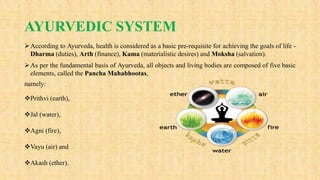
As per the fundamental basis of Ayurveda, all objects and living bodies are composed of five basic
elements, called the Pancha Mahabhootas,
namely:
Prithvi (earth),
Jal (water),
Agni (fire),
Vayu (air) and
Akash (ether).
AYURVEDIC SYSTEM
The philosophy of Ayurveda is based on the fundamental correlation between the universe and the
man.
Hence Ayurveda has also stressed on environmental aspects and has advised various measures for
conservation of nature as well as to avoid the pollution of Air, water and Soil.
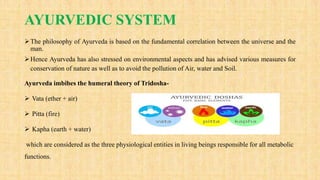
Ayurveda imbibes the humeral theory of Tridosha-
 Vata (ether + air)
 Pitta (fire)
 Kapha (earth + water)
which are considered as the three physiological entities in living beings responsible for all metabolic
functions.
AYURVEDIC SYSTEM
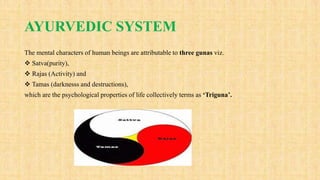
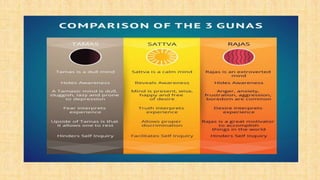
The mental characters of human beings are attributable to three gunas viz.
 Satva(purity),
 Rajas (Activity) and
 Tamas (darknesss and destructions),
which are the psychological properties of life collectively terms as ‘Triguna’.
AYURVEDIC SYSTEM
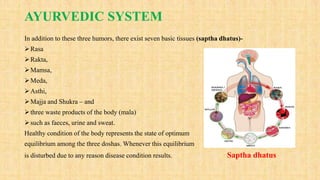
In addition to these three humors, there exist seven basic tissues (saptha dhatus)-
Rasa
Rakta,
Mamsa,
Meda,
Asthi,
Majja and Shukra – and
three waste products of the body (mala)
such as faeces, urine and sweat.
Healthy condition of the body represents the state of optimum
equilibrium among the three doshas. Whenever this equilibrium
is disturbed due to any reason disease condition results. Saptha dhatus
AYURVEDIC SYSTEM
 Healthy condition of the body represents the state of optimum equilibrium among the three doshas.
Whenever this equilibrium is disturbed due to any reason disease condition results.
 Ayurveda originated in India long back in pre-vedic period. Rigveda and Atharvaveda (5000years B.C.),
the earliest documented ancient Indian knowledge has references on health and diseases. Ayurveda texts
like Charak Samhita and Sushruta Samhita were documented about 1000 years B.C. The term Ayurveda
means ‘Science of Life’.
 It deals elaborately with measures for healthful living during the entire span of life and its various
phases. Besides, dealing with principles for maintenance of health, it has also developed a wide range of
therapeutic measures to combat illness.
 These principles of positive health and therapeutic measures relate to physical, mental, social and
spiritual welfare of human beings.
AYURVEDIC SYSTEM
Diagnosis
In Ayurveda diagnosis is always done of the patient as a whole. The physician takes a careful note of
the patient’s internal physiological characteristics and mental disposition. He also studies such other
factors as the affected bodily tissues, humours, the site at which the disease is located, patient’s
resistance and vitality, his daily routine, dietary habits, the gravity of clinical conditions, condition of
digestion and details of personal, social, economic and environmental situation of the patient.
The diagnosis also involves the following examinations:
• General physical examination
• Pulse examination
• Urine examination
• Examination of the faeces
• Examination of tongue and eyes
• Examination of skin and ear including tactile and auditory functions
AYURVEDIC SYSTEM
Treatment
Treatment of the disease consists in removal of causative factors responsible for disequilibria of the
body matrix or of any of its constituent parts through the use of Panchkarma procedures,
Panchakarma is a combination of five procedures of purification
Vamana (Emesis),
Virechana (Purgation),
Niroohavasti (Decoction enema),
Nasya (instillation of medicine through nostrils), and
Anuvasanavasti (Oil enema).
These procedures aim at plucking away the deep-rooted imbalances in the body.
Medicines
suitable diet
AYURVEDIC SYSTEM
Preventive Treatment & the concepts of Aetio-Pathogenesis
Ayurveda has developed a very vivid analytical description of the stages and events that take place
since the causative factors commence to operate till the final manifestation of disease. This very
much enhances the preventive role of this system of medicine by making it possible to take proper
and effective steps in advance, to arrest further progress in pathogenesis or to take suitable
therapeutic measures to curb the disease in its earliest stage of onset.
Types of Treatment The treatment of disease can broadly be classified as
Shodhana therapy (Purification Treatment)
Shamana therapy (Palliative Treatment)
Pathya Vyavastha (Prescription of diet and activity)
Nidan Parivarjan (Avoidance of disease causing and aggravating factors)
Satvavajaya(Psychotherapy)
Rasayana therapy (use of immuno modulators and rejuvenation medicines)
HOMEOPATHIC SYSTEM
Introduction
 It is a distinct medical specialty being practiced across the world. It is a recognized medical
system in India through the Homeopathy Central Council Act, 1973.
 Ancient medical wisdom as well as Hippocratic writings speaks of two diverse principles of
treating diseases.
One is Contraria Contrariis Curantur (Latin) which means opposites are cured by opposites. This
principle teaches to treat disease by using remedies that produce opposite effects.
The other principle is the Similia Similibus Curentur (Latin), which means let similar things take
care of similar things.
HOMEOPATHIC SYSTEM
Hippocrates was known to have said, "Through the like, disease is produced and through the
application of the like it is cured.
" The word ‘Homeopathy’ is derived from two Greek words hómoios (similar) and páthos
(suffering).
 This means in Homeopathy natural diseases are treated with substances that produce effects
similar to the suffering.
 The key principle of this medical approach is similia similibus curentur. Homeopaths generally
refer this as Like be treated with likes.
HOMEOPATHIC SYSTEM
HISTORY
The system was propounded by a German physician Dr. Christian Friedrich Samuel
Hahnemann (10th April, 1755 – 2nd July, 1843).
The main principle of Homeopathy is similia.
Another principle, namely,
Individualisation speaks of holistic approach in health
disease and treatment by taking into consideration of the sick individual at physical, mental, social
and spiritual levels.
The concept of prescribing medicines having exceedingly low quantity of original medicinal
substances is called theory of minimum dose.
This is emerging as Nano pharmacology.
HOMEOPATHIC SYSTEM
Another major contribution of Hahnemann is his teaching on using only those medicines whose
therapeutic efficacy has been verified on human beings safely. He named this as Drug Proving.
This is gaining wider acceptability in the scientific fraternity and is now called Human
Pathogenitic Trial. (HPT) Thus, the scientific validity of the principles postulated by Hahnemann
in early 18th century are getting validation with the advancement of science.
Therefore, it is said that Hahnemann was ahead of his time in terms of knowledge and wisdom.
FUNDAMENTAL PRINCIPLES OF
HOMOEOPATHY
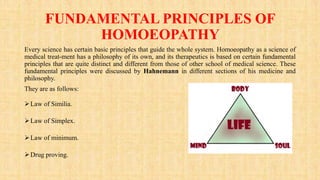
Every science has certain basic principles that guide the whole system. Homoeopathy as a science of
medical treat-ment has a philosophy of its own, and its therapeutics is based on certain fundamental
principles that are quite distinct and different from those of other school of medical science. These
fundamental principles were discussed by Hahnemann in different sections of his medicine and
philosophy.
They are as follows:
Law of Similia.
Law of Simplex.
Law of minimum.
Drug proving.
Drug dynamization or potentization.
Vital force.
Acute and Chronic Diseases.
Individualization.
Direction of cure.
Law of similia
The therapeutic law on which homoeopathy is based is Simillia Similibus Curentur, which means
‘Let likes be cured by likes’. In this art of healing, the medicine administered to a diseased
individual is such that if given to a healthy person it produces same sufferings (diseases) as found in
the diseases individual. Thus, the symptoms of the diseased individual are to be matched with the
pathogenesis of the medicine, and the medicines which are most similar, viz. Simillimum is selected
and administered with certainty to cure.
Law of simplex
Simple and single drugs should be prescribed at a time. Thus, medicines are proved on healthy
human beings singly and in simple form without admixture of any other substance.
Law of minimum
Drugs are administered in a minimum quantity because of hypersensitivity in disease and the action
of drug is always directed towards normal by virtue of altered receptivity of tissue to stimuli in
disease. The medicines are just required to arouse a reaction in the body. If they are given in large
doses, they cause physiological action producing unwanted side effects and organic damage. The
minutest quantity of medicine helps it to reach the disease, which is of very subtle in nature. The
curative action of drug can only be expected without any unwanted aggravation by using minimum
quantity of medicine.
Drug proving
To apply drugs for therapeutic purposes, their curative power should be known. The curative power of a
drug is its ability to produce disease symptoms when employed on a healthy person. The curative power of
a drug is known by its pathogenesis and is ascertained by proving the drug singly on healthy human being.
This serves the only true record of the curative properties of drug.
Drug dynamization or potentization
Disease is a disturbance or deviation in the normal har-monious flow of life force which is dynamic in
nature. Now medicine used to encounter disease should also have dynamic action to act on the dynamic
disturbance of life force. Therefore, the drugs are dynamized or potentized liberating their dynamic
curative power which lies dormant in them. This dynamization is done by the process of Trituration (in
case of insoluble substances) or Succession (in case of soluble substances).
Individualization
No two individuals are alike in the world, so the diseases affecting individuals can never be the same
assuming the unique individual picture in each diseased individual. Thus, medicines can never be
prescribed on the basis of the name of the disease without individualizing each case of disease. Direction
of cure Dr. Hering states that ‘cure takes place within outward from above to downward and the
symptoms disappears in the reverse of their appearance’. If the direction is reverse of that stated then it
is not cure but suppression which has occurred.
Vital force
Disease is nothing but the disharmonious flow of the vital force giving rise to abnormal sensation and
functions (symp-toms and signs). In order to restore the health, the disor-dered vital force is to be
brought back to normal. Disease and health are two different quantitative states of this vital force of
living being, and cure is to be affected here.
Vital force has the following characteristics:
 spiritual,
 autocratic,
 automatic,
 dynamic,
 unintelligent and
 instinctive.
Acute and chronic diseases
The diseases are classified into these types depending upon their onset, nature of progress and
termination of diseases.
Direction of cure
Dr. Hering states that ‘cure takes place within outward from above to downward and the
symptoms disappears in the reverse of their appearance’. If the direction is reverse of that stated
then it is not cure but suppression which has occurred.
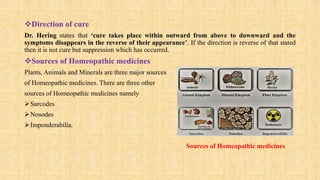
Sources of Homeopathic medicines
Plants, Animals and Minerals are three major sources
of Homeopathic medicines. There are three other
sources of Homeopathic medicines namely
Sarcodes
Nosodes
Imponderabilia.
Sources of Homeopathic medicines
THANK YOU

Various medicine systems

  • 1.
    PHARMACOGNOSY AND PHYTOCHEMISTRY-I Module-IV Prepared by Gowri SankarChintapalli Assistant Professor ARKA JAIN UNIVERSITY
  • 2.
  • 3.
    MAJOR ALTERNATIVE SYSTEMSOF MEDICINES Allopathy system Ayurvedic system Unani system Siddha system Homeopathic system Chinese system
  • 4.
    AYURVEDIC SYSTEM The word‘Ayurveda’ has derived out of fusion of two separate words- Áyu’ i.e. life and ‘veda’ i.e. knowledge. Thus in literal meaning Ayurveda is the science of life. Ayurveda is a classical system of preventive, promotive and curative healthcare originating from the Vedas documented around 5000 years ago and currently recognized and practiced in India and many countries in the world. It is believed that Ayurveda is originated out of Vedas (particularly Rigveda and Atharvaveda). The knowledge of Ayurveda was first comprehensively documented in the compendia like ‘Brahma Samhita’, Ágnivesha tantra’, ‘Bhela Samhita’ etc.
  • 5.
    AYURVEDIC SYSTEM Out ofthese, only some part of Bhela Samhita is available today. The Agnivesha Tantra was edited by Charak around 5000 years back called Charak Samhita and thereafter re-edited by Dridhbala, which is one of the main text of Ayurveda available in complete form today. This is the most translated trearty of Ayurveda, which got translated in to many foreign languages like Tibetan, Arabic, Unan and Greek even in ancient time.  In recent past many scholars have translated Charak Samhita in to English, German, and Japanese languages. Likewise another full available ancient text mainly dealing with surgical aspect of diseases is Sushruta Samhita, which has also undergone 3-4 editions in past 5000 years.
  • 6.
    AYURVEDIC SYSTEM According toAyurveda, health is considered as a basic pre-requisite for achieving the goals of life - Dharma (duties), Arth (finance), Kama (materialistic desires) and Moksha (salvation). As per the fundamental basis of Ayurveda, all objects and living bodies are composed of five basic elements, called the Pancha Mahabhootas, namely: Prithvi (earth), Jal (water), Agni (fire), Vayu (air) and Akash (ether).
  • 7.
    AYURVEDIC SYSTEM The philosophyof Ayurveda is based on the fundamental correlation between the universe and the man. Hence Ayurveda has also stressed on environmental aspects and has advised various measures for conservation of nature as well as to avoid the pollution of Air, water and Soil. Ayurveda imbibes the humeral theory of Tridosha-  Vata (ether + air)  Pitta (fire)  Kapha (earth + water) which are considered as the three physiological entities in living beings responsible for all metabolic functions.
  • 8.
    AYURVEDIC SYSTEM The mentalcharacters of human beings are attributable to three gunas viz.  Satva(purity),  Rajas (Activity) and  Tamas (darknesss and destructions), which are the psychological properties of life collectively terms as ‘Triguna’.
  • 10.
    AYURVEDIC SYSTEM In additionto these three humors, there exist seven basic tissues (saptha dhatus)- Rasa Rakta, Mamsa, Meda, Asthi, Majja and Shukra – and three waste products of the body (mala) such as faeces, urine and sweat. Healthy condition of the body represents the state of optimum equilibrium among the three doshas. Whenever this equilibrium is disturbed due to any reason disease condition results. Saptha dhatus
  • 11.
    AYURVEDIC SYSTEM  Healthycondition of the body represents the state of optimum equilibrium among the three doshas. Whenever this equilibrium is disturbed due to any reason disease condition results.  Ayurveda originated in India long back in pre-vedic period. Rigveda and Atharvaveda (5000years B.C.), the earliest documented ancient Indian knowledge has references on health and diseases. Ayurveda texts like Charak Samhita and Sushruta Samhita were documented about 1000 years B.C. The term Ayurveda means ‘Science of Life’.  It deals elaborately with measures for healthful living during the entire span of life and its various phases. Besides, dealing with principles for maintenance of health, it has also developed a wide range of therapeutic measures to combat illness.  These principles of positive health and therapeutic measures relate to physical, mental, social and spiritual welfare of human beings.
  • 12.
    AYURVEDIC SYSTEM Diagnosis In Ayurvedadiagnosis is always done of the patient as a whole. The physician takes a careful note of the patient’s internal physiological characteristics and mental disposition. He also studies such other factors as the affected bodily tissues, humours, the site at which the disease is located, patient’s resistance and vitality, his daily routine, dietary habits, the gravity of clinical conditions, condition of digestion and details of personal, social, economic and environmental situation of the patient. The diagnosis also involves the following examinations: • General physical examination • Pulse examination • Urine examination • Examination of the faeces • Examination of tongue and eyes • Examination of skin and ear including tactile and auditory functions
  • 13.
    AYURVEDIC SYSTEM Treatment Treatment ofthe disease consists in removal of causative factors responsible for disequilibria of the body matrix or of any of its constituent parts through the use of Panchkarma procedures, Panchakarma is a combination of five procedures of purification Vamana (Emesis), Virechana (Purgation), Niroohavasti (Decoction enema), Nasya (instillation of medicine through nostrils), and Anuvasanavasti (Oil enema). These procedures aim at plucking away the deep-rooted imbalances in the body. Medicines suitable diet
  • 14.
    AYURVEDIC SYSTEM Preventive Treatment& the concepts of Aetio-Pathogenesis Ayurveda has developed a very vivid analytical description of the stages and events that take place since the causative factors commence to operate till the final manifestation of disease. This very much enhances the preventive role of this system of medicine by making it possible to take proper and effective steps in advance, to arrest further progress in pathogenesis or to take suitable therapeutic measures to curb the disease in its earliest stage of onset. Types of Treatment The treatment of disease can broadly be classified as Shodhana therapy (Purification Treatment) Shamana therapy (Palliative Treatment) Pathya Vyavastha (Prescription of diet and activity) Nidan Parivarjan (Avoidance of disease causing and aggravating factors) Satvavajaya(Psychotherapy) Rasayana therapy (use of immuno modulators and rejuvenation medicines)
  • 15.
    HOMEOPATHIC SYSTEM Introduction  Itis a distinct medical specialty being practiced across the world. It is a recognized medical system in India through the Homeopathy Central Council Act, 1973.  Ancient medical wisdom as well as Hippocratic writings speaks of two diverse principles of treating diseases. One is Contraria Contrariis Curantur (Latin) which means opposites are cured by opposites. This principle teaches to treat disease by using remedies that produce opposite effects. The other principle is the Similia Similibus Curentur (Latin), which means let similar things take care of similar things.
  • 16.
    HOMEOPATHIC SYSTEM Hippocrates wasknown to have said, "Through the like, disease is produced and through the application of the like it is cured. " The word ‘Homeopathy’ is derived from two Greek words hómoios (similar) and páthos (suffering).  This means in Homeopathy natural diseases are treated with substances that produce effects similar to the suffering.  The key principle of this medical approach is similia similibus curentur. Homeopaths generally refer this as Like be treated with likes.
  • 17.
    HOMEOPATHIC SYSTEM HISTORY The systemwas propounded by a German physician Dr. Christian Friedrich Samuel Hahnemann (10th April, 1755 – 2nd July, 1843). The main principle of Homeopathy is similia. Another principle, namely, Individualisation speaks of holistic approach in health disease and treatment by taking into consideration of the sick individual at physical, mental, social and spiritual levels. The concept of prescribing medicines having exceedingly low quantity of original medicinal substances is called theory of minimum dose. This is emerging as Nano pharmacology.
  • 18.
    HOMEOPATHIC SYSTEM Another majorcontribution of Hahnemann is his teaching on using only those medicines whose therapeutic efficacy has been verified on human beings safely. He named this as Drug Proving. This is gaining wider acceptability in the scientific fraternity and is now called Human Pathogenitic Trial. (HPT) Thus, the scientific validity of the principles postulated by Hahnemann in early 18th century are getting validation with the advancement of science. Therefore, it is said that Hahnemann was ahead of his time in terms of knowledge and wisdom.
  • 19.
    FUNDAMENTAL PRINCIPLES OF HOMOEOPATHY Everyscience has certain basic principles that guide the whole system. Homoeopathy as a science of medical treat-ment has a philosophy of its own, and its therapeutics is based on certain fundamental principles that are quite distinct and different from those of other school of medical science. These fundamental principles were discussed by Hahnemann in different sections of his medicine and philosophy. They are as follows: Law of Similia. Law of Simplex. Law of minimum. Drug proving.
  • 20.
    Drug dynamization orpotentization. Vital force. Acute and Chronic Diseases. Individualization. Direction of cure.
  • 21.
    Law of similia Thetherapeutic law on which homoeopathy is based is Simillia Similibus Curentur, which means ‘Let likes be cured by likes’. In this art of healing, the medicine administered to a diseased individual is such that if given to a healthy person it produces same sufferings (diseases) as found in the diseases individual. Thus, the symptoms of the diseased individual are to be matched with the pathogenesis of the medicine, and the medicines which are most similar, viz. Simillimum is selected and administered with certainty to cure. Law of simplex Simple and single drugs should be prescribed at a time. Thus, medicines are proved on healthy human beings singly and in simple form without admixture of any other substance. Law of minimum Drugs are administered in a minimum quantity because of hypersensitivity in disease and the action of drug is always directed towards normal by virtue of altered receptivity of tissue to stimuli in disease. The medicines are just required to arouse a reaction in the body. If they are given in large doses, they cause physiological action producing unwanted side effects and organic damage. The minutest quantity of medicine helps it to reach the disease, which is of very subtle in nature. The curative action of drug can only be expected without any unwanted aggravation by using minimum quantity of medicine.
  • 22.
    Drug proving To applydrugs for therapeutic purposes, their curative power should be known. The curative power of a drug is its ability to produce disease symptoms when employed on a healthy person. The curative power of a drug is known by its pathogenesis and is ascertained by proving the drug singly on healthy human being. This serves the only true record of the curative properties of drug. Drug dynamization or potentization Disease is a disturbance or deviation in the normal har-monious flow of life force which is dynamic in nature. Now medicine used to encounter disease should also have dynamic action to act on the dynamic disturbance of life force. Therefore, the drugs are dynamized or potentized liberating their dynamic curative power which lies dormant in them. This dynamization is done by the process of Trituration (in case of insoluble substances) or Succession (in case of soluble substances). Individualization No two individuals are alike in the world, so the diseases affecting individuals can never be the same assuming the unique individual picture in each diseased individual. Thus, medicines can never be prescribed on the basis of the name of the disease without individualizing each case of disease. Direction of cure Dr. Hering states that ‘cure takes place within outward from above to downward and the symptoms disappears in the reverse of their appearance’. If the direction is reverse of that stated then it is not cure but suppression which has occurred.
  • 23.
    Vital force Disease isnothing but the disharmonious flow of the vital force giving rise to abnormal sensation and functions (symp-toms and signs). In order to restore the health, the disor-dered vital force is to be brought back to normal. Disease and health are two different quantitative states of this vital force of living being, and cure is to be affected here. Vital force has the following characteristics:  spiritual,  autocratic,  automatic,  dynamic,  unintelligent and  instinctive. Acute and chronic diseases The diseases are classified into these types depending upon their onset, nature of progress and termination of diseases.
  • 24.
    Direction of cure Dr.Hering states that ‘cure takes place within outward from above to downward and the symptoms disappears in the reverse of their appearance’. If the direction is reverse of that stated then it is not cure but suppression which has occurred. Sources of Homeopathic medicines Plants, Animals and Minerals are three major sources of Homeopathic medicines. There are three other sources of Homeopathic medicines namely Sarcodes Nosodes Imponderabilia. Sources of Homeopathic medicines
  • 25.