PHARMACOGNOSY
AND
PHYTOCHEMISTRY-I
Module-3
Prepared by
GOWRI SANKAR CHINTAPALLI
ASSISTANT PROFESSOR
ARKA JAIN UNIVERSITY
PLANT TISSUE CULTURE
Plant tissue culture is defined as culturing plant seeds, organs, explants, tissues, cells, or protoplasts on
a chemically defined synthetic nutrient media under sterile and controlled conditions of light,
temperature, and humidity.
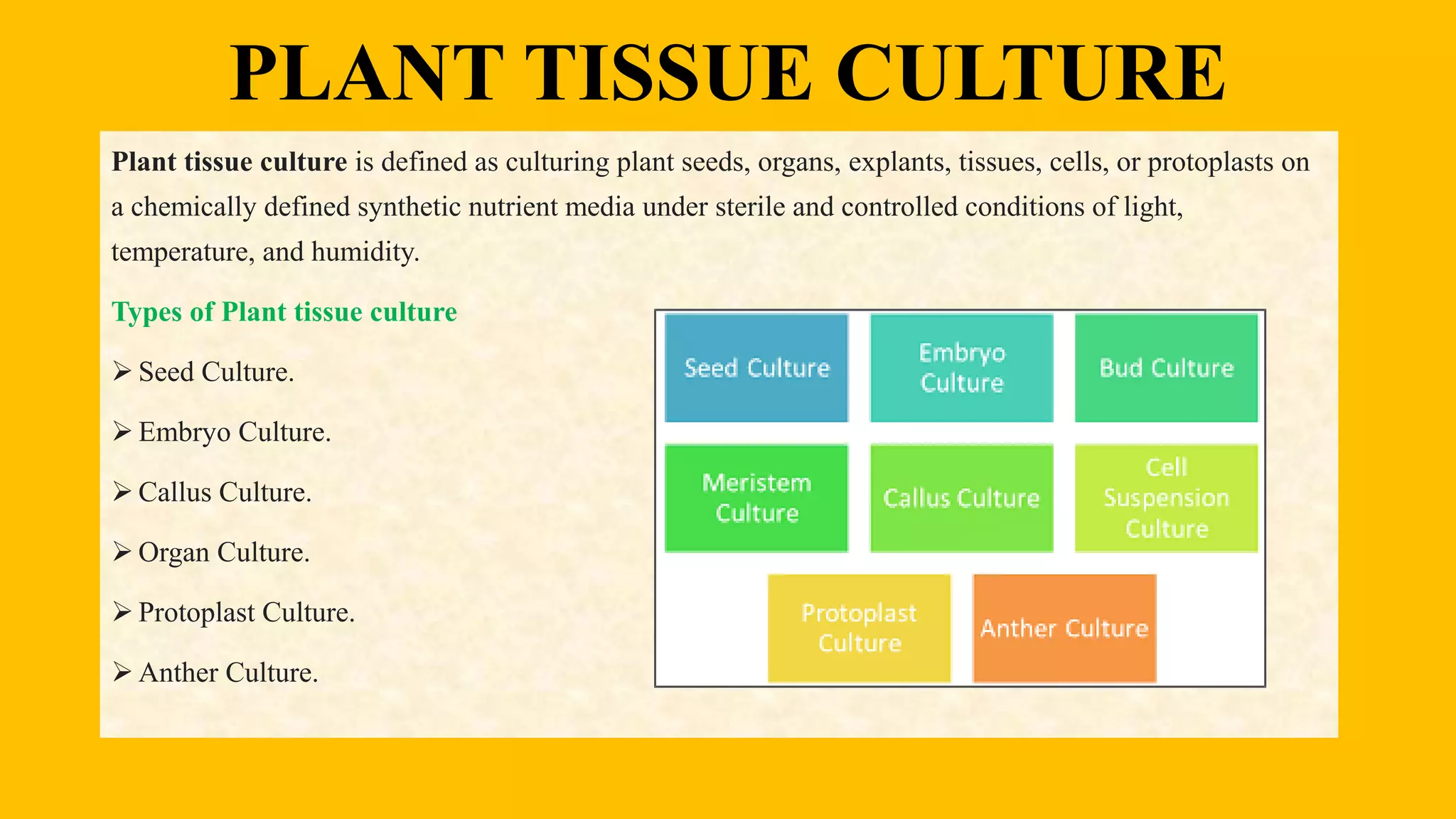
Types of Plant tissue culture
 Seed Culture.
 Embryo Culture.
 Callus Culture.
 Organ Culture.
 Protoplast Culture.
 Anther Culture.
PLANT TISSUE CULTURE
 Preparing Plant Tissue Culture Medium
Media composition Plant tissue culture media should generally contain some or all of the
following components:
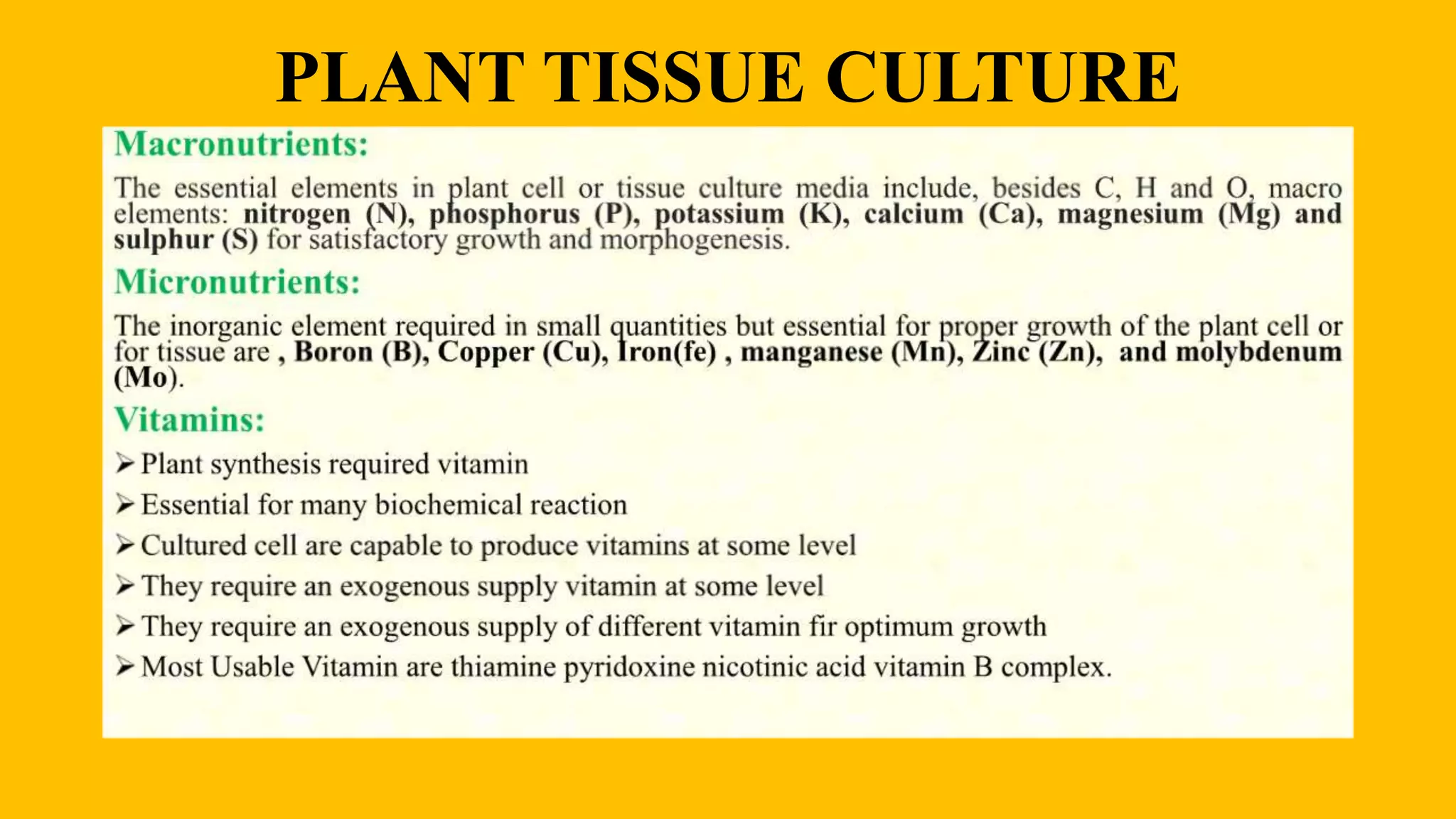
Macronutrients
Micronutrients
Vitamins
Amino acids or nitrogen supplements
Source(s) of carbon
Undefined organic supplements
Growth regulators
Solidifying agents
PLANT TISSUE CULTURE
Amino acids or nitrogen supplements:
Amino acid are added for substitution for augmentation of the nitrogen supply. If is noted that
theonine, glycine and valine reduce ammonium utilisation by inactiving glumate synthase located in
chloroplasts and cytoplasm.
Source(s) of carbon:
Carbohydrates are used as carbon sources. The standard carbon source is sucrose at a concentration
of 2-5 per cent. Monosaccharides like glucose or fructose can also be used as carbon sources but are
generally less suitable. Sucrose is the best source, since sucrose is dehydrolysed into usable sugars
during autoclaving.
Undefined organic supplements:
The requirements of tissue cultures for trace amounts of certain organic substances were satisfied by
“undefined” supplements such as fruit juices, coconut milk, yeast or malt extracts and hydrolysed
casein. These supplements can contribute vitamins, amino acids and growth regulants to a culture
medium.
PLANT TISSUE CULTURE
Growth regulators:
The growth and the development of higher plant tissue in Vitro is controlled by Endogenous plant
growth regulators. There are 5 known groups of these growth regulators namely auxins, cytokinins,
gibberellins, unsaturated hydrocarbon gases and growth inhibitor. The previous two group are of
great importance for culture media preparation while the letter to group are represented by ethylene
and abscisic acid.
PLANT TISSUE CULTURE
Solidifying agents:
Agar and phytagel are the most commonly
used solidifying agents in tissue culture.
Agar is extracted from red algae, mainly
from the species Gelidium amansii Lamouroux,
and consists of a complex mixture of
polysaccharides, especially
agarose and agaropectins.
PLANT TISSUE CULTURE
Steps in Plant tissue Culture:
Initiation stage
Multiplication stage
Root formation stage
Shoot formation stage
Acclimatization stage
PLANT TISSUE CULTURE
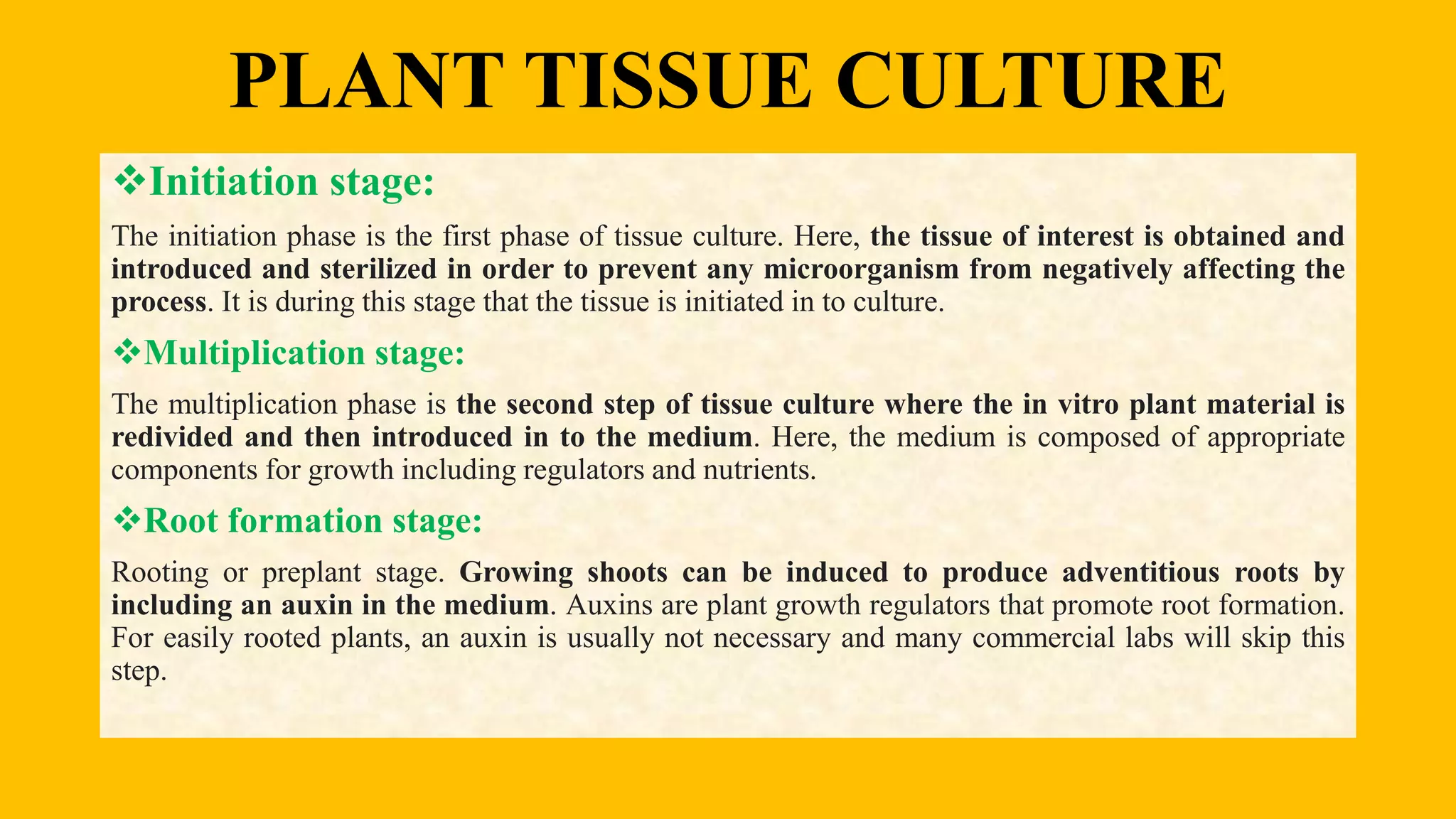
Initiation stage:
The initiation phase is the first phase of tissue culture. Here, the tissue of interest is obtained and
introduced and sterilized in order to prevent any microorganism from negatively affecting the
process. It is during this stage that the tissue is initiated in to culture.
Multiplication stage:
The multiplication phase is the second step of tissue culture where the in vitro plant material is
redivided and then introduced in to the medium. Here, the medium is composed of appropriate
components for growth including regulators and nutrients.
Root formation stage:
Rooting or preplant stage. Growing shoots can be induced to produce adventitious roots by
including an auxin in the medium. Auxins are plant growth regulators that promote root formation.
For easily rooted plants, an auxin is usually not necessary and many commercial labs will skip this
step.
PLANT TISSUE CULTURE
Shoot formation stage:
A cytokinin is a plant growth regulator that promotes shoot
formation from growing plant cells. Rooting or preplant stage.
Growing shoots can be induced to produce adventitious roots
by including an auxin in the medium. Auxins are plant growth
regulators that promote root formation. Shoot formation stage
Acclimatization stage:
Acclimatization here simply means the adaptation of
plantlets to a new environment. Plantlets or shoots in the
culture vessels are accustomed to a different micro-environment.
You customize this micro-environment in a way that the developing
plants experience minimal stress and optimum conditions to grow
and multiply.
Acclimatization stage
PLANT TISSUE CULTURE
Procedure for plant tissue culture
Sterilisation of glassware tools/vessels
Preparation of explant
Surface sterilisation of explant
Production of callus from explant
Proliferation of cultured callus
Subculturing of callus
Suspension culture
Sterilisation of
glassware tools/vessels
• Autoclaves are widely used to sterilize
instruments, glassware and plasticware, solutions
and media, and to decontaminate biological
wastes. Because of the physical hazards (e.g.,
heat, steam, and pressure) associated with
autoclaving, extra care must be taken to ensure
their safe use.
Preparation of
explant
• To selection explant there are some factors that must
be considered are as follows:
Physiological or ontogenic age of the organ that is to
serve the explant source. ...
Size and location of the explant.
Quality of the source plant.
Surface sterilisation
of explant
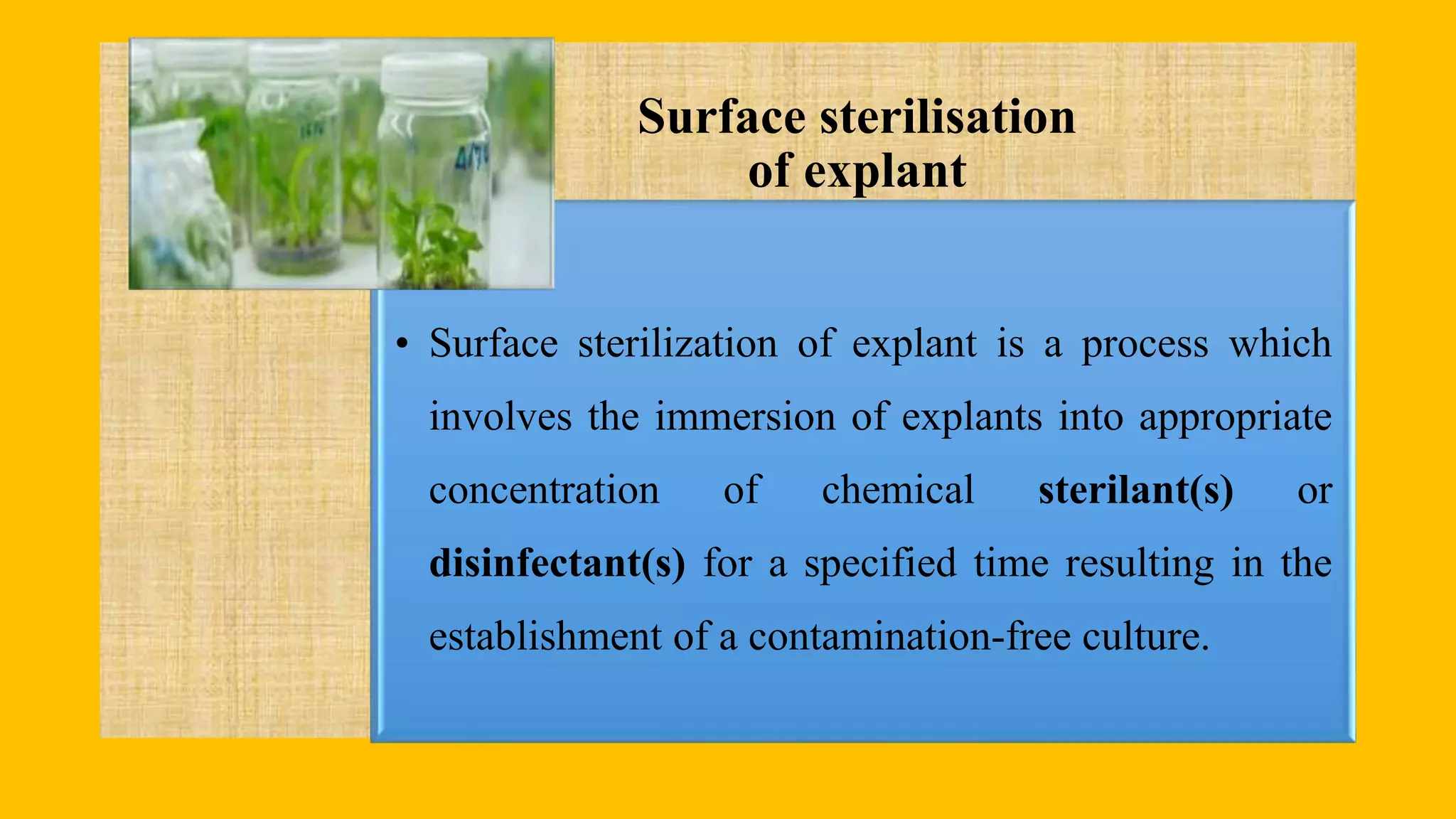
• Surface sterilization of explant is a process which
involves the immersion of explants into appropriate
concentration of chemical sterilant(s) or
disinfectant(s) for a specified time resulting in the
establishment of a contamination-free culture.
Production of
callus from explant
• In living plants, callus cells are those cells that cover
a plant wound. In biological research and
biotechnology callus formation is induced from plant
tissue samples (explants) after surface sterilization
and plating onto tissue culture medium in vitro (in a
closed culture vessel such as a Petri dish).
Production of
callus from explant
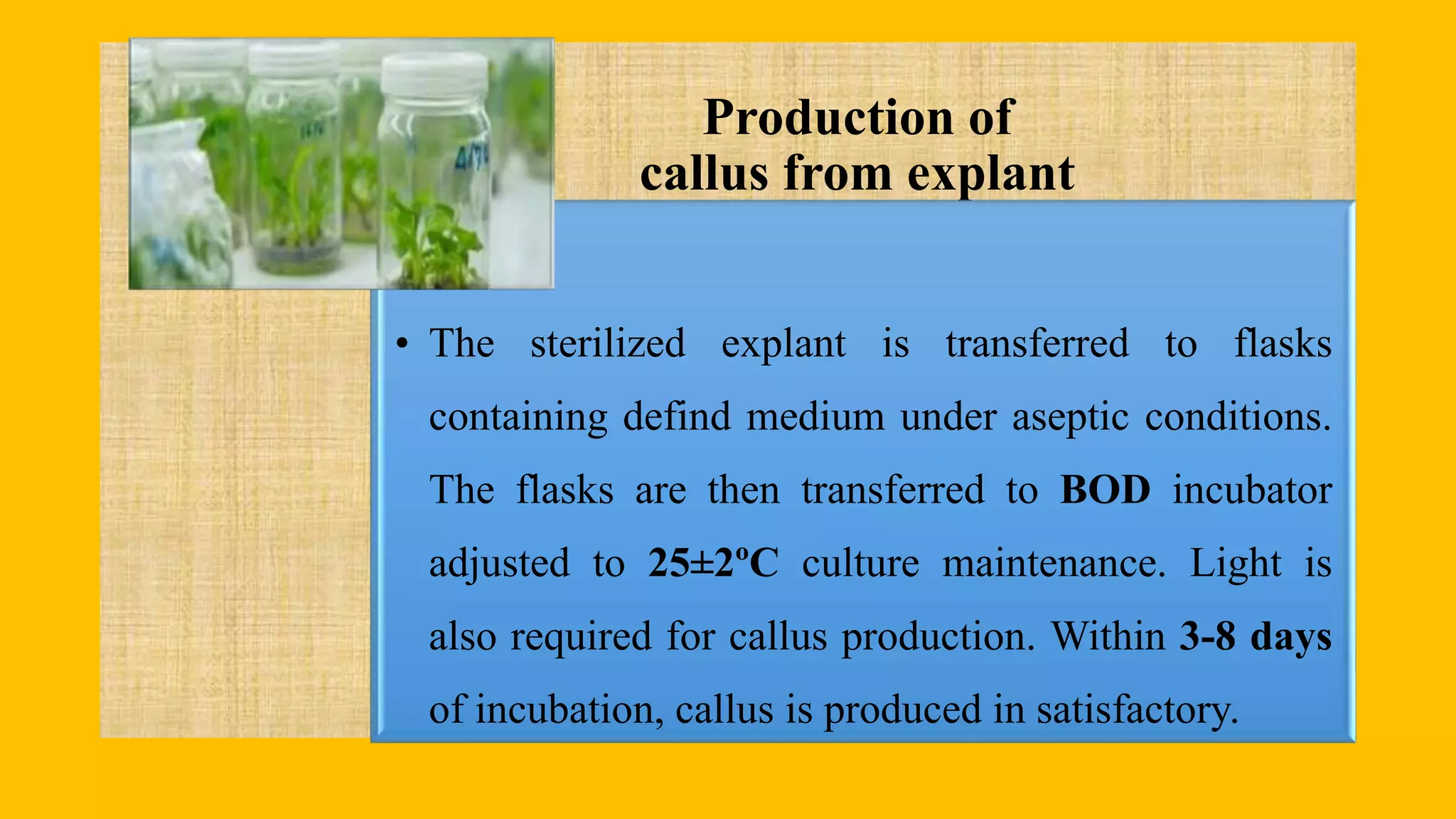
• The sterilized explant is transferred to flasks
containing defind medium under aseptic conditions.
The flasks are then transferred to BOD incubator
adjusted to 25±2ºC culture maintenance. Light is
also required for callus production. Within 3-8 days
of incubation, callus is produced in satisfactory.
Proliferation of
cultured callus
• Well-developed callus is cut into small pieces and
transferred to another fresh medium containing an
altered composition of hormones to support growth.
Such medium used for the production of more
amount of callus is termed proliferation medium.
Sub-culturing of
callus
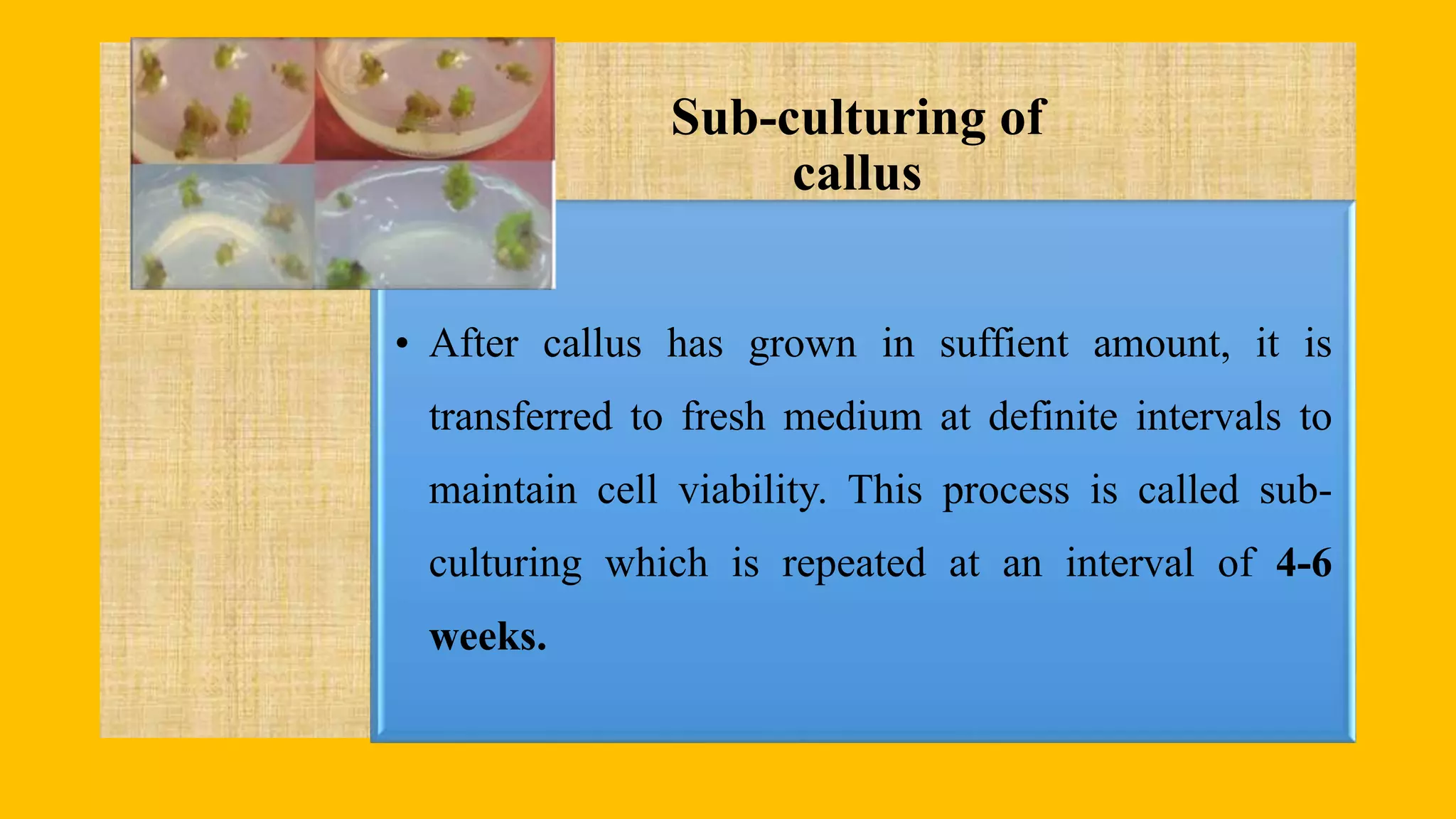
• After callus has grown in suffient amount, it is
transferred to fresh medium at definite intervals to
maintain cell viability. This process is called sub-
culturing which is repeated at an interval of 4-6
weeks.
Suspension culture
• Surface sterilization of explant is a process which
involves the immersion of explants into appropriate
concentration of chemical sterilant(s) or
disinfectant(s) for a specified time resulting in the
establishment of a contamination-free culture.
CARROT ROOT CULTURE
THANK YOU

PLANT TISSUE CULTURE

  • 1.
    PHARMACOGNOSY AND PHYTOCHEMISTRY-I Module-3 Prepared by GOWRI SANKARCHINTAPALLI ASSISTANT PROFESSOR ARKA JAIN UNIVERSITY
  • 3.
    PLANT TISSUE CULTURE Planttissue culture is defined as culturing plant seeds, organs, explants, tissues, cells, or protoplasts on a chemically defined synthetic nutrient media under sterile and controlled conditions of light, temperature, and humidity. Types of Plant tissue culture  Seed Culture.  Embryo Culture.  Callus Culture.  Organ Culture.  Protoplast Culture.  Anther Culture.
  • 4.
    PLANT TISSUE CULTURE Preparing Plant Tissue Culture Medium Media composition Plant tissue culture media should generally contain some or all of the following components: Macronutrients Micronutrients Vitamins Amino acids or nitrogen supplements Source(s) of carbon Undefined organic supplements Growth regulators Solidifying agents
  • 5.
  • 6.
    PLANT TISSUE CULTURE Aminoacids or nitrogen supplements: Amino acid are added for substitution for augmentation of the nitrogen supply. If is noted that theonine, glycine and valine reduce ammonium utilisation by inactiving glumate synthase located in chloroplasts and cytoplasm. Source(s) of carbon: Carbohydrates are used as carbon sources. The standard carbon source is sucrose at a concentration of 2-5 per cent. Monosaccharides like glucose or fructose can also be used as carbon sources but are generally less suitable. Sucrose is the best source, since sucrose is dehydrolysed into usable sugars during autoclaving. Undefined organic supplements: The requirements of tissue cultures for trace amounts of certain organic substances were satisfied by “undefined” supplements such as fruit juices, coconut milk, yeast or malt extracts and hydrolysed casein. These supplements can contribute vitamins, amino acids and growth regulants to a culture medium.
  • 7.
    PLANT TISSUE CULTURE Growthregulators: The growth and the development of higher plant tissue in Vitro is controlled by Endogenous plant growth regulators. There are 5 known groups of these growth regulators namely auxins, cytokinins, gibberellins, unsaturated hydrocarbon gases and growth inhibitor. The previous two group are of great importance for culture media preparation while the letter to group are represented by ethylene and abscisic acid.
  • 8.
    PLANT TISSUE CULTURE Solidifyingagents: Agar and phytagel are the most commonly used solidifying agents in tissue culture. Agar is extracted from red algae, mainly from the species Gelidium amansii Lamouroux, and consists of a complex mixture of polysaccharides, especially agarose and agaropectins.
  • 9.
    PLANT TISSUE CULTURE Stepsin Plant tissue Culture: Initiation stage Multiplication stage Root formation stage Shoot formation stage Acclimatization stage
  • 10.
    PLANT TISSUE CULTURE Initiationstage: The initiation phase is the first phase of tissue culture. Here, the tissue of interest is obtained and introduced and sterilized in order to prevent any microorganism from negatively affecting the process. It is during this stage that the tissue is initiated in to culture. Multiplication stage: The multiplication phase is the second step of tissue culture where the in vitro plant material is redivided and then introduced in to the medium. Here, the medium is composed of appropriate components for growth including regulators and nutrients. Root formation stage: Rooting or preplant stage. Growing shoots can be induced to produce adventitious roots by including an auxin in the medium. Auxins are plant growth regulators that promote root formation. For easily rooted plants, an auxin is usually not necessary and many commercial labs will skip this step.
  • 11.
    PLANT TISSUE CULTURE Shootformation stage: A cytokinin is a plant growth regulator that promotes shoot formation from growing plant cells. Rooting or preplant stage. Growing shoots can be induced to produce adventitious roots by including an auxin in the medium. Auxins are plant growth regulators that promote root formation. Shoot formation stage Acclimatization stage: Acclimatization here simply means the adaptation of plantlets to a new environment. Plantlets or shoots in the culture vessels are accustomed to a different micro-environment. You customize this micro-environment in a way that the developing plants experience minimal stress and optimum conditions to grow and multiply. Acclimatization stage
  • 12.
  • 13.
    Procedure for planttissue culture Sterilisation of glassware tools/vessels Preparation of explant Surface sterilisation of explant Production of callus from explant Proliferation of cultured callus Subculturing of callus Suspension culture
  • 14.
    Sterilisation of glassware tools/vessels •Autoclaves are widely used to sterilize instruments, glassware and plasticware, solutions and media, and to decontaminate biological wastes. Because of the physical hazards (e.g., heat, steam, and pressure) associated with autoclaving, extra care must be taken to ensure their safe use.
  • 15.
    Preparation of explant • Toselection explant there are some factors that must be considered are as follows: Physiological or ontogenic age of the organ that is to serve the explant source. ... Size and location of the explant. Quality of the source plant.
  • 16.
    Surface sterilisation of explant •Surface sterilization of explant is a process which involves the immersion of explants into appropriate concentration of chemical sterilant(s) or disinfectant(s) for a specified time resulting in the establishment of a contamination-free culture.
  • 17.
    Production of callus fromexplant • In living plants, callus cells are those cells that cover a plant wound. In biological research and biotechnology callus formation is induced from plant tissue samples (explants) after surface sterilization and plating onto tissue culture medium in vitro (in a closed culture vessel such as a Petri dish).
  • 18.
    Production of callus fromexplant • The sterilized explant is transferred to flasks containing defind medium under aseptic conditions. The flasks are then transferred to BOD incubator adjusted to 25±2ºC culture maintenance. Light is also required for callus production. Within 3-8 days of incubation, callus is produced in satisfactory.
  • 19.
    Proliferation of cultured callus •Well-developed callus is cut into small pieces and transferred to another fresh medium containing an altered composition of hormones to support growth. Such medium used for the production of more amount of callus is termed proliferation medium.
  • 20.
    Sub-culturing of callus • Aftercallus has grown in suffient amount, it is transferred to fresh medium at definite intervals to maintain cell viability. This process is called sub- culturing which is repeated at an interval of 4-6 weeks.
  • 21.
    Suspension culture • Surfacesterilization of explant is a process which involves the immersion of explants into appropriate concentration of chemical sterilant(s) or disinfectant(s) for a specified time resulting in the establishment of a contamination-free culture.
  • 22.
  • 24.