VARICOSE VEINS
A SEMINAR PRESENTATION
TEZPUR MEDICAL COLLEGE AND HOSPITAL
4/4/2019Shubham Gupta ©
DEFINITION
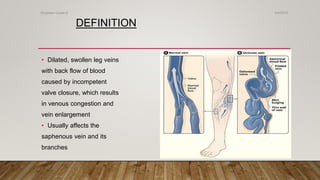
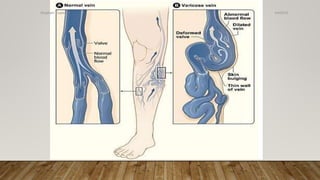
• Dilated, swollen leg veins
with back flow of blood
caused by incompetent
valve closure, which results
in venous congestion and
vein enlargement
• Usually affects the
saphenous vein and its
branches
4/4/2019Shubham Gupta ©
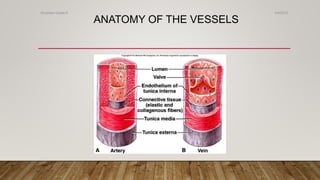
ANATOMY OF THE VESSELS
4/4/2019Shubham Gupta ©
VENOUS DISEASE
SUPERFICIAL SYSTEM
• Varicose Veins
• Spider Veins
• Venous Malformation (birth marks and others)
• Venous Reflux
• Leg Swelling
• Venous Ulceration
4/4/2019Shubham Gupta ©
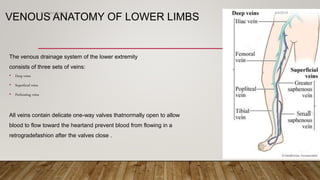
VENOUS ANATOMY OF LOWER LIMBS
The venous drainage system of the lower extremity
consists of three sets of veins:
• Deep veins
• Superficial veins
• Perforating veins
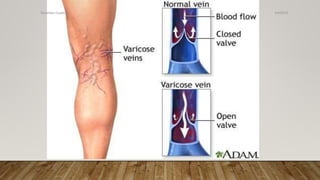
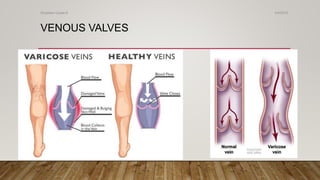
All veins contain delicate one-way valves thatnormally open to allow
blood to flow toward the heartand prevent blood from flowing in a
retrogradefashion after the valves close .
4/4/2019Shubham Gupta ©
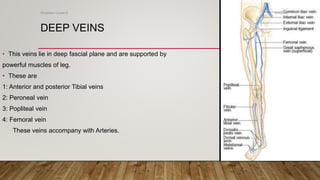
DEEP VEINS
• This veins lie in deep fascial plane and are supported by
powerful muscles of leg.
• These are
1: Anterior and posterior Tibial veins
2: Peroneal vein
3: Popliteal vein
4: Femoral vein
These veins accompany with Arteries.
4/4/2019Shubham Gupta ©
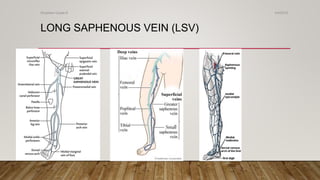
LONG SAPHENOUS VEIN (LSV)
4/4/2019Shubham Gupta ©
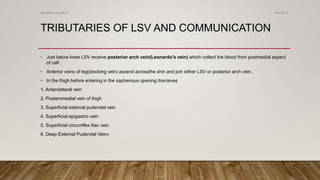
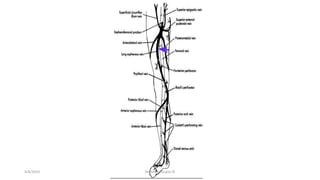
TRIBUTARIES OF LSV AND COMMUNICATION
• Just below knee LSV receive posterior arch vein(Leonardo's vein) which collect the blood from postmedial aspect
of calf .
• Anterior veins of leg(stocking vein) ascend acrossthe shin and join either LSV or posterior arch vein .
• In the thigh before entering in the saphenous opening itrecieves
1. Anterolateral vein
2. Posteromedial vein of thigh
3. Superficial external pudendal vein
4. Superficial epigastric vein
5. Superficial circumflex iliac vein
6. Deep External Pudendal Veinv
4/4/2019Shubham Gupta ©
4/4/2019 Shubham Gupta ©
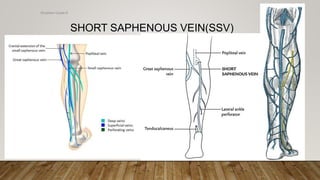
SHORT SAPHENOUS VEIN(SSV)
4/4/2019Shubham Gupta ©
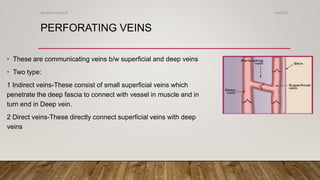
PERFORATING VEINS
• These are communicating veins b/w superficial and deep veins
• Two type:
1 Indirect veins-These consist of small superficial veins which
penetrate the deep fascia to connect with vessel in muscle and in
turn end in Deep vein.
2 Direct veins-These directly connect superficial veins with deep
veins
4/4/2019Shubham Gupta ©
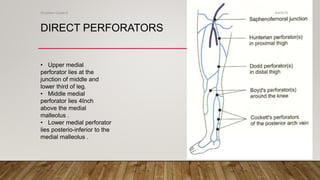
DIRECT PERFORATORS
• Upper medial
perforator lies at the
junction of middle and
lower third of leg.
• Middle medial
perforator lies 4Inch
above the medial
malleolus .
• Lower medial perforator
lies posterio-inferior to the
medial malleolus .
4/4/2019Shubham Gupta ©
VENOUS VALVES
4/4/2019Shubham Gupta ©
CLASSIFICATION OF VARICOSE VEINS
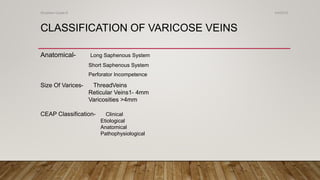
Anatomical- Long Saphenous System
Short Saphenous System
Perforator Incompetence
Size Of Varices- ThreadVeins
Reticular Veins1- 4mm
Varicosities >4mm
CEAP Classification- Clinical
Etiological
Anatomical
Pathophysiological
4/4/2019Shubham Gupta ©
CLASSIFICATION-CEAP
• C. (Clinical class):
- Class 0: No visible or palpable signs of venous disease.
- Class I : Telangiectasis or reticular veins.
- Class 2: Varicose veins.
- Class 3: Edema.
- Class 4: Skin changes e.g. venous eczema, pigmentation and lipodermatosclerosis.
- Class 5: Skin changes with healed ulceration
- Class 6: Skin changes with active ulceration
4/4/2019Shubham Gupta ©
E. (Etiology):
• Congenital.
• Primary (undetermined cause).
• Secondary:- Post-thrombotic - Post-traumatic
A. (Anatomic distribution of veins):
• Superficial.
• Perforator.
• Deep.
P. (Pathophysiologicmechanism):
• Reflux.
• Obstruction.
• Reflux and obstruction.
4/4/2019Shubham Gupta ©
CAUSES AND
PATHOPHYSIOLOGY
4/4/2019Shubham Gupta ©
AETIOLOGY
PRIMARY VARICOSE VEINS
• Defect in Saphenofemoral valve
• Defect in Saphenopopliteal valve
• Defect in Valve of Perforators
4/4/2019Shubham Gupta ©
SECONDARY VARICOSE VEINS
• Anything that increases intra-abdominal presure
• Anything that raises pressure in superficial or deep veins
• Pregnancy
• Obesity
• Abdominal or pelvic mass
• Old age
• Long standing
• Thrombosis of leg veins
4/4/2019Shubham Gupta ©
CONGENITAL CAUSES
• Arteriovenous fistulas
4/4/2019Shubham Gupta ©
RISK FACTORS
The following risk factors are linked to a higher risk of having varicose veins:
Gender: Varicose veins affect women more often than males. It may be that female
hormones relax veins. If so, taking birth control pills or hormone therapy (HT) might
contribute.
Genetics: Varicose veins often run in families.
Obesity: Being overweight or obese increases the risk of varicose veins.
4/4/2019Shubham Gupta ©
CONTD….
• Age: The risk increases with age, due to wear and tear on vein
valves.
• Some jobs: An individual who has to spend a long time standing at
work may have a higher chance of varicose veins.
4/4/2019Shubham Gupta ©
PATHOPHYSIOLOGY
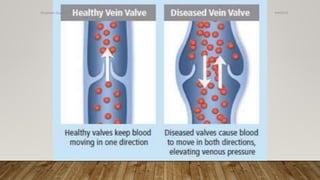
• The veins have one-way valves so that the blood can travel in only one direction.
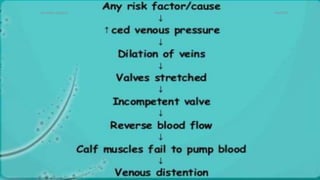
• If the walls of the vein become stretched and less flexible (elastic), the valves
may get weaker.
4/4/2019Shubham Gupta ©
CONTD…..
• A weakened valve can allow blood to leak backward and eventually flow in the opposite
direction.
• When this occurs, blood can accumulate in the vein(s), which then become enlarged and
swollen.
4/4/2019Shubham Gupta ©
CLINICAL PICTURE
• Thorough history taking:
- Occupation and prolonged standing
- Throbophlebitis or DVT
- Coaguation disorders
- Diabetes
- Results of previous treatment
- Pregnancy and contraceptive pills
4/4/2019Shubham Gupta ©
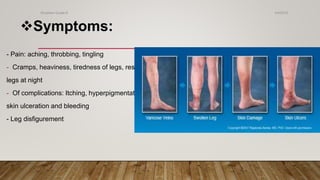
- Pain: aching, throbbing, tingling
- Cramps, heaviness, tiredness of legs, restless
legs at night
- Of complications: Itching, hyperpigmentation,
skin ulceration and bleeding
- Leg disfigurement
Symptoms:
4/4/2019Shubham Gupta ©
EXAMINATION
4/4/2019Shubham Gupta ©
1. Varicose veins :
Which vein has been varicosed - long saphenous or short saphenous or
both.
2. Swelling : It may be (a) localized or (b) generalized.
3. Skin of the limb : colour and texture.
4. Morrissey’s test: Whether there is any impulse on coughing at the
saphenous opening (saphena- varix).
A. INSPECTION
4/4/2019Shubham Gupta ©
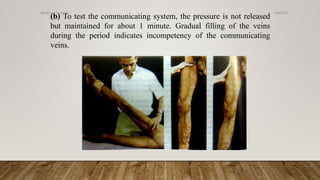
1. Brodie-Trendelenburg test :
• This test is done to determine the incompetency of the sapheno-femoral valve and other communicating
system
• This test can be performed in two ways . In both the methods, the patient is first placed in the
recumbent position and his legs are raised to empty the veins.. This may be hastened by milking the
veins proximally.
• The sapheno-femoral junction is now compressed with the thumb of the clinician or a tourniquet is
applied just below the sapheno-femoral junction and the patient asked to stand up quickly.
(a) In the first method, the pressure is released. If the varices fill quickly with a column of blood
from above, it indicates incompetency of the sapheno-femoral valve. This is called positive Trendelenburg
test.
B. PALAPATION
4/4/2019Shubham Gupta ©
(b) To test the communicating system, the pressure is not released
but maintained for about 1 minute. Gradual filling of the veins
during the period indicates incompetency of the communicating
veins.
4/4/2019Shubham Gupta ©
2. Tourniquet test:
• It can be called a variant of Trendelenburg test. In this test the tourniquet is
tied round thigh or the leg at different levels after the superficial veins have
been made empty by raising the leg in recumbent position.
• The patient is now asked to stand up. If the veins above the tourniquet fill up
and those below it remain collapsed, it indicates presence of incompetent
communicating vein above the tourniquet.
• Similarly if the veins below the tourniquet fill rapidly whereas veins above it
remain empty, the incompetent communicating vein must be below the
tourniquet.
4/4/2019Shubham Gupta ©
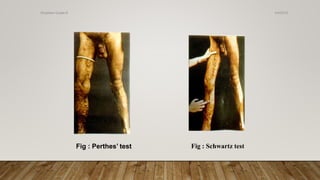
3. Perthes’ test:
• The affected lower extremity is wrapped with elastic bandage.
• With the elastic bandage on, the patient is instructed to move round and exercise.
• Severe crampy pain is complained of if there is deep vein thrombosis.
4. Perthes’ test (modified):
• This test is primarily intended to know whether the deep veins are normal or not.
• A tourniquet is tied round the upper part of the thigh tight enough to prevent any
reflux down the vein.
• The patient is asked to walk quickly with tourniquet in place.
• If the communicating and deep veins are normal the varicose veins will shrink
whereas if they are blocked the varicose vein will be more distended.
4/4/2019Shubham Gupta ©
Fig : Perthes’ test Fig : Schwartz test
4/4/2019Shubham Gupta ©
5. Schwartz test:
In a long standing case if a tap is made on the long saphenous varicose vein in lower
part of the leg an impulse can be felt at the saphenous opening with the other hand.
6. Pratt’s test:
• This test is performed to know the position of the perforators.
• Firstly an Esmarch elastic bandage is applied from toes to groin.
• A tourniquet is then applied at the groin. This causes emptying of the varicose
veins.
• The tourniquet is kept in position and the elastic bandage is taken off.
• The same elastic bandage is now applied from groin downwards. At the positions
of the perforators ‘blow outs’ or visible varices can be seen .
4/4/2019Shubham Gupta ©
7. Morrissey’s Cough impulse test:
• The limb is elevated to empty the varicose veins. The limb is then
put to bed and the patient is asked to cough focibly.
• An expansile impulse is felt in the long saphenous vein
particularly at the saphenous opening if the sapheno-femoral
valve is incompetent.
C. PERCUSSION : if the prominent parts of the varicose veins
are tapped, an impulse can be felt by the finger at the saphenous
opening.
D. AUSCULTATION : the importance of auscultation is limited
to the arteriovenous fistula, where a continuous machinery murmur
may be heard.
4/4/2019Shubham Gupta ©
INVESTIGATIONS
4/4/2019Shubham Gupta ©
Venous Doppler
• With the patient standing, the Doppler probe is placed
at saphenofemoral junction and later wherever required.
• Basically by hearing the changes in sound ; venous
flow, venous patency, venous reflux can be identified.
• Doppler test : when a hand held Doppler is kept at
saphenofemoral junction, typical audible ‘whoose
signal’ >0.5 sec while performing Valsalva manoeuvre
is the sign of reflux at SFJ. It is also used at
saphenopopliteal junction and at perforators.
4/4/2019Shubham Gupta ©
Duplex scan
• It is a highly reliable ultrasound imaging technique which
along with direct visualization of veins, gives the functional
and anatomical information.
• Here high resolution B mode ultrasound imaging and Doppler
ultrasound is used.
• Examination is done in standing, lying down positon, and also
with Valsalva manoeurvre.
• In order to standardize measurements of venous diameter and
reflux, it recommended that examination of superficial veins is
performed with the patient standing.
• Hand held Doppler probe is placed over the site and visualized
for any block and reversal of flow.
4/4/2019Shubham Gupta ©
• Deep vein thrombosis is very well-identified by this method.
• Reflux is defined as retrograde blood flow in the reverse
direction to physiological flow lasting for 0.5 sec or more.
• The aim of the duplex scan is to establish :
i. The presence of reflux in the deep and superficial venous
system.
ii. The exact distribution and extent of reflux in the
superficial venous system including affected junctions and
perforators.
iii. The presence of obstruction in the deep venous system.
iv. The suitability of the incompetent superficial veins for the
different treatment available.
4/4/2019Shubham Gupta ©
• Digitally coded free flow (B flow) USG : it allows
simultaneous visualization of flowing blood/ blood cells and
surrounding stationary structures to give proper hemodynamic
imaging.
v. The presence of thrombus within the superficial veins.
vi. An indication of a pelvic source of reflux or obstruction.
4/4/2019Shubham Gupta ©
Plethysmography
• It is a non invasive method which measures volume changes in the leg.
• It gives functional information on venous volume changes and calf
muscle pump insufficiency.
• Photophlethysmography : using probe transmission of light through
skin, venous filling of the surface venules which reflects the superficial
venous pressure is measured.
Initially patient performs dorsiflexion at ankle for 10 times to empty
venules and pressure tracing falls in photophlethysmography.
Patient takes rest and refilling occurs. In venous incompetence filling
also occur by venous reflux and so refilling time is faster than normal.
4/4/2019Shubham Gupta ©
• Air plethysmography : patient is initially in supine position with veins
emptied by elevation of leg.
Air filled plastic pressure bladder is placed on calf to detect volume changes
and minimum volume is recorded.
Patient is turned to upright position and venous volume is assessed.
Maximum venous volume divided by time required to achieve maximum
venous volume gives the venous filling index (VFI). VFI is a measure of
reflux.
Ejection fraction is volume change measured prior and after single toetip
manoeurvre which is a measure of calf pump action.
Increased VFI and diminished ejection fraction in a patient will benefit from
surgery.
4/4/2019Shubham Gupta ©
Ambulatory venous pressure (AVP) :
• It is an invasive method. Needle inserted into dorsal vein of
foot and is connected to transducer to get its pressure which is
equivalent to deep veins of the calf.
• Ten tiptoe manoeuvres are done by the patient. With initial
rise in pressure, pressure decreases and eventually stabilizes
with a balance. Pressure now is called as ambulatory venous
pressure.
• Raise in AVP signifies venous hypertension. Patients with
AVP more than 80 mmHg has got 80% chance of venous ulcer
formation.
4/4/2019Shubham Gupta ©
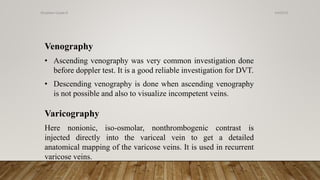
Venography
• Ascending venography was very common investigation done
before doppler test. It is a good reliable investigation for DVT.
• Descending venography is done when ascending venography
is not possible and also to visualize incompetent veins.
Varicography
Here nonionic, iso-osmolar, nonthrombogenic contrast is
injected directly into the variceal vein to get a detailed
anatomical mapping of the varicose veins. It is used in recurrent

varicose veins.
4/4/2019Shubham Gupta ©
TREATMENT OF
VARICOSE VEINS
4/4/2019Shubham Gupta ©
Treatment Modalities:
1.CONSERVATIVE TREATMENT
2.MINIMALLY INVASIVE PROCEDURES
a)NON ENDOTHERMAL,NON TUMESCENT ABLATION.
b)THERMAL and TUMESCENT ABLATION.
3.OPEN SURGERY
a)SAPHENOFEMORAL LIGATION AND GREAT SAPHENOUS STRIPPING
b) SAPHENOPOPLITEAL JUNCTION LIGATION AND SMALL SAPHENOUS STRIPPING
4.ADJUNCTIVE SURGERY
a)PHLEBECTOMY
b)PERFORATOR LIGATION
4/4/2019Shubham Gupta ©
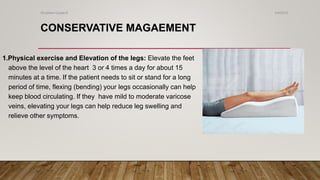
CONSERVATIVE MAGAEMENT
1.Physical exercise and Elevation of the legs: Elevate the feet
above the level of the heart 3 or 4 times a day for about 15
minutes at a time. If the patient needs to sit or stand for a long
period of time, flexing (bending) your legs occasionally can help
keep blood circulating. If they have mild to moderate varicose
veins, elevating your legs can help reduce leg swelling and
relieve other symptoms.
4/4/2019Shubham Gupta ©
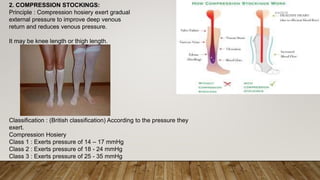
2. COMPRESSION STOCKINGS:
Principle : Compression hosiery exert gradual
external pressure to improve deep venous
return and reduces venous pressure.
It may be knee length or thigh length.
Classification : (British classification) According to the pressure they
exert.
Compression Hosiery
Class 1 : Exerts pressure of 14 – 17 mmHg
Class 2 : Exerts pressure of 18 - 24 mmHg
Class 3 : Exerts pressure of 25 - 35 mmHg
4/4/2019Shubham Gupta ©
3. DRUG THERAPY :
• Calcium dobesilate ( 500 mg BD) It improves lymph flow macrophage mediated
proteolysis and reduces oedema.
• Diosmin (450 mg BD)
• Toxerutin ( 500 mg BD)
• Benzopyrones
4/4/2019Shubham Gupta ©
MINIMALLY INVASIVE PROCEDURES :
A) Non Endothermal,Non tumescent ablation
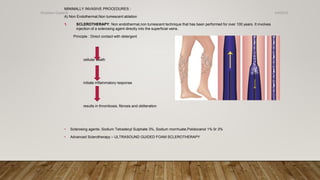
1. SCLEROTHERAPY: Non endothermal,non tumescent technique that has been performed for over 100 years. It involves
injection of a sclerosing agent directly into the superficial veins.
Principle : Direct contact with detergent
cellular death
initiate inflammatory response
results in thrombosis, fibrosis and obliteration
• Sclerosing agents :Sodium Tetradecyl Sulphate 3%, Sodium morrhuate,Polidocanol 1% 0r 3%
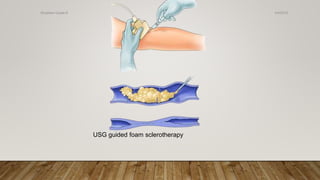
• Advanced Sclerotherapy – ULTRASOUND GUIDED FOAM SCLEROTHERAPY
4/4/2019Shubham Gupta ©
USG guided foam sclerotherapy
4/4/2019Shubham Gupta ©
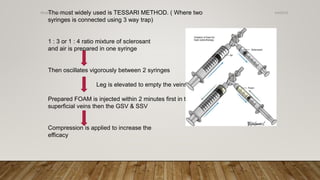
The most widely used is TESSARI METHOD. ( Where two
syringes is connected using 3 way trap)
1 : 3 or 1 : 4 ratio mixture of sclerosant
and air is prepared in one syringe
Then oscillates vigorously between 2 syringes
Leg is elevated to empty the veins
Prepared FOAM is injected within 2 minutes first in the
superficial veins then the GSV & SSV
Compression is applied to increase the
efficacy
4/4/2019Shubham Gupta ©
Advantages of UGFS :
• It doesn’t required tumescent anaesthetics.
• Treatment of calf veins with overlying skin damage or ulcer without piercing the damage part.
• Low cost.
• Easily applicable in axial or superficial veins.
Disadvantages of UGFS : -
• It can cause phlebitis
• Pigmentation can be high
4/4/2019Shubham Gupta ©
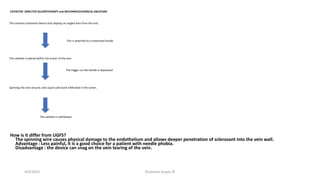
CATHETER- DIRECTED SCLEROTHERAPY and MECHANICOCHEMICAL ABLATION:
This involves treatment device that deploys an angled wire from the end.
This is attached to a motorized handle
The catheter is placed within the lumen of the vein.
The trigger on the handle is depressed
Spinning the wire around, and Liquid sclerosant infiltrated in the lumen.
The catheter is withdrawn
How is it differ from UGFS?
The spinning wire causes physical damage to the endothelium and allows deeper penetration of sclerosant into the vein wall.
Advantage : Less painful, it is a good choice for a patient with needle phobia.
Disadvantage : the device can snag on the vein tearing of the vein.
4/4/2019 Shubham Gupta ©
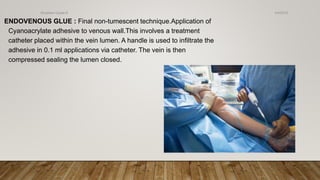
ENDOVENOUS GLUE : Final non-tumescent technique.Application of
Cyanoacrylate adhesive to venous wall.This involves a treatment
catheter placed within the vein lumen. A handle is used to infiltrate the
adhesive in 0.1 ml applications via catheter. The vein is then
compressed sealing the lumen closed.
4/4/2019Shubham Gupta ©
B) THERMAL , TUMESCENT ABLATION :
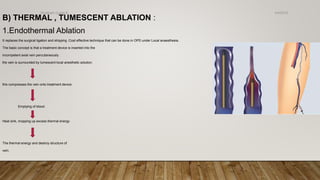
1.Endothermal Ablation
It replaces the surgical ligation and stripping .Cost effective technique that can be done in OPD under Local anaesthesia.
The basic concept is that a treatment device is inserted into the
incompetent axial vein percutaneously .
the vein is surrounded by tumescent local anesthetic solution.
this compresses the vein onto treatment device
Emptying of blood
Heat sink, mopping up excess thermal energy
The thermal energy and destroy structure of
vein.
4/4/2019Shubham Gupta ©
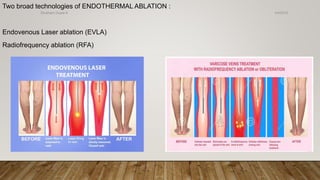
Two broad technologies of ENDOTHERMAL ABLATION :
Endovenous Laser ablation (EVLA)
Radiofrequency ablation (RFA)
4/4/2019Shubham Gupta ©
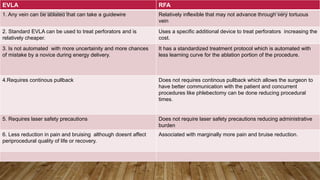
EVLA RFA
1. Any vein can be ablated that can take a guidewire Relatively inflexible that may not advance through very tortuous
vein
2. Standard EVLA can be used to treat perforators and is
relatively cheaper.
Uses a specific additional device to treat perforators increasing the
cost.
3. Is not automated with more uncertainity and more chances
of mistake by a novice during energy delivery.
It has a standardized treatment protocol which is automated with
less learning curve for the ablation portion of the procedure.
4.Requires continous pullback Does not requires continous pullback which allows the surgeon to
have better communication with the patient and concurrent
procedures like phlebectomy can be done reducing procedural
times.
5. Requires laser safety precautions Does not require laser safety precautions reducing administrative
burden
6. Less reduction in pain and bruising although doesnt affect
periprocedural quality of life or recovery.
Associated with marginally more pain and bruise reduction.
4/4/2019Shubham Gupta ©
OPEN SURGERY :
TYPES
• SAPHENOFEMORAL LIGATION and GREAT SAPHENOUS STRIPPING
• SAPHENOPOPLITEAL JUCTION LIGATION and SHORT SAPHENOUS STRIPPING
• ADJUNCTIVE SURGICAL TECHNIQUE
Indications :
• GSV or LSV INCOMPETENCY.
• PERFORATING VEIN INCOMPETENCY
Contraindications :
• DEEP VEIN THROMBOSIS
• PREGNANCY
• THROMBOPHLEBITIS
• PERIPHERAL VASCULAR DISEASE
4/4/2019Shubham Gupta ©
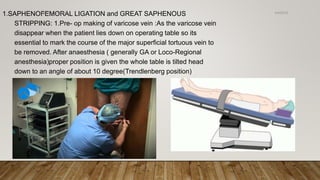
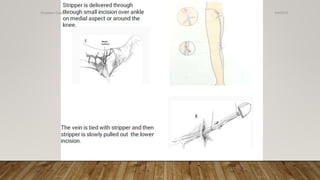
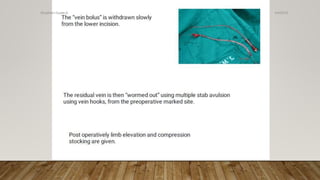
1.SAPHENOFEMORAL LIGATION and GREAT SAPHENOUS
STRIPPING: 1.Pre- op making of varicose vein :As the varicose vein
disappear when the patient lies down on operating table so its
essential to mark the course of the major superficial tortuous vein to
be removed. After anaesthesia ( generally GA or Loco-Regional
anesthesia)proper position is given the whole table is tilted head
down to an angle of about 10 degree(Trendlenberg position)
4/4/2019Shubham Gupta ©
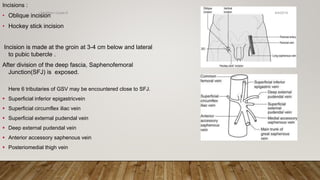
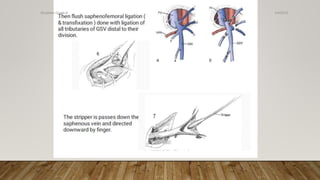
Incisions :
• Oblique incision
• Hockey stick incision
Incision is made at the groin at 3-4 cm below and lateral
to pubic tubercle .
After division of the deep fascia, Saphenofemoral
Junction(SFJ) is exposed.
Here 6 tributaries of GSV may be encountered close to SFJ.
 Superficial inferior epigastricvein
 Superficial circumflex iliac vein
 Superficial external pudendal vein
 Deep external pudendal vein
 Anterior accessory saphenous vein
 Posteriomedial thigh vein
4/4/2019Shubham Gupta ©
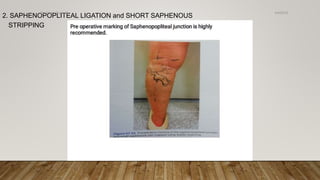
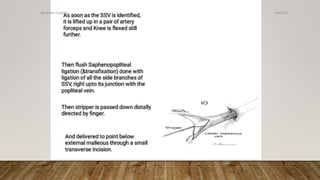
2. SAPHENOPOPLITEAL LIGATION and SHORT SAPHENOUS
STRIPPING
4/4/2019Shubham Gupta ©
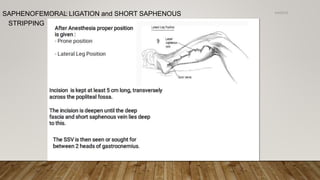
SAPHENOFEMORAL LIGATION and SHORT SAPHENOUS
STRIPPING
4/4/2019Shubham Gupta ©
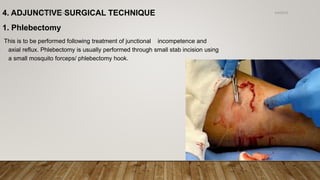
4. ADJUNCTIVE SURGICAL TECHNIQUE
1. Phlebectomy
This is to be performed following treatment of junctional incompetence and
axial reflux. Phlebectomy is usually performed through small stab incision using
a small mosquito forceps/ phlebectomy hook.
4/4/2019Shubham Gupta ©
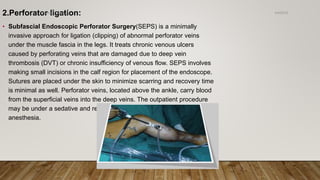
2.Perforator ligation:
• Subfascial Endoscopic Perforator Surgery(SEPS) is a minimally
invasive approach for ligation (clipping) of abnormal perforator veins
under the muscle fascia in the legs. It treats chronic venous ulcers
caused by perforating veins that are damaged due to deep vein
thrombosis (DVT) or chronic insufficiency of venous flow. SEPS involves
making small incisions in the calf region for placement of the endoscope.
Sutures are placed under the skin to minimize scarring and recovery time
is minimal as well. Perforator veins, located above the ankle, carry blood
from the superficial veins into the deep veins. The outpatient procedure
may be under a sedative and regional anesthesia or under general
anesthesia.
4/4/2019Shubham Gupta ©
COMPLICATIONS OF VARICOSE VEIN SURGERIES/
INTERVENTIONS:
• Infection
• Haematoma
• Nerve Injury
1. Saphenous Nerve injury 1-7%
2. Sural Nerve injury 20%
3. Common Peroneal Nerve injury 4%
• Recurrence 20-30%
• Deep Vein Thrombosis < 0.5%
4/4/2019Shubham Gupta ©
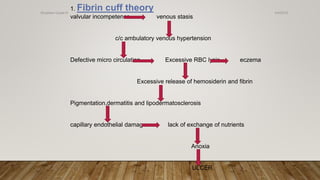
1. Fibrin cuff theory
valvular incompetence venous stasis
c/c ambulatory venous hypertension
Defective micro circulation Excessive RBC lysis eczema
Excessive release of hemosiderin and fibrin
Pigmentation,dermatitis and lipodermatosclerosis
capillary endothelial damage lack of exchange of nutrients
Anoxia
ULCER
4/4/2019Shubham Gupta ©
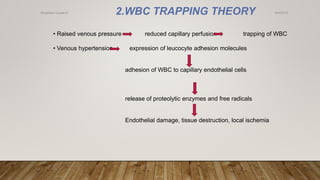
2.WBC TRAPPING THEORY
• Raised venous pressure reduced capillary perfusion trapping of WBC
• Venous hypertension expression of leucocyte adhesion molecules
adhesion of WBC to capillary endothelial cells
release of proteolytic enzymes and free radicals
Endothelial damage, tissue destruction, local ischemia
4/4/2019Shubham Gupta ©
COMPLICATIONS OF VARICOSE VEIN
HAEMORRHAGE: Venous haemorrhage can occour from the ruptured
varicose vein or sloughed varicose veins, often torrential, but can be controlled
very well by elevation and pressure damage.
4/4/2019Shubham Gupta ©
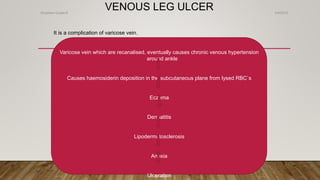
VENOUS LEG ULCER
It is a complication of varicose vein.
Varicose vein which are recanalised, eventually causes chronic venous hypertension
around ankle
Causes haemosiderin deposition in the subcutaneous plane from lysed RBC`s
Eczema
Dermatitis
Lipodermatosclerosis
Anoxia
Ulceration
4/4/2019Shubham Gupta ©
INVESTIGATIONS
Discharge from ulcers for culture and sensitivity.
X-ray of the area to look for periostitis
Wedged biopsy from the ulcer edge to rule out
Marijolin’s ulcer
Investigations to rule out other causes of leg ulcer
like arterial; neurological; diabetes; sickle cell
disease and other haemolytic diseases.
Erythrocyte sedementation rate; C-reactive
protein, peripheral smear; red cell count.
Doppler-venous and often arterial.
4/4/2019Shubham Gupta ©
TREATMENT
Bisgaard method of treating venous ulcer;
Measures to reduce oedema, increase venous
drainage, so as to promote ulcer healing.
Elevation
Massage of the indurated area and whole calf.
Passive and active exercise.
4/4/2019Shubham Gupta ©
Care of ulcer by regular cleaning with
povidone iodine, H2O2 . Decreasing with
EUSOL.
Four layer badage technique to achieve high
compression pressure . It is changed once a
week.
Antibiotics depending on culture and sensitivity
of the discharge.
Once ulcer bed granulates well, split skin graft
(SSG) is placed , or pinch graft.
Specific treatment of varicose vein should be
undertaken – trendelenburg operation, stripping
of veins, perforator ligation.
4/4/2019Shubham Gupta ©
DEEP VEIN THROMBOSIS
Deep venous thrombosis per se is due to varicose vein is rare but can occur if
there is associated deep vein disease or recurrent thrombophlebitis.
Deep vein thrombosis is also called as phlebothrombosis.
It is a semisolid clot in the vein which has got high tendency to develop
pulmonary embolism and sudden death.
The common site of beginning of thrombus is soleal vein which later propagate
proximally often dettached to cause acute pulmonary embolism.
4/4/2019Shubham Gupta ©
MODIFIED PERTHES’ TEST
This test is primarily intended to know whether
the deep veins are normal or not.
The test is positive when the superficial veins
become further dilated and tortuous ,and the
patient complains of severe bursting pain in the
leg. This suggest an occluded deep venous
system due to previous deep venous thrombisis.
4/4/2019Shubham Gupta ©
1) VENOUS DOPPLER WITH DUPLEX SCANNING: It shows non
compressible vein which is wider than normal. On compression over the calf muscle it
doesnot show ant augmentation of flow. Normal venous sound at the area of femoral
vein disappears during inspiration and is absent in deep vein thrombosis.
2) VENOGRAM
3) RADIOACTIVE I125 FIBRINOGEN STUDY
4) HAEMOGRAM WITH PLATELET COUNT: D-dimer test or analysis of fibrin degraded
products.
5) VENTILATION PERFUSION SCANNING.
INVESTIGATIONS
4/4/2019Shubham Gupta ©
TREATMENT
1)Rest, elevation of limb, bandaging the entire limb with
crepe bandage.
2)Anticoagulants : Heparin or low molecular weight
heparin, warfarin, phenindione.
4/4/2019Shubham Gupta ©
3)For fixed thrombus :
 Initial dose of heparin of 25000 units per day for 7 days is given. Then later the patient is advised
to continue warfarin for 3-6 months. Dose is controlled by assessing Activated partial
thromboplastin time (APTT).
 Low molecular weight heparin is preferred to heparin
 Warfarin should be started as early as possible- day one and day two- 10mg each day , day three-
5mg . On day three prothrombin time is done.duration of treatment is for 3-6 months with regular
monitoring.
4)For free thrombus-
 Fibrinolysins- Streptokinase 6 lakhs to start with and later 1 lakh hourly. It is administered through
a Venous cathether.
 Venous thrombectomy is done using Fogarty venous catheter.
4/4/2019Shubham Gupta ©
ETIOLOGY OF DEEP VEIN THROMBOSIS
• Virchow`s triad :
1. Contact of blood with an abnormal surface (eg. Endothelial damage )
2. Abnormal blood flow (stasis of blood)
3. Abnormal blood (eg. Thrombophilia)
4/4/2019Shubham Gupta ©
PIGMENTATION(HAEMOSIDEROSI
S),ECZEMA, DERMATITIS.
Varicose vein which are recanalised, eventually causes chronic
venous hypertension around ankle
Causes haemosiderin deposition in the subcutaneous plane from lysed RBC`s
Eczema
Dermatitis
4/4/2019Shubham Gupta ©
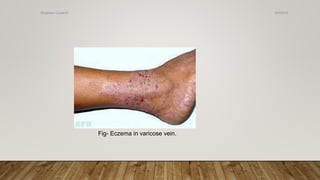
Fig- Eczema in varicose vein.
4/4/2019Shubham Gupta ©
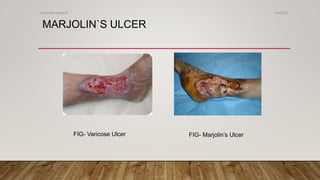
MARJOLIN`S ULCER
FIG- Varicose Ulcer FIG- Marjolin’s Ulcer
4/4/2019Shubham Gupta ©
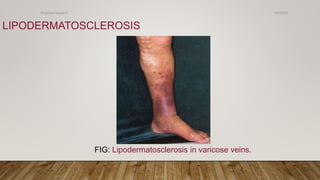
LIPODERMATOSCLEROSIS
FIG: Lipodermatosclerosis in varicose veins.
4/4/2019Shubham Gupta ©
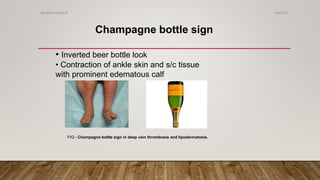
Champagne bottle sign
• Inverted beer bottle look
• Contraction of ankle skin and s/c tissue
with prominent edematous calf
FIG:- Champagne bottle sign in deep vein thrombosis and lipodermatosis.
4/4/2019Shubham Gupta ©
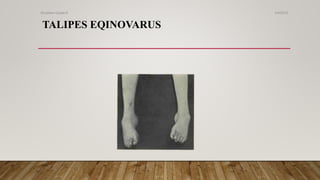
TALIPES EQINOVARUS
4/4/2019Shubham Gupta ©
REFERENCES
• Bailey&Love Short Practise of Surgery 27/e
• Gray’s Anatomy for Students
• A Manual on Clinical Surgery by S.Das 11/e
• SRB’s Manual of Surgery
4/4/2019Shubham Gupta ©
THANK YOU!
4/4/2019Shubham Gupta ©

Varicose veins

  • 1.
    VARICOSE VEINS A SEMINARPRESENTATION TEZPUR MEDICAL COLLEGE AND HOSPITAL 4/4/2019Shubham Gupta ©
  • 2.
    DEFINITION • Dilated, swollenleg veins with back flow of blood caused by incompetent valve closure, which results in venous congestion and vein enlargement • Usually affects the saphenous vein and its branches 4/4/2019Shubham Gupta ©
  • 3.
    ANATOMY OF THEVESSELS 4/4/2019Shubham Gupta ©
  • 4.
  • 5.
    VENOUS DISEASE SUPERFICIAL SYSTEM •Varicose Veins • Spider Veins • Venous Malformation (birth marks and others) • Venous Reflux • Leg Swelling • Venous Ulceration 4/4/2019Shubham Gupta ©
  • 6.
    VENOUS ANATOMY OFLOWER LIMBS The venous drainage system of the lower extremity consists of three sets of veins: • Deep veins • Superficial veins • Perforating veins All veins contain delicate one-way valves thatnormally open to allow blood to flow toward the heartand prevent blood from flowing in a retrogradefashion after the valves close . 4/4/2019Shubham Gupta ©
  • 7.
    DEEP VEINS • Thisveins lie in deep fascial plane and are supported by powerful muscles of leg. • These are 1: Anterior and posterior Tibial veins 2: Peroneal vein 3: Popliteal vein 4: Femoral vein These veins accompany with Arteries. 4/4/2019Shubham Gupta ©
  • 8.
    LONG SAPHENOUS VEIN(LSV) 4/4/2019Shubham Gupta ©
  • 9.
    TRIBUTARIES OF LSVAND COMMUNICATION • Just below knee LSV receive posterior arch vein(Leonardo's vein) which collect the blood from postmedial aspect of calf . • Anterior veins of leg(stocking vein) ascend acrossthe shin and join either LSV or posterior arch vein . • In the thigh before entering in the saphenous opening itrecieves 1. Anterolateral vein 2. Posteromedial vein of thigh 3. Superficial external pudendal vein 4. Superficial epigastric vein 5. Superficial circumflex iliac vein 6. Deep External Pudendal Veinv 4/4/2019Shubham Gupta ©
  • 10.
  • 11.
  • 12.
    PERFORATING VEINS • Theseare communicating veins b/w superficial and deep veins • Two type: 1 Indirect veins-These consist of small superficial veins which penetrate the deep fascia to connect with vessel in muscle and in turn end in Deep vein. 2 Direct veins-These directly connect superficial veins with deep veins 4/4/2019Shubham Gupta ©
  • 13.
    DIRECT PERFORATORS • Uppermedial perforator lies at the junction of middle and lower third of leg. • Middle medial perforator lies 4Inch above the medial malleolus . • Lower medial perforator lies posterio-inferior to the medial malleolus . 4/4/2019Shubham Gupta ©
  • 14.
  • 15.
    CLASSIFICATION OF VARICOSEVEINS Anatomical- Long Saphenous System Short Saphenous System Perforator Incompetence Size Of Varices- ThreadVeins Reticular Veins1- 4mm Varicosities >4mm CEAP Classification- Clinical Etiological Anatomical Pathophysiological 4/4/2019Shubham Gupta ©
  • 16.
    CLASSIFICATION-CEAP • C. (Clinicalclass): - Class 0: No visible or palpable signs of venous disease. - Class I : Telangiectasis or reticular veins. - Class 2: Varicose veins. - Class 3: Edema. - Class 4: Skin changes e.g. venous eczema, pigmentation and lipodermatosclerosis. - Class 5: Skin changes with healed ulceration - Class 6: Skin changes with active ulceration 4/4/2019Shubham Gupta ©
  • 17.
    E. (Etiology): • Congenital. •Primary (undetermined cause). • Secondary:- Post-thrombotic - Post-traumatic A. (Anatomic distribution of veins): • Superficial. • Perforator. • Deep. P. (Pathophysiologicmechanism): • Reflux. • Obstruction. • Reflux and obstruction. 4/4/2019Shubham Gupta ©
  • 18.
  • 19.
    AETIOLOGY PRIMARY VARICOSE VEINS •Defect in Saphenofemoral valve • Defect in Saphenopopliteal valve • Defect in Valve of Perforators 4/4/2019Shubham Gupta ©
  • 20.
    SECONDARY VARICOSE VEINS •Anything that increases intra-abdominal presure • Anything that raises pressure in superficial or deep veins • Pregnancy • Obesity • Abdominal or pelvic mass • Old age • Long standing • Thrombosis of leg veins 4/4/2019Shubham Gupta ©
  • 21.
    CONGENITAL CAUSES • Arteriovenousfistulas 4/4/2019Shubham Gupta ©
  • 22.
    RISK FACTORS The followingrisk factors are linked to a higher risk of having varicose veins: Gender: Varicose veins affect women more often than males. It may be that female hormones relax veins. If so, taking birth control pills or hormone therapy (HT) might contribute. Genetics: Varicose veins often run in families. Obesity: Being overweight or obese increases the risk of varicose veins. 4/4/2019Shubham Gupta ©
  • 23.
    CONTD…. • Age: Therisk increases with age, due to wear and tear on vein valves. • Some jobs: An individual who has to spend a long time standing at work may have a higher chance of varicose veins. 4/4/2019Shubham Gupta ©
  • 24.
    PATHOPHYSIOLOGY • The veinshave one-way valves so that the blood can travel in only one direction. • If the walls of the vein become stretched and less flexible (elastic), the valves may get weaker. 4/4/2019Shubham Gupta ©
  • 25.
    CONTD….. • A weakenedvalve can allow blood to leak backward and eventually flow in the opposite direction. • When this occurs, blood can accumulate in the vein(s), which then become enlarged and swollen. 4/4/2019Shubham Gupta ©
  • 26.
  • 27.
  • 28.
  • 29.
    CLINICAL PICTURE • Thoroughhistory taking: - Occupation and prolonged standing - Throbophlebitis or DVT - Coaguation disorders - Diabetes - Results of previous treatment - Pregnancy and contraceptive pills 4/4/2019Shubham Gupta ©
  • 30.
    - Pain: aching,throbbing, tingling - Cramps, heaviness, tiredness of legs, restless legs at night - Of complications: Itching, hyperpigmentation, skin ulceration and bleeding - Leg disfigurement Symptoms: 4/4/2019Shubham Gupta ©
  • 31.
  • 32.
    1. Varicose veins: Which vein has been varicosed - long saphenous or short saphenous or both. 2. Swelling : It may be (a) localized or (b) generalized. 3. Skin of the limb : colour and texture. 4. Morrissey’s test: Whether there is any impulse on coughing at the saphenous opening (saphena- varix). A. INSPECTION 4/4/2019Shubham Gupta ©
  • 33.
    1. Brodie-Trendelenburg test: • This test is done to determine the incompetency of the sapheno-femoral valve and other communicating system • This test can be performed in two ways . In both the methods, the patient is first placed in the recumbent position and his legs are raised to empty the veins.. This may be hastened by milking the veins proximally. • The sapheno-femoral junction is now compressed with the thumb of the clinician or a tourniquet is applied just below the sapheno-femoral junction and the patient asked to stand up quickly. (a) In the first method, the pressure is released. If the varices fill quickly with a column of blood from above, it indicates incompetency of the sapheno-femoral valve. This is called positive Trendelenburg test. B. PALAPATION 4/4/2019Shubham Gupta ©
  • 34.
    (b) To testthe communicating system, the pressure is not released but maintained for about 1 minute. Gradual filling of the veins during the period indicates incompetency of the communicating veins. 4/4/2019Shubham Gupta ©
  • 35.
    2. Tourniquet test: •It can be called a variant of Trendelenburg test. In this test the tourniquet is tied round thigh or the leg at different levels after the superficial veins have been made empty by raising the leg in recumbent position. • The patient is now asked to stand up. If the veins above the tourniquet fill up and those below it remain collapsed, it indicates presence of incompetent communicating vein above the tourniquet. • Similarly if the veins below the tourniquet fill rapidly whereas veins above it remain empty, the incompetent communicating vein must be below the tourniquet. 4/4/2019Shubham Gupta ©
  • 36.
    3. Perthes’ test: •The affected lower extremity is wrapped with elastic bandage. • With the elastic bandage on, the patient is instructed to move round and exercise. • Severe crampy pain is complained of if there is deep vein thrombosis. 4. Perthes’ test (modified): • This test is primarily intended to know whether the deep veins are normal or not. • A tourniquet is tied round the upper part of the thigh tight enough to prevent any reflux down the vein. • The patient is asked to walk quickly with tourniquet in place. • If the communicating and deep veins are normal the varicose veins will shrink whereas if they are blocked the varicose vein will be more distended. 4/4/2019Shubham Gupta ©
  • 37.
    Fig : Perthes’test Fig : Schwartz test 4/4/2019Shubham Gupta ©
  • 38.
    5. Schwartz test: Ina long standing case if a tap is made on the long saphenous varicose vein in lower part of the leg an impulse can be felt at the saphenous opening with the other hand. 6. Pratt’s test: • This test is performed to know the position of the perforators. • Firstly an Esmarch elastic bandage is applied from toes to groin. • A tourniquet is then applied at the groin. This causes emptying of the varicose veins. • The tourniquet is kept in position and the elastic bandage is taken off. • The same elastic bandage is now applied from groin downwards. At the positions of the perforators ‘blow outs’ or visible varices can be seen . 4/4/2019Shubham Gupta ©

  • 39.
    7. Morrissey’s Coughimpulse test: • The limb is elevated to empty the varicose veins. The limb is then put to bed and the patient is asked to cough focibly. • An expansile impulse is felt in the long saphenous vein particularly at the saphenous opening if the sapheno-femoral valve is incompetent. C. PERCUSSION : if the prominent parts of the varicose veins are tapped, an impulse can be felt by the finger at the saphenous opening. D. AUSCULTATION : the importance of auscultation is limited to the arteriovenous fistula, where a continuous machinery murmur may be heard. 4/4/2019Shubham Gupta ©
  • 40.
  • 41.
    Venous Doppler • Withthe patient standing, the Doppler probe is placed at saphenofemoral junction and later wherever required. • Basically by hearing the changes in sound ; venous flow, venous patency, venous reflux can be identified. • Doppler test : when a hand held Doppler is kept at saphenofemoral junction, typical audible ‘whoose signal’ >0.5 sec while performing Valsalva manoeuvre is the sign of reflux at SFJ. It is also used at saphenopopliteal junction and at perforators. 4/4/2019Shubham Gupta ©
  • 42.
    Duplex scan • Itis a highly reliable ultrasound imaging technique which along with direct visualization of veins, gives the functional and anatomical information. • Here high resolution B mode ultrasound imaging and Doppler ultrasound is used. • Examination is done in standing, lying down positon, and also with Valsalva manoeurvre. • In order to standardize measurements of venous diameter and reflux, it recommended that examination of superficial veins is performed with the patient standing. • Hand held Doppler probe is placed over the site and visualized for any block and reversal of flow. 4/4/2019Shubham Gupta ©
  • 43.
    • Deep veinthrombosis is very well-identified by this method. • Reflux is defined as retrograde blood flow in the reverse direction to physiological flow lasting for 0.5 sec or more. • The aim of the duplex scan is to establish : i. The presence of reflux in the deep and superficial venous system. ii. The exact distribution and extent of reflux in the superficial venous system including affected junctions and perforators. iii. The presence of obstruction in the deep venous system. iv. The suitability of the incompetent superficial veins for the different treatment available. 4/4/2019Shubham Gupta ©
  • 44.
    • Digitally codedfree flow (B flow) USG : it allows simultaneous visualization of flowing blood/ blood cells and surrounding stationary structures to give proper hemodynamic imaging. v. The presence of thrombus within the superficial veins. vi. An indication of a pelvic source of reflux or obstruction. 4/4/2019Shubham Gupta ©
  • 45.
    Plethysmography • It isa non invasive method which measures volume changes in the leg. • It gives functional information on venous volume changes and calf muscle pump insufficiency. • Photophlethysmography : using probe transmission of light through skin, venous filling of the surface venules which reflects the superficial venous pressure is measured. Initially patient performs dorsiflexion at ankle for 10 times to empty venules and pressure tracing falls in photophlethysmography. Patient takes rest and refilling occurs. In venous incompetence filling also occur by venous reflux and so refilling time is faster than normal. 4/4/2019Shubham Gupta ©
  • 46.
    • Air plethysmography: patient is initially in supine position with veins emptied by elevation of leg. Air filled plastic pressure bladder is placed on calf to detect volume changes and minimum volume is recorded. Patient is turned to upright position and venous volume is assessed. Maximum venous volume divided by time required to achieve maximum venous volume gives the venous filling index (VFI). VFI is a measure of reflux. Ejection fraction is volume change measured prior and after single toetip manoeurvre which is a measure of calf pump action. Increased VFI and diminished ejection fraction in a patient will benefit from surgery. 4/4/2019Shubham Gupta ©
  • 47.
    Ambulatory venous pressure(AVP) : • It is an invasive method. Needle inserted into dorsal vein of foot and is connected to transducer to get its pressure which is equivalent to deep veins of the calf. • Ten tiptoe manoeuvres are done by the patient. With initial rise in pressure, pressure decreases and eventually stabilizes with a balance. Pressure now is called as ambulatory venous pressure. • Raise in AVP signifies venous hypertension. Patients with AVP more than 80 mmHg has got 80% chance of venous ulcer formation. 4/4/2019Shubham Gupta ©
  • 48.
    Venography • Ascending venographywas very common investigation done before doppler test. It is a good reliable investigation for DVT. • Descending venography is done when ascending venography is not possible and also to visualize incompetent veins. Varicography Here nonionic, iso-osmolar, nonthrombogenic contrast is injected directly into the variceal vein to get a detailed anatomical mapping of the varicose veins. It is used in recurrent varicose veins. 4/4/2019Shubham Gupta ©
  • 49.
  • 50.
  • 51.
  • 52.
    Treatment Modalities: 1.CONSERVATIVE TREATMENT 2.MINIMALLYINVASIVE PROCEDURES a)NON ENDOTHERMAL,NON TUMESCENT ABLATION. b)THERMAL and TUMESCENT ABLATION. 3.OPEN SURGERY a)SAPHENOFEMORAL LIGATION AND GREAT SAPHENOUS STRIPPING b) SAPHENOPOPLITEAL JUNCTION LIGATION AND SMALL SAPHENOUS STRIPPING 4.ADJUNCTIVE SURGERY a)PHLEBECTOMY b)PERFORATOR LIGATION 4/4/2019Shubham Gupta ©
  • 53.
    CONSERVATIVE MAGAEMENT 1.Physical exerciseand Elevation of the legs: Elevate the feet above the level of the heart 3 or 4 times a day for about 15 minutes at a time. If the patient needs to sit or stand for a long period of time, flexing (bending) your legs occasionally can help keep blood circulating. If they have mild to moderate varicose veins, elevating your legs can help reduce leg swelling and relieve other symptoms. 4/4/2019Shubham Gupta ©
  • 54.
    2. COMPRESSION STOCKINGS: Principle: Compression hosiery exert gradual external pressure to improve deep venous return and reduces venous pressure. It may be knee length or thigh length. Classification : (British classification) According to the pressure they exert. Compression Hosiery Class 1 : Exerts pressure of 14 – 17 mmHg Class 2 : Exerts pressure of 18 - 24 mmHg Class 3 : Exerts pressure of 25 - 35 mmHg 4/4/2019Shubham Gupta ©
  • 55.
    3. DRUG THERAPY: • Calcium dobesilate ( 500 mg BD) It improves lymph flow macrophage mediated proteolysis and reduces oedema. • Diosmin (450 mg BD) • Toxerutin ( 500 mg BD) • Benzopyrones 4/4/2019Shubham Gupta ©
  • 56.
    MINIMALLY INVASIVE PROCEDURES: A) Non Endothermal,Non tumescent ablation 1. SCLEROTHERAPY: Non endothermal,non tumescent technique that has been performed for over 100 years. It involves injection of a sclerosing agent directly into the superficial veins. Principle : Direct contact with detergent cellular death initiate inflammatory response results in thrombosis, fibrosis and obliteration • Sclerosing agents :Sodium Tetradecyl Sulphate 3%, Sodium morrhuate,Polidocanol 1% 0r 3% • Advanced Sclerotherapy – ULTRASOUND GUIDED FOAM SCLEROTHERAPY 4/4/2019Shubham Gupta ©
  • 57.
    USG guided foamsclerotherapy 4/4/2019Shubham Gupta ©
  • 58.
    The most widelyused is TESSARI METHOD. ( Where two syringes is connected using 3 way trap) 1 : 3 or 1 : 4 ratio mixture of sclerosant and air is prepared in one syringe Then oscillates vigorously between 2 syringes Leg is elevated to empty the veins Prepared FOAM is injected within 2 minutes first in the superficial veins then the GSV & SSV Compression is applied to increase the efficacy 4/4/2019Shubham Gupta ©
  • 59.
    Advantages of UGFS: • It doesn’t required tumescent anaesthetics. • Treatment of calf veins with overlying skin damage or ulcer without piercing the damage part. • Low cost. • Easily applicable in axial or superficial veins. Disadvantages of UGFS : - • It can cause phlebitis • Pigmentation can be high 4/4/2019Shubham Gupta ©
  • 60.
    CATHETER- DIRECTED SCLEROTHERAPYand MECHANICOCHEMICAL ABLATION: This involves treatment device that deploys an angled wire from the end. This is attached to a motorized handle The catheter is placed within the lumen of the vein. The trigger on the handle is depressed Spinning the wire around, and Liquid sclerosant infiltrated in the lumen. The catheter is withdrawn How is it differ from UGFS? The spinning wire causes physical damage to the endothelium and allows deeper penetration of sclerosant into the vein wall. Advantage : Less painful, it is a good choice for a patient with needle phobia. Disadvantage : the device can snag on the vein tearing of the vein. 4/4/2019 Shubham Gupta ©
  • 61.
    ENDOVENOUS GLUE :Final non-tumescent technique.Application of Cyanoacrylate adhesive to venous wall.This involves a treatment catheter placed within the vein lumen. A handle is used to infiltrate the adhesive in 0.1 ml applications via catheter. The vein is then compressed sealing the lumen closed. 4/4/2019Shubham Gupta ©
  • 62.
    B) THERMAL ,TUMESCENT ABLATION : 1.Endothermal Ablation It replaces the surgical ligation and stripping .Cost effective technique that can be done in OPD under Local anaesthesia. The basic concept is that a treatment device is inserted into the incompetent axial vein percutaneously . the vein is surrounded by tumescent local anesthetic solution. this compresses the vein onto treatment device Emptying of blood Heat sink, mopping up excess thermal energy The thermal energy and destroy structure of vein. 4/4/2019Shubham Gupta ©
  • 63.
    Two broad technologiesof ENDOTHERMAL ABLATION : Endovenous Laser ablation (EVLA) Radiofrequency ablation (RFA) 4/4/2019Shubham Gupta ©
  • 64.
    EVLA RFA 1. Anyvein can be ablated that can take a guidewire Relatively inflexible that may not advance through very tortuous vein 2. Standard EVLA can be used to treat perforators and is relatively cheaper. Uses a specific additional device to treat perforators increasing the cost. 3. Is not automated with more uncertainity and more chances of mistake by a novice during energy delivery. It has a standardized treatment protocol which is automated with less learning curve for the ablation portion of the procedure. 4.Requires continous pullback Does not requires continous pullback which allows the surgeon to have better communication with the patient and concurrent procedures like phlebectomy can be done reducing procedural times. 5. Requires laser safety precautions Does not require laser safety precautions reducing administrative burden 6. Less reduction in pain and bruising although doesnt affect periprocedural quality of life or recovery. Associated with marginally more pain and bruise reduction. 4/4/2019Shubham Gupta ©
  • 65.
    OPEN SURGERY : TYPES •SAPHENOFEMORAL LIGATION and GREAT SAPHENOUS STRIPPING • SAPHENOPOPLITEAL JUCTION LIGATION and SHORT SAPHENOUS STRIPPING • ADJUNCTIVE SURGICAL TECHNIQUE Indications : • GSV or LSV INCOMPETENCY. • PERFORATING VEIN INCOMPETENCY Contraindications : • DEEP VEIN THROMBOSIS • PREGNANCY • THROMBOPHLEBITIS • PERIPHERAL VASCULAR DISEASE 4/4/2019Shubham Gupta ©
  • 66.
    1.SAPHENOFEMORAL LIGATION andGREAT SAPHENOUS STRIPPING: 1.Pre- op making of varicose vein :As the varicose vein disappear when the patient lies down on operating table so its essential to mark the course of the major superficial tortuous vein to be removed. After anaesthesia ( generally GA or Loco-Regional anesthesia)proper position is given the whole table is tilted head down to an angle of about 10 degree(Trendlenberg position) 4/4/2019Shubham Gupta ©
  • 67.
    Incisions : • Obliqueincision • Hockey stick incision Incision is made at the groin at 3-4 cm below and lateral to pubic tubercle . After division of the deep fascia, Saphenofemoral Junction(SFJ) is exposed. Here 6 tributaries of GSV may be encountered close to SFJ.  Superficial inferior epigastricvein  Superficial circumflex iliac vein  Superficial external pudendal vein  Deep external pudendal vein  Anterior accessory saphenous vein  Posteriomedial thigh vein 4/4/2019Shubham Gupta ©
  • 68.
  • 69.
  • 70.
  • 71.
    2. SAPHENOPOPLITEAL LIGATIONand SHORT SAPHENOUS STRIPPING 4/4/2019Shubham Gupta ©
  • 72.
    SAPHENOFEMORAL LIGATION andSHORT SAPHENOUS STRIPPING 4/4/2019Shubham Gupta ©
  • 73.
  • 74.
    4. ADJUNCTIVE SURGICALTECHNIQUE 1. Phlebectomy This is to be performed following treatment of junctional incompetence and axial reflux. Phlebectomy is usually performed through small stab incision using a small mosquito forceps/ phlebectomy hook. 4/4/2019Shubham Gupta ©
  • 75.
    2.Perforator ligation: • SubfascialEndoscopic Perforator Surgery(SEPS) is a minimally invasive approach for ligation (clipping) of abnormal perforator veins under the muscle fascia in the legs. It treats chronic venous ulcers caused by perforating veins that are damaged due to deep vein thrombosis (DVT) or chronic insufficiency of venous flow. SEPS involves making small incisions in the calf region for placement of the endoscope. Sutures are placed under the skin to minimize scarring and recovery time is minimal as well. Perforator veins, located above the ankle, carry blood from the superficial veins into the deep veins. The outpatient procedure may be under a sedative and regional anesthesia or under general anesthesia. 4/4/2019Shubham Gupta ©
  • 76.
    COMPLICATIONS OF VARICOSEVEIN SURGERIES/ INTERVENTIONS: • Infection • Haematoma • Nerve Injury 1. Saphenous Nerve injury 1-7% 2. Sural Nerve injury 20% 3. Common Peroneal Nerve injury 4% • Recurrence 20-30% • Deep Vein Thrombosis < 0.5% 4/4/2019Shubham Gupta ©
  • 77.
  • 78.
    1. Fibrin cufftheory valvular incompetence venous stasis c/c ambulatory venous hypertension Defective micro circulation Excessive RBC lysis eczema Excessive release of hemosiderin and fibrin Pigmentation,dermatitis and lipodermatosclerosis capillary endothelial damage lack of exchange of nutrients Anoxia ULCER 4/4/2019Shubham Gupta ©
  • 79.
    2.WBC TRAPPING THEORY •Raised venous pressure reduced capillary perfusion trapping of WBC • Venous hypertension expression of leucocyte adhesion molecules adhesion of WBC to capillary endothelial cells release of proteolytic enzymes and free radicals Endothelial damage, tissue destruction, local ischemia 4/4/2019Shubham Gupta ©
  • 80.
    COMPLICATIONS OF VARICOSEVEIN HAEMORRHAGE: Venous haemorrhage can occour from the ruptured varicose vein or sloughed varicose veins, often torrential, but can be controlled very well by elevation and pressure damage. 4/4/2019Shubham Gupta ©
  • 81.
    VENOUS LEG ULCER Itis a complication of varicose vein. Varicose vein which are recanalised, eventually causes chronic venous hypertension around ankle Causes haemosiderin deposition in the subcutaneous plane from lysed RBC`s Eczema Dermatitis Lipodermatosclerosis Anoxia Ulceration 4/4/2019Shubham Gupta ©
  • 82.
    INVESTIGATIONS Discharge from ulcersfor culture and sensitivity. X-ray of the area to look for periostitis Wedged biopsy from the ulcer edge to rule out Marijolin’s ulcer Investigations to rule out other causes of leg ulcer like arterial; neurological; diabetes; sickle cell disease and other haemolytic diseases. Erythrocyte sedementation rate; C-reactive protein, peripheral smear; red cell count. Doppler-venous and often arterial. 4/4/2019Shubham Gupta ©
  • 83.
    TREATMENT Bisgaard method oftreating venous ulcer; Measures to reduce oedema, increase venous drainage, so as to promote ulcer healing. Elevation Massage of the indurated area and whole calf. Passive and active exercise. 4/4/2019Shubham Gupta ©
  • 84.
    Care of ulcerby regular cleaning with povidone iodine, H2O2 . Decreasing with EUSOL. Four layer badage technique to achieve high compression pressure . It is changed once a week. Antibiotics depending on culture and sensitivity of the discharge. Once ulcer bed granulates well, split skin graft (SSG) is placed , or pinch graft. Specific treatment of varicose vein should be undertaken – trendelenburg operation, stripping of veins, perforator ligation. 4/4/2019Shubham Gupta ©
  • 85.
    DEEP VEIN THROMBOSIS Deepvenous thrombosis per se is due to varicose vein is rare but can occur if there is associated deep vein disease or recurrent thrombophlebitis. Deep vein thrombosis is also called as phlebothrombosis. It is a semisolid clot in the vein which has got high tendency to develop pulmonary embolism and sudden death. The common site of beginning of thrombus is soleal vein which later propagate proximally often dettached to cause acute pulmonary embolism. 4/4/2019Shubham Gupta ©
  • 86.
    MODIFIED PERTHES’ TEST Thistest is primarily intended to know whether the deep veins are normal or not. The test is positive when the superficial veins become further dilated and tortuous ,and the patient complains of severe bursting pain in the leg. This suggest an occluded deep venous system due to previous deep venous thrombisis. 4/4/2019Shubham Gupta ©
  • 87.
    1) VENOUS DOPPLERWITH DUPLEX SCANNING: It shows non compressible vein which is wider than normal. On compression over the calf muscle it doesnot show ant augmentation of flow. Normal venous sound at the area of femoral vein disappears during inspiration and is absent in deep vein thrombosis. 2) VENOGRAM 3) RADIOACTIVE I125 FIBRINOGEN STUDY 4) HAEMOGRAM WITH PLATELET COUNT: D-dimer test or analysis of fibrin degraded products. 5) VENTILATION PERFUSION SCANNING. INVESTIGATIONS 4/4/2019Shubham Gupta ©
  • 88.
    TREATMENT 1)Rest, elevation oflimb, bandaging the entire limb with crepe bandage. 2)Anticoagulants : Heparin or low molecular weight heparin, warfarin, phenindione. 4/4/2019Shubham Gupta ©
  • 89.
    3)For fixed thrombus:  Initial dose of heparin of 25000 units per day for 7 days is given. Then later the patient is advised to continue warfarin for 3-6 months. Dose is controlled by assessing Activated partial thromboplastin time (APTT).  Low molecular weight heparin is preferred to heparin  Warfarin should be started as early as possible- day one and day two- 10mg each day , day three- 5mg . On day three prothrombin time is done.duration of treatment is for 3-6 months with regular monitoring. 4)For free thrombus-  Fibrinolysins- Streptokinase 6 lakhs to start with and later 1 lakh hourly. It is administered through a Venous cathether.  Venous thrombectomy is done using Fogarty venous catheter. 4/4/2019Shubham Gupta ©
  • 90.
    ETIOLOGY OF DEEPVEIN THROMBOSIS • Virchow`s triad : 1. Contact of blood with an abnormal surface (eg. Endothelial damage ) 2. Abnormal blood flow (stasis of blood) 3. Abnormal blood (eg. Thrombophilia) 4/4/2019Shubham Gupta ©
  • 91.
    PIGMENTATION(HAEMOSIDEROSI S),ECZEMA, DERMATITIS. Varicose veinwhich are recanalised, eventually causes chronic venous hypertension around ankle Causes haemosiderin deposition in the subcutaneous plane from lysed RBC`s Eczema Dermatitis 4/4/2019Shubham Gupta ©
  • 92.
    Fig- Eczema invaricose vein. 4/4/2019Shubham Gupta ©
  • 93.
    MARJOLIN`S ULCER FIG- VaricoseUlcer FIG- Marjolin’s Ulcer 4/4/2019Shubham Gupta ©
  • 94.
    LIPODERMATOSCLEROSIS FIG: Lipodermatosclerosis invaricose veins. 4/4/2019Shubham Gupta ©
  • 95.
    Champagne bottle sign •Inverted beer bottle look • Contraction of ankle skin and s/c tissue with prominent edematous calf FIG:- Champagne bottle sign in deep vein thrombosis and lipodermatosis. 4/4/2019Shubham Gupta ©
  • 96.
  • 97.

    REFERENCES • Bailey&Love ShortPractise of Surgery 27/e • Gray’s Anatomy for Students • A Manual on Clinical Surgery by S.Das 11/e • SRB’s Manual of Surgery 4/4/2019Shubham Gupta ©
  • 98.