1
VAPOUR ABSORPTION
MACHINES
BRIEF HISTORY
•-INVENTED BY FRENCH SCIENTIST IN 1890 BY
FERDINAND CARRE
• -1ST
MACHINE WAS SINGLE EFFECT MACHINE
•-JAPAN INTRODUCED 1ST
DOUBLE EFECT
MACHINE
•-INDIA 1ST
MACHINE WAS INSTALLED IN 1970
•-INDIGENEOUSLY MADE 1ST
MACHINE IN INDIA IN
1989 BY THERMAX ENGGINEERING
2
TYPES OF VAM
• 1. STEAM FIRED VAM
• A. SINGLE EFFECT
• B. DOUBLE EFFECT
• 2. DIRECT FIRED VAM
• A. HSD FIRED
• B. LDO FIRED
• C. NG FIRED
• 3. HOT WATER FIRED VAM
3
BASIC TERMS IN
REFRIGERATION
• DEFINITION OF REFRIGERATION
• -REFRIGERATION IS THE PROCESS OF COOLING
BY REMOVAL OF HEAT.
• MECHANICAL REFRIGERATION
• -THIS TYPE OF SYSTEMS WE USE IN COMMON e.g.
DOMESTIC REFRIGERATOR AND ROOM A.C.
• THIS TYPE OF REFRIGERATION CONSISTS OF
FOLLOWINGS:
• 1.EVAPORATOR
• 2.COMPRESSOR
• 3.CONDENSER
• 4.EXPANSION DEVICE
4
VAM Vs.MECHANICAL
REFRIGERATION
• DIFFERENCE FROM MECHANICAL
REFRIGRATION
• ANY VAM DIFFER FROM MECHANICAL
ONE AS IT DOES NOT HAVE ANY
COMPRESSOR AND EXPANSION
DEVICE.
5
SOME MORE DEFINITIONS
• HEAT: HEAT IS THE FORM OF ENERGY.
• HEAT FLOWS DOWNHILL
• SENSIBLE HEAT:HEAT WHICH CAN BE SENSED AND
MAESURED IN FACT THIS IS MOVEMENT OF
MOLECULES WITHIN THE SUBSTANCE & NO
CHANGE OF STATE OCCURS DURING SENSIBLE
HEATING.
• LATENT HEAT:IT IS THE ENERGY OF MOLECULES
SEPARATION ,THIS CANNOT BE MEASURED ON A
THERMOMETER AND CHANGE OF STATE OCCURS .
• ENTHALPY:
• IT IS THE AMOUNT OF TOTAL HEAT i.e. SUM OF
SENSIBLE AND LATENT HEAT.
6
SOME MORE DEFINITIONS
TONNE OF REFRIGERATION= ONE
TONNE ICE AT 320
F WHEN MELTED IN
24 Hrs.
WE WILL BE INSTALLING TWO VAM HOT
FIRED EACH HAVING CAPACITY
210TR.
DRIVING HEAT MEDIA:HOT WATER 74M3
7
HOW DOES THE VAM WORKS
• -BOILING POINT OF WATER IS A FUNCTION
OF PRESSURE.
• -AT ATMOSPHERIC PRESSURE WATER
BOILS AT1000
C,WHEN MAINTAINED AT HIGH
VACUUM, WATER WILL BOIL AT 6MMHg(abs.)
at 3.7o
c only.
• -LiBr HAS TENDENCY TO ABSORB WATER
DUE TO ITS CHEMICAL AFFINITY.AT HIGHER
CONCENTRATION AND LOWER
TEMPERATURE LiBr ABSORBS WATER
VAPOUR(REFRIGENT) VERY EFFECTIVELY.
8
Contd.
• -AS LiBr BECOMES DILUTE IT LOSSES ITS
CAPACITY TO ABSORB WATER VAPOUR. IT
THUS NEEDS TO BE RECONCENTRATED
USING AHEAT SOURCE. HEAT SOURCE MAY
BE STEAM OR HOT WATER.
• -THE HEATING CAUSES THE SOLUTION TO
RELEASE THE ABSORBED REFRIGERANT IN
THE FORM OF VAPOURS. THIS VAPOUR IS
COOLED IN A CHAMBER TO BECOME LIQUID
REFRIGERANT.
9
The Principle of Absorption
Cooling
• The two basic principles on which all air conditioning and
refrigeration plants operate are :
1) When a liquid evaporates, it absorbs heat, and when it
condenses it gives up that heat. This heat is called the
latent heat of evaporation, and latent heat of
condensation respectively.
2) Boiling point of liquid at Pressure.
* i.e Boiling point increases as pressure increases Boiling
point decreases if pressure decreases
* For example, at atmospheric pressure (760 mm of Hg
absolute) water boils at 100 0
C & at 6mm Hg absolute
pressure it boils at 3.7 0
C
10
• The absorption cooling works on the affinity of
some pairs of chemical to dissolve in one
another. For example, Lithium bromide solution
has affinity towards water, water has affinity
towards Ammonia etc.
• This affinity depends on two factors .
Temperature & the concentration of the solution.
(1)Affinity is directly propotional to Concentration
(2)Affinity is inversly proportional to temperature
11
Parts of VAM
1) Evaporator
2) Absorber
3) Regenerator
4) Condenser
Other parts are absorbent pump, refrigerant
pump, purge unit, LTHE, HTHE, HR,
DHE.
12
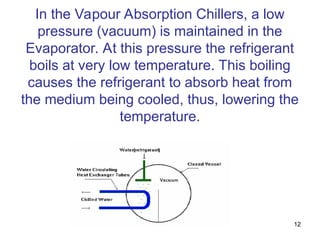
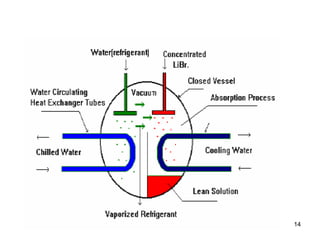
In the Vapour Absorption Chillers, a low
pressure (vacuum) is maintained in the
Evaporator. At this pressure the refrigerant
boils at very low temperature. This boiling
causes the refrigerant to absorb heat from
the medium being cooled, thus, lowering the
temperature.
13
• On absorbing the heat the refrigerant gets
vapourised. The refrigerant vapours thus
formed tend to increase the pressure in
the vessel. This will in turn increase the
boiling temperature and the desired
cooling effect will not be obtained. So, it is
necessary to remove the refrigerant
vapours from the vessel.
14
15
• A liquid having affinity towards the refrigerant
vapour is sprayed in the absorber which absorbs
the vapour and maintains the low pressure in the
shell.
• As the absorbent absorbs the refrigerant vapour,
it becomes dilute & losses its capacity to further
absorb refrigerant vapours.
• To maintain continuous cycle, it is essential that
the absorbent is enriched to its original level of
concentration and the refrigerant vapours are
condensed back to the liquid.
16
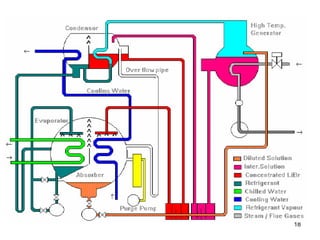
SINGLE EFFECT VAM
17
• This is achieved by pumping the dilute solution
continuously from absorber to the generator. In
the generator the addition of heat boils off the
refrigerant from the absorbent and the absorbent
regains its original level of concentration. The re-
concentrated absorbent returns to the absorber
to resume the absorption process.
• The refrigerant vapour .released. in the
generator flows to the condenser.
• In the condenser cooling water is circulated
through the coils, which picks up the heat carried
by the refrigerant vapour and vapour condenses
back to the liquid phase. The condensed liquid is
returned back to the evaporator thus completing
the absorption cycle.
18
19
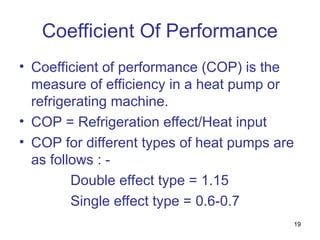
Coefficient Of Performance
• Coefficient of performance (COP) is the
measure of efficiency in a heat pump or
refrigerating machine.
• COP = Refrigeration effect/Heat input
• COP for different types of heat pumps are
as follows : -
Double effect type = 1.15
Single effect type = 0.6-0.7
20
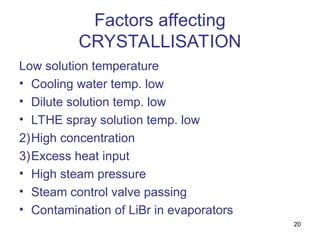
Factors affecting
CRYSTALLISATION
Low solution temperature
• Cooling water temp. low
• Dilute solution temp. low
• LTHE spray solution temp. low
2)High concentration
3)Excess heat input
• High steam pressure
• Steam control valve passing
• Contamination of LiBr in evaporators
21
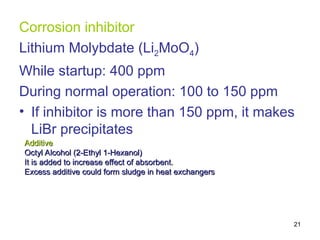
Corrosion inhibitor
Lithium Molybdate (Li2MoO4)
While startup: 400 ppm
During normal operation: 100 to 150 ppm
• If inhibitor is more than 150 ppm, it makes
LiBr precipitates
Additive
Additive
Octyl Alcohol (2-Ethyl 1-Hexanol)
It is added to increase effect of absorbent.
Excess additive could form sludge in heat exchangers

Vapour Absorption Machine General Principle.ppt

  • 1.
    1 VAPOUR ABSORPTION MACHINES BRIEF HISTORY •-INVENTEDBY FRENCH SCIENTIST IN 1890 BY FERDINAND CARRE • -1ST MACHINE WAS SINGLE EFFECT MACHINE •-JAPAN INTRODUCED 1ST DOUBLE EFECT MACHINE •-INDIA 1ST MACHINE WAS INSTALLED IN 1970 •-INDIGENEOUSLY MADE 1ST MACHINE IN INDIA IN 1989 BY THERMAX ENGGINEERING
  • 2.
    2 TYPES OF VAM •1. STEAM FIRED VAM • A. SINGLE EFFECT • B. DOUBLE EFFECT • 2. DIRECT FIRED VAM • A. HSD FIRED • B. LDO FIRED • C. NG FIRED • 3. HOT WATER FIRED VAM
  • 3.
    3 BASIC TERMS IN REFRIGERATION •DEFINITION OF REFRIGERATION • -REFRIGERATION IS THE PROCESS OF COOLING BY REMOVAL OF HEAT. • MECHANICAL REFRIGERATION • -THIS TYPE OF SYSTEMS WE USE IN COMMON e.g. DOMESTIC REFRIGERATOR AND ROOM A.C. • THIS TYPE OF REFRIGERATION CONSISTS OF FOLLOWINGS: • 1.EVAPORATOR • 2.COMPRESSOR • 3.CONDENSER • 4.EXPANSION DEVICE
  • 4.
    4 VAM Vs.MECHANICAL REFRIGERATION • DIFFERENCEFROM MECHANICAL REFRIGRATION • ANY VAM DIFFER FROM MECHANICAL ONE AS IT DOES NOT HAVE ANY COMPRESSOR AND EXPANSION DEVICE.
  • 5.
    5 SOME MORE DEFINITIONS •HEAT: HEAT IS THE FORM OF ENERGY. • HEAT FLOWS DOWNHILL • SENSIBLE HEAT:HEAT WHICH CAN BE SENSED AND MAESURED IN FACT THIS IS MOVEMENT OF MOLECULES WITHIN THE SUBSTANCE & NO CHANGE OF STATE OCCURS DURING SENSIBLE HEATING. • LATENT HEAT:IT IS THE ENERGY OF MOLECULES SEPARATION ,THIS CANNOT BE MEASURED ON A THERMOMETER AND CHANGE OF STATE OCCURS . • ENTHALPY: • IT IS THE AMOUNT OF TOTAL HEAT i.e. SUM OF SENSIBLE AND LATENT HEAT.
  • 6.
    6 SOME MORE DEFINITIONS TONNEOF REFRIGERATION= ONE TONNE ICE AT 320 F WHEN MELTED IN 24 Hrs. WE WILL BE INSTALLING TWO VAM HOT FIRED EACH HAVING CAPACITY 210TR. DRIVING HEAT MEDIA:HOT WATER 74M3
  • 7.
    7 HOW DOES THEVAM WORKS • -BOILING POINT OF WATER IS A FUNCTION OF PRESSURE. • -AT ATMOSPHERIC PRESSURE WATER BOILS AT1000 C,WHEN MAINTAINED AT HIGH VACUUM, WATER WILL BOIL AT 6MMHg(abs.) at 3.7o c only. • -LiBr HAS TENDENCY TO ABSORB WATER DUE TO ITS CHEMICAL AFFINITY.AT HIGHER CONCENTRATION AND LOWER TEMPERATURE LiBr ABSORBS WATER VAPOUR(REFRIGENT) VERY EFFECTIVELY.
  • 8.
    8 Contd. • -AS LiBrBECOMES DILUTE IT LOSSES ITS CAPACITY TO ABSORB WATER VAPOUR. IT THUS NEEDS TO BE RECONCENTRATED USING AHEAT SOURCE. HEAT SOURCE MAY BE STEAM OR HOT WATER. • -THE HEATING CAUSES THE SOLUTION TO RELEASE THE ABSORBED REFRIGERANT IN THE FORM OF VAPOURS. THIS VAPOUR IS COOLED IN A CHAMBER TO BECOME LIQUID REFRIGERANT.
  • 9.
    9 The Principle ofAbsorption Cooling • The two basic principles on which all air conditioning and refrigeration plants operate are : 1) When a liquid evaporates, it absorbs heat, and when it condenses it gives up that heat. This heat is called the latent heat of evaporation, and latent heat of condensation respectively. 2) Boiling point of liquid at Pressure. * i.e Boiling point increases as pressure increases Boiling point decreases if pressure decreases * For example, at atmospheric pressure (760 mm of Hg absolute) water boils at 100 0 C & at 6mm Hg absolute pressure it boils at 3.7 0 C
  • 10.
    10 • The absorptioncooling works on the affinity of some pairs of chemical to dissolve in one another. For example, Lithium bromide solution has affinity towards water, water has affinity towards Ammonia etc. • This affinity depends on two factors . Temperature & the concentration of the solution. (1)Affinity is directly propotional to Concentration (2)Affinity is inversly proportional to temperature
  • 11.
    11 Parts of VAM 1)Evaporator 2) Absorber 3) Regenerator 4) Condenser Other parts are absorbent pump, refrigerant pump, purge unit, LTHE, HTHE, HR, DHE.
  • 12.
    12 In the VapourAbsorption Chillers, a low pressure (vacuum) is maintained in the Evaporator. At this pressure the refrigerant boils at very low temperature. This boiling causes the refrigerant to absorb heat from the medium being cooled, thus, lowering the temperature.
  • 13.
    13 • On absorbingthe heat the refrigerant gets vapourised. The refrigerant vapours thus formed tend to increase the pressure in the vessel. This will in turn increase the boiling temperature and the desired cooling effect will not be obtained. So, it is necessary to remove the refrigerant vapours from the vessel.
  • 14.
  • 15.
    15 • A liquidhaving affinity towards the refrigerant vapour is sprayed in the absorber which absorbs the vapour and maintains the low pressure in the shell. • As the absorbent absorbs the refrigerant vapour, it becomes dilute & losses its capacity to further absorb refrigerant vapours. • To maintain continuous cycle, it is essential that the absorbent is enriched to its original level of concentration and the refrigerant vapours are condensed back to the liquid.
  • 16.
  • 17.
    17 • This isachieved by pumping the dilute solution continuously from absorber to the generator. In the generator the addition of heat boils off the refrigerant from the absorbent and the absorbent regains its original level of concentration. The re- concentrated absorbent returns to the absorber to resume the absorption process. • The refrigerant vapour .released. in the generator flows to the condenser. • In the condenser cooling water is circulated through the coils, which picks up the heat carried by the refrigerant vapour and vapour condenses back to the liquid phase. The condensed liquid is returned back to the evaporator thus completing the absorption cycle.
  • 18.
  • 19.
    19 Coefficient Of Performance •Coefficient of performance (COP) is the measure of efficiency in a heat pump or refrigerating machine. • COP = Refrigeration effect/Heat input • COP for different types of heat pumps are as follows : - Double effect type = 1.15 Single effect type = 0.6-0.7
  • 20.
    20 Factors affecting CRYSTALLISATION Low solutiontemperature • Cooling water temp. low • Dilute solution temp. low • LTHE spray solution temp. low 2)High concentration 3)Excess heat input • High steam pressure • Steam control valve passing • Contamination of LiBr in evaporators
  • 21.
    21 Corrosion inhibitor Lithium Molybdate(Li2MoO4) While startup: 400 ppm During normal operation: 100 to 150 ppm • If inhibitor is more than 150 ppm, it makes LiBr precipitates Additive Additive Octyl Alcohol (2-Ethyl 1-Hexanol) Octyl Alcohol (2-Ethyl 1-Hexanol) It is added to increase effect of absorbent. It is added to increase effect of absorbent. Excess additive could form sludge in heat exchangers Excess additive could form sludge in heat exchangers