Implementing a Mixed-Methods Protocol
in Impact Evaluation:
Challenges and Opportunities
Manuela De Allegri
The 1st Challenge: The Task Ahead
• Impact evaluation of complex health intervention combining
Performance Based Financing (PBF) with Conditional Cash
Transfers (CCT) in rural Malawi
• Request to measures changes in both quantity and quality of
service provision
• Intervention facilities selected ex-ante by implementing
agency
• Possible scale up during impact evaluation phase
Starting with the Research Question
• What is the impact of a combination of supply-side
and demand-side interventions on quality of
maternal care services?
• At what cost are the benefits of the RBF
intervention produced?
The 1st Opportunity: Space for Creativity
Mixed-methods design relying on a quasi-experiment
(pre- and post-test design with independent controls)
and an explanatory qualitative component
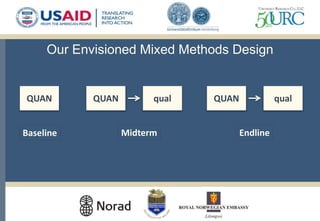
Our Envisioned Mixed Methods Design
QUAN QUAN qual QUAN qual
Baseline Midterm Endline
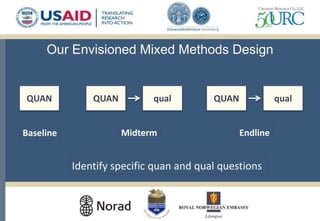
Our Envisioned Mixed Methods Design
QUAN QUAN qual QUAN qual
Baseline Midterm Endline
Identify specific quan and qual questions
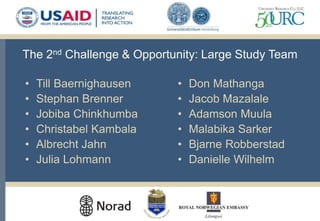
The 2nd Challenge & Opportunity: Large Study Team
• Till Baernighausen
• Stephan Brenner
• Jobiba Chinkhumba
• Christabel Kambala
• Albrecht Jahn
• Julia Lohmann
• Don Mathanga
• Jacob Mazalale
• Adamson Muula
• Malabika Sarker
• Bjarne Robberstad
• Danielle Wilhelm
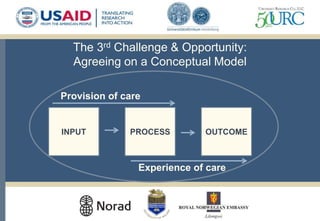
The 3rd Challenge & Opportunity:
Agreeing on a Conceptual Model
• v PROCESS OUTCOME
Provision of care
Experience of care
INPUT
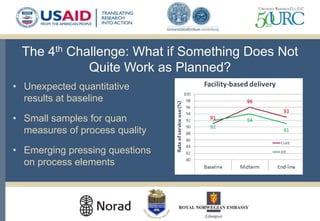
The 4th Challenge: What if Something Does Not
Quite Work as Planned?
• Unexpected quantitative
results at baseline
• Small samples for quan
measures of process quality
• Emerging pressing questions
on process elements
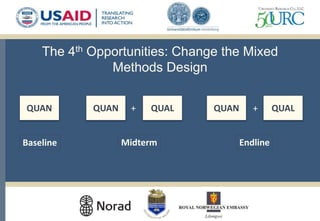
The 4th Opportunities: Change the Mixed
Methods Design
QUAN QUAN QUAL QUAN QUAL
Baseline Midterm Endline
+ +
Concluding Remarks
• Start with an explicit research question
• Exploit creativity & be daring
• Cherish large research teams
• Use theory as basis to build consensus in a team
• Allow co-existance of multiple mental models & make
adjustments to accommodate them
• Exploit the emerging nature of mixed methods designs
Thank you!
This study is made possible by the support of the American People through the
United States Agency for International Development (USAID). The findings of
this study are the sole responsibility of the research teams at the University of
Heidelberg and the College of Medicine Blantyre and do not necessarily reflect
the views of USAID or the United States Government.
This study was funded by the Norwegian Agency for Development Cooperation
(NORAD) and the Royal Norwegian Embassy in Lilongwe. The study is the
product of its authors, and responsibility for the accuracy of data included in this
report rests with the authors. The findings, interpretations and conclusions
presented do not necessarily reflect the views of NORAD or the Royal
Norwegian Embassy in Lilongwe or of NORAD.

Implementing a mixed-methods protocol in impact evaluation: challenges and opportunities

  • 1.
    Implementing a Mixed-MethodsProtocol in Impact Evaluation: Challenges and Opportunities Manuela De Allegri
  • 2.
    The 1st Challenge:The Task Ahead • Impact evaluation of complex health intervention combining Performance Based Financing (PBF) with Conditional Cash Transfers (CCT) in rural Malawi • Request to measures changes in both quantity and quality of service provision • Intervention facilities selected ex-ante by implementing agency • Possible scale up during impact evaluation phase
  • 3.
    Starting with theResearch Question • What is the impact of a combination of supply-side and demand-side interventions on quality of maternal care services? • At what cost are the benefits of the RBF intervention produced?
  • 4.
    The 1st Opportunity:Space for Creativity Mixed-methods design relying on a quasi-experiment (pre- and post-test design with independent controls) and an explanatory qualitative component
  • 5.
    Our Envisioned MixedMethods Design QUAN QUAN qual QUAN qual Baseline Midterm Endline
  • 6.
    Our Envisioned MixedMethods Design QUAN QUAN qual QUAN qual Baseline Midterm Endline Identify specific quan and qual questions
  • 7.
    The 2nd Challenge& Opportunity: Large Study Team • Till Baernighausen • Stephan Brenner • Jobiba Chinkhumba • Christabel Kambala • Albrecht Jahn • Julia Lohmann • Don Mathanga • Jacob Mazalale • Adamson Muula • Malabika Sarker • Bjarne Robberstad • Danielle Wilhelm
  • 8.
    The 3rd Challenge& Opportunity: Agreeing on a Conceptual Model • v PROCESS OUTCOME Provision of care Experience of care INPUT
  • 9.
    The 4th Challenge:What if Something Does Not Quite Work as Planned? • Unexpected quantitative results at baseline • Small samples for quan measures of process quality • Emerging pressing questions on process elements
  • 10.
    The 4th Opportunities:Change the Mixed Methods Design QUAN QUAN QUAL QUAN QUAL Baseline Midterm Endline + +
  • 11.
    Concluding Remarks • Startwith an explicit research question • Exploit creativity & be daring • Cherish large research teams • Use theory as basis to build consensus in a team • Allow co-existance of multiple mental models & make adjustments to accommodate them • Exploit the emerging nature of mixed methods designs
  • 12.
    Thank you! This studyis made possible by the support of the American People through the United States Agency for International Development (USAID). The findings of this study are the sole responsibility of the research teams at the University of Heidelberg and the College of Medicine Blantyre and do not necessarily reflect the views of USAID or the United States Government. This study was funded by the Norwegian Agency for Development Cooperation (NORAD) and the Royal Norwegian Embassy in Lilongwe. The study is the product of its authors, and responsibility for the accuracy of data included in this report rests with the authors. The findings, interpretations and conclusions presented do not necessarily reflect the views of NORAD or the Royal Norwegian Embassy in Lilongwe or of NORAD.

Editor's Notes

  • #3 Explain that you do not necessarily talk in chronological order
  • #4 Explain that you do not necessarily talk in chronological order
  • #6 Here specify why mixed methods
  • #7 Here specify why mixed methods
  • #12 Beyond the agreement on a single conceptual framework, we were still caught in people operating on different mental models – what constitutes valid research? What is an outcome?