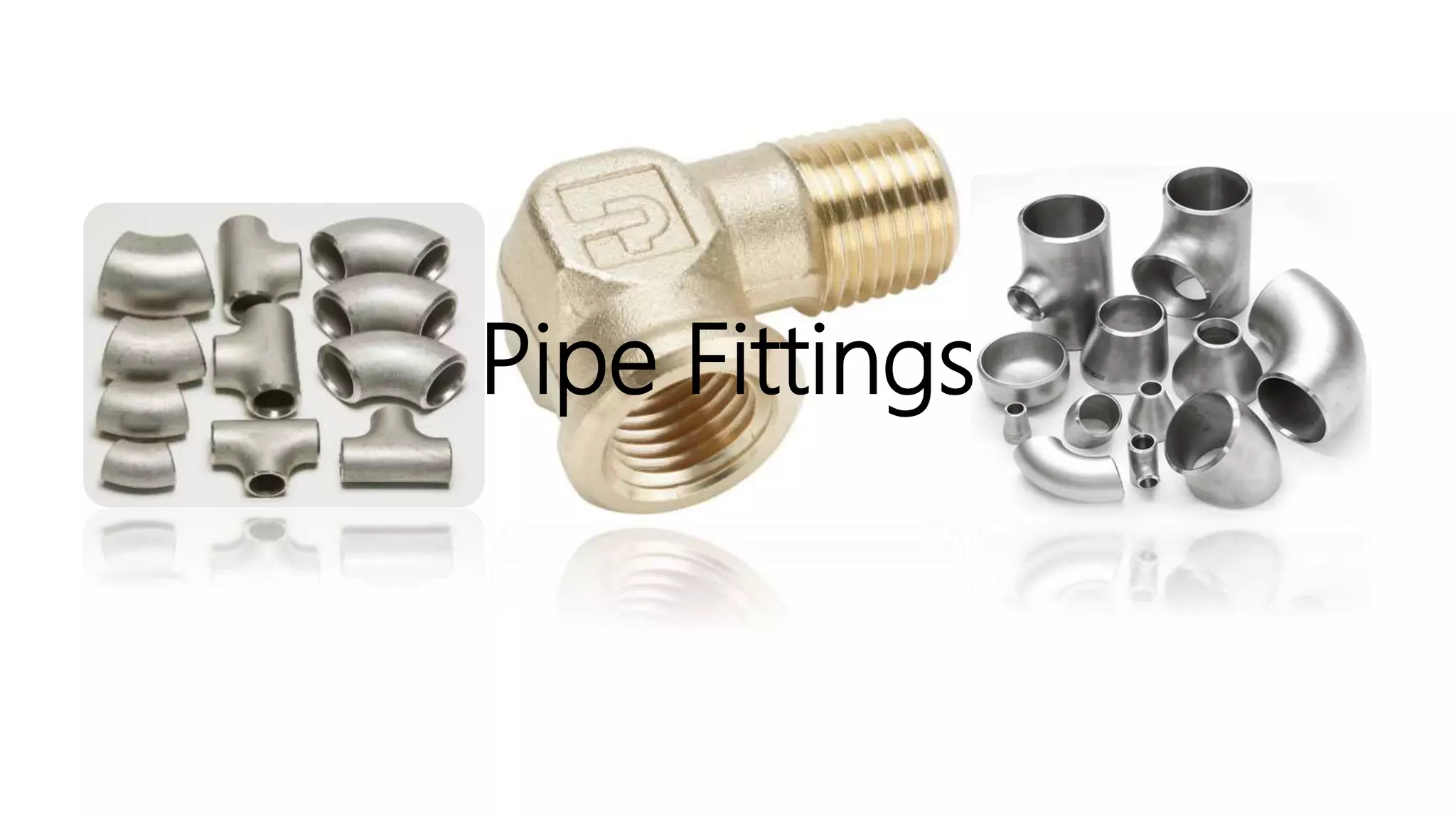
Pipe Fittings
What are Pipe Fittings?
• Pipe fittings are widely demanded for any piping and plumbing
systems used in industrial and commercial applications.
• Fittings allow pipes to be joined or installed in the appropriate place
and terminated or closed where necessary.
• Fittings are available in various shapes and sizes.
• They can be expensive, require time, and different materials and tools
to install.
• They are an essential part of piping and plumbing systems. There are
thousands of specialized fittings manufactured.
• Each type of pipe or tube requires its own type of fitting, but usually
all pipe fittings share some common features.
https://www.pipingmart.com/products/pipe-fittings 2
Purpose of a pipe fitting:
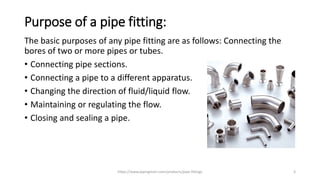
The basic purposes of any pipe fitting are as follows: Connecting the
bores of two or more pipes or tubes.
• Connecting pipe sections.
• Connecting a pipe to a different apparatus.
• Changing the direction of fluid/liquid flow.
• Maintaining or regulating the flow.
• Closing and sealing a pipe.
https://www.pipingmart.com/products/pipe-fittings 3
Pipe Fittings based on Purposes :
• Depending on the purposes served, pipe fittings can be categorized as
under:
• Pipe fittings to extend or terminate pipe runs: For example, Couplings,
Adapters, Unions , Caps and Plugs Pipe.
• Fittings to change a pipe's direction: For example , Elbows
• Pipe fittings to connect two or more pipes: For example: Tees, Cross,
Side-inlet Elbows, Wyes
• Pipe fittings to change pipe size: For example, Reducers, Bushings,
Couplings
• Pipe fittings to manage or regulate flow: For example, Valves
• Pipe fitting tools: For example, Pipe fasteners
• Pipe flanges
https://www.pipingmart.com/products/pipe-fittings 4
Applications of pipe fittings:
There is no end to applications of pipe fittings so long there is no end to
the applications of pipes . While the list of piping applications
continues to expand, its strength, flexibility, very good flow rates and
high chemical resistance are qualities which are uniquely suited for the
movement or transfer of liquids, steam, solids and air from one point to
another. With piping, pipe fittings have many other uses like as follows:
The transfer of extremely hazardous materials such as chemical and
waste.
• Protection of sensitive equipment from high pressures.
• Protection from corrosion and other extreme weather conditions.
• Resistance to household and industrial chemicals.
https://www.pipingmart.com/products/pipe-fittings 5
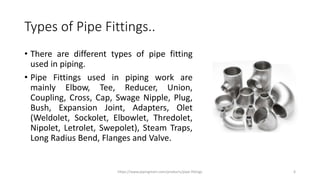
Types of Pipe Fittings..
• There are different types of pipe fitting
used in piping.
• Pipe Fittings used in piping work are
mainly Elbow, Tee, Reducer, Union,
Coupling, Cross, Cap, Swage Nipple, Plug,
Bush, Expansion Joint, Adapters, Olet
(Weldolet, Sockolet, Elbowlet, Thredolet,
Nipolet, Letrolet, Swepolet), Steam Traps,
Long Radius Bend, Flanges and Valve.
https://www.pipingmart.com/products/pipe-fittings 6
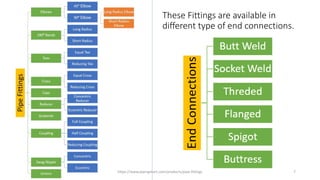
These Fittings are available in
different type of end connections.
https://www.pipingmart.com/products/pipe-fittings 7
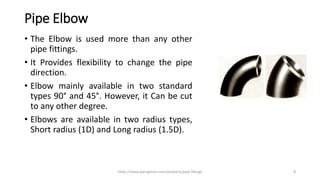
Pipe Elbow
• The Elbow is used more than any other
pipe fittings.
• It Provides flexibility to change the pipe
direction.
• Elbow mainly available in two standard
types 90° and 45°. However, it Can be cut
to any other degree.
• Elbows are available in two radius types,
Short radius (1D) and Long radius (1.5D).
https://www.pipingmart.com/products/pipe-fittings 8
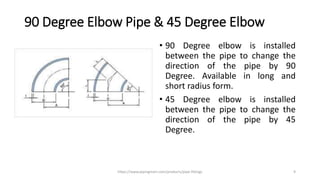
90 Degree Elbow Pipe & 45 Degree Elbow
• 90 Degree elbow is installed
between the pipe to change the
direction of the pipe by 90
Degree. Available in long and
short radius form.
• 45 Degree elbow is installed
between the pipe to change the
direction of the pipe by 45
Degree.
https://www.pipingmart.com/products/pipe-fittings 9
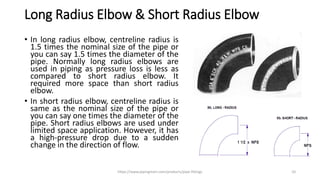
Long Radius Elbow & Short Radius Elbow
• In long radius elbow, centreline radius is
1.5 times the nominal size of the pipe or
you can say 1.5 times the diameter of the
pipe. Normally long radius elbows are
used in piping as pressure loss is less as
compared to short radius elbow. It
required more space than short radius
elbow.
• In short radius elbow, centreline radius is
same as the nominal size of the pipe or
you can say one times the diameter of the
pipe. Short radius elbows are used under
limited space application. However, it has
a high-pressure drop due to a sudden
change in the direction of flow.
https://www.pipingmart.com/products/pipe-fittings 10
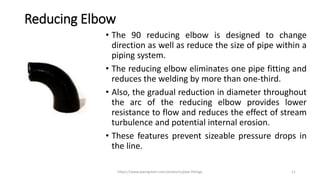
Reducing Elbow
• The 90 reducing elbow is designed to change
direction as well as reduce the size of pipe within a
piping system.
• The reducing elbow eliminates one pipe fitting and
reduces the welding by more than one-third.
• Also, the gradual reduction in diameter throughout
the arc of the reducing elbow provides lower
resistance to flow and reduces the effect of stream
turbulence and potential internal erosion.
• These features prevent sizeable pressure drops in
the line.
https://www.pipingmart.com/products/pipe-fittings 11
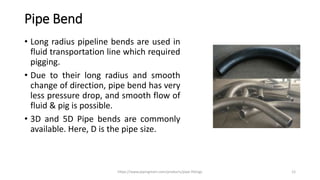
Pipe Bend
• Long radius pipeline bends are used in
fluid transportation line which required
pigging.
• Due to their long radius and smooth
change of direction, pipe bend has very
less pressure drop, and smooth flow of
fluid & pig is possible.
• 3D and 5D Pipe bends are commonly
available. Here, D is the pipe size.
https://www.pipingmart.com/products/pipe-fittings 12
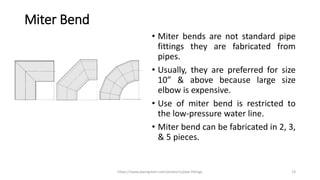
Miter Bend
• Miter bends are not standard pipe
fittings they are fabricated from
pipes.
• Usually, they are preferred for size
10” & above because large size
elbow is expensive.
• Use of miter bend is restricted to
the low-pressure water line.
• Miter bend can be fabricated in 2, 3,
& 5 pieces.
https://www.pipingmart.com/products/pipe-fittings 13
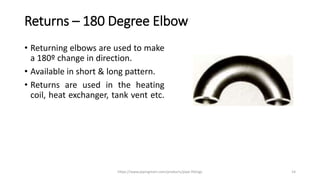
Returns – 180 Degree Elbow
• Returning elbows are used to make
a 180º change in direction.
• Available in short & long pattern.
• Returns are used in the heating
coil, heat exchanger, tank vent etc.
https://www.pipingmart.com/products/pipe-fittings 14
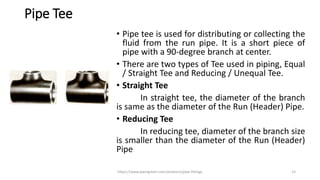
Pipe Tee
• Pipe tee is used for distributing or collecting the
fluid from the run pipe. It is a short piece of
pipe with a 90-degree branch at center.
• There are two types of Tee used in piping, Equal
/ Straight Tee and Reducing / Unequal Tee.
• Straight Tee
In straight tee, the diameter of the branch
is same as the diameter of the Run (Header) Pipe.
• Reducing Tee
In reducing tee, diameter of the branch size
is smaller than the diameter of the Run (Header)
Pipe
https://www.pipingmart.com/products/pipe-fittings 15
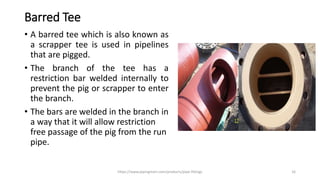
Barred Tee
• A barred tee which is also known as
a scrapper tee is used in pipelines
that are pigged.
• The branch of the tee has a
restriction bar welded internally to
prevent the pig or scrapper to enter
the branch.
• The bars are welded in the branch in
a way that it will allow restriction
free passage of the pig from the run
pipe.
https://www.pipingmart.com/products/pipe-fittings 16
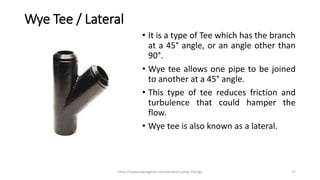
Wye Tee / Lateral
• It is a type of Tee which has the branch
at a 45° angle, or an angle other than
90°.
• Wye tee allows one pipe to be joined
to another at a 45° angle.
• This type of tee reduces friction and
turbulence that could hamper the
flow.
• Wye tee is also known as a lateral.
https://www.pipingmart.com/products/pipe-fittings 17
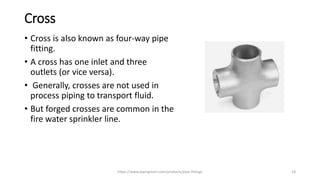
Cross
• Cross is also known as four-way pipe
fitting.
• A cross has one inlet and three
outlets (or vice versa).
• Generally, crosses are not used in
process piping to transport fluid.
• But forged crosses are common in the
fire water sprinkler line.
https://www.pipingmart.com/products/pipe-fittings 18
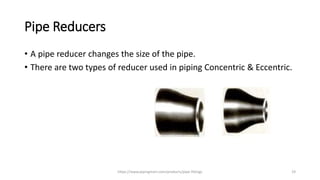
Pipe Reducers
• A pipe reducer changes the size of the pipe.
• There are two types of reducer used in piping Concentric & Eccentric.
https://www.pipingmart.com/products/pipe-fittings 19
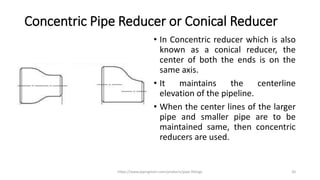
Concentric Pipe Reducer or Conical Reducer
• In Concentric reducer which is also
known as a conical reducer, the
center of both the ends is on the
same axis.
• It maintains the centerline
elevation of the pipeline.
• When the center lines of the larger
pipe and smaller pipe are to be
maintained same, then concentric
reducers are used.
https://www.pipingmart.com/products/pipe-fittings 20
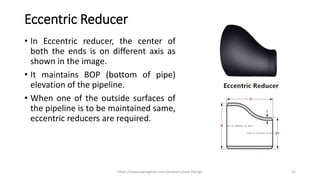
Eccentric Reducer
• In Eccentric reducer, the center of
both the ends is on different axis as
shown in the image.
• It maintains BOP (bottom of pipe)
elevation of the pipeline.
• When one of the outside surfaces of
the pipeline is to be maintained same,
eccentric reducers are required.
https://www.pipingmart.com/products/pipe-fittings 21
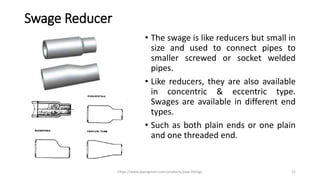
Swage Reducer
• The swage is like reducers but small in
size and used to connect pipes to
smaller screwed or socket welded
pipes.
• Like reducers, they are also available
in concentric & eccentric type.
Swages are available in different end
types.
• Such as both plain ends or one plain
and one threaded end.
https://www.pipingmart.com/products/pipe-fittings 22
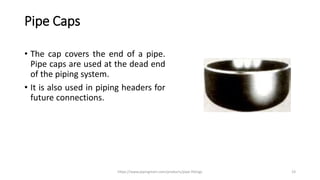
Pipe Caps
• The cap covers the end of a pipe.
Pipe caps are used at the dead end
of the piping system.
• It is also used in piping headers for
future connections.
https://www.pipingmart.com/products/pipe-fittings 23
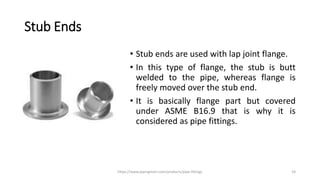
Stub Ends
• Stub ends are used with lap joint flange.
• In this type of flange, the stub is butt
welded to the pipe, whereas flange is
freely moved over the stub end.
• It is basically flange part but covered
under ASME B16.9 that is why it is
considered as pipe fittings.
https://www.pipingmart.com/products/pipe-fittings 24
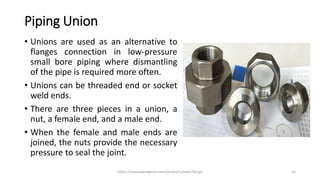
Piping Union
• Unions are used as an alternative to
flanges connection in low-pressure
small bore piping where dismantling
of the pipe is required more often.
• Unions can be threaded end or socket
weld ends.
• There are three pieces in a union, a
nut, a female end, and a male end.
• When the female and male ends are
joined, the nuts provide the necessary
pressure to seal the joint.
https://www.pipingmart.com/products/pipe-fittings 25
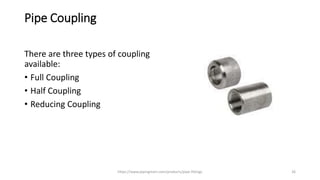
Pipe Coupling
There are three types of coupling
available:
• Full Coupling
• Half Coupling
• Reducing Coupling
https://www.pipingmart.com/products/pipe-fittings 26
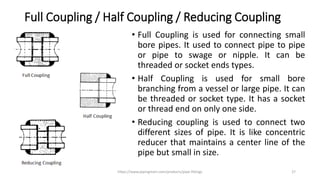
Full Coupling / Half Coupling / Reducing Coupling
• Full Coupling is used for connecting small
bore pipes. It used to connect pipe to pipe
or pipe to swage or nipple. It can be
threaded or socket ends types.
• Half Coupling is used for small bore
branching from a vessel or large pipe. It can
be threaded or socket type. It has a socket
or thread end on only one side.
• Reducing coupling is used to connect two
different sizes of pipe. It is like concentric
reducer that maintains a center line of the
pipe but small in size.
https://www.pipingmart.com/products/pipe-fittings 27
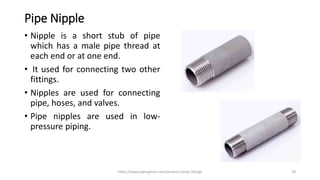
Pipe Nipple
• Nipple is a short stub of pipe
which has a male pipe thread at
each end or at one end.
• It used for connecting two other
fittings.
• Nipples are used for connecting
pipe, hoses, and valves.
• Pipe nipples are used in low-
pressure piping.
https://www.pipingmart.com/products/pipe-fittings 28
Socket weld and Threaded Pipe Fittings
• Socket weld and Threaded Pipe Fittings are forged product and
classified based on its pressure-temperature rating. Socket weld &
Threaded end fittings are available from NPS 1/8” to 4”. These fittings
are available in four pressure-temperature rating class.
• 2000 class fittings are available in only in threaded type.
• 3000 & 6000 class fittings are available in both Threaded and Socket
Weld types.
• 9000 class fittings are available in only socket weld type.
• Socket and threaded fittings are used for small bore and low-pressure
piping.
https://www.pipingmart.com/products/pipe-fittings 29
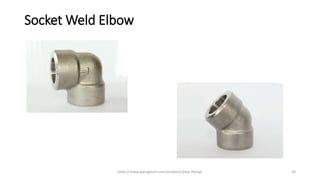
Socket Weld Elbow
https://www.pipingmart.com/products/pipe-fittings 30
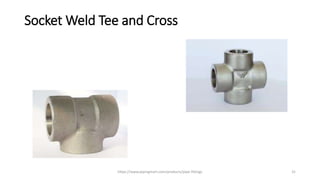
Socket Weld Tee and Cross
https://www.pipingmart.com/products/pipe-fittings 31
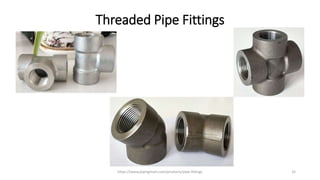
Threaded Pipe Fittings
https://www.pipingmart.com/products/pipe-fittings 32
Reference : https://www.pipingmart.com/products/pipe-fittings
https://www.pipingmart.com/products/pipe-fittings 33

Pipe fittings

  • 1.
  • 2.
    What are PipeFittings? • Pipe fittings are widely demanded for any piping and plumbing systems used in industrial and commercial applications. • Fittings allow pipes to be joined or installed in the appropriate place and terminated or closed where necessary. • Fittings are available in various shapes and sizes. • They can be expensive, require time, and different materials and tools to install. • They are an essential part of piping and plumbing systems. There are thousands of specialized fittings manufactured. • Each type of pipe or tube requires its own type of fitting, but usually all pipe fittings share some common features. https://www.pipingmart.com/products/pipe-fittings 2
  • 3.
    Purpose of apipe fitting: The basic purposes of any pipe fitting are as follows: Connecting the bores of two or more pipes or tubes. • Connecting pipe sections. • Connecting a pipe to a different apparatus. • Changing the direction of fluid/liquid flow. • Maintaining or regulating the flow. • Closing and sealing a pipe. https://www.pipingmart.com/products/pipe-fittings 3
  • 4.
    Pipe Fittings basedon Purposes : • Depending on the purposes served, pipe fittings can be categorized as under: • Pipe fittings to extend or terminate pipe runs: For example, Couplings, Adapters, Unions , Caps and Plugs Pipe. • Fittings to change a pipe's direction: For example , Elbows • Pipe fittings to connect two or more pipes: For example: Tees, Cross, Side-inlet Elbows, Wyes • Pipe fittings to change pipe size: For example, Reducers, Bushings, Couplings • Pipe fittings to manage or regulate flow: For example, Valves • Pipe fitting tools: For example, Pipe fasteners • Pipe flanges https://www.pipingmart.com/products/pipe-fittings 4
  • 5.
    Applications of pipefittings: There is no end to applications of pipe fittings so long there is no end to the applications of pipes . While the list of piping applications continues to expand, its strength, flexibility, very good flow rates and high chemical resistance are qualities which are uniquely suited for the movement or transfer of liquids, steam, solids and air from one point to another. With piping, pipe fittings have many other uses like as follows: The transfer of extremely hazardous materials such as chemical and waste. • Protection of sensitive equipment from high pressures. • Protection from corrosion and other extreme weather conditions. • Resistance to household and industrial chemicals. https://www.pipingmart.com/products/pipe-fittings 5
  • 6.
    Types of PipeFittings.. • There are different types of pipe fitting used in piping. • Pipe Fittings used in piping work are mainly Elbow, Tee, Reducer, Union, Coupling, Cross, Cap, Swage Nipple, Plug, Bush, Expansion Joint, Adapters, Olet (Weldolet, Sockolet, Elbowlet, Thredolet, Nipolet, Letrolet, Swepolet), Steam Traps, Long Radius Bend, Flanges and Valve. https://www.pipingmart.com/products/pipe-fittings 6
  • 7.
    These Fittings areavailable in different type of end connections. https://www.pipingmart.com/products/pipe-fittings 7
  • 8.
    Pipe Elbow • TheElbow is used more than any other pipe fittings. • It Provides flexibility to change the pipe direction. • Elbow mainly available in two standard types 90° and 45°. However, it Can be cut to any other degree. • Elbows are available in two radius types, Short radius (1D) and Long radius (1.5D). https://www.pipingmart.com/products/pipe-fittings 8
  • 9.
    90 Degree ElbowPipe & 45 Degree Elbow • 90 Degree elbow is installed between the pipe to change the direction of the pipe by 90 Degree. Available in long and short radius form. • 45 Degree elbow is installed between the pipe to change the direction of the pipe by 45 Degree. https://www.pipingmart.com/products/pipe-fittings 9
  • 10.
    Long Radius Elbow& Short Radius Elbow • In long radius elbow, centreline radius is 1.5 times the nominal size of the pipe or you can say 1.5 times the diameter of the pipe. Normally long radius elbows are used in piping as pressure loss is less as compared to short radius elbow. It required more space than short radius elbow. • In short radius elbow, centreline radius is same as the nominal size of the pipe or you can say one times the diameter of the pipe. Short radius elbows are used under limited space application. However, it has a high-pressure drop due to a sudden change in the direction of flow. https://www.pipingmart.com/products/pipe-fittings 10
  • 11.
    Reducing Elbow • The90 reducing elbow is designed to change direction as well as reduce the size of pipe within a piping system. • The reducing elbow eliminates one pipe fitting and reduces the welding by more than one-third. • Also, the gradual reduction in diameter throughout the arc of the reducing elbow provides lower resistance to flow and reduces the effect of stream turbulence and potential internal erosion. • These features prevent sizeable pressure drops in the line. https://www.pipingmart.com/products/pipe-fittings 11
  • 12.
    Pipe Bend • Longradius pipeline bends are used in fluid transportation line which required pigging. • Due to their long radius and smooth change of direction, pipe bend has very less pressure drop, and smooth flow of fluid & pig is possible. • 3D and 5D Pipe bends are commonly available. Here, D is the pipe size. https://www.pipingmart.com/products/pipe-fittings 12
  • 13.
    Miter Bend • Miterbends are not standard pipe fittings they are fabricated from pipes. • Usually, they are preferred for size 10” & above because large size elbow is expensive. • Use of miter bend is restricted to the low-pressure water line. • Miter bend can be fabricated in 2, 3, & 5 pieces. https://www.pipingmart.com/products/pipe-fittings 13
  • 14.
    Returns – 180Degree Elbow • Returning elbows are used to make a 180º change in direction. • Available in short & long pattern. • Returns are used in the heating coil, heat exchanger, tank vent etc. https://www.pipingmart.com/products/pipe-fittings 14
  • 15.
    Pipe Tee • Pipetee is used for distributing or collecting the fluid from the run pipe. It is a short piece of pipe with a 90-degree branch at center. • There are two types of Tee used in piping, Equal / Straight Tee and Reducing / Unequal Tee. • Straight Tee In straight tee, the diameter of the branch is same as the diameter of the Run (Header) Pipe. • Reducing Tee In reducing tee, diameter of the branch size is smaller than the diameter of the Run (Header) Pipe https://www.pipingmart.com/products/pipe-fittings 15
  • 16.
    Barred Tee • Abarred tee which is also known as a scrapper tee is used in pipelines that are pigged. • The branch of the tee has a restriction bar welded internally to prevent the pig or scrapper to enter the branch. • The bars are welded in the branch in a way that it will allow restriction free passage of the pig from the run pipe. https://www.pipingmart.com/products/pipe-fittings 16
  • 17.
    Wye Tee /Lateral • It is a type of Tee which has the branch at a 45° angle, or an angle other than 90°. • Wye tee allows one pipe to be joined to another at a 45° angle. • This type of tee reduces friction and turbulence that could hamper the flow. • Wye tee is also known as a lateral. https://www.pipingmart.com/products/pipe-fittings 17
  • 18.
    Cross • Cross isalso known as four-way pipe fitting. • A cross has one inlet and three outlets (or vice versa). • Generally, crosses are not used in process piping to transport fluid. • But forged crosses are common in the fire water sprinkler line. https://www.pipingmart.com/products/pipe-fittings 18
  • 19.
    Pipe Reducers • Apipe reducer changes the size of the pipe. • There are two types of reducer used in piping Concentric & Eccentric. https://www.pipingmart.com/products/pipe-fittings 19
  • 20.
    Concentric Pipe Reduceror Conical Reducer • In Concentric reducer which is also known as a conical reducer, the center of both the ends is on the same axis. • It maintains the centerline elevation of the pipeline. • When the center lines of the larger pipe and smaller pipe are to be maintained same, then concentric reducers are used. https://www.pipingmart.com/products/pipe-fittings 20
  • 21.
    Eccentric Reducer • InEccentric reducer, the center of both the ends is on different axis as shown in the image. • It maintains BOP (bottom of pipe) elevation of the pipeline. • When one of the outside surfaces of the pipeline is to be maintained same, eccentric reducers are required. https://www.pipingmart.com/products/pipe-fittings 21
  • 22.
    Swage Reducer • Theswage is like reducers but small in size and used to connect pipes to smaller screwed or socket welded pipes. • Like reducers, they are also available in concentric & eccentric type. Swages are available in different end types. • Such as both plain ends or one plain and one threaded end. https://www.pipingmart.com/products/pipe-fittings 22
  • 23.
    Pipe Caps • Thecap covers the end of a pipe. Pipe caps are used at the dead end of the piping system. • It is also used in piping headers for future connections. https://www.pipingmart.com/products/pipe-fittings 23
  • 24.
    Stub Ends • Stubends are used with lap joint flange. • In this type of flange, the stub is butt welded to the pipe, whereas flange is freely moved over the stub end. • It is basically flange part but covered under ASME B16.9 that is why it is considered as pipe fittings. https://www.pipingmart.com/products/pipe-fittings 24
  • 25.
    Piping Union • Unionsare used as an alternative to flanges connection in low-pressure small bore piping where dismantling of the pipe is required more often. • Unions can be threaded end or socket weld ends. • There are three pieces in a union, a nut, a female end, and a male end. • When the female and male ends are joined, the nuts provide the necessary pressure to seal the joint. https://www.pipingmart.com/products/pipe-fittings 25
  • 26.
    Pipe Coupling There arethree types of coupling available: • Full Coupling • Half Coupling • Reducing Coupling https://www.pipingmart.com/products/pipe-fittings 26
  • 27.
    Full Coupling /Half Coupling / Reducing Coupling • Full Coupling is used for connecting small bore pipes. It used to connect pipe to pipe or pipe to swage or nipple. It can be threaded or socket ends types. • Half Coupling is used for small bore branching from a vessel or large pipe. It can be threaded or socket type. It has a socket or thread end on only one side. • Reducing coupling is used to connect two different sizes of pipe. It is like concentric reducer that maintains a center line of the pipe but small in size. https://www.pipingmart.com/products/pipe-fittings 27
  • 28.
    Pipe Nipple • Nippleis a short stub of pipe which has a male pipe thread at each end or at one end. • It used for connecting two other fittings. • Nipples are used for connecting pipe, hoses, and valves. • Pipe nipples are used in low- pressure piping. https://www.pipingmart.com/products/pipe-fittings 28
  • 29.
    Socket weld andThreaded Pipe Fittings • Socket weld and Threaded Pipe Fittings are forged product and classified based on its pressure-temperature rating. Socket weld & Threaded end fittings are available from NPS 1/8” to 4”. These fittings are available in four pressure-temperature rating class. • 2000 class fittings are available in only in threaded type. • 3000 & 6000 class fittings are available in both Threaded and Socket Weld types. • 9000 class fittings are available in only socket weld type. • Socket and threaded fittings are used for small bore and low-pressure piping. https://www.pipingmart.com/products/pipe-fittings 29
  • 30.
  • 31.
    Socket Weld Teeand Cross https://www.pipingmart.com/products/pipe-fittings 31
  • 32.
  • 33.