Valuation forspecific purposes
Session Objective
 Start upValuation
 Distressed CompanyValuation
 SMEValuation
 Cyclic FirmValuation
 Insurance companyValuation
START-UPVALUATION
Definition:
Valuation of business for startups has never been straight forward with revenue or profits in hindsight. In this
situation valuing a company becomes a tedious task unlike the listed ones which already have steady revenues
and earnings. The value of a startup largely depends on market and industry forces in which the company is and
the demand and supply of money, similar recent transactions, and the level of desperation of promoters for
funding andwillingness of aninvestor to payapremium.
To promote startup businesses the Department of Industrial Policy and Promotion (DIPP) of the Government of
India has designated a dedicated website https://www.startupindia.gov.in/ to provide for a single window
platform
.
Several startup companies have seen unprecedented growth across the globe. India has attracted global
attention recently as the world’s fastest growing economy, reform being carried out, large market and
demographic dividend. Many Indian startups like Flipkart has built scalable and sustainable business in the last
decade and still thriving. There is huge opportunity for startups in the area of artificial intelligence, machine
learning,InternetofThings(IoT)andsuchother similarnewagetechnologyinitiatives
Purpose ofvaluation
For the purpose of valuation startups are those which carry characteristics of startup. Thus any definition of a startup is
only a reference point to the valuer and not a strict rule. With the background, let us look at the definition of startup as
given byDIPP
.
Start Up means an entity
, incorporated orregistered inIndia:
i) Not prior to sevenyears, however for BiotechnologyStartups not prior to ten years,
ii) With annualturnover not exceedingINR25crore in anyprecedingfinancialyear, and
iii) Workingtowards innovation, development or improvement of products or processesor services,or if it isascalable
businessmodel with ahigh potential of employment generation or wealth creation
ThefollowingProviso to be noted:-
iii)
i) Suchentity isnot formed by splitting up, or reconstruction, of abusinessalready in existence.
ii) Suchanentity shallceaseto beaStart Upif its turnover for the previousfinancialyears hasexceeded INR25croreor it
hascompleted 7years and for biotechnology start-ups10years from the date of incorporation/registration.
SuchaStart-up shallbeeligible for tax benefits only after it hasobtained certification from the Inter-Ministerial Board,
setup for suchpurpose
Characteristic
Lack of
financial
governance
-Limited
promoter
contribution
Negative cash
flows with
negativesales
-High
dependency on
external source
of funding
Optimistic
financial
projections
Lack of proof of
concept
Valuation approach forstart-ups
Investing in startup companies comes with higher risk and higher returns due to their inherent uncertainty in
achieving future projections. As per study taken by Luis Villalobos and William H.(Bill)Payee, ”Angel Investors
typically realizeabout 85%of their total returnscomesfrom 15%of their total portfolio start-upcompanies.”
It ispertinentto look for the track recordof promotersalongwith the fundamentals of businessmodelsand
readinessof plans. It is evenmore important in caseof early stage start-up companies. Most of the startup
goesout of the businessin earlystagephase.For valuing suchcompanies,market approachispreferredas
there is no proof of business and financial projections are too optimistic or speculative at this stage. The
valuationisrevisedwith eachroundof financing.
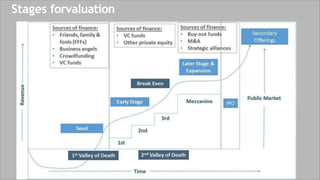
It is said that for great ideas to succeed it needs more than anything else mentoring as well as funding in
stagesat the right time.At eachstageof funding the valuationwill needupdating.Inthe caseof aStartUp,
the valuationconsiderationswould bedifferent at eachof thesestages:-
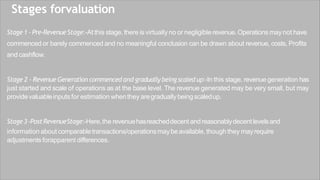
Stages forvaluation
Stage1 - Pre-RevenueStage:-At this stage,there is virtually no or negligible revenue.Operations maynot have
commenced or barely commenced and no meaningful conclusion can be drawn about revenue, costs, Profits
and cashflow.
Stage 2 - Revenue Generation commenced and gradually being scaled up:-In this stage, revenue generation has
just started and scale of operations as at the base level. The revenue generated may be very small, but may
providevaluableinputs for estimation whenthey aregraduallybeingscaledup.
Stage3-PostRevenueStage:-Here,the revenuehasreacheddecentandreasonablydecentlevelsand
information about comparabletransactions/operationsmaybeavailable, though they mayrequire
adjustments forapparent differences.
Stages forvaluation
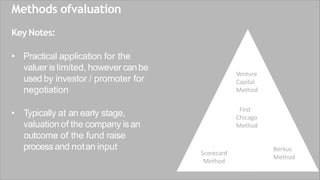
Methods ofvaluation
Venture
Capital
Method
.
Scorecard
Method
First
Chicago
Method
Berkus
Method
Key Notes:
• Practical application for the
valuer islimited, however canbe
used by investor / promoter for
negotiation
• Typically at an early stage,
valuation of the company isan
outcome of the fund raise
process and notan input
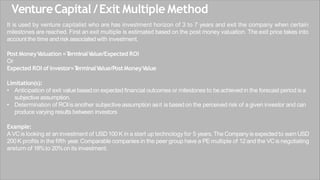
VentureCapital /Exit Multiple Method
It is used by venture capitalist who are has investment horizon of 3 to 7 years and exit the company when certain
milestones are reached. First an exit multiple is estimated based on the post money valuation. The exit price takes into
account the time andrisk associated with investment.
Post MoneyValuation =T
erminalValue/Expected ROI
Or
Expected ROI of investor=T
erminalValue/Post MoneyValue
Limitation(s):
• Anticipation of exit valuebasedon expected financial outcomes or milestones to be achieved in the forecast period isa
subjective assumption.
• Determination of ROIis another subjective assumption asit is basedon the perceived risk of a given investor and can
produce varying results between investors
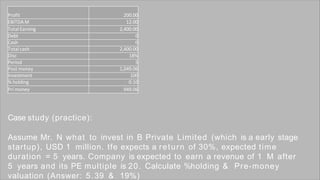
Example:
AVCis looking at an investment of USD 100 K in a start up technology for 5 years. The Companyis expected to earn USD
200 K profits in the fifth year. Comparable companies in the peer group have a PE multiple of 12 and the VCis negotiating
areturn of 18%to 20%on its investment.
Profit 200.00
EBITDA M 12.00
Total Earning 2,400.00
Debt 0
Cash 0
Total cash 2,400.00
Disc 18%
Period 5
Post money 1,049.06
Investment 100
% holding 0.10
Pri money 949.06
Case study (practice):
Assume Mr. N what to invest in B Private Limited (which is a early stage
startup), USD 1 million. tfe expects a return of 30%, expected time
duration = 5 years. Company is expected to earn a revenue of 1 M after
5 years and its PE multiple is 20. Calculate %holding & Pre-money
valuation (Answer: 5.39 & 19%)
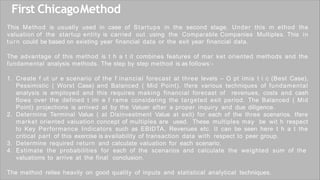
First ChicagoMethod
This Method is usually used in case of Startups in the second stage. Under this m ethod the
valuation of the startup entity is carried out using the Comparable Companies Multiples. This in
turn could be based on existing year financial data or the exit year financial data.
The advantage of this method is t h a t it combines features of mar ket oriented methods and the
fundamental analysis methods. The step by step method is as follows:-
1. Create f ut ur e scenario of the f inancial forecast at three levels – O pt imis t i c (Best Case),
Pessimistic ( Worst Case) and Balanced ( Mid Point). tfere various techniques of fundamental
analysis is employed and this requires making financial forecast of revenues, costs and cash
flows over the defined t im e f rame considering the targeted exit period. The Balanced ( Mid
Point) projections is arrived at by the Valuer after a proper inquiry and due diligence.
2. Determine Terminal Value ( at Disinvestment Value at exit) for each of the three scenarios. tfere
market oriented valuation concept of multiples are used. These multiples may be wit h respect
to Key Performance Indicators such as EBIDTA, Revenues etc. It can be seen here t h a t the
critical part of this exercise is availability of transaction data with respect to peer group.
3. Determine required return and calculate valuation for each scenario.
4. Estimate the probabilities for each of the scenarios and calculate the weighted sum of the
valuations to arrive at the final conclusion.
The method relies heavily on good quality of inputs and statistical analytical techniques.
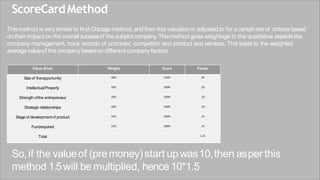
ScoreCardMethod
Thismethod isvery similar to first Chicago method, andthen this valuationin adjusted to for acertainset of criteria based
on their impact on the overall successof the subject company.Thismethod givesweightage to the qualitative aspects like
company management, track records of promoter, competitor and product and services. This leads to the weighted
averagevalueof the companybasedon different companyfactors.
Value driver Weight Score Factor
Size of theopportunity 30% 150% .45
IntellectualProperty 20% 100% .20
Strength ofthe entrepreneur 10% 100% .10
Strategic relationships 10% 100% .10
Stageof developmentof product 15% 100% .15
Fundrequired 15% 100% .15
Total 1.15
So,if the valueof (premoney)start upwas10,then asper this
method 1.5will be multiplied, hence10*1.5
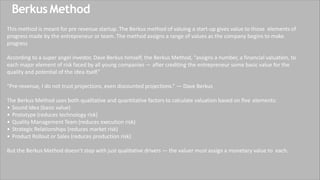
Berkus Method
This method is meant for pre revenue startup. The Berkus method of valuing a start-up gives value to those elements of
progress made by the entrepreneur or team. The method assigns a range of values as the company begins to make
progress
According to a super angel investor, Dave Berkus himself, the Berkus Method, “assigns a number, a financial valuation, to
each major element of risk faced by all young companies — after crediting the entrepreneur some basic value for the
quality and potential of the idea itself.”
“Pre-revenue, I do not trust projections, even discounted projections.” — Dave Berkus
The Berkus Method uses both qualitative and quantitative factors to calculate valuation based on five elements:
• Sound Idea (basic value)
• Prototype (reduces technology risk)
• Quality Management Team (reduces execution risk)
• Strategic Relationships (reduces market risk)
• Product Rollout or Sales (reduces production risk)
But the Berkus Method doesn’t stop with just qualitative drivers — the valuer must assign a monetary value to each.
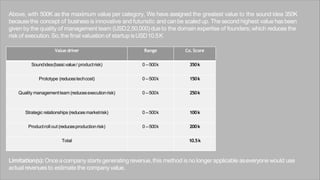
Value driver Range Co. Score
Soundidea(basicvalue/ productrisk) 0 –500k 350k
Prototype (reducestechcost) 0 –500k 150k
Quality managementteam(reducesexecutionrisk) 0 –500k 250k
Strategic relationships (reducesmarketrisk) 0 –500k 100k
Productroll out (reducesproductionrisk) 0 –500k 200k
Total 10.5k
Above, with 500K as the maximum value per category, We have assigned the greatest value to the sound idea 350K
becausethe concept of businessis innovative and futuristic and canbe scaledup. Thesecond highest valuehasbeen
given by the quality of management team (USD2,50,000) dueto the domain expertise of founders; which reduces the
risk of execution.So,the final valuationof startup isUSD10.5K
Limitation(s):Onceacompany starts generating revenue,this method isno longer applicable aseveryone would use
actual revenuesto estimatethe companyvalue.
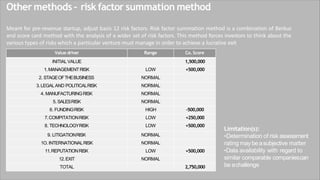
Value driver Range Co. Score
INITIALVALUE 1,500,000
1.MANAGEMENTRISK LOW +500,000
2. STAGEOFTHEBUSINESS NORMAL
3.LEGALAND POLITICALRISK NORMAL
4. MANUFACTURINGRISK NORMAL
5. SALESRISK NORMAL
6. FUNDINGRISK HIGH -500,000
7.COMPITATIONRISK LOW +250,000
8. TECHNOLOGYRISK LOW +500,000
9. LITIGATIONRISK NORMAL
1O.INTERNATIONALRISK NORMAL
11.REPUTATIONRISK LOW +500,000
12.EXIT NORMAL
TOTAL 2,750,000
Other methods – risk factor summation method
Meant for pre-revenue startup, adjust basis 12 risk factors. Risk factor summation method is a combination of Berkus
and score card method with the analysis of a wider set of risk factors. This method forces investors to think about the
various types of risks which a particular venture must manage in order to achieve a lucrative exit
Limitation(s):
•Determination of risk assessment
rating may be asubjective matter
•Data availability with regard to
similar comparable companiescan
be achallenge
DISTRESSEDASSETS
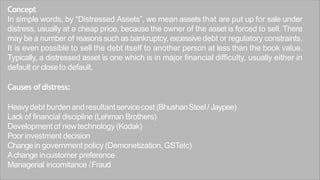
Concept
In simple words, by “Distressed Assets”, we mean assets that are put up for sale under
distress, usually at a cheap price, because the owner of the asset is forced to sell. There
may be a number of reasons such as bankruptcy, excessive debt or regulatory constraints.
It is even possible to sell the debt itself to another person at less than the book value.
Typically, a distressed asset is one which is in major financial difficulty, usually either in
default or closeto default.
Causes ofdistress:
Heavydebt burden andresultant servicecost (BhushanSteel/ Jaypee)
Lack of financial discipline (Lehman Brothers)
Developmentof newtechnology (Kodak)
Poor investment decision
Changein government policy (Demonetization,GSTetc)
Achange incustomer preference
Managerial incomitance /Fraud
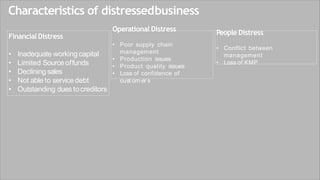
Characteristics of distressedbusiness
Financial Distress
• Inadequate workingcapital
• Limited Source offunds
• Declining sales
• Not able to servicedebt
• Outstanding dues tocreditors
Operational Distress
• Poor supply chain
management
• Production issues
• Product quality issues
• Loss of confidence of
cust om er s
People Distress
• Conflict between
management
• Loss of KMP
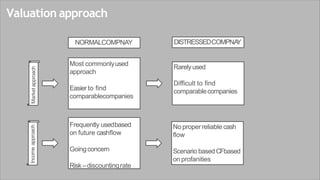
Valuation approach
Market
approach
Rarelyused
Difficult to find
comparablecompanies
Income
approach
No properreliable cash
flow
Scenario basedCFbased
on profanities
NORMALCOMPNAY
Most commonlyused
approach
Easier to find
comparablecompanies
Frequently usedbased
on future cashflow
Goingconcern
Risk–discountingrate
DISTRESSEDCOMPNA
Y
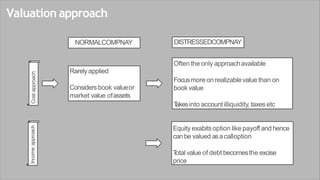
Valuation approach
Cost
approach
Rarelyapplied
Considersbook valueor
market value ofassets
Income
approach
NORMALCOMPNAY DISTRESSEDCOMPNAY
Often the only approachavailable
Focusmore on realizablevalue than on
book value
T
akesinto accountilliquidity, taxesetc
Equity exabitsoption like payoff andhence
canbe valued asacalloption
T
otal value of debt becomesthe excise
price
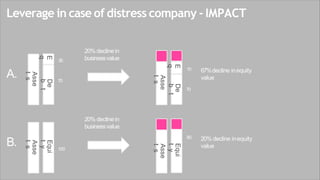
Leverage in case of distress company - IMPACT
De
b
t
Asse
t
s
E
q
30
70
De
b
t
Asse
t
s
E
q
10
70
20% declinein
businessvalue
67%decline inequity
value
A.
Equi
t
y
Asse
t
s
100
Equi
t
y
Asse
t
s
80
20% declinein
businessvalue
20% decline inequity
value
B.
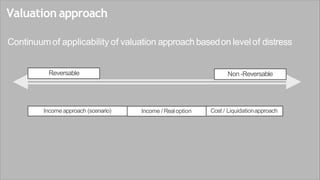
Valuation approach
Continuumof applicability of valuation approach basedon level of distress
Reversable Non -Reversable
Income approach (scenario) Income /Realoption Cost / Liquidationapproach
Cost approach – liquidationvalue concept
IVS 104, dealing with “Bases of Value” defines “ Liquidation Value” as the amount that would be
realized when an asset or group of assets are sold on a piecemeal basis, t h a t is w i t h o u t
consideration of benefits (or detriments) associated wi t h a going-concern business. Liquidation
value can be either in an orderly t ransaction wi t h a typical marketing period or in a forced
transaction wi t h a shortened marketing period and a valuer must disclose whether an orderly
or forced transaction is assumed.
O
r
d
r
y
L
q
u
d
a
i
o
n
V
a
u
e
l
:
t
i
l
e The orderly liquidation value (OLV) is typically included in an
appraisal of hard tangible assets (i.e. Machinery / equipment etc). It is an estimate of the gross
amount that the tangible assets would fetch in an auction-style liquidation with the seller
needing to sell the assets on an “as-is, where- is” basis. The term, orderly, implies that the
liquidation would allow for a reasonable time to identify all available buyers, and the seller
would have control of the sale process.
F
o
c
d
L
q
u
d
a
i
o
n
V
a
u
e
l
t
i
e
r : Unlike OLV, in Forced Liquidation Value (FLV), the first available buyer
is used and the seller does not have control of the sale process. Forced liquidation value (FLV) is the
amount of money that a company will receive if it sold its assets in an auction immediately. The
idea behind this FLV is to get an estimate of the financial position of the company in the worst
possible situation and circumstances. It is based on the assumption that the business will sell its
assets in the quickest time possible, which will usually lead to a low price.
CYCLICFIRMS
Cyclic Firms -Definition
The firms which move in tandem with economy’s ups and downs are called cyclical firms. Their business value
depends more on the macro variable rather than company specific factors. The earnings and cash flows are the
function of the current cycle the company is in the forecasting business value in based on the current numbers may lead
to erroneous projections and incorrect valuation. For example the share price of an oil company highly depends on crude
oil prices.Thesefluctuations in economylead to volatile cashflows andearnings.
Cyclicalfirms arethose companiesthat riseandfall in line with the direction in which the economy isgoing. It isnot that
other firms will not showariseor fall in line with the direction of the economy. But in the caseof cyclical firms, there isa
very muchmore positivecorrelation between the fortunes of acyclical firm and the economy than in the caseof other
firms.Thequestionsthen are:-
• Arewe supposed to treat the cyclical firms differently comparedto other firms?
• Whether we aresupposed to apply different valuationapproaches, methods and techniques when we arevaluing a
cyclical firm?
Main characteristics of cyclic firms
- Cyclic firm are at mercy of the economic
- Volatility in cashflow andearning
Challenges /Overcoming these challenges
KeyChallenges:
• The business value estimates should be made on the
b asi s o f l i fe cy c l e o f th e i n d u st r y an d i ts
characteristics.
• The values of the companies are largely affected by
macro-economic factors which are difficult to
anticipate.
• It is important to understand that which phase of
the cycle, company stands for projections purpose.
• Volatile earnings and cashflows
• Taking the current margins asnormalized margins in
terminal year
Over coming challenges:
When applying Discounted CashFlow (DCF) method
estimatesarenormalized for all the keyinputs namely
• Earnings andCashflow from operating assets
• Thegrowth in thesecashflow
• Identification of the point when the normal point of
the cycle willcome
• Establishadiscount rate to beappliedto the cash
flow
• Historicalperformanceanalysismust bein the
context of the businesscycle
Valuation methodologies
Valuation of cyclical firms canbedoneby usingall the three commonusedapproaches
• Income approach using DCFmodel
• Comparable trading multiples
• Transaction multiples
Theseresultant estimatesneed be adjustedto reflect the businesscycles on the firm’s valuation.Theprocessandthe method
of valuationunder different approachesremains the same.
Sinceit’s difficult to forecast the trend in the economy, soisthe forecasting of estimatesin caseof the cyclical firm. However a
probabilistic approach is suggested when projecting the nos as it gives multiples forecast under different scenarios. A
probability can be assigned to occurrence of a scenario, say boom, stagnation, and recession and the valuation is estimated
under the differentscenario.
Important points toremember
Observe the long term trends of EBITand cashflows
Multiple scenariomay forecasted under different phaseof cycle
Evaluate the pastcycles
Assignweights to valuationbasedon the probabilities
Always taketerminal valueon the normalized profits, not when the profits areat peak
Valuation methodologies
Step 1:
• Normal cyclescenarioDCFvalue[using pastdata]
• Terminal value should be based on normalized
level of profit and not peak or trough
Step 2:
Anew trend line scenario DCFvalue[focus on long
term trendline]
Step 3:
Develop economicrationale
Demand growth
Competition
T
echnology change
Step4:
Assign probability and get weighted value
[Takeweighted DCFbasedon the probabilities of
occurrence differentscenario]
Exampleof cyclic firms:Automobile, oil companies, steel, entertainment companies, airlines, electronics
INSURANCECO
Insurancecompany
When we talk of Valuation for Insurance Coverage, we are referring to valuation at three distinct
stages namely :
• Valuation for the purpose of taking Insurance Coverage
• Updation of valuation from time to time during the time insurance cover is in force
• Valuation for the purpose of settlement of an insurance claim
From a corporate perspective, the following are the individual assets for which valuation will be
called for with respect to Insurance Coverage : -
• Land and building
• Plant and machinery
• Factory and office equipment's
• Agricultural assets
• Exploration and evaluation assets
• Vehicles
• Computers, PCs, laptops, tablets
• Electronic equipment's
• Inventories of Raw Materials, Work in Progress, Finished Goods, Consumable Stores and Spares,
Packing Materials stored at various locations, as also stocks / goods in transit
• Cash Balances including cash in transit
- Key management personal
- Directors andofficers
- Employees
- Contract insurance
Valuation
Valuations for insurance coverage is in fact a specialized subject requiring in- depth knowledge and
experience in the field of insurance, risk management and intricacies involved in the assets in
question be it property or item of plant and equipment.
Insurance valuation is the valuation of insurance cover of an asset or other things which can be
insured. It is mainly a risk or safety management measure used to hedge alongside the risk of
unforeseen loss. The policy holder or insurance holder buying the insurance policy whereas policy
seller is known as insurance carrier. Main Objective of insurance coverage is to provide finance for
repair, replacement or rebuild the asset which is damaged or lost. The finance which is made is
based on the valuation clause in the policy as replacement clause, actual cash value, stated amount
and agreed value. Policy t folder should evaluate insurance policy details to determine if there is
adequate coverage enough to finance the replacement of an asset in the event of loss taking into
consideration the age, condition and remaining useful life of the asset.
Most business properties insurance companies use t wo different methods for determining the value
of property
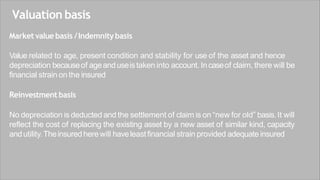
Valuation basis
Market value basis /Indemnitybasis
Value related to age, present condition and stability for use of the asset and hence
depreciation becauseof ageanduseistaken into account. Incaseof claim, there will be
financial strain on the insured
Reinvestment basis
No depreciation is deducted and the settlement of claim is on “new for old” basis.It will
reflect the cost of replacing the existing asset by a new asset of similar kind, capacity
andutility.Theinsured herewill haveleastfinancial strain provided adequate insured
PRINCIPLES OF INSURANCE COVERAGE
• Principles Of Indemnity
• Principles Of Loss Minimization
• Principles Of utmost Good Faith
• Principles Of Insurable Interest
• Principles Of Subrogation
• Principles Of contribution
• Principles Of Proximate Cause
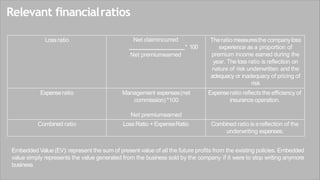
Relevant financialratios
Lossratio Net claimincurred
* 100
Net premiumearned
Theratio measuresthe companyloss
experience as a proportion of
premium income earned during the
year. The loss ratio is reflection on
nature of risk underwritten and the
adequacy or inadequacy of pricing of
risk
Expenseratio Management expenses(net
commission) *100
Net premiumearned
Expenseratio reflects the efficiency of
insurance operation.
Combined ratio LossRatio +ExpenseRatio Combined ratio is areflection of the
underwriting expenses.
Embedded Value (EV): represent the sum of present value of all the future profits from the existing policies. Embedded
value simply represents the value generated from the business sold by the company if it were to stop writing anymore
business
This PPT is prepared by the faculty
NANDINI DHARNIDHARKA
for SITUATION SPECIFIC VALUATION OF ASSET session with Assessors and
Registered Valuers Foundation.
Thank you
for choosing us as your RVO.

9 B. Specific valaution-converted-converted (1) (1).pptx

  • 1.
    Valuation forspecific purposes SessionObjective  Start upValuation  Distressed CompanyValuation  SMEValuation  Cyclic FirmValuation  Insurance companyValuation
  • 2.
  • 3.
    Definition: Valuation of businessfor startups has never been straight forward with revenue or profits in hindsight. In this situation valuing a company becomes a tedious task unlike the listed ones which already have steady revenues and earnings. The value of a startup largely depends on market and industry forces in which the company is and the demand and supply of money, similar recent transactions, and the level of desperation of promoters for funding andwillingness of aninvestor to payapremium. To promote startup businesses the Department of Industrial Policy and Promotion (DIPP) of the Government of India has designated a dedicated website https://www.startupindia.gov.in/ to provide for a single window platform . Several startup companies have seen unprecedented growth across the globe. India has attracted global attention recently as the world’s fastest growing economy, reform being carried out, large market and demographic dividend. Many Indian startups like Flipkart has built scalable and sustainable business in the last decade and still thriving. There is huge opportunity for startups in the area of artificial intelligence, machine learning,InternetofThings(IoT)andsuchother similarnewagetechnologyinitiatives
  • 4.
    Purpose ofvaluation For thepurpose of valuation startups are those which carry characteristics of startup. Thus any definition of a startup is only a reference point to the valuer and not a strict rule. With the background, let us look at the definition of startup as given byDIPP . Start Up means an entity , incorporated orregistered inIndia: i) Not prior to sevenyears, however for BiotechnologyStartups not prior to ten years, ii) With annualturnover not exceedingINR25crore in anyprecedingfinancialyear, and iii) Workingtowards innovation, development or improvement of products or processesor services,or if it isascalable businessmodel with ahigh potential of employment generation or wealth creation ThefollowingProviso to be noted:- iii) i) Suchentity isnot formed by splitting up, or reconstruction, of abusinessalready in existence. ii) Suchanentity shallceaseto beaStart Upif its turnover for the previousfinancialyears hasexceeded INR25croreor it hascompleted 7years and for biotechnology start-ups10years from the date of incorporation/registration. SuchaStart-up shallbeeligible for tax benefits only after it hasobtained certification from the Inter-Ministerial Board, setup for suchpurpose
  • 5.
    Characteristic Lack of financial governance -Limited promoter contribution Negative cash flowswith negativesales -High dependency on external source of funding Optimistic financial projections Lack of proof of concept
  • 6.
    Valuation approach forstart-ups Investingin startup companies comes with higher risk and higher returns due to their inherent uncertainty in achieving future projections. As per study taken by Luis Villalobos and William H.(Bill)Payee, ”Angel Investors typically realizeabout 85%of their total returnscomesfrom 15%of their total portfolio start-upcompanies.” It ispertinentto look for the track recordof promotersalongwith the fundamentals of businessmodelsand readinessof plans. It is evenmore important in caseof early stage start-up companies. Most of the startup goesout of the businessin earlystagephase.For valuing suchcompanies,market approachispreferredas there is no proof of business and financial projections are too optimistic or speculative at this stage. The valuationisrevisedwith eachroundof financing. It is said that for great ideas to succeed it needs more than anything else mentoring as well as funding in stagesat the right time.At eachstageof funding the valuationwill needupdating.Inthe caseof aStartUp, the valuationconsiderationswould bedifferent at eachof thesestages:-
  • 7.
    Stages forvaluation Stage1 -Pre-RevenueStage:-At this stage,there is virtually no or negligible revenue.Operations maynot have commenced or barely commenced and no meaningful conclusion can be drawn about revenue, costs, Profits and cashflow. Stage 2 - Revenue Generation commenced and gradually being scaled up:-In this stage, revenue generation has just started and scale of operations as at the base level. The revenue generated may be very small, but may providevaluableinputs for estimation whenthey aregraduallybeingscaledup. Stage3-PostRevenueStage:-Here,the revenuehasreacheddecentandreasonablydecentlevelsand information about comparabletransactions/operationsmaybeavailable, though they mayrequire adjustments forapparent differences.
  • 8.
  • 9.
    Methods ofvaluation Venture Capital Method . Scorecard Method First Chicago Method Berkus Method Key Notes: •Practical application for the valuer islimited, however canbe used by investor / promoter for negotiation • Typically at an early stage, valuation of the company isan outcome of the fund raise process and notan input
  • 10.
    VentureCapital /Exit MultipleMethod It is used by venture capitalist who are has investment horizon of 3 to 7 years and exit the company when certain milestones are reached. First an exit multiple is estimated based on the post money valuation. The exit price takes into account the time andrisk associated with investment. Post MoneyValuation =T erminalValue/Expected ROI Or Expected ROI of investor=T erminalValue/Post MoneyValue Limitation(s): • Anticipation of exit valuebasedon expected financial outcomes or milestones to be achieved in the forecast period isa subjective assumption. • Determination of ROIis another subjective assumption asit is basedon the perceived risk of a given investor and can produce varying results between investors Example: AVCis looking at an investment of USD 100 K in a start up technology for 5 years. The Companyis expected to earn USD 200 K profits in the fifth year. Comparable companies in the peer group have a PE multiple of 12 and the VCis negotiating areturn of 18%to 20%on its investment.
  • 11.
    Profit 200.00 EBITDA M12.00 Total Earning 2,400.00 Debt 0 Cash 0 Total cash 2,400.00 Disc 18% Period 5 Post money 1,049.06 Investment 100 % holding 0.10 Pri money 949.06 Case study (practice): Assume Mr. N what to invest in B Private Limited (which is a early stage startup), USD 1 million. tfe expects a return of 30%, expected time duration = 5 years. Company is expected to earn a revenue of 1 M after 5 years and its PE multiple is 20. Calculate %holding & Pre-money valuation (Answer: 5.39 & 19%)
  • 12.
    First ChicagoMethod This Methodis usually used in case of Startups in the second stage. Under this m ethod the valuation of the startup entity is carried out using the Comparable Companies Multiples. This in turn could be based on existing year financial data or the exit year financial data. The advantage of this method is t h a t it combines features of mar ket oriented methods and the fundamental analysis methods. The step by step method is as follows:- 1. Create f ut ur e scenario of the f inancial forecast at three levels – O pt imis t i c (Best Case), Pessimistic ( Worst Case) and Balanced ( Mid Point). tfere various techniques of fundamental analysis is employed and this requires making financial forecast of revenues, costs and cash flows over the defined t im e f rame considering the targeted exit period. The Balanced ( Mid Point) projections is arrived at by the Valuer after a proper inquiry and due diligence. 2. Determine Terminal Value ( at Disinvestment Value at exit) for each of the three scenarios. tfere market oriented valuation concept of multiples are used. These multiples may be wit h respect to Key Performance Indicators such as EBIDTA, Revenues etc. It can be seen here t h a t the critical part of this exercise is availability of transaction data with respect to peer group. 3. Determine required return and calculate valuation for each scenario. 4. Estimate the probabilities for each of the scenarios and calculate the weighted sum of the valuations to arrive at the final conclusion. The method relies heavily on good quality of inputs and statistical analytical techniques.
  • 13.
    ScoreCardMethod Thismethod isvery similarto first Chicago method, andthen this valuationin adjusted to for acertainset of criteria based on their impact on the overall successof the subject company.Thismethod givesweightage to the qualitative aspects like company management, track records of promoter, competitor and product and services. This leads to the weighted averagevalueof the companybasedon different companyfactors. Value driver Weight Score Factor Size of theopportunity 30% 150% .45 IntellectualProperty 20% 100% .20 Strength ofthe entrepreneur 10% 100% .10 Strategic relationships 10% 100% .10 Stageof developmentof product 15% 100% .15 Fundrequired 15% 100% .15 Total 1.15 So,if the valueof (premoney)start upwas10,then asper this method 1.5will be multiplied, hence10*1.5
  • 14.
    Berkus Method This methodis meant for pre revenue startup. The Berkus method of valuing a start-up gives value to those elements of progress made by the entrepreneur or team. The method assigns a range of values as the company begins to make progress According to a super angel investor, Dave Berkus himself, the Berkus Method, “assigns a number, a financial valuation, to each major element of risk faced by all young companies — after crediting the entrepreneur some basic value for the quality and potential of the idea itself.” “Pre-revenue, I do not trust projections, even discounted projections.” — Dave Berkus The Berkus Method uses both qualitative and quantitative factors to calculate valuation based on five elements: • Sound Idea (basic value) • Prototype (reduces technology risk) • Quality Management Team (reduces execution risk) • Strategic Relationships (reduces market risk) • Product Rollout or Sales (reduces production risk) But the Berkus Method doesn’t stop with just qualitative drivers — the valuer must assign a monetary value to each.
  • 15.
    Value driver RangeCo. Score Soundidea(basicvalue/ productrisk) 0 –500k 350k Prototype (reducestechcost) 0 –500k 150k Quality managementteam(reducesexecutionrisk) 0 –500k 250k Strategic relationships (reducesmarketrisk) 0 –500k 100k Productroll out (reducesproductionrisk) 0 –500k 200k Total 10.5k Above, with 500K as the maximum value per category, We have assigned the greatest value to the sound idea 350K becausethe concept of businessis innovative and futuristic and canbe scaledup. Thesecond highest valuehasbeen given by the quality of management team (USD2,50,000) dueto the domain expertise of founders; which reduces the risk of execution.So,the final valuationof startup isUSD10.5K Limitation(s):Onceacompany starts generating revenue,this method isno longer applicable aseveryone would use actual revenuesto estimatethe companyvalue.
  • 16.
    Value driver RangeCo. Score INITIALVALUE 1,500,000 1.MANAGEMENTRISK LOW +500,000 2. STAGEOFTHEBUSINESS NORMAL 3.LEGALAND POLITICALRISK NORMAL 4. MANUFACTURINGRISK NORMAL 5. SALESRISK NORMAL 6. FUNDINGRISK HIGH -500,000 7.COMPITATIONRISK LOW +250,000 8. TECHNOLOGYRISK LOW +500,000 9. LITIGATIONRISK NORMAL 1O.INTERNATIONALRISK NORMAL 11.REPUTATIONRISK LOW +500,000 12.EXIT NORMAL TOTAL 2,750,000 Other methods – risk factor summation method Meant for pre-revenue startup, adjust basis 12 risk factors. Risk factor summation method is a combination of Berkus and score card method with the analysis of a wider set of risk factors. This method forces investors to think about the various types of risks which a particular venture must manage in order to achieve a lucrative exit Limitation(s): •Determination of risk assessment rating may be asubjective matter •Data availability with regard to similar comparable companiescan be achallenge
  • 17.
  • 18.
    Concept In simple words,by “Distressed Assets”, we mean assets that are put up for sale under distress, usually at a cheap price, because the owner of the asset is forced to sell. There may be a number of reasons such as bankruptcy, excessive debt or regulatory constraints. It is even possible to sell the debt itself to another person at less than the book value. Typically, a distressed asset is one which is in major financial difficulty, usually either in default or closeto default. Causes ofdistress: Heavydebt burden andresultant servicecost (BhushanSteel/ Jaypee) Lack of financial discipline (Lehman Brothers) Developmentof newtechnology (Kodak) Poor investment decision Changein government policy (Demonetization,GSTetc) Achange incustomer preference Managerial incomitance /Fraud
  • 19.
    Characteristics of distressedbusiness FinancialDistress • Inadequate workingcapital • Limited Source offunds • Declining sales • Not able to servicedebt • Outstanding dues tocreditors Operational Distress • Poor supply chain management • Production issues • Product quality issues • Loss of confidence of cust om er s People Distress • Conflict between management • Loss of KMP
  • 20.
    Valuation approach Market approach Rarelyused Difficult tofind comparablecompanies Income approach No properreliable cash flow Scenario basedCFbased on profanities NORMALCOMPNAY Most commonlyused approach Easier to find comparablecompanies Frequently usedbased on future cashflow Goingconcern Risk–discountingrate DISTRESSEDCOMPNA Y
  • 21.
    Valuation approach Cost approach Rarelyapplied Considersbook valueor marketvalue ofassets Income approach NORMALCOMPNAY DISTRESSEDCOMPNAY Often the only approachavailable Focusmore on realizablevalue than on book value T akesinto accountilliquidity, taxesetc Equity exabitsoption like payoff andhence canbe valued asacalloption T otal value of debt becomesthe excise price
  • 22.
    Leverage in caseof distress company - IMPACT De b t Asse t s E q 30 70 De b t Asse t s E q 10 70 20% declinein businessvalue 67%decline inequity value A. Equi t y Asse t s 100 Equi t y Asse t s 80 20% declinein businessvalue 20% decline inequity value B.
  • 23.
    Valuation approach Continuumof applicabilityof valuation approach basedon level of distress Reversable Non -Reversable Income approach (scenario) Income /Realoption Cost / Liquidationapproach
  • 24.
    Cost approach –liquidationvalue concept IVS 104, dealing with “Bases of Value” defines “ Liquidation Value” as the amount that would be realized when an asset or group of assets are sold on a piecemeal basis, t h a t is w i t h o u t consideration of benefits (or detriments) associated wi t h a going-concern business. Liquidation value can be either in an orderly t ransaction wi t h a typical marketing period or in a forced transaction wi t h a shortened marketing period and a valuer must disclose whether an orderly or forced transaction is assumed. O r d r y L q u d a i o n V a u e l : t i l e The orderly liquidation value (OLV) is typically included in an appraisal of hard tangible assets (i.e. Machinery / equipment etc). It is an estimate of the gross amount that the tangible assets would fetch in an auction-style liquidation with the seller needing to sell the assets on an “as-is, where- is” basis. The term, orderly, implies that the liquidation would allow for a reasonable time to identify all available buyers, and the seller would have control of the sale process. F o c d L q u d a i o n V a u e l t i e r : Unlike OLV, in Forced Liquidation Value (FLV), the first available buyer is used and the seller does not have control of the sale process. Forced liquidation value (FLV) is the amount of money that a company will receive if it sold its assets in an auction immediately. The idea behind this FLV is to get an estimate of the financial position of the company in the worst possible situation and circumstances. It is based on the assumption that the business will sell its assets in the quickest time possible, which will usually lead to a low price.
  • 25.
  • 26.
    Cyclic Firms -Definition Thefirms which move in tandem with economy’s ups and downs are called cyclical firms. Their business value depends more on the macro variable rather than company specific factors. The earnings and cash flows are the function of the current cycle the company is in the forecasting business value in based on the current numbers may lead to erroneous projections and incorrect valuation. For example the share price of an oil company highly depends on crude oil prices.Thesefluctuations in economylead to volatile cashflows andearnings. Cyclicalfirms arethose companiesthat riseandfall in line with the direction in which the economy isgoing. It isnot that other firms will not showariseor fall in line with the direction of the economy. But in the caseof cyclical firms, there isa very muchmore positivecorrelation between the fortunes of acyclical firm and the economy than in the caseof other firms.Thequestionsthen are:- • Arewe supposed to treat the cyclical firms differently comparedto other firms? • Whether we aresupposed to apply different valuationapproaches, methods and techniques when we arevaluing a cyclical firm? Main characteristics of cyclic firms - Cyclic firm are at mercy of the economic - Volatility in cashflow andearning
  • 27.
    Challenges /Overcoming thesechallenges KeyChallenges: • The business value estimates should be made on the b asi s o f l i fe cy c l e o f th e i n d u st r y an d i ts characteristics. • The values of the companies are largely affected by macro-economic factors which are difficult to anticipate. • It is important to understand that which phase of the cycle, company stands for projections purpose. • Volatile earnings and cashflows • Taking the current margins asnormalized margins in terminal year Over coming challenges: When applying Discounted CashFlow (DCF) method estimatesarenormalized for all the keyinputs namely • Earnings andCashflow from operating assets • Thegrowth in thesecashflow • Identification of the point when the normal point of the cycle willcome • Establishadiscount rate to beappliedto the cash flow • Historicalperformanceanalysismust bein the context of the businesscycle
  • 28.
    Valuation methodologies Valuation ofcyclical firms canbedoneby usingall the three commonusedapproaches • Income approach using DCFmodel • Comparable trading multiples • Transaction multiples Theseresultant estimatesneed be adjustedto reflect the businesscycles on the firm’s valuation.Theprocessandthe method of valuationunder different approachesremains the same. Sinceit’s difficult to forecast the trend in the economy, soisthe forecasting of estimatesin caseof the cyclical firm. However a probabilistic approach is suggested when projecting the nos as it gives multiples forecast under different scenarios. A probability can be assigned to occurrence of a scenario, say boom, stagnation, and recession and the valuation is estimated under the differentscenario. Important points toremember Observe the long term trends of EBITand cashflows Multiple scenariomay forecasted under different phaseof cycle Evaluate the pastcycles Assignweights to valuationbasedon the probabilities Always taketerminal valueon the normalized profits, not when the profits areat peak
  • 29.
    Valuation methodologies Step 1: •Normal cyclescenarioDCFvalue[using pastdata] • Terminal value should be based on normalized level of profit and not peak or trough Step 2: Anew trend line scenario DCFvalue[focus on long term trendline] Step 3: Develop economicrationale Demand growth Competition T echnology change Step4: Assign probability and get weighted value [Takeweighted DCFbasedon the probabilities of occurrence differentscenario] Exampleof cyclic firms:Automobile, oil companies, steel, entertainment companies, airlines, electronics
  • 30.
  • 31.
    Insurancecompany When we talkof Valuation for Insurance Coverage, we are referring to valuation at three distinct stages namely : • Valuation for the purpose of taking Insurance Coverage • Updation of valuation from time to time during the time insurance cover is in force • Valuation for the purpose of settlement of an insurance claim From a corporate perspective, the following are the individual assets for which valuation will be called for with respect to Insurance Coverage : - • Land and building • Plant and machinery • Factory and office equipment's • Agricultural assets • Exploration and evaluation assets • Vehicles • Computers, PCs, laptops, tablets • Electronic equipment's • Inventories of Raw Materials, Work in Progress, Finished Goods, Consumable Stores and Spares, Packing Materials stored at various locations, as also stocks / goods in transit • Cash Balances including cash in transit
  • 32.
    - Key managementpersonal - Directors andofficers - Employees - Contract insurance Valuation Valuations for insurance coverage is in fact a specialized subject requiring in- depth knowledge and experience in the field of insurance, risk management and intricacies involved in the assets in question be it property or item of plant and equipment. Insurance valuation is the valuation of insurance cover of an asset or other things which can be insured. It is mainly a risk or safety management measure used to hedge alongside the risk of unforeseen loss. The policy holder or insurance holder buying the insurance policy whereas policy seller is known as insurance carrier. Main Objective of insurance coverage is to provide finance for repair, replacement or rebuild the asset which is damaged or lost. The finance which is made is based on the valuation clause in the policy as replacement clause, actual cash value, stated amount and agreed value. Policy t folder should evaluate insurance policy details to determine if there is adequate coverage enough to finance the replacement of an asset in the event of loss taking into consideration the age, condition and remaining useful life of the asset. Most business properties insurance companies use t wo different methods for determining the value of property
  • 33.
    Valuation basis Market valuebasis /Indemnitybasis Value related to age, present condition and stability for use of the asset and hence depreciation becauseof ageanduseistaken into account. Incaseof claim, there will be financial strain on the insured Reinvestment basis No depreciation is deducted and the settlement of claim is on “new for old” basis.It will reflect the cost of replacing the existing asset by a new asset of similar kind, capacity andutility.Theinsured herewill haveleastfinancial strain provided adequate insured
  • 34.
    PRINCIPLES OF INSURANCECOVERAGE • Principles Of Indemnity • Principles Of Loss Minimization • Principles Of utmost Good Faith • Principles Of Insurable Interest • Principles Of Subrogation • Principles Of contribution • Principles Of Proximate Cause
  • 35.
    Relevant financialratios Lossratio Netclaimincurred * 100 Net premiumearned Theratio measuresthe companyloss experience as a proportion of premium income earned during the year. The loss ratio is reflection on nature of risk underwritten and the adequacy or inadequacy of pricing of risk Expenseratio Management expenses(net commission) *100 Net premiumearned Expenseratio reflects the efficiency of insurance operation. Combined ratio LossRatio +ExpenseRatio Combined ratio is areflection of the underwriting expenses. Embedded Value (EV): represent the sum of present value of all the future profits from the existing policies. Embedded value simply represents the value generated from the business sold by the company if it were to stop writing anymore business
  • 36.
    This PPT isprepared by the faculty NANDINI DHARNIDHARKA for SITUATION SPECIFIC VALUATION OF ASSET session with Assessors and Registered Valuers Foundation. Thank you for choosing us as your RVO.