VALUATION METHODS OF
VC/PE
Ms. Jaya Sharma
Asst. Professor
MMIM
MEANING OF VALUATION
 Venture capital valuation is the process of
determining how much a startup is worth
when investors (like VCs) are deciding
whether to invest.
 VCs consider market opportunity, team
expertise, product or service, traction,
competitive landscape, financial projections,
and risk factors when determining whether to
invest in a startup or not.
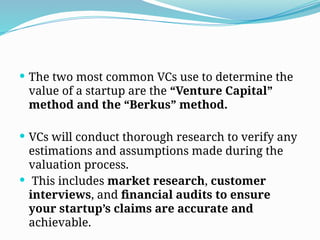
 The two most common VCs use to determine the
value of a startup are the “Venture Capital”
method and the “Berkus” method.
 VCs will conduct thorough research to verify any
estimations and assumptions made during the
valuation process.
 This includes market research, customer
interviews, and financial audits to ensure
your startup’s claims are accurate and
achievable.
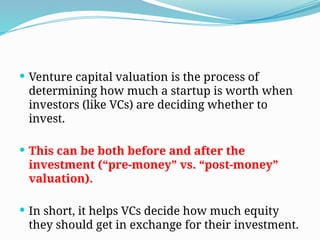
 Venture capital valuation is the process of
determining how much a startup is worth when
investors (like VCs) are deciding whether to
invest.
 This can be both before and after the
investment (“pre-money” vs. “post-money”
valuation).
 In short, it helps VCs decide how much equity
they should get in exchange for their investment.
Throughout the process of pitching VCs and fielding
investment offers, you might come across these
common terms:
Term What It Means Why It Matters
Pre-money valu
ation
The value of
your startup
before receiving
any new
investment
It determines
how much
equity the
investor will get
in exchange for
their money.
Post-money
valuation
The value of
your startup
after the new
investment is
This helps in
calculating the
ownership
percentage of
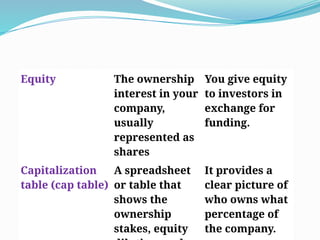
Equity The ownership
interest in your
company,
usually
represented as
shares
You give equity
to investors in
exchange for
funding.
Capitalization
table (cap table)
A spreadsheet
or table that
shows the
ownership
stakes, equity
It provides a
clear picture of
who owns what
percentage of
the company.
Term sheet A non-binding
agreement
outlining the
terms and
conditions of an
investment
This serves as
the basis for
drafting the
final, legally
binding
investment
documents.
Exit strategy A plan for how
investors will
eventually sell
their shares and
realize a return
on their
Your exit
strategy outlines
how and when
investors can
expect to make a
profit.
7 Key Factors VCs Consider When Valuing Startups
 Investing in startups is inherently risky, as the
average success rate of a startup is 10-20% .
 VCs also have limited funds which raises their
stakes even higher.
 To make the right investment decisions, VCs
consider various qualitative and quantitative
factors to assess risk, potential rewards, and
future performance of a startup.
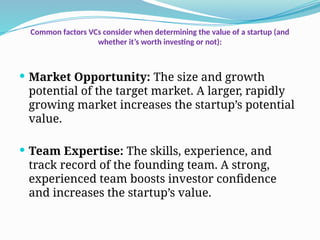
Common factors VCs consider when determining the value of a startup (and
whether it’s worth investing or not):
 Market Opportunity: The size and growth
potential of the target market. A larger, rapidly
growing market increases the startup’s potential
value.
 Team Expertise: The skills, experience, and
track record of the founding team. A strong,
experienced team boosts investor confidence
and increases the startup’s value.
 Product or Service: The uniqueness, quality,
and demand for the product or service. A highly
innovative or in-demand product can
significantly raise the startup’s value.
 Traction and Performance: Metrics like user
growth, revenue, and customer retention.
Positive traction shows the startup’s potential for
success and increases its value.
 Competitive Landscape: The number and
strength of competitors. Less competition or a
strong competitive edge can enhance the
startup’s value.
 Financial Projections: Future revenue, profit
potential, and scalability. Realistic, positive
financial projections can boost the startup’s
value.
 Risk Factors: Potential risks and how they are
mitigated. Lower risk levels generally increase
the startup’s value.
Based on these factors, VCs determine which
venture capital valuation method(s) are the
most appropriate to come to an accurate value.
METHODS WE NEED TO STUDY
 RISK RETURN ANALYSIS
 CONVENTIONAL METHOD
 REVENUE MULTIPLIER METHOD
1. RISK RETURN TRADE OFF
 Risk Return trade off is the fundamental concept
of finance that states that investors demand
higher return for taking on higher level of risks.
 Various valuation approaches of this analysis are
as follows:
 DCF ANALYSIS
 CAPM MODEL
 APT
 RISK ADJUSTED NET PRESENT VALUE
 EXPECTED RETURN
STEPS FOR DCF ANALYSIS
 Step 1: ESTIMATE FUTURE CASH FLOW
 Identify the cash flow streams
 Forecast the cash flows
 Consider the growth rate
 Step 2: DETERMINE THE DISCOUNT RATE
 WACC( Weighted Average Cost of Capital)
 Risk free rate
 Risk premium
 Step 3: CALCULATE THE PRESENT VALUE OF FUTURE
CASH FLOWS
 Apply the discount rate to each cash flow to determine its PV
 Calculate the Present value
 Step 4: Calculate the Terminal Value using Gordon Growth
Model and then estimate the perpetuity growth rate
 Step 5: Calculate the Enterprise Value by adding the PV
and Terminal value and after that adjust for debt and cash
to determine the equity value
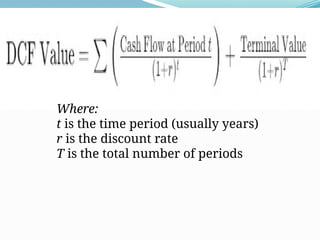
Where:
t is the time period (usually years)
r is the discount rate
T is the total number of periods
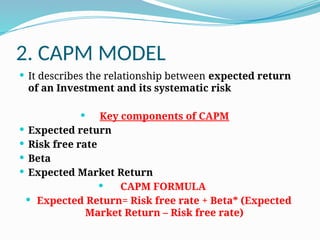
2. CAPM MODEL
 It describes the relationship between expected return
of an Investment and its systematic risk
 Key components of CAPM
 Expected return
 Risk free rate
 Beta
 Expected Market Return
 CAPM FORMULA
 Expected Return= Risk free rate + Beta* (Expected
Market Return – Risk free rate)
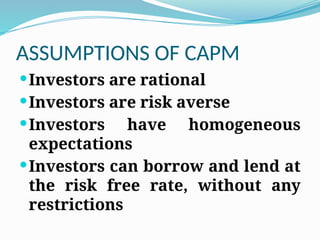
ASSUMPTIONS OF CAPM
Investors are rational
Investors are risk averse
Investors have homogeneous
expectations
Investors can borrow and lend at
the risk free rate, without any
restrictions
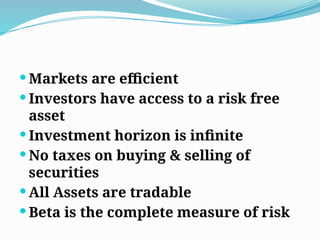
 Markets are efficient
 Investors have access to a risk free
asset
 Investment horizon is infinite
 No taxes on buying & selling of
securities
 All Assets are tradable
 Beta is the complete measure of risk
assumptions
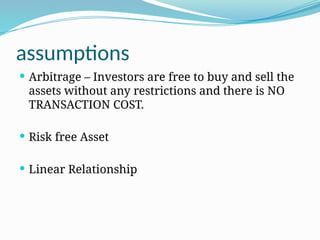
 Arbitrage – Investors are free to buy and sell the
assets without any restrictions and there is NO
TRANSACTION COST.
 Risk free Asset
 Linear Relationship
 Net Present Value (NPV) is the value of all future
cash flows (positive and negative) over the entire life
of an investment discounted to the present.
 NPV analysis is a form of intrinsic valuation and is
used extensively across finance and accounting for
determining the value of a business, investment
security, capital project, new venture, cost reduction
program, and anything that involves cash flow.
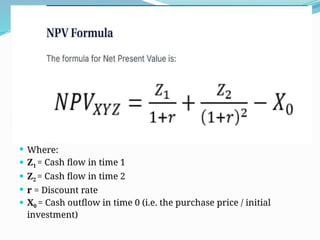
 Where:
 Z1 = Cash flow in time 1
 Z2 = Cash flow in time 2
 r = Discount rate
 X0 = Cash outflow in time 0 (i.e. the purchase price / initial
investment)
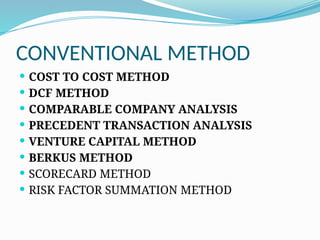
CONVENTIONAL METHOD
 COST TO COST METHOD
 DCF METHOD
 COMPARABLE COMPANY ANALYSIS
 PRECEDENT TRANSACTION ANALYSIS
 VENTURE CAPITAL METHOD
 BERKUS METHOD
 SCORECARD METHOD
 RISK FACTOR SUMMATION METHOD
comparable company analysis
 comparable company analysis is a valuation
method that involves comparing the Financial
matrix and ratios of the company belong to same
industries .various steps to Or various steps to
perform the analysis are
 1 identify comparable companies
 2. Gather financial data
 3. calculate financial ratios
 4. compare the calculated ratios
 5. determine valuation multiples and apply them
Advantages of CCA
 PROVIDES MARKET BASED VALUATION
 EASY TO UNDERSTAND
 USEFUL FOR PU
BLICLY TRADED COMPANIES
DISADVANTAGES
 DIFFICULTY IN FINDING COMPARABLE
COMPANIES
 IGNORES COMPANY SPECIFIC FACTORS
 SENSITIVE TO MARKET CONDITIONS
VALUATION METHOD INTRODUCTION TO VC.pptx

  • 1.
    VALUATION METHODS OF VC/PE Ms.Jaya Sharma Asst. Professor MMIM
  • 2.
    MEANING OF VALUATION Venture capital valuation is the process of determining how much a startup is worth when investors (like VCs) are deciding whether to invest.  VCs consider market opportunity, team expertise, product or service, traction, competitive landscape, financial projections, and risk factors when determining whether to invest in a startup or not.
  • 3.
     The twomost common VCs use to determine the value of a startup are the “Venture Capital” method and the “Berkus” method.  VCs will conduct thorough research to verify any estimations and assumptions made during the valuation process.  This includes market research, customer interviews, and financial audits to ensure your startup’s claims are accurate and achievable.
  • 4.
     Venture capitalvaluation is the process of determining how much a startup is worth when investors (like VCs) are deciding whether to invest.  This can be both before and after the investment (“pre-money” vs. “post-money” valuation).  In short, it helps VCs decide how much equity they should get in exchange for their investment.
  • 5.
    Throughout the processof pitching VCs and fielding investment offers, you might come across these common terms: Term What It Means Why It Matters Pre-money valu ation The value of your startup before receiving any new investment It determines how much equity the investor will get in exchange for their money. Post-money valuation The value of your startup after the new investment is This helps in calculating the ownership percentage of
  • 6.
    Equity The ownership interestin your company, usually represented as shares You give equity to investors in exchange for funding. Capitalization table (cap table) A spreadsheet or table that shows the ownership stakes, equity It provides a clear picture of who owns what percentage of the company.
  • 7.
    Term sheet Anon-binding agreement outlining the terms and conditions of an investment This serves as the basis for drafting the final, legally binding investment documents. Exit strategy A plan for how investors will eventually sell their shares and realize a return on their Your exit strategy outlines how and when investors can expect to make a profit.
  • 8.
    7 Key FactorsVCs Consider When Valuing Startups  Investing in startups is inherently risky, as the average success rate of a startup is 10-20% .  VCs also have limited funds which raises their stakes even higher.  To make the right investment decisions, VCs consider various qualitative and quantitative factors to assess risk, potential rewards, and future performance of a startup.
  • 9.
    Common factors VCsconsider when determining the value of a startup (and whether it’s worth investing or not):  Market Opportunity: The size and growth potential of the target market. A larger, rapidly growing market increases the startup’s potential value.  Team Expertise: The skills, experience, and track record of the founding team. A strong, experienced team boosts investor confidence and increases the startup’s value.
  • 10.
     Product orService: The uniqueness, quality, and demand for the product or service. A highly innovative or in-demand product can significantly raise the startup’s value.  Traction and Performance: Metrics like user growth, revenue, and customer retention. Positive traction shows the startup’s potential for success and increases its value.
  • 11.
     Competitive Landscape:The number and strength of competitors. Less competition or a strong competitive edge can enhance the startup’s value.  Financial Projections: Future revenue, profit potential, and scalability. Realistic, positive financial projections can boost the startup’s value.
  • 12.
     Risk Factors:Potential risks and how they are mitigated. Lower risk levels generally increase the startup’s value. Based on these factors, VCs determine which venture capital valuation method(s) are the most appropriate to come to an accurate value.
  • 13.
    METHODS WE NEEDTO STUDY  RISK RETURN ANALYSIS  CONVENTIONAL METHOD  REVENUE MULTIPLIER METHOD
  • 14.
    1. RISK RETURNTRADE OFF  Risk Return trade off is the fundamental concept of finance that states that investors demand higher return for taking on higher level of risks.  Various valuation approaches of this analysis are as follows:  DCF ANALYSIS  CAPM MODEL  APT  RISK ADJUSTED NET PRESENT VALUE  EXPECTED RETURN
  • 15.
    STEPS FOR DCFANALYSIS  Step 1: ESTIMATE FUTURE CASH FLOW  Identify the cash flow streams  Forecast the cash flows  Consider the growth rate  Step 2: DETERMINE THE DISCOUNT RATE  WACC( Weighted Average Cost of Capital)  Risk free rate  Risk premium
  • 16.
     Step 3:CALCULATE THE PRESENT VALUE OF FUTURE CASH FLOWS  Apply the discount rate to each cash flow to determine its PV  Calculate the Present value  Step 4: Calculate the Terminal Value using Gordon Growth Model and then estimate the perpetuity growth rate  Step 5: Calculate the Enterprise Value by adding the PV and Terminal value and after that adjust for debt and cash to determine the equity value
  • 17.
    Where: t is thetime period (usually years) r is the discount rate T is the total number of periods
  • 18.
    2. CAPM MODEL It describes the relationship between expected return of an Investment and its systematic risk  Key components of CAPM  Expected return  Risk free rate  Beta  Expected Market Return  CAPM FORMULA  Expected Return= Risk free rate + Beta* (Expected Market Return – Risk free rate)
  • 20.
    ASSUMPTIONS OF CAPM Investorsare rational Investors are risk averse Investors have homogeneous expectations Investors can borrow and lend at the risk free rate, without any restrictions
  • 21.
     Markets areefficient  Investors have access to a risk free asset  Investment horizon is infinite  No taxes on buying & selling of securities  All Assets are tradable  Beta is the complete measure of risk
  • 24.
    assumptions  Arbitrage –Investors are free to buy and sell the assets without any restrictions and there is NO TRANSACTION COST.  Risk free Asset  Linear Relationship
  • 32.
     Net PresentValue (NPV) is the value of all future cash flows (positive and negative) over the entire life of an investment discounted to the present.  NPV analysis is a form of intrinsic valuation and is used extensively across finance and accounting for determining the value of a business, investment security, capital project, new venture, cost reduction program, and anything that involves cash flow.
  • 33.
     Where:  Z1= Cash flow in time 1  Z2 = Cash flow in time 2  r = Discount rate  X0 = Cash outflow in time 0 (i.e. the purchase price / initial investment)
  • 34.
    CONVENTIONAL METHOD  COSTTO COST METHOD  DCF METHOD  COMPARABLE COMPANY ANALYSIS  PRECEDENT TRANSACTION ANALYSIS  VENTURE CAPITAL METHOD  BERKUS METHOD  SCORECARD METHOD  RISK FACTOR SUMMATION METHOD
  • 35.
    comparable company analysis comparable company analysis is a valuation method that involves comparing the Financial matrix and ratios of the company belong to same industries .various steps to Or various steps to perform the analysis are  1 identify comparable companies  2. Gather financial data  3. calculate financial ratios  4. compare the calculated ratios  5. determine valuation multiples and apply them
  • 36.
    Advantages of CCA PROVIDES MARKET BASED VALUATION  EASY TO UNDERSTAND  USEFUL FOR PU BLICLY TRADED COMPANIES
  • 37.
    DISADVANTAGES  DIFFICULTY INFINDING COMPARABLE COMPANIES  IGNORES COMPANY SPECIFIC FACTORS  SENSITIVE TO MARKET CONDITIONS