What is value?
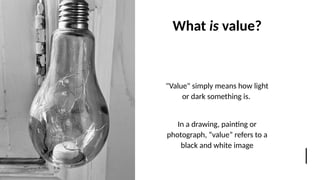
"Value"simply means how light
or dark something is.
In a drawing, painting or
photograph, “value” refers to a
black and white image
3.
Value and Light
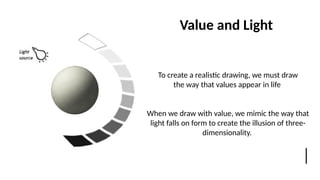
Tocreate a realistic drawing, we must draw
the way that values appear in life
When we draw with value, we mimic the way that
light falls on form to create the illusion of three-
dimensionality.
You try it!
Usinga range of values, draw a sphere from observation.
Use a light source from any angle.
7.
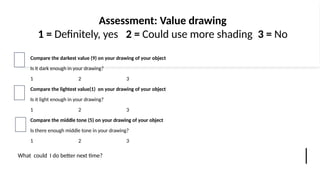
Assessment: Value drawing
1= Definitely, yes 2 = Could use more shading 3 = No
Compare the darkest value (9) on your drawing of your object
Is it dark enough in your drawing?
1 2 3
Compare the lightest value(1) on your drawing of your object
Is it light enough in your drawing?
1 2 3
Compare the middle tone (5) on your drawing of your object
Is there enough middle tone in your drawing?
1 2 3
What could I do better next time?
#2 Value drawing can be used to create a picture that feels so real and spacious that it seems like you could reach right into it. Value helps us create believable space, mood, atmosphere and various "special effects" in our pictures.
A drawing is said to be a value drawing when it is in black and white, when it has no color. Black, white, and the many shades of gray in between the two are called values, or sometimes tones.
#3 Whenever we see ANY THING, it means that it is being illuminated by a light source.
We see form through these differences in values (or differences in lightness and darkness). It is this range of values that makes objects look three-dimensional.
#4
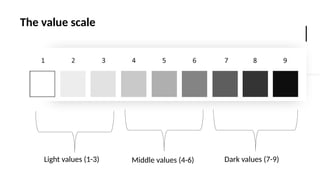
Artists use a system of nine values ranging from white to black, called a value scale. The scale consists of four light values (values 1 to 4), a middle value (also called a half-tone), and four dark values (values 6 to 9).
In drawing, the values on the value scale become your visual alphabet.
#5 For example, take a look around. Are you sitting at a table? What is making it look three- dimensional? The side plane and top plane of the table are two different values, right? One plane is most likely lighter, and the other is darker.
#6 Remember: As an object turns away from the light source, it gradually darkens as less light reaches it. Eventually, the object falls into shadow.
This incremental darkening of an object turning away from light creates a range of values.