Value Education - Challenges &
possibilities
• P.L.Dhar
• IITDelhi
Why Teach Values ?
• Value crisis is the root of all social and
technogenic maladies
• Aristotle “..the fate of empires depends on
the education of the youth.”
• Consequences of neglect of value
education: “..perfection of means and
confusion of the ends” …. Einstein
• What is education ? …Vision of Holistic
Education
Common Concerns about EHV
• EHV and Religious Education
• How can values be taught ? Values are
picked up from the environment, from Role
Models
• Only Enlightened beings can teach values,
not ordinary mortals
Dharma and Religion
• Each religion has two dimensions : outer
sheath and the inner core
• Outer sheath:Conditioned by historic, social
and political climate --parochial
• Inner core: spiritual truths Universal :
Laws of Nature pertaining to the subjective
world of Man : Dharma
What is Dharma ?
• Dharma : basic nature or characteristic
• dharma of fire is to burn ; all beings are
jaradharma
• sanatan dharma : Eternal Laws
• Na hi verena verani samantidha kudacanam
Averena ca sammanti esa dhammo sanantano
Value Education & Dharma
• Mental defilements like ill will, anger,
animosity, hatred, greed, etc. have the
characteristic of “agitation” and “burning”.
• Pure mind is full of love, compassion,
kindness, generosity, etc. and has the
characteristic of joy, peace, harmony.
• These laws are applicable to all.
• EHV: Understanding and Internalizing
such laws.
Can Values be taught ?
• “Taught” vs “caught” models and their
implications
• No way out of the present morass
• Inspiration rarely lasts after the charismatic
person has gone- example of Gandhiji
• Is value neutral education possible ?
• Any wider interpretation of facts, be these
historical, rational or scientific, necessitates
value judgement .
Can Values be taught ?
• The question is fundamentally flawed -
value neutral education is a myth
• Absence of formal discussion results in
conflicting signals from different teachers
• Role of family as an institution for value
education : Present state of families
How
should
values be
“taught”?
Cardinal Principles of Value
Education
♦♦The foundation should not be
made dependent on myth, or authority
♦Provoke the students to analyze the world and the
experiences of their own life
-its goals, aspirations,etc.
♦♦Value dimension should permeate teaching
♦Give practical training in self-restraint &
self observation to actually inculcate values
♦Teachers as senior students, nor moral masters
Analyzing nature …..to
appreciate Interconnectedness
• Analysis of Breathing Process--natural
cycles
• The continually changing constituents of
human body
• Quantum theory : what is reality ?
• Silent contributors to our success--deep
ecological perspective
• Interdependence-Inter-being →concern for
others
Analyzing Nature……. The
Evolutionary paradigm
• Theory of Evolution : Man has evolved
from the living cell over billions of years
through random genetic mutations +
natural selection motivated by survival
• Quantum physics : At a deeper level
matter and consciousness are actually
inseparable…deep down the consciousness
of mankind is ONE.
The Evolutionary paradigm
• View of sages of ancient India : Evolution is
a progressively clearer and more powerful
manifestation of the Universal
Consciousness pervading the Universe
• Matter--faint glimmer of the consciousness
• Plants --grow , breathe, communicate
• Animals--All the above+ movement+
elemental ethics
The Evolutionary paradigm
• Human beings--Quantum jump in all
abilities of animals + increased awareness,
esp. awareness about self + ability of self
control
• Future Evolution of Man --Huxley’s views :
Man’s evolution is not biological but
psycho-social; ..man’s most comprehensive
aim is.. greater self-fulfillment through
fuller realization of the possibilities
Future Evolution of Man
• Aurobindo :..It is through consciousness,
through its transmutation and no longer
through a new bodily organism as a first
instrumentation that the evolution can and
must be effected.
• Neuroscientists: Fuller utilisation of the
right cerebral hemisphere which functions
in non-linear, intuitive, holistic modes
Evolutionary Paradigm and
Universal Human Values
• Future Evolution : Greater self fulfillment
through movement to higher levels of
consciousness
• UHV⇒ Values that help in this journey
{ love, compassion, generosity, truthfulness
etc.}
• Undesirable values ⇒ Those which drag us
down the ladder of evolution { arrogance,
lust, pride, anger, acquisitiveness, etc.}
Analyzing Life’s experiences…I
• Do I feel happy when others
– cheat , steal, abuse, beat me
• What kind of friend, employer, customer,
servant, spouse, child......would I like?
• Is it true of all ?
Do unto others
as you wish
others to do unto you
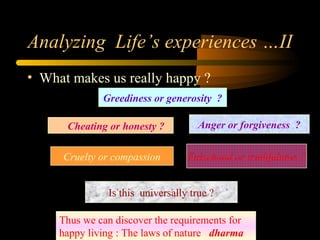
Analyzing Life’s experiences …II
• What makes us really happy ?
Greediness or generosity ?
Anger or forgiveness ?Cheating or honesty ?
Cruelty or compassion Falsehood or truthfulness ?
Is this universally true ?
Thus we can discover the requirements for
happy living : The laws of nature dharma
Analyzing Life’s Experiences..III
• UHV as requirement for happy living
imposed by Dharma < laws of nature>
• pure mind leads to joy , impure to suffering
• UHV{ love, kindness, compassion,
generosity, non-jealousy etc,} are the
characteristics of pure mind
• Humanistic psychology - UHV as the
higher needs of Man
Value Conflicts in Daily Life
• Truthfulness : avoiding caller on ’phone ;
disclosing terminal disease , owning up
mistake , narcissism
• Honesty : Private Tuition, selling a house,
Inflated Electricity bill, property tax
• Forbearance : trivial queries of weak
students , criticism of colleagues/students
• Compassion : beggars , accident victim,
giving lift in car
Knowing vs Imbibing Values
• Duryodhana’s dilemma
janami dharamam na ca me pravritt
janami adharmam na ca me nivritti.
• Chasm between conscious & unconscious
mind
• It is easier to denature plutonium than to
denature the evil spirit of Man- A.Einstein
• Practical training in mental purification
• Vipassana as taught by the Buddha
Value Orientation of Teaching
• Discuss in all subjects their value implications
– physics, chemistry, mathematics, biology,
social sciences…….
• Technology : Impact on society ⇒ social,
environmental and moral
• Marketing : Importance of being truthful
• Economics : There are many factors besides
profit
• Business management : Ethical issues
Responsibilities of Teachers of
Value Education
• Become Role Models of Value based life
– Teaching with love and compassion
– professional integrity - transparency in
evaluation
– accepting shortcomings gracefully, humility
– Regular meditation
• Working as senior students and not moral
masters
Concluding Remarks
• EHV is the paramount need of the hour to ensure
survival of the humanity
• EHV is best done by encouraging the students to
analyze the world and the experiences of their
own life -its goals, aspirations, etc.
• Value inculcation needs practical training in self
restraint and mental purification - possible through
Vipassana meditation
• EHV Teachers have to be role models-- not moral
masters but senior students
Thank
you!

Value education challenges and possibilities

  • 1.
    Value Education -Challenges & possibilities • P.L.Dhar • IITDelhi
  • 2.
    Why Teach Values? • Value crisis is the root of all social and technogenic maladies • Aristotle “..the fate of empires depends on the education of the youth.” • Consequences of neglect of value education: “..perfection of means and confusion of the ends” …. Einstein • What is education ? …Vision of Holistic Education
  • 3.
    Common Concerns aboutEHV • EHV and Religious Education • How can values be taught ? Values are picked up from the environment, from Role Models • Only Enlightened beings can teach values, not ordinary mortals
  • 4.
    Dharma and Religion •Each religion has two dimensions : outer sheath and the inner core • Outer sheath:Conditioned by historic, social and political climate --parochial • Inner core: spiritual truths Universal : Laws of Nature pertaining to the subjective world of Man : Dharma
  • 5.
    What is Dharma? • Dharma : basic nature or characteristic • dharma of fire is to burn ; all beings are jaradharma • sanatan dharma : Eternal Laws • Na hi verena verani samantidha kudacanam Averena ca sammanti esa dhammo sanantano
  • 6.
    Value Education &Dharma • Mental defilements like ill will, anger, animosity, hatred, greed, etc. have the characteristic of “agitation” and “burning”. • Pure mind is full of love, compassion, kindness, generosity, etc. and has the characteristic of joy, peace, harmony. • These laws are applicable to all. • EHV: Understanding and Internalizing such laws.
  • 7.
    Can Values betaught ? • “Taught” vs “caught” models and their implications • No way out of the present morass • Inspiration rarely lasts after the charismatic person has gone- example of Gandhiji • Is value neutral education possible ? • Any wider interpretation of facts, be these historical, rational or scientific, necessitates value judgement .
  • 8.
    Can Values betaught ? • The question is fundamentally flawed - value neutral education is a myth • Absence of formal discussion results in conflicting signals from different teachers • Role of family as an institution for value education : Present state of families
  • 9.
  • 10.
    Cardinal Principles ofValue Education ♦♦The foundation should not be made dependent on myth, or authority ♦Provoke the students to analyze the world and the experiences of their own life -its goals, aspirations,etc. ♦♦Value dimension should permeate teaching ♦Give practical training in self-restraint & self observation to actually inculcate values ♦Teachers as senior students, nor moral masters
  • 11.
    Analyzing nature …..to appreciateInterconnectedness • Analysis of Breathing Process--natural cycles • The continually changing constituents of human body • Quantum theory : what is reality ? • Silent contributors to our success--deep ecological perspective • Interdependence-Inter-being →concern for others
  • 12.
    Analyzing Nature……. The Evolutionaryparadigm • Theory of Evolution : Man has evolved from the living cell over billions of years through random genetic mutations + natural selection motivated by survival • Quantum physics : At a deeper level matter and consciousness are actually inseparable…deep down the consciousness of mankind is ONE.
  • 13.
    The Evolutionary paradigm •View of sages of ancient India : Evolution is a progressively clearer and more powerful manifestation of the Universal Consciousness pervading the Universe • Matter--faint glimmer of the consciousness • Plants --grow , breathe, communicate • Animals--All the above+ movement+ elemental ethics
  • 14.
    The Evolutionary paradigm •Human beings--Quantum jump in all abilities of animals + increased awareness, esp. awareness about self + ability of self control • Future Evolution of Man --Huxley’s views : Man’s evolution is not biological but psycho-social; ..man’s most comprehensive aim is.. greater self-fulfillment through fuller realization of the possibilities
  • 15.
    Future Evolution ofMan • Aurobindo :..It is through consciousness, through its transmutation and no longer through a new bodily organism as a first instrumentation that the evolution can and must be effected. • Neuroscientists: Fuller utilisation of the right cerebral hemisphere which functions in non-linear, intuitive, holistic modes
  • 16.
    Evolutionary Paradigm and UniversalHuman Values • Future Evolution : Greater self fulfillment through movement to higher levels of consciousness • UHV⇒ Values that help in this journey { love, compassion, generosity, truthfulness etc.} • Undesirable values ⇒ Those which drag us down the ladder of evolution { arrogance, lust, pride, anger, acquisitiveness, etc.}
  • 17.
    Analyzing Life’s experiences…I •Do I feel happy when others – cheat , steal, abuse, beat me • What kind of friend, employer, customer, servant, spouse, child......would I like? • Is it true of all ? Do unto others as you wish others to do unto you
  • 18.
    Analyzing Life’s experiences…II • What makes us really happy ? Greediness or generosity ? Anger or forgiveness ?Cheating or honesty ? Cruelty or compassion Falsehood or truthfulness ? Is this universally true ? Thus we can discover the requirements for happy living : The laws of nature dharma
  • 19.
    Analyzing Life’s Experiences..III •UHV as requirement for happy living imposed by Dharma < laws of nature> • pure mind leads to joy , impure to suffering • UHV{ love, kindness, compassion, generosity, non-jealousy etc,} are the characteristics of pure mind • Humanistic psychology - UHV as the higher needs of Man
  • 20.
    Value Conflicts inDaily Life • Truthfulness : avoiding caller on ’phone ; disclosing terminal disease , owning up mistake , narcissism • Honesty : Private Tuition, selling a house, Inflated Electricity bill, property tax • Forbearance : trivial queries of weak students , criticism of colleagues/students • Compassion : beggars , accident victim, giving lift in car
  • 21.
    Knowing vs ImbibingValues • Duryodhana’s dilemma janami dharamam na ca me pravritt janami adharmam na ca me nivritti. • Chasm between conscious & unconscious mind • It is easier to denature plutonium than to denature the evil spirit of Man- A.Einstein • Practical training in mental purification • Vipassana as taught by the Buddha
  • 22.
    Value Orientation ofTeaching • Discuss in all subjects their value implications – physics, chemistry, mathematics, biology, social sciences……. • Technology : Impact on society ⇒ social, environmental and moral • Marketing : Importance of being truthful • Economics : There are many factors besides profit • Business management : Ethical issues
  • 23.
    Responsibilities of Teachersof Value Education • Become Role Models of Value based life – Teaching with love and compassion – professional integrity - transparency in evaluation – accepting shortcomings gracefully, humility – Regular meditation • Working as senior students and not moral masters
  • 24.
    Concluding Remarks • EHVis the paramount need of the hour to ensure survival of the humanity • EHV is best done by encouraging the students to analyze the world and the experiences of their own life -its goals, aspirations, etc. • Value inculcation needs practical training in self restraint and mental purification - possible through Vipassana meditation • EHV Teachers have to be role models-- not moral masters but senior students
  • 25.