HUMAN VALUES COURSE
AY: 2016-2017
WELCOME
TO
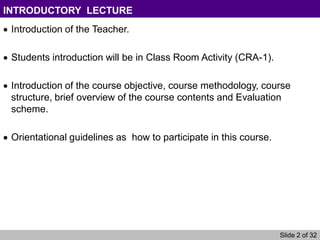
Slide 2 of 32
INTRODUCTORY LECTURE
Introduction of the Teacher.
Students introduction will be in Class Room Activity (CRA-1).
Introduction of the course objective, course methodology, course
structure, brief overview of the course contents and Evaluation
scheme.
Orientational guidelines as how to participate in this course.
Understanding the need, basic guidelines, content
and process for Value Education
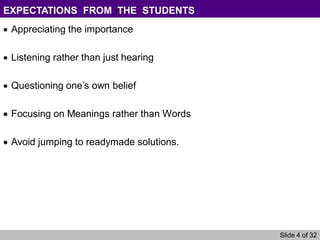
Slide 4 of 32
EXPECTATIONS FROM THE STUDENTS
Appreciating the importance
Listening rather than just hearing
Questioning one’s own belief
Focusing on Meanings rather than Words
Avoid jumping to readymade solutions.
Slide 5 of 32
Topics to be covered in Lecture-1
1.1 Need for Value Education
1.2 Basic Guidelines for Value Education
1.3 Content of Value Education
1.4 Process of Value Education
Slide 6 of 32
Need for Value Education
All Human Beings continuously aspire for a Happy Life, a fulfilling and
successful life.
The purpose of Education is to provide adequate competence to
actualize this aspiration.
Slide 7 of 32
Expectations from Education
Education should prepare the student for:
 Understanding ‘what to do’ – What is VALUABLE , as a human being
and
 Learning ‘how to do’ – skills, technology
Are both required or we can do with just one of them?
Both are important
What would be the priority between these two?
The Priority is
 Understanding ‘what to do’, then  Value Education
 Learning ‘how to do’ and Doing  Technical Education
Slide 8 of 32
The Current Priority: Learning ‘how to do’
Knowingly or unknowingly, our education has become skill-biased.
There is almost no input on Values.
So while we progress in skills, develop & use new technologies, we
are unable to ensure ethical use of the technology…
Science and technology can only help to provide the means to
achieve what is considered valuable.
It is not within the scope of Science and technology to provide the
competence of deciding what really is Valuable.
Value Education is a crucial missing link in the present Education
system. Because of this deficiency, most of our efforts may prove to
be wrong and serious crises at the individual, societal and
environmental level.
Slide 10 of 32
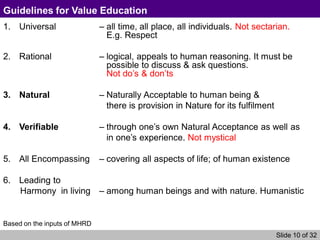
Guidelines for Value Education
1. Universal – all time, all place, all individuals. Not sectarian.
E.g. Respect
2. Rational – logical, appeals to human reasoning. It must be
possible to discuss & ask questions.
Not do’s & don’ts
3. Natural – Naturally Acceptable to human being &
there is provision in Nature for its fulfilment
4. Verifiable – through one’s own Natural Acceptance as well as
in one’s experience. Not mystical
5. All Encompassing – covering all aspects of life; of human existence
6. Leading to
Harmony in living – among human beings and with nature. Humanistic
Based on the inputs of MHRD
Slide 17 of 32
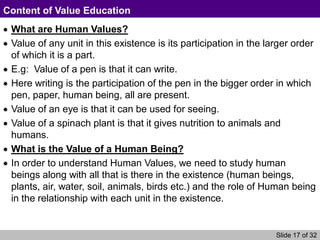
Content of Value Education
What are Human Values?
Value of any unit in this existence is its participation in the larger order
of which it is a part.
E.g: Value of a pen is that it can write.
Here writing is the participation of the pen in the bigger order in which
pen, paper, human being, all are present.
Value of an eye is that it can be used for seeing.
Value of a spinach plant is that it gives nutrition to animals and
humans.
What is the Value of a Human Being?
In order to understand Human Values, we need to study human
beings along with all that is there in the existence (human beings,
plants, air, water, soil, animals, birds etc.) and the role of Human being
in the relationship with each unit in the existence.
Slide 19 of 32
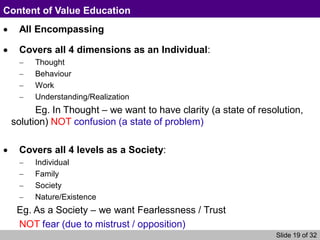
Content of Value Education
All Encompassing
Covers all 4 dimensions as an Individual:
Thought
Behaviour
Work
Understanding/Realization
Eg. In Thought – we want to have clarity (a state of resolution,
solution) NOT confusion (a state of problem)
Covers all 4 levels as a Society:
Individual
Family
Society
Nature/Existence
Eg. As a Society – we want Fearlessness / Trust
NOT fear (due to mistrust / opposition)
Slide 20 of 32
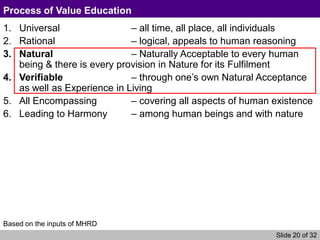
Process of Value Education
1. Universal – all time, all place, all individuals
2. Rational – logical, appeals to human reasoning
3. Natural – Naturally Acceptable to every human
being & there is every provision in Nature for its Fulfilment
4. Verifiable – through one’s own Natural Acceptance
as well as Experience in Living
5. All Encompassing – covering all aspects of human existence
6. Leading to Harmony – among human beings and with nature
Based on the inputs of MHRD
Slide 21 of 32
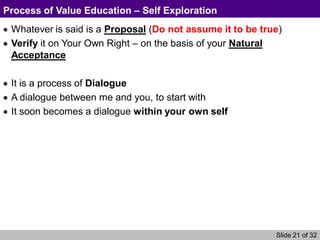
Process of Value Education – Self Exploration
Whatever is said is a Proposal (Do not assume it to be true)
Verify it on Your Own Right – on the basis of your Natural
Acceptance
It is a process of Dialogue
A dialogue between me and you, to start with
It soon becomes a dialogue within your own self
Slide 22 of 32
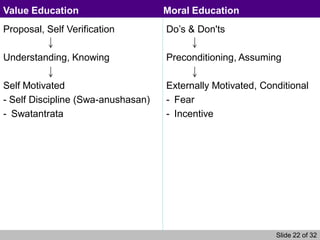
Proposal, Self Verification
Understanding, Knowing
Self Motivated
- Self Discipline (Swa-anushasan)
- Swatantrata
Do’s & Don'ts
Preconditioning, Assuming
Externally Motivated, Conditional
- Fear
- Incentive
Value Education Moral Education
Slide 23 of 32
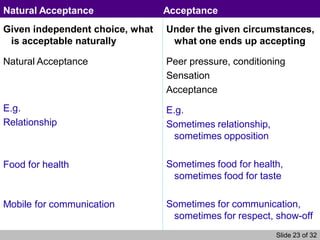
Given independent choice, what
is acceptable naturally
Natural Acceptance
E.g.
Relationship
Food for health
Mobile for communication
Under the given circumstances,
what one ends up accepting
Peer pressure, conditioning
Sensation
Acceptance
E.g.
Sometimes relationship,
sometimes opposition
Sometimes food for health,
sometimes food for taste
Sometimes for communication,
sometimes for respect, show-off
Natural Acceptance Acceptance
Slide 26 of 32
Status of Human Values in Higher Education – July 2013
2005 IIIT Hyderabad (AP)
2006 IIT Kanpur (UP)
2009 GBTU & MTU [ 700 Colleges]
2011 PTU (Punjab) [ 325 Colleges]
2012 HPTU, Hamirpur (HP) [ 46 Colleges]
2013 Royal University of Bhutan [ 11 Colleges]
2013 JNKVV, Jabalpur (MP) [ 6 Colleges]
2013 RVSKVV, Gwalior (MP) [ 2 Colleges]
Commissionerate of Higher Education, Andhra Pradesh
[approx. 200Degree Colleges in Andhra Pradesh ]
2013 K L UNIVERSITY, Andhra Pradesh
2015 JNTU, Hyderabad (AP) [ 462 Colleges]
Slide 27 of 32
HE President Dr. APJ Abdul Kalam’s Message to the Nation – 2006
Dr. Kalam, the then President of India, had 4
personal discussions about this,
recognized its potential and spoke about
the effort in his address to the nation on
the eve of Independence Day in Aug 2006
“… being practiced by Prof Ganesh Bagaria, … Prof Rajeev Sangal…
and their teams … [it] is a ‘teachable human value based skill’… This
process of imparting self-knowledge would promote a learning
atmosphere, where this whole movement of inquiry into knowledge, into
oneself, into the possibility of something beyond knowledge would bring
about naturally a psychological revolution.. From this comes inevitably
a totally different order in human relationship and therefore society
as a whole. The intelligent understanding of this process itself can
bring about a profound change in the consciousness of
mankind…” (VIDEO 3 min)
Source: http://www.indianembassy.ru/docs-htm/en/en_hp_win_official_direct_t075.htm
Slide 28 of 32
Summary
Need – To have the clarity about "what to do" / Human goal, Human
purpose, we need to know what is valuable for Human Being
Guidelines:
1. Universal – all time, all place, all individuals
2. Rational – logical, appeals to reasoning
3. Natural – to human being & to nature
4. Verifiable – through one’s own experience
5. All Encompassing – covering all aspects of human existence
6. Leading to Harmony – among human beings and with nature
Process
Content

Understanding value education

  • 1.
    HUMAN VALUES COURSE AY:2016-2017 WELCOME TO
  • 2.
    Slide 2 of32 INTRODUCTORY LECTURE Introduction of the Teacher. Students introduction will be in Class Room Activity (CRA-1). Introduction of the course objective, course methodology, course structure, brief overview of the course contents and Evaluation scheme. Orientational guidelines as how to participate in this course.
  • 3.
    Understanding the need,basic guidelines, content and process for Value Education
  • 4.
    Slide 4 of32 EXPECTATIONS FROM THE STUDENTS Appreciating the importance Listening rather than just hearing Questioning one’s own belief Focusing on Meanings rather than Words Avoid jumping to readymade solutions.
  • 5.
    Slide 5 of32 Topics to be covered in Lecture-1 1.1 Need for Value Education 1.2 Basic Guidelines for Value Education 1.3 Content of Value Education 1.4 Process of Value Education
  • 6.
    Slide 6 of32 Need for Value Education All Human Beings continuously aspire for a Happy Life, a fulfilling and successful life. The purpose of Education is to provide adequate competence to actualize this aspiration.
  • 7.
    Slide 7 of32 Expectations from Education Education should prepare the student for:  Understanding ‘what to do’ – What is VALUABLE , as a human being and  Learning ‘how to do’ – skills, technology Are both required or we can do with just one of them? Both are important What would be the priority between these two? The Priority is  Understanding ‘what to do’, then  Value Education  Learning ‘how to do’ and Doing  Technical Education
  • 8.
    Slide 8 of32 The Current Priority: Learning ‘how to do’ Knowingly or unknowingly, our education has become skill-biased. There is almost no input on Values. So while we progress in skills, develop & use new technologies, we are unable to ensure ethical use of the technology… Science and technology can only help to provide the means to achieve what is considered valuable. It is not within the scope of Science and technology to provide the competence of deciding what really is Valuable. Value Education is a crucial missing link in the present Education system. Because of this deficiency, most of our efforts may prove to be wrong and serious crises at the individual, societal and environmental level.
  • 9.
    Slide 10 of32 Guidelines for Value Education 1. Universal – all time, all place, all individuals. Not sectarian. E.g. Respect 2. Rational – logical, appeals to human reasoning. It must be possible to discuss & ask questions. Not do’s & don’ts 3. Natural – Naturally Acceptable to human being & there is provision in Nature for its fulfilment 4. Verifiable – through one’s own Natural Acceptance as well as in one’s experience. Not mystical 5. All Encompassing – covering all aspects of life; of human existence 6. Leading to Harmony in living – among human beings and with nature. Humanistic Based on the inputs of MHRD
  • 10.
    Slide 17 of32 Content of Value Education What are Human Values? Value of any unit in this existence is its participation in the larger order of which it is a part. E.g: Value of a pen is that it can write. Here writing is the participation of the pen in the bigger order in which pen, paper, human being, all are present. Value of an eye is that it can be used for seeing. Value of a spinach plant is that it gives nutrition to animals and humans. What is the Value of a Human Being? In order to understand Human Values, we need to study human beings along with all that is there in the existence (human beings, plants, air, water, soil, animals, birds etc.) and the role of Human being in the relationship with each unit in the existence.
  • 11.
    Slide 19 of32 Content of Value Education All Encompassing Covers all 4 dimensions as an Individual: Thought Behaviour Work Understanding/Realization Eg. In Thought – we want to have clarity (a state of resolution, solution) NOT confusion (a state of problem) Covers all 4 levels as a Society: Individual Family Society Nature/Existence Eg. As a Society – we want Fearlessness / Trust NOT fear (due to mistrust / opposition)
  • 12.
    Slide 20 of32 Process of Value Education 1. Universal – all time, all place, all individuals 2. Rational – logical, appeals to human reasoning 3. Natural – Naturally Acceptable to every human being & there is every provision in Nature for its Fulfilment 4. Verifiable – through one’s own Natural Acceptance as well as Experience in Living 5. All Encompassing – covering all aspects of human existence 6. Leading to Harmony – among human beings and with nature Based on the inputs of MHRD
  • 13.
    Slide 21 of32 Process of Value Education – Self Exploration Whatever is said is a Proposal (Do not assume it to be true) Verify it on Your Own Right – on the basis of your Natural Acceptance It is a process of Dialogue A dialogue between me and you, to start with It soon becomes a dialogue within your own self
  • 14.
    Slide 22 of32 Proposal, Self Verification Understanding, Knowing Self Motivated - Self Discipline (Swa-anushasan) - Swatantrata Do’s & Don'ts Preconditioning, Assuming Externally Motivated, Conditional - Fear - Incentive Value Education Moral Education
  • 15.
    Slide 23 of32 Given independent choice, what is acceptable naturally Natural Acceptance E.g. Relationship Food for health Mobile for communication Under the given circumstances, what one ends up accepting Peer pressure, conditioning Sensation Acceptance E.g. Sometimes relationship, sometimes opposition Sometimes food for health, sometimes food for taste Sometimes for communication, sometimes for respect, show-off Natural Acceptance Acceptance
  • 16.
    Slide 26 of32 Status of Human Values in Higher Education – July 2013 2005 IIIT Hyderabad (AP) 2006 IIT Kanpur (UP) 2009 GBTU & MTU [ 700 Colleges] 2011 PTU (Punjab) [ 325 Colleges] 2012 HPTU, Hamirpur (HP) [ 46 Colleges] 2013 Royal University of Bhutan [ 11 Colleges] 2013 JNKVV, Jabalpur (MP) [ 6 Colleges] 2013 RVSKVV, Gwalior (MP) [ 2 Colleges] Commissionerate of Higher Education, Andhra Pradesh [approx. 200Degree Colleges in Andhra Pradesh ] 2013 K L UNIVERSITY, Andhra Pradesh 2015 JNTU, Hyderabad (AP) [ 462 Colleges]
  • 17.
    Slide 27 of32 HE President Dr. APJ Abdul Kalam’s Message to the Nation – 2006 Dr. Kalam, the then President of India, had 4 personal discussions about this, recognized its potential and spoke about the effort in his address to the nation on the eve of Independence Day in Aug 2006 “… being practiced by Prof Ganesh Bagaria, … Prof Rajeev Sangal… and their teams … [it] is a ‘teachable human value based skill’… This process of imparting self-knowledge would promote a learning atmosphere, where this whole movement of inquiry into knowledge, into oneself, into the possibility of something beyond knowledge would bring about naturally a psychological revolution.. From this comes inevitably a totally different order in human relationship and therefore society as a whole. The intelligent understanding of this process itself can bring about a profound change in the consciousness of mankind…” (VIDEO 3 min) Source: http://www.indianembassy.ru/docs-htm/en/en_hp_win_official_direct_t075.htm
  • 18.
    Slide 28 of32 Summary Need – To have the clarity about "what to do" / Human goal, Human purpose, we need to know what is valuable for Human Being Guidelines: 1. Universal – all time, all place, all individuals 2. Rational – logical, appeals to reasoning 3. Natural – to human being & to nature 4. Verifiable – through one’s own experience 5. All Encompassing – covering all aspects of human existence 6. Leading to Harmony – among human beings and with nature Process Content