Value chain analysis for products and by-products from
egg laying birds in peri-urban areas of Nairobi City
Joshua Onono, Pablo Alarcon, Barbara Haesler, Eric Fevre, Maurice Karani,
Patrick Muinde, James Akoko, Maud Carron and Jonathan Rushton
14th conference of the International Society for Veterinary Epidemiology and Economics
Merida, Yucatan, Mexico
3-7 November 2015
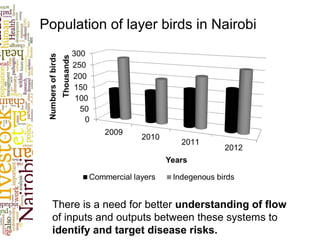
Population of layer birds in Nairobi
There is a need for better understanding of flow
of inputs and outputs between these systems to
identify and target disease risks.
Objectives
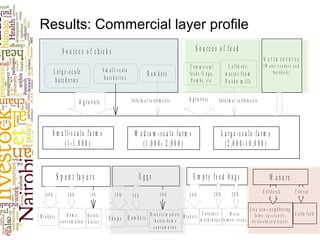
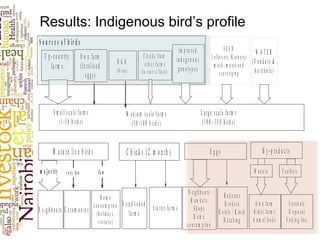
The objective was to map profiles of value chains
for products and by-products from commercial layers
and indigenous birds within the City of Nairobi.
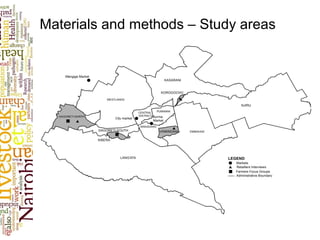
Materials and methods – Study areas
Materials and methods – Data collection
• Focus group discussions with poultry farmers: layers,
Indigenous birds.
– Inputs (day old chicks, mature birds, water, veterinary care,
feed);
– Outputs (products, buyers, farm gate prices).
– Challenges of poultry production, disease and food safety
risk.
• Key informant interviews with extension officers
– Triangulation of information
Materials and methods – Data analysis
• Mapping the chain for each system
– Interaction between value chain actors
– Flow of products and inputs.
– Qualitative description of risk practises
• Ranking challenges using non-parametric methods
(Kruskal Wallis One way Anova).
Results: Commercial layer profile
L a rg e -s c a le
h a tc h e rie s
S m a ll - s c a l e
h a tc h e r ie s
H a w k e rs
S o u rc e s o f c h ic k s
W A T E R S O U R C E S
( W a te r v e n d o r s a n d
b o r e h o le )
S m a ll-s c a le fa rm s
(1 -1 ,0 0 0 )
M e d iu m -s c a le fa rm s
(1 ,0 0 0 - 2 ,0 0 0 )
L a rg e -s c a le fa rm s
(2 ,0 0 0 -1 0 ,0 0 0 )
S p e n t la y e rs E g g s M a n u reE m p ty fe e d b a g s
C ro p fa rm s ,n e ig h b o r in g
fa rm s , u p -c o u n t ry ,
h o r t ic u lt u ra l p ro je c t s
C a ttle f e e d
U n f ilte r e d F ilte r e d
B r o k e r s
F u r n itu r e
w o r k s h o p s
M a iz e
fa rm e rs / s h o p s
6 0 % 2 0 % 2 0 %
B r o k e r s H o m e
c o n s u m p tio n
H o te ls /
k io s k s
S h o p s H a w k e r s
B r o k e r s /m a r k e ts
/h o te ls /h o m e
c o n s u m p tio n
5 0 % 2 0 % 3 0 %6 0 % 3 0 % 1 0 %
A g ro v e ts A g r o v e t sI n f o r m a l s e ttle m e n ts I n f o r m a l s e ttle m e n ts
L e f t o v e r ,
w a s te s f r o m
P o s h o m il ls
C o m m e r c ia l
f e e d s : U n g a ,
P e m b e , e tc
S o u rc e s o f fe e d
Results: Indigenous bird’s profile
S o u r c e s o f b ir d s
O w n fa rm
(fe rtilise d
e g g s)
U p -c o u n try
fa rm s
N G O
(D o le p )
S m a ll s c a le fa rm s
(1 -5 0 b ird s )
M e d iu m s c a le fa rm s
(5 0 -1 0 0 b ird s )
L a rg e sc a le fa rm s
(1 0 0 - 1 5 0 b ird s)
N e ig h b o u rs C e re m o n ie s
H o m e
c o n s u m p tio n
(h o lid a y s ,
v is ito rs )
E s ta b lis h e d
fa rm s
C h ic k s fro m
o th e r fa rm s
(to s ta rt a flo c k )
m a jo r ity
S ta rte r fa rm s
O w n fa rm
O th e r fa rm s
A n m a l fe e d s
Im p ro v e d
in d e g e n o u s
g e n o ty p e s
W A T E R
(V e n d o rs &
b o re h o le )
F E E D
L e fto v e rs , K ie n y e ji
m a s h , m a iz e a n d
s c a v e n g in g
M a tu re liv e b ird s C h ic k s (2 m o n th ) E g g s B y -p ro d u c ts
v e ry fe w fe w
N e ig h b o u rs
H a w k e rs
S h o p s
H o m e
c o n su m p tio n
B a k e rie s
B ro k e rs
H o te ls / K io s k
H a tc h in g
F e s tiv a ls
D is p o s a l
F is h in g lin e
M a n u re F e a th e rs
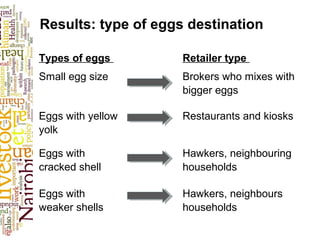
Results: type of eggs destination
Types of eggs Retailer type
Small egg size Brokers who mixes with
bigger eggs
Eggs with yellow
yolk
Restaurants and kiosks
Eggs with
cracked shell
Hawkers, neighbouring
households
Eggs with
weaker shells
Hawkers, neighbours
households
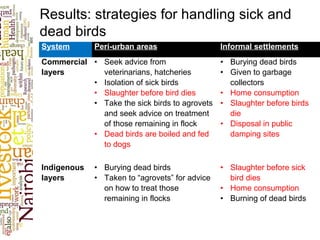
Results: strategies for handling sick and
dead birds
System Peri-urban areas Informal settlements
Commercial
layers
• Seek advice from
veterinarians, hatcheries
• Isolation of sick birds
• Slaughter before bird dies
• Take the sick birds to agrovets
and seek advice on treatment
of those remaining in flock
• Dead birds are boiled and fed
to dogs
• Burying dead birds
• Given to garbage
collectors
• Home consumption
• Slaughter before birds
die
• Disposal in public
damping sites
Indigenous
layers
• Burying dead birds
• Taken to “agrovets” for advice
on how to treat those
remaining in flocks
• Slaughter before sick
bird dies
• Home consumption
• Burning of dead birds
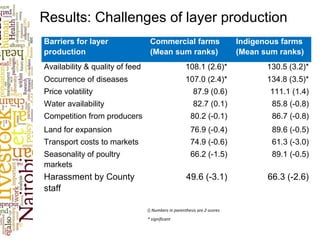
Results: Challenges of layer production
Barriers for layer
production
Commercial farms
(Mean sum ranks)
Indigenous farms
(Mean sum ranks)
Availability & quality of feed 108.1 (2.6)* 130.5 (3.2)*
Occurrence of diseases 107.0 (2.4)* 134.8 (3.5)*
Price volatility 87.9 (0.6) 111.1 (1.4)
Water availability 82.7 (0.1) 85.8 (-0.8)
Competition from producers 80.2 (-0.1) 86.7 (-0.8)
Land for expansion 76.9 (-0.4) 89.6 (-0.5)
Transport costs to markets 74.9 (-0.6) 61.3 (-3.0)
Seasonality of poultry
markets
66.2 (-1.5) 89.1 (-0.5)
Harassment by County
staff
49.6 (-3.1) 66.3 (-2.6)
() Numbers in parenthesis are Z-scores
* significant
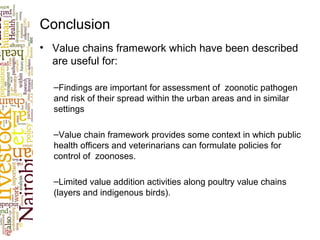
Conclusion
• Value chains framework which have been described
are useful for:
–Findings are important for assessment of zoonotic pathogen
and risk of their spread within the urban areas and in similar
settings
–Value chain framework provides some context in which public
health officers and veterinarians can formulate policies for
control of zoonoses.
–Limited value addition activities along poultry value chains
(layers and indigenous birds).
Thank you
University of Nairobi
International Institute
for the Environment
and Development
Roslin Institute
Kenya Medical
Research Institute
Collaborators
The partners
03/18/16
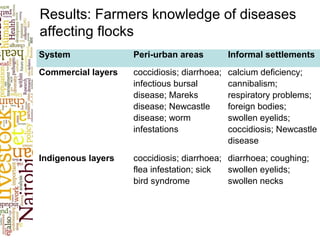
Results: Farmers knowledge of diseases
affecting flocks
System Peri-urban areas Informal settlements
Commercial layers coccidiosis; diarrhoea;
infectious bursal
disease; Mareks
disease; Newcastle
disease; worm
infestations
calcium deficiency;
cannibalism;
respiratory problems;
foreign bodies;
swollen eyelids;
coccidiosis; Newcastle
disease
Indigenous layers coccidiosis; diarrhoea;
flea infestation; sick
bird syndrome
diarrhoea; coughing;
swollen eyelids;
swollen necks

Value chain analysis for products and by-products of egg laying birds in peri-urban areas of Nairobi City

  • 1.
    Value chain analysisfor products and by-products from egg laying birds in peri-urban areas of Nairobi City Joshua Onono, Pablo Alarcon, Barbara Haesler, Eric Fevre, Maurice Karani, Patrick Muinde, James Akoko, Maud Carron and Jonathan Rushton 14th conference of the International Society for Veterinary Epidemiology and Economics Merida, Yucatan, Mexico 3-7 November 2015
  • 2.
    Population of layerbirds in Nairobi There is a need for better understanding of flow of inputs and outputs between these systems to identify and target disease risks.
  • 3.
    Objectives The objective wasto map profiles of value chains for products and by-products from commercial layers and indigenous birds within the City of Nairobi.
  • 4.
    Materials and methods– Study areas
  • 5.
    Materials and methods– Data collection • Focus group discussions with poultry farmers: layers, Indigenous birds. – Inputs (day old chicks, mature birds, water, veterinary care, feed); – Outputs (products, buyers, farm gate prices). – Challenges of poultry production, disease and food safety risk. • Key informant interviews with extension officers – Triangulation of information
  • 6.
    Materials and methods– Data analysis • Mapping the chain for each system – Interaction between value chain actors – Flow of products and inputs. – Qualitative description of risk practises • Ranking challenges using non-parametric methods (Kruskal Wallis One way Anova).
  • 7.
    Results: Commercial layerprofile L a rg e -s c a le h a tc h e rie s S m a ll - s c a l e h a tc h e r ie s H a w k e rs S o u rc e s o f c h ic k s W A T E R S O U R C E S ( W a te r v e n d o r s a n d b o r e h o le ) S m a ll-s c a le fa rm s (1 -1 ,0 0 0 ) M e d iu m -s c a le fa rm s (1 ,0 0 0 - 2 ,0 0 0 ) L a rg e -s c a le fa rm s (2 ,0 0 0 -1 0 ,0 0 0 ) S p e n t la y e rs E g g s M a n u reE m p ty fe e d b a g s C ro p fa rm s ,n e ig h b o r in g fa rm s , u p -c o u n t ry , h o r t ic u lt u ra l p ro je c t s C a ttle f e e d U n f ilte r e d F ilte r e d B r o k e r s F u r n itu r e w o r k s h o p s M a iz e fa rm e rs / s h o p s 6 0 % 2 0 % 2 0 % B r o k e r s H o m e c o n s u m p tio n H o te ls / k io s k s S h o p s H a w k e r s B r o k e r s /m a r k e ts /h o te ls /h o m e c o n s u m p tio n 5 0 % 2 0 % 3 0 %6 0 % 3 0 % 1 0 % A g ro v e ts A g r o v e t sI n f o r m a l s e ttle m e n ts I n f o r m a l s e ttle m e n ts L e f t o v e r , w a s te s f r o m P o s h o m il ls C o m m e r c ia l f e e d s : U n g a , P e m b e , e tc S o u rc e s o f fe e d
  • 8.
    Results: Indigenous bird’sprofile S o u r c e s o f b ir d s O w n fa rm (fe rtilise d e g g s) U p -c o u n try fa rm s N G O (D o le p ) S m a ll s c a le fa rm s (1 -5 0 b ird s ) M e d iu m s c a le fa rm s (5 0 -1 0 0 b ird s ) L a rg e sc a le fa rm s (1 0 0 - 1 5 0 b ird s) N e ig h b o u rs C e re m o n ie s H o m e c o n s u m p tio n (h o lid a y s , v is ito rs ) E s ta b lis h e d fa rm s C h ic k s fro m o th e r fa rm s (to s ta rt a flo c k ) m a jo r ity S ta rte r fa rm s O w n fa rm O th e r fa rm s A n m a l fe e d s Im p ro v e d in d e g e n o u s g e n o ty p e s W A T E R (V e n d o rs & b o re h o le ) F E E D L e fto v e rs , K ie n y e ji m a s h , m a iz e a n d s c a v e n g in g M a tu re liv e b ird s C h ic k s (2 m o n th ) E g g s B y -p ro d u c ts v e ry fe w fe w N e ig h b o u rs H a w k e rs S h o p s H o m e c o n su m p tio n B a k e rie s B ro k e rs H o te ls / K io s k H a tc h in g F e s tiv a ls D is p o s a l F is h in g lin e M a n u re F e a th e rs
  • 9.
    Results: type ofeggs destination Types of eggs Retailer type Small egg size Brokers who mixes with bigger eggs Eggs with yellow yolk Restaurants and kiosks Eggs with cracked shell Hawkers, neighbouring households Eggs with weaker shells Hawkers, neighbours households
  • 10.
    Results: strategies forhandling sick and dead birds System Peri-urban areas Informal settlements Commercial layers • Seek advice from veterinarians, hatcheries • Isolation of sick birds • Slaughter before bird dies • Take the sick birds to agrovets and seek advice on treatment of those remaining in flock • Dead birds are boiled and fed to dogs • Burying dead birds • Given to garbage collectors • Home consumption • Slaughter before birds die • Disposal in public damping sites Indigenous layers • Burying dead birds • Taken to “agrovets” for advice on how to treat those remaining in flocks • Slaughter before sick bird dies • Home consumption • Burning of dead birds
  • 11.
    Results: Challenges oflayer production Barriers for layer production Commercial farms (Mean sum ranks) Indigenous farms (Mean sum ranks) Availability & quality of feed 108.1 (2.6)* 130.5 (3.2)* Occurrence of diseases 107.0 (2.4)* 134.8 (3.5)* Price volatility 87.9 (0.6) 111.1 (1.4) Water availability 82.7 (0.1) 85.8 (-0.8) Competition from producers 80.2 (-0.1) 86.7 (-0.8) Land for expansion 76.9 (-0.4) 89.6 (-0.5) Transport costs to markets 74.9 (-0.6) 61.3 (-3.0) Seasonality of poultry markets 66.2 (-1.5) 89.1 (-0.5) Harassment by County staff 49.6 (-3.1) 66.3 (-2.6) () Numbers in parenthesis are Z-scores * significant
  • 12.
    Conclusion • Value chainsframework which have been described are useful for: –Findings are important for assessment of zoonotic pathogen and risk of their spread within the urban areas and in similar settings –Value chain framework provides some context in which public health officers and veterinarians can formulate policies for control of zoonoses. –Limited value addition activities along poultry value chains (layers and indigenous birds).
  • 13.
    Thank you University ofNairobi International Institute for the Environment and Development Roslin Institute Kenya Medical Research Institute Collaborators The partners 03/18/16
  • 14.
    Results: Farmers knowledgeof diseases affecting flocks System Peri-urban areas Informal settlements Commercial layers coccidiosis; diarrhoea; infectious bursal disease; Mareks disease; Newcastle disease; worm infestations calcium deficiency; cannibalism; respiratory problems; foreign bodies; swollen eyelids; coccidiosis; Newcastle disease Indigenous layers coccidiosis; diarrhoea; flea infestation; sick bird syndrome diarrhoea; coughing; swollen eyelids; swollen necks

Editor's Notes

  • #3 Poultry production and supply networks in developing countries are complex and poorly understood. Indigenous birds are described using phenotypic characteristics: fizzled feathered, naked neck, barred feathered, feathered shanks, bearded and dwarfed size. Commercial layers (Isa Brown and Ross).
  • #4 This study is part of a bigger project whose objective is to understand livestock food systems within Nairobi City.
  • #6 Individual questionnaires with retailers of poultry products: - Types of products sold and retail prices.
  • #7 Margins from different products were calculated as a different between farm-gate and retail prices expressed as percentage.