FOOD PRODUCTION,
STORAGE & DISTRIBUTION

         G R O U P - 1

               1
                   L/O/G/O
‘India will have to double food
  production by 2040’ The Indian Express Sun Dec 02 2012,
                                 ___


                                                        2
India's raw food sector covers fruit and
  vegetables; spices; meat and poultry;
  milk and milk products, beverages,
  fisheries, soya-based products, etc…..

The Indian food services industry is
 estimated to be nearly worth Rs
 75,000 crore (US$ 13.79 billion)
                                       3
Cropping Pattern
   India is a vast country. The climatic
   conditions like temperature, humidity
   and rainfall vary from one region to
   another. Accordingly, there is a rich
   variety of crops grown in different
   parts of the country. Despite this
   diversity, two broad cropping
   patterns can be identified.
   1)Kharif Crops
   2)Rabi Crops
                                           4
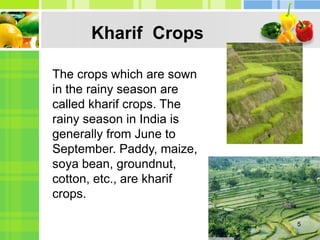
Kharif Crops

The crops which are sown
in the rainy season are
called kharif crops. The
rainy season in India is
generally from June to
September. Paddy, maize,
soya bean, groundnut,
cotton, etc., are kharif
crops.

                           5
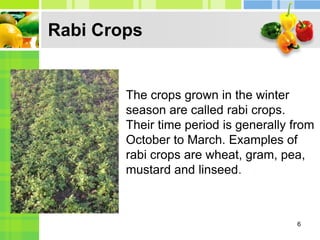
Rabi Crops


        The crops grown in the winter
        season are called rabi crops.
        Their time period is generally from
        October to March. Examples of
        rabi crops are wheat, gram, pea,
        mustard and linseed.


                                       6
The production crops for 2011-12


Rice    • Rice               103.41 million tonnes (record)
        • 103.41 million tonnes (record)
        • Wheat
        • 90.23 million tonnes: highest ever
                             88 million tonnes: highest
Wheat • Coarse Cereals       ever
        • 41.91 million tonnes
        • Maize
        • 21.33 million tonnes42 million tonnes
Coarse Cereals
        • Pulses
        • 17.02 million tonnes
Maize                         21.33 million tonnes
                                                       7
8
`


    9
10
11
STORAGE


   12
        L/O/G/O
INTRODUCTION

• Proper food storage is important to help
  you:
  * Preserve food quality, including
     nutrients, flavor and texture
  * Make the most of the money you spend
     on food by preventing spoilage
  * Keep food safe by limiting the growth of
     harmful bacteria and preventing
     contamination of foods
                                         13
High risk foods
• Dairy products, such as custard and
  dairy based desserts
• Eggs and egg products
• Cooked rice and pasta
• Prepared fruit salads
• Food that comes in packages, cans
  and jars can become high-risk foods
  once opened, and should be handled
  and stored correctly
                                        14
Date markings

• Food packages have date markings to
  let us know how long food can be kept
  before it is unsafe to eat or before the
  quality of the food begins to
  deteriorate.


                                         15
Storing leftovers
• Throw away any high risk food that
  has been standing at room
  temperature for more than two hours
• Divide food into smaller portions and
  put it in a shallow dish
• Do not put food in the fridge when it is
  still hot
• Leftovers stored in the fridge should
  be eaten within three days
                                         16
Freezing
• If food is properly frozen there are no
  food safety concerns
• The freezer temperature should be
  below -15 °C
• Frozen raw foods can be defrosted
  once and stored in the fridge for up to
  two days before they need to be
  cooked or thrown away

                                        17
Types of Food Storage Products

   • Canned foods

   • Dehydrated foods

   • Retort foods


                                 18
Canned foods
• Cheaper than other types of food
• Canned goods have a shelf life from two
  to seven years
• Canned goods can be eaten right out of
  the can, either cold or heated
• The canning process destroys many of
  the micronutrients in the food


                                       19
Dehydrated foods
• It involves reducing the moisture
  content in foods to create an
  unfavorable environment for spoilage
• Dehydrated foods can be either air-
  dried or freeze-dried
• Both methods can reduce the weight
  of fruits and vegetables by 80-90%,
  and meats by 30%
                                         20
Retort foods
• These foods are packaged in
  multilayer laminate pouches that are
  vacuum sealed and then heated to
  240-250° to sterilize the contents
• Retort products have a shelf life equal
  to that of canned goods
• They can be eaten straight out of their
  packaging
                                        21
8 tips of food storage
• Follow the First In, First Out (FIFO) rule
• Place meat as low as possible
• Store food in air-tight containers
• Store all food off the floor
• Temperature control still applies
• Do not overload refrigeration units
• Keep shelves and floors clean and
  organized
• When in doubt, throw it out

                                               22
Food Distribution


          23
               L/O/G/O
24
Retail concentration
Refers to the market-share generally
 belonging to the top 4 or 5 mass
 distribution firms
Reasons
  The particular relevance retail is gaining on
   a global scale
  The particular shape of the food chain
Positive & negative impacts

                                             25
Logistics
 Management of the flow of resources between the
  point of origin and the point of destination in order to
  meet some requirement

• Logistics fields

   Procurement logistics
   Production logistics
   Distribution logistics
   Disposal logistics
   Reverse logistics
   Green logistics
•


                                                        26
Agricultural marketing

Covers the services involved in moving
an agricultural product from the farm to the
consumer
Interconnected activities
Also includes acts of buying supplies,
renting equipment & paying labor


                                         27
Introduction to PDS

Established by the Government of India
under Ministry of Consumer Affairs, Food, and
Public Distribution

It distributes subsidized food and non-food
items to India's poor.

Major commodities distributed include staple
food grains, such as wheat, rice, sugar,
and kerosene

PDS or FPS                                    28
Fallouts of P.D.S System
1. Growing instances of the consumers receiving
inferior quality food grains.

2. Deceitful dealers replace good supplies
received from the F.C.I. with inferior stock

3. Illicit fair price shop owners have been found to
create large number of bogus cards

4. Many FPS dealers resort to malpractice, illegal
diversions of commodities, hoarding and black
marketing due to the minimal salary.           29
5. Numerous malpractices make safe and
nutritious food inaccessible and unaffordable

6. Identification of households to be denoted BPL
status and distribution to granted PDS services
has been highly irregular

7. Regional allocation and coverage of FPS are
unsatisfactory.


                                                30
•CONCLUSION
Indian food economy is one of the
strongest sector.
Eventhough food production is
increasing per year, due to factors
such as food inflation , inefficient
distribution systems and storage
systems ,India is facing downfall in
its food maintenance.
                                       31

food production distribution & storage in india

  • 1.
    FOOD PRODUCTION, STORAGE &DISTRIBUTION G R O U P - 1 1 L/O/G/O
  • 2.
    ‘India will haveto double food production by 2040’ The Indian Express Sun Dec 02 2012, ___ 2
  • 3.
    India's raw foodsector covers fruit and vegetables; spices; meat and poultry; milk and milk products, beverages, fisheries, soya-based products, etc….. The Indian food services industry is estimated to be nearly worth Rs 75,000 crore (US$ 13.79 billion) 3
  • 4.
    Cropping Pattern India is a vast country. The climatic conditions like temperature, humidity and rainfall vary from one region to another. Accordingly, there is a rich variety of crops grown in different parts of the country. Despite this diversity, two broad cropping patterns can be identified. 1)Kharif Crops 2)Rabi Crops 4
  • 5.
    Kharif Crops The cropswhich are sown in the rainy season are called kharif crops. The rainy season in India is generally from June to September. Paddy, maize, soya bean, groundnut, cotton, etc., are kharif crops. 5
  • 6.
    Rabi Crops The crops grown in the winter season are called rabi crops. Their time period is generally from October to March. Examples of rabi crops are wheat, gram, pea, mustard and linseed. 6
  • 7.
    The production cropsfor 2011-12 Rice • Rice 103.41 million tonnes (record) • 103.41 million tonnes (record) • Wheat • 90.23 million tonnes: highest ever 88 million tonnes: highest Wheat • Coarse Cereals ever • 41.91 million tonnes • Maize • 21.33 million tonnes42 million tonnes Coarse Cereals • Pulses • 17.02 million tonnes Maize 21.33 million tonnes 7
  • 8.
  • 9.
    ` 9
  • 10.
  • 11.
  • 12.
    STORAGE 12 L/O/G/O
  • 13.
    INTRODUCTION • Proper foodstorage is important to help you: * Preserve food quality, including nutrients, flavor and texture * Make the most of the money you spend on food by preventing spoilage * Keep food safe by limiting the growth of harmful bacteria and preventing contamination of foods 13
  • 14.
    High risk foods •Dairy products, such as custard and dairy based desserts • Eggs and egg products • Cooked rice and pasta • Prepared fruit salads • Food that comes in packages, cans and jars can become high-risk foods once opened, and should be handled and stored correctly 14
  • 15.
    Date markings • Foodpackages have date markings to let us know how long food can be kept before it is unsafe to eat or before the quality of the food begins to deteriorate. 15
  • 16.
    Storing leftovers • Throwaway any high risk food that has been standing at room temperature for more than two hours • Divide food into smaller portions and put it in a shallow dish • Do not put food in the fridge when it is still hot • Leftovers stored in the fridge should be eaten within three days 16
  • 17.
    Freezing • If foodis properly frozen there are no food safety concerns • The freezer temperature should be below -15 °C • Frozen raw foods can be defrosted once and stored in the fridge for up to two days before they need to be cooked or thrown away 17
  • 18.
    Types of FoodStorage Products • Canned foods • Dehydrated foods • Retort foods 18
  • 19.
    Canned foods • Cheaperthan other types of food • Canned goods have a shelf life from two to seven years • Canned goods can be eaten right out of the can, either cold or heated • The canning process destroys many of the micronutrients in the food 19
  • 20.
    Dehydrated foods • Itinvolves reducing the moisture content in foods to create an unfavorable environment for spoilage • Dehydrated foods can be either air- dried or freeze-dried • Both methods can reduce the weight of fruits and vegetables by 80-90%, and meats by 30% 20
  • 21.
    Retort foods • Thesefoods are packaged in multilayer laminate pouches that are vacuum sealed and then heated to 240-250° to sterilize the contents • Retort products have a shelf life equal to that of canned goods • They can be eaten straight out of their packaging 21
  • 22.
    8 tips offood storage • Follow the First In, First Out (FIFO) rule • Place meat as low as possible • Store food in air-tight containers • Store all food off the floor • Temperature control still applies • Do not overload refrigeration units • Keep shelves and floors clean and organized • When in doubt, throw it out 22
  • 23.
  • 24.
  • 25.
    Retail concentration Refers tothe market-share generally belonging to the top 4 or 5 mass distribution firms Reasons The particular relevance retail is gaining on a global scale The particular shape of the food chain Positive & negative impacts 25
  • 26.
    Logistics  Management ofthe flow of resources between the point of origin and the point of destination in order to meet some requirement • Logistics fields  Procurement logistics  Production logistics  Distribution logistics  Disposal logistics  Reverse logistics  Green logistics • 26
  • 27.
    Agricultural marketing Covers theservices involved in moving an agricultural product from the farm to the consumer Interconnected activities Also includes acts of buying supplies, renting equipment & paying labor 27
  • 28.
    Introduction to PDS Establishedby the Government of India under Ministry of Consumer Affairs, Food, and Public Distribution It distributes subsidized food and non-food items to India's poor. Major commodities distributed include staple food grains, such as wheat, rice, sugar, and kerosene PDS or FPS 28
  • 29.
    Fallouts of P.D.SSystem 1. Growing instances of the consumers receiving inferior quality food grains. 2. Deceitful dealers replace good supplies received from the F.C.I. with inferior stock 3. Illicit fair price shop owners have been found to create large number of bogus cards 4. Many FPS dealers resort to malpractice, illegal diversions of commodities, hoarding and black marketing due to the minimal salary. 29
  • 30.
    5. Numerous malpracticesmake safe and nutritious food inaccessible and unaffordable 6. Identification of households to be denoted BPL status and distribution to granted PDS services has been highly irregular 7. Regional allocation and coverage of FPS are unsatisfactory. 30
  • 31.
    •CONCLUSION Indian food economyis one of the strongest sector. Eventhough food production is increasing per year, due to factors such as food inflation , inefficient distribution systems and storage systems ,India is facing downfall in its food maintenance. 31