Value beyond
the pill
The possibilities that technology offers healthcare
By Marc Southern
June 2013


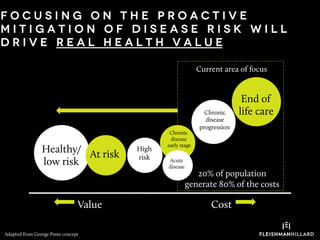
F o c u s i n g o n t h e P r o a c t i v e
m i t i g a t i o n o f d i s e a s e r i s k w i l l
d r i v e r e a l h e a l t h v a l u e
Value Cost
Healthy/
low risk
At risk
High
risk
Chronic
disease
early stage
Acute
disease
Chronic
disease
progression
End of
life care
20% of population
generate 80% of the costs
Adapted from George Poste concept
Current area of focus
V a l u e b e y o n d t h e p i l l
Healthcare companies can extend their value
proposition, providing services beyond the pill
Creating solutions, not only products
providing healthcare stakeholders, including patients,
with more knowledge, freedom and power to improve
health outcomes
4	
  
http://www.flickr.com/photos/betsyweber/6276753696/
5	
  
Novartis
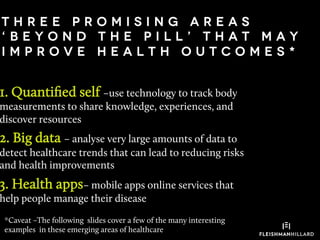
t h r e e p r o m i s i n g a r e a s
‘ B e y o n d t h e p i l l ’ t h a t m a y
I M P R O V E H E A L T H O U T C O M E S *
1. Quantified self –use technology to track body
measurements to share knowledge, experiences, and
discover resources
2. Big data – analyse very large amounts of data to
detect healthcare trends that can lead to reducing risks
and health improvements
3. Health apps– mobile apps online services that
help people manage their disease
*Caveat –The following slides cover a few of the many interesting
examples in these emerging areas of healthcare
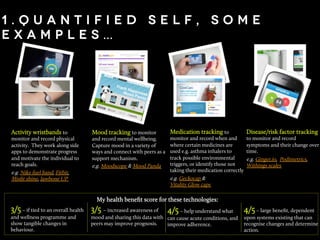
1 . Q u a n t i f i e d s e l f , s o m e
e x a m p l e s …
Activity wristbands to
monitor and record physical
activity. They work along side
apps to demonstrate progress
and motivate the individual to
reach goals.
e.g. Nike fuel band, Fitbit,
Misfit shine, Jawbone UP
Mood tracking to monitor
and record mental wellbeing.
Capture mood in a variety of
ways and connect with peers as a
support mechanism.
e.g. Moodscope & Mood Panda
Medication tracking to
monitor and record when and
where certain medicines are
used e.g. asthma inhalers to
track possible environmental
triggers, or identify those not
taking their medication correctly
e.g. Geckocap &
Vitality Glow caps
Disease/risk factor tracking
to monitor and record
symptoms and their change over
time.
e.g. Ginger.io, Podimetrics,
Withings scales
My health benefit score for these technologies: 	
  
3/5– if tied to an overall health
and wellness programme and
show tangible changes in
behaviour.
3/5 – increased awareness of
mood and sharing this data with
peers may improve prognosis.
4/5 – help understand what
can cause acute conditions, and
improve adherence.
4/5– large benefit, dependent
upon systems existing that can
recognise changes and determine
action.
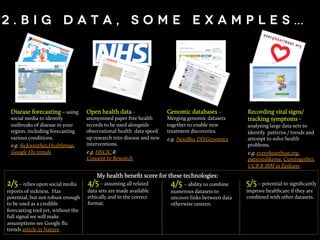
2 . B i g d a t a , s o m e e x a m p l e s …
Recording vital signs/
tracking symptoms -
analysing large data sets to
identify patterns / trends and
attempt to solve health
problems.
e.g. everyheartbeat.org,
patientslikeme, Curetogether,
UCB & IBM in Epilepsy
Open health data -
anonymised paper free health
records to be used alongside
observational health data speed
up research into disease and new
interventions.
e.g. HSCIC &
Consent to Research
Disease forecasting – using
social media to identify
outbreaks of disease in your
region, including forecasting
various conditions.
e.g. Sickweather,Healthmap,
Google Flu trends
Genomic databases –
Merging genomic datasets
together to enable new
treatment discoveries.
e.g. NextBio, DIYGenomics
My health benefit score for these technologies: 	
  
4/5– assuming all related
data sets are made available
ethically and in the correct
format.
2/5– relies upon social media
reports of sickness. Has
potential, but not robust enough
to be used as a credible
forecasting tool yet, without the
full signal we will make
assumptions see Google flu
trends article in Nature.
4/5 – ability to combine
numerous datasets to
uncover links between data
otherwise unseen.
5/5– potential to significantly
improve healthcare if they are
combined with other datasets.
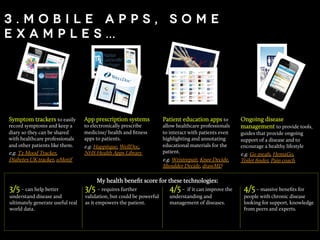
3 . M o b i l e a p p s , s o m e
e x a m p l e s …
Patient education apps to
allow healthcare professionals
to interact with patients even
highlighting and annotating
educational materials for the
patient.
e.g. Wristrepair, Knee Decide,
Shoulder Decide, drawMD
App prescription systems
to electronically prescribe
medicine/ health and fitness
apps to patients.
e.g. Happitque, WellDoc,
NHS Health Apps Library
Symptom trackers to easily
record symptoms and keep a
diary so they can be shared
with healthcare professionals
and other patients like them.
e.g. T2 Mood Tracker,
Diabetes UK tracker, uMotif
Ongoing disease
management to provide tools,
guides that provide ongoing
support of a disease and to
encourage a healthy lifestyle
e.g. Go meals, HemaGo,
Toilet finder, Pain coach
My health benefit score for these technologies: 	
  
4/5– if it can improve the
understanding and
management of diseases.
3/5 – requires further
validation, but could be powerful
as it empowers the patient.
3/5 – can help better
understand disease and
ultimately generate useful real
world data.
4/5– massive benefits for
people with chronic disease
looking for support, knowledge
from peers and experts.
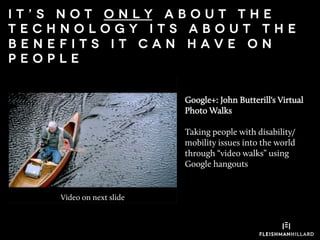
Google+: John Butterill's Virtual
Photo Walks
Taking people with disability/
mobility issues into the world
through “video walks” using
Google hangouts
I t ’ s n o t o n l y a b o u t t h e
t e c h n o l o g y i t s a b o u t t h e
b e n e f i t s i t c a n h a v e o n
p e o p l e
Video on next slide
11	
  
C h a n g i n g t h e r u l e s i n t h e
h e a l t h c a r e i n d u s t r y
Companies are getting more involved in
shaping the nature of the health sector. They
will be focused on delivering better health
outcomes in a broader way that encompasses
products and services beyond the pill.
The new winners will be the companies that
manage to position themselves as valuable
partners, open to collaboration. In every
industry, success flows from the ability to
adapt to (or reshape) industry architecture and
your role within it.
http://www.flickr.com/photos/londonmatt/3163571645/

Value Beyond The Pill: The Possibilities That Technology Offers Healthcare

  • 1.
    Value beyond the pill Thepossibilities that technology offers healthcare By Marc Southern June 2013
  • 2.
                              F o c u s i n g o n t h e P r o a c t i v e m i t i g a t i o n o f d i s e a s e r i s k w i l l d r i v e r e a l h e a l t h v a l u e Value Cost Healthy/ low risk At risk High risk Chronic disease early stage Acute disease Chronic disease progression End of life care 20% of population generate 80% of the costs Adapted from George Poste concept Current area of focus
  • 3.
    V a lu e b e y o n d t h e p i l l Healthcare companies can extend their value proposition, providing services beyond the pill Creating solutions, not only products providing healthcare stakeholders, including patients, with more knowledge, freedom and power to improve health outcomes
  • 4.
  • 5.
  • 6.
    t h re e p r o m i s i n g a r e a s ‘ B e y o n d t h e p i l l ’ t h a t m a y I M P R O V E H E A L T H O U T C O M E S * 1. Quantified self –use technology to track body measurements to share knowledge, experiences, and discover resources 2. Big data – analyse very large amounts of data to detect healthcare trends that can lead to reducing risks and health improvements 3. Health apps– mobile apps online services that help people manage their disease *Caveat –The following slides cover a few of the many interesting examples in these emerging areas of healthcare
  • 7.
    1 . Qu a n t i f i e d s e l f , s o m e e x a m p l e s … Activity wristbands to monitor and record physical activity. They work along side apps to demonstrate progress and motivate the individual to reach goals. e.g. Nike fuel band, Fitbit, Misfit shine, Jawbone UP Mood tracking to monitor and record mental wellbeing. Capture mood in a variety of ways and connect with peers as a support mechanism. e.g. Moodscope & Mood Panda Medication tracking to monitor and record when and where certain medicines are used e.g. asthma inhalers to track possible environmental triggers, or identify those not taking their medication correctly e.g. Geckocap & Vitality Glow caps Disease/risk factor tracking to monitor and record symptoms and their change over time. e.g. Ginger.io, Podimetrics, Withings scales My health benefit score for these technologies:   3/5– if tied to an overall health and wellness programme and show tangible changes in behaviour. 3/5 – increased awareness of mood and sharing this data with peers may improve prognosis. 4/5 – help understand what can cause acute conditions, and improve adherence. 4/5– large benefit, dependent upon systems existing that can recognise changes and determine action.
  • 8.
    2 . Bi g d a t a , s o m e e x a m p l e s … Recording vital signs/ tracking symptoms - analysing large data sets to identify patterns / trends and attempt to solve health problems. e.g. everyheartbeat.org, patientslikeme, Curetogether, UCB & IBM in Epilepsy Open health data - anonymised paper free health records to be used alongside observational health data speed up research into disease and new interventions. e.g. HSCIC & Consent to Research Disease forecasting – using social media to identify outbreaks of disease in your region, including forecasting various conditions. e.g. Sickweather,Healthmap, Google Flu trends Genomic databases – Merging genomic datasets together to enable new treatment discoveries. e.g. NextBio, DIYGenomics My health benefit score for these technologies:   4/5– assuming all related data sets are made available ethically and in the correct format. 2/5– relies upon social media reports of sickness. Has potential, but not robust enough to be used as a credible forecasting tool yet, without the full signal we will make assumptions see Google flu trends article in Nature. 4/5 – ability to combine numerous datasets to uncover links between data otherwise unseen. 5/5– potential to significantly improve healthcare if they are combined with other datasets.
  • 9.
    3 . Mo b i l e a p p s , s o m e e x a m p l e s … Patient education apps to allow healthcare professionals to interact with patients even highlighting and annotating educational materials for the patient. e.g. Wristrepair, Knee Decide, Shoulder Decide, drawMD App prescription systems to electronically prescribe medicine/ health and fitness apps to patients. e.g. Happitque, WellDoc, NHS Health Apps Library Symptom trackers to easily record symptoms and keep a diary so they can be shared with healthcare professionals and other patients like them. e.g. T2 Mood Tracker, Diabetes UK tracker, uMotif Ongoing disease management to provide tools, guides that provide ongoing support of a disease and to encourage a healthy lifestyle e.g. Go meals, HemaGo, Toilet finder, Pain coach My health benefit score for these technologies:   4/5– if it can improve the understanding and management of diseases. 3/5 – requires further validation, but could be powerful as it empowers the patient. 3/5 – can help better understand disease and ultimately generate useful real world data. 4/5– massive benefits for people with chronic disease looking for support, knowledge from peers and experts.
  • 10.
    Google+: John Butterill'sVirtual Photo Walks Taking people with disability/ mobility issues into the world through “video walks” using Google hangouts I t ’ s n o t o n l y a b o u t t h e t e c h n o l o g y i t s a b o u t t h e b e n e f i t s i t c a n h a v e o n p e o p l e Video on next slide
  • 11.
    11   C ha n g i n g t h e r u l e s i n t h e h e a l t h c a r e i n d u s t r y Companies are getting more involved in shaping the nature of the health sector. They will be focused on delivering better health outcomes in a broader way that encompasses products and services beyond the pill. The new winners will be the companies that manage to position themselves as valuable partners, open to collaboration. In every industry, success flows from the ability to adapt to (or reshape) industry architecture and your role within it. http://www.flickr.com/photos/londonmatt/3163571645/