

BEYOND THE PILL
BEYOND THE PILL

©
PM
Gr
ou
p2

01

The shift from just selling pills to developing
value-added services has only just begun

0.
Al
l ri
gh
ts
res
erv
ed

Executive Summary

.

As a first step managers should undertake mapping related to the breadth of
services offered and level of customisation, leading to a service model archetype

A rigorous review across the (holistic) value chain is required to decide on
what to build internally and where to involve the best external partners

26

www.pmlive.com/pme

Pharmaceutical Market Europe November 2013
BEYOND THE PILL

T
©

PM

he case for ‘beyond the pill’ services is
becoming well established. Most new
drugs coming to market are perceived
by some to have relatively limited value in
their own right (eg incremental benefits over
existing options). Some of the most urgent
unmet needs in healthcare in the developed
world (and therefore where the industry can
add most value in these regions) are not
just within the provision of medicines, but
also within healthcare systems and services.
Biopharmaceutical companies must therefore
consider the whole package; they should offer
compelling beyond the pill services related
to their products that address stakeholder
needs along the patient pathway, leading to
better health outcomes, while at the same time
providing a source of competitive advantage.
The strategic purpose and tactical mix
of these services can vary significantly,
so how do biopharma companies go
about choosing the right services, for
the right audience at the right time?
A beyond the pill approach should have a
central strategy at its core which underpins all
services offered. This strategy should include
in-depth customer analysis as well as disease,
brand and competition mapping, resulting
in a detailed assessment of stakeholder
needs throughout the patient pathway.
The completed mapping forms the basis
from which the service model strategy
can be developed, involving prioritisation
of the service model components and
development of the proposed solutions.
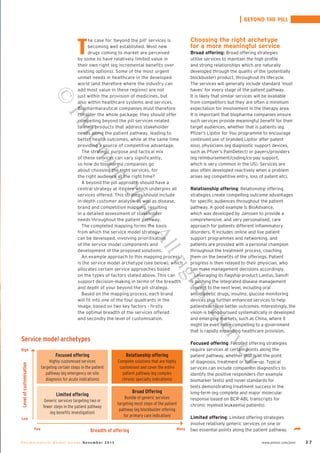
An example approach to this mapping process
is the service model archetype (see below), which
allocates certain service approaches based
on the types of factors stated above. This can
support decision-making in terms of the breadth
and depth of your beyond the pill strategy.
Based on the mapping process, each brand
will fit into one of the four quadrants in the
image, based on two key factors - firstly
the optimal breadth of the services offered
and secondly the level of customisation.

Choosing the right archetype
for a more meaningful service

Gr

ou

p2

Broad offering: Broad offering strategies
utilise services to maintain the high profile
and strong relationships which are naturally
developed through the quality of the (potentially
blockbuster) product, throughout its lifecycle.
The services will generally include standard ‘must
haves’ for every stage of the patient pathway.
It is likely that similar services will be available
from competitors but they are often a minimum
expectation for involvement in the therapy area.
It is important that biopharma companies ensure
such services provide meaningful benefit for their
target audiences, whether that is patients (eg
Pfizer’s Lipitor for You programme to encourage
continued use of branded Lipitor after patent
loss), physicians (eg diagnostic support devices,
such as Pfizer’s PainDetect) or payers/providers
(eg reimbursement/coding/co-pay support,
which is very common in the US). Services are
also often developed reactively when a problem
arises (eg competitive entry, loss of patent etc).

01

0.

Al

l ri

Relationship offering: Relationship offering
strategies create compelling outcome advantages
for specific audiences throughout the patient
pathway. A good example is BioAdvance,
which was developed by Janssen to provide a
comprehensive, and very personalised. care
approach for patients different inflammatory
disorders. It includes online and live patient
support programmes and networking, and
patients are provided with a personal champion
throughout the treatment process, coaching
them on the benefits of the offerings. Patient
progress is then relayed to their physician, who
can make management decisions accordingly.
Leveraging its flagship product Lantus, Sanofi
is pushing the integrated disease management
concept to the next level, including oral
anti-diabetic drugs, insulins, glucose monitoring
devices plus further enhanced services to help
patients achieve better outcomes. Interestingly, the
vision is being pursued systematically in developed
and emerging markets, such as China, where it
might be even more compelling to a government
that is rapidly expanding healthcare provision.

gh

erv

Complete solutions that are highly
customised and cover the entire
patient pathway (eg complex
chronic specialty indications)

diagnosis for acute indications)

.

Relationship offering

Highly customised services
targeting certain steps in the patient

Broad Offering

Limited offering
Generic services targeting two or
fewer steps in the patient pathway
(eg benefits investigation)

Low

targeting most steps of the patient
pathway (eg blockbuster offering
for primary care indication)

Breadth of offering

Pharmaceutical Market Europe November 2013

require services at certain points along the
patient pathway, whether that is at the point
of diagnosis, treatment or follow-up. Typical
services can include companion diagnostics to
identify the positive responders (for example
biomarker tests) and novel standards for
tests demonstrating treatment success in the
long-term (eg complete and major molecular
response based on BCR-ABL transcripts for
chronic myeloid leukaemia patients).

ed

Focused offering
Level of customisation

res

Focused offering: Focused offering strategies

High

Few

ts

Service model archetypes

Many

Limited offering: Limited offering strategies
involve relatively generic services on one or
two essential points along the patient pathway.
www.pmlive.com/pme

27
BEYOND THE PILL
For example, to support access to Nexium in
the US, AstraZeneca provide a Prescription
Savings programme for uninsured patients.

Assigning internal responsibilities
to fulfil the service strategy

©

One of the most common questions biopharma
companies have around beyond the pill is where
the planning and strategy – including the mapping
and selection around service model archetypes
– should originate from within the organisation.
While it doesn’t fit naturally into any one existing
job categories, marketing may seem like the
most natural fit as many of the types of services
provided in beyond the pill have traditionally
been considered marketing-type activities.
A poll on the Beyond the Pill LinkedIn group
posed this question, with marketing receiving 30
per cent of the vote, compared to 54 per cent for
the executive level, with the remainder shared
between R&D, sales and other. From the poll it is
clear that committed leadership is a prerequisite
for success, however, the functional lead probably
lies elsewhere within the organisation. Ultimately,
who leads it is probably less important than
establishing a cross-functional team that has the
principal responsibility of owning and driving
the beyond the pill programmes. Marketing and
medical should certainly be represented within
this team and legal/compliance input is essential.

partnership options for external services blocks,
often different in each country, can be grouped
into technology partners, such as mobile solutions
providers (eg BT Health in the UK), healthcare
partners, such as medical call centres and
biopharmaceutical distributors, and commercial/
marketing partners providing access to paying
customers, eg medical assistance operators.

Adapting commercial models to
maximise beyond the pill benefits

0.
01
p2
ou
Gr
PM

Traditional commercial models, focused on
pharmaceutical representatives targeting
prescribing physicians, can limit the available
funds for services strategies. Up to now, services
have generally been provided free. This has
created an expectation that this will always
be the case, but it is not a sustainable model
for delivery of meaningful, comprehensive
services. However, despite the fact that the
biopharmaceutical industry is well-placed to be
the core provider of beyond the pill services,
companies are currently not setup to generate
revenue in this way. It is only a matter of time
before the design and delivery of such services
is owned by other stakeholders who will be
more than happy to charge for their services.
To date, most companies have decided
not to change the revenue mechanism for
their products, still charging for the pill/vial
being distributed to their customers. Pay-forperformance and risk-sharing schemes have
been typically pursued after facing significant
market access challenges. Fresenius Medical
Care, the global market leader for renal
care, has successfully implemented a variety
of revenue mechanisms across countries,
such as razor-and-blade pricing for (haemo)
dialysis equipment/consumables charged to
centres, fee-for-service pricing per dialysis with
payers and long-term government contracts
with negotiated quality/service levels and
prices. Such business models may become
the template for biopharma in the future.
The shift from just selling pills to providing
services strategically to various different
customers/stakeholders has begun. Over time,
the biopharmaceutical sector will uncover
increasingly attractive business models, as did
insightful medical devices companies, such
as Fresenius Medical Care who embarked on
a similar journey decades ago. Longer-term,
we expect an evolution beyond the traditional
revenue mechanisms and commercial
models, which will be essential for biopharma
companies to maximise their value creation
within the healthcare sector at large.

Given the strict regulations the biopharma
sector is governed by and given that knowledge
gaps may exist in certain areas related to
certain services, biopharma companies often
consider external partners for implementing
the decided services strategy. Since many
required services are already available in today’s
healthcare systems, such as medical call centres,
telemedicine solutions and home care, a rigorous
review across the holistic value chain to decide
on what to build internally and where to involve
the best partners going forward is required.
The holistic value chain to deliver the services
strategy encompasses all necessary steps
including those not necessarily supplied by the
biopharma company, as outlined below using
the example of managing Alzheimer’s patients:
Customer advice and sale to (paying)
customers, eg patients, nursing homes
Patient-specific configuration and training
of involved stakeholders, eg caregiver
Permanent oversight of relevant patient
data, such as patient location using GPS
Initiation and implementation of key actions,
such as emergency calls to caregivers
Upgrading of overall system, such as oversight
algorithms and action trigger criteria.
Before selecting potential partners, biopharma
managers need to decide where they want to
focus internal resources leveraging their core
competencies best. The large number of different
28

www.pmlive.com/pme

.
ed
erv
res
ts
gh
l ri
Al

The role of external partners

The Authors
Aleksandar Ruzicic and Meike Wenzel are partners;
Wendy van der Lubbe is manager at specialist

executiveinsight.ch or w.vanderlubbe@executiveinsight.ch
Pharmaceutical Market Europe November 2013

Beyond-the-pill: how to move from selling pills to value-added solutions

  • 1.
    BEYOND THE PILL BEYONDTHE PILL © PM Gr ou p2 01 The shift from just selling pills to developing value-added services has only just begun 0. Al l ri gh ts res erv ed Executive Summary . As a first step managers should undertake mapping related to the breadth of services offered and level of customisation, leading to a service model archetype A rigorous review across the (holistic) value chain is required to decide on what to build internally and where to involve the best external partners 26 www.pmlive.com/pme Pharmaceutical Market Europe November 2013
  • 2.
    BEYOND THE PILL T © PM hecase for ‘beyond the pill’ services is becoming well established. Most new drugs coming to market are perceived by some to have relatively limited value in their own right (eg incremental benefits over existing options). Some of the most urgent unmet needs in healthcare in the developed world (and therefore where the industry can add most value in these regions) are not just within the provision of medicines, but also within healthcare systems and services. Biopharmaceutical companies must therefore consider the whole package; they should offer compelling beyond the pill services related to their products that address stakeholder needs along the patient pathway, leading to better health outcomes, while at the same time providing a source of competitive advantage. The strategic purpose and tactical mix of these services can vary significantly, so how do biopharma companies go about choosing the right services, for the right audience at the right time? A beyond the pill approach should have a central strategy at its core which underpins all services offered. This strategy should include in-depth customer analysis as well as disease, brand and competition mapping, resulting in a detailed assessment of stakeholder needs throughout the patient pathway. The completed mapping forms the basis from which the service model strategy can be developed, involving prioritisation of the service model components and development of the proposed solutions. An example approach to this mapping process is the service model archetype (see below), which allocates certain service approaches based on the types of factors stated above. This can support decision-making in terms of the breadth and depth of your beyond the pill strategy. Based on the mapping process, each brand will fit into one of the four quadrants in the image, based on two key factors - firstly the optimal breadth of the services offered and secondly the level of customisation. Choosing the right archetype for a more meaningful service Gr ou p2 Broad offering: Broad offering strategies utilise services to maintain the high profile and strong relationships which are naturally developed through the quality of the (potentially blockbuster) product, throughout its lifecycle. The services will generally include standard ‘must haves’ for every stage of the patient pathway. It is likely that similar services will be available from competitors but they are often a minimum expectation for involvement in the therapy area. It is important that biopharma companies ensure such services provide meaningful benefit for their target audiences, whether that is patients (eg Pfizer’s Lipitor for You programme to encourage continued use of branded Lipitor after patent loss), physicians (eg diagnostic support devices, such as Pfizer’s PainDetect) or payers/providers (eg reimbursement/coding/co-pay support, which is very common in the US). Services are also often developed reactively when a problem arises (eg competitive entry, loss of patent etc). 01 0. Al l ri Relationship offering: Relationship offering strategies create compelling outcome advantages for specific audiences throughout the patient pathway. A good example is BioAdvance, which was developed by Janssen to provide a comprehensive, and very personalised. care approach for patients different inflammatory disorders. It includes online and live patient support programmes and networking, and patients are provided with a personal champion throughout the treatment process, coaching them on the benefits of the offerings. Patient progress is then relayed to their physician, who can make management decisions accordingly. Leveraging its flagship product Lantus, Sanofi is pushing the integrated disease management concept to the next level, including oral anti-diabetic drugs, insulins, glucose monitoring devices plus further enhanced services to help patients achieve better outcomes. Interestingly, the vision is being pursued systematically in developed and emerging markets, such as China, where it might be even more compelling to a government that is rapidly expanding healthcare provision. gh erv Complete solutions that are highly customised and cover the entire patient pathway (eg complex chronic specialty indications) diagnosis for acute indications) . Relationship offering Highly customised services targeting certain steps in the patient Broad Offering Limited offering Generic services targeting two or fewer steps in the patient pathway (eg benefits investigation) Low targeting most steps of the patient pathway (eg blockbuster offering for primary care indication) Breadth of offering Pharmaceutical Market Europe November 2013 require services at certain points along the patient pathway, whether that is at the point of diagnosis, treatment or follow-up. Typical services can include companion diagnostics to identify the positive responders (for example biomarker tests) and novel standards for tests demonstrating treatment success in the long-term (eg complete and major molecular response based on BCR-ABL transcripts for chronic myeloid leukaemia patients). ed Focused offering Level of customisation res Focused offering: Focused offering strategies High Few ts Service model archetypes Many Limited offering: Limited offering strategies involve relatively generic services on one or two essential points along the patient pathway. www.pmlive.com/pme 27
  • 3.
    BEYOND THE PILL Forexample, to support access to Nexium in the US, AstraZeneca provide a Prescription Savings programme for uninsured patients. Assigning internal responsibilities to fulfil the service strategy © One of the most common questions biopharma companies have around beyond the pill is where the planning and strategy – including the mapping and selection around service model archetypes – should originate from within the organisation. While it doesn’t fit naturally into any one existing job categories, marketing may seem like the most natural fit as many of the types of services provided in beyond the pill have traditionally been considered marketing-type activities. A poll on the Beyond the Pill LinkedIn group posed this question, with marketing receiving 30 per cent of the vote, compared to 54 per cent for the executive level, with the remainder shared between R&D, sales and other. From the poll it is clear that committed leadership is a prerequisite for success, however, the functional lead probably lies elsewhere within the organisation. Ultimately, who leads it is probably less important than establishing a cross-functional team that has the principal responsibility of owning and driving the beyond the pill programmes. Marketing and medical should certainly be represented within this team and legal/compliance input is essential. partnership options for external services blocks, often different in each country, can be grouped into technology partners, such as mobile solutions providers (eg BT Health in the UK), healthcare partners, such as medical call centres and biopharmaceutical distributors, and commercial/ marketing partners providing access to paying customers, eg medical assistance operators. Adapting commercial models to maximise beyond the pill benefits 0. 01 p2 ou Gr PM Traditional commercial models, focused on pharmaceutical representatives targeting prescribing physicians, can limit the available funds for services strategies. Up to now, services have generally been provided free. This has created an expectation that this will always be the case, but it is not a sustainable model for delivery of meaningful, comprehensive services. However, despite the fact that the biopharmaceutical industry is well-placed to be the core provider of beyond the pill services, companies are currently not setup to generate revenue in this way. It is only a matter of time before the design and delivery of such services is owned by other stakeholders who will be more than happy to charge for their services. To date, most companies have decided not to change the revenue mechanism for their products, still charging for the pill/vial being distributed to their customers. Pay-forperformance and risk-sharing schemes have been typically pursued after facing significant market access challenges. Fresenius Medical Care, the global market leader for renal care, has successfully implemented a variety of revenue mechanisms across countries, such as razor-and-blade pricing for (haemo) dialysis equipment/consumables charged to centres, fee-for-service pricing per dialysis with payers and long-term government contracts with negotiated quality/service levels and prices. Such business models may become the template for biopharma in the future. The shift from just selling pills to providing services strategically to various different customers/stakeholders has begun. Over time, the biopharmaceutical sector will uncover increasingly attractive business models, as did insightful medical devices companies, such as Fresenius Medical Care who embarked on a similar journey decades ago. Longer-term, we expect an evolution beyond the traditional revenue mechanisms and commercial models, which will be essential for biopharma companies to maximise their value creation within the healthcare sector at large. Given the strict regulations the biopharma sector is governed by and given that knowledge gaps may exist in certain areas related to certain services, biopharma companies often consider external partners for implementing the decided services strategy. Since many required services are already available in today’s healthcare systems, such as medical call centres, telemedicine solutions and home care, a rigorous review across the holistic value chain to decide on what to build internally and where to involve the best partners going forward is required. The holistic value chain to deliver the services strategy encompasses all necessary steps including those not necessarily supplied by the biopharma company, as outlined below using the example of managing Alzheimer’s patients: Customer advice and sale to (paying) customers, eg patients, nursing homes Patient-specific configuration and training of involved stakeholders, eg caregiver Permanent oversight of relevant patient data, such as patient location using GPS Initiation and implementation of key actions, such as emergency calls to caregivers Upgrading of overall system, such as oversight algorithms and action trigger criteria. Before selecting potential partners, biopharma managers need to decide where they want to focus internal resources leveraging their core competencies best. The large number of different 28 www.pmlive.com/pme . ed erv res ts gh l ri Al The role of external partners The Authors Aleksandar Ruzicic and Meike Wenzel are partners; Wendy van der Lubbe is manager at specialist executiveinsight.ch or w.vanderlubbe@executiveinsight.ch Pharmaceutical Market Europe November 2013