$elling-on-Value™   A Powerful Business Model
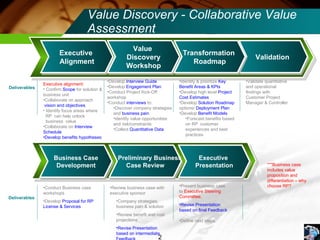
Value Discovery - Collaborative Value Assessment Executive  Presentation Preliminary Business Case Review Business Case Development Validation  Executive  Alignment Value  Discovery Workshop Transformation  Roadmap Deliverables Executive alignment : Confirm  Scope  for solution & business unit Collaborate on approach  vision and objectives .  Identify focus areas where  RP  can help unlock  business  value Collaborate on  Interview Schedule Develop benefits hypotheses Develop  Interview Guide Develop  Engagement Plan Conduct Project Kick-Off workshop  Conduct  interviews  to: Discover company strategies and  business pain .  identify value opportunities and risk/constraints Collect  Quantitative Data Identify & prioritize  Key Benefit Areas & KPIs Develop high level  Project Cost Estimates Develop  Solution Roadmap  options/  Deployment Plan Develop  Benefit Models Forecast benefits based on RP  customer experiences and best practices Validate quantitative and operational findings with Customer Project Manager & Controller Conduct Business case workshops  Develop  Proposal for RP  License & Services Review business case with executive sponsor Company strategies, business pain & solution  Review benefit and cost projections. Revise Presentation based on intermediate Feedback Present business case to  Executive Steering Committee. Revise Presentation based on final Feedback Define next steps. Deliverables ***Business case includes value proposition and differentiation – why choose RP?
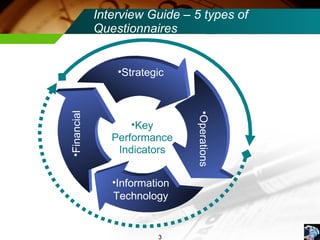
Interview Guide – 5 types of Questionnaires Strategic Financial Information Technology Operations Key Performance Indicators
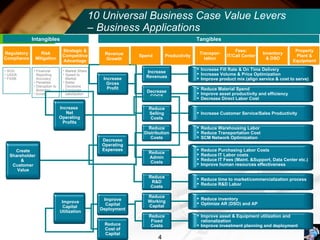
10 Universal Business Case Value Levers  – Business Applications SOX USDA FASB Financial Reporting Accuracy Penalties Disruption to Business Errors Market Share Speed to Market Better Decisions Employee satisfaction Intangibles Strategic & Competitive Advantage Risk Mitigation Regulatory Compliance Property Plant & Equipment Tangibles Inventory & DSO Fees: IT/Call Center Transpor-tation Productivity Spend Revenue Growth Create Shareholder  &  Customer Value Increase  Net Operating Profits Improve Capital  Utilization Decrease Operating Expenses Increase Gross Profit Reduce Cost of Capital Improve Capital Deployment Increase Revenues Decrease COGS Reduce Selling Costs Reduce Distribution Costs Reduce Admin Costs Reduce R&D Costs Reduce Working Capital Reduce Fixed Costs Increase Fill Rate & On Time Delivery Increase Volume & Price Optimization Improve product mix (align service & cost to serve) Reduce Material Spend Improve asset productivity and efficiency Decrease Direct Labor Cost Increase Customer Service/Sales Productivity Reduce Warehousing Labor Reduce Transportation Cost SCM Network Optimization Reduce time to market/commercialization process Reduce R&D Labor Reduce inventory Optimize AR (DSO) and AP Improve asset & Equipment utilization and rationalization Improve investment planning and deployment Reduce Purchasing Labor Costs Reduce IT Labor costs  Reduce IT Fees (Maint. &Support, Data Center etc.) Improve human resources effectiveness
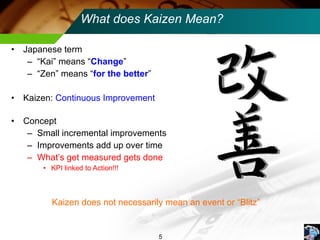
What does Kaizen Mean? Japanese term  “ Kai” means “ Change ” “ Zen” means “ for the better ” Kaizen:  Continuous Improvement Concept Small incremental improvements Improvements add up over time What’s get measured gets done KPI linked to Action!!! Kaizen does not necessarily mean an event or  “Blitz”
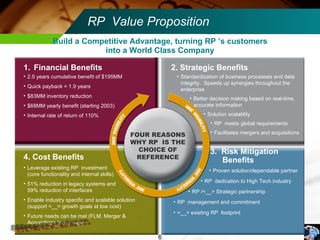
RP  Value Proposition Build a Competitive Advantage, turning RP  ’s customers into a World Class Company FOUR REASONS WHY RP  IS THE CHOICE OF REFERENCE 1.  Financial Benefits 4. Cost Benefits 2. Strategic Benefits 3.  Risk Mitigation Benefits 2.5 years cumulative benefit of $195MM Quick payback = 1.9 years $83MM inventory reduction $68MM yearly benefit (starting 2003) Internal rate of return of 110% Leverage existing RP  investment  (core functionality and internal skills) 51% reduction in legacy systems and  59% reduction of interfaces Enable industry specific and scalable solution (support <__> growth goals at low cost) Future needs can be met (FLM, Merger & Acquisitions processes) Standardization of business processes and data integrity.  Speeds up synergies throughout the enterprise Better decision making based on real-time, accurate information Solution scalablity RP  meets global requirements Proven solution/dependable partner RP  dedication to High Tech industry RP /<__> Strategic partnership RP  management and commitment Facilitates mergers and acquisitions <__> existing RP  footprint Illustration

Value Based Selling™ business model - Intro

  • 1.
    $elling-on-Value™ A Powerful Business Model
  • 2.
    Value Discovery -Collaborative Value Assessment Executive Presentation Preliminary Business Case Review Business Case Development Validation Executive Alignment Value Discovery Workshop Transformation Roadmap Deliverables Executive alignment : Confirm Scope for solution & business unit Collaborate on approach vision and objectives . Identify focus areas where RP can help unlock business value Collaborate on Interview Schedule Develop benefits hypotheses Develop Interview Guide Develop Engagement Plan Conduct Project Kick-Off workshop Conduct interviews to: Discover company strategies and business pain . identify value opportunities and risk/constraints Collect Quantitative Data Identify & prioritize Key Benefit Areas & KPIs Develop high level Project Cost Estimates Develop Solution Roadmap options/ Deployment Plan Develop Benefit Models Forecast benefits based on RP customer experiences and best practices Validate quantitative and operational findings with Customer Project Manager & Controller Conduct Business case workshops Develop Proposal for RP License & Services Review business case with executive sponsor Company strategies, business pain & solution Review benefit and cost projections. Revise Presentation based on intermediate Feedback Present business case to Executive Steering Committee. Revise Presentation based on final Feedback Define next steps. Deliverables ***Business case includes value proposition and differentiation – why choose RP?
  • 3.
    Interview Guide –5 types of Questionnaires Strategic Financial Information Technology Operations Key Performance Indicators
  • 4.
    10 Universal BusinessCase Value Levers – Business Applications SOX USDA FASB Financial Reporting Accuracy Penalties Disruption to Business Errors Market Share Speed to Market Better Decisions Employee satisfaction Intangibles Strategic & Competitive Advantage Risk Mitigation Regulatory Compliance Property Plant & Equipment Tangibles Inventory & DSO Fees: IT/Call Center Transpor-tation Productivity Spend Revenue Growth Create Shareholder & Customer Value Increase Net Operating Profits Improve Capital Utilization Decrease Operating Expenses Increase Gross Profit Reduce Cost of Capital Improve Capital Deployment Increase Revenues Decrease COGS Reduce Selling Costs Reduce Distribution Costs Reduce Admin Costs Reduce R&D Costs Reduce Working Capital Reduce Fixed Costs Increase Fill Rate & On Time Delivery Increase Volume & Price Optimization Improve product mix (align service & cost to serve) Reduce Material Spend Improve asset productivity and efficiency Decrease Direct Labor Cost Increase Customer Service/Sales Productivity Reduce Warehousing Labor Reduce Transportation Cost SCM Network Optimization Reduce time to market/commercialization process Reduce R&D Labor Reduce inventory Optimize AR (DSO) and AP Improve asset & Equipment utilization and rationalization Improve investment planning and deployment Reduce Purchasing Labor Costs Reduce IT Labor costs Reduce IT Fees (Maint. &Support, Data Center etc.) Improve human resources effectiveness
  • 5.
    What does KaizenMean? Japanese term “ Kai” means “ Change ” “ Zen” means “ for the better ” Kaizen: Continuous Improvement Concept Small incremental improvements Improvements add up over time What’s get measured gets done KPI linked to Action!!! Kaizen does not necessarily mean an event or “Blitz”
  • 6.
    RP ValueProposition Build a Competitive Advantage, turning RP ’s customers into a World Class Company FOUR REASONS WHY RP IS THE CHOICE OF REFERENCE 1. Financial Benefits 4. Cost Benefits 2. Strategic Benefits 3. Risk Mitigation Benefits 2.5 years cumulative benefit of $195MM Quick payback = 1.9 years $83MM inventory reduction $68MM yearly benefit (starting 2003) Internal rate of return of 110% Leverage existing RP investment (core functionality and internal skills) 51% reduction in legacy systems and 59% reduction of interfaces Enable industry specific and scalable solution (support <__> growth goals at low cost) Future needs can be met (FLM, Merger & Acquisitions processes) Standardization of business processes and data integrity. Speeds up synergies throughout the enterprise Better decision making based on real-time, accurate information Solution scalablity RP meets global requirements Proven solution/dependable partner RP dedication to High Tech industry RP /<__> Strategic partnership RP management and commitment Facilitates mergers and acquisitions <__> existing RP footprint Illustration

Editor's Notes

  • #5 The distribution contribution from the strategy focuses on Improved Revenue: Improved DIFOTS and service levels Reduced operating costs: Reduced freight, indirect labour, and Whse costs network and service delivery optimisation leverage of new or alternate distribution channels Reduction in working capital; Reduced inventory thru improved SCP, TM Improved asset utilization: Improved asset utilization and rationalization
  • #6 Transition: Let ’s start with the word Kaizen and describe what it means. Kaizen means continuous improvement The main idea is that over time, small incremental improvements will add up to a significantly improved organization and systems. Kaizen does not automatically mean an event or “Blitz”, which is another commonly used term. Most often Kaizen refers to small improvements here and there.