Improving Profitability by Leveraging Technology & Best PracticesGraham Riley & Mike TheisIron MountainEducation Code: WE03-2912
Learning ObjectivesUpon completion of this session, participants will be able to:Identify inefficient workflowsBuild a cost and benefit analysis modelIdentify key stakeholdersCommunicate the fiscal value of best practice adoption to senior managementMake recommendations for workflow   improvements based on best                      practices
AgendaThe Financial LandscapeValueOrganizational spendTotal cost of ownership of informational assetsCase StudiesNext Steps
Definition of “Value”Number represented by a figurerelative worth, merit, or importancemonetary worth, as in commerce or tradeequivalent worth or return in moneyestimated or assigned worth; valuationdenomination, as of a monetary issuequality of anything which renders it        desirable or useful
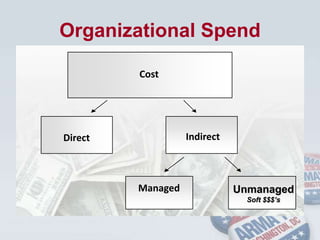
CostIndirectDirectManagedUnmanagedSoft $$$’sOrganizational Spend
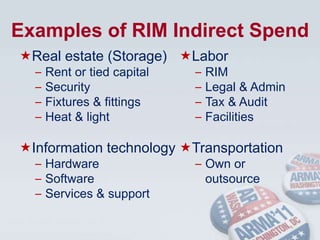
Examples of RIM Indirect SpendReal estate (Storage)
Rent or tied capital
Security
Fixtures & fittings
Heat & light
Information technology
Hardware
Software
Services & support
Labor
RIM
Legal & Admin
Tax & Audit
Facilities
Transportation
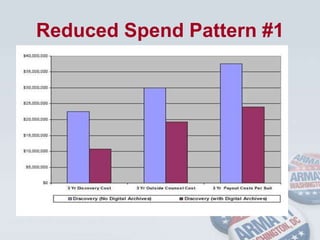
Own or      outsourceReduced Spend Pattern #1
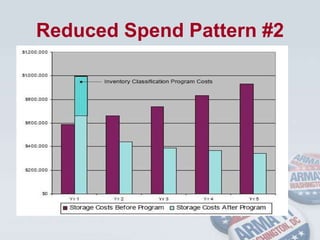
Reduced Spend Pattern #2
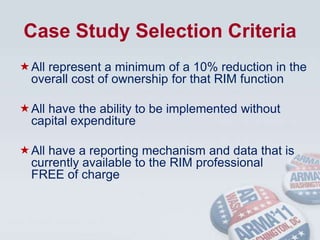
Case Study Selection CriteriaAll represent a minimum of a 10% reduction in the overall cost of ownership for that RIM function
All have the ability to be implemented without capital expenditure
All have a reporting mechanism and data that is currently available to the RIM professional       FREE of chargeCase Study DisclaimerYou have full and open access to your organization’s workflow and cost metrics
Best practice must be presented to and championed by appropriate authority and decision-maker within your organization
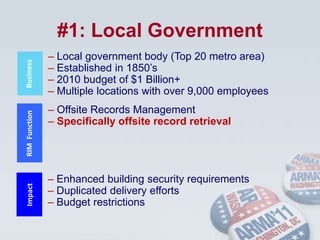
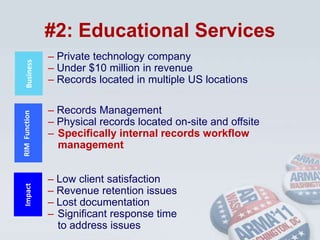
Without the organization’s openness to change behavior, there are no guarantees of any improvements in profitability!BusinessRIM  FunctionImpact#1: Local GovernmentLocal government body (Top 20 metro area)
 Established in 1850’s
 2010 budget of $1 Billion+
 Multiple locations with over 9,000 employees
 Offsite Records Management
Specifically offsite record retrieval
 Enhanced building security requirements
 Duplicated delivery efforts
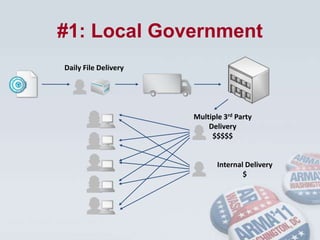
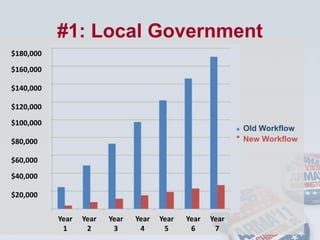
 Budget restrictions#1: Local GovernmentDaily File DeliveryMultiple 3rd Party Delivery$$$$$Internal Delivery$
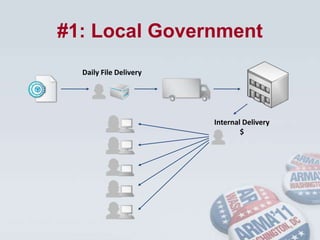
#1: Local GovernmentDaily File DeliveryInternal Delivery$
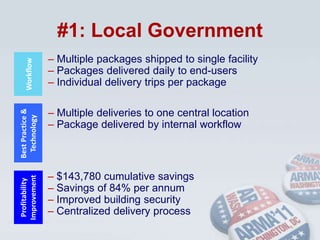
WorkflowBest Practice & TechnologyProfitability Improvement#1: Local Government Multiple packages shipped to single facility
 Packages delivered daily to end-users

Improving Profitability by Leveraging Technology and Best Practices

Editor's Notes

  • #2 Talking PointsThank audienceAppropriate we play our partAsk for interactionClarify “Technology”
  • #3 Talking PointsBy product – annual reviewsPay increases
  • #4 Talking PointsSpeaking “Finance”
  • #5 Talking PointsContent within the context of the business
  • #6 Talking PointsThis second example shows how the change in behavior after an initial investment starts to drive out costs with savings increasing each year throughout the life of the recordRemember the two premises we shared that formed the basis of this workshop – you cannot change what you cannot see, so these side-by-side comparisons are only possible after the true costs of ownership associated with existing RIM functions has been analyzed and an alternative option proposed and then implemented.So how do we gather the information that will give us insight into our current spend and to perform the analysis required comparing current workflows with any proposed workflows?This brings us to our case studies.
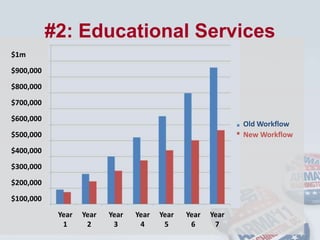
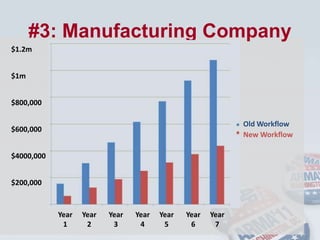
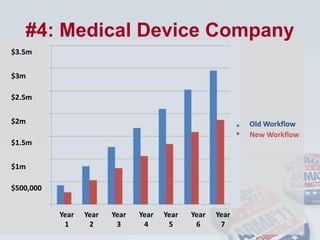
  • #8 Talking Points  So how will we go about achieving that desired level of spend and realize significant costs savings?Sadly there is no silver bullet or tool that will do that for us. It is a process vs. an event with the savings following one of two trend lines.The first trend line shows how costs, while still climbing are doing so at a significantly slower rate than they would have if we had not made a change in behavior and adopted a new technology or best practice.As we conclude each case study we will be illustrating these trend lines between what costs would have been incurred if a change was not made and the current trends after a change of behavior was adopted.
  • #9 Talking Points This second example shows how the change in behavior after an initial investment starts to drive out costs with savings increasing each year throughout the life of the recordRemember the two premises we shared that formed the basis of this workshop – you cannot change what you cannot see, so these side-by-side comparisons are only possible after the true costs of ownership associated with existing RIM functions has been analyzed and an alternative option proposed and then implemented.So how do we gather the information that will give us insight into our current spend and to perform the analysis required comparing current workflows with any proposed workflows?This brings us to our case studies.
  • #10 Slide #15: Talking Points (Graham) So from the multitude of examples we had to choose from, how did we decide upon the case studies that we will be sharing?We realized that there is a variety of organizations represented by their respective RIM professionals either listening to this workshop or attending during the conference so the case studies were pulled from a variety of organizations – some large some small, some service-based and some manufacturing.As we go through the case studies, the savings and the implications of changing workflows should be scaled in order to be commensurate with the size of the participant’s organization.As we are in Q4 2010 we also realized that there would be no budgets set aside so each case study has the ability to be initiated without establishing new budgets or the requirement of any capital investment.Therefore we selected case studies that would realize double-digit savings, no need to pay now and then benefit later – rather just utilize the tools that we will be sharing!
  • #11 Talking Points  We now know how we arrived at the case studies that we will reviewing; however we do have a couple of case study disclaimers that are based upon the two premises on which the workshop was developed – you cannot change what you cannot see or show any cost savings for RIM functions when the cost of that function, the TCO is unknown.Albert Einstein stated that the definition of insanity was doing the same thing over and over again and expecting different results.So without any change in behavior why would we expect to see any changes to our RIM functional spend? We have seen from the organizational spend models that our RIM spend today is a direct reflection of how we behave today; therefore Mike and I can guarantee that we will not see the significant improvements in profitability that we are capable of delivering if change is not initiated.
  • #13 The organization requested 30+ boxes of files to be delivered on a weekly basis. Files retrieved by a 3rd party were delivered to a central facility where each box was delivered to each individual requestor.There was a cost associated with each delivery, so 30 requests meant that 30 delivery fees were incurred.There were also internal personnel making other scheduled deliveries (i.e. mail, packages) throughout the organization.Many times an individual or department was visited multiple times by multiple people throughout the day.
  • #14 The solution was stunningly simple as it was effective in reducing costs!The same 30+ requests occurred every week; however the 3rd party provider made the regular delivery to the centralized facility – and left!That is where the engagement of the 3rd party stops.Boxes are now delivered to the requestors utilizing internal resources who will be making other scheduled deliveries throughout the facility.The organization is now looking at 5 delivery costs per week (one per day) vs. 30+

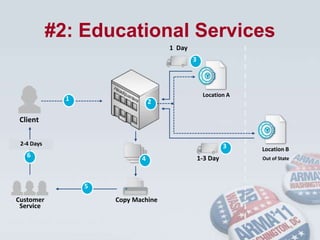
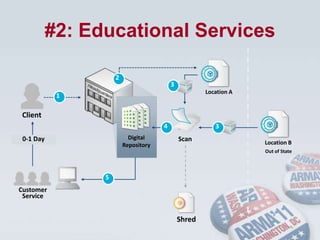
  • #18 Should a client have a query regarding their documentation a call was placed to the customer service group located at corporate headquarters. Customer service then determines if the clients information is on-site at HQ or off site at one of two locations.Location A was within a few miles of the corporate HQ, therefore information could be retrieved within 24 hours.Location B was out of state where it could take anywhere from 1-3 days to arrive once requested.Regardless of the information’s original location (on-site, Location A or B), a copy was made to minimize the risk of the original being lost.It was the copy that was then presented to Customer Service who then contacted the client in order to address their question(s).Typical response times to a client was anywhere from 2-4 days.Copies and originals ALL stored on-site.

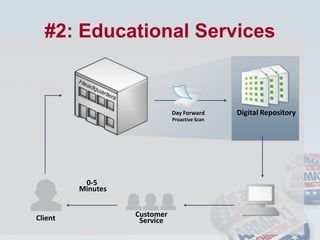
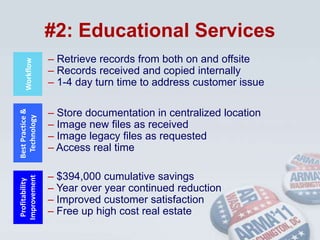
  • #19 In the new workflow the need for a clients paper documentation will be completely eliminated; along with off-site storage fees!Upon receipt of any new client information the information is imaged within days of receipt with images residing in a DRCi for immediate access.Any client information stored on-site at the HQ was also imaged with the images also residing in a DRCi.Any client information older than 6 months was stored in either location A or B.Once a request is made for client information stored at either location A or B, the information is imaged remotely and uploaded to the DRCi.The organization was also able to standardize the indexing criteria for both new and legacy information.Customer service could now address a clients question within seconds or worst case within 24 hours.
  • #20 As this solution evolves, the need to access information that is off site will continue to diminish. Requests to access the legacy records will be reduced by about 25% annually.At that time all information that is used to resolve client inquires will be resident and accessible within the DRCi enabling client questions to be addressed in one call.No more off-site storage-transportation-handling fees and delay!No more “lost” information.No more copies or need for on-site storage.
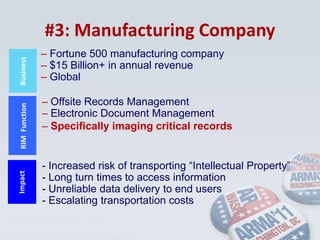
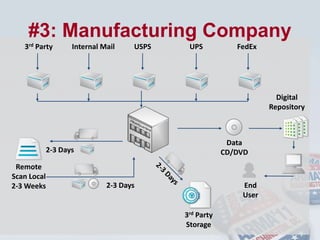
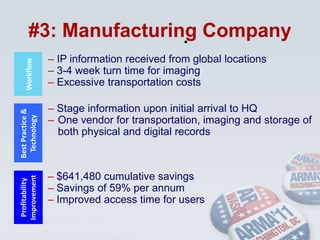
  • #24 In the old workflow the organization collects IP from all offices over the world.The documentation is shipped via multiple 3rd party carriers to corporate HQ.Bi-weekly the documentation is boxed up and transported to an out of state imaging vendor, taking anywhere from 2-3 days to arrive.It took 2-3 weeks for the documentation to be imaged, then it is transported back to HQ along with a DVD (via another courier) to the IT Dept.IT loads the images into the DRCi allowing user access approx 3-4 weeks from the time the information first arrived at HQ.Should there be issues with the media then the whole process is repeated.Once the hard copy documentation arrives back at HQ it is prepped and bar-coded then transported again to off-site storage.
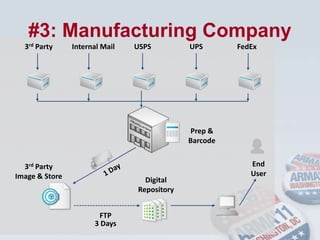
  • #25 Here is the organizations new workflow with the IP documentation still being collected at HQ from all offices over the world.At this point the workflow changes, with the documentation being prepped and bar-coded and immediately transported to an off-site facility.Upon arrival at the off-site facility the documentation is imaged and FTP’d to the DRCi.The physical documentation is then securely stored with no further transportation fees being incurred.Information is now available to the end-users with 3-5 days from the time the documentation arrived at HQ.
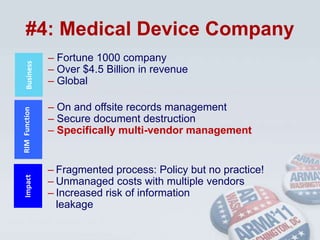
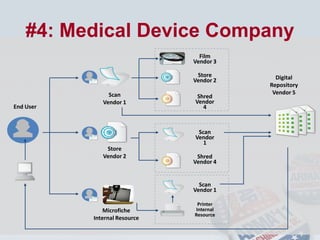
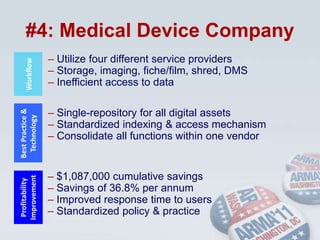
  • #29 4th and final case study – Greater the problem or complexity the greater the savings!When the end-user requests information they have three options to choose from and they need to be engaged at each step in the workflow.The issues facing this company involve:Significant complexity and costs due to multiple vendors in accessing information from the DRCiMultiple transportation costs and complex chain-of custodyMajority of spend in the process is “un-managed”Lengthy and variable turnaround time from initial request to accessing the informationInconsistent indexing of the informationInconsistent destruction policy and practice
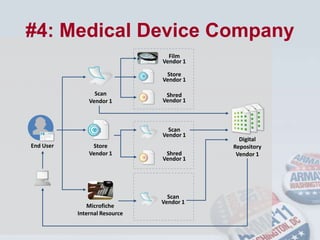
  • #30 When the end-user requests information they still have three options to choose from however:Single vendor for film - fiche – scanning – storage – destructionWith the new workflow the organization is benefitting by:Significant complexity and costs due to multiple vendors in accessing information from the DRCiNo transportation costs and simplified chain-of custodyAll spend in the process is “managed”Standard SLA’s for turnaround time for each media type and formatConsistent indexing of the informationConsistent destruction policy and practice
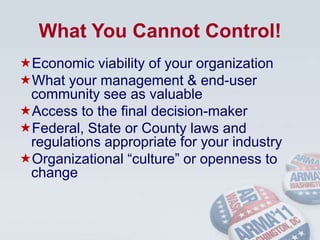
  • #33 Talking Points As we return home from this conference and go back to work on Monday morning, we will be facing the exact same economic conditions affecting our organizations that were in place when we left.The economy will continue to re-set or recalibrate itself, law makers will also be heading into work and continue in their tasks of re-regulating and we will in turn be held accountable for complying with those regulations, more and more information will have been generated and you have to continue in the balancing act of supporting our customers while remaining profitable.All of these things you cannot change or control. However you now have tools that are proven, scalable, flexible and repeatable. Enabling you to play your part in initiating workflow improvements and adding real dollars to the bottom line.
  • #38 Talking PointsContent within the context of the business
  • #39 Talking PointsContent within the context of the business