


Value Analysis

                              IED
                            Lesson 4

Emma Tracanella
emma.tracanella@gmail.com
Course program
1. Italian Startups
2. Set up a startup in Italy
3. I've got an idea. And now?
4. Value analysis
5. Business model
6. Communicate, communicate, communicate
7. Being net
8. Find your market
9. Funding: venture capital, business angel and other
ways of financing
10. Pitch
Today's table of content


1. Direct and Indirect Costs

2. Cash and Accrual Basis Accounting

3. Perceived Value
I've got an idea. And now?: quick recap

During last lesson we discussed:

1. General design principles (no ToDo list available..)
2. Definition of a project (clear goal that must be
   reached in a fixed time using available resources)
3. Product life cycle (planning, analysis, design,
   implementation, maintenance... maturity and decline
   or evolutionary maintenance and a new cycle)
I've got an idea. And now?: quick recap

We detailed
 • Some basics useful from concept to company
 • What is a lean startup
 • How to formalize and write my project
 • Who can help me (Kublai, business incubators,
    seed accelerators)
All you need to know about costs
Costs

In production, research, retail, and accounting,
a cost is the value of money that has been
used up to produce something, and hence is
not available for use anymore.

Two kind of costs:
 • Direct costs
 • Indirect costs
Direct costs
Costs that can be identified specifically with a
particular project or activity, or that can be
directly assigned to them with a high degree of
accuracy.

Direct costs generally includes:
  • Salary and wages
  • Material, supplies and equipment
     purchased directly for the specific project
  • Communication and travels costs
Indirect costs
Costs that are not classified as direct

Indirect costs generally includes:
  • Salary of administrative staff providing
     normal support activities
  • Office supplies, computers
  • Local telephone calls
  • Memberships

=> Overhead
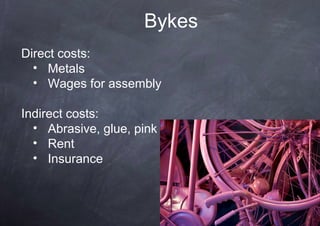
Bykes
Direct costs:
  • Metals
  • Wages for assembly

Indirect costs:
  • Abrasive, glue, pink
  • Rent
  • Insurance
Actual cost of doing business


• Before you can price a product or a service, you
  need to know your cost to produce it.
Photographer
• How much charge a photo?

• Minimum fee?

• No costs?

A useful tool: the Cost of Business calculator. It list
annual expenses, but it depends on your inputs
which can be hard to estimate.
Cost of doing business calculator/1

Expenses
• Office and/or studio (rent, mortgage payments,
  taxes, insurances, home maintenance, …)

• Phone (cell and/or landline and faxes) – remember
  to include also the cost of the phone itself

• Photo/Video/Audio Equipment and Accessories

• Equipment services and Repairs

                                             https://nppa.org/calculator
Cost of doing business calculator/2
• Computer(s) (harware and software)

• Broadband internet

• Web hosting/Portal services

• Vehicle Expenses (Lease, Insurance,
  Maintenance)

• Office supplies and Furnitures

• Postage and Shipping
                                        https://nppa.org/calculator
Cost of doing business calculator/3
• Professional Development

• Advertising and Promotion

• Subsciption and Dues

• Equipment and Business Insurance

• Health Insurance/Deductibles/Copays

• Legal and Accounting Services
                                        https://nppa.org/calculator
Cost of doing business calculator/4
• Taxes and Licenses (Business and Self-
  Employment)

• Office Assistance (Payroll, Answering Service,
  Intern, etc.)

• Utilities

• Travel and Entertainment


                                             https://nppa.org/calculator
Cost of doing business calculator/5
Income factors

• Desired Annual Salary

• Non-assigment Income

• Number of Days You Can Bill Per Year


                                         https://nppa.org/calculator
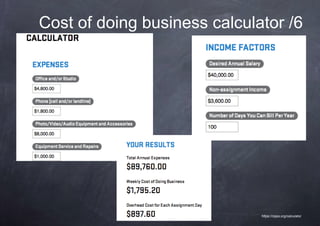
Cost of doing business calculator /6


                              https://nppa.org/calculator
Accounting

• The difference between cash and accrual basis
  accounting has to do with the time frame in which
  revenues and expenses are recorded and reported.

• Cash basis accounting will suffice if your business
  is a simple one. However, the accrual basis will
  give a more accurate picture of the results of
  business operations.
Cash Accounting

• Revenues are reported on the income statement in
  the period in which the cash is received from
  customers.

• Expenses are reported on the income statement
  when the cash is paid out.


Focus on the amount of cash in bank and on making
sure all bills are paid.
Accrual Basis Accounting
• Revenues are reported on the income statement
  when they are earned - which often occurs before
  the cash is received from the customers.

• Expenses are reported on the income statement in
  the period when they occur or when they expire -
  which is often in a period different from when the
  payment is made.

Provides more information about the business and
gives meaningfull financial reports.
Value
• The extent to which a good or service is perceived
  by its customer to meet his or her needs or wants,
  measured by the customer’s willingness to pay for
  it

• It depends more on the customer’s perception of
  the worth of the product than on its intrinsict value.


How do we create the perception of value when we
talk to our customers?
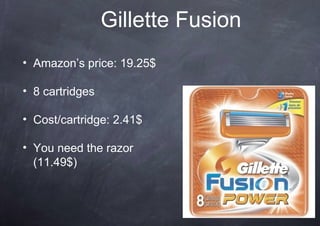
Gillette Fusion
• Amazon’s price: 19.25$

• 8 cartridges

• Cost/cartridge: 2.41$

• You need the razor
  (11.49$)
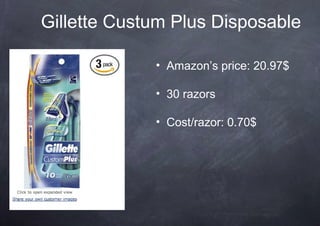
Gillette Custum Plus Disposable

             • Amazon’s price: 20.97$

             • 30 razors

             • Cost/razor: 0.70$
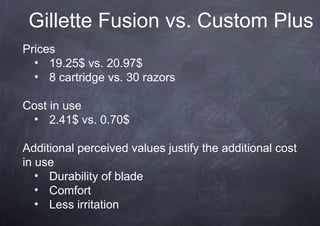
Gillette Fusion vs. Custom Plus
Prices
  • 19.25$ vs. 20.97$
  • 8 cartridge vs. 30 razors

Cost in use
 • 2.41$ vs. 0.70$

Additional perceived values justify the additional cost
in use
   • Durability of blade
   • Comfort
   • Less irritation
Gillette Idea
By providing something at below the market price
(the razor), you can create a market for a secondary
product (the blade) upon which you make ongoing
profits.

The mark-up on the secondary products is
disproportionate relative to their cost so were highly
profitable for the manufacturer.
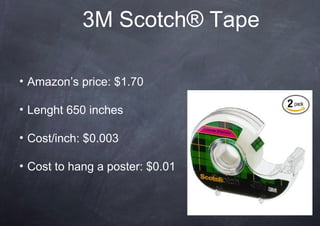
3M Scotch® Tape

• Amazon’s price: $1.70

• Lenght 650 inches

• Cost/inch: $0.003

• Cost to hang a poster: $0.01
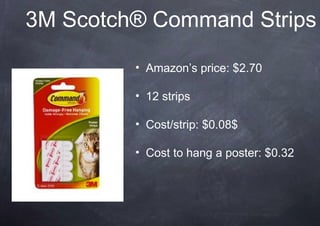
3M Scotch® Command Strips

         • Amazon’s price: $2.70

         • 12 strips

         • Cost/strip: $0.08$

         • Cost to hang a poster: $0.32
3M Scotch® Tape vs. Strips
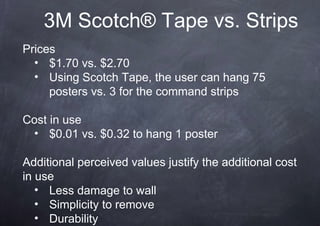
Prices
  • $1.70 vs. $2.70
  • Using Scotch Tape, the user can hang 75
     posters vs. 3 for the command strips

Cost in use
 • $0.01 vs. $0.32 to hang 1 poster

Additional perceived values justify the additional cost
in use
   • Less damage to wall
   • Simplicity to remove
   • Durability
A-Style
Logo
  • 1989 stikers on the walls of Milano
     and Roma
  • Patented by Italian designer Marco
     Bruns

Clothing Brand
  • Italian brand founded in 1999

A-style has used street-level buzz
marketing to grow to international
prominence
Lacoste
  • Founded in 1933 by the tennis man Rene
    Lacoste
  • At the end of 1990 the company change its
    strategy: marketing, retails outlets, product
    range, …
  • Sale of t-shirts in limited series

Re-establishing Lacoste as “a distinctive premium
brand”
More Examples
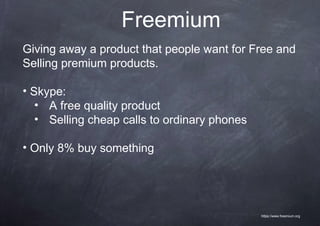
Freemium
Giving away a product that people want for Free and
Selling premium products.

• Skype:
   • A free quality product
   • Selling cheap calls to ordinary phones

• Only 8% buy something


                                              https://www.freemium.org
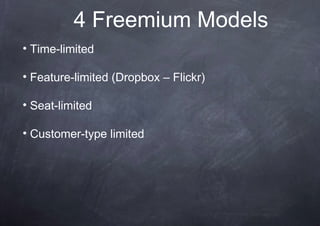
4 Freemium Models
• Time-limited

• Feature-limited (Dropbox – Flickr)

• Seat-limited

• Customer-type limited
Advertising Model
Became popular with the growth of radio and TV.
  • Indirect revenue from people looking to
    promote services

  • Increasingly difficult

  • Youtube, Facebook
Low-Cost Model
• Significant volumes of customers (at a low
customer acquisition cost) and by charging a very
low price

• Revenue from a whole host of ancillary sources

• Ryanair
Analyze Competitors
Next week


Business model.


                        (with Frieda Brioschi)

Value analysis

  • 1.
    Value Analysis IED Lesson 4 Emma Tracanella emma.tracanella@gmail.com
  • 2.
    Course program 1. ItalianStartups 2. Set up a startup in Italy 3. I've got an idea. And now? 4. Value analysis 5. Business model 6. Communicate, communicate, communicate 7. Being net 8. Find your market 9. Funding: venture capital, business angel and other ways of financing 10. Pitch
  • 3.
    Today's table ofcontent 1. Direct and Indirect Costs 2. Cash and Accrual Basis Accounting 3. Perceived Value
  • 4.
    I've got anidea. And now?: quick recap During last lesson we discussed: 1. General design principles (no ToDo list available..) 2. Definition of a project (clear goal that must be reached in a fixed time using available resources) 3. Product life cycle (planning, analysis, design, implementation, maintenance... maturity and decline or evolutionary maintenance and a new cycle)
  • 5.
    I've got anidea. And now?: quick recap We detailed • Some basics useful from concept to company • What is a lean startup • How to formalize and write my project • Who can help me (Kublai, business incubators, seed accelerators)
  • 6.
    All you needto know about costs
  • 7.
    Costs In production, research,retail, and accounting, a cost is the value of money that has been used up to produce something, and hence is not available for use anymore. Two kind of costs: • Direct costs • Indirect costs
  • 8.
    Direct costs Costs thatcan be identified specifically with a particular project or activity, or that can be directly assigned to them with a high degree of accuracy. Direct costs generally includes: • Salary and wages • Material, supplies and equipment purchased directly for the specific project • Communication and travels costs
  • 9.
    Indirect costs Costs thatare not classified as direct Indirect costs generally includes: • Salary of administrative staff providing normal support activities • Office supplies, computers • Local telephone calls • Memberships => Overhead
  • 10.
    Bykes Direct costs: • Metals • Wages for assembly Indirect costs: • Abrasive, glue, pink • Rent • Insurance
  • 11.
    Actual cost ofdoing business • Before you can price a product or a service, you need to know your cost to produce it.
  • 12.
    Photographer • How muchcharge a photo? • Minimum fee? • No costs? A useful tool: the Cost of Business calculator. It list annual expenses, but it depends on your inputs which can be hard to estimate.
  • 13.
    Cost of doingbusiness calculator/1 Expenses • Office and/or studio (rent, mortgage payments, taxes, insurances, home maintenance, …) • Phone (cell and/or landline and faxes) – remember to include also the cost of the phone itself • Photo/Video/Audio Equipment and Accessories • Equipment services and Repairs https://nppa.org/calculator
  • 14.
    Cost of doingbusiness calculator/2 • Computer(s) (harware and software) • Broadband internet • Web hosting/Portal services • Vehicle Expenses (Lease, Insurance, Maintenance) • Office supplies and Furnitures • Postage and Shipping https://nppa.org/calculator
  • 15.
    Cost of doingbusiness calculator/3 • Professional Development • Advertising and Promotion • Subsciption and Dues • Equipment and Business Insurance • Health Insurance/Deductibles/Copays • Legal and Accounting Services https://nppa.org/calculator
  • 16.
    Cost of doingbusiness calculator/4 • Taxes and Licenses (Business and Self- Employment) • Office Assistance (Payroll, Answering Service, Intern, etc.) • Utilities • Travel and Entertainment https://nppa.org/calculator
  • 17.
    Cost of doingbusiness calculator/5 Income factors • Desired Annual Salary • Non-assigment Income • Number of Days You Can Bill Per Year https://nppa.org/calculator
  • 18.
    Cost of doingbusiness calculator /6 https://nppa.org/calculator
  • 19.
    Accounting • The differencebetween cash and accrual basis accounting has to do with the time frame in which revenues and expenses are recorded and reported. • Cash basis accounting will suffice if your business is a simple one. However, the accrual basis will give a more accurate picture of the results of business operations.
  • 20.
    Cash Accounting • Revenuesare reported on the income statement in the period in which the cash is received from customers. • Expenses are reported on the income statement when the cash is paid out. Focus on the amount of cash in bank and on making sure all bills are paid.
  • 21.
    Accrual Basis Accounting •Revenues are reported on the income statement when they are earned - which often occurs before the cash is received from the customers. • Expenses are reported on the income statement in the period when they occur or when they expire - which is often in a period different from when the payment is made. Provides more information about the business and gives meaningfull financial reports.
  • 22.
    Value • The extentto which a good or service is perceived by its customer to meet his or her needs or wants, measured by the customer’s willingness to pay for it • It depends more on the customer’s perception of the worth of the product than on its intrinsict value. How do we create the perception of value when we talk to our customers?
  • 23.
    Gillette Fusion • Amazon’sprice: 19.25$ • 8 cartridges • Cost/cartridge: 2.41$ • You need the razor (11.49$)
  • 24.
    Gillette Custum PlusDisposable • Amazon’s price: 20.97$ • 30 razors • Cost/razor: 0.70$
  • 25.
    Gillette Fusion vs.Custom Plus Prices • 19.25$ vs. 20.97$ • 8 cartridge vs. 30 razors Cost in use • 2.41$ vs. 0.70$ Additional perceived values justify the additional cost in use • Durability of blade • Comfort • Less irritation
  • 26.
    Gillette Idea By providingsomething at below the market price (the razor), you can create a market for a secondary product (the blade) upon which you make ongoing profits. The mark-up on the secondary products is disproportionate relative to their cost so were highly profitable for the manufacturer.
  • 27.
    3M Scotch® Tape •Amazon’s price: $1.70 • Lenght 650 inches • Cost/inch: $0.003 • Cost to hang a poster: $0.01
  • 28.
    3M Scotch® CommandStrips • Amazon’s price: $2.70 • 12 strips • Cost/strip: $0.08$ • Cost to hang a poster: $0.32
  • 29.
    3M Scotch® Tapevs. Strips Prices • $1.70 vs. $2.70 • Using Scotch Tape, the user can hang 75 posters vs. 3 for the command strips Cost in use • $0.01 vs. $0.32 to hang 1 poster Additional perceived values justify the additional cost in use • Less damage to wall • Simplicity to remove • Durability
  • 30.
    A-Style Logo •1989 stikers on the walls of Milano and Roma • Patented by Italian designer Marco Bruns Clothing Brand • Italian brand founded in 1999 A-style has used street-level buzz marketing to grow to international prominence
  • 31.
    Lacoste •Founded in 1933 by the tennis man Rene Lacoste • At the end of 1990 the company change its strategy: marketing, retails outlets, product range, … • Sale of t-shirts in limited series Re-establishing Lacoste as “a distinctive premium brand”
  • 32.
  • 33.
    Freemium Giving away aproduct that people want for Free and Selling premium products. • Skype: • A free quality product • Selling cheap calls to ordinary phones • Only 8% buy something https://www.freemium.org
  • 34.
    4 Freemium Models •Time-limited • Feature-limited (Dropbox – Flickr) • Seat-limited • Customer-type limited
  • 35.
    Advertising Model Became popularwith the growth of radio and TV. • Indirect revenue from people looking to promote services • Increasingly difficult • Youtube, Facebook
  • 36.
    Low-Cost Model • Significantvolumes of customers (at a low customer acquisition cost) and by charging a very low price • Revenue from a whole host of ancillary sources • Ryanair
  • 37.
  • 38.
    Next week Business model. (with Frieda Brioschi)