Value –Added AssessmentTammie Edwards AED 6335 Summer 2010 – Dr. Berkey
What is Value-Added Assessment?“The idea behind value-added modeling is to level the playing field by using statistical procedures that allow direct comparisons between schools and teachers—even when those schools are working with quite different populations of students”.  Educational Leadership, November 2005
  Based on a review of students' test score gains from previous grades, researchers can predict the amount of growth those students are likely to make in a given year. Value-added assessment can show whether particular students - those in a particular class- have made the expected amount of progress, have made less progress than expected, or have been stretched beyond what they could reasonably be expected to achieve.
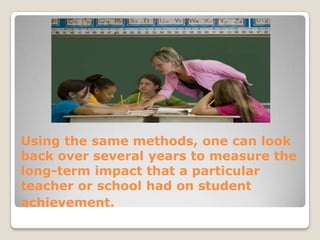
Using the same methods, one can look back over several years to measure the long-term impact that a particular teacher or school had on student achievement.
The Purpose of The Value-Added Model.To provide longitudinal growth data on each child.
Unlike AYP, Value-Added levels the playing field.Because of the focus on EACH child.
Shed pattern is usually found in low income communities.  Teachers focus on the low students because there are so many of them.Reverse shed pattern reflects the opposite of that and usually occurs in high income communities.  Here teachers teach to the high achievers.In the Tepee pattern, teachers focus on the middle achievers.  Research shows that there are three distinct patterns of instruction in classrooms and districts-given the names shed, reverse shed, and tepee.
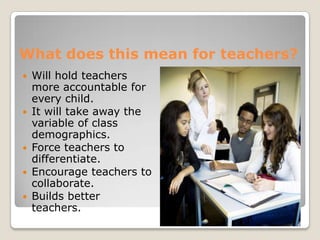
What does this mean for teachers?Will hold teachers more accountable for every child.It will take away the variable of class demographics.Force teachers to differentiate. Encourage teachers to collaborate.Builds better teachers.
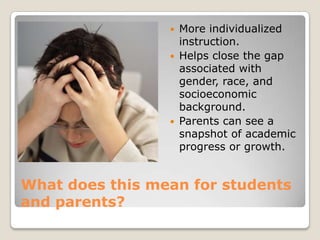
What does this mean for students and parents?More individualized instruction.Helps close the gap associated with gender, race, and socioeconomic background.  Parents can see a snapshot of academic progress or growth.
Pros and Cons (Research Points, Summer 2004)Establishes that good teaching matters.Focuses attention on student knowledge and skills.Can be used to track effectiveness of districts, schools,and programs.Cannot tell us what better teaching looks like or how to create it.Is only as good as the quality of student tests.Should not be the sole measure of individual teacher effectiveness.
Value-added assessment proves that verygood teaching can boost student learningand that family background does not determinea student’s destiny.

Value –Added Assessment

  • 1.
    Value –Added AssessmentTammieEdwards AED 6335 Summer 2010 – Dr. Berkey
  • 2.
    What is Value-AddedAssessment?“The idea behind value-added modeling is to level the playing field by using statistical procedures that allow direct comparisons between schools and teachers—even when those schools are working with quite different populations of students”. Educational Leadership, November 2005
  • 3.
    Basedon a review of students' test score gains from previous grades, researchers can predict the amount of growth those students are likely to make in a given year. Value-added assessment can show whether particular students - those in a particular class- have made the expected amount of progress, have made less progress than expected, or have been stretched beyond what they could reasonably be expected to achieve.
  • 4.
    Using the samemethods, one can look back over several years to measure the long-term impact that a particular teacher or school had on student achievement.
  • 5.
    The Purpose ofThe Value-Added Model.To provide longitudinal growth data on each child.
  • 6.
    Unlike AYP, Value-Addedlevels the playing field.Because of the focus on EACH child.
  • 7.
    Shed pattern isusually found in low income communities. Teachers focus on the low students because there are so many of them.Reverse shed pattern reflects the opposite of that and usually occurs in high income communities. Here teachers teach to the high achievers.In the Tepee pattern, teachers focus on the middle achievers. Research shows that there are three distinct patterns of instruction in classrooms and districts-given the names shed, reverse shed, and tepee.
  • 8.
    What does thismean for teachers?Will hold teachers more accountable for every child.It will take away the variable of class demographics.Force teachers to differentiate. Encourage teachers to collaborate.Builds better teachers.
  • 9.
    What does thismean for students and parents?More individualized instruction.Helps close the gap associated with gender, race, and socioeconomic background. Parents can see a snapshot of academic progress or growth.
  • 10.
    Pros and Cons(Research Points, Summer 2004)Establishes that good teaching matters.Focuses attention on student knowledge and skills.Can be used to track effectiveness of districts, schools,and programs.Cannot tell us what better teaching looks like or how to create it.Is only as good as the quality of student tests.Should not be the sole measure of individual teacher effectiveness.
  • 11.
    Value-added assessment provesthat verygood teaching can boost student learningand that family background does not determinea student’s destiny.