WHAT IS THE VALUE
OF YOUR BUSINESS
© Vladimir Hulpach, P.O.Box 17005, Fountain Hills, AZ 85269, USA
Do You Want to Know What Is Your
Business Net Worth?
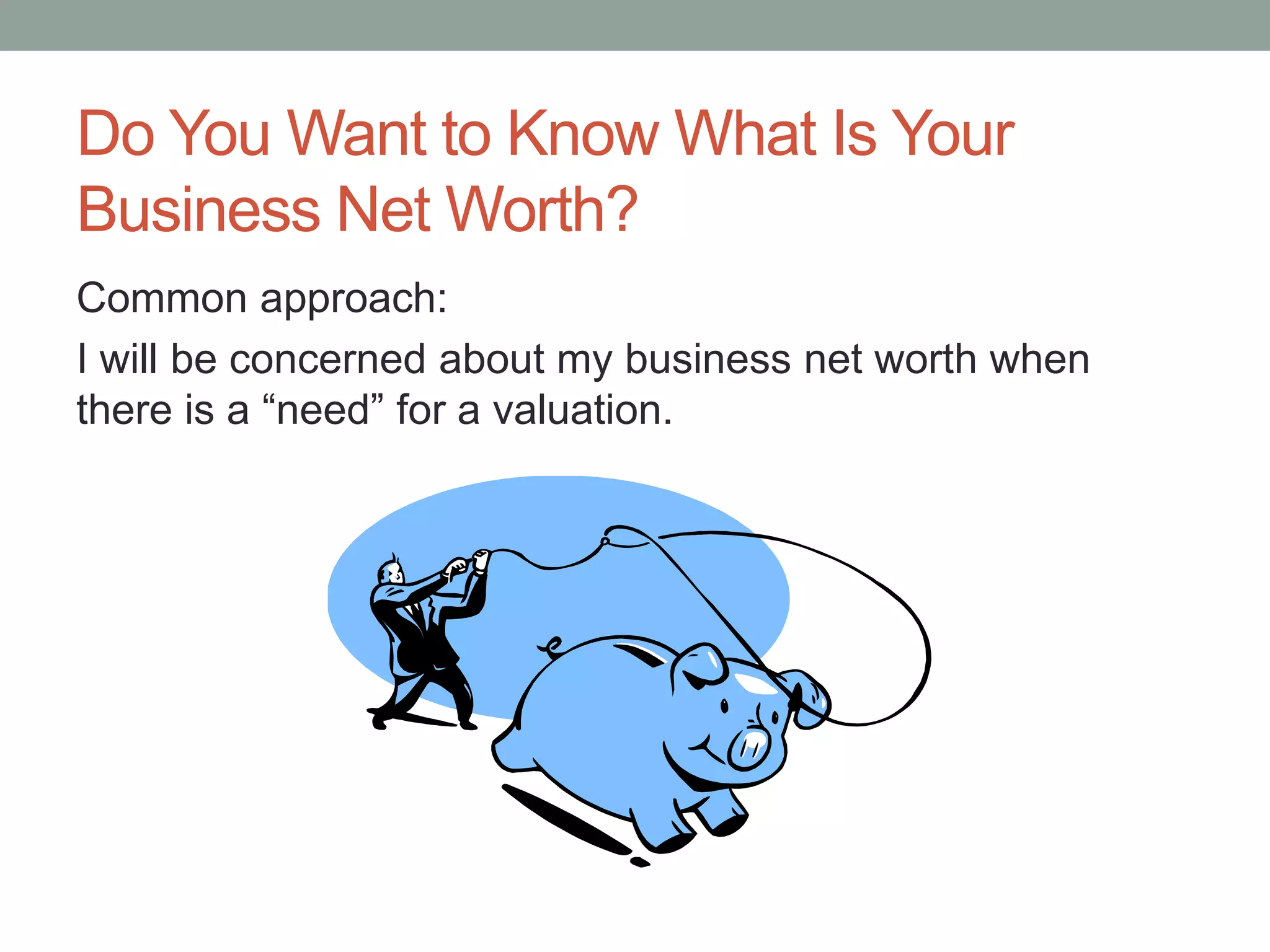
Common approach:
I will be concerned about my business net worth when
there is a “need” for a valuation.
Needs for a valuation do come up!
Common Examples:
 Sale of a business
 Mergers and acquisitions
 Estate and gifting
 Succession planning
 Insurance
 Financing
Why and When Should You Care
Responsive Approach
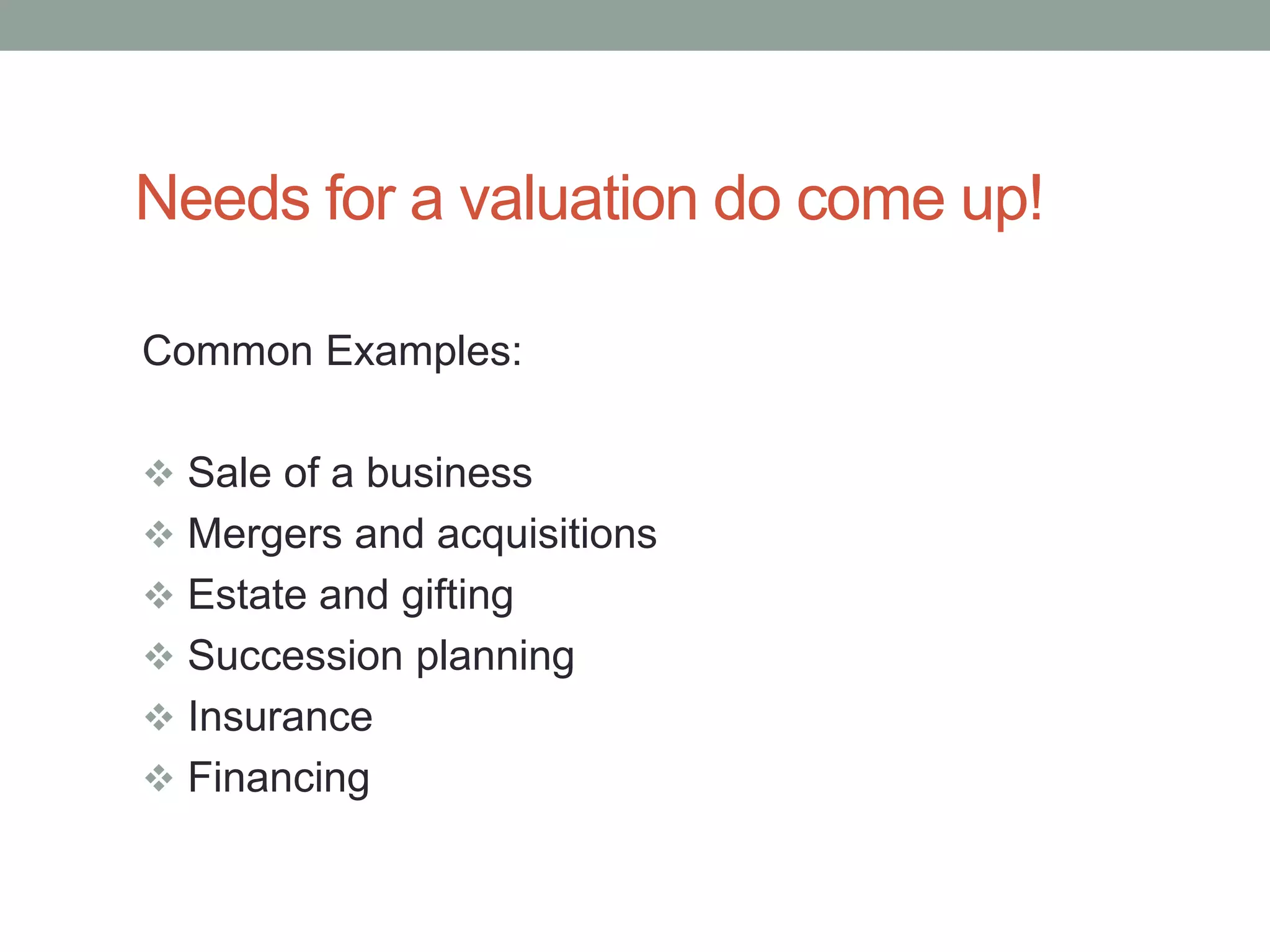
Previous examples =
mostly forced by circumstances.
Proactive Approach
Allows to fix a price or set
methods to determine business
value in planning for
foreseeable events:
• Buy/Sell Agreements
• Family Business
Succession
• Insurance
• Stock Options
• Trigger Value
Are we able to predict
situations dictating a need
for business valuation?
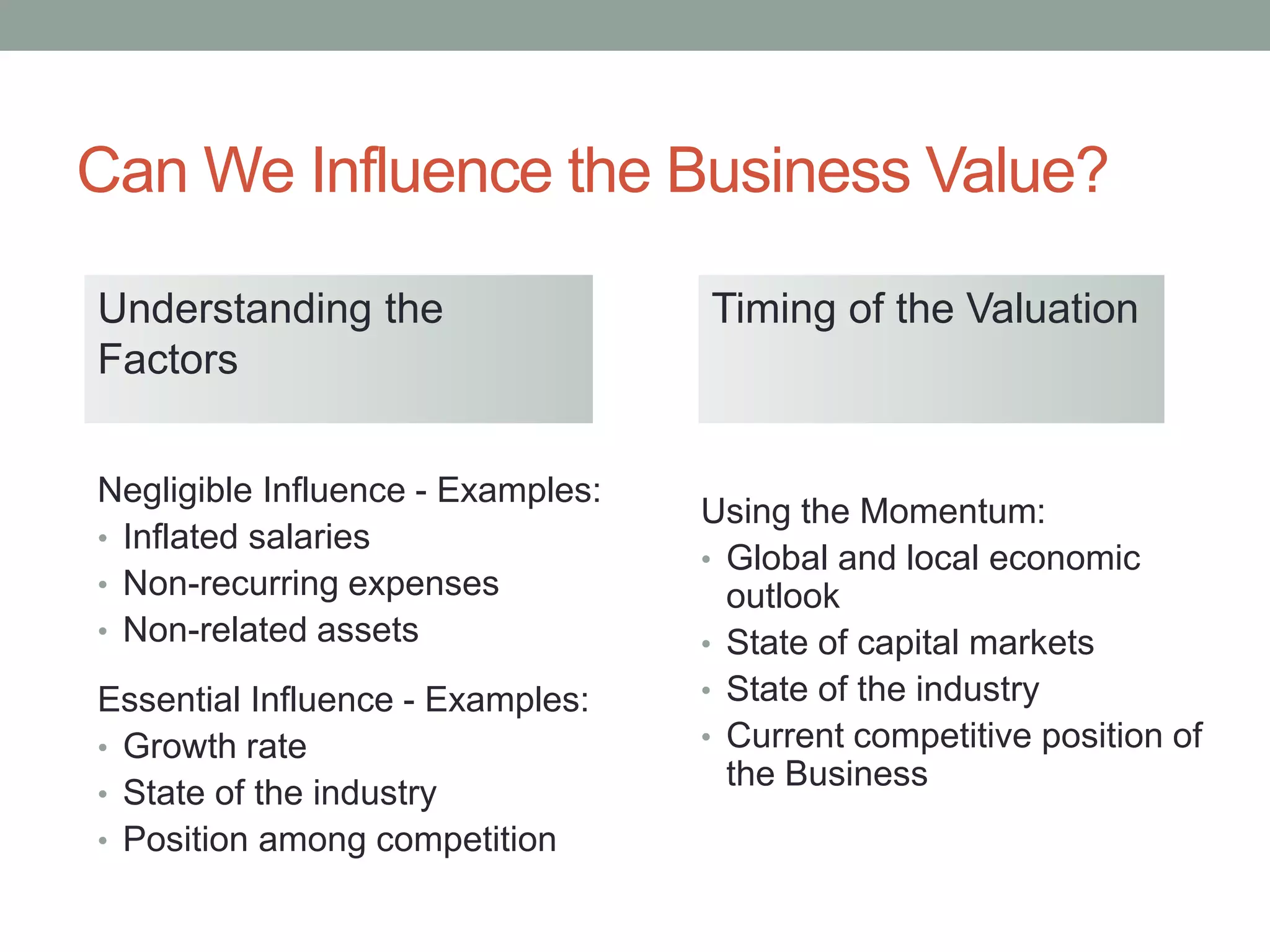
Can We Influence the Business Value?
Negligible Influence - Examples:
• Inflated salaries
• Non-recurring expenses
• Non-related assets
Essential Influence - Examples:
• Growth rate
• State of the industry
• Position among competition
Using the Momentum:
• Global and local economic
outlook
• State of capital markets
• State of the industry
• Current competitive position of
the Business
Understanding the
Factors
Timing of the Valuation
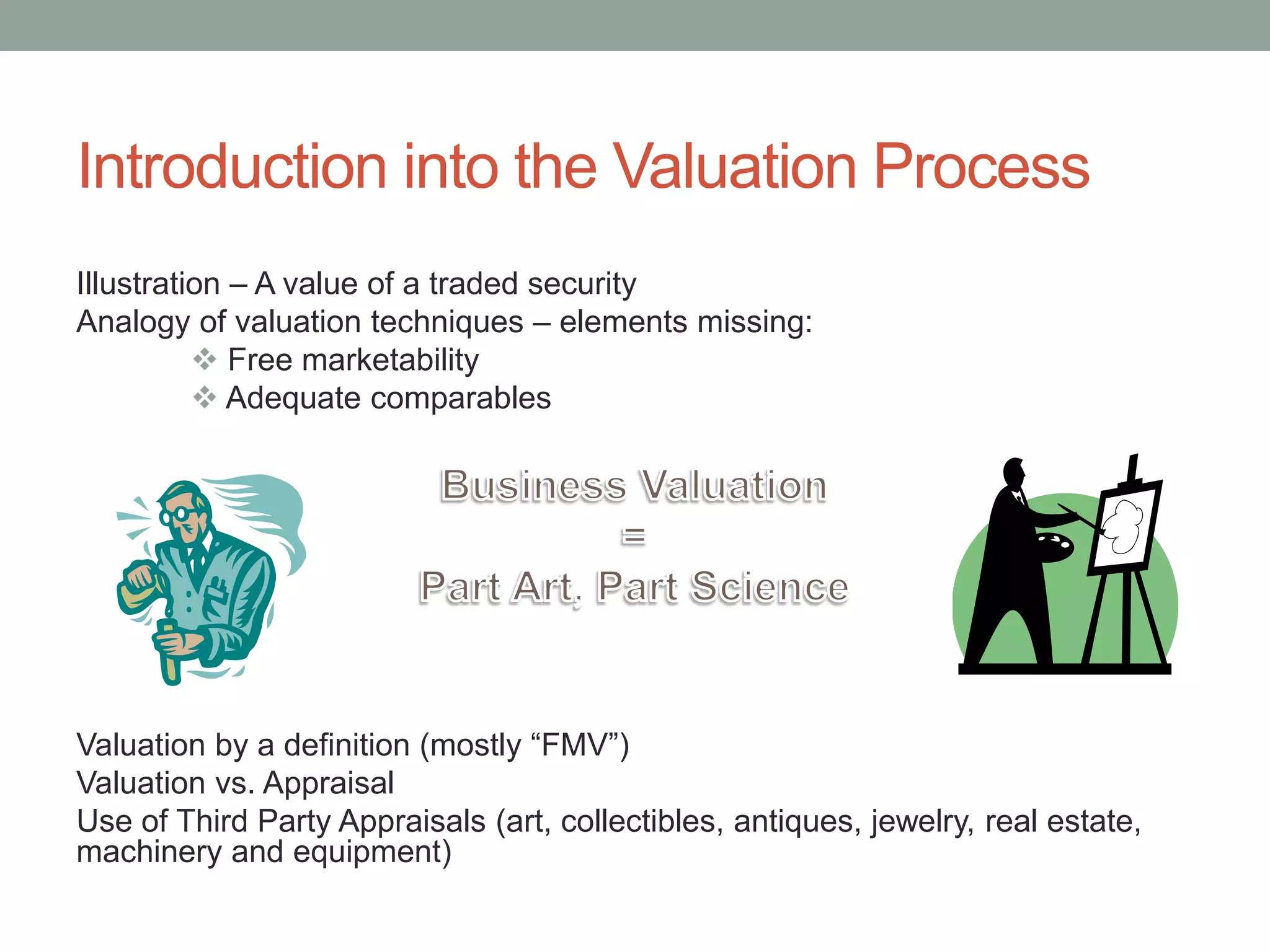
Introduction into the Valuation Process
Illustration – A value of a traded security
Analogy of valuation techniques – elements missing:
 Free marketability
 Adequate comparables
Valuation by a definition (mostly “FMV”)
Valuation vs. Appraisal
Use of Third Party Appraisals (art, collectibles, antiques, jewelry, real estate,
machinery and equipment)
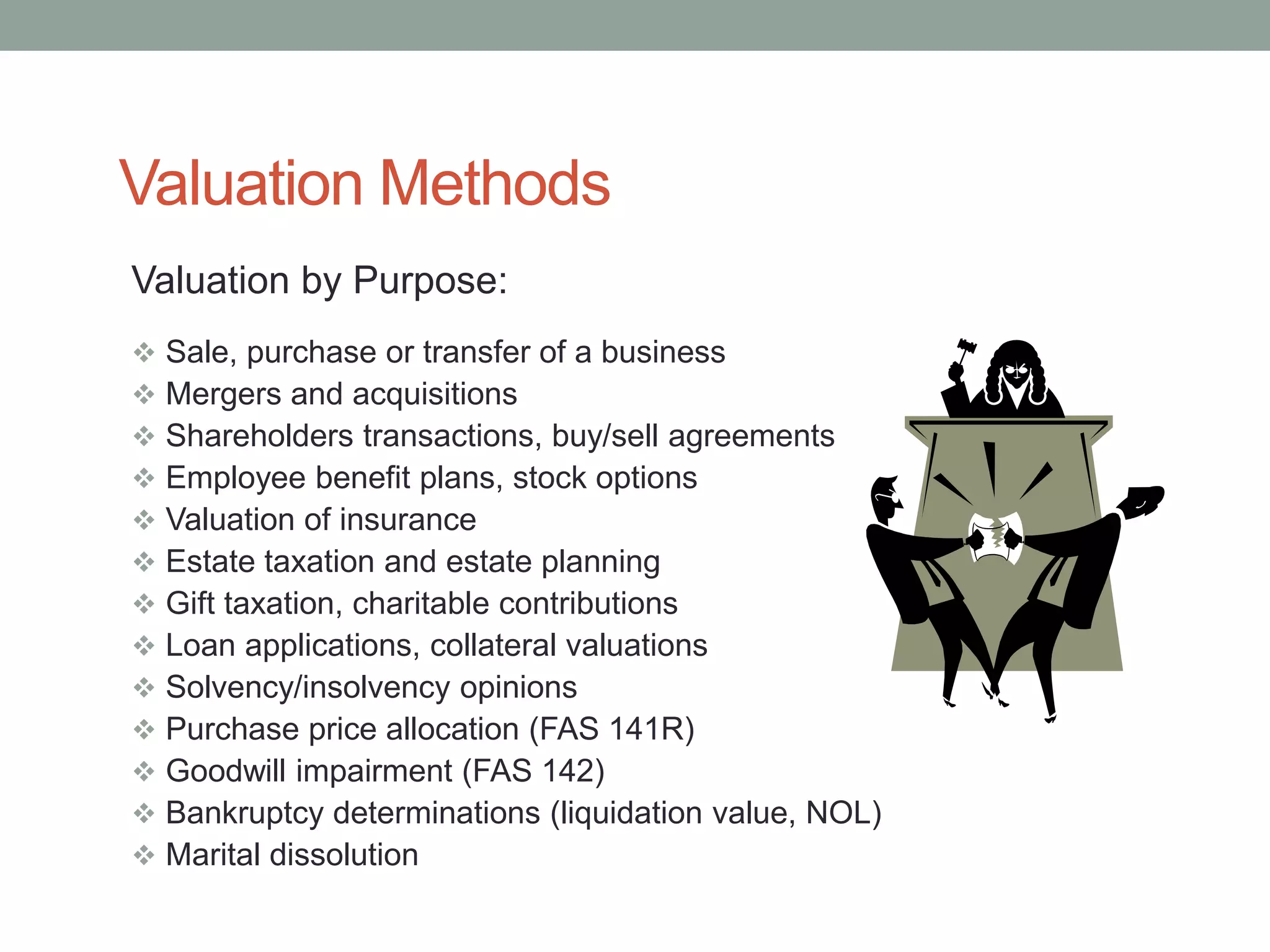
Valuation Methods
Valuation by Purpose:
 Sale, purchase or transfer of a business
 Mergers and acquisitions
 Shareholders transactions, buy/sell agreements
 Employee benefit plans, stock options
 Valuation of insurance
 Estate taxation and estate planning
 Gift taxation, charitable contributions
 Loan applications, collateral valuations
 Solvency/insolvency opinions
 Purchase price allocation (FAS 141R)
 Goodwill impairment (FAS 142)
 Bankruptcy determinations (liquidation value, NOL)
 Marital dissolution
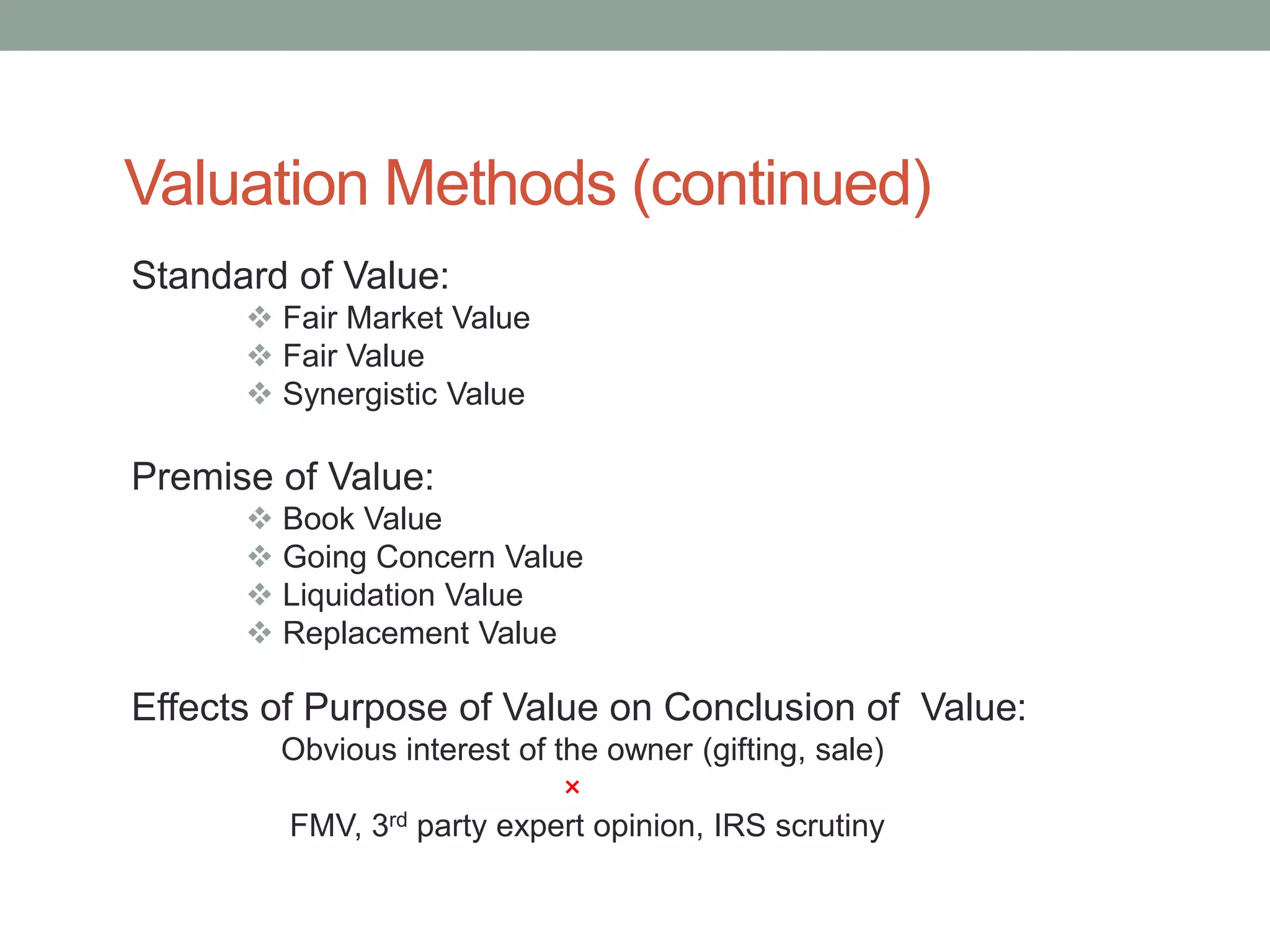
Valuation Methods (continued)
Standard of Value:
 Fair Market Value
 Fair Value
 Synergistic Value
Premise of Value:
 Book Value
 Going Concern Value
 Liquidation Value
 Replacement Value
Effects of Purpose of Value on Conclusion of Value:
Obvious interest of the owner (gifting, sale)
×
FMV, 3rd party expert opinion, IRS scrutiny
Some Myths about Valuation
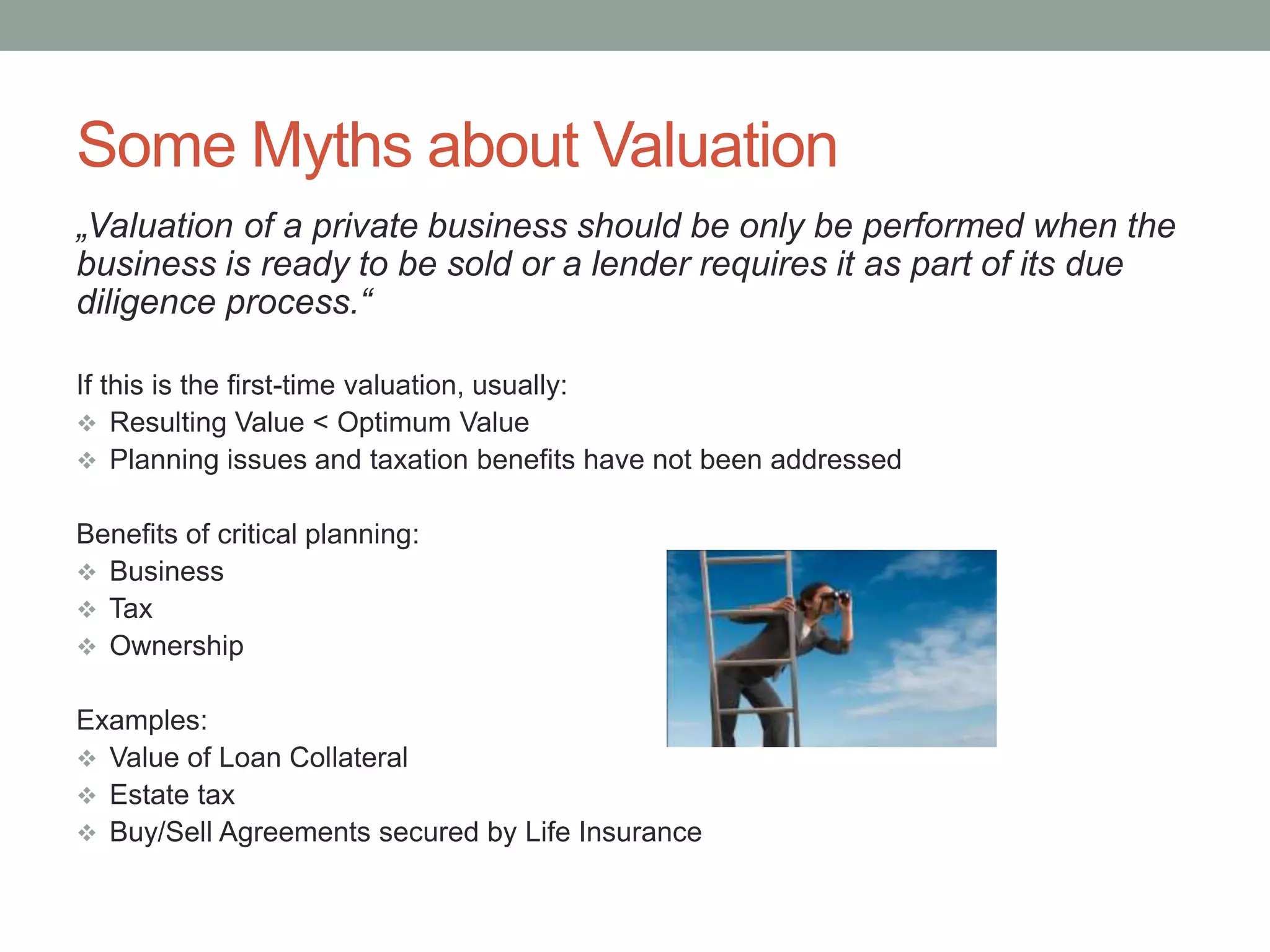
„Valuation of a private business should be only be performed when the
business is ready to be sold or a lender requires it as part of its due
diligence process.“
If this is the first-time valuation, usually:
 Resulting Value < Optimum Value
 Planning issues and taxation benefits have not been addressed
Benefits of critical planning:
 Business
 Tax
 Ownership
Examples:
 Value of Loan Collateral
 Estate tax
 Buy/Sell Agreements secured by Life Insurance
Some Myths about Valuation - continued
„Businesses in my industry usually sell for two times annual revenue,
why should I pay someone to elaborately value my business?“
Quick estimates using various multiples (Revenue Multiple, Net Income/Profit Multiple...):
What do the Multiples tell us?
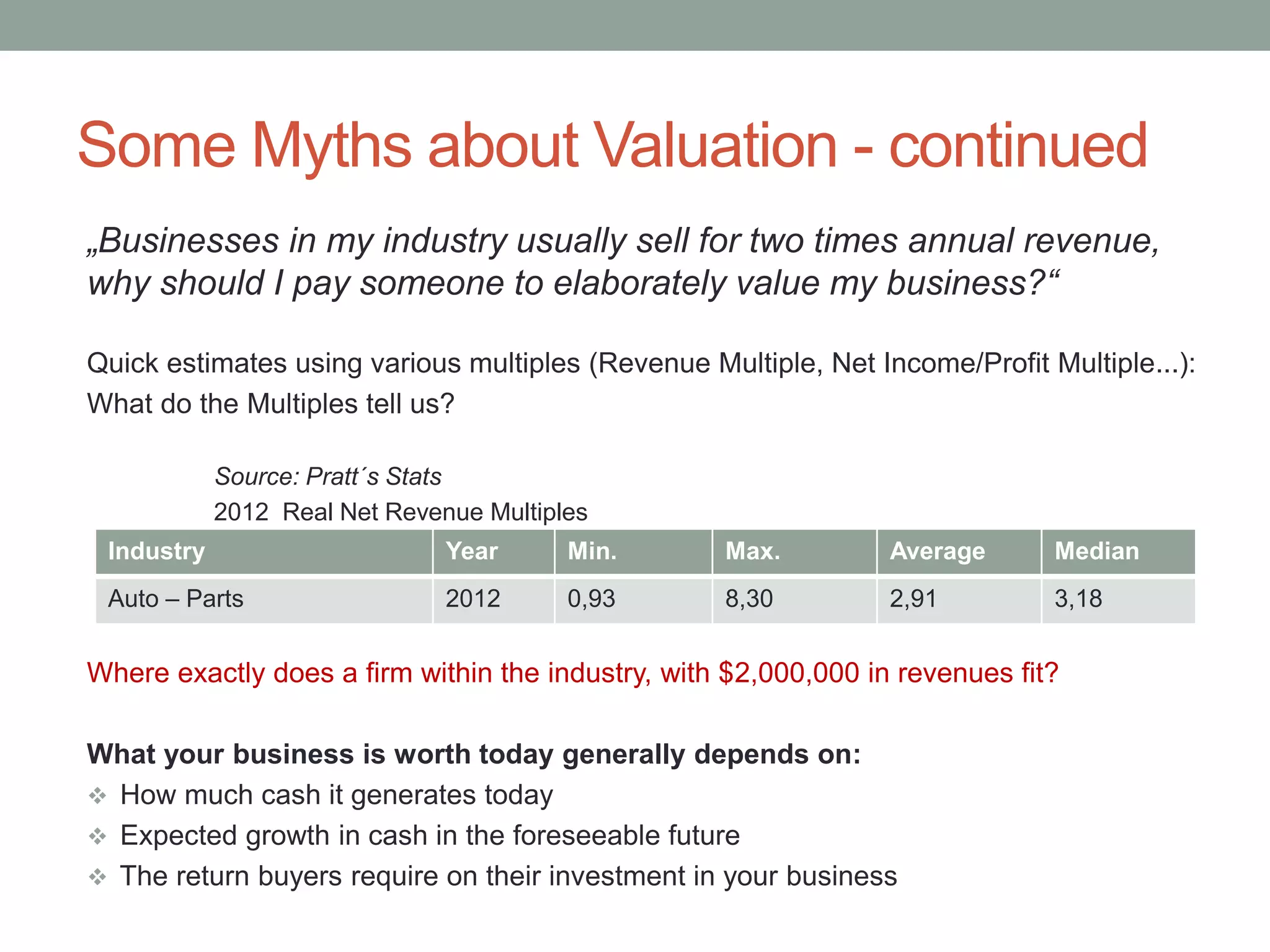
Source: Pratt´s Stats
2012 Real Net Revenue Multiples
Where exactly does a firm within the industry, with $2,000,000 in revenues fit?
What your business is worth today generally depends on:
 How much cash it generates today
 Expected growth in cash in the foreseeable future
 The return buyers require on their investment in your business
Industry Year Min. Max. Average Median
Auto – Parts 2012 0,93 8,30 2,91 3,18
Some Myths about Valuation - continued
„My business loses money, so it cannot be worth much.“
Fact: Most private businesses appear to lose money.
Financial statements reflect an array of discretionary and non-standard items.
Examples:
 Salaries
 Accelerated depreciation
 Value of intangible assets
 Non-business assets
 Need to normalize financial statements
(duty of a valuation analyst)
NORMALIZED FINANCIAL STATEMENTS
+
OTHER ELEMENTS OF THE VALUATION PROCESS
↓
REALISTIC VALUE
The Valuation Process
Methodology by NACVA (National Association of Certified Valuators and Analysts):
1. Value Estimate Assignment
• Description of Assignment
• Purpose and Function of Valuation
• Standard, Premise and Level of Value
• Methods of Valuation
• Value Estimate Key Assumptions
• Limiting Conditions
• Executive Summary
2. Company Overview
• History and Background
• Capital Structure
• Management and Personnel
• Facilities and Equipment
• Products and Services
• Other
3. Economic Conditions
• Global and/or US Economic Outlook
• Regional and Local Economic Conditions
The Valuation Process (continued)
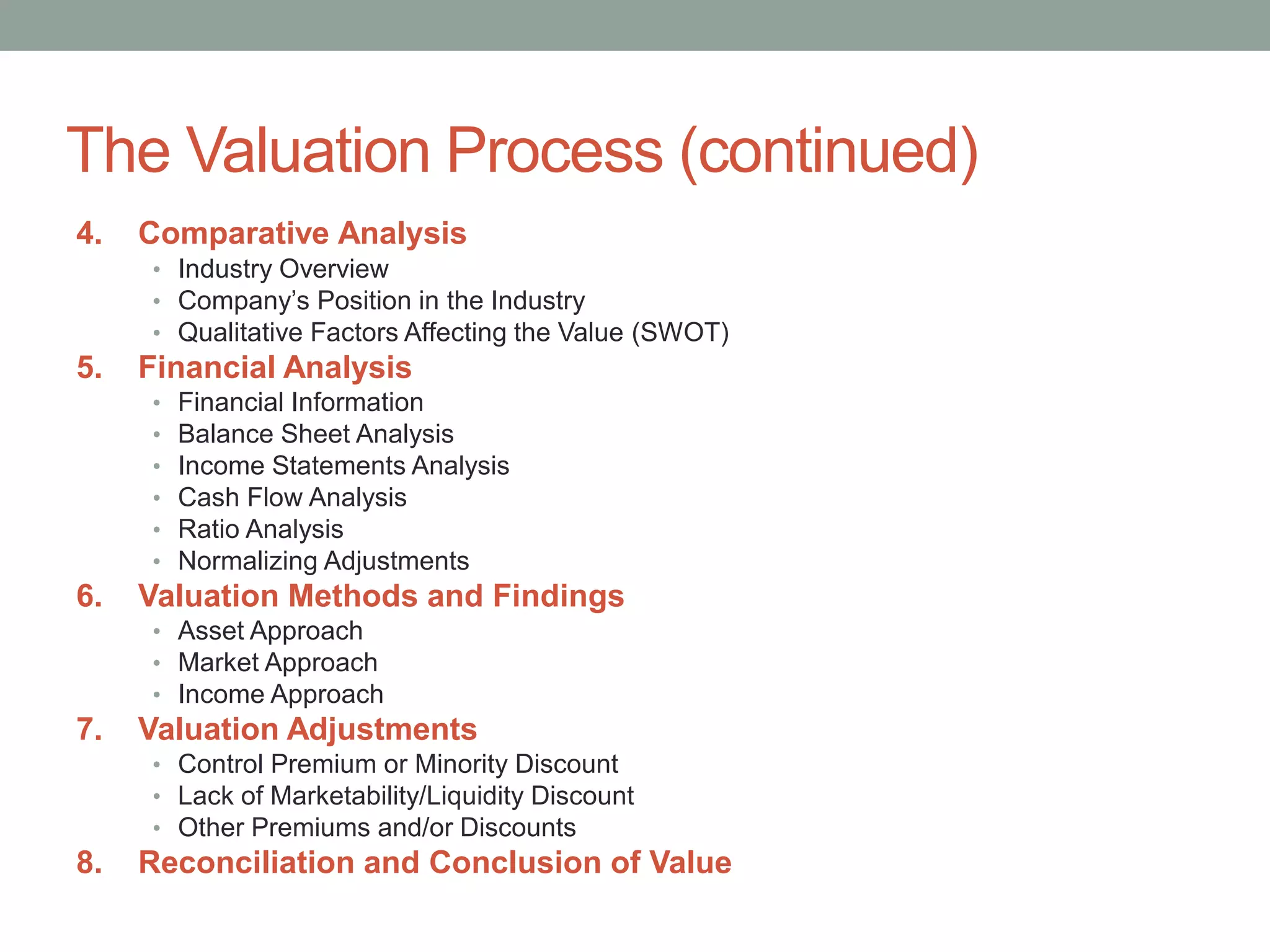
4. Comparative Analysis
• Industry Overview
• Company’s Position in the Industry
• Qualitative Factors Affecting the Value (SWOT)
5. Financial Analysis
• Financial Information
• Balance Sheet Analysis
• Income Statements Analysis
• Cash Flow Analysis
• Ratio Analysis
• Normalizing Adjustments
6. Valuation Methods and Findings
• Asset Approach
• Market Approach
• Income Approach
7. Valuation Adjustments
• Control Premium or Minority Discount
• Lack of Marketability/Liquidity Discount
• Other Premiums and/or Discounts
8. Reconciliation and Conclusion of Value
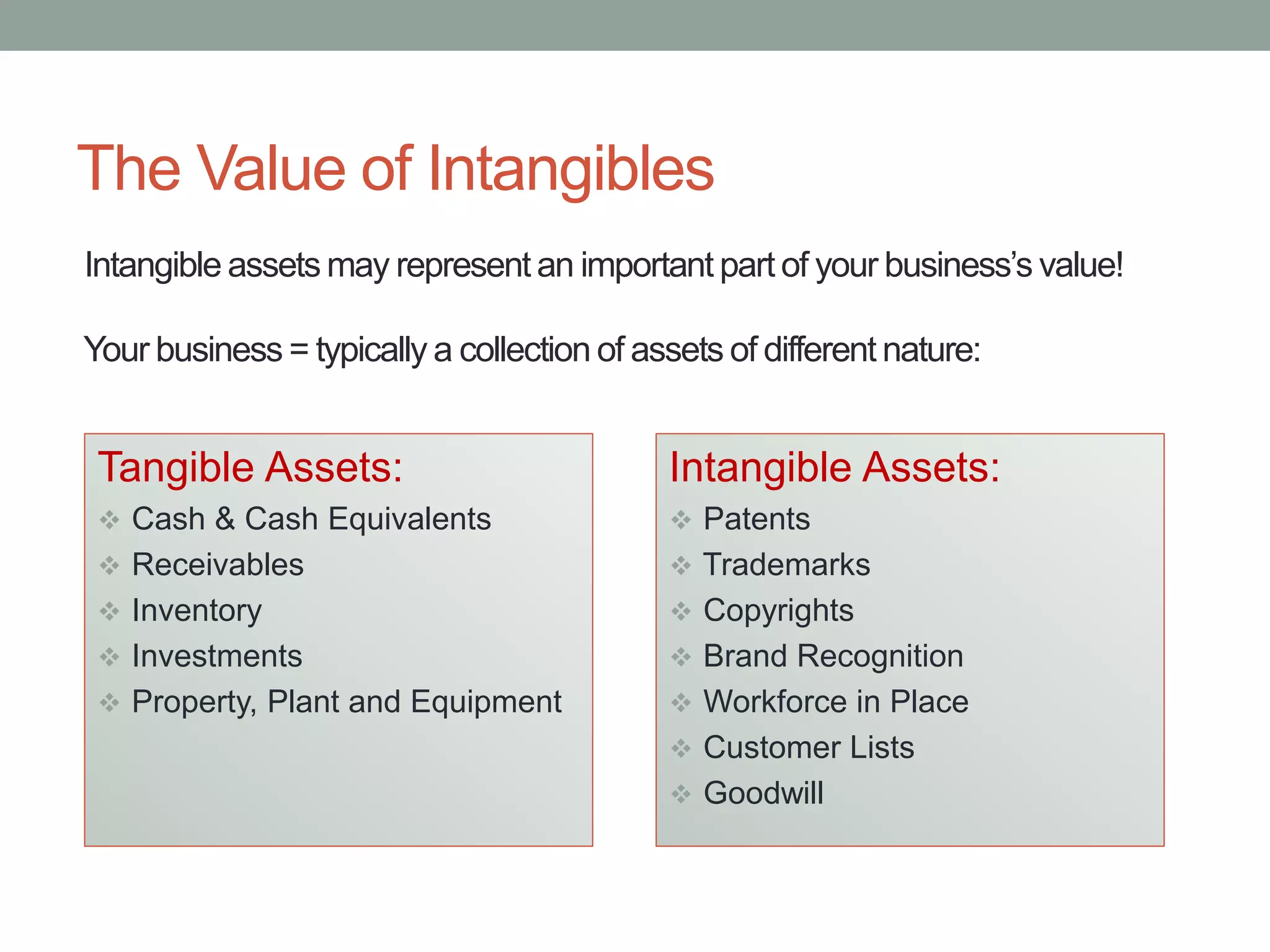
The Value of Intangibles
Intangible assets may represent an important part of your business’s value!
Your business = typically a collection of assets of different nature:
Tangible Assets:
 Cash & Cash Equivalents
 Receivables
 Inventory
 Investments
 Property, Plant and Equipment
Intangible Assets:
 Patents
 Trademarks
 Copyrights
 Brand Recognition
 Workforce in Place
 Customer Lists
 Goodwill
The Value of Intangibles (continued)
What is Goodwill?
Typically goodwill = a residuum: When a business is sold for a price
higher than Fair Market Value, goodwill represents the difference.
„Goodwill is a proclamation of the new management about how it will
use the acquired assets in a way impossible for the previous owner.“
Synergy example: A hotel chain buys an independent golf course.
Acquired Goodwill (on the books)
x
Hidden Goodwill (built-in)
Not amortized but tested for impairment
Different approaches to valuation of Intellectual Property:
 Income vs. cost methods (patents)
 Comparative methods (effective royalty rate)
 Substitution methods (workforce value)
 Projection - distribution simulation
Planning an Exit Strategy
The benefits of understanding
 Factors determining the value → maximize the value
 Structure of the value → asset separation, tax strategies
Advantages of a family business in Exit Strategy Planning!
Sale of Business
Preparation for a sale of a business:
 Learn about comparable transactions
 Recognize the market conditions
 Optimalize the business operations
 Normalize financials and/or adjust practices
 Invest in the company?
 Estimate tax implications
 Select the sales and marketing tools
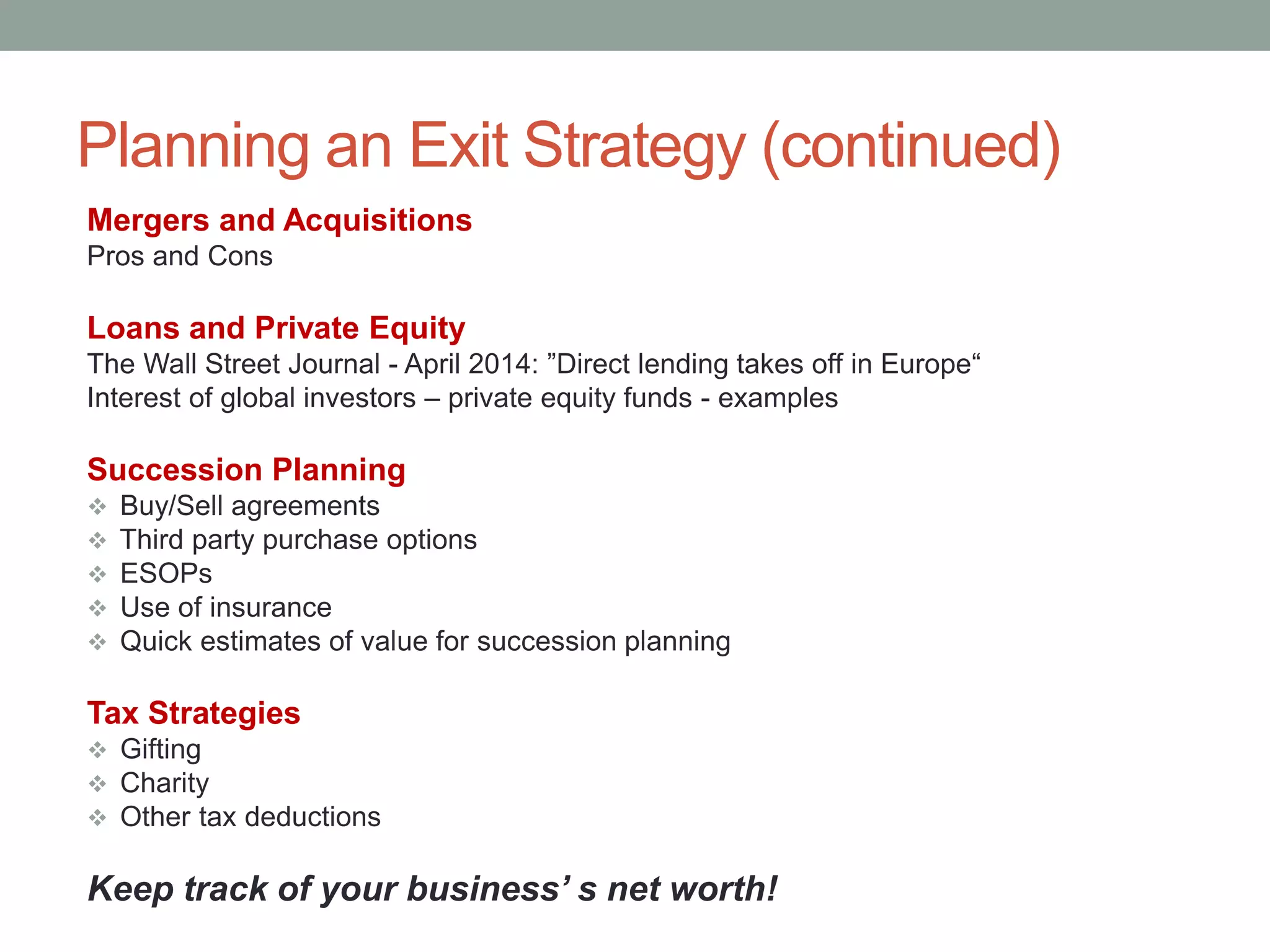
Planning an Exit Strategy (continued)
Mergers and Acquisitions
Pros and Cons
Loans and Private Equity
The Wall Street Journal - April 2014: ”Direct lending takes off in Europe“
Interest of global investors – private equity funds - examples
Succession Planning
 Buy/Sell agreements
 Third party purchase options
 ESOPs
 Use of insurance
 Quick estimates of value for succession planning
Tax Strategies
 Gifting
 Charity
 Other tax deductions
Keep track of your business’ s net worth!

What Is the Value of Your Business.

  • 1.
    WHAT IS THEVALUE OF YOUR BUSINESS © Vladimir Hulpach, P.O.Box 17005, Fountain Hills, AZ 85269, USA
  • 2.
    Do You Wantto Know What Is Your Business Net Worth? Common approach: I will be concerned about my business net worth when there is a “need” for a valuation.
  • 3.
    Needs for avaluation do come up! Common Examples:  Sale of a business  Mergers and acquisitions  Estate and gifting  Succession planning  Insurance  Financing
  • 4.
    Why and WhenShould You Care Responsive Approach Previous examples = mostly forced by circumstances. Proactive Approach Allows to fix a price or set methods to determine business value in planning for foreseeable events: • Buy/Sell Agreements • Family Business Succession • Insurance • Stock Options • Trigger Value Are we able to predict situations dictating a need for business valuation?
  • 5.
    Can We Influencethe Business Value? Negligible Influence - Examples: • Inflated salaries • Non-recurring expenses • Non-related assets Essential Influence - Examples: • Growth rate • State of the industry • Position among competition Using the Momentum: • Global and local economic outlook • State of capital markets • State of the industry • Current competitive position of the Business Understanding the Factors Timing of the Valuation
  • 6.
    Introduction into theValuation Process Illustration – A value of a traded security Analogy of valuation techniques – elements missing:  Free marketability  Adequate comparables Valuation by a definition (mostly “FMV”) Valuation vs. Appraisal Use of Third Party Appraisals (art, collectibles, antiques, jewelry, real estate, machinery and equipment)
  • 7.
    Valuation Methods Valuation byPurpose:  Sale, purchase or transfer of a business  Mergers and acquisitions  Shareholders transactions, buy/sell agreements  Employee benefit plans, stock options  Valuation of insurance  Estate taxation and estate planning  Gift taxation, charitable contributions  Loan applications, collateral valuations  Solvency/insolvency opinions  Purchase price allocation (FAS 141R)  Goodwill impairment (FAS 142)  Bankruptcy determinations (liquidation value, NOL)  Marital dissolution
  • 8.
    Valuation Methods (continued) Standardof Value:  Fair Market Value  Fair Value  Synergistic Value Premise of Value:  Book Value  Going Concern Value  Liquidation Value  Replacement Value Effects of Purpose of Value on Conclusion of Value: Obvious interest of the owner (gifting, sale) × FMV, 3rd party expert opinion, IRS scrutiny
  • 9.
    Some Myths aboutValuation „Valuation of a private business should be only be performed when the business is ready to be sold or a lender requires it as part of its due diligence process.“ If this is the first-time valuation, usually:  Resulting Value < Optimum Value  Planning issues and taxation benefits have not been addressed Benefits of critical planning:  Business  Tax  Ownership Examples:  Value of Loan Collateral  Estate tax  Buy/Sell Agreements secured by Life Insurance
  • 10.
    Some Myths aboutValuation - continued „Businesses in my industry usually sell for two times annual revenue, why should I pay someone to elaborately value my business?“ Quick estimates using various multiples (Revenue Multiple, Net Income/Profit Multiple...): What do the Multiples tell us? Source: Pratt´s Stats 2012 Real Net Revenue Multiples Where exactly does a firm within the industry, with $2,000,000 in revenues fit? What your business is worth today generally depends on:  How much cash it generates today  Expected growth in cash in the foreseeable future  The return buyers require on their investment in your business Industry Year Min. Max. Average Median Auto – Parts 2012 0,93 8,30 2,91 3,18
  • 11.
    Some Myths aboutValuation - continued „My business loses money, so it cannot be worth much.“ Fact: Most private businesses appear to lose money. Financial statements reflect an array of discretionary and non-standard items. Examples:  Salaries  Accelerated depreciation  Value of intangible assets  Non-business assets  Need to normalize financial statements (duty of a valuation analyst) NORMALIZED FINANCIAL STATEMENTS + OTHER ELEMENTS OF THE VALUATION PROCESS ↓ REALISTIC VALUE
  • 12.
    The Valuation Process Methodologyby NACVA (National Association of Certified Valuators and Analysts): 1. Value Estimate Assignment • Description of Assignment • Purpose and Function of Valuation • Standard, Premise and Level of Value • Methods of Valuation • Value Estimate Key Assumptions • Limiting Conditions • Executive Summary 2. Company Overview • History and Background • Capital Structure • Management and Personnel • Facilities and Equipment • Products and Services • Other 3. Economic Conditions • Global and/or US Economic Outlook • Regional and Local Economic Conditions
  • 13.
    The Valuation Process(continued) 4. Comparative Analysis • Industry Overview • Company’s Position in the Industry • Qualitative Factors Affecting the Value (SWOT) 5. Financial Analysis • Financial Information • Balance Sheet Analysis • Income Statements Analysis • Cash Flow Analysis • Ratio Analysis • Normalizing Adjustments 6. Valuation Methods and Findings • Asset Approach • Market Approach • Income Approach 7. Valuation Adjustments • Control Premium or Minority Discount • Lack of Marketability/Liquidity Discount • Other Premiums and/or Discounts 8. Reconciliation and Conclusion of Value
  • 14.
    The Value ofIntangibles Intangible assets may represent an important part of your business’s value! Your business = typically a collection of assets of different nature: Tangible Assets:  Cash & Cash Equivalents  Receivables  Inventory  Investments  Property, Plant and Equipment Intangible Assets:  Patents  Trademarks  Copyrights  Brand Recognition  Workforce in Place  Customer Lists  Goodwill
  • 15.
    The Value ofIntangibles (continued) What is Goodwill? Typically goodwill = a residuum: When a business is sold for a price higher than Fair Market Value, goodwill represents the difference. „Goodwill is a proclamation of the new management about how it will use the acquired assets in a way impossible for the previous owner.“ Synergy example: A hotel chain buys an independent golf course. Acquired Goodwill (on the books) x Hidden Goodwill (built-in) Not amortized but tested for impairment Different approaches to valuation of Intellectual Property:  Income vs. cost methods (patents)  Comparative methods (effective royalty rate)  Substitution methods (workforce value)  Projection - distribution simulation
  • 16.
    Planning an ExitStrategy The benefits of understanding  Factors determining the value → maximize the value  Structure of the value → asset separation, tax strategies Advantages of a family business in Exit Strategy Planning! Sale of Business Preparation for a sale of a business:  Learn about comparable transactions  Recognize the market conditions  Optimalize the business operations  Normalize financials and/or adjust practices  Invest in the company?  Estimate tax implications  Select the sales and marketing tools
  • 17.
    Planning an ExitStrategy (continued) Mergers and Acquisitions Pros and Cons Loans and Private Equity The Wall Street Journal - April 2014: ”Direct lending takes off in Europe“ Interest of global investors – private equity funds - examples Succession Planning  Buy/Sell agreements  Third party purchase options  ESOPs  Use of insurance  Quick estimates of value for succession planning Tax Strategies  Gifting  Charity  Other tax deductions Keep track of your business’ s net worth!

Editor's Notes

  • #2 Add date
  • #4 M+A; LI to cover buy-sell obligations; valuation of co. or of collateral
  • #6 No: This is 3rd party independent IRS compliant review. Yes: See above examples. Understanding the principles => optimizing the value.
  • #8 M+A; LI to cover buy-sell obligations; valuation of co. or of collateral
  • #9 Effects of Purpose: go back 1 slide for examples
  • #11 Answer: from 1,860,000 to 16,600,000 margin !
  • #13 History – prohibition, current orgs: IACVA, NACVA, GACVA, RICS, IVSC, TEGoVA
  • #14 No. 6 - All 3 methods must be considered!
  • #15 Vliv účelu: go back 1 slide to expamples
  • #16 tax implications of goodwill determination
  • #17 Prep of sale = not only “Anung” of comps, respect market/investment conditions