PM Vallone 10/20/2014 
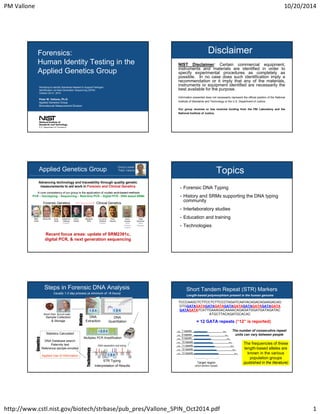
Forensics: 
Human Identity Testing in the 
Applied Genetics Group 
Workshop to Identify Standards Needed to Support Pathogen 
Identification via Next-Generation Sequencing (SPIN) 
October 20-21, 2014 
Peter M. Vallone, Ph.D. 
Applied Genetics Group 
Biomolecular Measurement Division 
Disclaimer 
NIST Disclaimer: Certain commercial equipment, 
instruments and materials are identified in order to 
specify experimental procedures as completely as 
possible. In no case does such identification imply a 
recommendation or it imply that any of the materials, 
instruments or equipment identified are necessarily the 
best available for the purpose. 
Information presented does not necessarily represent the official position of the National 
Institute of Standards and Technology or the U.S. Department of Justice. 
Our group receives or has received funding from the FBI Laboratory and the 
National Institute of Justice. 
Applied Genetics Group 
Group Leader 
Peter Vallone 
Advancing technology and traceability through quality genetic 
measurements to aid work in Forensic and Clinical Genetics 
A core competency of our group is the application of nucleic acid-based methods 
PCR – Genotyping – Sequencing – Real-time PCR – Digital PCR - DNA based SRMs 
Dave 
Duewer 
Data 
analysis 
support 
Patti 
Rohmiller 
Office 
Manager 
Clinical Genetics 
Ross 
Haynes 
Jo Lynne 
Harenza 
Postdoc 
Forensic Genetics 
Erica 
Butts 
Margaret 
Kline 
Mike Becky Hill 
Coble 
Katherine 
Gettings 
Postdoc 
Kevin 
Kiesler 
Recent focus areas: update of SRM2391c, 
digital PCR, & next generation sequencing 
Topics 
• Forensic DNA Typing 
• History and SRMs supporting the DNA typing 
community 
• Interlaboratory studies 
• Education and training 
• Technologies 
Steps in Forensic DNA Analysis 
Usually 1-2 day process (a minimum of ~8 hours) 
1.5 h 1.5 h 
DNA 
Extraction 
DNA 
Quantitation 
~3.5 h 
Multiplex PCR Amplification 
DNA separation and sizing 
1.5 h 
STR Typing 
Interpretation of Results 
Blood Stain Buccal swab 
Sample Collection 
& Storage 
Statistics Calculated 
DNA Database search 
Paternity test 
Reference sample enrolled 
Applied Use of Information 
Technology 
Biology 
Genetics 
Short Tandem Repeat (STR) Markers 
Length-based polymorphism present in the human genome 
TCCCAAGCTCTTCCTCTTCCCTAGATCAATACAGACAGAAGACAG 
GTGGATAGATAGATAGATAGATAGATAGATAGATAGATAGATA 
GATAGATATCATTGAAAGACAAAACAGAGATGGATGATAGATAC 
ATGCTTACAGATGCACAC 
= 12 GATA repeats (“12” is reported) 
Target region 
(short tandem repeat) 
7 repeats 
8 repeats 
9 repeats 
10 repeats 
11 repeats 
12 repeats 
13 repeats 
The number of consecutive repeat 
units can vary between people 
The frequencies of these 
length-based alleles are 
known in the various 
population groups 
(published in the literature) 
http://www.cstl.nist.gov/biotech/strbase/pub_pres/Vallone_SPIN_Oct2014.pdf 1
PM Vallone 10/20/2014 
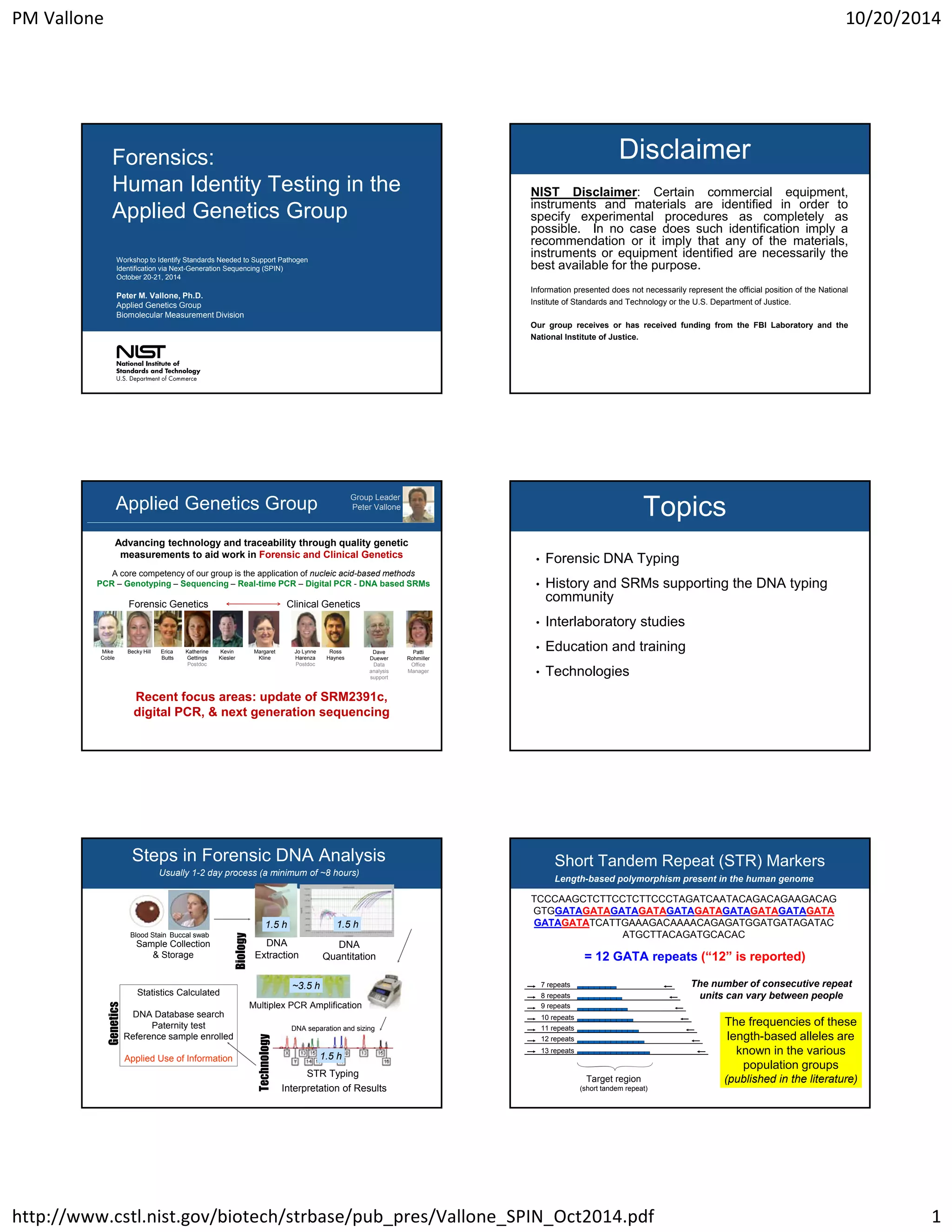
Identifiler (Applied Biosystems) 15 STR Loci Kit 
Information is tied together with multiplex PCR and data analysis 
D8S1179 
D21S11 
D7S820 CSF1PO 
(15,16)-(29,29)-(9,11)-(10,11)-(16,17)-(6,7)-(8,12)-(10,11)-(19,19)-(14,16)- 
(15,17)-(8,12)-(D13S317 
11,15)-(X,Y)-(9,11)-(19,22) 
D16S539 D2S1338 
The frequencies of the STR alleles are known in a population 
The allele frequencies are independent and can be multiplied (product rule) 
The Random Match Probability 
D18S51 
(RMP) is over 1 in 800 trillion 
D3S1358 TH01 
VWA TPOX 
D19S433 
for unrelated individuals 
AMEL D5S818 FGA 
This test contains the 13 FBI core loci (NDIS) 
Applications of Human Identity Testing 
• Forensic cases: matching suspect with evidence 
• Kinship determination 
• Missing persons investigations 
• Military DNA “dog tag” 
• Convicted felon DNA databases 
• Mass disasters: putting pieces back together 
• Historical investigations 
• Genetic genealogy 
Human Identity Testing with DNA 
• Always testing human DNA (one species) 
• The majority of the identification tests are performed with a core 
set of short tandem repeat markers (STRs) 13 → 20 
• Mitochondrial DNA (high copy number, maternally inherited) 
• Selected SNPs (identity, biogeograpical ancestry, phenotype) 
• Currently the workflow is very similar in all DNA testing labs 
• Extraction, qPCR quantification, multiplex PCR kit, separation and detection 
(capillary electrophoresis) 
• Performed with very similar commercial reagents and instrumentation (no in 
house or home brew assays are used – validation is important) 
FBI DNA Advisory Board Quality Assurance Standards 
for Forensic DNA Testing Laboratories 
Oct 1 ,1998 
A lab must follow the QAS to attain accreditation 
• Scope 
• Definitions 
• Quality Assurance Program 
• Organization and Management 
• Personnel 
• Facilities 
• Validation 
• Analytical Procedures 
• Equipment and Calibration 
Maintenance 
• Reports 
• Review 
• Proficiency Testing 
• Corrective Action 
• Audits 
• Safety 
• Outsourcing 
http://www.fbi.gov/about-us/lab/biometric-analysis/codis/qas_testlabs 
Standard Reference Material 2391c : 
PCR-Based DNA Profiling Standard 
• Components A through D are DNA extracts in liquid form 
• Components E and F are cells spotted on 903 paper or 
FTA paper 
• Certified values are for STR alleles based on length 
polymorphisms observed using capillary electrophoresis 
Lab 1 Lab 2 
Helps meet QAS Std. 9.5.5 and ISO 17025 
Standard Reference Material 
Calibration with SRMs 
enables confidence in 
comparisons of results 
between laboratories 
SRM 2391c 
Current price: $626 USD 
Genomic DNAs characterized for the 
expanded CODIS core loci and Y-STRs 
NIST Nucleic acid-based standards 
SRM NIST DNA-based SRMs 
2366 Cytomegalovirus (CMV) for DNA Measurements2 
2393 CAG Repeat Length Mutation in Huntington's Disease1 
2374 DNA Sequence Library for External RNA Controls3 
2372 Human DNA Quantitation Standard1 
2391c PCR Based DNA Profiling Standard1,5 
2392, 2392-I Mitochondrial DNA Sequencing1 
2394 Heteroplasmic Mitochondrial DNA Mutation Detection Std4 
Candidates currently under characterization 
BK Virus3 
HER2 Copy Number Measurement1 
Pathlength Standard for Nanoliter Spectrophotometers6 
Genome in a Bottle (NA 12878)1 
Forensic DNA Typing 
1extracted genomic DNA (human); 2extracted genomic DNA (viral in BAC); 3extracted DNA 
(plasmid) 4PCR products; 5cell lines on paper substrate; 6Uracil and Tryptophan solutions 
http://www.cstl.nist.gov/biotech/strbase/pub_pres/Vallone_SPIN_Oct2014.pdf 2
PM Vallone 10/20/2014 
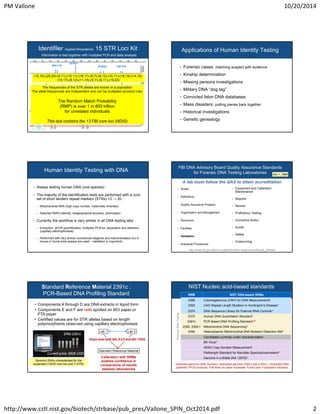
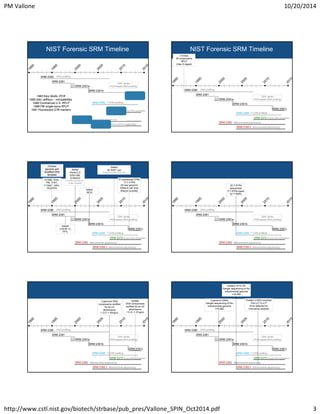
NIST Forensic SRM Timeline 
SRM 2391b 
2391 series 
PCR-based DNA profiling 
SRM 2395 Y CHR profiling 
SRM 2391c 
SRM 2372 Human DNA quantitation 
SRM 2391a 
SRM 2392 Mitochondrial sequencing 
SRM 2392-I Mitochondrial sequencing 
SRM 2390 DNA profiling 
SRM 2391 
1983 Kary Mullis -PCR 
1985 Alec Jeffreys – minisatellites 
1986 Commercial U.S. RFLP 
1988 FBI single-locus RFLP 
1991 Fluorescent STR markers 
3 boxes 
NIST Forensic SRM Timeline 
20 components 
RFLP 
(Hae III digest) 
SRM 2390 DNA profiling 
SRM 2391 
SRM 2391a 
SRM 2391b 
2391 series 
PCR-based DNA profiling 
SRM 2391c 
SRM 2395 Y CHR profiling 
SRM 2372 Human DNA quantitation 
SRM 2392 Mitochondrial sequencing 
SRM 2392-I Mitochondrial sequencing 
Added 
SE33 
2 boxes 
genomic and 
amplified DNA 
template 
D1S80, DQα, 
PM, TH01, 
F13A01, vWA, 
FES/FPS 
Added 
Penta E,D 
D2S1358, 
D19S433 
D1S80 products no 
longer supplied 
SRM 2390 DNA profiling 
SRM 2391 
SRM 2391a 
Dropped D1S80, DQα, PM 
SRM 2391b 
Added 
26 ‘NIST’ loci 
51 autosomal STRs 
17 Y STRs 
All new genomic 
DNAs & cell lines 
Mixture included 
2391 series 
PCR-based DNA profiling 
SRM 2391c 
SRM 2395 Y CHR profiling 
SRM 2372 Human DNA quantitation 
SRM 2392 Mitochondrial sequencing 
SRM 2392-I Mitochondrial sequencing 
Added 
CODIS 13, 
FFFL 
SRM 2390 DNA profiling 
SRM 2391 
22 Y-STRs 
sequenced 
5 Y-STRs typed 
42 Y-SNPs 
SRM 2391a 
SRM 2391b 
2391 series 
PCR-based DNA profiling 
SRM 2391c 
SRM 2395 Y CHR profiling 
SRM 2372 Human DNA quantitation 
SRM 2392 Mitochondrial sequencing 
SRM 2392-I Mitochondrial sequencing 
SRM 2390 DNA profiling 
SRM 2391 
SRM 2391a 
3 genomic DNA 
components certified 
for ds UV 
absorbance 
1 O.D. ≈ 50ng/uL 
SRM 2391b 
DNA components 
certified for ss UV 
absorbance 
1 O.D. ≈ 37ng/uL 
2391 series 
Update: 
PCR-based DNA profiling 
SRM 2391c 
SRM 2395 Y CHR profiling 
SRM 2372 Human DNA quantitation 
SRM 2392 Mitochondrial sequencing 
SRM 2392-I Mitochondrial sequencing 
Addition of HL-60 
Sanger sequencing of the 
mitochondrial genome 
2 genomic DNAs 
≈16,569 
Sanger sequencing of the 
mitochondrial genome 
SRM 2390 DNA profiling 
SRM 2391 
≈16,569 
SRM 2391a 
Position 4,929 corrected 
SRM 2391b 
from a C to a T 
Error detected by 
microarray analysis 
2391 series 
PCR-based DNA profiling 
SRM 2391c 
SRM 2395 Y CHR profiling 
SRM 2372 Human DNA quantitation 
SRM 2392 Mitochondrial sequencing 
SRM 2392-I Mitochondrial sequencing 
http://www.cstl.nist.gov/biotech/strbase/pub_pres/Vallone_SPIN_Oct2014.pdf 3
PM Vallone 10/20/2014 
Purpose of an Interlaboratory Study 
Interlaboratory studies (ILS) are a way 
for multiple laboratories to compare 
results and demonstrate that the 
methods or instrument platforms used 
in one's own laboratory are 
reproducible in another laboratory 
NIST Initiated Interlaboratory Studies 
ILS Participating 
Labs Publications/Dissemination 
Evaluation of CSF1PO, 
TPOX, and TH01 34 
Kline MC, Duewer DL, Newall P, Redman JW, Reeder DJ, Richard M. 
(1997) Interlaboratory evaluation of STR triplex CTT. J. Forensic Sci. 42: 
897-906 
Mixed Stain Studies 
#1 and #2 (1997 and 1999) 
45 
Duewer DL, Kline MC, Redman JW, Newall PJ, Reeder DJ. (2001) NIST 
Mixed Stain Studies #1 and #2: interlaboratory comparison of DNA 
quantification practice and short tandem repeat multiplex performance with 
multiple-source samples. J. Forensic Sci. 46: 1199-1210 
The ILS lead to publications, reference materials, 
and dissemination of results to the community 
Independent measure of how the DNA typing 
Mixed Stain Study #3 
(2000 and 2001) 74 
Kline, M.C., Duewer, D.L., Redman, J.W., Butler, J.M. (2003) NIST mixed 
stain study 3: DNA quantitation accuracy and its influence on short tandem 
repeat multiplex signal intensity. Anal. Chem. 75: 2463-2469. 
Duewer, D.L., Kline, M.C., Redman, J.W., Butler, J.M. (2004) NIST Mixed 
Stain Study #3: signal intensity balance in commercial short tandem repeat 
multiplexes, Anal. Chem. 76: 6928-6934. 
DNA Quantitation Study 
80 Kline, M.C., Duewer, D.L., Redman, J.W., Butler, J.M. (2005) Results from 
(2004) the NIST 2004 DNA Quantitation Study, J. Forensic Sci. 50(3):571-578 
Mixture Interpretation 
Study (2005) 
community is performing 
69 http://www.cstl.nist.gov/strbase/interlab/MIX05/MIX05poster.pdf 
Mixture Interpretation 
Study (2013) 108 Manuscript in preparation 
Rapid DNA Testing 
(Fall 2013) 3 http://www.cstl.nist.gov/strbase/pub_pres/Vallone_BCC_Talk_Sept2013.pdf 
Individual Performance in an Interlaboratory 
Study 
DNA Quantitation 
10 
5 
3 
1 
0.5 
0.3 
R S T V X U W 
Various samples (R-W) 
97.5% 
75% 
Median 
25% 
2.5% 
DNA Concentration, ng / L 
Overall results 
Individual lab performance 
Modified plot from Kline, M.C., et al. (2003) Anal. Chem. 75: 2463-2469 
NIST Mixed Stain Study 3: DNA Quantitation Accuracy and Its Influence on Short Tandem Repeat 
Multiplex Signal Intensity 
Results… 
• Quantitation Methods and Frequency of Use 
• Interpretation of Semi-Quantitative Data 
• Method Sensitivities 
• Combining Within-Analyst Replicates and Within-laboratory Duplicates 
• Distributions of the Among-laboratory Results 
• Measurement Variability 
• Measurement Performance Characteristics 
• Consensus Values and Variability as Functions of [DNA] 
• Blot-Based Vs. Q-PCR Methods 
• Single-Source Vs. Multiple-Source Materials 
• Polypropylene Vs. Teflon Sample Containers 
Education and Training 
http://www.cstl.nist.gov/strbase/ 
Since 10/1997 
Information related to: 
Basics of STR typing 
Variant allele reports 
STR typing kit 
STR loci ‘fact sheets’ 
Population data 
Software tools 
Team outputs: 
Since 1998 ≈ 200 papers 
Since 2000 ≈ 865 posters/ 
presentations/workshops 
Textbooks Written by Dr. John Butler 
http://www.cstl.nist.gov/biotech/strbase/pub_pres/Vallone_SPIN_Oct2014.pdf 4
PM Vallone 10/20/2014 
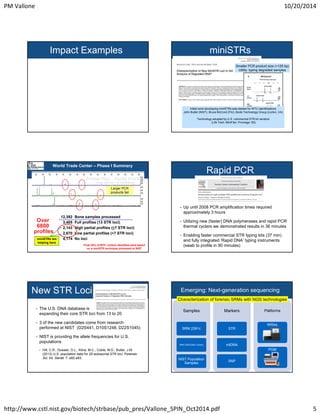
Impact Examples miniSTRs 
Smaller PCR product size (<125 bp) 
Utility: typing degraded samples 
Initial work developing miniSTRs was started for WTC identifications 
John Butler (NIST), Bruce McCord (FIU), Bode Technology Group (Lorton, VA) 
Technology adopted by U.S. commercial STR kit vendors 
(Life Tech: MiniFiler, Promega: S5) 
World Trade Center – Phase I Summary 
Profiler Plus – Partial Profile 
Degradation or Inhibition 
Larger PCR 
products fail 
12,392 Bone samples processed 
3,405 Full profiles (13 STR loci) 
2,143 High partial profiles (>7 STR loci) 
2,670 Low partial profiles (<7 STR loci) 
4,174 No loci 
Over 
6800 
profiles 
miniSTRs are 
helping here 
Final 20% of WTC victims identified were based 
on a miniSTR technique pioneered at NIST 
Rapid PCR 
• Up until 2008 PCR amplification times required 
approximately 3 hours 
• Utilizing new (faster) DNA polymerases and rapid PCR 
thermal cyclers we demonstrated results in 36 minutes 
• Enabling faster commercial STR typing kits (37 min) 
and fully integrated ‘Rapid DNA’ typing instruments 
(swab to profile in 90 minutes) 
New STR Loci 
• The U.S. DNA database is 
expanding their core STR loci from 13 to 20 
• 3 of the new candidates come from research 
performed at NIST (D2S441, D10S1248, D22S1045) 
• NIST is providing the allele frequencies for U.S. 
populations 
• Hill, C.R., Duewer, D.L., Kline, M.C., Coble, M.D., Butler, J.M. 
(2013) U.S. population data for 29 autosomal STR loci. Forensic 
Sci. Int. Genet. 7: e82-e83. 
Emerging: Next-generation sequencing 
Characterization of forensic SRMs with NGS technologies 
Samples 
SRM 2391c 
SRM 2392/2392I (mtDNA) 
NIST Population 
Samples 
Markers 
STR 
mtDNA 
SNP 
Platforms 
MiSeq 
PGM 
http://www.cstl.nist.gov/biotech/strbase/pub_pres/Vallone_SPIN_Oct2014.pdf 5
PM Vallone 10/20/2014 
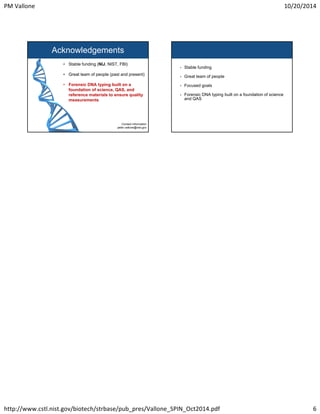
Acknowledgements 
• Stable funding (NIJ, NIST, FBI) 
• Great team of people (past and present) 
• Forensic DNA typing built on a 
foundation of science, QAS, and 
reference materials to ensure quality 
measurements 
Contact Information 
peter.vallone@nist.gov 
• Stable funding 
• Great team of people 
• Focused goals 
• Forensic DNA typing built on a foundation of science 
and QAS 
http://www.cstl.nist.gov/biotech/strbase/pub_pres/Vallone_SPIN_Oct2014.pdf 6

Forensics: Human Identity Testing in the Applied Genetics Group

  • 1.
    PM Vallone 10/20/2014 Forensics: Human Identity Testing in the Applied Genetics Group Workshop to Identify Standards Needed to Support Pathogen Identification via Next-Generation Sequencing (SPIN) October 20-21, 2014 Peter M. Vallone, Ph.D. Applied Genetics Group Biomolecular Measurement Division Disclaimer NIST Disclaimer: Certain commercial equipment, instruments and materials are identified in order to specify experimental procedures as completely as possible. In no case does such identification imply a recommendation or it imply that any of the materials, instruments or equipment identified are necessarily the best available for the purpose. Information presented does not necessarily represent the official position of the National Institute of Standards and Technology or the U.S. Department of Justice. Our group receives or has received funding from the FBI Laboratory and the National Institute of Justice. Applied Genetics Group Group Leader Peter Vallone Advancing technology and traceability through quality genetic measurements to aid work in Forensic and Clinical Genetics A core competency of our group is the application of nucleic acid-based methods PCR – Genotyping – Sequencing – Real-time PCR – Digital PCR - DNA based SRMs Dave Duewer Data analysis support Patti Rohmiller Office Manager Clinical Genetics Ross Haynes Jo Lynne Harenza Postdoc Forensic Genetics Erica Butts Margaret Kline Mike Becky Hill Coble Katherine Gettings Postdoc Kevin Kiesler Recent focus areas: update of SRM2391c, digital PCR, & next generation sequencing Topics • Forensic DNA Typing • History and SRMs supporting the DNA typing community • Interlaboratory studies • Education and training • Technologies Steps in Forensic DNA Analysis Usually 1-2 day process (a minimum of ~8 hours) 1.5 h 1.5 h DNA Extraction DNA Quantitation ~3.5 h Multiplex PCR Amplification DNA separation and sizing 1.5 h STR Typing Interpretation of Results Blood Stain Buccal swab Sample Collection & Storage Statistics Calculated DNA Database search Paternity test Reference sample enrolled Applied Use of Information Technology Biology Genetics Short Tandem Repeat (STR) Markers Length-based polymorphism present in the human genome TCCCAAGCTCTTCCTCTTCCCTAGATCAATACAGACAGAAGACAG GTGGATAGATAGATAGATAGATAGATAGATAGATAGATAGATA GATAGATATCATTGAAAGACAAAACAGAGATGGATGATAGATAC ATGCTTACAGATGCACAC = 12 GATA repeats (“12” is reported) Target region (short tandem repeat) 7 repeats 8 repeats 9 repeats 10 repeats 11 repeats 12 repeats 13 repeats The number of consecutive repeat units can vary between people The frequencies of these length-based alleles are known in the various population groups (published in the literature) http://www.cstl.nist.gov/biotech/strbase/pub_pres/Vallone_SPIN_Oct2014.pdf 1
  • 2.
    PM Vallone 10/20/2014 Identifiler (Applied Biosystems) 15 STR Loci Kit Information is tied together with multiplex PCR and data analysis D8S1179 D21S11 D7S820 CSF1PO (15,16)-(29,29)-(9,11)-(10,11)-(16,17)-(6,7)-(8,12)-(10,11)-(19,19)-(14,16)- (15,17)-(8,12)-(D13S317 11,15)-(X,Y)-(9,11)-(19,22) D16S539 D2S1338 The frequencies of the STR alleles are known in a population The allele frequencies are independent and can be multiplied (product rule) The Random Match Probability D18S51 (RMP) is over 1 in 800 trillion D3S1358 TH01 VWA TPOX D19S433 for unrelated individuals AMEL D5S818 FGA This test contains the 13 FBI core loci (NDIS) Applications of Human Identity Testing • Forensic cases: matching suspect with evidence • Kinship determination • Missing persons investigations • Military DNA “dog tag” • Convicted felon DNA databases • Mass disasters: putting pieces back together • Historical investigations • Genetic genealogy Human Identity Testing with DNA • Always testing human DNA (one species) • The majority of the identification tests are performed with a core set of short tandem repeat markers (STRs) 13 → 20 • Mitochondrial DNA (high copy number, maternally inherited) • Selected SNPs (identity, biogeograpical ancestry, phenotype) • Currently the workflow is very similar in all DNA testing labs • Extraction, qPCR quantification, multiplex PCR kit, separation and detection (capillary electrophoresis) • Performed with very similar commercial reagents and instrumentation (no in house or home brew assays are used – validation is important) FBI DNA Advisory Board Quality Assurance Standards for Forensic DNA Testing Laboratories Oct 1 ,1998 A lab must follow the QAS to attain accreditation • Scope • Definitions • Quality Assurance Program • Organization and Management • Personnel • Facilities • Validation • Analytical Procedures • Equipment and Calibration Maintenance • Reports • Review • Proficiency Testing • Corrective Action • Audits • Safety • Outsourcing http://www.fbi.gov/about-us/lab/biometric-analysis/codis/qas_testlabs Standard Reference Material 2391c : PCR-Based DNA Profiling Standard • Components A through D are DNA extracts in liquid form • Components E and F are cells spotted on 903 paper or FTA paper • Certified values are for STR alleles based on length polymorphisms observed using capillary electrophoresis Lab 1 Lab 2 Helps meet QAS Std. 9.5.5 and ISO 17025 Standard Reference Material Calibration with SRMs enables confidence in comparisons of results between laboratories SRM 2391c Current price: $626 USD Genomic DNAs characterized for the expanded CODIS core loci and Y-STRs NIST Nucleic acid-based standards SRM NIST DNA-based SRMs 2366 Cytomegalovirus (CMV) for DNA Measurements2 2393 CAG Repeat Length Mutation in Huntington's Disease1 2374 DNA Sequence Library for External RNA Controls3 2372 Human DNA Quantitation Standard1 2391c PCR Based DNA Profiling Standard1,5 2392, 2392-I Mitochondrial DNA Sequencing1 2394 Heteroplasmic Mitochondrial DNA Mutation Detection Std4 Candidates currently under characterization BK Virus3 HER2 Copy Number Measurement1 Pathlength Standard for Nanoliter Spectrophotometers6 Genome in a Bottle (NA 12878)1 Forensic DNA Typing 1extracted genomic DNA (human); 2extracted genomic DNA (viral in BAC); 3extracted DNA (plasmid) 4PCR products; 5cell lines on paper substrate; 6Uracil and Tryptophan solutions http://www.cstl.nist.gov/biotech/strbase/pub_pres/Vallone_SPIN_Oct2014.pdf 2
  • 3.
    PM Vallone 10/20/2014 NIST Forensic SRM Timeline SRM 2391b 2391 series PCR-based DNA profiling SRM 2395 Y CHR profiling SRM 2391c SRM 2372 Human DNA quantitation SRM 2391a SRM 2392 Mitochondrial sequencing SRM 2392-I Mitochondrial sequencing SRM 2390 DNA profiling SRM 2391 1983 Kary Mullis -PCR 1985 Alec Jeffreys – minisatellites 1986 Commercial U.S. RFLP 1988 FBI single-locus RFLP 1991 Fluorescent STR markers 3 boxes NIST Forensic SRM Timeline 20 components RFLP (Hae III digest) SRM 2390 DNA profiling SRM 2391 SRM 2391a SRM 2391b 2391 series PCR-based DNA profiling SRM 2391c SRM 2395 Y CHR profiling SRM 2372 Human DNA quantitation SRM 2392 Mitochondrial sequencing SRM 2392-I Mitochondrial sequencing Added SE33 2 boxes genomic and amplified DNA template D1S80, DQα, PM, TH01, F13A01, vWA, FES/FPS Added Penta E,D D2S1358, D19S433 D1S80 products no longer supplied SRM 2390 DNA profiling SRM 2391 SRM 2391a Dropped D1S80, DQα, PM SRM 2391b Added 26 ‘NIST’ loci 51 autosomal STRs 17 Y STRs All new genomic DNAs & cell lines Mixture included 2391 series PCR-based DNA profiling SRM 2391c SRM 2395 Y CHR profiling SRM 2372 Human DNA quantitation SRM 2392 Mitochondrial sequencing SRM 2392-I Mitochondrial sequencing Added CODIS 13, FFFL SRM 2390 DNA profiling SRM 2391 22 Y-STRs sequenced 5 Y-STRs typed 42 Y-SNPs SRM 2391a SRM 2391b 2391 series PCR-based DNA profiling SRM 2391c SRM 2395 Y CHR profiling SRM 2372 Human DNA quantitation SRM 2392 Mitochondrial sequencing SRM 2392-I Mitochondrial sequencing SRM 2390 DNA profiling SRM 2391 SRM 2391a 3 genomic DNA components certified for ds UV absorbance 1 O.D. ≈ 50ng/uL SRM 2391b DNA components certified for ss UV absorbance 1 O.D. ≈ 37ng/uL 2391 series Update: PCR-based DNA profiling SRM 2391c SRM 2395 Y CHR profiling SRM 2372 Human DNA quantitation SRM 2392 Mitochondrial sequencing SRM 2392-I Mitochondrial sequencing Addition of HL-60 Sanger sequencing of the mitochondrial genome 2 genomic DNAs ≈16,569 Sanger sequencing of the mitochondrial genome SRM 2390 DNA profiling SRM 2391 ≈16,569 SRM 2391a Position 4,929 corrected SRM 2391b from a C to a T Error detected by microarray analysis 2391 series PCR-based DNA profiling SRM 2391c SRM 2395 Y CHR profiling SRM 2372 Human DNA quantitation SRM 2392 Mitochondrial sequencing SRM 2392-I Mitochondrial sequencing http://www.cstl.nist.gov/biotech/strbase/pub_pres/Vallone_SPIN_Oct2014.pdf 3
  • 4.
    PM Vallone 10/20/2014 Purpose of an Interlaboratory Study Interlaboratory studies (ILS) are a way for multiple laboratories to compare results and demonstrate that the methods or instrument platforms used in one's own laboratory are reproducible in another laboratory NIST Initiated Interlaboratory Studies ILS Participating Labs Publications/Dissemination Evaluation of CSF1PO, TPOX, and TH01 34 Kline MC, Duewer DL, Newall P, Redman JW, Reeder DJ, Richard M. (1997) Interlaboratory evaluation of STR triplex CTT. J. Forensic Sci. 42: 897-906 Mixed Stain Studies #1 and #2 (1997 and 1999) 45 Duewer DL, Kline MC, Redman JW, Newall PJ, Reeder DJ. (2001) NIST Mixed Stain Studies #1 and #2: interlaboratory comparison of DNA quantification practice and short tandem repeat multiplex performance with multiple-source samples. J. Forensic Sci. 46: 1199-1210 The ILS lead to publications, reference materials, and dissemination of results to the community Independent measure of how the DNA typing Mixed Stain Study #3 (2000 and 2001) 74 Kline, M.C., Duewer, D.L., Redman, J.W., Butler, J.M. (2003) NIST mixed stain study 3: DNA quantitation accuracy and its influence on short tandem repeat multiplex signal intensity. Anal. Chem. 75: 2463-2469. Duewer, D.L., Kline, M.C., Redman, J.W., Butler, J.M. (2004) NIST Mixed Stain Study #3: signal intensity balance in commercial short tandem repeat multiplexes, Anal. Chem. 76: 6928-6934. DNA Quantitation Study 80 Kline, M.C., Duewer, D.L., Redman, J.W., Butler, J.M. (2005) Results from (2004) the NIST 2004 DNA Quantitation Study, J. Forensic Sci. 50(3):571-578 Mixture Interpretation Study (2005) community is performing 69 http://www.cstl.nist.gov/strbase/interlab/MIX05/MIX05poster.pdf Mixture Interpretation Study (2013) 108 Manuscript in preparation Rapid DNA Testing (Fall 2013) 3 http://www.cstl.nist.gov/strbase/pub_pres/Vallone_BCC_Talk_Sept2013.pdf Individual Performance in an Interlaboratory Study DNA Quantitation 10 5 3 1 0.5 0.3 R S T V X U W Various samples (R-W) 97.5% 75% Median 25% 2.5% DNA Concentration, ng / L Overall results Individual lab performance Modified plot from Kline, M.C., et al. (2003) Anal. Chem. 75: 2463-2469 NIST Mixed Stain Study 3: DNA Quantitation Accuracy and Its Influence on Short Tandem Repeat Multiplex Signal Intensity Results… • Quantitation Methods and Frequency of Use • Interpretation of Semi-Quantitative Data • Method Sensitivities • Combining Within-Analyst Replicates and Within-laboratory Duplicates • Distributions of the Among-laboratory Results • Measurement Variability • Measurement Performance Characteristics • Consensus Values and Variability as Functions of [DNA] • Blot-Based Vs. Q-PCR Methods • Single-Source Vs. Multiple-Source Materials • Polypropylene Vs. Teflon Sample Containers Education and Training http://www.cstl.nist.gov/strbase/ Since 10/1997 Information related to: Basics of STR typing Variant allele reports STR typing kit STR loci ‘fact sheets’ Population data Software tools Team outputs: Since 1998 ≈ 200 papers Since 2000 ≈ 865 posters/ presentations/workshops Textbooks Written by Dr. John Butler http://www.cstl.nist.gov/biotech/strbase/pub_pres/Vallone_SPIN_Oct2014.pdf 4
  • 5.
    PM Vallone 10/20/2014 Impact Examples miniSTRs Smaller PCR product size (<125 bp) Utility: typing degraded samples Initial work developing miniSTRs was started for WTC identifications John Butler (NIST), Bruce McCord (FIU), Bode Technology Group (Lorton, VA) Technology adopted by U.S. commercial STR kit vendors (Life Tech: MiniFiler, Promega: S5) World Trade Center – Phase I Summary Profiler Plus – Partial Profile Degradation or Inhibition Larger PCR products fail 12,392 Bone samples processed 3,405 Full profiles (13 STR loci) 2,143 High partial profiles (>7 STR loci) 2,670 Low partial profiles (<7 STR loci) 4,174 No loci Over 6800 profiles miniSTRs are helping here Final 20% of WTC victims identified were based on a miniSTR technique pioneered at NIST Rapid PCR • Up until 2008 PCR amplification times required approximately 3 hours • Utilizing new (faster) DNA polymerases and rapid PCR thermal cyclers we demonstrated results in 36 minutes • Enabling faster commercial STR typing kits (37 min) and fully integrated ‘Rapid DNA’ typing instruments (swab to profile in 90 minutes) New STR Loci • The U.S. DNA database is expanding their core STR loci from 13 to 20 • 3 of the new candidates come from research performed at NIST (D2S441, D10S1248, D22S1045) • NIST is providing the allele frequencies for U.S. populations • Hill, C.R., Duewer, D.L., Kline, M.C., Coble, M.D., Butler, J.M. (2013) U.S. population data for 29 autosomal STR loci. Forensic Sci. Int. Genet. 7: e82-e83. Emerging: Next-generation sequencing Characterization of forensic SRMs with NGS technologies Samples SRM 2391c SRM 2392/2392I (mtDNA) NIST Population Samples Markers STR mtDNA SNP Platforms MiSeq PGM http://www.cstl.nist.gov/biotech/strbase/pub_pres/Vallone_SPIN_Oct2014.pdf 5
  • 6.
    PM Vallone 10/20/2014 Acknowledgements • Stable funding (NIJ, NIST, FBI) • Great team of people (past and present) • Forensic DNA typing built on a foundation of science, QAS, and reference materials to ensure quality measurements Contact Information peter.vallone@nist.gov • Stable funding • Great team of people • Focused goals • Forensic DNA typing built on a foundation of science and QAS http://www.cstl.nist.gov/biotech/strbase/pub_pres/Vallone_SPIN_Oct2014.pdf 6