1. A political constitution defines the structure of government offices, how power is distributed, who holds sovereign authority, and the goals of the association and its members. Laws govern how officials exercise their powers and enforce rules.
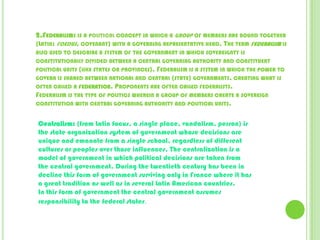
2. Forms of government include federalism where power is shared between central/national and state/provincial governments, and centralism where decisions are made by a single central authority regardless of regional differences.
3. A state is a form of social organization with institutions that have involuntary coercive power to regulate life within a particular territory.
![Among the reasons for this centralization can tell:The need for states to provide services to their citizens economically federal territories alone can not.The need for large amounts of investments that require a large percentage of resources, materials and human economic collapse federal territories.The need for central planning.Despotism: is a form of government by a single authority, either an individual (Despot), or tightly knit group, which rules with absolute political power.Monarchy: A monarchyis a form of government in which supreme power is absolutely or nominally lodged with an individual, who is the head of state, often for life or until abdication, and "is wholly set apart from all other members of the state."[1] The person who heads a monarchy is called a monarch. It was a common form of government in the world during ancient and medieval times.Democracy is a political government either carried out directly by the people (direct democracy) or by means of elected representatives of the people (Representative democracy).](https://image.slidesharecdn.com/valess-100209181049-phpapp01/85/Valentina-Morales-5b-5-320.jpg)