Product innovation involves the creation and introduction of new or improved goods and services. This includes inventions that are new to a company or market as well as improvements to existing products. There are several reasons why developing new products is important for businesses, including responding to changing consumer needs and wants, refreshing products that have reached maturity in their life cycles, and capitalizing on environmental changes. Developing successful new products involves understanding customer needs through research, developing product concepts, testing prototypes with customers, and analyzing results to refine strategies. Financial analysis is then used to evaluate new product opportunities.
In this document
Powered by AI
Explains product innovation, types like new and improved products, consumer needs, and market competition.
Details reasons for new product failures, essential six steps for product success including identifying customer needs and testing prototypes.
Discusses matching product capabilities to market needs, clear positioning, launch goals, and strategies for opportunity identification.
Focuses on idea generation processes, identifying internal and external sources of ideas and criteria for evaluation.
Details the operational planning stages including production, distribution, promotional strategies, and quality assurance.
Explains the importance of financial analysis, challenges in modeling new products, and critical tips for effective financial assessment.
Discusses creating intuitive financial models, scenario analysis, and the categorization of costs for product assessment.
Highlights the need for effective presentation and stakeholder engagement in financial modeling to support product decisions.
Describes concept testing, product testing procedures, and the importance of pre-launch strategies for validating ideas.
Explains the significance of market testing, evaluating customer interest, and gathering market insights before launch.
Details the real test of products through market tests to gather feedback, validate concepts, and refine marketing strategies.
Introduces the Stage-Gate model, emphasizing structured stages and gates for managing product development effectively.
Discusses the criteria for evaluating projects within the Stage-Gate framework and its flexible adaptation in organizations.
Product innovation isthe creation and subsequent introduction of a good or service that is either
new, or improved on previous goods or services. This is broader than the normally accepted definition
of innovation to include invention of new products which, in this context, are still considered innovative
New Product- New to a company or new to a market; they include existing products which have been
improved or revised-brand extensions. Additions to existing line repositioned products targeted at to new
markets and new to the world products.
In business “New Product” is a set of benefits offered for exchange and can be tangible ( that is
something physical you can touch) or intangible (like a service, experience, or belief)
A business focuses on designing new products and selling these products to customers. The company’s
goal with creating new products involves two parts. The first part consists of finding a product that
customers want to pay for; only products that customers purchase produce revenue for the business. The
second part consists of beating competitors to market. The first company to offer a product generates the
greatest number of repeat customers.
New Product Concept
Reason why developing a new product Every business needs to innovate to stay ahead of the
competition. No business can continue to offer the same unchanged product; otherwise sales would
decrease and profits reduced. In this article we will explore some of the reasons why lack of products
development can affect sales and profit.
Consumer "Needs and Wants" Change
Consumer "needs and wants" continuously change. Firms should respond to these changes through their
products and services. Otherwise consumers will switch to competitor products that satisfy their "needs
and wants". For example consumers are becoming more health conscious, this is forcing companies to
introduce low sugar, salt and fat products. Coca-Cola Zero which contains no sugar is a classic example
of new product development even though Coca-Cola's existing product range already contained diet
coke. Both diet coke and Coca-Cola Zero contain no sugar but they taste different.
Product Reaches The End Of Its Product Life Cycle
The product maybe at the end of its Product Life Cycle, so the company may introduce new and improved
updated versions. Microsoft has done this by moving from the Xbox to the Xbox 360 and now Xbox 360
limited editions allow Microsoft to refresh the product through small changes.
Product Is At The Maturity Stage Of Its Product Life Cycle
The product might be at the maturity stage of its Product Life Cycle and need modifications to stimulate
an increase in sales. Nintendo have replaced its DSi console with the 3DS console which contains
additional features such as an extra camera so that you can film in 3D, a 3D screen which doesn't require
glasses, a joystick and motion sensors.
Environmental Changes
There may be environmental changes which the company wants to capitalise on. Music companies are
now selling more music via internet downloads than through traditional retail shops. Record companies
were pushed into selling music through the internet following the success of the internet site Napster,
which offered illegal music downloads. In April 2006 the song "Crazy" by Gnarls Barkley made history by
becoming the first song to achieve the number one spot in the UK charts through music download sales
only. In March 2011 Mercury Records stopped releasing singles on CD as by then 99% of single sales
were through downloads.
Competitors
Competitors may force change. This is very apparent in the technology market, where new products are
constantly being introduced to a target market that welcomes change and innovation. Technology
consumers are not afraid to try new products, in fact they often want the latest gadget to show to friends
and colleagues. If a product is successful then competitors will attempt to develop similar products. In fact
Google say that they developed the Android operating system to prevent the technology market for
products such as mobile phones and tablets being dominated by one supplier.
All Products Experiencing Problems
If all of your products are experiencing poor sales or suffering from a negative reputation it is time to
change your product offering. In 2001 the introduction of the Pod MP3 player reversed the fortunes of
2.
Apple Computers. Sincethen Apple has introduced the successful iPhone and iPad and increased its
share price from $9.07 per share (Oct 2001) to over $400 per share
Succeed and failure factors
Reasons for new product failure
• Overestimation of market size
• Poor design
• Incorrect positioning
• Wrong timing
• Priced too high
• Ineffective promotion
• Management influence
• High development costs
• Competition
Six steps of new product success factors
1. Discover details of your customers' unmet needs. You should develop a set of interview questions,
meet with these suffering customers in the environment where they’re suffering, and listen to what they say
when you ask them the questions. Through this listening, you must discover more details about the nature
of their pain--and try to assess what kind of product would encourage them to become customers.
2. Develop hypotheses. Using the observations of customer needs and your vision of the technology, you
should make educated guesses about the most important product features likely to lead to wide customer
adoption. Moreover, you should make a numeric estimate of the number of customers you thinks will use a
prototype with those features.
3. Build a prototype solution. The next step is to develop a quick and inexpensive prototype with those
features. The first version is not likely to meet the customer’s unmet need but it should help you get a better
understanding of what you need to do to close the gap between what the prototype can do, and what the
ultimate product will need to be able to do in order to get the customer to buy it.
4. Test with customers. You must then give the prototype to customers and observe how they use it. You
should keep track of how many customers actually use the product, and ask them what they like and don’t
like about the product. The general objective of this step is to learn and collect data that will either confirm or
disconfirm the hypotheses developed earlier.
5. Analyze variance. You should compare the expected outcome with the observed results. This
comparison will generate insights that shape your strategic positioning.
6. Pick strategy. Better-than-expected results are likely to confirm that you will gain market share if you
turn the current version of the prototype into a product and market it aggressively. If the results are worse
than expected, you must learn from what did not work and develop another prototype. And you should
iterate and test until observed results exceed expectations, or until it becomes clear that it’s time to shut
down the business.
In the battle for customers your venture has one big advantage over big companies - it can learn faster. Use
these six steps to learn fast and gain share before your venture runs out of cash.
Product Launch is a process that has a lifecycle.
Thinking of a product launch as a process may change your entire perspective about launching products.
Many people think of a product launch as an event, something that happens with a big bang. There may
very well be a launch event as part of a launch process, but it may be just one of the things that are part
of a winning launch.
The purpose of a Product Launch is to build sales momentum.
So why take the time to plan and execute a product launch? It’s to build sales momentum. Sales
momentum enables your company to grow and prosper. You will add more customers, expand your
influence, hire more people and grow even more momentum.6 Secrets to a Winning Product Launch
A winning product launch delivers sales momentum for your company. It’s one of the few opportunities to
go from incremental to exponential sales. So why do so few companies get it right? It’s not because
they’re lucky. It’s because they understand the 6 secrets of a winning product launch:
3.
1. Matching ProductCapabilities to Market Needs
2. Clear Positioning and Messaging
3. Setting Clear Launch Goals
4. The Power of Leverage
5. Priming the Pump
6. Timing the Launch to Maximize Sale
Opportunities identification
1. For opportunity identification, first look at three C’s (Corporation, Customer, Competitors)
2. Corporation core competencies can be used in a wide variety of products / markets, that can
significantly contribute to the benefits, and that are difficult to imitate. Evaluate if these
competencies be applied to new products, customer segments, or markets.
3. Stay away from a “Solution first” approach. First uncover ALL customer needs, then filter
important but unmet (or low satisfaction) needs, then brainstorm solutions, and then choose high-potential
concepts.
4. Articulated Needs can be uncovered qualitatively (interviews, focus groups, market information
etc) or quantitatively (surveys, market data). Unarticulated needs can be uncovered using Lead
User Research (needs of the lead user), first-hand observation of daily participation, Usability
research etc.
5. Customers tell you a characteristics need (A thermal cup should keep my coffee hot), a target
value need (My coffee should stay hot for 20 minutes), an opinion (My coffee never stays hot
enough), or a direct need (A cup of coffee that stays hot until I finish drinking it)
6. Perceptual Mapping: Visually display customer perceptions of the industry. Maps can be created
using Overall Similarities (OS) method: Abstract & emotional (Rate products as similar or
different). Or, using Attribute Rating (AR) method: Concrete & rational.
7. Perceptual mapping in steps:
o Select the products to include: Products that are very similar (For McDonald’s, it’ll be
Burger King), that have similar features (Subway), that address similar customer needs
(Pizza Hut), that compete for the same customer dollar (Grocery)
o Select the attributes to consider: Performance (Features, Service, Quality, Convenience),
Image (Occasions, Characteristics, Company Image). Attributes should be binary types
(‘Good quality’ instead of ‘Quality’).
o Select the respondents: Demographic (income, age, family status, sex), User / Non-user
(yours, competitors’), Level of usage (Heavy, light, non-user).
o Collect the data: For example, on a 5 points scale (Strongly Disagree to Strongly Agree).
o Perform statistical analysis (See below)
o Interpret (See below)
8. Statistical Analysis: Use an optimal weighted combination of all attributes that accounts for the
most amount of variance in the data. Put this on the X axis. The second weighted combination
that amounts for second most amount of variance subject to constraint “no correlation to X” is put
on Y axis. These two, in many cases, account for 90+% of cumulative variance. Plot all attributes
and products on these two axes.
9. Interpretations (Strategic group of competitors): Close substitutes are close to each other on the
map.
10. Interpretations (Attribute Correlation): Highly correlated (Same direction), Negatively correlated
(Opposite direction), Unrelated (perpendicular)
11. Interpretations (Product Strengths & Weaknesses): Where does a product stand on a specific
attribute axis (ex, Milk has low value on “Modern” attribute below).
12. Interpretations (Differentiations): Longer attribute arrows reflect higher levels of differentiation
among competitors on that attribute. Note: The length of the line does not indicate attribute
importance.
4.
13. Interpretations (Namesof axes): Vectors of attributes that are long and closer to one of the axes
help us name the X,Y axes.
14. Interpretations (Opportunities): Put customer segments / clusters on the map or plot customer (or
segment) preference vectors on the map and see if you can design a new product can get closer
to the cluster or be where there is a good density of vectors with few competing products.
Idea Generation
Systematic Search for New Product Ideas
Internal sources
Customers
Competitors
Distributors
Suppliers
• Process to spot good ideas and drop poor ones
• Criteria
– Market Size
– Product Price
– Development Time & Costs
– Manufacturing Costs
– Rate of Return
–
Systems
A set of detailed methods, procedures and routines created to carry out a specific activity, perform a duty
or solve a problem.
Systems have: inputs, output and feedback mechanisms.
5.
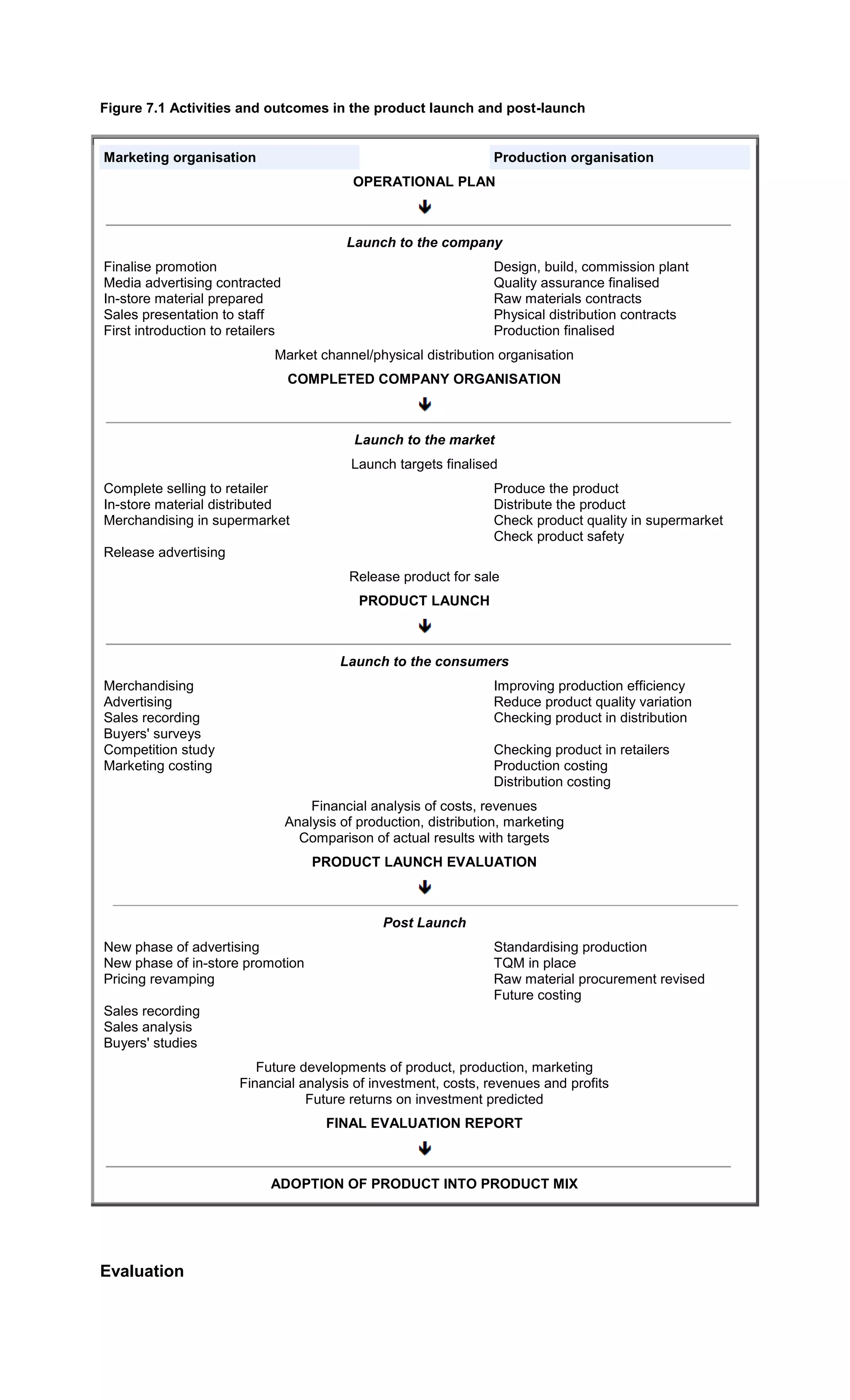
Figure 7.1 Activitiesand outcomes in the product launch and post-launch
Marketing organisation Production organisation
OPERATIONAL PLAN
Launch to the company
Finalise promotion
Media advertising contracted
In-store material prepared
Sales presentation to staff
First introduction to retailers
Design, build, commission plant
Quality assurance finalised
Raw materials contracts
Physical distribution contracts
Production finalised
Market channel/physical distribution organisation
COMPLETED COMPANY ORGANISATION
Launch to the market
Launch targets finalised
Complete selling to retailer
In-store material distributed
Merchandising in supermarket
Release advertising
Produce the product
Distribute the product
Check product quality in supermarket
Check product safety
Release product for sale
PRODUCT LAUNCH
Launch to the consumers
Merchandising
Advertising
Sales recording
Buyers' surveys
Competition study
Marketing costing
Improving production efficiency
Reduce product quality variation
Checking product in distribution
Checking product in retailers
Production costing
Distribution costing
Financial analysis of costs, revenues
Analysis of production, distribution, marketing
Comparison of actual results with targets
PRODUCT LAUNCH EVALUATION
Post Launch
New phase of advertising
New phase of in-store promotion
Pricing revamping
Sales recording
Sales analysis
Buyers' studies
Standardising production
TQM in place
Raw material procurement revised
Future costing
Future developments of product, production, marketing
Financial analysis of investment, costs, revenues and profits
Future returns on investment predicted
FINAL EVALUATION REPORT
ADOPTION OF PRODUCT INTO PRODUCT MIX
Evaluation
6.
Is a systematiccollection and analysis of data in order to assist the strengths and weakness of programs,
policies in organizations to improve their effectiveness.
Is a systematic determination of a subject merit, worth and significance, using criteria governed by a set
of standards.
Checklist
Is a type of informational job aid used to reduce failure by compensating for potential limits of human
memory and attention.
Financial Analysis
Is an aspect overall business finance functions that involves examining historical data to gain information
about the current and future financial health of a company.
The objective of the financial statements is to provide information to all the users of these accounts to
help them in their decision making.
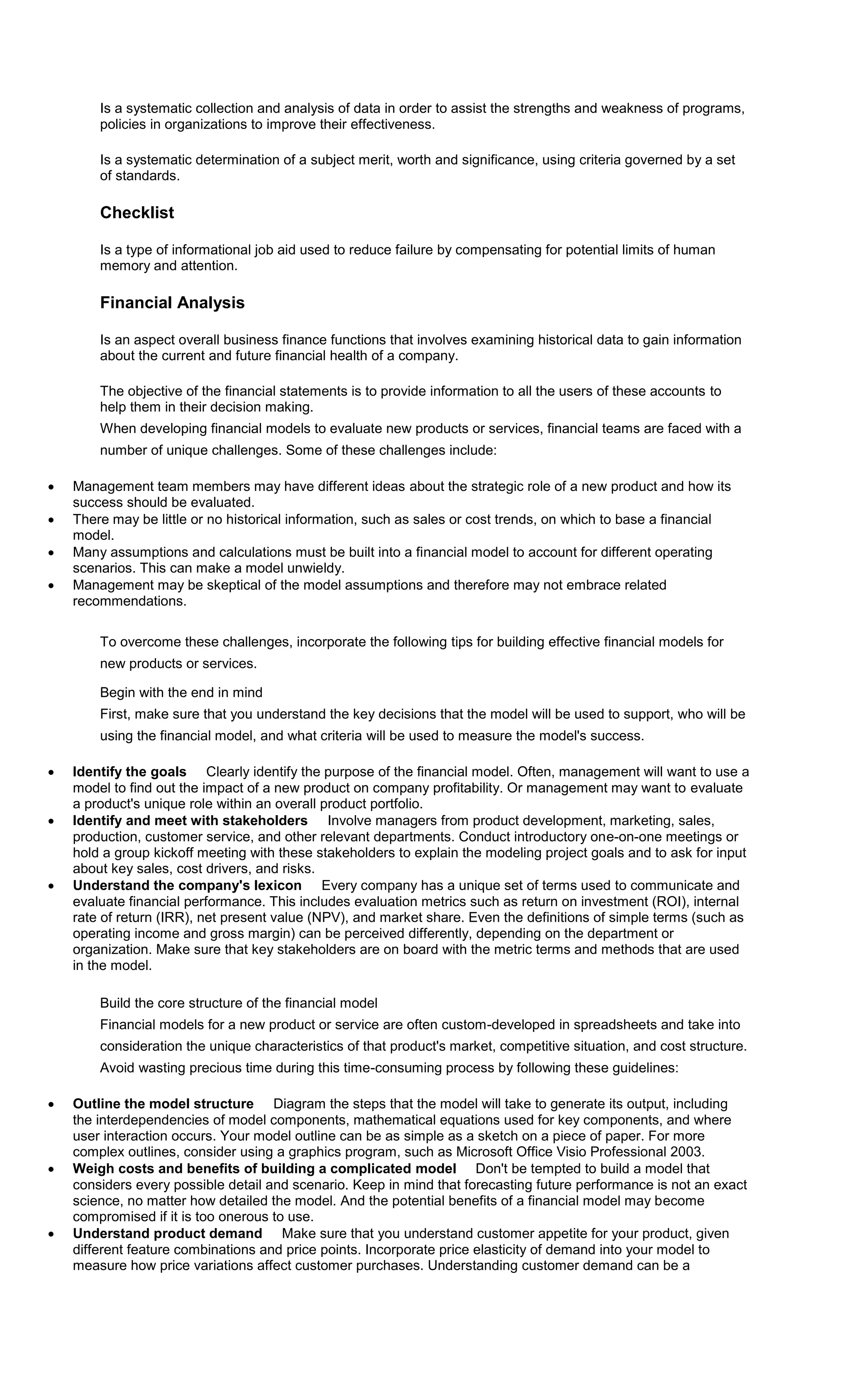
When developing financial models to evaluate new products or services, financial teams are faced with a
number of unique challenges. Some of these challenges include:
Management team members may have different ideas about the strategic role of a new product and how its
success should be evaluated.
There may be little or no historical information, such as sales or cost trends, on which to base a financial
model.
Many assumptions and calculations must be built into a financial model to account for different operating
scenarios. This can make a model unwieldy.
Management may be skeptical of the model assumptions and therefore may not embrace related
recommendations.
To overcome these challenges, incorporate the following tips for building effective financial models for
new products or services.
Begin with the end in mind
First, make sure that you understand the key decisions that the model will be used to support, who will be
using the financial model, and what criteria will be used to measure the model's success.
Identify the goals Clearly identify the purpose of the financial model. Often, management will want to use a
model to find out the impact of a new product on company profitability. Or management may want to evaluate
a product's unique role within an overall product portfolio.
Identify and meet with stakeholders Involve managers from product development, marketing, sales,
production, customer service, and other relevant departments. Conduct introductory one-on-one meetings or
hold a group kickoff meeting with these stakeholders to explain the modeling project goals and to ask for input
about key sales, cost drivers, and risks.
Understand the company's lexicon Every company has a unique set of terms used to communicate and
evaluate financial performance. This includes evaluation metrics such as return on investment (ROI), internal
rate of return (IRR), net present value (NPV), and market share. Even the definitions of simple terms (such as
operating income and gross margin) can be perceived differently, depending on the department or
organization. Make sure that key stakeholders are on board with the metric terms and methods that are used
in the model.
Build the core structure of the financial model
Financial models for a new product or service are often custom-developed in spreadsheets and take into
consideration the unique characteristics of that product's market, competitive situation, and cost structure.
Avoid wasting precious time during this time-consuming process by following these guidelines:
Outline the model structure Diagram the steps that the model will take to generate its output, including
the interdependencies of model components, mathematical equations used for key components, and where
user interaction occurs. Your model outline can be as simple as a sketch on a piece of paper. For more
complex outlines, consider using a graphics program, such as Microsoft Office Visio Professional 2003.
Weigh costs and benefits of building a complicated model Don't be tempted to build a model that
considers every possible detail and scenario. Keep in mind that forecasting future performance is not an exact
science, no matter how detailed the model. And the potential benefits of a financial model may become
compromised if it is too onerous to use.
Understand product demand Make sure that you understand customer appetite for your product, given
different feature combinations and price points. Incorporate price elasticity of demand into your model to
measure how price variations affect customer purchases. Understanding customer demand can be a
7.
challenging part offinancial modeling, and you may need to work with marketing research or outside
consultants to fully address this area.
Categorize costs Break down costs associated with your product into different categories to aid data
analysis and forecasting. Examples of cost categories include:
Variable costs, including direct materials and direct labor per unit of production.
Fixed costs, such as advertising and product manager salaries.
Mixed costs, such as communications.
Step costs, such as compensation for customer service representatives, each of whom can handle only a
certain number of customer inquiries.
You also need to understand how overhead costs from the parent company will be allocated to the
product.
Perform scenario analysis
Because financial models attempt to forecast future performance, they often involve many assumptions.
Models should allow for testing a number of business situations and their potential impact on — for
example, profitability and market share.
Identify key drivers Choose key variables that the user can change in the model to drive different
operating scenarios. Examples of these key variables are unit prices, unit costs, price elasticity of demand,
and market share. For example, perhaps your team feels strongly that unit costs and fixed costs will remain
relatively stable, so you'll want to focus on the impact that different unit prices have on the product's demand
and profitability.
Understand the risks Gain an understanding of the risks involved in a potential product launch. For
example, if a key distributor relationship is not established, what impact can that have on sales? If it is a
significant impact, that risk should be turned into a model variable and evaluated in different scenarios.
Incorporate spreadsheet features Users can alter inputs to run different scenarios, but they often need to
hard-code changes in the model input section and save those scenarios as separate files. Learn how to use
spreadsheet features, such as the Scenario Manager and Spinner features in Microsoft Office Excel 2003, to
more easily develop and evaluate multiple scenarios on the fly.
Make the model intuitive
Ideally, a financial model will be distributed to stakeholders so that they can use it to test different
scenarios and to help in their planning activities. Make sure that your model is easy to use so that those
who weren't involved in building it will still be able to derive value from it.
Color-code for easy interpretation Key variables, such as unit prices, unit costs, or required head count
can be highlighted by using cell shading or font color. For example, red shading or font colors might be used
for cells that need user input. Areas on the worksheet that contain formulas can also be color-coded —
perhaps using gray for cells that contain formulas and therefore should not be altered.
Safeguard your model Use the protection feature of the spreadsheet program to prevent user tampering
that might have a ripple effect on the rest of the financial model.
Use multiple worksheets Split key sections of the model into separate worksheets (all within the same
spreadsheet file). For example, your model might have different worksheets for user input, output, a summary
of data elements (for instance, outline of revenues, costs, income, expected returns, and market share), and
supporting graphs. Be sure to use logical names for each worksheet tab.
Use comments and name cells Use the comments function to add an explanation to a particular cell
where you may have a formula that merits description. For instance, in Excel, you can insert a comment by
clicking the Insert menu, clicking Comment, and then entering your text. Be sure to use clear, helpful names
for column and row headers and titles for charts, tables, and graphs.
Provide helpful graphics Because the output of the model will likely be used in management
presentations, consider including graphs in the model. For instance, a breakeven point graph that illustrates
fixed costs, variable costs, total costs, and total revenues over time can help management find out when the
product might break even, and the graph can also outline short-term funding requirements.
Wrap it up
When the stakeholders have been engaged, the financial model created, and the scenarios developed,
wrap up the project by making your recommendations and handing off the model to the people who will
use it.
Document model framework and assumptions Develop a brief report that summarizes how the model
was constructed and that includes worksheet descriptions, key formulas, limitations, and a list of stakeholders
who participated in developing requirements. This documentation should enable a person who was not
involved in the model development to use the model effectively.
Test the model As part of the quality control/testing process for your model, try to break the model by
creating scenarios that stretch its capabilities. Sometimes it is best to get another person who wasn't involved
in the model development to test the model.
8.
Conduct afinal presentation and hand off the model Finally, present the model assumptions, findings,
and your recommendations to the stakeholders. Try to resist pressure to make the new product forecast more
positive than the most likely scenario indicates. If the numbers don't add up for developing and launching the
proposed product, make recommendations, such as lowering unit costs or increasing advertising, that might
improve the product's outlook. Finally, hand off the model to the stakeholders who will need to use it.
Financial modeling is critical to determine whether to build and launch a new product or service. To create
an effective financial model, make sure that you outline the model structure, identify key drivers, allow for
scenario analysis, and make the model intuitive and easy to use.
As you develop your financial model, communicate with stakeholders so that the final model meets all
users' needs and expectations. With these basic building blocks in place, you'll ensure that your model
will become a valuable tool for business decision-makers.
Product concept is the understanding of the dynamics of the product in order to showcase the best
qualities and maximum features of the product. Marketers spend a lot of time and research in order to
target their attended audience. Marketers will look into a product concept before marketing a product
towards their customers.
While the "product concept" is based upon the idea that customers prefer products that have the most
quality, performance, and features, some customers prefer a product that is simpler and easier to use.
Concept Test
Concept testing is the process of using quantitative methods and qualitative methods to evaluate
consumer response to a product idea prior to the introduction of a product to the market. It can also be
used to generate communication designed to alter consumer attitudes toward existing products. These
methods involve the evaluation by consumers of product concepts having certain rational benefits, such
as "a detergent that removes stains but is gentle on fabrics," or non-rational benefits, such as "a shampoo
that lets you be yourself." Such methods are commonly referred to as concept testing and have been
performed using field surveys, personal interviews and focus groups, in combination with various
quantitative methods, to generate and evaluate product concepts.
The concept generation portions of concept testing have been predominantly qualitative. Advertising
professionals have generally created concepts and communications of these concepts for evaluation by
consumers, on the basis of consumer surveys and other market research, or on the basis of their own
experience as to which concepts they believe represent product ideas that are worthwhile in the
consumer market.
The quantitative portions of concept testing procedures have generally been placed in three categories:
(1) concept evaluations, where concepts representing product ideas are presented to consumers
in verbal or visual form and then quantitatively evaluated by consumers by indicating degrees of
purchase intent, likelihood of trial, etc.,
9.
(2) positioning, whichis concept evaluation wherein concepts positioned in the same functional
product class are evaluated together, and
(3) product/concept tests, where consumers first evaluate a concept, then the corresponding
product, and the results are compared.
Product Testing
also called consumer testing or comparative testing, is a process of measuring the properties or
performance of products. The theory is that since the advent of mass production manufacturers
produce branded products which they assert and advertise to be identical within some technical standard.
Product testing seeks to ensure that consumers can understand what products will do for them and which
products are the best values. Product testing is a strategy to increase consumer protection by checking
the claims made during marketing strategies such as advertising, which by their nature are in the interest
of the entity distributing the service and not necessarily in the interest of the consumer. The advent of
product testing was the beginning of the modern consumer movement.
Product testing might be accomplished by a manufacturer, an independent laboratory, a government
agency, etc. Often an existing formal test is used as a basis for testing. Other times engineers develop
methods of test which are suited to the specific purpose. Comparative testing subjects several replicate
samples of similar products to identical test conditions.
Pre-Launch
Pre-launch a marketing technique to let as many people as possible know that a new product will be
introduced at a specific date in the near future and – supported by many affiliates - promoting this product
heavily already before it is officially on sale. The strategy behind a prelaunch campaign is to get people
interested and curious about the new product and finally eager to be one of the first to buy.
Some products and services don’t have a pre-launch phase. For companies where building a minimum
viable product isn’t a months-long effort, it makes sense to just launch a beta and then start talking about
it. For other companies however, the product might take a bit longer to develop and talking about it
before it’s been released in some form could be pointless (because you don’t have a call to action yet),
risky (competitors position against you or customers get confused because there aren’t enough details) or
both.
One of the techniques that I’ve used in the past is to engage with the market by talking about the
business problem that your product or service is going to solve, without getting into exactly how you plan
on solving it. At IBM we sometimes referred to this as “market preparation”.
For larger companies this often entails spending a lot of time (and money) with industry analysts and
industry leaders sharing your company’s unique point of view on the market and why it is currently being
under-served. If you do this properly you’ll come to a point where your point of view starts to align well
with that of the influential folks you’ve been working with. By the time you launch, these folks will be
standing behind you saying that your view of the market is one customer should consider.
Pre-launch startups generally don’t have the time, clout or cash to change the way Gartner Group thinks
about a market but that shouldn’t stop you from taking your message out directly to the market you care
about. There’s never been a better time for startups to get the message out. Here are some
considerations:
1. Create a clear message about your market point of view – you will need to create a set of messages
that clearly illustrate what the unmet need is the in market and why that need has not been met by
existing players. You can go so far as to talk about the characteristics of the needed solution (without
getting into the gorey details of exactly how you plan to solve it).
2. Develop case studies that illustrate the pain you will be solving – Gather a set of real examples of
customers you have worked with that have the problem and clearly illustrate the need for a new type of
solution on the market.
3. Spread the word – Launch a blog, write guest posts for other blogs, comment on relevant blog posts,
write articles, write an e-book, speak at conferences and events, open a Twitter account and start
sharing information that illustrates your point of view. There’s no end of ways to get your message out
there. Do your homework and find out where your market hangs out. What forums do they participate
in? What blogs and newsletters do they read? Get your message in front of them in the places where
they already are.
4. Engage and gather feedback – Starting a dialog with your potential customers about how you see the
market gives you a chance to test your messages and see what resonates and what doesn’t. You’ve
made a set of assumptions (backed up by customer research hopefully), the more folks in the market
you can talk to the more you can fine-tune your market story.
5. Capture where you can – If it makes sense you can start capturing a list of potential beta customers or
a mailing list that you can use when you launch.
10.
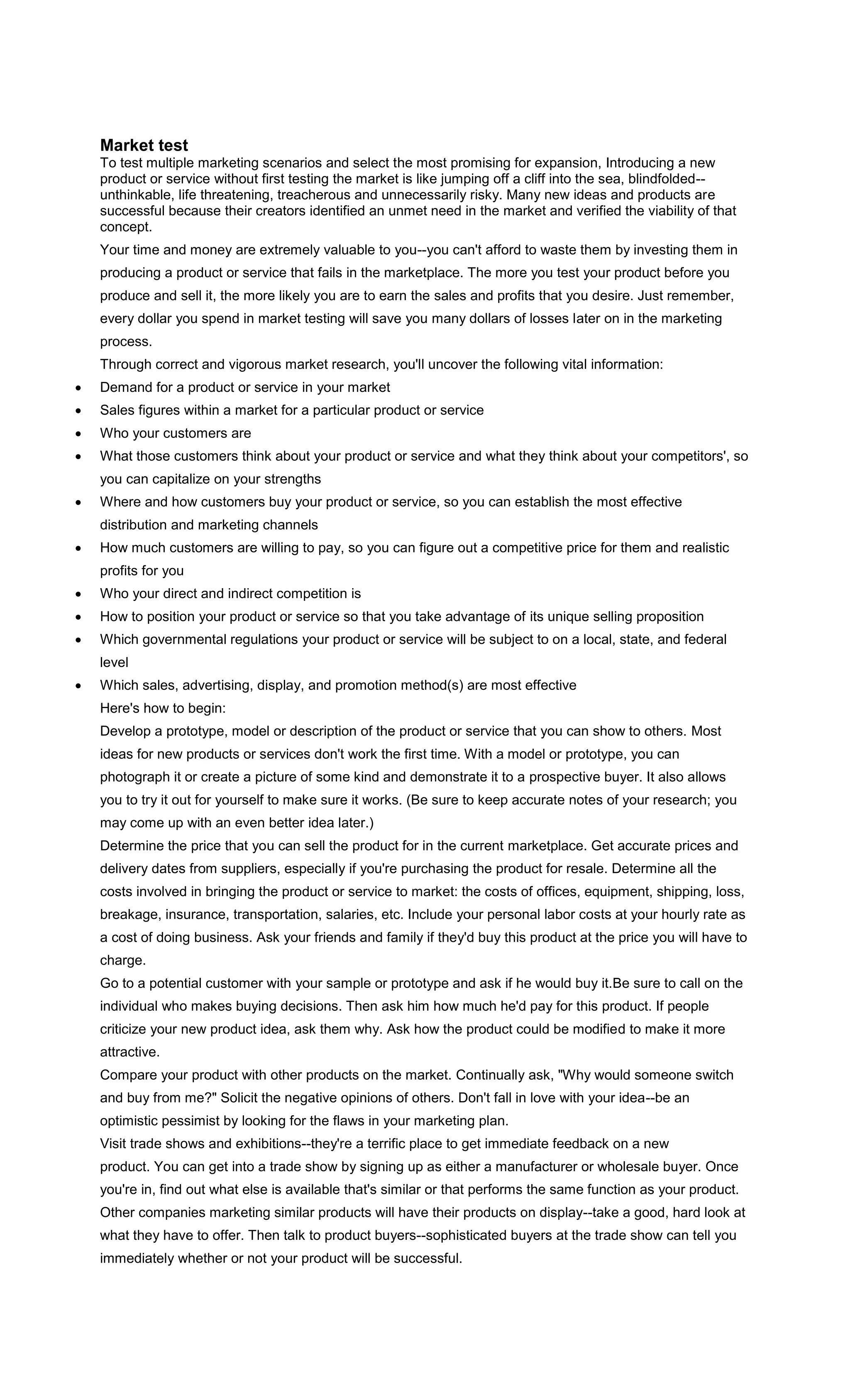
Market test
Totest multiple marketing scenarios and select the most promising for expansion, Introducing a new
product or service without first testing the market is like jumping off a cliff into the sea, blindfolded--
unthinkable, life threatening, treacherous and unnecessarily risky. Many new ideas and products are
successful because their creators identified an unmet need in the market and verified the viability of that
concept.
Your time and money are extremely valuable to you--you can't afford to waste them by investing them in
producing a product or service that fails in the marketplace. The more you test your product before you
produce and sell it, the more likely you are to earn the sales and profits that you desire. Just remember,
every dollar you spend in market testing will save you many dollars of losses later on in the marketing
process.
Through correct and vigorous market research, you'll uncover the following vital information:
Demand for a product or service in your market
Sales figures within a market for a particular product or service
Who your customers are
What those customers think about your product or service and what they think about your competitors', so
you can capitalize on your strengths
Where and how customers buy your product or service, so you can establish the most effective
distribution and marketing channels
How much customers are willing to pay, so you can figure out a competitive price for them and realistic
profits for you
Who your direct and indirect competition is
How to position your product or service so that you take advantage of its unique selling proposition
Which governmental regulations your product or service will be subject to on a local, state, and federal
level
Which sales, advertising, display, and promotion method(s) are most effective
Here's how to begin:
Develop a prototype, model or description of the product or service that you can show to others. Most
ideas for new products or services don't work the first time. With a model or prototype, you can
photograph it or create a picture of some kind and demonstrate it to a prospective buyer. It also allows
you to try it out for yourself to make sure it works. (Be sure to keep accurate notes of your research; you
may come up with an even better idea later.)
Determine the price that you can sell the product for in the current marketplace. Get accurate prices and
delivery dates from suppliers, especially if you're purchasing the product for resale. Determine all the
costs involved in bringing the product or service to market: the costs of offices, equipment, shipping, loss,
breakage, insurance, transportation, salaries, etc. Include your personal labor costs at your hourly rate as
a cost of doing business. Ask your friends and family if they'd buy this product at the price you will have to
charge.
Go to a potential customer with your sample or prototype and ask if he would buy it.Be sure to call on the
individual who makes buying decisions. Then ask him how much he'd pay for this product. If people
criticize your new product idea, ask them why. Ask how the product could be modified to make it more
attractive.
Compare your product with other products on the market. Continually ask, "Why would someone switch
and buy from me?" Solicit the negative opinions of others. Don't fall in love with your idea--be an
optimistic pessimist by looking for the flaws in your marketing plan.
Visit trade shows and exhibitions--they're a terrific place to get immediate feedback on a new
product. You can get into a trade show by signing up as either a manufacturer or wholesale buyer. Once
you're in, find out what else is available that's similar or that performs the same function as your product.
Other companies marketing similar products will have their products on display--take a good, hard look at
what they have to offer. Then talk to product buyers--sophisticated buyers at the trade show can tell you
immediately whether or not your product will be successful.
11.
The only realtest of a product is a market test, where you take your new product or service to a customer
who can buy it to see if he likes it. As soon as you know your cost and price, make a sales call on a
potential buyer. (The ability to sell the product is more important than any other skill--this will give you a
chance to sharpen yours.) Listen carefully to the comments and objections of the buyer--their feedback is
priceless.
Then once you've determined there's a large enough market for your product--at the price you'll have to
charge to make a profit--immediately begin thinking of ways to improve both the product and the
marketing. Continually tweaking your plans--instead of sticking only with your original ideas--will help
ensure your product's success.
Final Evaluation
“Stage/Gate Process” A sequence system in product launch
Stage-Gate® is a value-creating business process and risk model designed to quickly and profitably
transform an organization's best new ideas into winning new products. When embraced by organizations,
it creates a culture of product innovation excellence - product leadership, accountability, high-performance
teams, customer and market focus, robust solutions, alignment, discipline, speed and
quality.
The Stage-Gate Product Innovation Process. Taken from SG Navigator
In addition to the benefits that are well-documented by research and benchmarking firms, many
companies that have implemented and adopted an authentic Stage-Gate process realize:
Accelerated speed-to-market
Increased new product success rates
Decreased new product failures
Increased organizational discipline and focus on the right projects
Fewer errors, waste and re-work within projects
Improved alignment across business leaders
Efficient and effective allocation of scarce resources
Improved visibility of all projects in the pipeline
Improved cross-functional engagement and collaboration
Improved communication and coordination with external stakeholders.
How Does a Stage-Gate® Process Work?
The Stage-Gate model is based on the belief that product innovation begins with ideas and ends once a
product is successfully launched into the market. This has a lot to do with the benchmarking research that
the Stage-Gate model design is premised on, and is a much broader and more cross-functional view of a
product development process.
The Stage-Gate model takes the often complex and chaotic process of taking an idea from inception to
launch, and breaks it down into smaller stages (where project activities are conducted) and gates (where
business evaluations and Go/Kill decisions are made). In its entirety, Stage-Gate incorporates Pre-development
Activities (business justification and preliminary feasibilities), Development Activities
(technical, marketing, and operations development) and Commercialization Activities (market launch and
post launch learning) into one complete, robust process.
12.
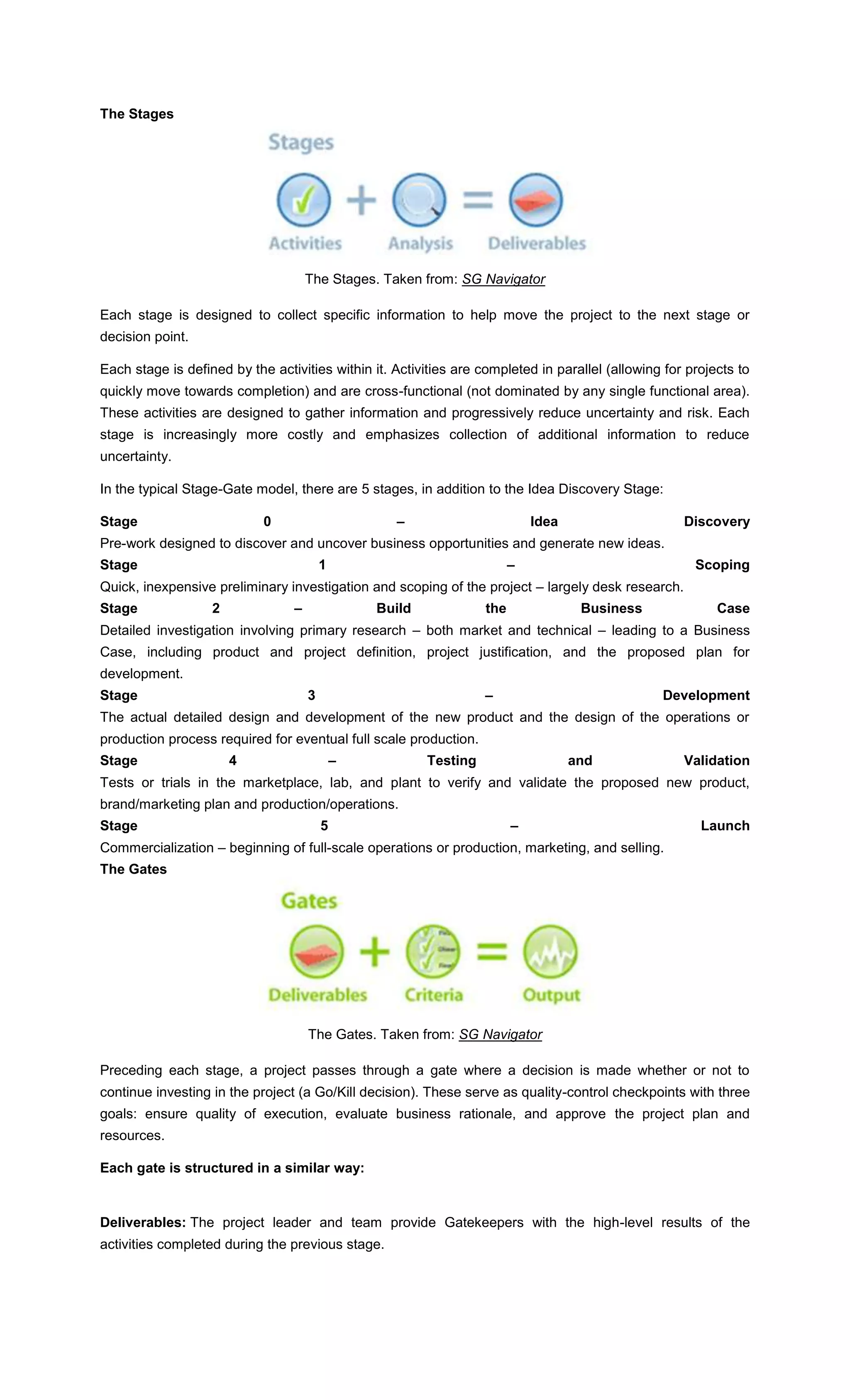
The Stages
TheStages. Taken from: SG Navigator
Each stage is designed to collect specific information to help move the project to the next stage or
decision point.
Each stage is defined by the activities within it. Activities are completed in parallel (allowing for projects to
quickly move towards completion) and are cross-functional (not dominated by any single functional area).
These activities are designed to gather information and progressively reduce uncertainty and risk. Each
stage is increasingly more costly and emphasizes collection of additional information to reduce
uncertainty.
In the typical Stage-Gate model, there are 5 stages, in addition to the Idea Discovery Stage:
Stage 0 – Idea Discovery
Pre-work designed to discover and uncover business opportunities and generate new ideas.
Stage 1 – Scoping
Quick, inexpensive preliminary investigation and scoping of the project – largely desk research.
Stage 2 – Build the Business Case
Detailed investigation involving primary research – both market and technical – leading to a Business
Case, including product and project definition, project justification, and the proposed plan for
development.
Stage 3 – Development
The actual detailed design and development of the new product and the design of the operations or
production process required for eventual full scale production.
Stage 4 – Testing and Validation
Tests or trials in the marketplace, lab, and plant to verify and validate the proposed new product,
brand/marketing plan and production/operations.
Stage 5 – Launch
Commercialization – beginning of full-scale operations or production, marketing, and selling.
The Gates
The Gates. Taken from: SG Navigator
Preceding each stage, a project passes through a gate where a decision is made whether or not to
continue investing in the project (a Go/Kill decision). These serve as quality-control checkpoints with three
goals: ensure quality of execution, evaluate business rationale, and approve the project plan and
resources.
Each gate is structured in a similar way:
Deliverables: The project leader and team provide Gatekeepers with the high-level results of the
activities completed during the previous stage.
13.
Criteria: The projectis measured against a defined set of success criteria that every new product project
is measured against. Criteria should be robust to help screen out winning products, sooner. The authentic
Stage-Gate process incorporates 6 proven criteria: Strategic Fit, Product and Competitive Advantage,
Market Attractiveness, Technical Feasibility, Synergies/Core Competencies, Financial Reward/Risk.
Outputs: A decision is made (Go/Kill/Hold/Recycle). New product development resources are committed
to continuing the project. The action plan for the next stage is approved. A list of deliverables and date for
the next gate is set.
The Stage-Gate model is designed to improve the speed and quality of execution of new product
development activities. The process helps project teams prepare the right information, with the right level
of detail, at the right gate to support the best decision possible, and allocate capital and operating
resources. The process empowers the project team by providing them with a roadmap, with clear
decisions, priorities, and deliverables at each gate. Higher quality deliverables submitted to Gatekeepers
enables timely decisions.
Flexible Implementation into an Organization
Many top performing organizations report that ‘making Stage-Gate stick and sustaining it’ requires good
change management. The authentic Stage-Gate design is sophisticated because it has evolved and
benefitted from 25+ years of business and industry benchmarking research and learnings from more
company implementations than any other innovation process in the world. For most organizations, the
authentic Stage-Gate design represents a goal to work towards: adopting core basic principles initially
and continuously embracing more and more of its design as the company’s innovation capability
improves. In addition to tailoring the Stage-Gate model to accommodate an organization’s innovation
capability, consider also tailoring it to fit and support the unique needs of your business culture, global
strategies, customer types (B2B and B2C), new product strategies, and types of innovation projects.
SGP Concept
Objectives
Stages and Gates