

Pricing
In Marketing
Pricing
Understanding and Capturing
Customer Value
Pricing:
Understanding and
Capturing Customer Value
• What Is a Price?
• Customer Perceptions of Value
• Company and Product Costs
• Other Internal and External
Considerations Affecting Price Decisions
Topic Outline
Price is the amount of money charged for
a product or service. It is the sum of all
the values that consumers give up in
order to gain the benefits of having or
using a product or service.
What Is a Price?
Price is the only element in the marketing
mix that produces revenue; all other
elements represent costs
Flexible and complex
What Is a Price?
Factors to Consider When
Setting Prices
Understanding how much value consumers place
on the benefits they receive from the product and
setting a price that captures that value
Customer Perceptions of Value
Factors to Consider When
Setting Prices
Customer Perceptions of Value
Factors to Consider When
Setting Prices
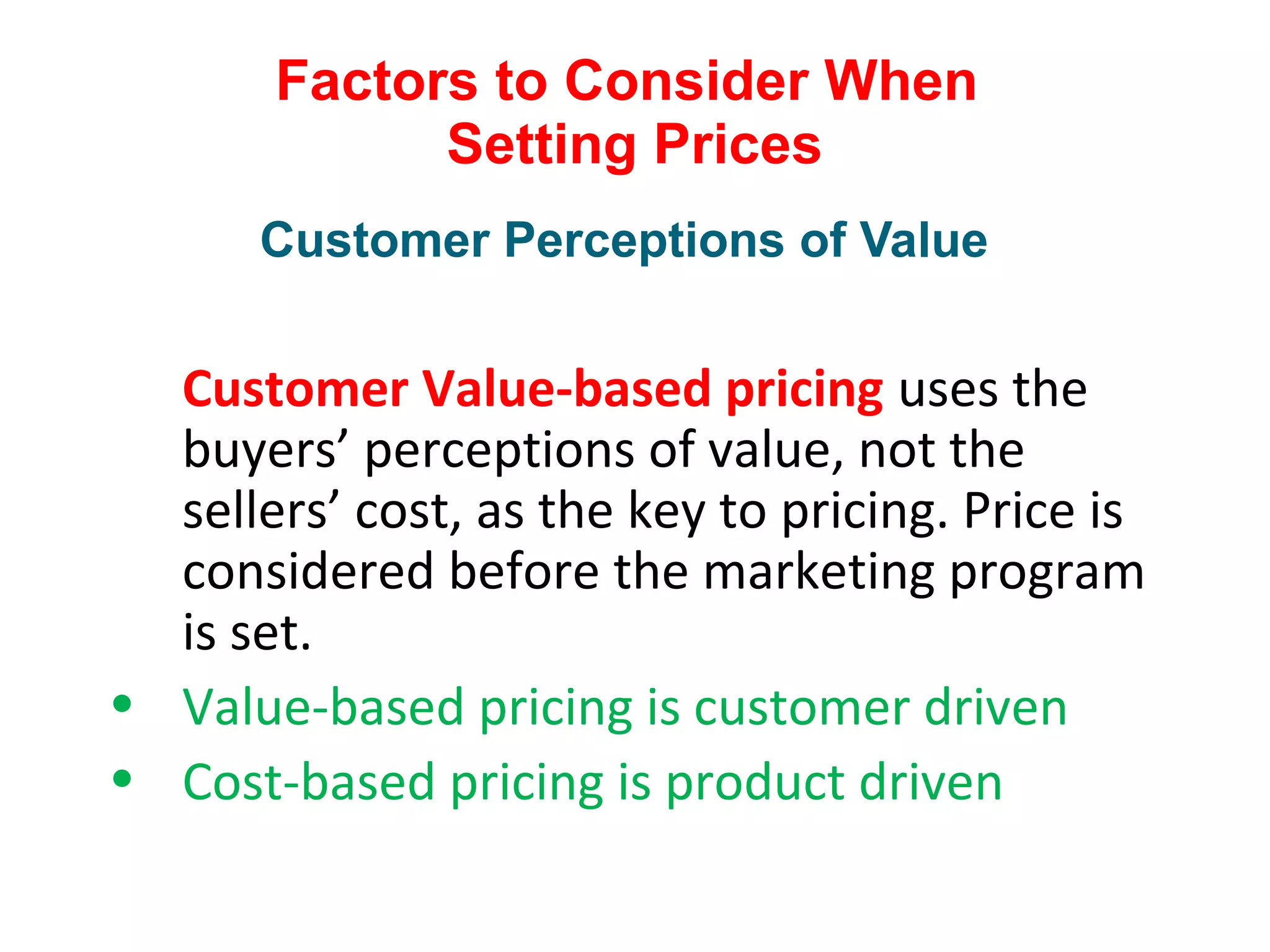
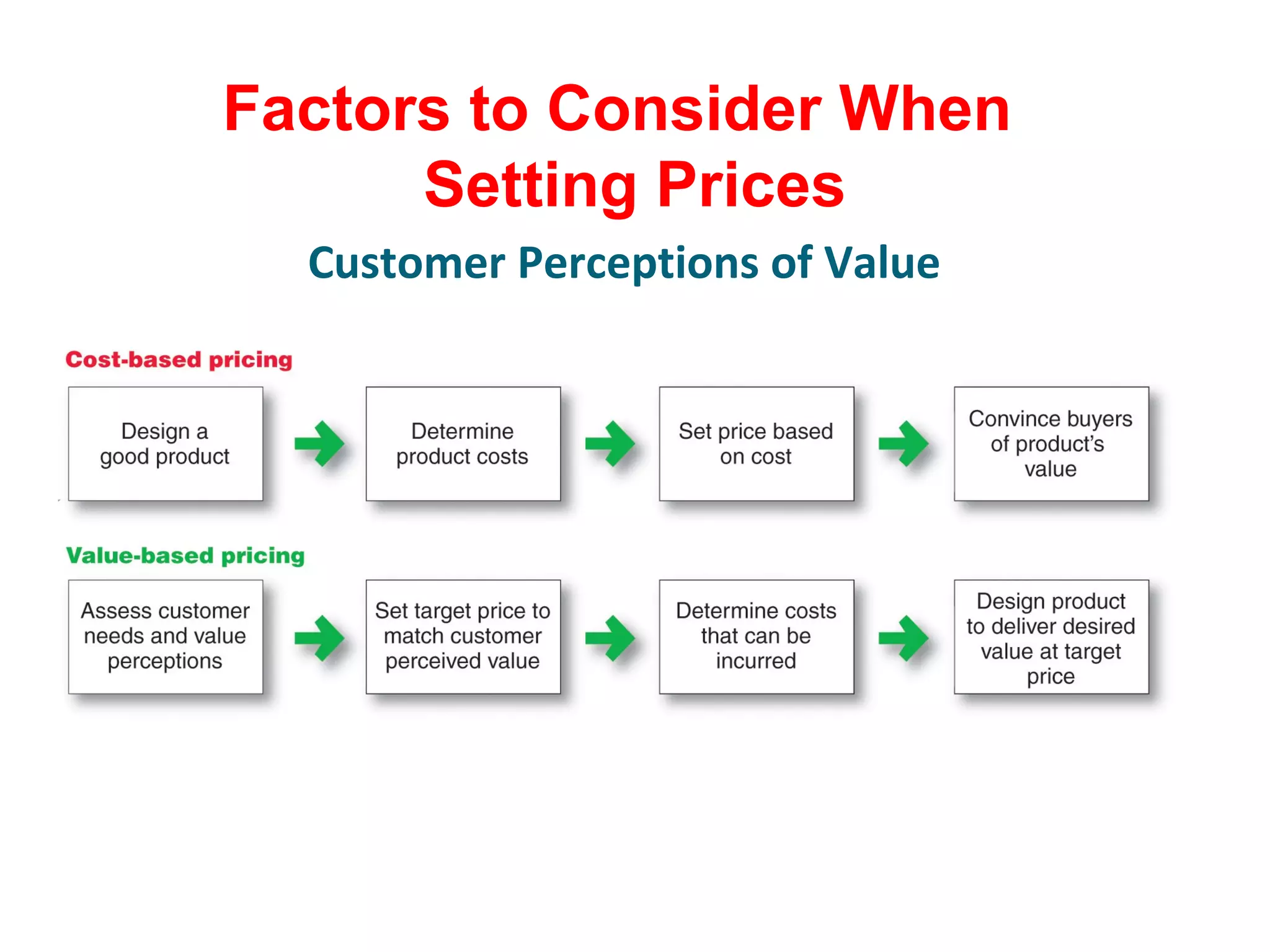
Customer Value-based pricing uses the
buyers’ perceptions of value, not the
sellers’ cost, as the key to pricing. Price is
considered before the marketing program
is set.
• Value-based pricing is customer driven
• Cost-based pricing is product driven
Customer Perceptions of Value
Factors to Consider When
Setting Prices
Customer Perceptions of Value
Factors to Consider When
Setting Prices
Customer Perceptions of Value
Factors to Consider When
Setting Prices
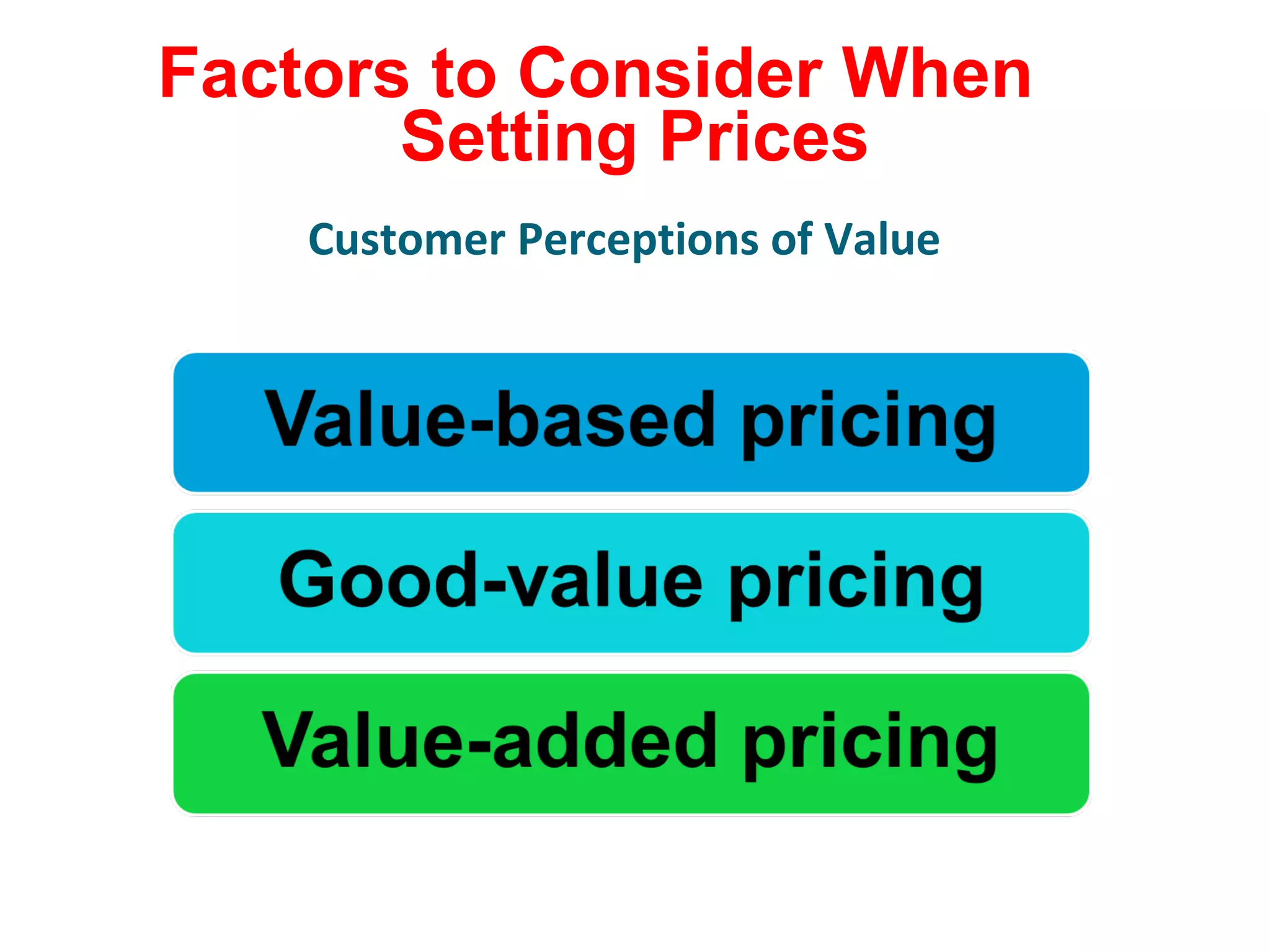
Good-value pricing offers the right
combination of quality and good service at
a fair price
Existing brands are being redesigned to
offer more quality for a given price or the
same quality for a lower price
Customer Perceptions of Value
Factors to Consider When
Setting Prices
Everyday low pricing (EDLP) involves
charging a constant everyday low price
with few or no temporary price discounts
High-low pricing involves charging higher
prices on an everyday basis but running
frequent promotions to lower prices
temporarily on selected items
Customer Perceptions of Value
Factors to Consider
When Setting Prices
• Value-added pricing attaches value-added
features and services to differentiate
offers, support higher prices, and build
pricing power
• Pricing power is the ability to escape price
competition and to justify higher prices and
margins without losing market share
Customer Perceptions of Value
Factors to Consider
When Setting Prices
Cost-based pricing involves setting prices
based on the costs for producing,
distributing, and selling the product plus a
fair rate of return for its effort and risk
Company and Product Costs
Factors to Consider When
Setting Prices
Cost-based pricing adds a standard markup
to the cost of the product
Company and Product Costs
Factors to Consider When
Setting Prices
Company and Product Costs
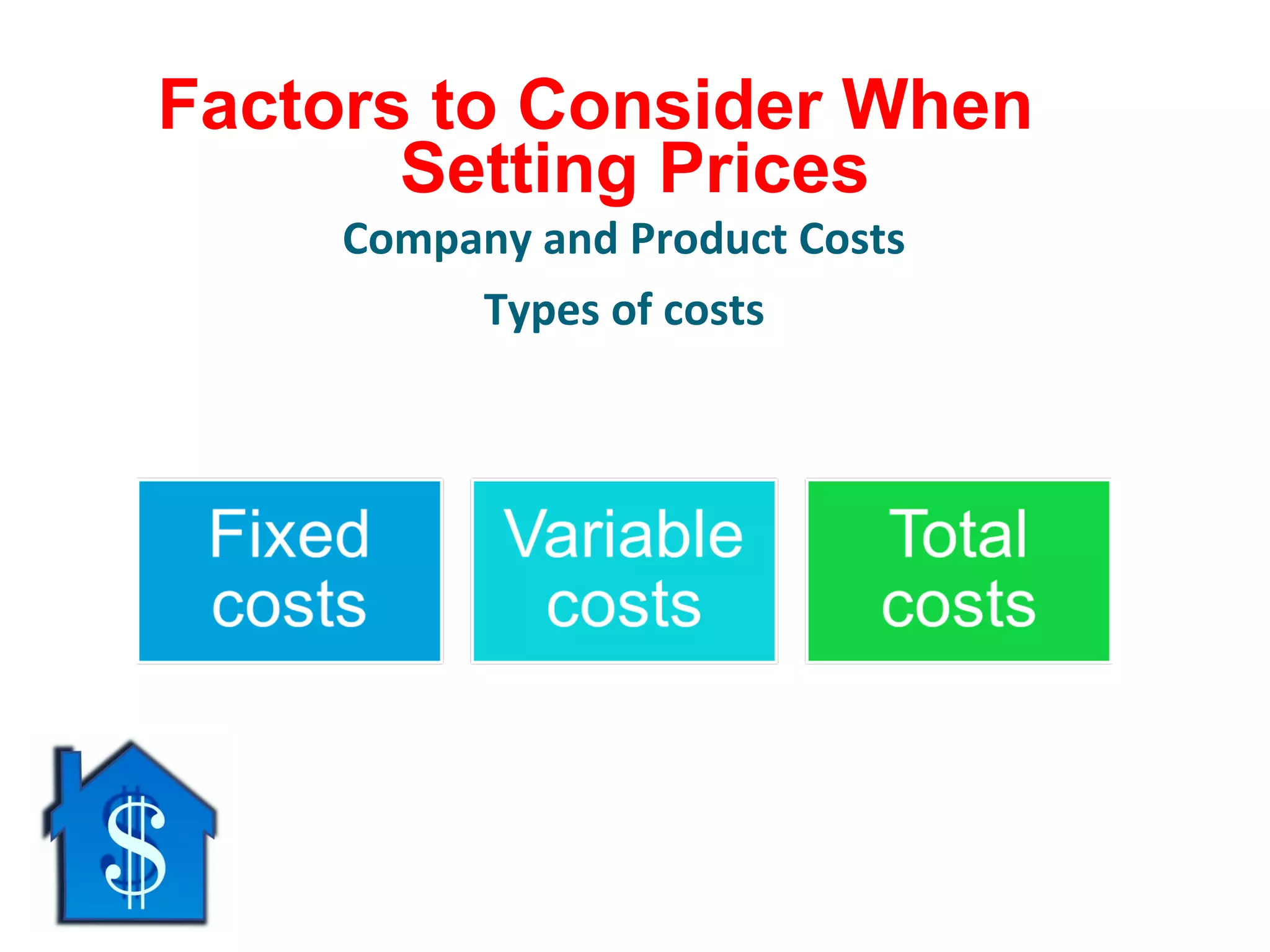
Types of costs
Factors to Consider
When Setting Prices
Fixed costs are the costs that do not vary
with production or sales level
• Rent
• Interest on loan
• Executive salaries
Company and Product Costs
Factors to Consider When
Setting Prices
Variable costs are the costs that vary with
the level of production
• Packaging
• Raw materials
Company and Product Costs
Factors to Consider
When Setting Prices
Total costs are the sum of the fixed and
variable costs for any given level of
production
Company and Product Costs
Factors to Consider When
Setting Prices
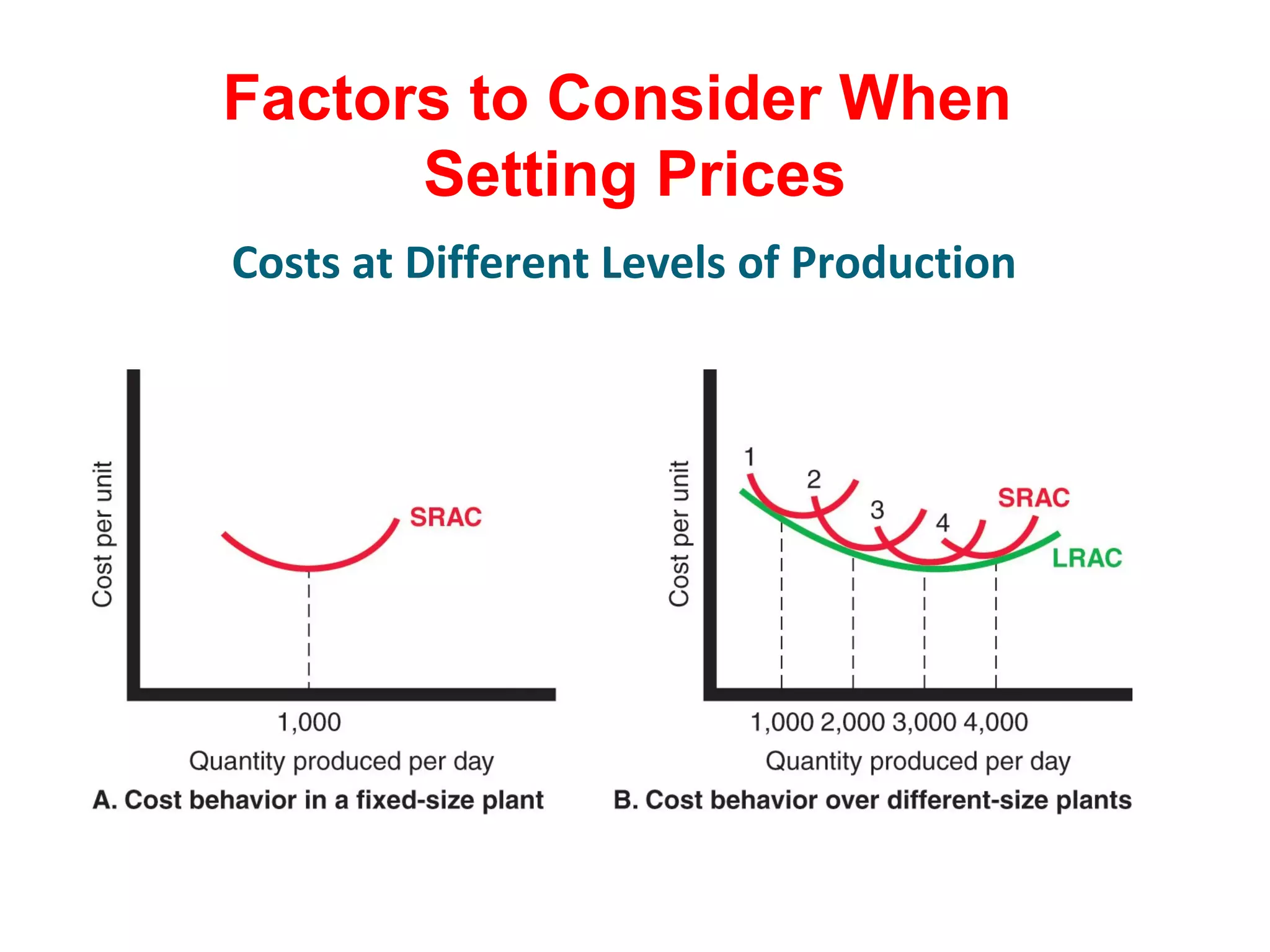
Costs at Different Levels of Production
Factors to Consider When
Setting Prices
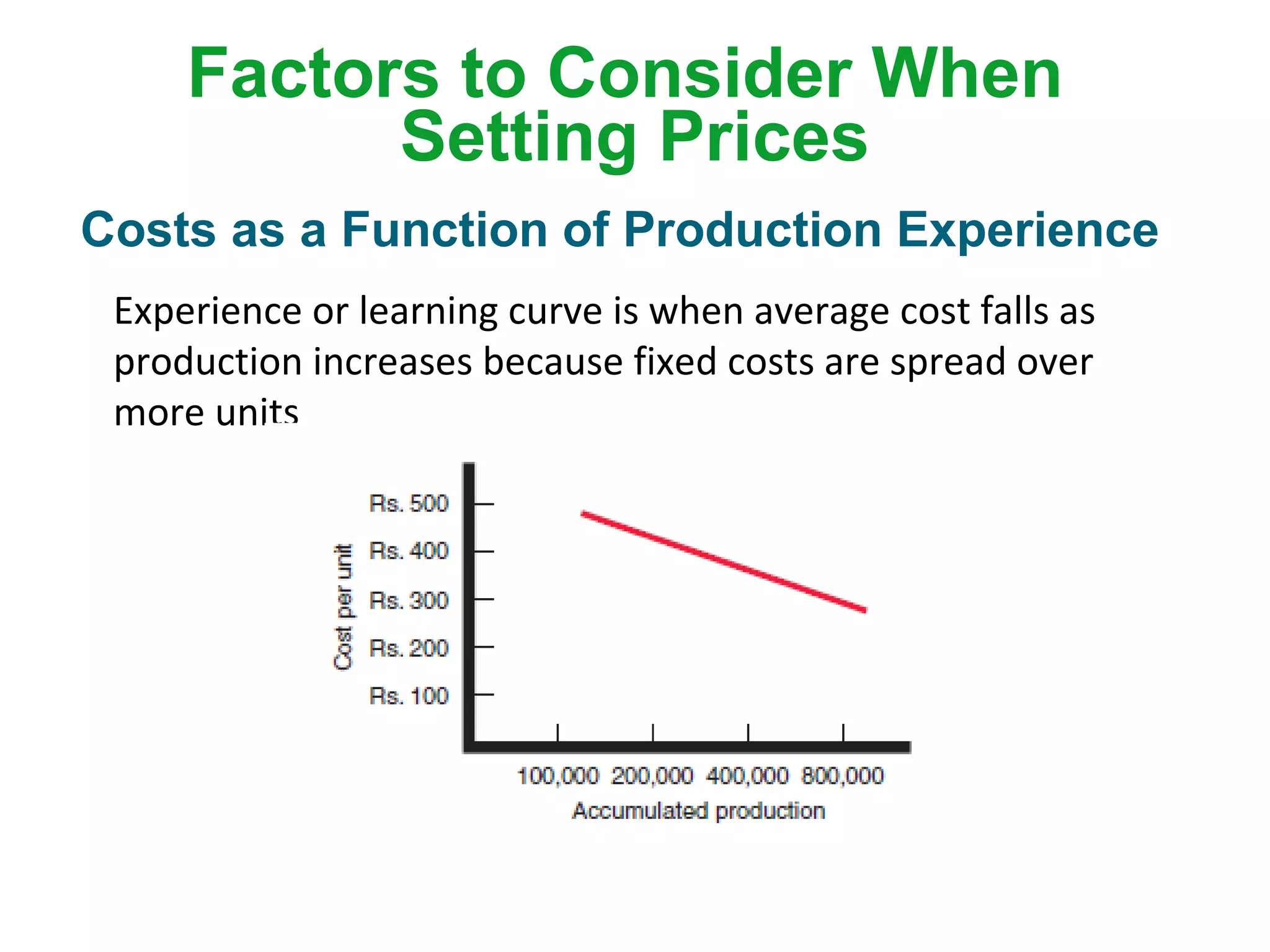
Experience or learning curve is when average cost falls as
production increases because fixed costs are spread over
more units
Costs as a Function of Production Experience
Factors to Consider When
Setting Prices
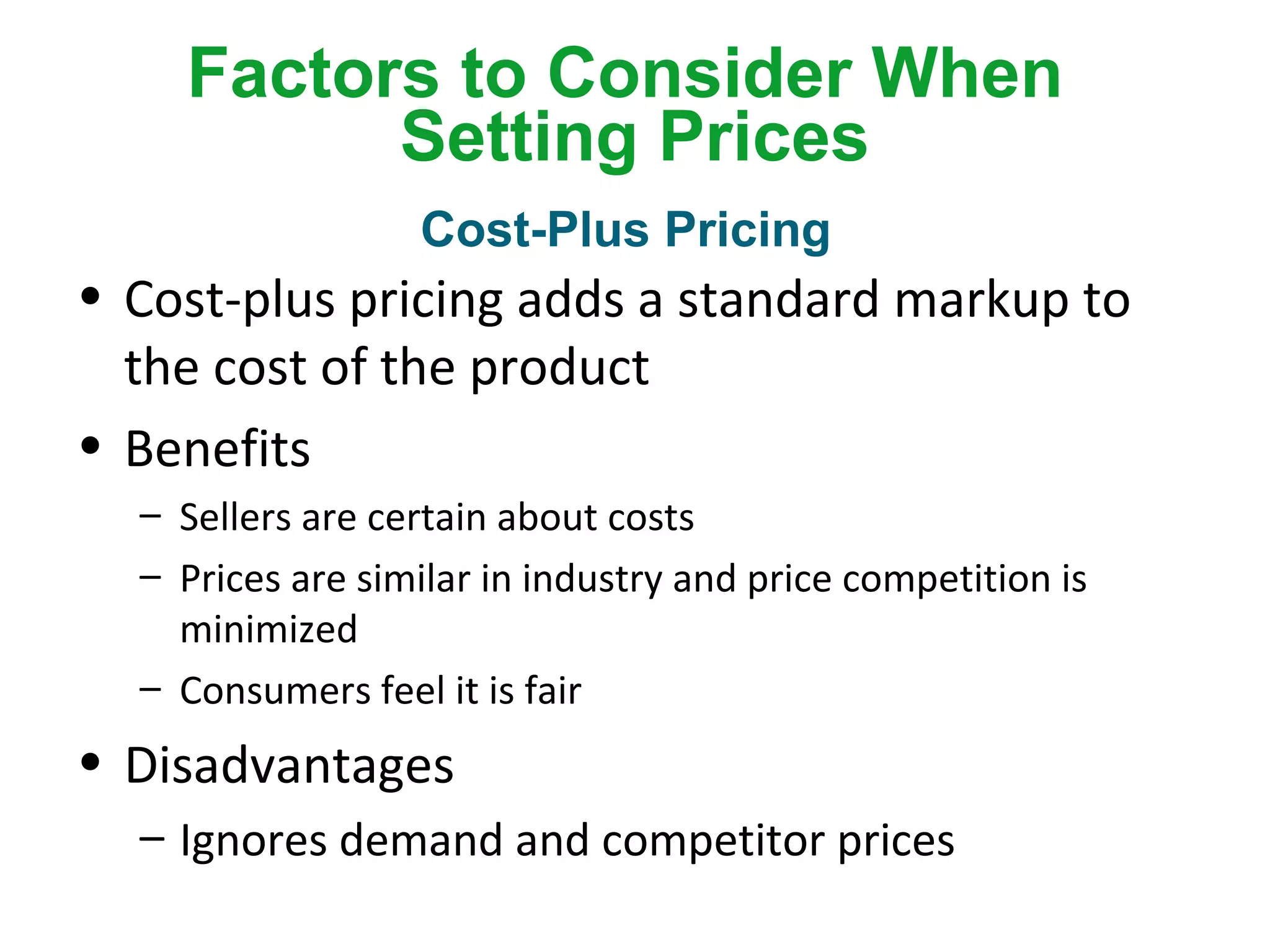
• Cost-plus pricing adds a standard markup to
the cost of the product
• Benefits
– Sellers are certain about costs
– Prices are similar in industry and price competition is
minimized
– Consumers feel it is fair
• Disadvantages
– Ignores demand and competitor prices
Cost-Plus Pricing
Factors to Consider
When Setting Prices
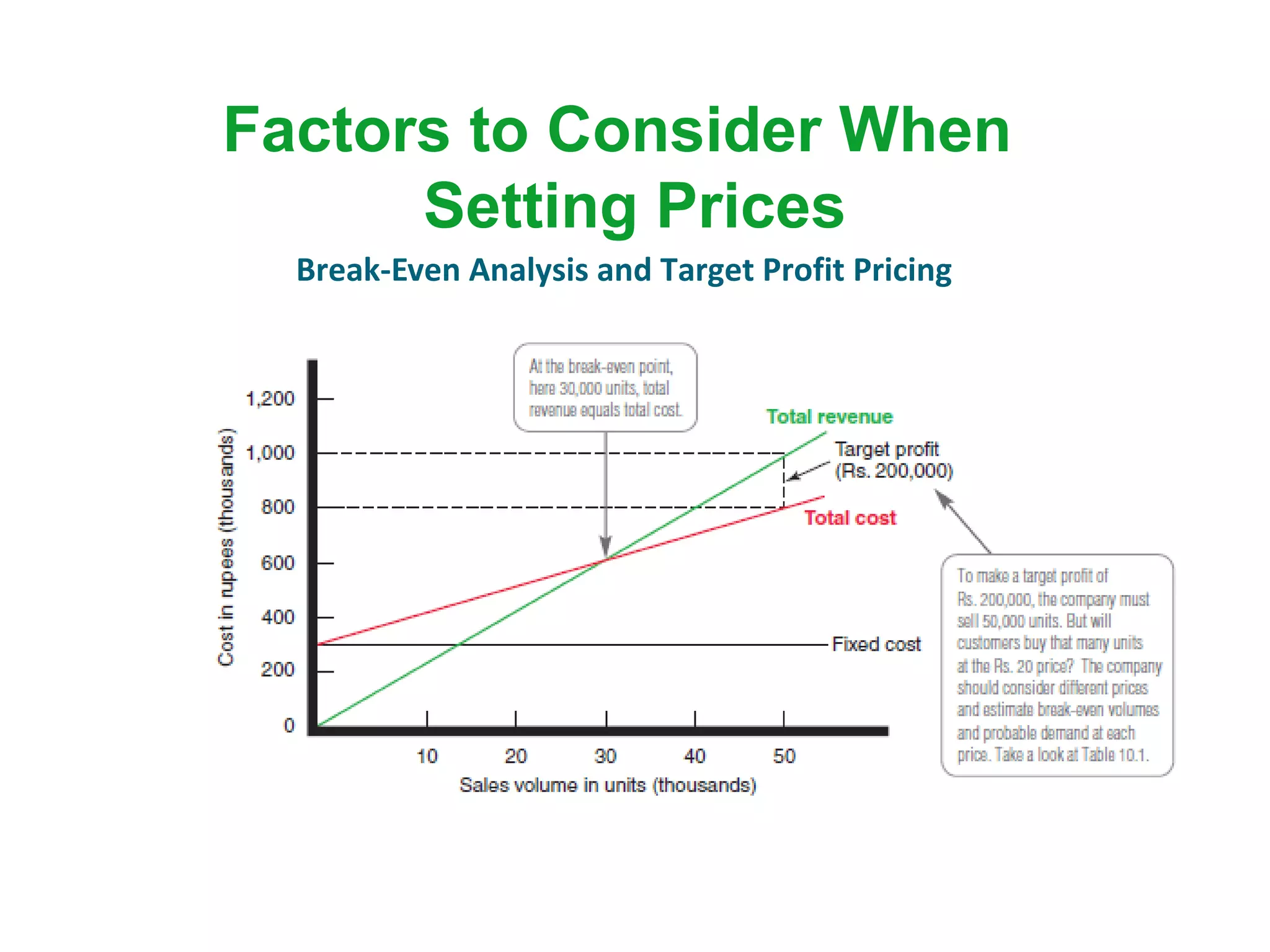
Break-even pricing is the price at which total
costs are equal to total revenue and there
is no profit
Target profit pricing is the price at which the
firm will break even or make the profit it’s
seeking
Break-Even Analysis and Target Profit
Pricing
Factors to Consider When
Setting Prices
Break-Even Analysis and Target Profit Pricing
• How does the company’s market offering
compare with competitor’s offering in terms of
customer value?
• How strong are current competitors and what
are their current pricing strategies?
Factors to Consider When
Setting Prices
Competitor Based Pricing
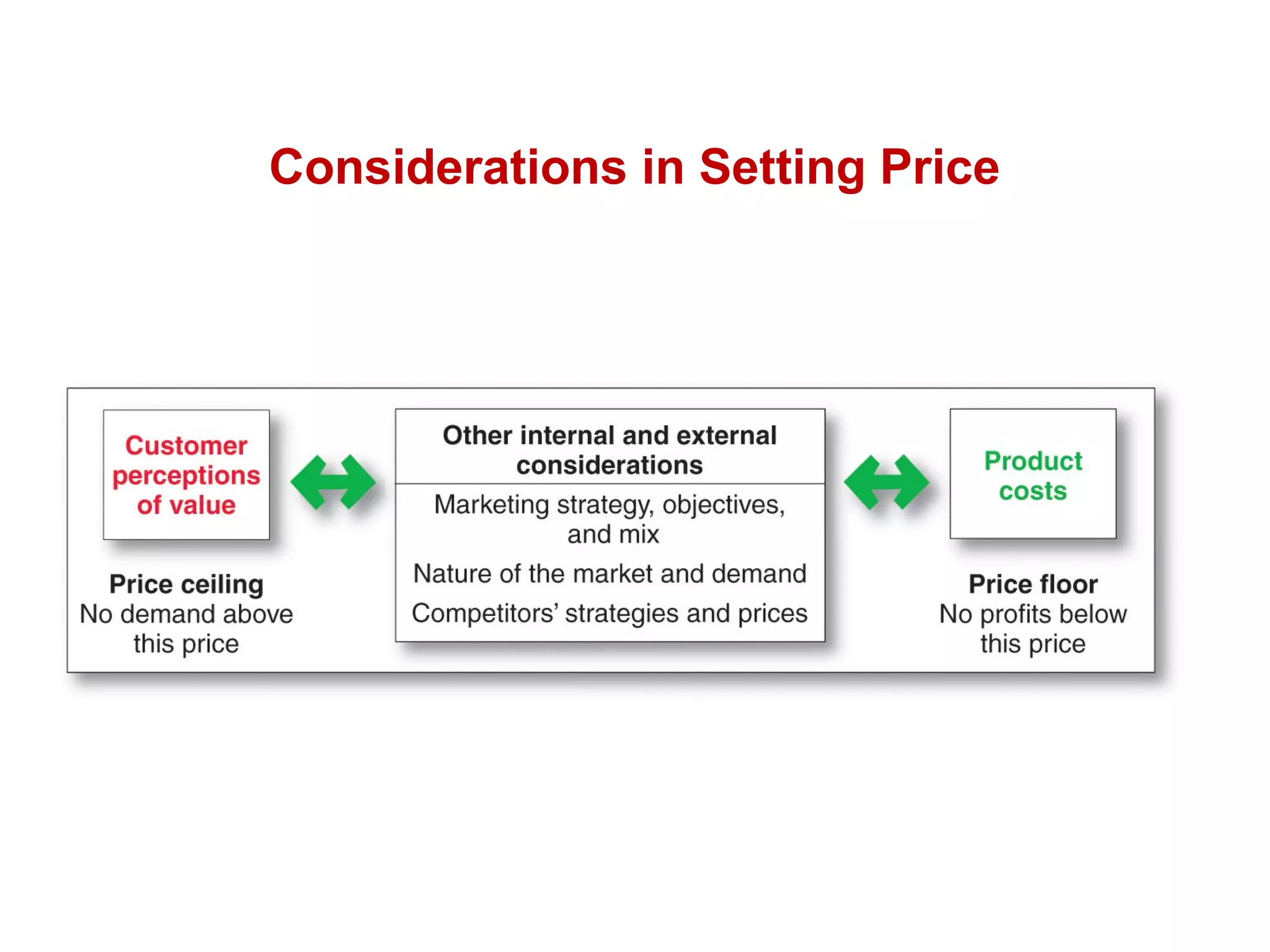
Considerations in Setting Price
Factors to Consider When
Setting Prices
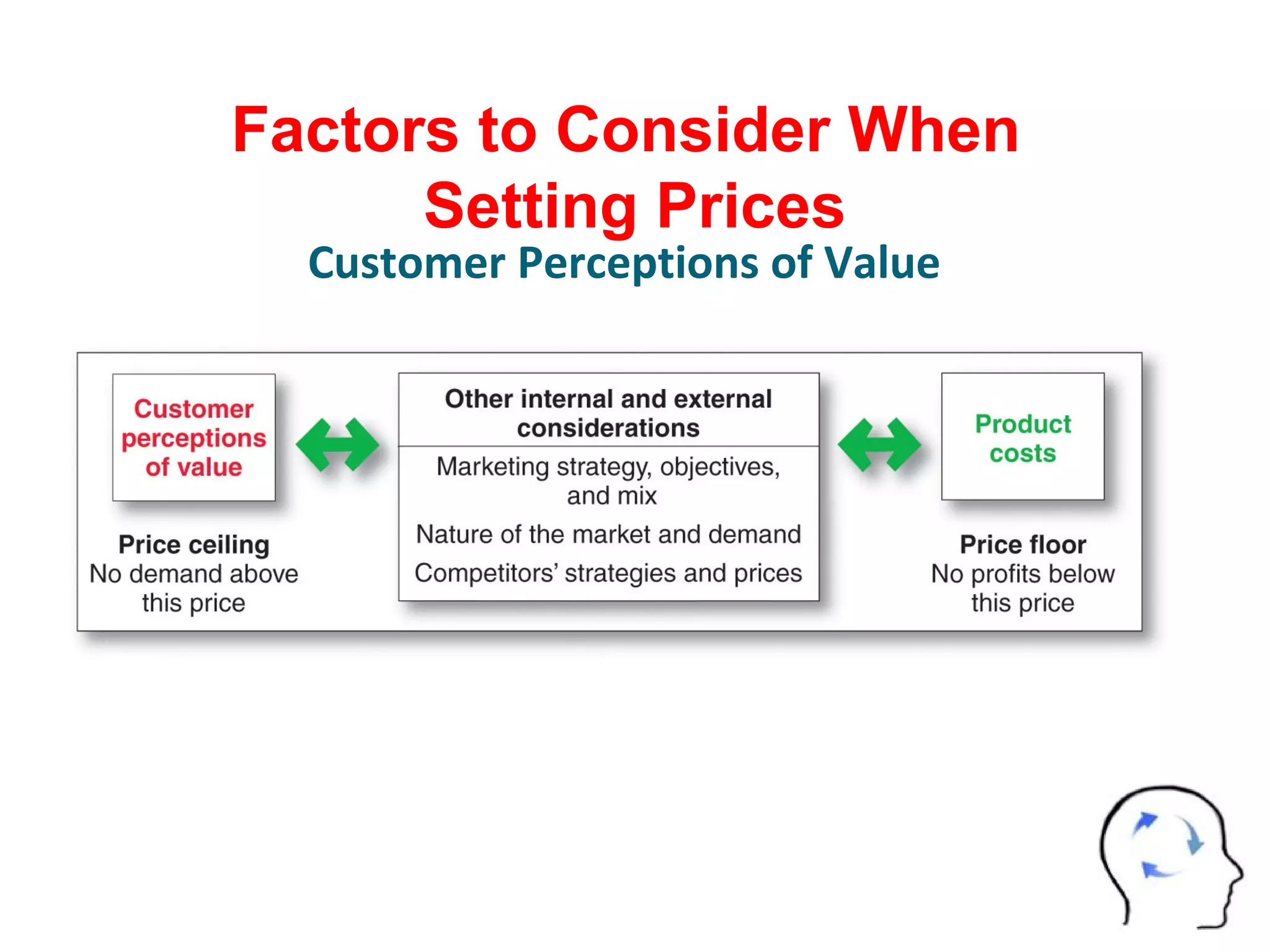
• Customer perceptions of value set the
upper limit for prices, and costs set
the lower limit
• Companies must consider internal
and external factors when setting
prices
Other Internal and External Considerations
Affecting Price Decisions
Factors to Consider When
Setting Prices
Overall marketing strategy, objectives and
mix
Positioning determines marketing mix
Accomplish marketing objectives a many levels
Integrated marketing mix
Target costing starts with an ideal selling price based on
consumer value considerations and then targets costs that
will ensure that the price is met
Other Internal and External Considerations
Affecting Price Decisions
Factors to Consider When
Setting Prices
Organizational considerations include:
• Who should set the price
• Who can influence the price
Other Internal and External Considerations
Affecting Price Decisions
Factors to Consider When
Setting Prices
The Market and Demand
•Before setting prices, the marketer must
understand the relationship between price
and demand for its products
Other Internal and External Considerations
Affecting Price Decisions
Factors to Consider When
Setting Prices
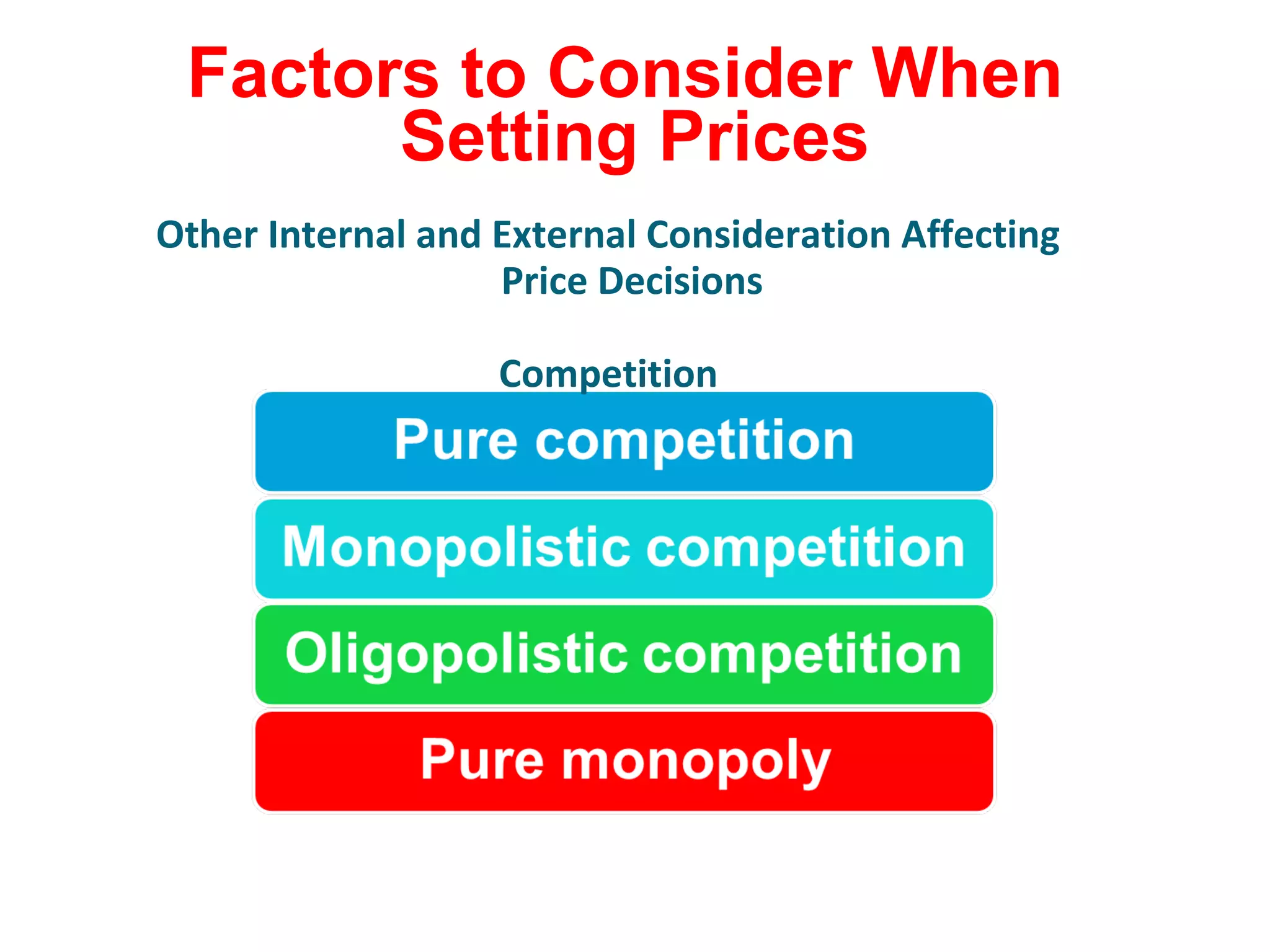
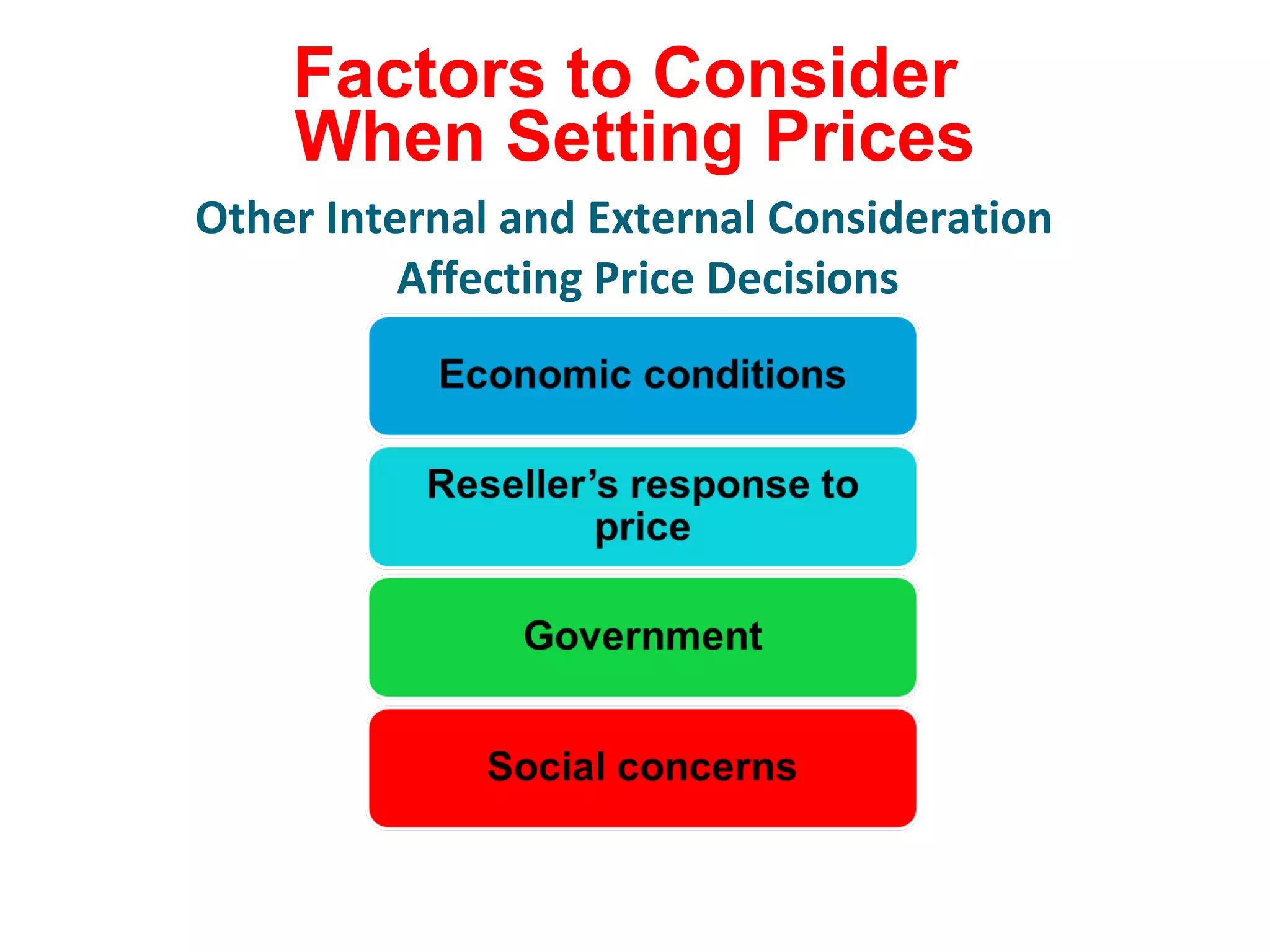
Other Internal and External Consideration Affecting
Price Decisions
Competition
Factors to Consider When
Setting Prices
The demand curve shows the number of units the
market will buy in a given period at different prices
• Normally, demand and price are inversely related
• Higher price = lower demand
• For prestige (luxury) goods, higher price can equal
higher demand when consumers perceive higher prices
as higher quality
Other Internal and External Considerations
Affecting Price Decisions
Factors to Consider When
Setting Prices
Other Internal and External Considerations
Affecting Price Decisions
Factors to Consider When
Setting Prices
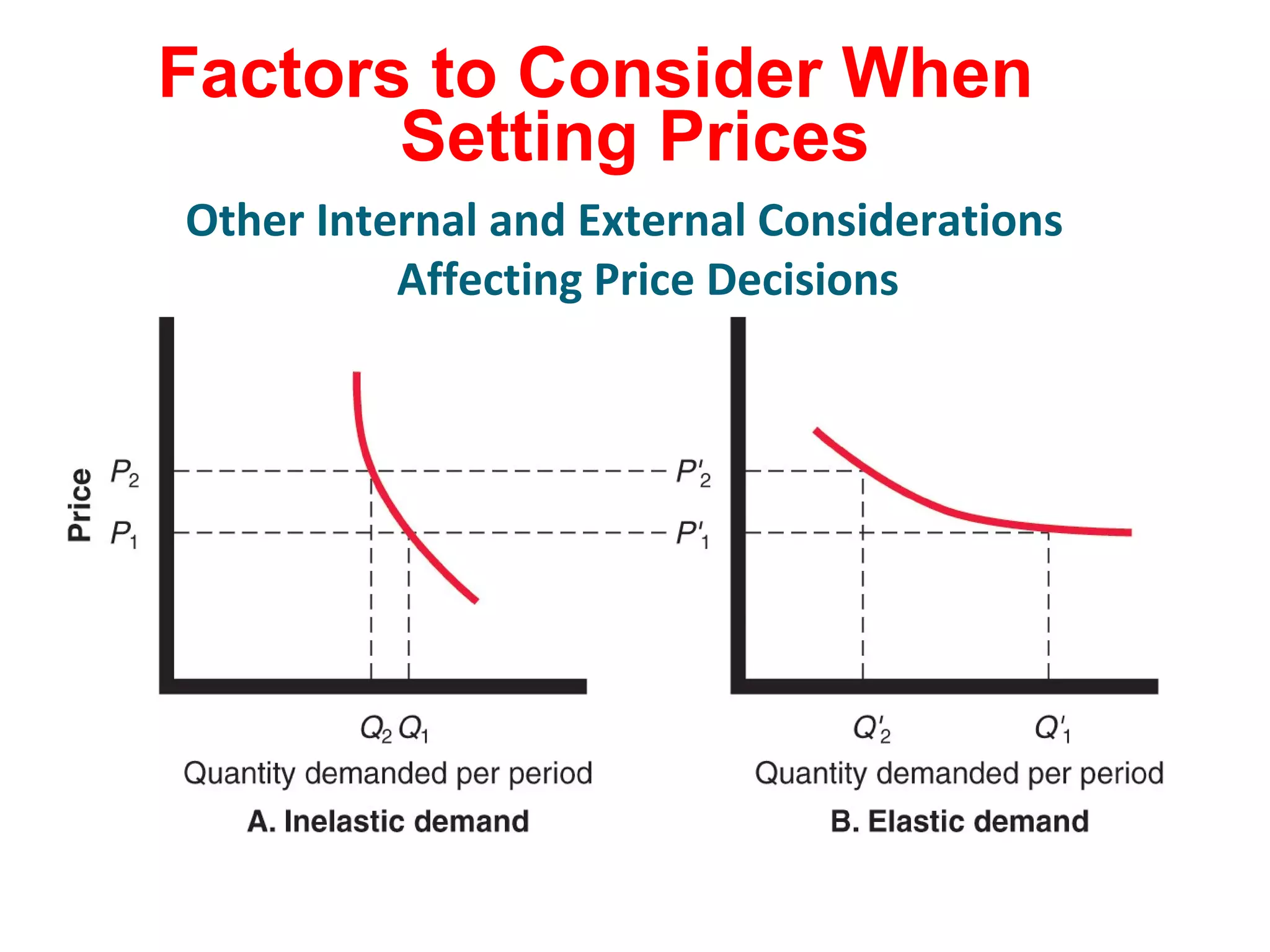
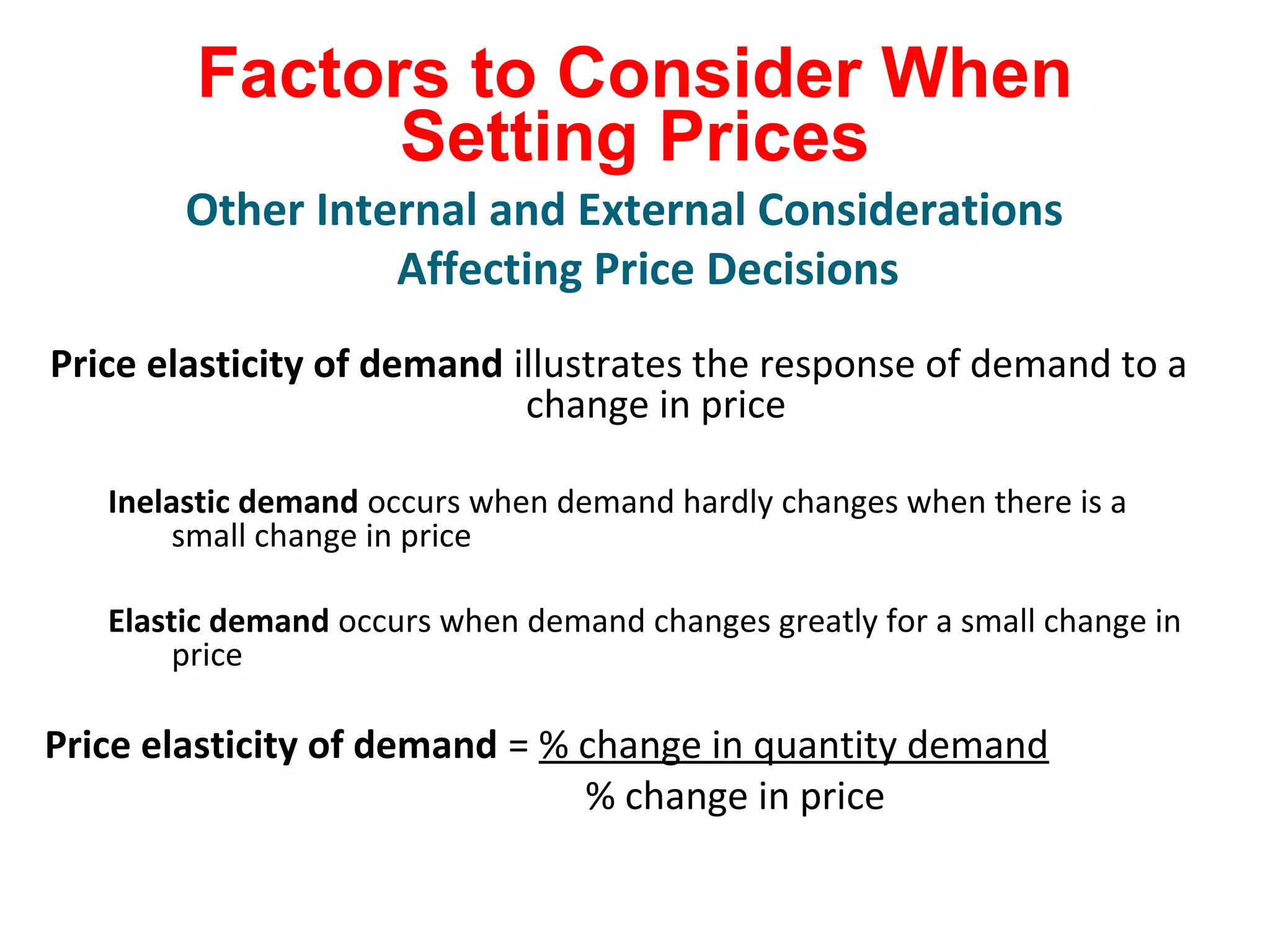
Price elasticity of demand illustrates the response of demand to a
change in price
Inelastic demand occurs when demand hardly changes when there is a
small change in price
Elastic demand occurs when demand changes greatly for a small change in
price
Price elasticity of demand = % change in quantity demand
% change in price
Other Internal and External Considerations
Affecting Price Decisions
Factors to Consider
When Setting Prices
Other Internal and External Consideration
Affecting Price Decisions
Pricing Understanding and Capturing Customer Value - Marketing

Pricing Understanding and Capturing Customer Value - Marketing

  • 1.
  • 2.
    Pricing: Understanding and Capturing CustomerValue • What Is a Price? • Customer Perceptions of Value • Company and Product Costs • Other Internal and External Considerations Affecting Price Decisions Topic Outline
  • 3.
    Price is theamount of money charged for a product or service. It is the sum of all the values that consumers give up in order to gain the benefits of having or using a product or service. What Is a Price?
  • 4.
    Price is theonly element in the marketing mix that produces revenue; all other elements represent costs Flexible and complex What Is a Price?
  • 5.
    Factors to ConsiderWhen Setting Prices Understanding how much value consumers place on the benefits they receive from the product and setting a price that captures that value Customer Perceptions of Value
  • 6.
    Factors to ConsiderWhen Setting Prices Customer Perceptions of Value
  • 7.
    Factors to ConsiderWhen Setting Prices Customer Value-based pricing uses the buyers’ perceptions of value, not the sellers’ cost, as the key to pricing. Price is considered before the marketing program is set. • Value-based pricing is customer driven • Cost-based pricing is product driven Customer Perceptions of Value
  • 8.
    Factors to ConsiderWhen Setting Prices Customer Perceptions of Value
  • 9.
    Factors to ConsiderWhen Setting Prices Customer Perceptions of Value
  • 10.
    Factors to ConsiderWhen Setting Prices Good-value pricing offers the right combination of quality and good service at a fair price Existing brands are being redesigned to offer more quality for a given price or the same quality for a lower price Customer Perceptions of Value
  • 11.
    Factors to ConsiderWhen Setting Prices Everyday low pricing (EDLP) involves charging a constant everyday low price with few or no temporary price discounts High-low pricing involves charging higher prices on an everyday basis but running frequent promotions to lower prices temporarily on selected items Customer Perceptions of Value
  • 12.
    Factors to Consider WhenSetting Prices • Value-added pricing attaches value-added features and services to differentiate offers, support higher prices, and build pricing power • Pricing power is the ability to escape price competition and to justify higher prices and margins without losing market share Customer Perceptions of Value
  • 13.
    Factors to Consider WhenSetting Prices Cost-based pricing involves setting prices based on the costs for producing, distributing, and selling the product plus a fair rate of return for its effort and risk Company and Product Costs
  • 14.
    Factors to ConsiderWhen Setting Prices Cost-based pricing adds a standard markup to the cost of the product Company and Product Costs
  • 15.
    Factors to ConsiderWhen Setting Prices Company and Product Costs Types of costs
  • 16.
    Factors to Consider WhenSetting Prices Fixed costs are the costs that do not vary with production or sales level • Rent • Interest on loan • Executive salaries Company and Product Costs
  • 17.
    Factors to ConsiderWhen Setting Prices Variable costs are the costs that vary with the level of production • Packaging • Raw materials Company and Product Costs
  • 18.
    Factors to Consider WhenSetting Prices Total costs are the sum of the fixed and variable costs for any given level of production Company and Product Costs
  • 19.
    Factors to ConsiderWhen Setting Prices Costs at Different Levels of Production
  • 20.
    Factors to ConsiderWhen Setting Prices Experience or learning curve is when average cost falls as production increases because fixed costs are spread over more units Costs as a Function of Production Experience
  • 21.
    Factors to ConsiderWhen Setting Prices • Cost-plus pricing adds a standard markup to the cost of the product • Benefits – Sellers are certain about costs – Prices are similar in industry and price competition is minimized – Consumers feel it is fair • Disadvantages – Ignores demand and competitor prices Cost-Plus Pricing
  • 22.
    Factors to Consider WhenSetting Prices Break-even pricing is the price at which total costs are equal to total revenue and there is no profit Target profit pricing is the price at which the firm will break even or make the profit it’s seeking Break-Even Analysis and Target Profit Pricing
  • 23.
    Factors to ConsiderWhen Setting Prices Break-Even Analysis and Target Profit Pricing
  • 24.
    • How doesthe company’s market offering compare with competitor’s offering in terms of customer value? • How strong are current competitors and what are their current pricing strategies? Factors to Consider When Setting Prices Competitor Based Pricing
  • 25.
  • 26.
    Factors to ConsiderWhen Setting Prices • Customer perceptions of value set the upper limit for prices, and costs set the lower limit • Companies must consider internal and external factors when setting prices Other Internal and External Considerations Affecting Price Decisions
  • 27.
    Factors to ConsiderWhen Setting Prices Overall marketing strategy, objectives and mix Positioning determines marketing mix Accomplish marketing objectives a many levels Integrated marketing mix Target costing starts with an ideal selling price based on consumer value considerations and then targets costs that will ensure that the price is met Other Internal and External Considerations Affecting Price Decisions
  • 28.
    Factors to ConsiderWhen Setting Prices Organizational considerations include: • Who should set the price • Who can influence the price Other Internal and External Considerations Affecting Price Decisions
  • 29.
    Factors to ConsiderWhen Setting Prices The Market and Demand •Before setting prices, the marketer must understand the relationship between price and demand for its products Other Internal and External Considerations Affecting Price Decisions
  • 30.
    Factors to ConsiderWhen Setting Prices Other Internal and External Consideration Affecting Price Decisions Competition
  • 31.
    Factors to ConsiderWhen Setting Prices The demand curve shows the number of units the market will buy in a given period at different prices • Normally, demand and price are inversely related • Higher price = lower demand • For prestige (luxury) goods, higher price can equal higher demand when consumers perceive higher prices as higher quality Other Internal and External Considerations Affecting Price Decisions
  • 32.
    Factors to ConsiderWhen Setting Prices Other Internal and External Considerations Affecting Price Decisions
  • 33.
    Factors to ConsiderWhen Setting Prices Price elasticity of demand illustrates the response of demand to a change in price Inelastic demand occurs when demand hardly changes when there is a small change in price Elastic demand occurs when demand changes greatly for a small change in price Price elasticity of demand = % change in quantity demand % change in price Other Internal and External Considerations Affecting Price Decisions
  • 34.
    Factors to Consider WhenSetting Prices Other Internal and External Consideration Affecting Price Decisions