ShekhAhamadhusen D et al. Int. Journal of Engineering Research and Applications www.ijera.com
ISSN : 2248-9622, Vol. 4, Issue 4( Version 5), April 2014, pp.122-126
www.ijera.com 122 | P a g e
Secure Cloud StorageForPrivacy-Preserving Public Audit
ShekhAhamadhusen D., Prof. Rahul Deshmukh
Abstract-
In Cloud Environment, using cloud storage service, users can remotely store their data and enjoy the on-demand
high-quality applications and services from a shared pool of configurable computing resources, without the
burden of local data storage and maintenance. However, the fact that users no longer have physical possession
of the outsourced data makes the data integrity protection in cloud computing a formidable task, especially for
users with constrained computing resources. Moreover, users should be able to just use the cloud storage as if it
is local, without worrying about the need to verify its integrity. Thus, enabling public auditability for cloud
storage is of critical importance so that users can resort to a third-party auditor (TPA) to check the integrity of
outsourced data and be worry free. To securely introduce an effective TPA, the auditing process should bring in
no new vulnerabilities toward user data privacy, and introduce no additional online burden to user. In this paper,
we propose a secure cloud storage system supporting privacy-preserving public auditing. We further extend our
result to enable the TPA to perform audits for multiple users simultaneously and efficiently. Extensive security
and performance analysis show the proposed schemes are provably secure and highly efficient.
I.Introduction
Advances in networking technology and an increase
in the need for computing resources haveprompted
many organizations to outsource their storage and
computing needs. This new economicand computing
model is commonly referred to as cloud computing
and includes various typesof services such as:
infrastructure as a service (IaaS), where a customer
makes use of a service
provider's computing, storage or networking
infrastructure; platform as a service (PaaS), where
acustomer leverages the provider's resources to run
custom applications; and software as aservice (SaaS),
where customers use software that is run on the
providers infrastructure.Cloud infrastructures can be
roughly categorized as either private or public. In a
private cloud,the infrastructure is managed and
owned by the customer and located on-premise (i.e.,
in thecustomers region of control). In particular, this
means that access to customer data is under itscontrol
and is only granted to parties it trusts. In a public
cloud the infrastructure is owned andmanaged by a
cloud service provider and is located o_-premise (i.e.,
in the service provider's regionof control). This
means that customer data is outside its control and
could potentially be grantedto untrusted parties.
CLOUD computing has been envisioned as the next
generation Information Technology (IT) architecture
for enterprises, due to its long list of unprecedented
advantages in the IT history: on-demand self-service,
ubiquitous network access, location independent
resource pooling, rapid resource elasticity, usage-
based pricing and transference of risk. From users’
perspective, including both individuals and IT
enterprises, storing data remotely to the cloud in a
flexible on-demand manner brings appealing
benefits: relief of the burden for storage management,
universal data access with location independence, and
avoidance of capital expenditure on hardware,
software, and personnel maintenances, etc. While
cloud computing makes these advantages more
appealing than ever, it also brings new and
challenging security threats toward users’ outsourced
data. Since Cloud Service Providers (CSP) is separate
administrative entities, data outsourcing is actually
relinquishing user’s ultimate control over the fate of
their data. As a result, the correctness of the data in
the cloud is being put at risk due to the following
reasons. First of all, although the infrastructures
RESEARCH ARTICLE OPEN ACCESS
ShekhAhamadhusen D et al. Int. Journal of Engineering Research and Applications www.ijera.com
ISSN : 2248-9622, Vol. 4, Issue 4( Version 5), April 2014, pp.122-126
www.ijera.com 123 | P a g e
under the cloud are much more powerful and reliable
than personal computing devices, they are still facing
the broad range of both internal and external threats
for data integrity. Examples of outages and security
breaches of noteworthy cloud services appear from
time to time. Second, there do exist various
motivations for CSP to behave unfaithfully toward
the cloud users regarding their outsourced data status.
For examples, CSP might reclaim storage for
monetary reasons by discarding data that have not
been or are rarely accessed, or even hide data loss
incidents to maintain a reputation.
II. Literature Survey
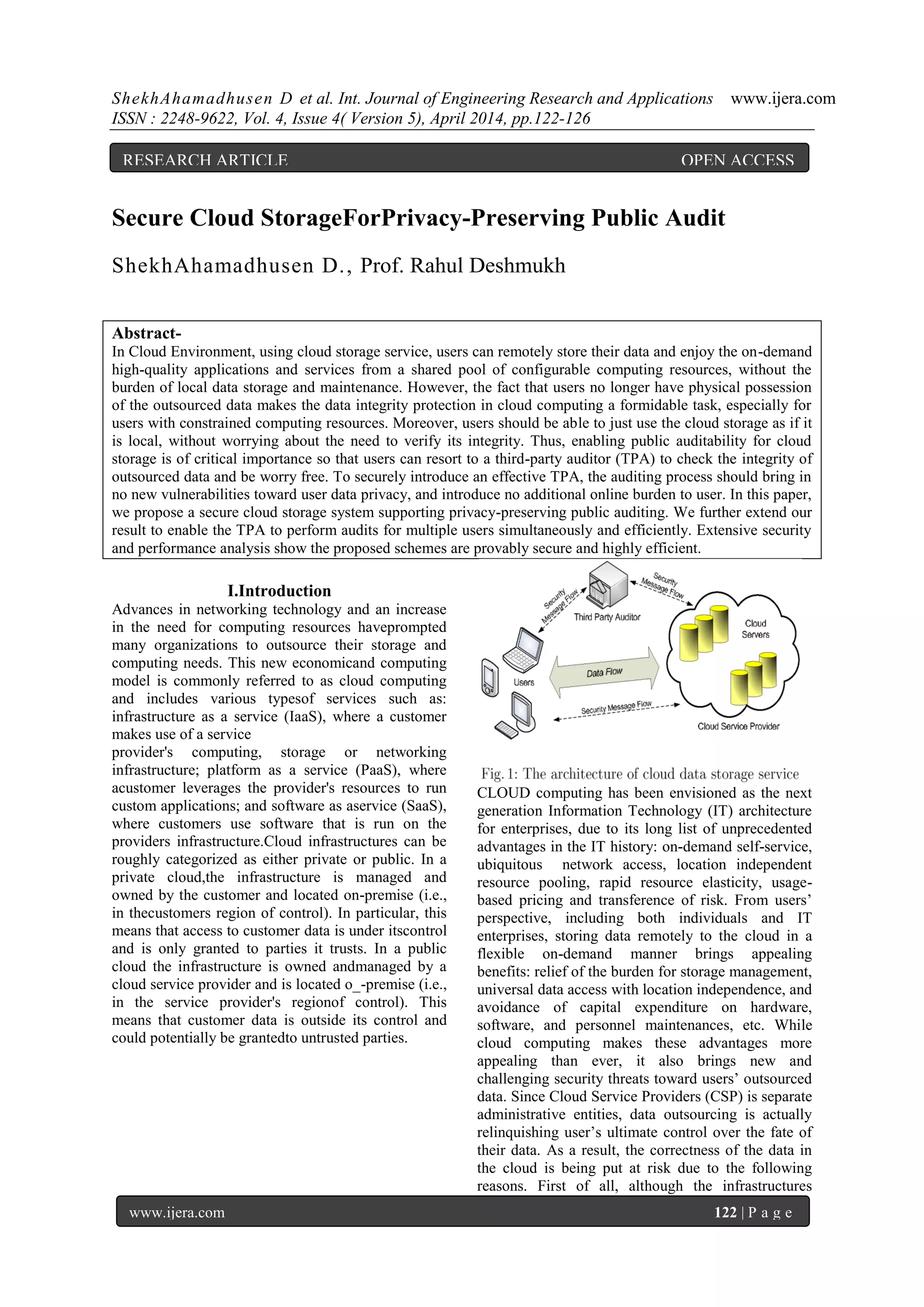
We consider a cloud data storage service
involving three different entities: the cloud user, who
has large amount of data files to be stored in the
cloud; the cloud server, which is managed by the
cloud service provider to provide data storage service
and has significant storage. Space and computation
resources (we will not differentiate CS and CSP
hereafter); the third-party auditor, who has expertise
and capabilities that cloud users do not have and is
trusted to assess the cloud storage service reliability
on behalf of the user upon request. Users rely on the
CS for cloud data storage and maintenance. They
may also dynamically interact with the CS to access
and update their stored data for various application
purposes. As users no longer possess their data
locally, it is of critical importance for users to ensure
that their data are being correctly stored and
maintained. In short, although outsourcing data to the
cloud is economically attractive for long-term large-
scale storage, it does not immediately offer any
guarantee on data integrity and availability. This
problem, if not properly addressed, may impede the
success of cloud architecture. To save the
computation resource as well as the online burden
potentially brought by the periodic storage
correctness verification, cloud users may resort to
TPA for ensuring the storage integrity of their out
sourced data. Public auditability allows an external
party, in addition to the user himself, to verify the
correctness of remotely stored data. However, most
of these schemes, do not consider the privacy
protection of users’ data against external auditors.
Cloud Computing has been envisioned as the next-
generation architecture of IT Enterprise. It moves the
application software and databases to the centralized
large data centers, where the management of the data
and services may not be fully trust worthy. This
unique paradigm brings about many new security
challenges, which have not been well understood.
This work studies the problem of ensuring the
integrity of data storage in Cloud Computing. In
particular, we consider the task of allowing a Third
Party Auditor (TPA), on behalf of the cloud client, to
verify the integrity of the dynamic data stored in the
cloud. The introduction of TPA eliminates the
involvement of the client through the auditing of
whether his data stored in the cloud is indeed intact,
which can be important in achieving economies of
scale for Cloud Computing. The support for data
dynamics via the most general forms of data
operation, such as block modification, insertion and
deletion, is also a significant step toward practicality,
since services in Cloud Computing are not limited to
archive or backup data only. While prior works on
ensuring remote data integrity often lacks the support
of either public auditability or dynamic data
operations, this paper achieves both. We first identify
the difficulties and potential security problems of
direct extensions with fully dynamic data updates
from prior works and then show how to construct an
elegant verification scheme for the seamless
integration of these two salient features in our
protocol design. In particular, to achieve efficient
data dynamics, we improve the existing proof of
storage models by manipulating the classic Merkle
Hash Tree construction for block tag authentication.
To support efficient handling of multiple auditing
tasks, we further explore the technique of bilinear
aggregate signature to extend our main result into a
multi-user setting, where TPA can perform multiple
auditing tasks simultaneously. Extensive security and
performance analysis show that the proposed
schemes are highly efficient and provably secure[1].
We introduce a model for Provable Data Possession
(PDP) that allows a client that has stored data at an
untrusted server to verify that the server possesses the
original data without retrieving it. The model
generates probabilistic proofs of possession by
sampling random sets of blocks from the server,
which drastically reduces I/O costs. The client
maintains a constant amount of metadata to verify the
proof. The challenge/response protocol transmits a
small, constant amount of data, which minimizes
network communication. Thus, the PDP model for
remote data checking supports large data sets in
widely-distributed storage systems. We present two
provably-secure PDP schemes that are more efficient
than previous solutions, even when compared with
schemes that achieve weaker guarantees. In
particular, the overhead at the server is low (or even
constant), as opposed to linear in the size of the data.
Experiments using our implementation verify the
practicality of PDP and reveal that the performance
of PDP is bounded by disk I/O and not by
cryptographic computation[2].
ShekhAhamadhusen D et al. Int. Journal of Engineering Research and Applications www.ijera.com
ISSN : 2248-9622, Vol. 4, Issue 4( Version 5), April 2014, pp.122-126
www.ijera.com 124 | P a g e
Figure 2.1.Types of cloud
Cloud computing is the long dreamed vision of
computing as a utility, where data owners can
remotely store their data in the cloud to enjoy on-
demand high-quality applications and services from a
shared pool of configurable computing resources.
While data outsourcing relieves the owners of the
burden of local data storage and maintenance, it also
eliminates their physical control of storage
dependability and security, which traditionally has
been expected by both enterprises and individuals
with high service-level requirements. In order to
facilitate rapid deployment of cloud data storage
service and regain security assurances with out
sourced data dependability, efficient methods that
enable on-demand data correctness verification on
behalf of cloud data owners have to be designed. In
this article we propose that publicly auditable cloud
data storage is able to help this nascent cloud
economy become fully established. With public
auditability, a trusted entity with expertise and
capabilities data owners do not possess can be
delegated as an external audit party to assess the risk
of outsourced data when needed. Such an auditing
service not only helps save data owners’ computation
resources but also provides a transparent yet cost-
effective method for data owners to gain trust in the
cloud. We describe approaches and system
requirements that should be brought into
consideration, and outline challenges that need to be
resolved for such a publicly auditable secure cloud
storage service to become a reality[4].
III. Problem Statement
The cloud user, who has large amount of
data files to be stored in the cloud; the cloud server,
which is managed by the cloud service provider to
provide data storage service and has significant
storage space and computation resources (we will not
differentiate CS and CSP hereafter); the third-party
auditor, who has expertise and capabilities that cloud
users do not have and is trusted to assess the cloud
storage service reliability on behalf of the user upon
request. Users rely on the CS for cloud data storage
and maintenance. They may also dynamically interact
with the CS to access and update their stored data for
various application purposes. As users no longer
possess their data locally, it is of critical importance
for users to ensure that their data are being correctly
stored and maintained. To save the computation
resource as well as the online burden potentially
brought by the periodic storage correctness
verification, cloud users may resort to TPA for
ensuring the storage integrity of their out sourced
data, while hoping to keep their data private from
TPA. Using third-party auditing service provides a
cost-effective method for users to gain trust in cloud.
We assume the TPA, who is in the business of
auditing, is reliable and independent. However, it
may harm the user if the TPA could learn the out
sourced data after the audit[5]. Note that in our
model, beyond users’ reluctance to leak data to TPA;
we also assume that a cloud server has no incentives
to reveal their hosted data to external parties.
IV. The Proposed Mechanism
Our work is among the first few ones to support
privacy-preserving public auditing in cloud
computing, with a focus on data storage. Besides,
with the prevalence of cloud computing, a
foreseeable increase of auditing tasks from different
users may be delegated to TPA. Our work also
utilizes the technique of public key-based
homomorphic linear authenticator or HLA which
enables TPA to perform the auditing without
demanding the local copy of data and thus drastically
reduces the communication and computation
overhead as compared to the straight forward data
auditing approaches. By integrating the HLA with
random masking, our protocol guarantees that the
TPA could not learn any knowledge about the data
content stored in the cloud server (CS) during the
efficient auditing process. The aggregation and
algebraic properties of the authenticator further
benefit our design for the batch auditing.
 Public audit ability -- to verify the correctness of
the cloud data on demand without retrieving a
copy of the whole data.
 It provides security and performance guarantees.
V. Methodology Used
Methodologies are the process of analyzing
the principles or procedure for enabling secure
external auditing process against data integrity with
the support of homomorphic linear authenticator in
public cloud environment.
ShekhAhamadhusen D et al. Int. Journal of Engineering Research and Applications www.ijera.com
ISSN : 2248-9622, Vol. 4, Issue 4( Version 5), April 2014, pp.122-126
www.ijera.com 125 | P a g e
MODULES NAMES
Service Provider
 Authentication
 Resource Provisioning
Third Party Auditor
 Authentication
 Auditing Process
Data Owner
 Authentication
 Key Maker
 Auditing Request
Authentication
If you are the new user going to consume
the service then they have to register first by
providing necessary details. After successful
completion of sign up process, the user has to login
into the application by providing username and exact
password. The user has to provide exact username
and password which was provided at the time of
registration, if login success means it will take up to
main page else it will remain in the login page itself..
SERVICE PROVIDER
 Resource Provisioning
The process of providing resources to customers or
clients with accounts, the appropriate access to those
accounts, all the rights associated with those
accounts, and all of the resources necessary to
manage the accounts. When used in reference to a
client, provisioning can be thought of as a form of
customer service.
THIRD PARTY AUDITOR
 Auditing Process
In public auditing module, the auditor perceives and
recognizes the propositions before him for
examination, collects evidence, evaluates the same
and on this basis formulates his judgment which is
communicated through his audit report.
DATA OWNER
 Key Maker
In this module, keys are generated according to the
user setup in order to generate verification Meta data
of uploaded file.
 Auditing Request
User can send the auditing request to external auditor
along with the signatures and Meta data of the file.
Then auditor will request for generated proof from
service provider in order to do auditing process.
Finally data owner will get the audit report.
PARTICLE FILTERING ALGORITHM
Public Key-Based Homomorphic Linear
Authenticator (HLA)
HLA-based solution is to effectively support public
auditability without having to retrieve the data blocks
themselves, the HLA technique can be used. HLAs,
like MACs, are also some unforgeable verification
metadata that authenticate the integrity of a data
block. The difference is that HLAs can be
aggregated. It is possible to compute an aggregated
HLA which authenticates a linear combination of the
individual data blocks. At a high level, an HLA-
based proof of storage system works as follow. The
user still authenticates each element of F = {mi} by a
set of HLAs. The TPA verifies the cloud storage by
sending a random set of challenge {vi}. The cloud
server then returns 𝜇 = 𝑣𝑖 ∗ 𝑚𝑖𝑖 and its aggregated
authenticator 𝜎computed from ∅.
STEP 1:Setup Phase: The cloud user runs KeyGen
to generate the public and secret parameters.
STEP 2:SigGen: Given a data file F = {mi}, the user
runs SigGen to compute authenticator.
STEP 3: Audit Phase: The TPA first retrieves the
file tag t. With respect to the mechanism we
describe in the Setup phase, the TPA verifies the
signature via secret key, and quits by emitting
FALSE if the verification fails.
VI. Conclusion
We propose a privacy-preserving public
auditing system for data storage security in Cloud
Computing. We utilize the homomorphic linear
authenticator and random masking to guarantee that
the TPA would not learn any knowledge about the
data content stored on the cloud server during the
efficient auditing process, which not only eliminates
the burden of cloud user from the tedious and
possibly expensive auditing task, but also alleviates
the users’ fear of their outsourced data leakage.
Considering TPA may concurrently handle multiple
audit sessions from different users for their
outsourced data files, we further extend our privacy-
preserving public auditing protocol into a multi-user
setting, where the TPA can perform multiple auditing
tasks in a batch manner for better efficiency.
Extensive analysis shows that our schemes are
provably secure and highly efficient.
References
[1] Q. Wang, C. Wang, K. Ren, W. Lou, and J. Li,
“Enabling Public Auditability and Data
Dynamics for Storage Security in Cloud
Computing,” IEEE Trans. Parallel and
Distributed Systems, vol. 22, no. 5, pp. 847-
859, May 2011.
[2] G. Ateniese, R. Burns, R. Curtmola, J.
Herring, L. Kissner, Z. Peterson, and D. Song,
“Provable Data Possession at Untrusted
Stores,” Proc. 14th ACM Conf. Computer and
Comm. Security (CCS ’07), pp. 598-609,
2007.
ShekhAhamadhusen D et al. Int. Journal of Engineering Research and Applications www.ijera.com
ISSN : 2248-9622, Vol. 4, Issue 4( Version 5), April 2014, pp.122-126
www.ijera.com 126 | P a g e
[3] M.A. Shah, R. Swaminathan, and M. Baker,
“Privacy-Preserving Audit and Extraction of
Digital Contents,” Cryptology ePrint Archive,
Report 2008/186, 2008.
[4] C. Wang, K. Ren, W. Lou, and J. Li, “Towards
Publicly Auditable Secure Cloud Data Storage
Services,” IEEE Network Magazine, vol. 24,
no. 4, pp. 19-24, July/Aug. 2010.
[5] M.A. Shah, M. Baker, J.C. Mogul, and R.
Swaminathan, “Auditing to Keep Online
Storage Services Honest,” Proc. 11th USENIX
Workshop Hot Topics in Operating Systems
(HotOS ’07), pp. 1-6, 2007.
[6] R. Curtmola, O. Khan, and R. Burns, “Robust
Remote Data Checking,” Proc. Fourth ACM
Int’l Workshop Storage Security and
Survivability (StorageSS ’08), pp. 63-68,
2008.
[7] A.L. Ferrara, M. Green, S. Hohenberger, and
M. Pedersen, “Practical Short Signature Batch
Verification,” Proc. Cryptographers’ Track at
the RSA Conf. 2009 on Topics in Cryptology
(CT-RSA), pp. 309-324, 2009.

V04405122126

  • 1.
    ShekhAhamadhusen D etal. Int. Journal of Engineering Research and Applications www.ijera.com ISSN : 2248-9622, Vol. 4, Issue 4( Version 5), April 2014, pp.122-126 www.ijera.com 122 | P a g e Secure Cloud StorageForPrivacy-Preserving Public Audit ShekhAhamadhusen D., Prof. Rahul Deshmukh Abstract- In Cloud Environment, using cloud storage service, users can remotely store their data and enjoy the on-demand high-quality applications and services from a shared pool of configurable computing resources, without the burden of local data storage and maintenance. However, the fact that users no longer have physical possession of the outsourced data makes the data integrity protection in cloud computing a formidable task, especially for users with constrained computing resources. Moreover, users should be able to just use the cloud storage as if it is local, without worrying about the need to verify its integrity. Thus, enabling public auditability for cloud storage is of critical importance so that users can resort to a third-party auditor (TPA) to check the integrity of outsourced data and be worry free. To securely introduce an effective TPA, the auditing process should bring in no new vulnerabilities toward user data privacy, and introduce no additional online burden to user. In this paper, we propose a secure cloud storage system supporting privacy-preserving public auditing. We further extend our result to enable the TPA to perform audits for multiple users simultaneously and efficiently. Extensive security and performance analysis show the proposed schemes are provably secure and highly efficient. I.Introduction Advances in networking technology and an increase in the need for computing resources haveprompted many organizations to outsource their storage and computing needs. This new economicand computing model is commonly referred to as cloud computing and includes various typesof services such as: infrastructure as a service (IaaS), where a customer makes use of a service provider's computing, storage or networking infrastructure; platform as a service (PaaS), where acustomer leverages the provider's resources to run custom applications; and software as aservice (SaaS), where customers use software that is run on the providers infrastructure.Cloud infrastructures can be roughly categorized as either private or public. In a private cloud,the infrastructure is managed and owned by the customer and located on-premise (i.e., in thecustomers region of control). In particular, this means that access to customer data is under itscontrol and is only granted to parties it trusts. In a public cloud the infrastructure is owned andmanaged by a cloud service provider and is located o_-premise (i.e., in the service provider's regionof control). This means that customer data is outside its control and could potentially be grantedto untrusted parties. CLOUD computing has been envisioned as the next generation Information Technology (IT) architecture for enterprises, due to its long list of unprecedented advantages in the IT history: on-demand self-service, ubiquitous network access, location independent resource pooling, rapid resource elasticity, usage- based pricing and transference of risk. From users’ perspective, including both individuals and IT enterprises, storing data remotely to the cloud in a flexible on-demand manner brings appealing benefits: relief of the burden for storage management, universal data access with location independence, and avoidance of capital expenditure on hardware, software, and personnel maintenances, etc. While cloud computing makes these advantages more appealing than ever, it also brings new and challenging security threats toward users’ outsourced data. Since Cloud Service Providers (CSP) is separate administrative entities, data outsourcing is actually relinquishing user’s ultimate control over the fate of their data. As a result, the correctness of the data in the cloud is being put at risk due to the following reasons. First of all, although the infrastructures RESEARCH ARTICLE OPEN ACCESS
  • 2.
    ShekhAhamadhusen D etal. Int. Journal of Engineering Research and Applications www.ijera.com ISSN : 2248-9622, Vol. 4, Issue 4( Version 5), April 2014, pp.122-126 www.ijera.com 123 | P a g e under the cloud are much more powerful and reliable than personal computing devices, they are still facing the broad range of both internal and external threats for data integrity. Examples of outages and security breaches of noteworthy cloud services appear from time to time. Second, there do exist various motivations for CSP to behave unfaithfully toward the cloud users regarding their outsourced data status. For examples, CSP might reclaim storage for monetary reasons by discarding data that have not been or are rarely accessed, or even hide data loss incidents to maintain a reputation. II. Literature Survey We consider a cloud data storage service involving three different entities: the cloud user, who has large amount of data files to be stored in the cloud; the cloud server, which is managed by the cloud service provider to provide data storage service and has significant storage. Space and computation resources (we will not differentiate CS and CSP hereafter); the third-party auditor, who has expertise and capabilities that cloud users do not have and is trusted to assess the cloud storage service reliability on behalf of the user upon request. Users rely on the CS for cloud data storage and maintenance. They may also dynamically interact with the CS to access and update their stored data for various application purposes. As users no longer possess their data locally, it is of critical importance for users to ensure that their data are being correctly stored and maintained. In short, although outsourcing data to the cloud is economically attractive for long-term large- scale storage, it does not immediately offer any guarantee on data integrity and availability. This problem, if not properly addressed, may impede the success of cloud architecture. To save the computation resource as well as the online burden potentially brought by the periodic storage correctness verification, cloud users may resort to TPA for ensuring the storage integrity of their out sourced data. Public auditability allows an external party, in addition to the user himself, to verify the correctness of remotely stored data. However, most of these schemes, do not consider the privacy protection of users’ data against external auditors. Cloud Computing has been envisioned as the next- generation architecture of IT Enterprise. It moves the application software and databases to the centralized large data centers, where the management of the data and services may not be fully trust worthy. This unique paradigm brings about many new security challenges, which have not been well understood. This work studies the problem of ensuring the integrity of data storage in Cloud Computing. In particular, we consider the task of allowing a Third Party Auditor (TPA), on behalf of the cloud client, to verify the integrity of the dynamic data stored in the cloud. The introduction of TPA eliminates the involvement of the client through the auditing of whether his data stored in the cloud is indeed intact, which can be important in achieving economies of scale for Cloud Computing. The support for data dynamics via the most general forms of data operation, such as block modification, insertion and deletion, is also a significant step toward practicality, since services in Cloud Computing are not limited to archive or backup data only. While prior works on ensuring remote data integrity often lacks the support of either public auditability or dynamic data operations, this paper achieves both. We first identify the difficulties and potential security problems of direct extensions with fully dynamic data updates from prior works and then show how to construct an elegant verification scheme for the seamless integration of these two salient features in our protocol design. In particular, to achieve efficient data dynamics, we improve the existing proof of storage models by manipulating the classic Merkle Hash Tree construction for block tag authentication. To support efficient handling of multiple auditing tasks, we further explore the technique of bilinear aggregate signature to extend our main result into a multi-user setting, where TPA can perform multiple auditing tasks simultaneously. Extensive security and performance analysis show that the proposed schemes are highly efficient and provably secure[1]. We introduce a model for Provable Data Possession (PDP) that allows a client that has stored data at an untrusted server to verify that the server possesses the original data without retrieving it. The model generates probabilistic proofs of possession by sampling random sets of blocks from the server, which drastically reduces I/O costs. The client maintains a constant amount of metadata to verify the proof. The challenge/response protocol transmits a small, constant amount of data, which minimizes network communication. Thus, the PDP model for remote data checking supports large data sets in widely-distributed storage systems. We present two provably-secure PDP schemes that are more efficient than previous solutions, even when compared with schemes that achieve weaker guarantees. In particular, the overhead at the server is low (or even constant), as opposed to linear in the size of the data. Experiments using our implementation verify the practicality of PDP and reveal that the performance of PDP is bounded by disk I/O and not by cryptographic computation[2].
  • 3.
    ShekhAhamadhusen D etal. Int. Journal of Engineering Research and Applications www.ijera.com ISSN : 2248-9622, Vol. 4, Issue 4( Version 5), April 2014, pp.122-126 www.ijera.com 124 | P a g e Figure 2.1.Types of cloud Cloud computing is the long dreamed vision of computing as a utility, where data owners can remotely store their data in the cloud to enjoy on- demand high-quality applications and services from a shared pool of configurable computing resources. While data outsourcing relieves the owners of the burden of local data storage and maintenance, it also eliminates their physical control of storage dependability and security, which traditionally has been expected by both enterprises and individuals with high service-level requirements. In order to facilitate rapid deployment of cloud data storage service and regain security assurances with out sourced data dependability, efficient methods that enable on-demand data correctness verification on behalf of cloud data owners have to be designed. In this article we propose that publicly auditable cloud data storage is able to help this nascent cloud economy become fully established. With public auditability, a trusted entity with expertise and capabilities data owners do not possess can be delegated as an external audit party to assess the risk of outsourced data when needed. Such an auditing service not only helps save data owners’ computation resources but also provides a transparent yet cost- effective method for data owners to gain trust in the cloud. We describe approaches and system requirements that should be brought into consideration, and outline challenges that need to be resolved for such a publicly auditable secure cloud storage service to become a reality[4]. III. Problem Statement The cloud user, who has large amount of data files to be stored in the cloud; the cloud server, which is managed by the cloud service provider to provide data storage service and has significant storage space and computation resources (we will not differentiate CS and CSP hereafter); the third-party auditor, who has expertise and capabilities that cloud users do not have and is trusted to assess the cloud storage service reliability on behalf of the user upon request. Users rely on the CS for cloud data storage and maintenance. They may also dynamically interact with the CS to access and update their stored data for various application purposes. As users no longer possess their data locally, it is of critical importance for users to ensure that their data are being correctly stored and maintained. To save the computation resource as well as the online burden potentially brought by the periodic storage correctness verification, cloud users may resort to TPA for ensuring the storage integrity of their out sourced data, while hoping to keep their data private from TPA. Using third-party auditing service provides a cost-effective method for users to gain trust in cloud. We assume the TPA, who is in the business of auditing, is reliable and independent. However, it may harm the user if the TPA could learn the out sourced data after the audit[5]. Note that in our model, beyond users’ reluctance to leak data to TPA; we also assume that a cloud server has no incentives to reveal their hosted data to external parties. IV. The Proposed Mechanism Our work is among the first few ones to support privacy-preserving public auditing in cloud computing, with a focus on data storage. Besides, with the prevalence of cloud computing, a foreseeable increase of auditing tasks from different users may be delegated to TPA. Our work also utilizes the technique of public key-based homomorphic linear authenticator or HLA which enables TPA to perform the auditing without demanding the local copy of data and thus drastically reduces the communication and computation overhead as compared to the straight forward data auditing approaches. By integrating the HLA with random masking, our protocol guarantees that the TPA could not learn any knowledge about the data content stored in the cloud server (CS) during the efficient auditing process. The aggregation and algebraic properties of the authenticator further benefit our design for the batch auditing.  Public audit ability -- to verify the correctness of the cloud data on demand without retrieving a copy of the whole data.  It provides security and performance guarantees. V. Methodology Used Methodologies are the process of analyzing the principles or procedure for enabling secure external auditing process against data integrity with the support of homomorphic linear authenticator in public cloud environment.
  • 4.
    ShekhAhamadhusen D etal. Int. Journal of Engineering Research and Applications www.ijera.com ISSN : 2248-9622, Vol. 4, Issue 4( Version 5), April 2014, pp.122-126 www.ijera.com 125 | P a g e MODULES NAMES Service Provider  Authentication  Resource Provisioning Third Party Auditor  Authentication  Auditing Process Data Owner  Authentication  Key Maker  Auditing Request Authentication If you are the new user going to consume the service then they have to register first by providing necessary details. After successful completion of sign up process, the user has to login into the application by providing username and exact password. The user has to provide exact username and password which was provided at the time of registration, if login success means it will take up to main page else it will remain in the login page itself.. SERVICE PROVIDER  Resource Provisioning The process of providing resources to customers or clients with accounts, the appropriate access to those accounts, all the rights associated with those accounts, and all of the resources necessary to manage the accounts. When used in reference to a client, provisioning can be thought of as a form of customer service. THIRD PARTY AUDITOR  Auditing Process In public auditing module, the auditor perceives and recognizes the propositions before him for examination, collects evidence, evaluates the same and on this basis formulates his judgment which is communicated through his audit report. DATA OWNER  Key Maker In this module, keys are generated according to the user setup in order to generate verification Meta data of uploaded file.  Auditing Request User can send the auditing request to external auditor along with the signatures and Meta data of the file. Then auditor will request for generated proof from service provider in order to do auditing process. Finally data owner will get the audit report. PARTICLE FILTERING ALGORITHM Public Key-Based Homomorphic Linear Authenticator (HLA) HLA-based solution is to effectively support public auditability without having to retrieve the data blocks themselves, the HLA technique can be used. HLAs, like MACs, are also some unforgeable verification metadata that authenticate the integrity of a data block. The difference is that HLAs can be aggregated. It is possible to compute an aggregated HLA which authenticates a linear combination of the individual data blocks. At a high level, an HLA- based proof of storage system works as follow. The user still authenticates each element of F = {mi} by a set of HLAs. The TPA verifies the cloud storage by sending a random set of challenge {vi}. The cloud server then returns 𝜇 = 𝑣𝑖 ∗ 𝑚𝑖𝑖 and its aggregated authenticator 𝜎computed from ∅. STEP 1:Setup Phase: The cloud user runs KeyGen to generate the public and secret parameters. STEP 2:SigGen: Given a data file F = {mi}, the user runs SigGen to compute authenticator. STEP 3: Audit Phase: The TPA first retrieves the file tag t. With respect to the mechanism we describe in the Setup phase, the TPA verifies the signature via secret key, and quits by emitting FALSE if the verification fails. VI. Conclusion We propose a privacy-preserving public auditing system for data storage security in Cloud Computing. We utilize the homomorphic linear authenticator and random masking to guarantee that the TPA would not learn any knowledge about the data content stored on the cloud server during the efficient auditing process, which not only eliminates the burden of cloud user from the tedious and possibly expensive auditing task, but also alleviates the users’ fear of their outsourced data leakage. Considering TPA may concurrently handle multiple audit sessions from different users for their outsourced data files, we further extend our privacy- preserving public auditing protocol into a multi-user setting, where the TPA can perform multiple auditing tasks in a batch manner for better efficiency. Extensive analysis shows that our schemes are provably secure and highly efficient. References [1] Q. Wang, C. Wang, K. Ren, W. Lou, and J. Li, “Enabling Public Auditability and Data Dynamics for Storage Security in Cloud Computing,” IEEE Trans. Parallel and Distributed Systems, vol. 22, no. 5, pp. 847- 859, May 2011. [2] G. Ateniese, R. Burns, R. Curtmola, J. Herring, L. Kissner, Z. Peterson, and D. Song, “Provable Data Possession at Untrusted Stores,” Proc. 14th ACM Conf. Computer and Comm. Security (CCS ’07), pp. 598-609, 2007.
  • 5.
    ShekhAhamadhusen D etal. Int. Journal of Engineering Research and Applications www.ijera.com ISSN : 2248-9622, Vol. 4, Issue 4( Version 5), April 2014, pp.122-126 www.ijera.com 126 | P a g e [3] M.A. Shah, R. Swaminathan, and M. Baker, “Privacy-Preserving Audit and Extraction of Digital Contents,” Cryptology ePrint Archive, Report 2008/186, 2008. [4] C. Wang, K. Ren, W. Lou, and J. Li, “Towards Publicly Auditable Secure Cloud Data Storage Services,” IEEE Network Magazine, vol. 24, no. 4, pp. 19-24, July/Aug. 2010. [5] M.A. Shah, M. Baker, J.C. Mogul, and R. Swaminathan, “Auditing to Keep Online Storage Services Honest,” Proc. 11th USENIX Workshop Hot Topics in Operating Systems (HotOS ’07), pp. 1-6, 2007. [6] R. Curtmola, O. Khan, and R. Burns, “Robust Remote Data Checking,” Proc. Fourth ACM Int’l Workshop Storage Security and Survivability (StorageSS ’08), pp. 63-68, 2008. [7] A.L. Ferrara, M. Green, S. Hohenberger, and M. Pedersen, “Practical Short Signature Batch Verification,” Proc. Cryptographers’ Track at the RSA Conf. 2009 on Topics in Cryptology (CT-RSA), pp. 309-324, 2009.