Search, Analytics, and UX
Prepared for University of Oregon, School of Journalism
February 2012


                                                          1
Intro   Hi!


Goals   1. Identify user experience factors influencing the
           success of an SEO and/or SEM campaign
        2. Identify keyword research tools and techniques
        3. Identify metrics and analytics best practices


                                                              2
Agenda

         3
•   How do you get started? Creating and maintaining a
Agenda       campaign
         •   Designing for effectiveness
         •   How do you know it works? Measuring what matters.


                                                                  4
How do you get started?

                          6
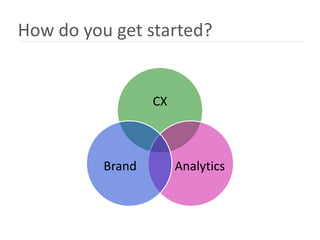
How do you get started?


                  CX


          Brand        Analytics
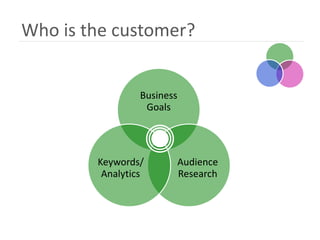
Who is the customer?


                 Business
                  Goals


        Keywords/       Audience
         Analytics      Research
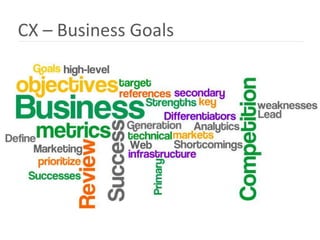
CX – Business Goals
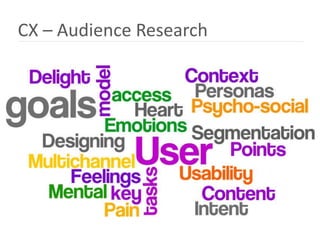
CX – Audience Research
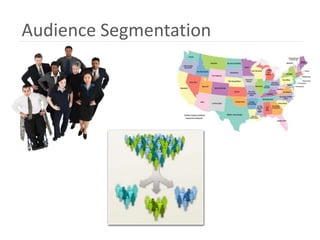
Audience Segmentation
CX – Keywords & Analytics
Brand and Competition
Competitor Research


                       Online


                      Real World
Competitor Research


© DC Comics


               http://keywordcompetitor.com/newDesignImages/features/OnlineKey
               wordResearch.png
Gap Analysis and Brand Research


  http://blog.roymatheson.com/Portals/85919/images/grand-canyon1.jpg
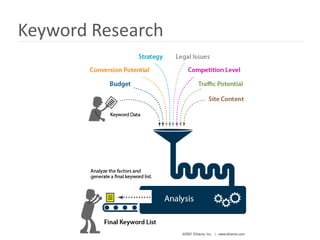
Keyword Research
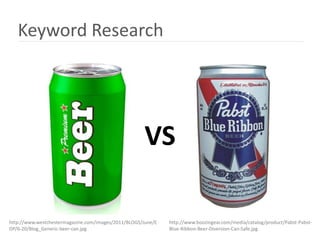
Keyword Research


                                                      VS

http://www.westchestermagazine.com/images/2011/BLOGS/June/E   http://www.boozingear.com/media/catalog/product/Pabst-Pabst-
DP/6-20/Blog_Generic-beer-can.jpg                             Blue-Ribbon-Beer-Diversion-Can-Safe.jpg
Keyword Research
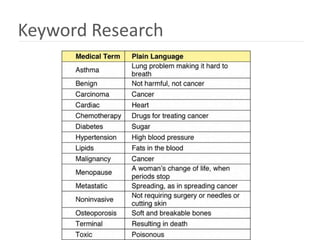
Keyword Research
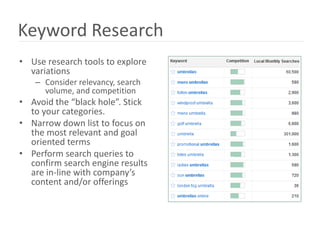
• Use research tools to explore
  variations
   – Consider relevancy, search
     volume, and competition
• Avoid the “black hole”. Stick
  to your categories.
• Narrow down list to focus on
  the most relevant and goal
  oriented terms
• Perform search queries to
  confirm search engine results
  are in-line with company’s
  content and/or offerings
Keyword Research – Organic vs. Paid
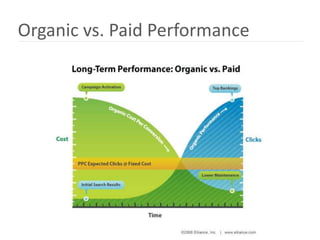
Organic vs. Paid Performance
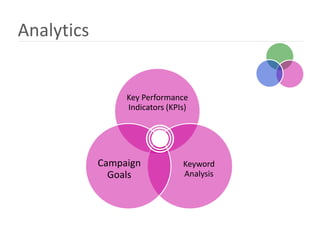
Analytics


                 Key Performance
                 Indicators (KPIs)


            Campaign            Keyword
              Goals             Analysis
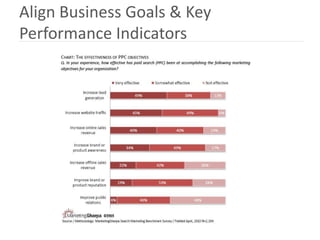
Align Business Goals & Key
Performance Indicators
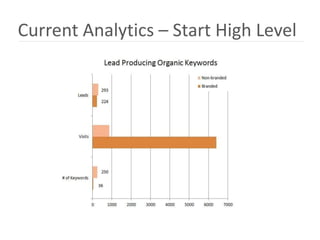
Current Analytics – Start High Level
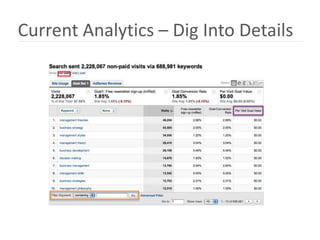
Current Analytics – Dig Into Details
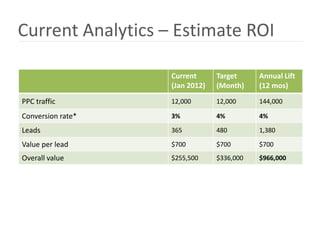
Current Analytics – Estimate ROI

                   Current      Target     Annual Lift
                   (Jan 2012)   (Month)    (12 mos)
PPC traffic        12,000       12,000     144,000

Conversion rate*   3%           4%         4%

Leads              365          480        1,380

Value per lead     $700         $700       $700
Overall value      $255,500     $336,000   $966,000
Activity: Research and Planning
                     http://www.flickr.com/photos/daveog/129202092/


                                                         28
Designing for Effectiveness

                              29
Designing for effectiveness
•   Digital Experience Framework
•   Planning the campaign
•   Sketching the story arc
•   Landing Pages
•   Design Principles
•   Stand out in SERPs
•   Activity
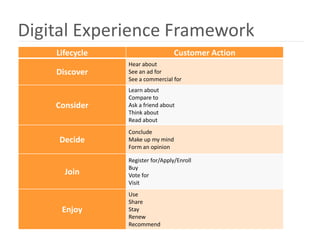
Digital Experience Framework
    Lifecycle                     Customer Action
                Hear about
    Discover    See an ad for
                See a commercial for
                Learn about
                Compare to
    Consider    Ask a friend about
                Think about
                Read about
                Conclude
    Decide      Make up my mind
                Form an opinion

                Register for/Apply/Enroll
                Buy
      Join      Vote for
                Visit
                Use
                Share
     Enjoy      Stay
                Renew
                Recommend
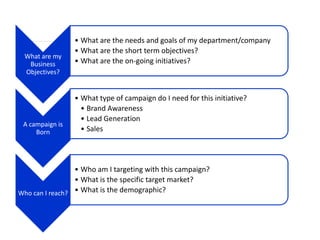
• What are the needs and goals of my department/company
                 • What are the short term objectives?
 What are my
  Business       • What are the on-going initiatives?
 Objectives?


                 • What type of campaign do I need for this initiative?
                   • Brand Awareness
                   • Lead Generation
 A campaign is
     Born          • Sales


                 • Who am I targeting with this campaign?
                 • What is the specific target market?
Who can I reach? • What is the demographic?
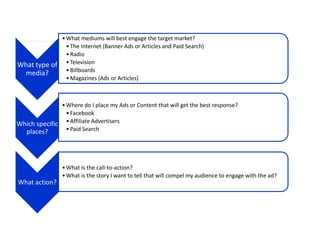
• What mediums will best engage the target market?
                   • The Internet (Banner Ads or Articles and Paid Search)
                   • Radio
What type of       • Television
                   • Billboards
 media?
                   • Magazines (Ads or Articles)


               • Where do I place my Ads or Content that will get the best response?
                 • Facebook
Which specific • Affiliate Advertisers
  places?        • Paid Search


                 • What is the call-to-action?
                 • What is the story I want to tell that will compel my audience to engage with the ad?
What action?
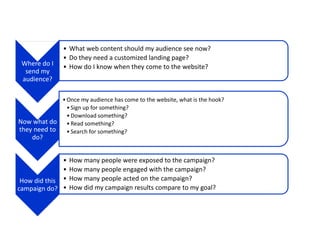
• What web content should my audience see now?
                • Do they need a customized landing page?
 Where do I     • How do I know when they come to the website?
  send my
 audience?

             • Once my audience has come to the website, what is the hook?
               • Sign up for something?
               • Download something?
Now what do • Read something?
they need to   • Search for something?
    do?


              •   How many people were exposed to the campaign?
              •   How many people engaged with the campaign?
 How did this •   How many people acted on the campaign?
campaign do? •    How did my campaign results compare to my goal?
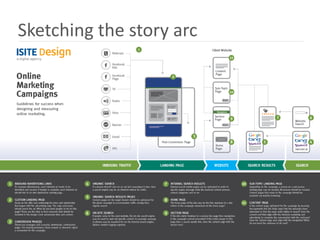
Sketching the story arc
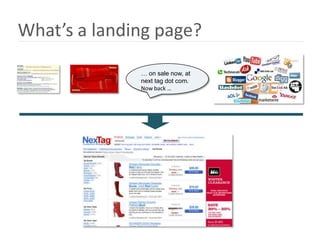
What’s a landing page?

              … on sale now, at
              next tag dot com.
              Now back …
Why landing pages matter

• First impressions
  count
• Relationship-
  building


                           Image from http://www.fastlife.com/
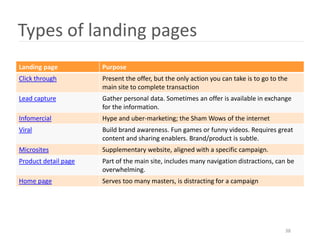
Types of landing pages
Landing page          Purpose
Click through         Present the offer, but the only action you can take is to go to the
                      main site to complete transaction
Lead capture          Gather personal data. Sometimes an offer is available in exchange
                      for the information.
Infomercial           Hype and uber-marketing; the Sham Wows of the internet
Viral                 Build brand awareness. Fun games or funny videos. Requires great
                      content and sharing enablers. Brand/product is subtle.
Microsites            Supplementary website, aligned with a specific campaign.
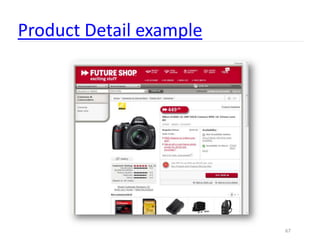
Product detail page   Part of the main site, includes many navigation distractions, can be
                      overwhelming.
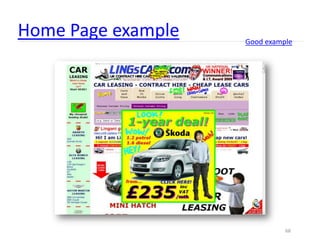
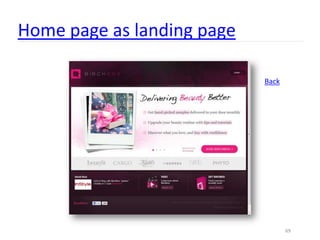
Home page             Serves too many masters, is distracting for a campaign


                                                                                        38
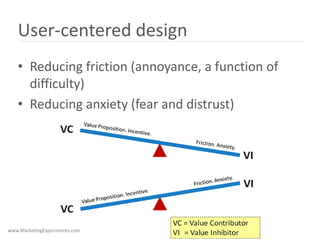
User-centered design
   • Reducing friction (annoyance, a function of
     difficulty)
   • Reducing anxiety (fear and distrust)


www.MarketingExperiments.com
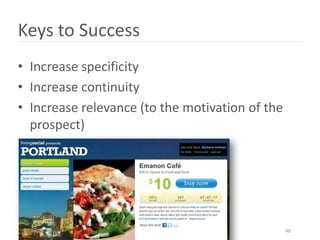
Keys to Success
• Increase specificity
• Increase continuity
• Increase relevance (to the motivation of the
  prospect)


                                                 40
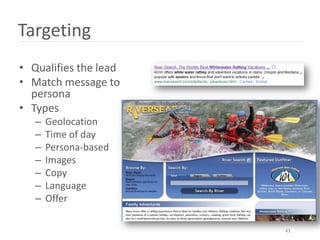
Targeting
• Qualifies the lead
• Match message to
  persona
• Types
   –   Geolocation
   –   Time of day
   –   Persona-based
   –   Images
   –   Copy
   –   Language
   –   Offer

                       41
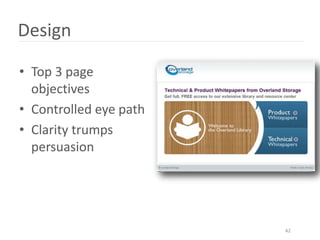
Design

• Top 3 page
  objectives
• Controlled eye path
• Clarity trumps
  persuasion


                        42
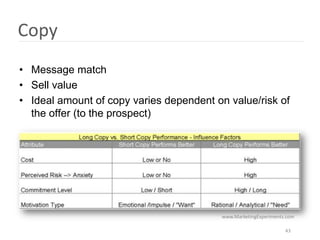
Copy
• Message match
• Sell value
• Ideal amount of copy varies dependent on value/risk of
  the offer (to the prospect)


                                         www.MarketingExperiments.com

                                                                 43
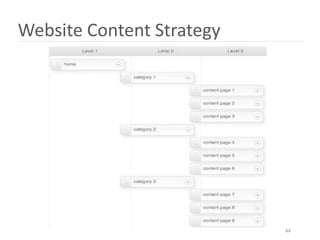
Website Content Strategy


                           44
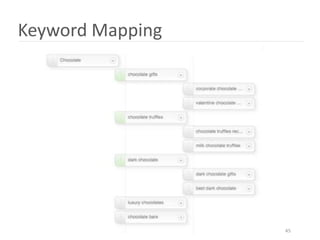
Keyword Mapping


                  45
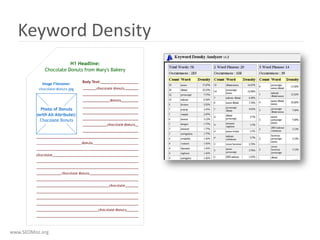
Keyword Density


www.SEOMoz.org
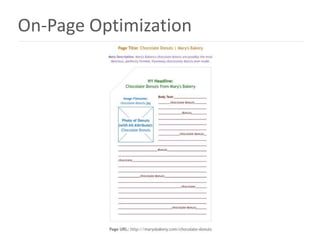
On-Page Optimization
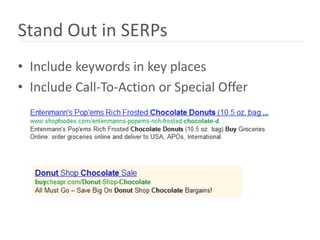
Stand Out in SERPs
• Include keywords in key places
• Include Call-To-Action or Special Offer
Landing Page Content Strategy
• Content must feature keywords
• Focus on 1-2 category terms & 10 keywords
  max per page
• Think about other content on the site that can
  be linked to the page
• Remember: You can’t rank for a keyword if
  you don’t have content to support it!
Activity: Design a campaign
                     http://www.flickr.com/photos/mikett/39962761/


                                                         50
How do you know it worked?

                             51
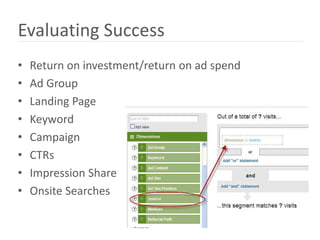
Evaluating Success
•   Return on investment/return on ad spend
•   Ad Group
•   Landing Page
•   Keyword
•   Campaign
•   CTRs
•   Impression Share
•   Onsite Searches
Align Key Performance Indicators
• Click Through
   – How many people see an ad compared to how many people click through to an ad.
• Conversion
   – How many people visit the landing page compared to how many people complete the
     action or goal of the page.
• Bounce Rate
   – How many people leave the page immediately after landing on it without going to any
     other pages in your site
• Revenue
   – The amount of money that has been brought in from a marketing campaign
• ROI
   – Revenue compared to how much was spend on the campaign
• Shares, Click-Backs, Newsletter Subscribers, New Visitors
   – Exposure that your brand received through a campaign


                                                                                     53
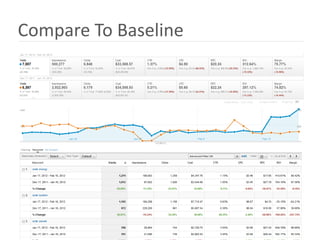
Compare To Baseline
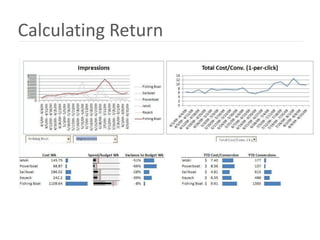
Calculating Return
Activity: Create measurement
                  http://www.flickr.com/photos/wausaublog/201256237/


                                                            56
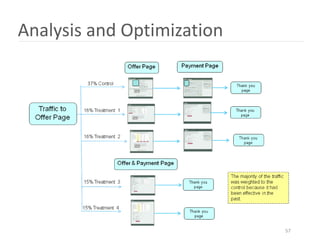
Analysis and Optimization


                            57
Summary
• Increase simplicity,
  continuity, relevance
• Clarity trumps persuasion
• Alignment is critical
   – Campaign goal to type of
     landing page
   – Message to audience
   – KPIs to goals
   – Design to campaign
• Test, evaluate, refine
                                Ihttp://www.geocities.com/palsaraptor/CTCronoColor.png
                                                                          58
fin


      Gigantor®, www.gigantor.org
                                    59
Amanda Bernard   abernard@isitedesign.com   @amandabernard
Barbara Holmes   bholmes@isitedesign.com    @volleyballbarb
Ryan Summers     rsummers@isitedesign.com


   Thank you

                                                       60
References
• Blink: The Power of Thinking Without Thinking, Malcolm
  Gladwell, 2005
• http://www.meclabs.com/marketing_experiments
• Unbounce Blog http://unbounce.com/blog/
• Internet Retailer http://www.internetretailer.com/
• The UX of Search http://www.slideshare.net/gaijinstu/the-
  ux-of-search-1898939
• SEO 2.0 The game has changed. Has your strategy?
  http://www.zaaz.com/pdf/seo.pdf
• Beyond Search. The Gilbane Group
  http://gilbane.com/beyond-search.html
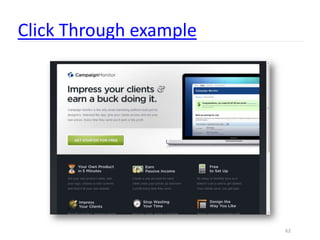
Click Through example


                        62
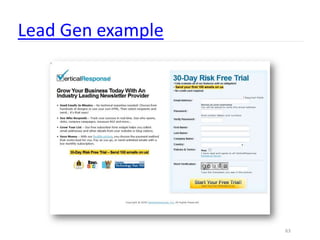
Lead Gen example


                   63
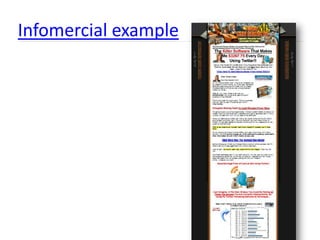
Infomercial example


                      64
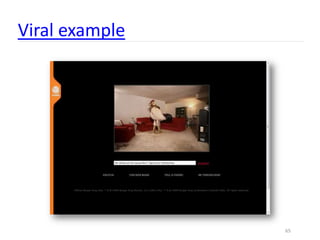
Viral example


                65
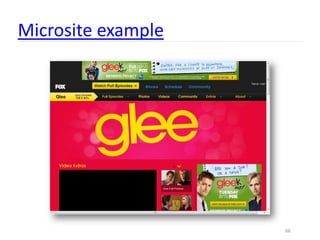
Microsite example


                    66
Product Detail example


                         67
Home Page example   Good example


                              68
Home page as landing page

                            Back


                                   69
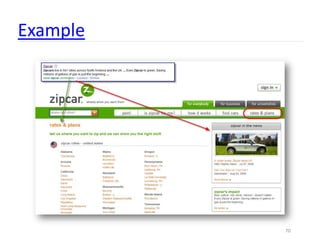
Example


          70
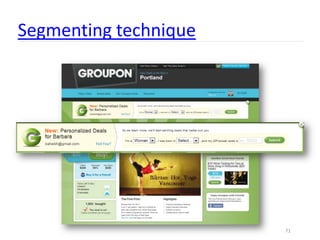
Segmenting technique


                       71

Ux of search workshop isite design_feb2012

  • 1.
    Search, Analytics, andUX Prepared for University of Oregon, School of Journalism February 2012 1
  • 2.
    Intro Hi! Goals 1. Identify user experience factors influencing the success of an SEO and/or SEM campaign 2. Identify keyword research tools and techniques 3. Identify metrics and analytics best practices 2
  • 3.
  • 4.
    How do you get started? Creating and maintaining a Agenda campaign • Designing for effectiveness • How do you know it works? Measuring what matters. 4
  • 6.
    How do youget started? 6
  • 7.
    How do youget started? CX Brand Analytics
  • 8.
    Who is thecustomer? Business Goals Keywords/ Audience Analytics Research
  • 9.
  • 10.
  • 11.
  • 12.
    CX – Keywords& Analytics
  • 13.
  • 14.
    Competitor Research Online Real World
  • 15.
    Competitor Research © DCComics http://keywordcompetitor.com/newDesignImages/features/OnlineKey wordResearch.png
  • 16.
    Gap Analysis andBrand Research http://blog.roymatheson.com/Portals/85919/images/grand-canyon1.jpg
  • 17.
  • 18.
    Keyword Research VS http://www.westchestermagazine.com/images/2011/BLOGS/June/E http://www.boozingear.com/media/catalog/product/Pabst-Pabst- DP/6-20/Blog_Generic-beer-can.jpg Blue-Ribbon-Beer-Diversion-Can-Safe.jpg
  • 19.
  • 20.
    Keyword Research • Useresearch tools to explore variations – Consider relevancy, search volume, and competition • Avoid the “black hole”. Stick to your categories. • Narrow down list to focus on the most relevant and goal oriented terms • Perform search queries to confirm search engine results are in-line with company’s content and/or offerings
  • 21.
    Keyword Research –Organic vs. Paid
  • 22.
    Organic vs. PaidPerformance
  • 23.
    Analytics Key Performance Indicators (KPIs) Campaign Keyword Goals Analysis
  • 24.
    Align Business Goals& Key Performance Indicators
  • 25.
    Current Analytics –Start High Level
  • 26.
    Current Analytics –Dig Into Details
  • 27.
    Current Analytics –Estimate ROI Current Target Annual Lift (Jan 2012) (Month) (12 mos) PPC traffic 12,000 12,000 144,000 Conversion rate* 3% 4% 4% Leads 365 480 1,380 Value per lead $700 $700 $700 Overall value $255,500 $336,000 $966,000
  • 28.
    Activity: Research andPlanning http://www.flickr.com/photos/daveog/129202092/ 28
  • 29.
  • 30.
    Designing for effectiveness • Digital Experience Framework • Planning the campaign • Sketching the story arc • Landing Pages • Design Principles • Stand out in SERPs • Activity
  • 31.
    Digital Experience Framework Lifecycle Customer Action Hear about Discover See an ad for See a commercial for Learn about Compare to Consider Ask a friend about Think about Read about Conclude Decide Make up my mind Form an opinion Register for/Apply/Enroll Buy Join Vote for Visit Use Share Enjoy Stay Renew Recommend
  • 32.
    • What arethe needs and goals of my department/company • What are the short term objectives? What are my Business • What are the on-going initiatives? Objectives? • What type of campaign do I need for this initiative? • Brand Awareness • Lead Generation A campaign is Born • Sales • Who am I targeting with this campaign? • What is the specific target market? Who can I reach? • What is the demographic?
  • 33.
    • What mediumswill best engage the target market? • The Internet (Banner Ads or Articles and Paid Search) • Radio What type of • Television • Billboards media? • Magazines (Ads or Articles) • Where do I place my Ads or Content that will get the best response? • Facebook Which specific • Affiliate Advertisers places? • Paid Search • What is the call-to-action? • What is the story I want to tell that will compel my audience to engage with the ad? What action?
  • 34.
    • What webcontent should my audience see now? • Do they need a customized landing page? Where do I • How do I know when they come to the website? send my audience? • Once my audience has come to the website, what is the hook? • Sign up for something? • Download something? Now what do • Read something? they need to • Search for something? do? • How many people were exposed to the campaign? • How many people engaged with the campaign? How did this • How many people acted on the campaign? campaign do? • How did my campaign results compare to my goal?
  • 35.
  • 36.
    What’s a landingpage? … on sale now, at next tag dot com. Now back …
  • 37.
    Why landing pagesmatter • First impressions count • Relationship- building Image from http://www.fastlife.com/
  • 38.
    Types of landingpages Landing page Purpose Click through Present the offer, but the only action you can take is to go to the main site to complete transaction Lead capture Gather personal data. Sometimes an offer is available in exchange for the information. Infomercial Hype and uber-marketing; the Sham Wows of the internet Viral Build brand awareness. Fun games or funny videos. Requires great content and sharing enablers. Brand/product is subtle. Microsites Supplementary website, aligned with a specific campaign. Product detail page Part of the main site, includes many navigation distractions, can be overwhelming. Home page Serves too many masters, is distracting for a campaign 38
  • 39.
    User-centered design • Reducing friction (annoyance, a function of difficulty) • Reducing anxiety (fear and distrust) www.MarketingExperiments.com
  • 40.
    Keys to Success •Increase specificity • Increase continuity • Increase relevance (to the motivation of the prospect) 40
  • 41.
    Targeting • Qualifies thelead • Match message to persona • Types – Geolocation – Time of day – Persona-based – Images – Copy – Language – Offer 41
  • 42.
    Design • Top 3page objectives • Controlled eye path • Clarity trumps persuasion 42
  • 43.
    Copy • Message match •Sell value • Ideal amount of copy varies dependent on value/risk of the offer (to the prospect) www.MarketingExperiments.com 43
  • 44.
  • 45.
  • 46.
  • 47.
  • 48.
    Stand Out inSERPs • Include keywords in key places • Include Call-To-Action or Special Offer
  • 49.
    Landing Page ContentStrategy • Content must feature keywords • Focus on 1-2 category terms & 10 keywords max per page • Think about other content on the site that can be linked to the page • Remember: You can’t rank for a keyword if you don’t have content to support it!
  • 50.
    Activity: Design acampaign http://www.flickr.com/photos/mikett/39962761/ 50
  • 51.
    How do youknow it worked? 51
  • 52.
    Evaluating Success • Return on investment/return on ad spend • Ad Group • Landing Page • Keyword • Campaign • CTRs • Impression Share • Onsite Searches
  • 53.
    Align Key PerformanceIndicators • Click Through – How many people see an ad compared to how many people click through to an ad. • Conversion – How many people visit the landing page compared to how many people complete the action or goal of the page. • Bounce Rate – How many people leave the page immediately after landing on it without going to any other pages in your site • Revenue – The amount of money that has been brought in from a marketing campaign • ROI – Revenue compared to how much was spend on the campaign • Shares, Click-Backs, Newsletter Subscribers, New Visitors – Exposure that your brand received through a campaign 53
  • 54.
  • 55.
  • 56.
    Activity: Create measurement http://www.flickr.com/photos/wausaublog/201256237/ 56
  • 57.
  • 58.
    Summary • Increase simplicity, continuity, relevance • Clarity trumps persuasion • Alignment is critical – Campaign goal to type of landing page – Message to audience – KPIs to goals – Design to campaign • Test, evaluate, refine Ihttp://www.geocities.com/palsaraptor/CTCronoColor.png 58
  • 59.
    fin Gigantor®, www.gigantor.org 59
  • 60.
    Amanda Bernard abernard@isitedesign.com @amandabernard Barbara Holmes bholmes@isitedesign.com @volleyballbarb Ryan Summers rsummers@isitedesign.com Thank you 60
  • 61.
    References • Blink: ThePower of Thinking Without Thinking, Malcolm Gladwell, 2005 • http://www.meclabs.com/marketing_experiments • Unbounce Blog http://unbounce.com/blog/ • Internet Retailer http://www.internetretailer.com/ • The UX of Search http://www.slideshare.net/gaijinstu/the- ux-of-search-1898939 • SEO 2.0 The game has changed. Has your strategy? http://www.zaaz.com/pdf/seo.pdf • Beyond Search. The Gilbane Group http://gilbane.com/beyond-search.html
  • 62.
  • 63.
  • 64.
  • 65.
  • 66.
  • 67.
  • 68.
    Home Page example Good example 68
  • 69.
    Home page aslanding page Back 69
  • 70.
  • 71.

Editor's Notes

  • #7 Amanda transitions to Barbara
  • #8 Customer experience perspectiveBrand and competitionMeasurement baselineIdeally, you need to understand as much as practical about all three in order to narrow your focus to the intersection. This sweet spot where you’ve achieved a ‘perfect balance’ between business, customer, and measurement needs. All three broad disciplines work together.
  • #9 Customer experience perspectiveBrand and competitionMeasurement baselineIdeally, you need to understand as much as practical about all three in order to narrow your focus to the intersection. This sweet spot where you’ve achieved a ‘perfect balance’ between business, customer, and measurement needs. All three broad disciplines work together.
  • #10 From a business perspective, the customer experience is all about gaining a deep understanding of what the business is trying to accomplish. As a consultant or even as an in-house practitioner, understanding the natural business cycle of the sponsoring company is essential. You need to know what the business goals are on a broad level, and what the specific goals are for the particular campaign you’re working on. Why this campaign? What is the duration? What are the specific business goals? Is this a seasonal business? Is there some time-based driver for results? Also, you need to understand any and all data that your client already has. What do the current logs say? Are there patterns of engagement that can be deduced from the data? Define ClientName’s business objectives, strengths and weaknesses of the current site, competition and references Primary and secondary business objectivesDefine high-level success metrics Review and prioritize key target marketsReview competition DifferentiatorsSuccesses? Shortcomings?User Segmentationkey tasks and goals Content functionality application integrationmarketing and lead generation process success metrics business goals technical infrastructure web analytics
  • #11 Who is your target audience?IntentEmotional, psycho-socialLet’s not forget the customer in the customer experience. The more you know about your client’s customer the better able you’ll be to design solutions that achieve business success. So, what do you need to learn?Demographics and psychographics. Who is your customer. Traditional market research techniques are useful to know about the general groups of users. Age, gender, income, what kind of phone they use, technology buying patterns, and so on. Market research tends to miss the psychographic and social nuances of people. Things like intent. What are people looking for when they conduct a search? What is their frame of mind? Are they anxious? Worried? Happy? Excited? What do the target customers feel about the process they are going through? Is it easy to plan a trip? Easy to book a flight? What works and doesn’t work as it relates to the tools that people are using to live their life? Does one website work better than another; what does “work better” mean to this audience? For a caPersonasUser goalsIntentContextMultichannel accessUser Segmentationkey tasks and goals Content Pain PointsUsabilityDesigning DelightEmotionsPsycho-socialFeelingsHeartMental model
  • #12 Barbara toss to Ryan Search segments / AudienceAudiences can be demographicalAudiences can be geographicAudience can be on-site behavior groupsMatch keyword groups to audiences
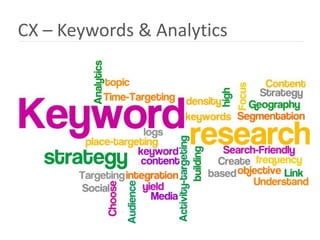
  • #13 http://www.promisemedia.com/organic-marketing/seo-keyword-research-pays-off-with-audienceEffective online media creates content based in part on SEO-based keyword research. The popularity of a keyword phrase has an important impact on a document’s ranking in search engine result pages. Otherwise, the article won’t be easily found — or not found at all.Use the Google keyword tool: https://adwords.google.com/select/KeywordToolExternalTry the SEO Book Keyword Suggestion Tool: http://tools.seobook.com/keyword-tools/seobook/Another good one is the SEOmoz Keyword Difficulty Tool: http://www.seomoz.org/keyword-difficultyHttp://www.volacci.com/blog/ben-finklea/2009/may/04/online-audience-research-advanced-seoWords used to create the wordleAudience researchkeyword researchSegmentationTargetingChoose a topicFocus on high yield keywordsCreate content based on researchKeyword logsKeyword frequencyKeyword densityTime-TargetingGeography or place-targetingActivity-targetingAnalyticsContent strategySearch-FriendlyKeyword StrategyUnderstand your objectiveSocial Media integrationLink building strategyhttp://www.searchenginejournal.com/%E2%80%A6because-most-seos-don%E2%80%99t-know-what-strategy-means/39334/What is SEO strategy?Your strategy is the basic, high-level way you are going to accomplish something. If you were an army and your objective was to conquer Iraq, then your strategy might be to cut communication, bomb critical cities and capture the capital.Those are your strategies.
  • #14 Ryan transition to Amanda
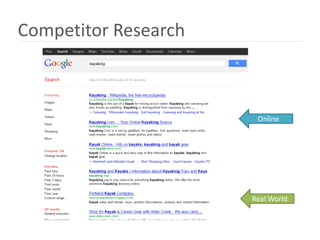
  • #15 Consider the difference between online and real-world competitors. Clients will typically think of offline competitors but it’s important to examine both real world and online competition for SEM campaigns/projects.
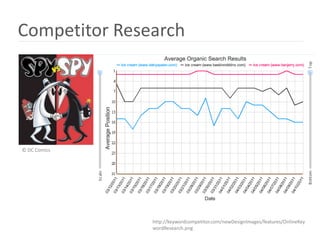
  • #16 Research top 3-5 real-world competitors and identify other online competitorsUse tools to spy on competitors (SEMRush, SEOMoz tools, look at organic keywords, traffic estimates, PPC keywords and ads, page titles and meta descriptions)Visit competitors sites and social profiles to spot content and keyword trends; On site look at meta data and use tools to scan site
  • #18 **Should this be part of the ‘Designing’ section? The first activity could lead up to the keyword research in the next activity. Needs a handout and a link to each of the tools**
  • #19 Brand keywords are the “low hanging fruit”. Non-branded keywords are the prizeHave to determine a keyword category to start with or keywords for specific page(s)Brainstorm with client, brainstorm internally, research competitors, review client’s on-site and organic search analytics data, review PPC keyword and landing page data (if available),
  • #20 Think about the words your target audience would use to research or purchase your client’s services/products online. Step inside their shoes and use social listening tools to help you. Also can use on-site and organic search terms found in analytics to determine words and phrases used by your audience.Watch out for industry terms! The words your client uses may not be the same words your client’s customers use!
  • #21 Then use keyword research tools to explore keyword variations (focusing on category or page), examine keyword search volume and competition. For example- Google Trends, Google Insights for Search, and Google Adwords Keyword Tool. **Add these to a handout**Narrow down kw list to focus on the most relevant and ROI-driven (goal oriented) keywords. Perform search queries for most keywords to ensure search engine relevancy is in-line with the company’s content/offeringsReview list with client (be prepared to defend or discard kws!); Refine together, then establish baseline to measure campaign KPIs
  • #22 Basically the same approachKeywords selected may be different due to competition and cost-per-click estimatesUse Paid Search to test keywords for organic
  • #23 Basically the same approachKeywords selected may be different due to competition and cost-per-click estimatesUse Paid Search to test keywords for organic
  • #24 Amanda transition to Ryan
  • #25 Should you focus on SEO, PPC, or a combination of both?
  • #26 Start high-levelUse data to set baseline and measure SEO target KW Visits, keyword, bounce rate, keyword conversion rate, refer to your existing analyticsSearch segments: All SEO, mobile, all PPC, keyworkds, branded/non-branded, Eng (?), with/without conv., bounce rate +/-Keyword research tools
  • #27 Get granularUse data to set baseline and measure SEO target KW Visits, keyword, bounce rate, keyword conversion rate, refer to your existing analyticsSearch segments: All SEO, mobile, all PPC, keyworkds, branded/non-branded, Eng (?), with/without conv., bounce rate +/-Keyword research toolsActual data for your site (domestic)Keyword reportTraffic volume/conversion/bounce
  • #28 Estimate ROI and conversion increase do determine what you can expect from increasing search volume vs. search conversion rate.
  • #29 Ryan transition to BarbaraIn this activity we want you to gather and be able to describe what you currently know about the business and customers and goals for the campaign.Personas/Audience: who are you trying to reach? Where are these people already? What is their emotional state, psycho-social graphics, demographics? To do: Organize the class into 4 or 5 groups. Each group can/should do a discovery.Each group can ask us questions about our business and what we’re trying to accomplish. 5 minutes. We provide handouts related to company profile, current keyword research (can be partially complete) and we spend 20. minutes in the activity of learning as much as possible about the company. ISITErs can use a flip chart to record global answers to questions so that all may refer to them. 10 minutes spent doing keyword or competitive trend research. Use Google Trends, Google Insights for Search, and Google Adwords Keyword Tool. Look up: -- list of keywords -- keyword competitiveness and search volume. Decide on 10 keywords to focus on -- Identifying opportunities for keywords based on news and current events/hot topics -- Popularity of keywords over time; can vett choice of keyword phrases5 minute presentation of the persona(s) that have been created by one group. Ask other groups to chime in with other information or nuances that need/should be included.
  • #30 BarbaraNow that you know a bit about the target customer and what your client is trying to accomplish, let’s go through the steps of designing a campaign. We’ll be covering the key items that contribute to an effective campaign.
  • #31 Building the story arc – Content StrategyDesigning the progressive story – Landing Pages
  • #32 Building the story arc – Content StrategyDesigning the progressive story – Landing PagesWork with the client to determine which point(s) in the lifecycle is the most important. Use this to drive your strategy.
  • #33 Ryan
  • #34 The answers to these questions inform whether SEO or PPC or a combo is the best approach.
  • #35 This is a good lead up to the activity and the other activities too. May need to move this slide to the end of the Designing section
  • #36 BarbaraBuild the conversation; build the relationshipOne of the easiest ways to get a handle on a particular campaign is to draw a sketch of how all the pieces will fit together. Sketching enables you to map out the customer flow through your experience and ensures that you account for all the nuances that could occur in a particular campaign. For example, a PPC ad may lead to a specific page in your site or to a microsite. While organic search results might drive customers to a different page in the site. It is important to account for all the digital and analog touchpoints where a prospect might engage with your brand and/or message so that you’re providing a cohesive user experience.
  • #37 Landing pages are what a user sees online as a result of clicking or typing a URL into a web browser. Triggered primarily by advertising, paid keyword searches, organic searches, radio/broadcast advertising and promotions.www.hubspot.com/outbound-vs-inbound-marketing
  • #38 Once people click on an ad, they enter a relationship with a business. Ideally that relationship will culminate in a sale or relationship of some sort. The quality of the conversation that occurs between the user and the company dramatically impacts the conversion. Landing pages matter because they represent a high-impact engagement a user has with a company, it’s brand, it’s promise, it’s products. If the first click doesn’t result in a message match and a trust building experience, the brand is damaged. Users leave the site, the sale is lost.Landing pages are the foundation of the active conversation we begin to have with users.Landing pages continue the conversion funnel, and represent a huge opportunity to us and to our clients. 97% of traffic (on average) abandons a website.
  • #39 http://unbounce.com/landing-page-design/7-types-of-landing-page/#more-1469
  • #40 From Flint McGlaughlin, Marketing Experiments www.MarketingExperiments.comOptimization is all about the techniques and strategies that minimize the obstacles for the user and maximize the security and trust. Landing page optimization is about relationship building and brand promise. The takeway here is that the lowest amount of friction yields the greatest click through.Friction is a function of difficulty; annoyance. Resistance inside the mind of the site visitor. Reduce it and counterbalance it with incentives.Anxiety isn’t internal resistance; it’s a fear. Anticipate and address the fear. Long process, distrust, etc. Address with credibility and trust; quantitative data points. Cannot brag, but get a third party to make the trust statement about you. People buy from people, not from websites.Optimization takes place in the mindPeople don’t buy from a website, they buy from a personThe website/landing page does the work of a person; building a relationship of trust and credibility
  • #41 Barb-Need image Communicate the value proposition: who are you, what can I do here, why should I care or give you my business?
  • #43 Barb-Controlled eye path2-kinds of marketers—Data marketers - want to see the mathCommunication marketers – want to see the graphics and write the copy. Clarity trumps persuasion. Speak clearly above all else. Study metrics and focus on clarifying the parts that are confusing.
  • #45 Barbara hand over to AmandaUse your keywords to inform your content strategy. This is where you focus on your main keyword categories and start mapping keywords to the content pages. This exercise can reveal content and keyword opportunities that may have been overlooked during the initial keyword research and gap analysis.
  • #46 Simple example of a keyword map
  • #47 www.SEOMoz.org
  • #48 Optimize your page title, URL, metadata, and then you’ll have a “perfectly” optimized page
  • #49 Include keywords in key places = Title/Headline, Ad Description/Meta Description, Page URL/display URLInclude a call-to-action, special offer, or key differentiator
  • #50 Barbara transition to AmandaFocus on no more than 4 head terms, 10 keywords per pageYour site cannot rank in search or ads for a keyword if the landing page does not have content to support itThink about other on-site content that can be linked to the page
  • #51 BarbaraBreak out activity.Regroup with you teams and now we’re going to come up with a campaign and a landing page design.Refer back to your notes and your keywords and your customer research. Using sketch pad/markers, devise a PPC ad and a companion landing page. 15 minutesEach group will come up and present their campaign ideas to the rest of the group. 10 minutes
  • #52 Barbara transition to Ryan
  • #53 Ryan and AmandaLook at your analytics reports -> Click throughs, visitsReview keyword search reports and onsite search reports. Onsite search reports can highlight the needs of customers and identify gaps in website content
  • #56 Surface results over time in search specific dashboards. Find out what keywords, groups and segments have the best performanceFind out what keyword groups and segments have the worst performanceMake changes based on your data that will help increase the ROAS
  • #57 BarbaraFinal activityRegroup and block out the measurement strategy that your campaign will use. Identify the KPIs and the expected lift or change from the baseline that you’d expect to see. Pick out the KPIs from a master list or set of sticky notes.Split teams into two groups: SEO and PPC focusedIdentify how long you’d run the ad or run the measurements to see if the optimization is achieving the desired lift; test the ad, before evaluating if any other changes were needed. 10 minutesEach group will present their plan to the rest 10 minutes
  • #58 Barbara transition to RyanLanding page optimization cannot happen with out measurement. Analytics are critical. It’s the only way to know if what you’re doing works.
  • #59 Ryan Clarity trumps persuasion. For a quality offer, you should focus more on lucid expression than on persuasive copy.Emphasize the benefits. An offer/response interaction comprises a cost incurred in exchange for a benefit. When expressing your offer, you should be transparent about both, but emphasize the benefit in headlines, sub-heads and calls-to-action (e.g., links, button text, etc.)Minimize Friction through simplification of page and order path designs. Adjust the number of steps, and the nature and complexity of requested inputs to control Friction.Overcome Anxiety in the conversion path by addressing and over-correcting for sources of concern, such as removal of any “payment-related” terms along the conversion path of a free trial offer.Optimus prime
  • #60 Gigantor® www.gigantor.org