PLATO IN WEIMAR.
PLATO’S IDEAL STATE AND THE WEIMAR
REPUBLIC (1919-1933): THE
IMPOSSIBILITY OF CREATING THE
PERFECT STATE.
UBALDO VILLANI-LUBELLI
(FACULTY OF LAW, UNIVERSITY OF
SALENTO)
#ISNS2015 Buenos Aires Conference
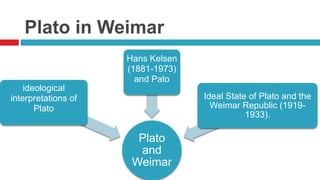
Plato in Weimar
Plato
and
Weimar
ideological
interpretations of
Plato
Hans Kelsen
(1881-1973)
and Pato
Ideal State of Plato and the
Weimar Republic (1919-
1933).
Plato in Weimar
Ulrich von
Wilamowitz-
Möllendorf
Werner
Jaeger
(Third Humanism)
Julius
Stenzel
In the political cultural trasformation which took place in the period from the last
years of the
19th Centrury to the beginning of the 20° Century, there was in Germany a revival
of Plato’s
Political thought mainly thanks to
Plato in Weimar
The affinity between Greeks and Germans may seem
obvious given the primacy in Europe of German
classical philology between the 19th and 20th Century,
but it was based not so much on this primacy as on the
basis of “a spiritual affinity determined by fate, still
alive and working within us” as Werner Jaeger says
in his famous book Paideia.
Platon in Weimar
Nur in ihr gibt es eine Gemeinschaft gewachsener sozialer und
geistiger Formen und Ideale, gleichgültig in welcher
tausendfältigen Brechung und Abwandlung sie sich auf dem
Boden der verschiedenen Rassen und Stämme dieser
Völkerfamilie variieren, kreuzen und verdrängen, absterben und
sich wieder erneuern. In solcher Gemeinschaft steht sowohl das
Abeldland in seiner Gesamtheit als auch jedes seiner führenden
Kulturvölker für sich und auf seine besondere Weise zur Antike.
Fassen wir Geschichte in diesem tieferen Sinne der
Wurzelverbundenheit auf, so kann sie nicht den ganzen
Planeten als Schauplatz umfassen, und kein Ausdehnung unseres
geographischen Horizonts kann jemals die Grenzen “unserer”
Geschichte nach der Vergangenheit hin weiter ziehen, als unser
historisches Schicksal sie seit Jahrtausenden gesteckt hat. Ob
Plato in Weimar
Aber im hellen Lichte des bewußten Schaffens,
zu dem die deutsche Rasse jetzt sich regte,
wurde die Antike zum zwieten Male, und nun in
einem viel höheren und geistigeren Sinn,
Führerin und Anregerin der werdenden
Volkskultur (W. Jaeger, conference
Humanismus als Tradition und Erlebnis, 1919)
Plato in Weimar
The affinity between the classical Greeks and the Germans allows
Jaeger to marginalize both the Latin tradition (and its references to
Rome) and the Slavic one (with its Byzantine tradition).
Here we should remember that the First World War had also revived the
problem of the school system in Germany ("humanistic
gymnasium”). The discipline under fire was Latin.
Edward Schwartz interpreted it as a French influence, as a legacy of
the Enlightenment and the Revolution, unlike the Greek line which
represented German idealism and liberation from the Enlightenment
tradition. Das Griechentum was the foundation of the cultural and
ideological counterattack against egalitarian democracy (Weimar
democracy).
Plato in Weimar
Edward Schwartz, Gymnasium und
Weltkultur:
Nun werden wir es nach wie vor als einen
Vorzug des deutschen Verhänisses zur
Antike ansehen, daß uns Homer gilt als
Vergil, oder Plato mehr als Cicero und
Seneca; es kann sogar für unsere
Rechtsentwicklung von Bedeutung
werden, daß die mächtig
fortschreitende, zukunftsreiche
Wissenschaft vom griechischen Recht
das Monopol der spezifisch
römischen Konstruktionen zerbricht,
und es würde unzweifelhaft den innersten
Plato in Weimar
Wilamowitz-Möllendorf and the Prussian
nationalism
and the authority of the Kaiser.
In his famous book Platon in 1919, and in the second
edition in 1920, Wilamowitz, faced with the defeat of
the First World War and with the defeat of the values in
which he believed (Prussian nationalism,
warmongering, the German empire), declared that he
wanted to “fight under Plato’s banner to his last
Plato in Weimar
“Platon Staat hat eine einheitliche
Bevölkerung, alle Bürger sind frei
und sind Brüder … Platon ist
daher nicht von einer rationellen
Züchtung der Menschen
zurückgeschreckt, hat also
Bestrebungen gehuldigt, die in der
letzen Friedenszeiten namentlich in
England unter dem Namen
Eugenik viel besprochen wurden.”
(Wilamowitz-Möllendorf)
Der griechische und der platonische
Staatsgedanke (1919)
Plato in Weimar
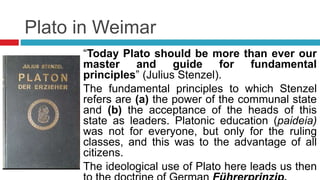
“Today Plato should be more than ever our
master and guide for fundamental
principles” (Julius Stenzel).
The fundamental principles to which Stenzel
refers are (a) the power of the communal state
and (b) the acceptance of the heads of this
state as leaders. Platonic education (paideia)
was not for everyone, but only for the ruling
classes, and this was to the advantage of all
citizens.
The ideological use of Plato here leads us then
Plato in Weimar
Die griechische Staatsethik im Zeitalter des Platon was a manifesto of
this theme. It was given in 1924, but published, not by chance, in 1934,
when the Nazi regime was already established.
Jaeger’s interpretation differed from Wilamowitz’s in two ways: first, it was
closer to Hegel in that it insisted on the organic nature of the state and its
supremacy (as Lebensgemeinschaft) over the individual; second, it
seemed very up to date compared to Wilamowitz’s nostalgia for the Imperial
era and Prussian society.
In his discourse Jaeger insisted on the idea of the Greek state ethic
elevated by Plato as the ideal: (a) the supremacy of the state over the
individual, (b) the need for moral health and communal symmetry
Plato in Weimar
In a 1928 article, Die Platonische Philosophie als Paideia, Jaeger
wrote that the sophists “founded their teachings on a theory of the
State and of society which used the ideology of dominant
democracy to support sceptical and individualistic society”.
In a later article in 1932, Staat und Kultur, Jaeger was to clarify the
threat that democratic individualism represented to society and to the
German state. The enemy to defeat is still the bad divisive
individualism spread by the Sophists who at that Weimar democracy
time were democrats and political parties.
Plato in Weimar
For this reason, Jaeger believed it necessary to go
back to the Greek (and Platonic) inheritance that would
mean continuity from the Greeks to the Germans.
“There is a fundamental Greek concept of life in which
we feel related to them in nature and in race:
heroism” (Jaeger).
In his introduction to his book Paideia Jaeger writes
that “the essence of being Greek does not only
represent for us a historical mirror of the
civilization of the modern world but a symbol of
Hans Kelsen’s Plato between
philosophy and law
Alongside this ideological and instrumental use of Plato that make up the
cultural fabric in which Nazism lies, there are other authors like for example
Hans Kelsen (1881-1973), an Austrian philosopher and jurist, who had
considerable influence in Weimar Germany, who read Plato in a different,
certainly more neutral, way.
Kelsen understood the Weimar crisis perfectly. He worked a lot on the sources
of Western thought.
He was a politically aware philosopher and jurist, he saw in the crisis of the law
the crisis in civilization itself. Kelsen’s task then, regards the foundation of his
own science, the law. In the face of the fogging of early twentieth century
certainties under nihilistic metaphysical criticism and of the crisis in
epistemological foundations of the law, Kelsen looked to the masters of
Western thought, and especially to Plato. Whichever way you want to read
Kelsen’s constant and complex dialogue with Plato you cannot ignore the role it
Hans Kelsen’s Plato between
philosophy and law
Plato, The Seventh Letter
[334c] All this has been said by way of counsel to Dion's
friends and relatives. And one piece of counsel I add, as I
repeat now for the third time to you in the third place the
same counsel as before, and the same doctrine.
Neither Sicily, nor yet any other State - such is my
doctrine - should be enslaved to human despots
but rather to laws; …
[337c] And when the laws have been laid down, then
everything depends on the following
condition. On the one hand, if the victors prove
themselves subservient to the laws more than [337d] the
vanquished, then all things will abound in safety and
happiness, and all evils will be avoided; but should it
prove otherwise, neither I nor anyone else should be
called in to take part in helping the man who refuses to
For Kelsen (1881-1973), in
fact, the Grundnorm, by
definition, does not derive
from other laws. It is a
paradigm in the sense that it
can indicate a particular
written constitution and so
makes its interpretation the
responsibility of the jurist but
also gives the responsibility
for decision-making to
politicians. It’s possible to
identify the sovereignty
Hans Kelsen - Plato – Leo
Strauss
According to Kelsen the guiding
light of Plato’s philosophy is the
idea of Good, anyway, the ethical
question is none other than the
extreme development of the
epistemological question: the idea
of the Good allows the whole world
to be brought into the domain of the
logos. On the other hand such a
domain cannot be purely a
conceptualization of the world. It
must push us to act, to human
praxis. The domain of the logos
manifests itself mainly in the
political solution to conflict between
Leo Strauss, What is Political
Philosophy?
Every political action aims at either
preservation or change: When desiring
to preserve, we wish to prevent a change
for the worse; when desiring to change,
we wish to bring about something better.
All political action is then guided by
some thought of better and worse. But
thought of better or worse implies
thought of the good … All political action
has then in itself a directness towards
knowledge of the good: of the good life, or
Hans Kelsen and Plato:
The Seventh Letter
Kelsen emphasises that it is not so much Plato’s work as
his life which shows us his political passion:
“Heute weiß man, daß Platon seiner ganzen Natur nach mehr
Politiker als Theoretiker war … Wenn es ein Dokument gibt,
aus dem man die eigentlichsten Absichten Platons erfahren
kann, so ist es seine Selbstbiographie, der sog. VII. Brief … Es
ist nicht nur das Werk Platons, das uns seine politische
Leidenschaft zeigt, es ist ebenso auch sein Leben.” (H.
Kelsen, Die Illusion der Gerechtigkeit. Eine kritische
Untersuchung der Sozialphilosophie Platons)
Hans Kelsen and Plato:
The Seventh Letter
“Platon ist kein unvoreingenommener
Richter über seinen Liebling, der ihn,
den Weltfremden, trotz aller Sehnsucht
nach Macht und Herrschaft der realen
Macht und Herrschaft gegenüber
hilflosen und naiven Philosophen, in
ein Abenteuer verstrickt hat, das wie
eine tragische Donquichotterie
anmutet. In seinen Dion ist Platon sein
Eros auch zum äußeren Schicksal
geworden.”
H. Kelsen, Die Illusion der
Gerechtigkeit. Eine kritische
Untersuchung der Sozialphilosophie
Platons
In his interpretation of the Seventh
Letter Hans Kelsen (1881-1973) says
that Plato was certainly not an impartial
judge of the actions of his loved one
(Dion). Despite his inexperience in
worldly things – and anyway afflicted by
a profound desire for power, a slave to
real power and in his turn wielder of
power as regarded naïve and helpless
philosophers – he found himself
involved by Dion in an adventure
whose details seem tragically quixotic.
It was in Dion himself that he could see
his Eros made external fate.
Ideal State of Plato and
the Weimar Republic.
Comparing Plato’s ideal state and the Weimar republic is not a
chance interpretation. Both historical experiences were failed attempts
to realize the perfect State. If Plato’s political thought can be found in
other works, the Seventh Letter tells us about Plato’s experience in
Siracusa where he hoped to see his political plan realized.
The Sicilian city became an extraordinary political constitutional
workshop where Plato tried to create the “ideal” state founded on justice
and ruled by a philosopher-king.
In the same way, despite all the obvious historical differences, at
Weimar, through a process just as rational and abstract, a constitutional
workshop was realized aimed at creating the perfect democracy in
which it was intended that all political groups would be represented.
Ideal State of Plato and
the Weimar Republic
The historical context that characterizes Plato’s State and the Weimar republic is
similar: faced with the impossibility of a nomos, with the disappearance of
certainties, with the erosion of epistemological foundations of the Law there was an
attempt to build a political ideal founded on justice. It is not by chance that an
author like Hans Kelsen looked to Plato because it was in him that metaphysical
thought along with its problematic was founded.
But Weimar is also a constitutional workshop which seems built for the very
purpose of showing the limits of a “perfect” democratic system : founded on a
constitution which is the result of an operation of artificial juridic engineering it is
rationalist and dreams of being able to politically represent all political persuasions.
In this way it prevents the establishment of any theologia civilis, and does not allow
it any specific identity or spiritual foundation capable of welding the new republic
onto the preceding Imperial tradition. This condemns Weimar to listening to parties
against the democratic system of the time, like the young national-socialist party
(and the German communist party), who “use” democracy rejecting its inevitable
constitutional teleology.
THANK YOU VERY MUCH
FOR YOUR ATTENTION!
TWITTER@UVILLANILUBELLI
(FACULTY OF LAW, UNIVERSITY OF
SALENTO)
#ISNS2015 Buenos Aires Conference

Plato in Weimar. Plato's Ideal State and the Weimar Republic: The impossibility of Creating The Perfect State

  • 1.
    PLATO IN WEIMAR. PLATO’SIDEAL STATE AND THE WEIMAR REPUBLIC (1919-1933): THE IMPOSSIBILITY OF CREATING THE PERFECT STATE. UBALDO VILLANI-LUBELLI (FACULTY OF LAW, UNIVERSITY OF SALENTO) #ISNS2015 Buenos Aires Conference
  • 2.
    Plato in Weimar Plato and Weimar ideological interpretationsof Plato Hans Kelsen (1881-1973) and Pato Ideal State of Plato and the Weimar Republic (1919- 1933).
  • 3.
    Plato in Weimar Ulrichvon Wilamowitz- Möllendorf Werner Jaeger (Third Humanism) Julius Stenzel In the political cultural trasformation which took place in the period from the last years of the 19th Centrury to the beginning of the 20° Century, there was in Germany a revival of Plato’s Political thought mainly thanks to
  • 4.
    Plato in Weimar Theaffinity between Greeks and Germans may seem obvious given the primacy in Europe of German classical philology between the 19th and 20th Century, but it was based not so much on this primacy as on the basis of “a spiritual affinity determined by fate, still alive and working within us” as Werner Jaeger says in his famous book Paideia.
  • 5.
    Platon in Weimar Nurin ihr gibt es eine Gemeinschaft gewachsener sozialer und geistiger Formen und Ideale, gleichgültig in welcher tausendfältigen Brechung und Abwandlung sie sich auf dem Boden der verschiedenen Rassen und Stämme dieser Völkerfamilie variieren, kreuzen und verdrängen, absterben und sich wieder erneuern. In solcher Gemeinschaft steht sowohl das Abeldland in seiner Gesamtheit als auch jedes seiner führenden Kulturvölker für sich und auf seine besondere Weise zur Antike. Fassen wir Geschichte in diesem tieferen Sinne der Wurzelverbundenheit auf, so kann sie nicht den ganzen Planeten als Schauplatz umfassen, und kein Ausdehnung unseres geographischen Horizonts kann jemals die Grenzen “unserer” Geschichte nach der Vergangenheit hin weiter ziehen, als unser historisches Schicksal sie seit Jahrtausenden gesteckt hat. Ob
  • 6.
    Plato in Weimar Aberim hellen Lichte des bewußten Schaffens, zu dem die deutsche Rasse jetzt sich regte, wurde die Antike zum zwieten Male, und nun in einem viel höheren und geistigeren Sinn, Führerin und Anregerin der werdenden Volkskultur (W. Jaeger, conference Humanismus als Tradition und Erlebnis, 1919)
  • 7.
    Plato in Weimar Theaffinity between the classical Greeks and the Germans allows Jaeger to marginalize both the Latin tradition (and its references to Rome) and the Slavic one (with its Byzantine tradition). Here we should remember that the First World War had also revived the problem of the school system in Germany ("humanistic gymnasium”). The discipline under fire was Latin. Edward Schwartz interpreted it as a French influence, as a legacy of the Enlightenment and the Revolution, unlike the Greek line which represented German idealism and liberation from the Enlightenment tradition. Das Griechentum was the foundation of the cultural and ideological counterattack against egalitarian democracy (Weimar democracy).
  • 8.
    Plato in Weimar EdwardSchwartz, Gymnasium und Weltkultur: Nun werden wir es nach wie vor als einen Vorzug des deutschen Verhänisses zur Antike ansehen, daß uns Homer gilt als Vergil, oder Plato mehr als Cicero und Seneca; es kann sogar für unsere Rechtsentwicklung von Bedeutung werden, daß die mächtig fortschreitende, zukunftsreiche Wissenschaft vom griechischen Recht das Monopol der spezifisch römischen Konstruktionen zerbricht, und es würde unzweifelhaft den innersten
  • 9.
    Plato in Weimar Wilamowitz-Möllendorfand the Prussian nationalism and the authority of the Kaiser. In his famous book Platon in 1919, and in the second edition in 1920, Wilamowitz, faced with the defeat of the First World War and with the defeat of the values in which he believed (Prussian nationalism, warmongering, the German empire), declared that he wanted to “fight under Plato’s banner to his last
  • 10.
    Plato in Weimar “PlatonStaat hat eine einheitliche Bevölkerung, alle Bürger sind frei und sind Brüder … Platon ist daher nicht von einer rationellen Züchtung der Menschen zurückgeschreckt, hat also Bestrebungen gehuldigt, die in der letzen Friedenszeiten namentlich in England unter dem Namen Eugenik viel besprochen wurden.” (Wilamowitz-Möllendorf) Der griechische und der platonische Staatsgedanke (1919)
  • 11.
    Plato in Weimar “TodayPlato should be more than ever our master and guide for fundamental principles” (Julius Stenzel). The fundamental principles to which Stenzel refers are (a) the power of the communal state and (b) the acceptance of the heads of this state as leaders. Platonic education (paideia) was not for everyone, but only for the ruling classes, and this was to the advantage of all citizens. The ideological use of Plato here leads us then
  • 12.
    Plato in Weimar Diegriechische Staatsethik im Zeitalter des Platon was a manifesto of this theme. It was given in 1924, but published, not by chance, in 1934, when the Nazi regime was already established. Jaeger’s interpretation differed from Wilamowitz’s in two ways: first, it was closer to Hegel in that it insisted on the organic nature of the state and its supremacy (as Lebensgemeinschaft) over the individual; second, it seemed very up to date compared to Wilamowitz’s nostalgia for the Imperial era and Prussian society. In his discourse Jaeger insisted on the idea of the Greek state ethic elevated by Plato as the ideal: (a) the supremacy of the state over the individual, (b) the need for moral health and communal symmetry
  • 13.
    Plato in Weimar Ina 1928 article, Die Platonische Philosophie als Paideia, Jaeger wrote that the sophists “founded their teachings on a theory of the State and of society which used the ideology of dominant democracy to support sceptical and individualistic society”. In a later article in 1932, Staat und Kultur, Jaeger was to clarify the threat that democratic individualism represented to society and to the German state. The enemy to defeat is still the bad divisive individualism spread by the Sophists who at that Weimar democracy time were democrats and political parties.
  • 14.
    Plato in Weimar Forthis reason, Jaeger believed it necessary to go back to the Greek (and Platonic) inheritance that would mean continuity from the Greeks to the Germans. “There is a fundamental Greek concept of life in which we feel related to them in nature and in race: heroism” (Jaeger). In his introduction to his book Paideia Jaeger writes that “the essence of being Greek does not only represent for us a historical mirror of the civilization of the modern world but a symbol of
  • 15.
    Hans Kelsen’s Platobetween philosophy and law Alongside this ideological and instrumental use of Plato that make up the cultural fabric in which Nazism lies, there are other authors like for example Hans Kelsen (1881-1973), an Austrian philosopher and jurist, who had considerable influence in Weimar Germany, who read Plato in a different, certainly more neutral, way. Kelsen understood the Weimar crisis perfectly. He worked a lot on the sources of Western thought. He was a politically aware philosopher and jurist, he saw in the crisis of the law the crisis in civilization itself. Kelsen’s task then, regards the foundation of his own science, the law. In the face of the fogging of early twentieth century certainties under nihilistic metaphysical criticism and of the crisis in epistemological foundations of the law, Kelsen looked to the masters of Western thought, and especially to Plato. Whichever way you want to read Kelsen’s constant and complex dialogue with Plato you cannot ignore the role it
  • 16.
    Hans Kelsen’s Platobetween philosophy and law Plato, The Seventh Letter [334c] All this has been said by way of counsel to Dion's friends and relatives. And one piece of counsel I add, as I repeat now for the third time to you in the third place the same counsel as before, and the same doctrine. Neither Sicily, nor yet any other State - such is my doctrine - should be enslaved to human despots but rather to laws; … [337c] And when the laws have been laid down, then everything depends on the following condition. On the one hand, if the victors prove themselves subservient to the laws more than [337d] the vanquished, then all things will abound in safety and happiness, and all evils will be avoided; but should it prove otherwise, neither I nor anyone else should be called in to take part in helping the man who refuses to For Kelsen (1881-1973), in fact, the Grundnorm, by definition, does not derive from other laws. It is a paradigm in the sense that it can indicate a particular written constitution and so makes its interpretation the responsibility of the jurist but also gives the responsibility for decision-making to politicians. It’s possible to identify the sovereignty
  • 17.
    Hans Kelsen -Plato – Leo Strauss According to Kelsen the guiding light of Plato’s philosophy is the idea of Good, anyway, the ethical question is none other than the extreme development of the epistemological question: the idea of the Good allows the whole world to be brought into the domain of the logos. On the other hand such a domain cannot be purely a conceptualization of the world. It must push us to act, to human praxis. The domain of the logos manifests itself mainly in the political solution to conflict between Leo Strauss, What is Political Philosophy? Every political action aims at either preservation or change: When desiring to preserve, we wish to prevent a change for the worse; when desiring to change, we wish to bring about something better. All political action is then guided by some thought of better and worse. But thought of better or worse implies thought of the good … All political action has then in itself a directness towards knowledge of the good: of the good life, or
  • 18.
    Hans Kelsen andPlato: The Seventh Letter Kelsen emphasises that it is not so much Plato’s work as his life which shows us his political passion: “Heute weiß man, daß Platon seiner ganzen Natur nach mehr Politiker als Theoretiker war … Wenn es ein Dokument gibt, aus dem man die eigentlichsten Absichten Platons erfahren kann, so ist es seine Selbstbiographie, der sog. VII. Brief … Es ist nicht nur das Werk Platons, das uns seine politische Leidenschaft zeigt, es ist ebenso auch sein Leben.” (H. Kelsen, Die Illusion der Gerechtigkeit. Eine kritische Untersuchung der Sozialphilosophie Platons)
  • 19.
    Hans Kelsen andPlato: The Seventh Letter “Platon ist kein unvoreingenommener Richter über seinen Liebling, der ihn, den Weltfremden, trotz aller Sehnsucht nach Macht und Herrschaft der realen Macht und Herrschaft gegenüber hilflosen und naiven Philosophen, in ein Abenteuer verstrickt hat, das wie eine tragische Donquichotterie anmutet. In seinen Dion ist Platon sein Eros auch zum äußeren Schicksal geworden.” H. Kelsen, Die Illusion der Gerechtigkeit. Eine kritische Untersuchung der Sozialphilosophie Platons In his interpretation of the Seventh Letter Hans Kelsen (1881-1973) says that Plato was certainly not an impartial judge of the actions of his loved one (Dion). Despite his inexperience in worldly things – and anyway afflicted by a profound desire for power, a slave to real power and in his turn wielder of power as regarded naïve and helpless philosophers – he found himself involved by Dion in an adventure whose details seem tragically quixotic. It was in Dion himself that he could see his Eros made external fate.
  • 20.
    Ideal State ofPlato and the Weimar Republic. Comparing Plato’s ideal state and the Weimar republic is not a chance interpretation. Both historical experiences were failed attempts to realize the perfect State. If Plato’s political thought can be found in other works, the Seventh Letter tells us about Plato’s experience in Siracusa where he hoped to see his political plan realized. The Sicilian city became an extraordinary political constitutional workshop where Plato tried to create the “ideal” state founded on justice and ruled by a philosopher-king. In the same way, despite all the obvious historical differences, at Weimar, through a process just as rational and abstract, a constitutional workshop was realized aimed at creating the perfect democracy in which it was intended that all political groups would be represented.
  • 21.
    Ideal State ofPlato and the Weimar Republic The historical context that characterizes Plato’s State and the Weimar republic is similar: faced with the impossibility of a nomos, with the disappearance of certainties, with the erosion of epistemological foundations of the Law there was an attempt to build a political ideal founded on justice. It is not by chance that an author like Hans Kelsen looked to Plato because it was in him that metaphysical thought along with its problematic was founded. But Weimar is also a constitutional workshop which seems built for the very purpose of showing the limits of a “perfect” democratic system : founded on a constitution which is the result of an operation of artificial juridic engineering it is rationalist and dreams of being able to politically represent all political persuasions. In this way it prevents the establishment of any theologia civilis, and does not allow it any specific identity or spiritual foundation capable of welding the new republic onto the preceding Imperial tradition. This condemns Weimar to listening to parties against the democratic system of the time, like the young national-socialist party (and the German communist party), who “use” democracy rejecting its inevitable constitutional teleology.
  • 22.
    THANK YOU VERYMUCH FOR YOUR ATTENTION! TWITTER@UVILLANILUBELLI (FACULTY OF LAW, UNIVERSITY OF SALENTO) #ISNS2015 Buenos Aires Conference